Towing an iceberg from Antarctica isn’t a new idea.

It was proposed 70 years ago by a maverick California scientist at Scripps.

Sign up for the California Science Weekly newsletter. Fresh California science every Friday!

Annie Spratt on Unsplash

A year ago, Cape Town, South Africa was suffering one of the worst droughts in its history. The city of 4 million made headlines by being one of the first major cities on the planet to run out of municipal water, and entering a so-called Zero-Day status that seemed a harbinger of things to come for many other cities (Los Angeles included) facing dire water shortages.

Cape Town averted disaster by orchestrating a series of conservation and water diversion measures that helped in the short term. However, the water supply situation is still tenuous, and many people believe that similar Zero-Day scenarios could become a part of the new normal, an era when drastic, some might say crazy solutions enter the realm of the possible.

Enter the Antarctic iceberg idea. Bloomberg has a wonderful story this week about Nicholas Sloane, a 56-year-old South African marine-salvage expert who is developing a plan to tow an iceberg from Antarctica to the South African city, where it would be moored off-shore and hacked and “mined” for fresh water.

One problem with the idea is that to make any dent in a large city’s water supply, the iceberg will have to be big. Very big.

โ€œTo make it economically feasible,” Sloane tells Bloomberg. the iceberg would measure about 1,000 meters (3,281 feet) long, 500 meters wide, and 250 meters deep, and weigh 125 million tons. โ€œThat would supply about 20% of Cape Townโ€™s water needs for a year.โ€

As outlandish as the idea seems, some scientists think it’s possible, or at least worth a try. Sloane’s company Iceberg Towing International has hired some of the most reputable names in iceberg transport (not a long list), and feasibility studies are underway.

But one interesting footnote to all of this is that the idea of towing icebergs is not new. In fact, one of the early proponents of towing icebergs was an iconoclastic ocean scientist from the Scripps Oceanographic Institute in San Diego. In the late 1940s, John Isaacs proposed transporting an 8 billion-ton iceberg to San Diego to relieve California droughts.

The idea was to capture “an eight-billion ton iceberg, 20 miles long, 3000 feet wide, and 1000 feet deep in the Antarctic and towing it up to San Clemente Island off San Diego in a matter of 200 days.” That’s thinking outside the box.

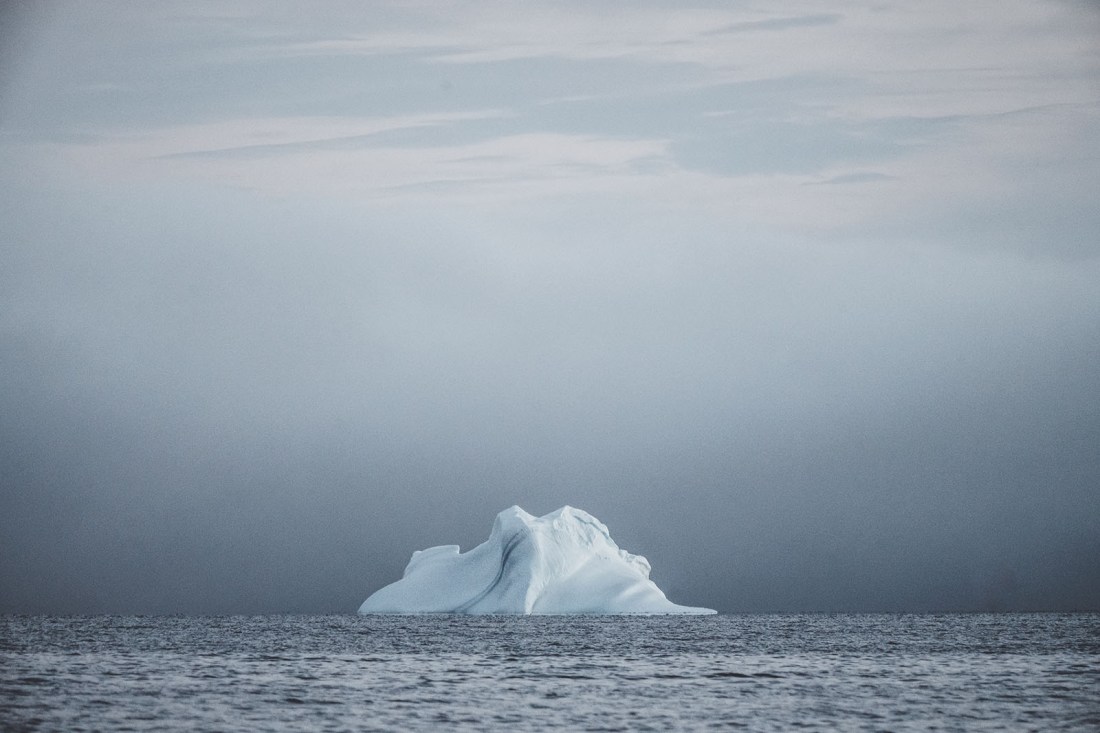
Speaking of a box, one of the interesting details of the story is how much better Antarctic icebergs are for this kind of thing than those in the Arctic. Arctic icebergs are the pinnacled, mountainous type that we are most familiar with from photos, and the kind that likely sunk the Titanic. Antarctic icebergs are “tabular”, big and flat, not soaring blue spires like those from Greenland. This makes them far easier to transport and less likely to fall to pieces while being pulled across vast ocean distances.

Credit: Erik Olsen

By most accounts, Isaacs was an odd, but brilliant character. He was also a well-known polymath who became a world-renowned scientist, engineer, teacher, naturalist, fisherman, author, inventor, and Scripps professor. His colleagues called him a โ€œgiant of scienceโ€ and an “idea man”, willing to take on most any problem that interested him with implacable energy and often unorthodox solutions. Over the course of his career, he was elected to the American Geophysical Union, the National Academy of Sciences, the National Academy of Engineering, and the American Academy of Arts and Sciences.

After he died, the iceberg towing idea came up several additional times, including a wonderful 1973 Rand study titled “Antarctic Icebergs as a Global Fresh Water Source” that proposed creating an “iceberg train”, essentially a series of icebergs tied together like boxcars. In the paper, RAND gave a nod to Isaacs idea and tried to flesh out the details of how such a scheme would actually work.

As recent as 1978, California’s legislature endorsed the idea of towing two icebergs to southern California for drought relief. 

Isaacs died in 1980. Needless to say, in the age of climate change, it would be nice to have a man like him around again. However, his legacy does live on: Through the California Sea Grant program Scripps awards six Undergraduate Research Assistantships each summer.


Sign up for the California Science Weekly newsletter. Fresh California science every Friday!
Using California reservoirs like a battery // NASA’s Mars Helicopter // A gazillion ladybugs fill the sky // The fish with Dragonglass teeth // Lighter than air metal

Sign up for the California Science Weekly newsletter. Fresh California science every Friday!

Week of June 7, 2019

Environment

California uses reservoirs and pumps to tackle climate change

PG&E Corp.

California has some of the most aggressive renewable energy goals in the country. The state is required to obtain at least 33% of its electricity from renewable resources by 2020, and 100% from carbon-free sources by 2045. That’s going to take a lot of energy storage, and the fact is that Lithium-ion batteries, like Elon Musk’s Powerwall, produce a few hundred megawatts of electricity at most and will not be up to the task.

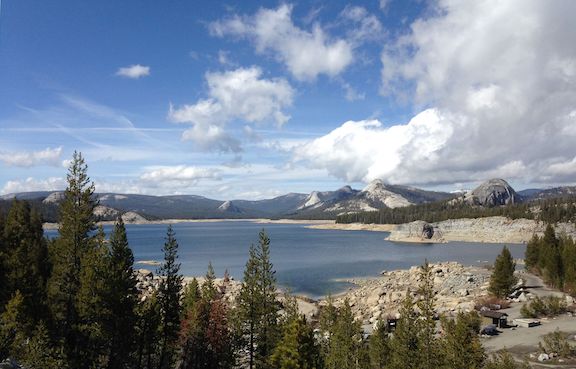
Up in the Sierras, 50 miles east of Fresno, there is a natural battery of sorts that harnesses the power of gravity and has been around for over 20 years. Bloomberg writes about PG&E Corp.โ€™s Helms Pumped Storage plant, which delivers over 1,200 megawatts every day, enough to power 900,000 homes, and it does so cleanly. It is kind of an amazing project.

The facility uses so-called โ€œpumped-hydro storageโ€, basically turning existing reservoirs at different altitudes into a kind of battery. The idea is simple. Take two reservoirs at different elevations, connected by pipes or tunnels. When electricity is abundant, pump water from the lower reservoir to the one uphill. When the grid needs power, let the water flow back down through turbines.

Helms relies on energy from Diablo Canyon to power the pumps during the reverse cycle at night, but the amount of power generated when the water flows down during the day more than compensates for the power used at night, making the plant both environmentally friendly and economical. 

It’s century-old technology, but it works. There are seven in California alone. Unfortunately, they are very expensive (the projects can cost more than $1 billion to build), and there aren’t that many reservoirs around that meet the specifications to make pumped hydro work. That said, Nine projects are proposed in California. One proposed project by NextEra Energy Inc. would go near Joshua Tree National Park, but construction hasn’t started yet. 

Bloomberg


Space

NASA’s Mars Helicopter getting ready for its close-up 

The next big mission to Mars will carry more than the landers and rovers that we all know and love. In fact, the Mars 2020 mission will carry an actual helicopter. The advantages of a flying vehicle are obvious: you can go much farther and cross terrain that would be impossible for a ground-based system to traverse. But there’s a hitch: 

“Nobody’s built a Mars Helicopter before, so we are continuously entering new territory,” said MiMi Aung, project manager for the Mars Helicopter at NASA’s Jet Propulsion Laboratory in Pasadena, California.

It’s not like building a copter for Earth. The tenuous Martian atmosphere has 1% the density of Earth, so all the flight systems have to be engineered differently. And what about controlling the vehicle from Earth over large interplanetary distances? The dynamics are significantly more complicated than when driving a rover over the surface.

None of that is deterring the folks at NASA’s Jet Propulsion Laboratory in La Canada Flintridge, who have been testing the Mars Helicopter for the Mars 2020 launch.  It may be hovering above the red Martian landscape in 2021. However, the craft will carry no instruments. Its purpose is to prove that powered flight on Mars is possible.   

JPL


Animals

It’s a bird. It’s a plane. It’s a gazillion ladybugs!

There were no clouds in the sky the other day over San Bernardino County when a weather satellite picked up a large blob hovering in the air. Instead, the 80-mile by 80-mile mass was a massive cloud of ladybugs flying at between 5,000 and 9,000 feet. That’s a crazy amount of ladybugs. 

California is home to about 200 species of ladybugs, but scientists have not yet identified which species were seen in the radar image, but they say it’s likely they are Hippodamia convergens, known as the convergent lady beetle.

Los Angeles Times    NPR


Animals

The fish with Dragonglass teeth

Credit: Scripps Institution of Oceanography

The Dragonfish is a crazy-looking animal. Part of its allure is a set of dagger pointed teeth that happen to be transparent and amazingly strong. 

In fact, the teeth of the species Aristostomias scintillans are made of nanoscale-size crystal particles that make them much stronger than the teeth of other sea animals like sharks and other fish. The fish’s teeth caught the attention of scientists at Scripps Institution of Oceanography in San Diego, and led them to consider how new materials might be developed to take advantage of the crystal structures. Perhaps, like Dragonglass, they can be forged into objects with magical properties.  

New York Times


Materials Science

Lighter than air metal

Lawrence Livermore National Laboratory

Scientists at the Lawrence Livermore National Laboratory have developed a type of metal foam that is strong, but so light it can ride on a mosquitoโ€™s back. 

It’s not really foam, though. Itโ€™s called โ€œporous metal monolith” or ultra-low density metal, and is really a spaghetti-like web of randomly connected nanometer-sized wires made of gold, silver and copper. They take the shape of miniature marshmallows and contain the same or fewer number of atoms as air. Exactly what the material might be used for is still an open question. Perhaps Patagonia will someday use the material to make backpacks for mosquitos. 

Lawrence Livermore National Laboratory


MORE

The ocean microplastics problem is even worse than we thought. Way worse, say scientists at MBARI. 

Three South Koreans were nabbed poaching $600,000 worth of succulent plants. The Dudleya plants are hugely popular in Asia. 

How might California use recent winter storm to replenish aquifers? It’s harder than it might seem

Can empathy be cultivated? One Stanford scientist thinks so. 

Cal Berkeley has its own experimental forest, and it may help us better understand wildfires. 

Could California seaweed become the biofuel of the future? 

150 lakes in the Tahoe Basin are still frozen, and it’s June.

Apple’s new “Spaceship” HQ is surprisingly earthquake ready.

There’s a town in California that was built to survive wildfires.

California says coffee may not be so bad for you after all.

A huge graveyard of strange fossilized worms was discovered off the coast of California.

Astronomers aren’t happy with SpaceX’s new array of Starlink satellites.   

Drones will replace fireworks at the California state fair. 

That’s it! Have a great week, and please send your friends an invitation to sign up for the California Science Weekly newsletter. 

Design by Luis Ramirez

California companies lead the effort to save the world with microbes, California connection: meet 2018 Nobel Prize winner in chemistry Frances Arnold, Carnegie Observatories and the GMT, Questioning “Disaster tourism” in California, Feeling the Force in Anaheim and more

Sign up for the California Science Weekly newsletter. Fresh California science every Friday!

Week of May 31, 2019

Biology

California companies are leading the effort to save the world with microbes

Wikipedia

Overfishing is arguably one of the most significant threats to the human food supply on the planet. Approximately three billion people in the world rely on both wild and farmed seafood as their primary source of protein, and ten percent of the worldโ€™s population depends on fisheries to make a living.

One the of dirty little secrets of the global commercial fish industry is that it takes fish to make fish. While many people see farmed fish as an ideal solution to meeting our protein needs in the future, the reality is that feeding farmed fish right now requires massive inputs of so-called forage fish, namely small fish like anchovies, herring, menhaden, capelin, anchovy, pilchard, sardines, and mackerel that occur in large numbers in the ocean, particularly the cold Southern and Northern latitudes. A multi-billion dollar industry is dedicated to using large ships that ply the ocean with nets to bring up millions of tons of forage fish every year.

So is there a way to feed farmed fish that reduces the need to trawl the seas for forage fish? It turns out that one California company is working on a solution, and it involves one of the most abundant organisms on earth: bacteria.

NovoNutrients is a Mountain View, California, startup, whose offices lie close to both Facebook and Google. The company is harnessing the new technology of synthetic biology or synbio to get bacteria to do our bidding, creating proteins using the same tiny organisms that curdle milk into yogurt and cause innumerable diseases.

California Science Weekly


Chemistry / Nobel Prizes

California connection: meet Frances Arnold, the 2018 Nobel Prize winner in chemistry

CalTech

The 2018 Nobel Prizes, announced in October, included a very special California name: Frances Arnold. Dr. Arnold is a professor of chemical engineering at the California Institute of Technology, an institution that has seen its share of Nobel winners: 39.  She calls La Canada Flintridge home, adding brain power to a city already loaded with brilliant minds (JPL is headquartered there).  

A wonderful profile of Dr. Arnold can be found in this week’s New York Times, written by the always witty and fun Natalie Angier. The piece does an admirable job of explaining directed evolution, the process she developed that is now widely used to generate novel enzymes and other biomolecules by harnessing cellular machinery. Her process is being used to develop biofuels, medicines, agricultural prodiucts and even in laundry detergent to remove stains. 

It is only the 52nd time in history that the Nobel prize was awarded to a female scientist. That’s out of a total of 892 awards (17%) given since the prize was created by Alfred Nobel, the inventor of dynamite, who established the prize in 1895. It should be noted that the brilliant French chemist Marie Curie won it twice. 

The Nobel site also has a wonderful series on women in science that’s worth reading in its entirety. It’s very well illustrated and put together. The piece on Dr. Arnold is particularly good. 

The New York Times   Nobel Prize


Astronomy / Space

Carnegie Observatories and the Giant Magellan Telescope 

Carnegie Observatories

While many science institutions in California are extremely well-known (we cover many of them here), one Pasadena organization gets little media attention, but is arguably one of the most important places in the world in astronomy.  

The Carnegie Observatories, located in Pasadena, is playing a leading role in humanity’s grasp of the origins of the cosmos. Scientists at the Carnegie are working at the Las Campanas Observatory in Chile’s Atacama desert, home to the twin Magellan telescopes, and site of the future Giant Magellan Telescope (GMT).  

The Giant Magellan Telescope is arguably one of the most important astronomic scientific instruments ever constructed. When completed in 2025, it stands to revolutionize our view and understanding of the universe. The GMT is a segmented mirror telescope using seven incredibly precise reflecting surfaces that have been shaped and polished to within a wavelength of light, approximately one-millionth of an inch. It will have a resolving power of almost 25 meters, dwarfing that of most other terrestrial-based telescopes. In fact, it will have ten times the resolution of the Hubble Space Telescope, NASA’s current workhorse for mirror-based astronomical observation. That means it will resolve points of light 10 times sharper than Hubble.

Construction of the Magellan is underway and you can follow its progress here.   
 

Carnegie Observatories


Environment

Questioning “Disaster tourism” in California

San Francisco Chronicle

The 2018 Camp Fire in Paradise, California fire wiped out a small community of mostly retired homeowners who sought out the quiet, forested glens in Northern California as a place to spend the waning years of their lives. The fire is considered the deadliest in California history and resulted in the death of 88 people and the destruction of 13,696 homes.  

The San Francisco Chronicle delves into the idea of “disaster tourism”, following several people who made a special effort to visit the destroyed town to see the damage for themselves, take pictures and video. They were not alone. Apparently, three cleanup workers were fired after posting insensitive images of the devastation on social media. And one artist spray-painted chilling images around Paradise.  

For the people who once called Paradise home, let alone for the relatives of the ones who lost their lives in the tragic fire, the idea of people poking around to gaze, paint and take selfies in the ruins might have distasteful quality. 

San Francisco Chronicle


Space / Companies

Feel the Force in Anaheim

Disney Theme Parks

It was 53 years ago this month that Disneyland delighted (or annoyed, depending on your tolerance for earworms) visitors with the opening of the It’s a Small World ride. Perhaps it’s fitting, or a sign of how much more commercialized the world has become, that this week (Friday, May 31, in fact) saw the opening of Star Wars: Galaxyโ€™s Edge, a new 14-acre addition to the theme park that capitalizes on Disney’s $4 billion, 2012 purchase of the Star Wars franchise from Lucasfilm. The centerpiece of the new addition is a 100-foot long Millennium Falcon.   

The New York Times gets a personalized tour of the new addition, and seemed to think it was both “jaw-dropping” and incomplete, since several of the marquee attractions still aren’t open. In the Los Angeles Times, the reporter both appreciated and questioned how interactive it is, as it forces people who don’t know each other to work together to achieve various goals. 

We can’t help pity the parents who will not only pay nearly $120 per person to enter the park, but will then have to shell out an additional $200 for a hand-built lightsaber. 

New York Times     Los Angeles Times


MORE

Could a drought in California be linked to a drought in the Midwest? A recent Stanford-led study looks at so-called “Domino droughts”. (Stanford Water in the West)

Some lovely shots, recently discovered, of California’s desert landscapes from the 1920s, all shot by two women.  (Atlas Obscura)

A bill making its way through the California legislature will allow “harvesting” of roadkill. With a permit. Didn’t know it was illegal, but apparently, it is.  (CalMatters)

Elephant seals speak in dialects, but they may be losing them. Wow, this is so interesting. Who knew? There are numerous rookeries of elephant seals around California.  (The Atlantic)

The Aquarium of the Pacific in Long Beach has a new wing called Pacific Visions that just opened. (Aquarium of the Pacific)

Hawthorne, California-based SpaceX’s internet-beaming Starlink satellites are totally bumming out astronomers. (Axios)

Saving pets is apparently a big – and expensive – thing near San Francisco. (Alta Online)

Spotting wildfires around California may get easier with an array of new cameras. (NY Times)

The Petersen Automotive Museum in Los Angeles has a new exhibit: โ€˜Hollywood Dream Machinesโ€™ with over 40 vehicles from cinema history, including Blade Runner, A Clockwork Orange, Mad Max: Fury Road, Back to the Future, and RoboCop. (Smith Journal)

Speaking of the Carnegie Observatories (see above) NASAโ€™s Transiting Exoplanets Survey Satellite discovered that a nearby system hosts the first Earth-sized planet. Carnegie scientists were involved in the discovery. (Carnegie Observatories)

A rare (and very smelly) corpse lily is set to bloom in Long Beach. (LA Times)

Excellent story on the decline of the vaquita porpoise, a marine mammal that is almost extinct in the Gulf of California. (Undark)

You may soon get a sandwich delivered to you by drone in San Diego.  (Freight Waves)

That’s it! Have a great week, and please send your friends an invitation to sign up for the California Science Weekly newsletter. 

Design by Luis Ramirez

How California Companies are Leading the Effort to Save the World with Microbes

Synbio startups like NovoNutrients are developing novel products to help feed the world and stop climate change.

Wikipedia – CC BY-SA 3.0

(Sign up for the California Science Weekly newsletter, delivered fresh to your inbox every Friday)

Overfishing is arguably one of the most significant threats to the human food supply on the planet. Approximately three billion people in the world rely on both wild and farmed seafood as their primary source of protein, and ten percent of the world’s population depends on fisheries to make a living.

One the of dirty little secrets of the global commercial fish industry is that it takes fish to make fish. While many people see farmed fish as an ideal solution to meeting our protein needs in the future, the reality is that feeding farmed fish right now requires massive inputs of so-called forage fish, namely small fish like anchovies, herring, menhaden, capelin, anchovy, pilchard, sardines, and mackerel that occur in large numbers in the ocean, particularly the cold Southern and Northern latitudes. A multi-billion dollar industry is dedicated to using large ships that ply the ocean with nets to bring up millions of tons of forage fish every year.

These forage fish go into making fishmeal, essentially powders and pellets made from ground up forage fish. As fish farming increases, which it has for decades, so does the need to harvest more feeder fish. Increasingly, this is done unsustainably, and illegally. Some scientists warn that as the feeder fish industry explodes, entire marine ecosystems, including those that support animals like whales and large pelagic fish stand in danger of collapse.

So is there a way to feed farmed fish that reduces the need to trawl the seas for forage fish? It turns out that one California company is working on a solution, and it involves one of the most abundant organisms on earth: bacteria.

NovoNutrients is a Mountain View, California, startup, whose offices lie close to both Facebook and Google. The company is harnessing new technology of synthetic biology or synbio to get bacteria to do our bidding, creating proteins using the same tiny organisms that curdle milk into yogurt and cause innumerable diseases.

NovoNutrients’ product is called Novomeal, and while it is not yet commercially available (the company says late 2019 or early 2020), it holds the promise to not only reduce overfishing, but to help diminish atmospheric carbon dioxide, one of the main culprits in climate change.

How it is able to do this is about as close to a “killing two birds with one stone” as one can get in science.

At the company’s headquarters, bacteria and other single-celled organisms are incubated in large steel vats called bioreactors and are fed industrial carbon dioxide which they convert into proteins that can be processed into a powder to feed fish grown in aquaculture. It sounds simple and too good to be true. But the company thinks it may hold the key to a sustainable future.

“We take untreated industrial emissions of CO2 and we turn them into protein โ€” initially for animal feed and starting in fish farming,” says the company’s Web site.

Since bacteria can be grown in largely unlimited supply, which is not the case for forage fish, the company’s technology holds the promise of beginning to solve two of humanity’s most pressing current problems: global warming and overfishing.

The promises of synbio go way beyond creating fishmeal. Frances Arnold, the winner of this year’s winner of the Nobel Prize in chemistry, is a professor of chemical engineering at the California Institute of Technology. The award was bestowed upon Arnold (who, by the way, lives in La Canada Flintridge), for developing a technique called directed evolution.

Directed evolution is a form of synbio that generates novel enzymes and other biomolecules by tweaking the genetic machinery of bacteria like E-coli. A wonderful explanation of the process can be read here, but essentially the process mutates genes that encode proteins, getting them to make specific proteins that serve a particular need. Arnold has already created several companies like Provivi, that develop products using the method. Some proteins can be used to consume harmful chemicals after, say, an oil spill. Others perform more mundane, but hardly less useful tasks like removing laundry stains.

A key point here is that all of these companies and individuals call California home. That, of course, is no coincidence, as the state remains on the forefront of innovation in biotechnology. We’ve created this site to bring you exactly these kinds of stories, and hope that you will follow us on Twitter and subscribe to our weekly newsletter.

Lithium in Death Valley, Frogs making comeback, JPL’s Climate Elvis, Science of traffic jams, Mono Lake’s gulls, Amazing scallop eyes, Cow burps, Bee thieves

Sign up for the California Science Weekly newsletter. Fresh California science every Friday!

Week of May 10, 2019


Editor’s note: We’re heading to Indonesia next week on an assignment, so we’ll miss an issue of California Science Weekly. But keep an eye on our Twitter feed for posts.

A war is brewing over lithium mining near Death Valley

Lithium. It is one of the world’s most valuable elements, allowing batteries to be more powerful and longer-lasting than ever before. Right now, most lithium is mined in the high deserts of South America, but a new battle is being waged between battery companies and environmentalists over whether to mine lithium in Panamint Valley in California, right on the edge of Death Valley. There are strong arguments to be made that having a large domestic source of lithium is key to a carbon-free future, but some are saying that mining would potentially despoil one of California’s most treasured natural areas.

The LA Times has a story on how Australia-based firm Battery Mineral Resources Ltd. is seeking permission to drill four exploratory wells beneath the valley floor to see if enough lithium is there to make a mine economically viable. 


Environment / Animals

The comeback of Mark Twain’s frogs

Red-Legged Frog Release.

The California red-legged frog is said to be the species featured in Twain’s short story “The Celebrated Jumping Frog of Calaveras County.”

They began to disappear decades ago due to disease and habitat destruction, but a recent program to reintroduce them back in Yosemite Valley is seeing some progress. The program reintroduced about 4,000 California red-legged frog eggs and tadpoles and 500 adult frogs, into Yosemite and near the Merced River. For the first time, biologists have found eggs from the reintroduced frogs. That’s great news, given the rapidly declining state of frogs around the globe. The recent IPBES UN report says that more than 40 percent of amphibian species around the world are threatened with extinction.

KQED 


Space / Climate Change

Climate Elvis at JPL

Josh Willis works at the Jet Propulsion Laboratory in La Canada Flintridge, California. He’s a scientist studying the change in ocean temperatures and how they impact Greenlandโ€™s melting glaciers. He’s also an Elvis impersonator and a comedian, who hopes to make people aware of the perils we face if we don’t change our behavior towards the changing climate, but getting a laugh along the way. Laughter is, after all, the best medicine. That said, we won’t be laughing much if climate change gets as bad as many scientists say. See the UN report referenced above.  

Grist


Infrastructure

Science of traffic jams

Credit: Erik Olsen

Traffic jams. They are the bane of California drivers. But what causes them, and is there any way to lessen their severity? Mathematicians have developed all sorts of models to better understand how traffic forms, and some of them has been helpful to improve flow. For example, extra-long freeway entry lanes (take a drive on Highway 110, the old Route 66, which has very short entry lanes, to see what I’m talking about.) An interesting story in Nautilus examines how fluid models are being used to better predict and reduce traffic jams. It’s complicated, but you will learn about the jamiton. And we’re not holding our breath that things will improve in places like LA anytime soon. 

Nautilus


Animals

Gulls of Mono Lake

Kristie Nelson studies seagulls at Mono Lake, home to massive colonies of gulls. Her Mono Lake Gull Project examines how gulls serve as an indicator of ecosystem health. The gulls spend most of their time at the coast, but during breeding season they make fly to saline places like Mono Lake where the population can reach up to 65,000 birds. 

A video at Science Friday looks at her work and has some great scenes of the voracious birds going after the lake’s insanely numerous Alkali Flies, moving across the bazillions of them, beaks open, like a lawnmower.

Science Friday


Marine science / Animals

Scallop eyes surprise scientists

Wikipedia

Many people know that scallops have eyes, blue ones, in fact. But their eyes function a bit differently than our own. As light enters into the scallop eye, it goes through the pupil and then a lens. Interestingly, the scallop has two retinas, and when the light hits them it strikes a crystal mirror made of guanine at the back of the eye. 

A study in Current Biology looks at two species: the bay scallop Argopecten irradians and the sea scallop Placopecten magellanicus, and reveals that scallops have a novel way of focusing light. They have no irises like ours and so they use their pupils to dilate and contract, and this, along with changes to the curvature of the cornea, improves resolution and forms crisper images. Vision is such an amazingly complex ability, yet it has likely evolved 50 times among animals, a process called convergent evolution. There are several scallop species in California, and the next time you are diving and see one, remember that it probably sees you right back.

Current Biology Smithsonian


Climate Change

Reducing cow burps with seaweed

UC Davis

You’ve seen Harris Ranch on I5? Did you know that California is a major producer of beef and dairy. Cows produce prodigious amounts of methane, one of the most potent greenhouse gases. In fact, methane is 30 times worse than CO2. Meanwhile, more than halfย of all methane emissions in California come from the burps, farts, and exhalations of livestock. And belches are the worst, accounting for roughly 95% of the methane released into the environment. Worldwide, livestock accounts for 16% of our greenhouse gas emissions. A fascinating new approach at Scripps Institution of Oceanography proposes using seaweed as cow feed. Scripps notes that “just a small amount ofย Asparagopsisย seaweed to cattle feed can dramatically reduce methane emissions from dairy cows by more than 50 percent”.


Agriculture

Bee thieves in California

National Geographic

It’s no longer cattle rustling and horse stealing. Bee thieves are threatening almond growers in California. A lucrative bee rental industry has surged.


MORE

Scientists have identified 67 marine species in California moving north from their commonly known habitat due to severe marine heatwaves from 2014-2016.

The Keeling Curve has been called one of the most important scientific works of the 20th century. Developed by Charles Keeling at the Scripps Institute of Oceanography in San Diego, California, it is a measurement of the concentration of carbon dioxide in the atmosphere from Hawaiiโ€™s Mauna Loa since 1958. Here’s why it’s so important.   

Thanks to the rains the areas where the Woolsey burned outdoor areas, scorched an Old West film set and Jewish summer camps in the Santa Monica Mountains, there is lush green and wildflowers.

Once a Gold Rush boomtown, Bodie, California, is now an isolated ghost town. Meet one of the five people who still live there in the winter.

Lovely pictures of a sunrise. On Mars.

HUGE Basking sharks are swimming around and feeding right off the coast of California.

Design by Luis Ramirez

Netflix’s Our Planet takes on California, Talking with your brain, Banning animal dissection, California’s “King Tides”, Threats to California’s artichokes

Sign up for the California Science Weekly newsletter. Fresh California science every Friday!

Week of May 3, 2019

Here at the California Science Weekly, we are working hard to bring you the most interesting, informative and entertaining stories about science in the state of California. Every week, we pore through hundreds of articles and Web sites to find the top stories that we believe are worthy of your time. We hope you’ll stay with us and share our work with others via Twitter and Facebook. If there is anything you’d be interested in learning more about, send us a note, and let us know.


Marine Science

Netflix’s amazing Our Planet takes a long look at one of California’s iconic coastal ecosystems

For Californians who have not yet had the joyful opportunity to catch Netflix’s new nature show Our Planet, you should click over now and catch episode four, which features long, impossibly beautiful ruminations on California’s coastal environment.

It captures the recovery of the sea otter population around Monterey and features stunning moving images of Monterey kelp forests, one of our most iconic coastal ecosystems. Huge red and black California sheephead (a type of wrasse) gnaw and crush sea urchins, sea lions gambol in huge numbers like playful puppies, and the time-lapses of urchins creeping across the rocky strata are downright terrifying. Given the incredible array of exotic places that the show has been so far, it’s awfully nice to have California recognized as a biological hot spot worthy of such admirable high-definition filmmaking.

California’s kelp beds have been under threat for decades, with some in severe decline. The culprits are purple sea urchins, who consume kelp, preventing them from growing. Years ago, urchins were kept in check by the otter population, which was decimated for the fur trade. The Our Planet episode explains this in some detail.

Kelp is an amazing organism and is a potential ally in the fight against global warming. When free to grow in a healthy environment, kelp grow remarkably fast, up to two feet a day. Kelp absorbs carbon and provides critical habitat and food for more than 800 species of marine animals. Recent warming caused a 60-fold explosion of purple urchins Californiaโ€™s coast, and the kelp was devastated by these ravenous porcupines of the sea. Over the last 100 years, the Palos Verdes Peninsula has lost 75 percent of its kelp forests.

But efforts over the past decade, by organizations like the Santa Monica-based Bay Foundation, are seeking to bring the kelp back by eradicating urchins, often with divers who wield hammers and smash the urchins. So, not exactly pretty, but the efforts have been effective in restoring this incredibly important part of the ecosystem.

Netflix


Medicine

Talking with your brain

UCSF

Scientists at the University of California San Francisco have developed a brain-computer interface to turn brain signals into computer-synthesized speech. It could be a way for people who have lost the ability to speak to communicate.

The so-called ECoG Electrode Array is made up of dozens of electrodes that are implanted on the brain and record brain activity. The computer deciphers the brainโ€™s motor commands and then generates sentences to try to match the speakerโ€™s natural speaking rhythms.

Brain-computer interfaces are not new, not even those that can generate speech. But previous efforts produced about eight words a minute, while this one generates about 150 words a minute, which scientists say is the pace of natural speech.

Here’s the paper in Nature.

New York Times UCSF


Animals

Banning animal dissection from biology class

Flickr

A new California law might outlaw the use of animals like cats and frogs for dissections in science classes. Cats used for dissection tend to be euthanized animals acquired from shelters; frogs and other amphibians are often gathered in the wild.

Those in support of the bill say that killing the animals is cruel and unnecessary. They say kids can get the same or similar educational experience by using models and computer programs. For those who grew up dissecting animals and believe it is an important part of science education, the move is perceived as an attack on time-honored traditions of biology class. Students are allowed under current law allows to opt out of performing dissections if they have a moral objection, but this would be a state-wide ban at public schools.

SacBee Pacific Standard Magazine


Climate Change

California’s King Tides a harbinger of climate change

King tides are a natural phenomenon in California. Every year when there is an alignment of the gravitational pull between sun and moon, tides are literally pulled higher up the shore. Scientists warm, however, that when king tides take place during floods or storms, sea levels can damage the coastline and coastal property. Studies show that California will be greatly impacted by sea level rise, and so the point of the project is to help us visualize future sea level rise by observing the highest high tides of today.

The King Tide Project has a wonderful series of images from earlier this year showing the highest tides around the state.

King Tide Project๏ปฟ


Climate Change / Agriculture

California’s artichokes may be threatened by climate change

Climate change is going to have massive impacts around the world and will impact many facets of our lives. But perhaps few other impacts are as important as how it will affect the world’s food supply. California’s economy is largely built on agriculture, and few products are more representative of our food production than the California artichoke. A 2018 report by Agronomy, a peer-reviewed, open access scientific journal, laid out a stark future for California agriculture. The classic California artichoke faces particular threats. A warming ocean and changing the marine layer, which the artichoke depends on, not to mention the spread of pests like the artichoke plume moth, could devastate the state’s artichoke crops.

Similarly, the New York Times looks at various products around the nation and what problems various states may face. As one of the top producers of agricultural products in the world, California faces particular challenges.

New York Times Capital and Main


MORE

A map of “wicked weather and deadly disasters” from the Washington Post shows California faring well against tornadoes and hurricanes, but not, alas, against wildfires.

California Sierra’s snowpack is 2.5 times larger than last year. Using Lidar and a spectrometer, this is how NASA’s JPL figures that out.

In case you missed it, the New York Times reports that California’s raisin industry is controlled by a “raisin mafia”.  

Fifty years ago, an oil spill off Santa Barbara became a galvanizing moment for the US environmental movement.

The Golden State Killer case was just the beginning. How DNA will continue to solve crimes.

How palm trees came to define Los Angeles, and why it’s all a myth.

A fantastic story in Wired about the discovery of a new earthquake fault in California.

Fifty years ago, an oil spill off Santa Barbara became a galvanizing moment for the US environmental movement.

The Golden State Killer case was just the beginning. How DNA will continue to solve crimes.

How palm trees came to define Los Angeles, and why it’s all a myth.

A fantastic story in Wired about the discovery of a new earthquake fault in California.

Design by Luis Ramirez

Strange new sea life in California, Magnificent murres, Eagle cam at Big Bear, Going to prison for killing a fish, Oral history of the Keck observatory

Sign up for the California Science Weekly newsletter. Fresh California science every Friday!

Week of April 19, 2019

Here at the California Science Weekly, we are working hard to bring you the most interesting, informative and entertaining stories about science in the state of California. Every week, we pore through hundreds of articles and Web sites to find the top stories that we believe are worthy of your time. We hope you’ll stay with us and share our work with others via Twitter and Facebook. If there is anything you’d be interested in learning more about, send us a note, and let us know.


Environment

Something’s happening here. Sea life around California is changing.

Hakai Magazine

This time of year, it is normal to see whales – grays and humpbacks among them – migrating north to cooler climes and nutrient-rich waters in Alaska. But it’s not normal for them to hang around for a long time, nor is it normal to see them frolicking together in San Francisco Bay.

โ€œThis was like opening a door temporarily for southern species to move northward,โ€ Eric Sanford, a professor of biological sciences at the University of California at Davisโ€™s Bodega Marine Laboratory told the Washington Post.

Welcome to the new normal. The new hotter normal. As climate change brings floods, higher sea levels, drought and more severe storms, it is also leading to strange behavior in the animal world. Species that once lived much further south around Mexico are now finding their way into California waters, surprising and also concerning scientists who say that these migrations are a sign of bad things to come.

The whales are likely hanging around, say scientists, because they are hungry, meaning that something is happening to their food supplies.

But we’ve also witnessed other species on the coast that are rarely or never before seen. A yellow-bellied sea snake washed up on Newport Beach. A very rare olive Ridley sea turtle was seen near Capistrano Beach. And who can forget the huge hoodwinker sunfish that made headlines last month.

It is likely just the beginning of a massive change in our local ecosystems, and the consequences could be especially severe for the species that already live here, whose habitats are changing. Case in point, the massive die off of starfish caused by an infectious wasting disease that reduces these beautiful creatures to mush. A new report published in the journal Science Advances lays much of the blame on the changing climate. Check out the video by Hakai Magazine.

Science Advances Hakai Magazine


Animals / History of Science

Behold the magnificent murre

Creative Commons: Didier Descouens

During the California gold rush, the rocky volcanic Farallon Islands off the coast of San Francisco became a kind of war zone, as groups of men battled over a precious resource: birds eggs. In particular, the eggs of the common murre, a sharp-beaked black and white bird whose eggs are curiously conical. Scientists speculate the reason for the rather odd shape is that evolution designed them to roll in circles, instead of tumbling into the sea.

The marine science magazine Hakai has a great piece on the common murre and the work being done to better understand their biology and evolutionary history. One recently discovered fact is that common murre females lay eggs with different colors and reflectance, allowing the parent murres to specifically identify it as their own offspring. Wow! Johnny, that IS you!

But back to the so-called eggs wars of the late 1850s. Smithsonian magazine has a wonderful story by Paige Blankenbuehler about the conflict, which arose because so many people had come to California in search of gold, and of course they had to eat. Food production, in some cases, could not keep up with demand. Certain foods, in particular, chicken eggs, became so scarce that enterprising poachers went to the Farallones to collect the eggs for sale to hungry 49ers. The competition to collect them became so fierce that “brawls broke out constantly between rival gangs, ranging in brutality from threats and shell-throwing to stabbings and shootouts.”

Yikes. All over some colorful, conical eggs.

Smithsonian Magazine Hakai Magazine


Animals

Big Bear Lake’s adorable new Eaglets

Eagle cam Friends of Big Bear Valley

Though indigenous to California, bald eagles are not often seen around the state, at least near our big cities. It used to be common to see them, but in the early 1970s, after the bald eagle numbers declined dramatically due to impacts from insecticides, the bird was listed as an endangered species. In fact, in the 80s, there were fewer than 30 nesting pairs in the state. Today, they’ve recovered somewhat and can occasionally be seen at lakes, reservoirs, rivers, and some rangelands and coastal wetlands. 

But now, you can see two baby bald eagles that just hatched at Big Bear Lake. A live cam put up by Friends of Big Bear Valley allows you to ogle them live from the comfort of your computer screen or device.

Eagle Cam


Animals

Going to prison for killing a rare fish

Death Valley National Park

In April 2016, three drunk men broke into a fenced-in limestone cavern at Death Valley National Park, home of the endangered Devils Hole pupfish, one of the rarest fish in the world. The fish has evolved in extreme desert conditions and has been isolated for tens of thousands of years, and this is one of the only places they live. Thinking it was a nice night for a swim, one of the men plunged into the warm pool where, it so happened, the pupfish were breeding. One of the fish died.

The men were caught (an excellent tale told by High Country News), and Trenton Sargent, the guy who jumped into the pool, pleaded guilty to violating the Endangered Species Act, destruction of federal property, and possessing a firearm while a felon. He was sentenced to a year in prison.

Folks, leave endangered species alone. And don’t trespass on or destroy federal property.

High Country News


Space / History of Science

An oral history of the Keck Observatory

Credit: California Institute of Technology

One of the amazing lesser-known repositories of the history of science is the vast oral history project at the California Institute of Technology.

Since 1978, the esteemed scientific school has been collecting the stories of some of its most distinguished names, many of them Nobel Prize winners. Others, hardly known at all, have made huge contributions to human health and they deserve greater attention.

A recent oral history from the archive is actually an edited compendium of interviews that tells the story of the Keck Observatory. The Keck Observatory near the summit of Mauna Kea Hawaii consists of two telescopes peering into the heavens from 13,600 ft. above sea level. A major advance of the telescope (and some of the details of how are covered in the oral history) was the ability to operate using 36 hexagonal segments as a single, contiguous mirror. Each telescope weighs 300 tons and operates with nanometer precision. Scientists using the Keck have made major discoveries about exoplanets, star formation, and dark matter.

There’s a ton of great information about the telescope and the discoveries being made at the Keck site.

Cal Tech


MORE

Keep Fluffy indoors! Growing urban coyote populations are feasting on pets, especially in LA County.

The Red Hot Chili Pepper’s bassist is a bee keeper. Go, Flea, go!

Sand artist makes amazing art. Then it washes away.

Beautiful posters of the Most Endangered Wildlife in Every US State. California? The Point Arena Mountain Beaver.

The magnificent BLDGBLOG looks at the San Andreas Fault.

More on the Lassen County raptor poacher.

Design by Luis Ramirez