A Pacific White-Sided Dolphin swims alongside a boat off Newport Beach, California
For those who are fortunate enough to live near the coast of California, Dolphin sightings are a frequent delight. Dolphins are a diverse group of marine mammals found in all of the world’s oceans, but they are especially abundant in California. The California coast is home to numerous species of dolphins, each with their own unique characteristics and behaviors. An afternoon spent at the beach will very often result in a sighting of these magnificent and majestic animals frolicking in the waves.
For those who may not know, dolphins and porpoises are toothed whales. Both porpoises and dolphins are members of the same scientific order, Cetacea, which includes all whales, including the magnificent blues, grey whales and humpbacks that also ply the California coast.
The exact number of dolphins off the California coast is impossible to know since many species migrate and no authoritative study of their total numbers has ever been published. But one estimate of the dolphin population in Southern California suggests that well over half a million live between the frigid, rocky coastal waters of Monterey and San Diego. Scientists have documented 11 species of dolphins in California’s waters alone. We take a look at a few of those here.
One of the most common, and beautiful, dolphins found off the coast of California is the Pacific White-Sided Dolphin (Lagenorhyncus obliquidens). These dolphins are easily recognized by their distinctive markings, which include a white underbelly and gray and white stripes along the sides. White-Sided Dolphins can reach up to 400 pounds and can grow to 8 feet in length, with males typically being larger than females. They are also known for their energetic and playful behavior, often bow-riding the waves alongside boats and performing wonderful acrobatics in the air. Boaters and whale watchers can witness pods of these animals following their boat for half an hour or more, often swimming on their sides near the surface and gazing up with attentive eyes.
White-sided dolphins feed on a variety of prey, but mostly consume fish and squid. They are skilled hunters and have been known to work together in groups to corral and capture their meals.
Another species found off the California coast is the Common Dolphin (Delphinus delphis). These dolphins have a distinctive sleek, hydrodynamic shape, with a dark gray or black dorsal region and a light gray or white underbelly. Common Dolphins are also known for their high level of activity, often seen jumping and playing in the water. Common dolphins can travel 100 miles in a single day.
This species is one of the most well-known and widely distributed marine mammals, and is often associated with playful acrobatics and a high level of intelligence. California is home to several large “super pods” or “megapods” of Common Dolphins that are often seen by boaters or whale-watching tours. As the American Cetacean Society explains, common dolphins typically travel and hunt in large herds of hundreds or even thousands. One resident megapod frequently forages between Ventura and Dana Point.
A Pacific White-Sided Dolphin
Common dolphins have been the subject of numerous studies examining their cognitive abilities. They are known to have complex social relationships and to exhibit behaviors that suggest a high level of problem-solving ability and adaptability. In addition, they are capable of using tools, such as seaweed, to herd fish and protect themselves from predators. They also have excellent memories and are able to recognize individual dolphins and remember past experiences.
The Bottlenose Dolphin (Tursiops truncatus) is another species that can be found off the coast of California. This species is easily recognizable due to its large size and beak-like snout. Bottlenose Dolphins are known for their intelligence and playful nature, and are often (unfortunately) used in marine mammal shows and research programs.
Bottlenose dolphins have a complex mating system that involves a variety of behaviors, including courtship displays, vocalizations, and physical contact. Female Bottlenose dolphins give birth to a single calf every three to five years, and the calves are nursed by their mothers for up to a year. Male Bottlenose dolphins compete for access to females, and the strongest and most dominant males are the most successful at mating.
A lesser-known (and seen) species found in the waters of California is the Risso’s Dolphin (Grampus griseus). These dolphins are identified by their tall, curved, sickle-shaped dorsal fin located mid-way down their back. Often they also have distinctive scars and scratches, which are believed to be caused by “teeth raking” between other dolphins. They also frequently have circular markings, likely from encounters with squid or lampreys. Risso’s Dolphins are generally less active than the other species found in the area, and are often seen alone or in small groups.
Finally, the Dall’s Porpoise (Phocoenoides dalli) is another species that can be found in the waters off the California coast. These dolphins are identified by their short, stocky bodies and small triangular dorsal fins. Dall’s Porpoises are known for their speed and agility, and are often seen riding the bow waves of boats.
Few places on earth match the coast of California for the sheer number and variety of dolphins that swim in the cool, nutrient-rich waters that well up from the state’s deep canyons. So next time you’re near the coast, keep an eye out for these incredible creatures and enjoy the show!
51 years ago today a man named Edwin Philip Pister rescued an entire species from extinction.
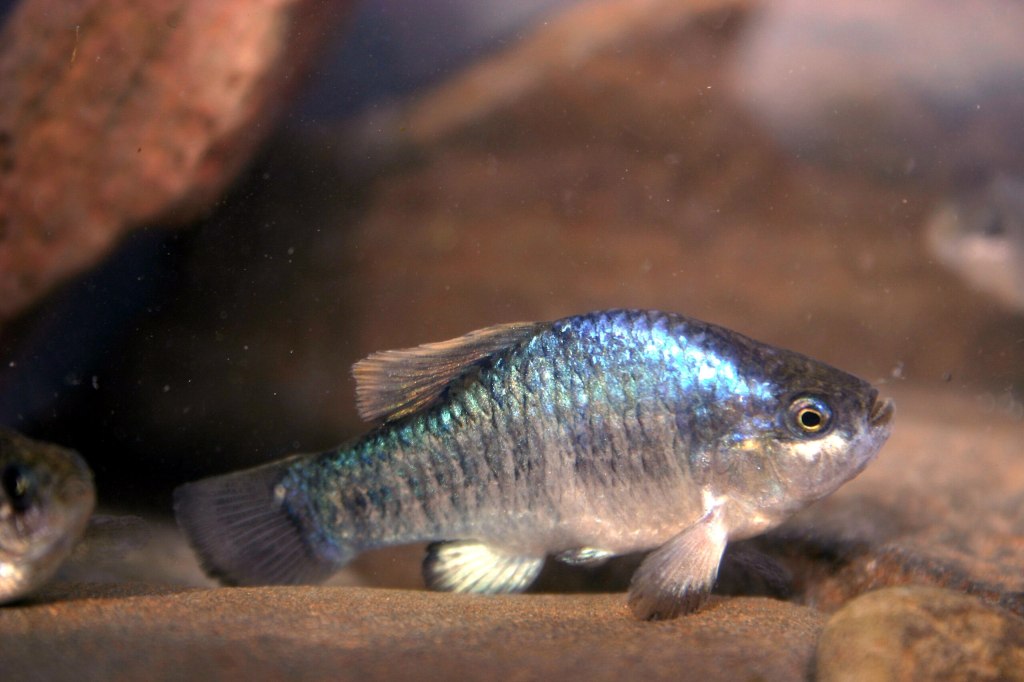
Less than 2.5 inches in length, the Owens pupfish is a silvery-blue fish in the family Cyprinodontidae. Endemic to California’s Owens Valley, 200 miles north of Los Angeles, the fish has lived on the planet since the Pleistocene, becoming a new species when its habitat was divided by changing climatic conditions, 60,000 years ago.
For thousands of years, the Owens Valley was largely filled with water, crystal-clear snowmelt that still streams off the jagged, precipitous slab faces of the Sierra Nevada mountains. Pupfish were common, with nine species populating various lakes and streams from Death Valley to an ara just south of Mammoth Lakes. The Paiute people scooped them out of the water and dried them for the winter.
In the late 19th century, Los Angeles was a rapidly growing young metropolis, still in throes of growing pains that would last decades. While considered an ugly younger sibling to the city of San Francisco, Los Angeles had the appeal of near year-round sunshine and sandy beaches whose beauty that rivaled those of the French Riviera.
Owens pupfish (California Department of Fish and Wildlife)
But by the late 1900s, the city began outgrowing its water supply. Fred Eaton, mayor of Los Angeles, and his water czar, William Mulholland, hatched a plan to build an aqueduct from Owens Valley to Los Angeles. Most Californians know the story. Through a series of shady deals, Mulholland and Eaton managed to get control of the water in the Owens Valley and, in 1913, the aqueduct was finished. It was great news for the new city, but terrible news for many of the creatures (not to mention the farmers) who depended on the water flowing into and from the Owens Lake to survive.
So named because they exhibit playful, puppy-like behavior, the Owens pupfish rapidly began to disappear. Pupfish are well-known among scientists for being able to live in extreme and isolated situations. They can tolerate high levels of salinity. Some live in water that exceeds 100° Fahrenheit, and they can even tolerate up to 113° degrees for short periods. They are also known to survive in near-freezing temperatures common in the lower desert.
Owens River in the Eastern Sierra (Erik Olsen)
One of those animals is the Owens pupfish.
But hot or cold are one thing. The disappearance of water altogether is another.
As California has developed, and as climate change has caused temperatures to rise, thus increasing evaporation, all of California’s pupfish populations have come under stress. Add to these conditions, the early 20th-century introduction by the California Department of Fish and Wildlife of exotic species like largemouth bass and rainbow trout to lakes and streams in the eastern Sierras, and you get a recipe for disaster. And disaster is exactly what happened.
Several species of pupfish in the state have been put on the endangered species list. Several species, including the Owens pupfish, the Death Valley Pupfish and the Devils Hole pupfish are some of the rarest species of fish on the planet. The Devils Hole pupfish recently played the lead role in a recent story about a man who accidentally killed one of the fish during a drunken spree. According to news stories, he stomped on the fish when he tried to swim in a fenced-off pool in Death Valley National Park. He went to jail.
The remains of the Owens River flowing through Owens Valley in California. Credit: Erik Olsen
The impact on the Owens pupfish habitat was so severe that in 1948, just after it was scientifically described, it was declared extinct.
That is, until one day in 1964, when researchers discovered a remnant population of Owens pupfish in a desert marshland called Fish Slough, a few miles from Bishop, California. Wildlife officials immediately began a rescue mission to save the fish and reintroduce them into what were considered suitable habitats. Many were not, and by the late 1960s, the only remaining population of Owens pupfish, about 800 individuals, barely hung on in a “room-sized” pond near Bishop.
On August 18, 1969, a series of heavy rains caused foliage to grow and clog the inflow of water into the small pool. It happened so quickly, that when scientists learned of the problem, they realized they had just hours to save the fish from extinction.
Edwin Philip Pister
Among the scientists who came to the rescue that day was a stocky, irascible 40-year-old fish biologist named Phil Pister. Pister had worked for the California Department of Fish and Game (now the California Department of Fish and Wildlife) most of his career. An ardent acolyte of Aldo Leopold, regarded as one of the fathers of American conservation, Pister valued nature on par, or even above, human needs. As the Los Angeles Times put it in a 1990 obituary, “The prospect of Pister off the leash was fearsome.”
“I was born on January 15, 1929, the same day as Martin Luther King—perhaps this was a good day for rebels,” he once said.
Pister had few friends among his fellow scientists. Known for being argumentative, disagreeable, and wildly passionate about the protection of California’s abundant, but diminishing, natural resources, Pister realized that immediate action was required to prevent the permanent loss of the Owens pupfish. He rallied several of his underlings and rushed to the disappearing pool with buckets, nets, and aerators.
Within a few hours, the small team was able to capture the entire remaining population of Owens pupfish in two buckets, transporting them to a nearby wetland. However, as Pister himself recalls in an article for Natural History Magazine:
“In our haste to rescue the fish, we had unwisely placed the cages in eddies away from the influence of the main current. Reduced water velocity and accompanying low dissolved oxygen were rapidly taking their toll.”
Los Angeles Aqueduct. Credit: Erik Olsen
As noted earlier, pupfish are amazingly tolerant of extreme conditions, but like many species, they can also be fragile, and within a short amount of time, many of the pupfish Pister had rescued were dying, floating belly up in the cages. Pister realized immediate action was required, lest the species disappear from the planet forever. Working alone, he managed to net the remaining live fish into the buckets and then carefully carried them by foot across an expanse of marsh. “I realized that I literally held within my hands the existence of an entire vertebrate species,” he wrote.
Pister managed to get the fish into cool, moving water where the fish could breathe and move about. He says about half the the population survived, but that was enough.
Today, the Owens pupfish remains in serious danger of extinction. On several occasions over the last few decades, the Owens pupfish have suffered losses by largemouth bass that find their way into the pupfish’s refuges, likely due to illegal releases by anglers. In 2009, the US Fish and Wildlife Service estimated that five populations totaling somewhere between 1,500 and 20,000 Owens pupfish live in various springs, marshes, and sloughs in the Owens Valley, where they are federally protected.
For decades, the majestic blue whale has been celebrated as the largest animal ever to have existed, with popular claims frequently stating that these marine giants can reach lengths of 100 feet or more. However, no single blue whale has ever been scientifically measured at 100 feet. Mainstream media, in its quest for sensational stories, has perpetuated this myth, overshadowing scientific data that places the average size much lower. This discrepancy not only distorts our understanding of these magnificent creatures but also highlights the broader issue of how media can shape and sometimes mislead public perception of scientific facts.
The perception that blue whales commonly reach lengths of 100 feet or more likely stems from a combination of historical anecdotes, estimation errors, and a tendency to highlight extreme examples.
The blue whale (Balaenoptera musculus) is a truly magnificent creature. Hunted nearly to extinction in the 19th and 19th centuries, the blue whale has staged a hopeful recovery in the last five decades, since commercial whaling was outlawed by the international community in 1966 (although some Soviet whale hunting continued into the early 1970s).
Blue whale tail fluke in Sri Lanka. Credit: Erik Olsen
Before commercial whaling began, it was estimated that there were some 400,000 blue whales on earth. 360,000 were killed in the Antarctic alone. The International Union for Conservation of Nature estimates that there are probably between 10,000 and 25,000 blue whales worldwide today, divided among some five separate populations or groups. One of those groups, the largest in the world, is called the Eastern North Pacific population, consists of some 2,000 animals and makes an annual migration from the warm waters of Baja California to Alaska and back every year. Many swim so close to shore that a lucrative whale-watching industry has emerged in places like Southern California, where numerous fishing vessels have been converted into whale-watching ships.
But here’s the problem: not a single blue whale has ever been scientifically verified as being 100 feet long. That’s right. Not one.
Blue whales were in the news recently with the publication of two papers by Stanford’s Jeremy Goldbogen at the Hopkins Marine Station in Pacific Grove, California. The first paper recorded a leviathan’s heartbeat at great depths in Monterey Bay, revealing the somewhat astonishing fact that the whales’ heart rate slows significantly the deeper they go, reaching an average minimum of about four to eight beats per minute, with a low of two beats per minute. That figure was about 30 to 50 percent lower than predicted, said the researchers. The second paper looked at the blue whale’s size, and attempted to quantify how whales got so big and, well, why they are not bigger.
So let’s talk further about size because there are some misconceptions out there about how big these animals can get.
The blue whale is frequently cited as the largest animal to have ever lived. That’s true (so far as we know) if by size we mean weight. The largest dinosaur that we’ve ever found fossils for is the Argentinosaurus. The Argentinosaurus lived about 100 million to 93 million years ago during the Cretaceous period in what is now Argentina and is part of a group of dinosaurs known as titanosaurs. Titanosaurs were long-necked sauropods, four-legged, herbivorous animals that often grew to extraordinary sizes. We can only speculate about the actual size of Argentinosaurus since all that we know comes from just 13 bones. Scientists estimate that the Argentinosaurus probably weighed somewhere around 70-80 tons, maybe reaching as much as 90 tons. The Natural History Museum in London suggests the animal may have been as long as 115 feet.
Argentinosaurus: Nobu Tamura
Another contender for the world’s largest dinosaur is Dreadnoughtus, and in this case, the fossil record is a bit more informative. The fossils for Dreadnoughtus contained 115 bones, representing roughly 70 percent of the dinosaur’s skeleton behind its head. Dreadnoughtus was said to reach lengths of about 85 feet with an estimated mass of about 65 tons.
However, estimates for the top size of blue whales go up to 200 tons. And, as many articles and references about blue whales will tell you, blue whales can reach lengths of up to 100 feet long or more. The number of legitimate science books, articles, Web sites and even esteemed science journals that quote this number is in the thousands. Google it.
But here’s the problem: not a single blue whale has ever been scientifically verified as being 100 feet long. That’s right. Not one.
That said, there are two references in scientific papers of blue whales that are near 100 feet. The first is a measurement dating back to 1937. This was at an Antarctic whaling station where the animal was said to measure 98 feet. But even that figure is shrouded in some suspicion. First of all, 1937 was a long time ago, and while the size of a foot or meter has not changed, a lot of record-keeping during that time is suspect, as whales were not measured using standard zoological measurement techniques. The 98-foot specimen was recorded by Lieut. Quentin R. Walsh of the US Coast Guard, who was acting as a whaling inspector of the factory ship Ulysses. Sadly, there is scant detail available about this measurement and it remains suspect in the scientific community.
The second is from a book and a 1973 paper by the late biologist Dale W. Rice, who references a single female in Antarctica whose “authenticated” measurement was also 98 feet. The measurement was conducted by the late Japanese biologist Masaharu Nishiwaki. Nishiwaki and Rice were friends, and while both are deceased, a record of their correspondence exists in a collection of Rice’s papers held by Sally Mizroch, co-trustee of the Dale W. Rice Research Library in Seattle. Reached by email, Dr. Mizroch said that Nishiwaki, who died in 1984, was a very well-respected scientist and that the figure he cited should be treated as reliable.
According to Mizroch, who has reviewed many of the Antarctic whaling records from the whaling era, whales were often measured in pieces after they were cut up, which greatly introduces the possibility for error. That is likely not the case with the 98-foot measurement, which took place in 1947 at a whaling station in Antarctica where Nishiwaki was stationed as a scientific observer.
Proper scientific measurements, the so-called “standard method”, are taken by using a straight line from the tip of the snout to the notch in the tail flukes. This technique was likely not used until well into the 20th century, said Mizroch. In fact, it wasn’t until the 1940s that the use of a metal tape measure became commonplace. According to Dan Bortolotti, author of Wild Blue: A Natural History of the World’s Largest Animal, many of the larger whales in the whaling records — especially those said to be over 100 feet — were probably measured incorrectly or even deliberately exaggerated because bonus money was paid to whalers based on the size of the animal caught.
So, according to the best records we have, the largest blue whale ever properly measured ws 98 feet long. Granted, 98 feet is close to 100 feet, but it’s not 100 feet and it’s certainly not over 100 feet, as so many otherwise reputable references state.
So setting aside the fact that so many sources say the blue whale has reached 100 feet or more, and that there is no scientific evidence proving this, a key question to ask is how large can whales become. The second scientific paper cited above in Science looked at energetics, the study of how efficiently animals ingest prey and turn the energy it contains into body mass.
National Oceanic and Atmospheric Administration
Most baleen whales are so-called lunge feeders. They open their mouths wide and lunge at prey like krill or copepods, drawing in hundreds of pounds of food at a time. Lunge-feeding baleen whales, it turns out, are wonderfully efficient feeders. The larger they become, the larger their gulps are, and the more food they draw in. But they also migrate vast distances, and oftentimes have to dive deep to find prey, both of which consume a large amount of energy.
Using an ocean-going Fitbit-like tag, the scientists tracked whales’ foraging patterns, hoping to measure the animals energetic efficiency, or the total amount of energy gained from foraging, relative to the energy expended in finding and consuming prey. Using data from numerous expeditions around the globe that involved tens of thousands of hours of fieldwork at sea on living whales from pole to pole, the team concluded that there are likely ecological limits to how large a whale can become and that they are likely constrained by the amount of food available in their specific habitat.
Whale fall off the California Coast (Ocean Exploration Trust)
John Calambokidis, a Senior Research Biologist and co-founder of Cascadia Research, a non-profit research organization formed in 1979 based in Olympia, Washington, has studied blue whales up and down the West Coast for decades. He told California Curated that the persistent use of the 100-foot figure can be misleading, especially when the number is used as a reference to all blue whales.
The sizes among different blue whale groups differ significantly depending on their location around the globe. Antarctic whales tend to be much bigger, largely due to the amount of available food in cold Southern waters. The blue whales we see off the coast of California, Oregon, Washington and Alaska, are part of a different group from those in the North Pacific. They differ slightly both morphologically and genetically, and they consume different types and quantities of food. North Pacific blue whales tend to be smaller, and likely have always been so. Calambokidis believes that the chances any blue whales off the West Coast of the US ever reaching anything close to 100 feet is “almost non-existent”.
We emailed Regina Asmutis-Silvia, Executive Director North America of Whale and Dolphin Conservation, to ask about this discrepancy among so many seemingly authoritative outlets. She wrote: “While it appears biologically possible for blue whales to reach or exceed lengths of 100’, the current (and limited) photogrammetry data suggest that the larger blue whales which have been more recently sampled are under 80 feet.” (Photogrammetry is the process of using several photos of an object (like a blue whale) to extract a three-dimensional measurement. from two-dimensional data. It is widely used in biology, as well as engineering, architecture and many other disciplines.) Photogrammetry measurements are now often acquired by drones and have proven to be a more accurate means of measuring whale size at sea.
Antarctic whaling station.
Here’s a key point: In the early part of the 20th century and before, whales were measured by whalers for the purpose of whaling, not measured by scientists for the purpose of science. Again, none of this is to say that blue whales aren’t gargantuan animals. They are massive and magnificent, but if we are striving for precision, it is not accurate to declare, as so many articles do, that blue whales reach lengths of 100 feet or more. This is not to say it’s impossible that whales grew to or above 100 feet, it’s that, according to the scientific records, none ever has.
A relevant point from Dr. Asmutis-Silvia about the early days of Antarctic whaling: “Given that whales are long-lived and we don’t know at what age each species reaches its maximum length, it is possible that we took some very big, very old whales before we started to measure what we were taking.”
This seems entirely reasonable, but the fact still remains that we still do not have a single verified completely reliable account of any blue whale, any animal for that matter, ever growing to 100 feet. References to the 100-foot number, which we reiterate are found everywhere, also seem to suggest that blue whales today reach that length, and this is not backed up by a shred of evidence. The largest blue whales measured using the modern photogrammetry techniquesmentioned above have never surpassed 90 feet.
In an email exchange with Jeremy Goldbogen, the scientist at Stanford who authored the two studies above, he says that measurements with drones off California “have been as high as 26 meters” or 85 feet.
So, why does nearly every citation online and elsewhere regularly cite the 100-foot number? It probably has to do with our love of superlatives and round numbers. We have a deep visceral NEED to be able to say that such and such animal is the biggest or the heaviest or the smallest or whatever. And, when it comes down to it, 100 feet is a nice round number that rolls easily off the tongue or typing fingers.
All said, blue whales remain incredible and incredibly large animals, and deserve our appreciation and protection. Their impressive rebound over the last half-century is to be widely celebrated, but let’s not, in the spirit of scientific inquiry, overstate their magnificence. They are magnificent enough.
Here we are in late summer and the great white shark stories keep coming. On August 22, a drone captured a white shark swimming beneath some surfers, who remained oblivious. Two days ago, a pair of kayakers off Cambria filmed a great white swimming beneath their boats. The shark circled the kayaks for a few minutes and then swam away. And in July, a large grouping of white sharks was spotted off Monterey. Of course, the list goes on.
The fact is, great whites in California waters are not unusual. They’ve always been around. But over the last 20 years, the population has grown, so much so that scientists are calling it a remarkable comeback, which may not be the most comforting thing to hear if you spend a lot of time in the water.
The growth in the shark population has several causes, says Chris Lowe at the Shark Lab at California State University Long Beach. First, the last 50 years have seen a dramatic improvement in water quality. That means the overall ecosystem is more healthy, allowing a richer abundance of animals on every level of the food chain. More importantly, though, is the impact of the 1972 Marine Mammal Protection Act, which made it illegal to kill or molest marine mammals like sea lions. As a result, the sea lion population has exploded in Southern California. Sea lions are sharks’ favorite food, so it stands to reason: more sea lions, more great white sharks.
The CSULB Shark Lab has tagged around 40 great whites that swim in Southern California waters. Most of them are juveniles and are less than 10 feet long. The lab tracks the movement of the sharks using stationary buoys placed near beaches, and they use the data to inform lifeguards and coastal municipalities about the prevalence of the animals. The lab and local lifeguards also use drones to monitor popular beaches. Using this information, they’ve developed protocols from San Diego to Santa Barbara on how to best advises the public when sharks are sighted. The Shark Lab also recently began a project called Shark Shack, an personal outreach program designed to provide people directly with shark safety tips. The mobile shack visits beaches along the California coast and talks to people about what to do if they encounter them in the water.
That’s a lot of effort to console an easily-panicked public over a concern that many scientists say is overblown. While attacks make big headlines, they are exceedingly rare. According to the shark research committee, which has tracked shark attacks along the West Coast of the United States for decades, there have been just 13 fatal shark attacks reported in California over the past 60 years. The last fatal attack in California was in 2012 at Surf Beach, Lompoc, in Santa Barbara County. The global average of fatal attacks worldwide per year is six.
“Your chances of being bit by a shark is the same as winning the Powerball,” Lowe told Quartz. “It’s that small.”
Sharks, he says, demand respect and should be admired, albeit from afar. The animals are an important part of the ecosystem, serving as apex predators that keep other species in check.
So, as summer winds down, try to not let the headlines scare you. Sure, be aware of your surroundings in the water. Check with the lifeguards at your favorite beach, and try your best not to look like a sea lion.
The birth of the 1000th chick as part of an extensive breeding and reintroduction program gives hope to many other species in peril.
National Park Service
The California condor is North America’s largest flying bird. It also one of the ugliest birds in the world. Sorry, in the universe. The bird would, in fact, be right at home in the cantina on Mos Eisley. But the bird’s ungainly size and ugliness are what make it special, special enough to save.
We live in the Anthropocene, the time of man. There are few species on the planet that have eluded our impact. The condor has fared poorly, though not as poorly as some. Just 37 years ago there were 22 California condors left. They were functionally extinct in the wild: all those remaining birds had been captured and put into an ambitious breeding program to try and revive the species.
Now, nearly four decades later, a consortium of government agencies and nonprofit groups announced a rather astonishing milestone: the birth of the 1,000th California condor chick since the rescue program began. The condor’s plight is far from over. The species remains critically endangered. They live mainly in California, Arizona, southern Utah and Baja California, Mexico. The ultimate goal of the condor recovery program is a self-sustaining population, meaning the birds mate and multiply on their own in the wild.
“The radical reduction of the world’s biodiversity is something for which future generations will least forgive us.”
E.O. Wilson
Condors have died over the years, mostly due to lead poisoning, scientists discovered. The birds are scavengers and dine on carrion, oftentimes animals that have been killed by shotguns with lead shot. That realization led to California’s ban on lead ammunition, which took effect on July 1, and mandates non-lead ammunition in the taking of any wildlife in California. Many hunters objected to the ban because non-lead ammo is more expensive, but it’s better to have less lead in the environment as a whole.
California Condor (Wikipedia)
In many ways, California has taken the lead in endangered species protection. One of the most successful breeding and reintroduction programs in history is taking place right off the California coast, in the Channel Islands, where the Island Fox has made an impressive recovery due to extensive (and expensive) efforts to relocate golden eagles, which predated on foxes. That said, other species in the state, like the Delta Smelt, remain in peril.
It’s hard to place a value on saving a species like the California Condor. With a nearly 10-foot wingspan, they are clearly impressive birds. Their ugliness (although, I suppose beauty is in the eye of the beholder) is perhaps one of their most endearing qualities. It’s comforting to know that the bird will be around a lot longer (fingers crossed), rather than meet the fate of so many other avian species like the Dodo or the Passenger Pigeon that we know only as bones and feathers in a museum.
As the great Harvard biologist E.O. Wilson once put it: “The radical reduction of the world’s biodiversity is something for which future generations will least forgive us.”
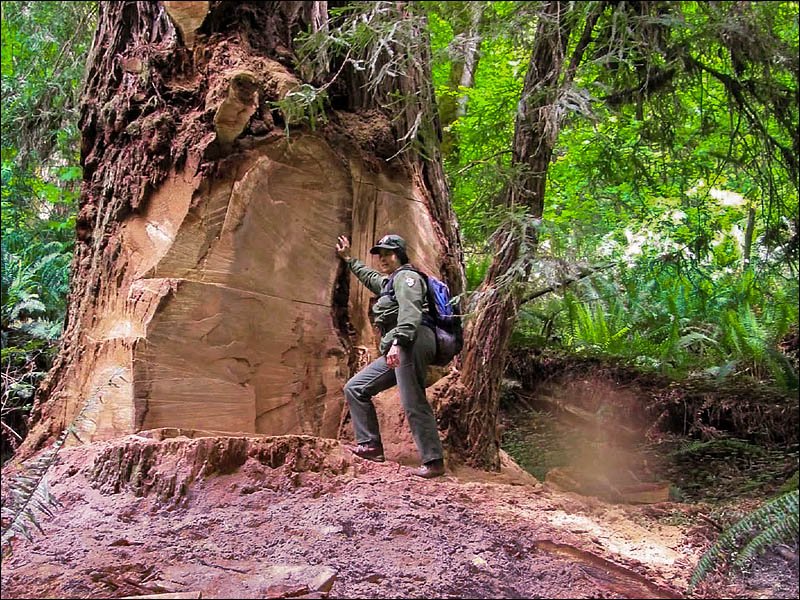
Probably our favorite thing we read all week was this story from Bloomberg about the illegal theft of so-called Redwood burls from California’s Redwood National Park. Burls are the massive, swollen, misshapen growths that naturally occur on trees. Basically, the grain has grown from the tree in a deformed manner, a form of cellular misdirection. They look a little bit like tumors or additional appendages. But because of the strange patterns they exhibit when the fresh wood is exposed, burls are extremely valuable around the world. They are used to make tables and countertops and footstools, etc. A quick search online came up with numerous sites selling redwood burl tables for tens of thousands of dollars. Certain raw burl pieces are also extremely valuable. No wonder thieves go after them.
The problem is that choice redwood burls are very rare. They take many years, often hundreds of years, to grow and become large and complex. And if there’s one place large, ancient redwoods grow in abundance, it’s Redwood National Park in Northern California.
Poachers have been entering Redwood National Park in the night with saws and cutting off the burls to sell for big bucks. The trees usually survive, but they are permanently scarred. Burl removal is legal if the trees are in private hands and the owner gives the ok. But burl cutting is illegal in the national park, as you can imagine. And since we’re talking Redwoods National Park, we’re talking some of the tallest, finest, rarest, most beautiful trees on the planet, so the thought that criminals are burl poaching in these parks gets pretty infuriating.
Luckily, as the story explains, park rangers like Branden Pero are tasked with catching the burl poachers and they’ve brought some high technology to bear (including hidden cameras) to nab Derek Alwin Hughes, a 35-year old meth user who was charged with six crimes, including Grand Theft.
If you lived in Los Angeles in the 70s, then you remember the days when schools closed due to poor air quality. With few Federal laws in place mandating controls on car exhaust, the city was often blanketed under a disgusting layer of brown smog.
We’ve come a long way since then. The 1970 Clean Air Act and the EPA’s strict regulation of exhaust emissions, improved LA’s air and made it breathable again. It’s been called one of the greatest successes in US environmental history. But according to a study published this year by scientists at New York University and the American Thoracic Society, we’ve been taken several steps backward, especially where ozone is concerned. Ozone can damage lungs, trigger asthma attacks and lead to other life-threatening problems.
The problem is particularly bad in Southern California, where researchers found a 10% increase in deaths attributable to ozone pollution from 2010 to 2017. While downtown and the westside have fared somewhat better, inland regions around Riverside and San Bernadino are experiencing the most dangerous levels of pollution. California regulators have been tasked with devising a plan by the end of the year to reduce ozone, and they say it’s going to be expensive, perhaps costing as much as $14 billion.
Let’s stick with air quality and health for a moment. A powerful new 5-part podcast series by the Chico Enterprise Record called Inhaled looks at the health impacts of last year’s wildfires, with a particular focus on the Camp Fire, the deadliest, most destructive wildfire in California history. It turns out that the smoke from the Camp Fire, and numerous other fires around the state, has led to lingering health problems for many people. Smoke contains toxic particles that can lodge themselves into lungs and cause permanent health problems. Those health effects are now being felt by many people, many of whom are finding it difficult to get the health care they need. It’s an important story because we tend to think of the impact of wildfires as something immediate, with death and property damage occurring quickly, when the reality is the damage to personal health can linger for years.
An interesting update on the Mars InSight lander, which has been experiencing lingering problems with its heat probe, an autonomous hammer that’s supposed to penetrate five meters down into the Martian soil to get all sorts of never-before-made measurements. The bad news: they haven’t fixed it. The good news: they HAVE been able to measure small Mars quakes, providing scientists with new data and clues about the planet’s interior. (Planetary Society)
A look at the problem of feral horses in California. Wild mustang populations are out of control, competing with cattle and native wildlife for resources. If the federal government doesn’t rein them in, ranchers may take matters into their own hands. (Alta Magazine)
California’s illegal pot farms are killing wild fish. Run-off, water diversion, and pollution from illegal cannabis farms are polluting streams where fish like steelhead and salmon thrive, killing many. (Bitterroot Magazine)
Hawthrone-based SpaceX faces challenges in launching thousands of satellites to provide space-based internet service. But the payoff could help finance the company’s bigger space ambitions. (LA Times)
Another serial-rape suspect is nabbed (this time in Sacramento) with DNA testing technology. (SacBee)
A compelling argument that the iPhone may be reducing resource consumption rather than increasing it. Think of all the things you no longer own because smartphones have replaced them: calculator, camcorder, clock radio, mobile telephone, and tape recorder. (Wired)
Jupiter‘s moon Io is the most volcanically active body in the solar system. Caltech scientist Katherine de Kleer has been capturing the moon’s volcanic landscape in incredible detail. (New York Times)
Caltech scientists at the Owens Valley Radio Observatory have been able to pinpoint the location of so-called fast radio bursts to a distant galaxy almost 8 billion light-years away. (CalTech)
Some dude went snorkeling in Sausal Creek in Oakland. He saw some fish. Interesting, but kind of gross. (SF Gate)
There’s a new book out about how California’s longstanding role as a center for health, wellness, nutritional fads, and sunshine changed its architecture. (LA Curbed)
That’s it! Have a great week, and please send your friends an invitation to sign up for the California Science Weekly newsletter.
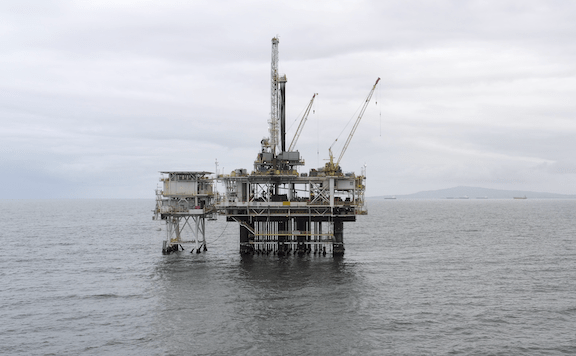
House approves a measure to block offshore drilling for a year
Credit: Erik Olsen
The House passed a spending bill late Thursday that would block offshore drilling along most U.S. shores, including a ban on seismic testing used to find oil and gas reserves. Unfortunately, it only lasts a year. Many groups, particularly in California, have long sought an end to drilling, and there was immense hope that would be the case in 2016 when President Obama permanently ended oil and gas leasing in parts of the Atlantic and Arctic oceans. However, President Trump issued an executive order in April 2017 that would roll back these protections, and in January 2018, now former U.S. Department of the Interior Secretary Ryan Zinke proposing opening up nearly all federal waters to oil and gas extraction. The new measure potentially restores the safeguard that protected California’s coast for more than a quarter century.
It’s not easy to find great places to gaze up into the night sky and take in the grandeur and awe of the universe. Light pollution from cities has obscured the skies in so many places around the state, that you are often lucky, even on a clear night, to see more than a dozen or so points of light. Of course, this is a problem everywhere, not just California. In June 2016, it was estimated that one-third of the world’s population could no longer see the Milky Way.
For California residents seeking dark spaces to escape with their telescopes or just a blanket to lie on, there is some hope. Many municipalities are installing less light polluting LEDs or passing ordinances to turn off certain lights during the night to reduce light pollution.
There are a few places where you can still go to find clear night skies. The light pollution map offers a very handy resource to find California’s best star viewing opportunities. Not surprisingly, desert areas and sections of Northern California offer some of the best locations. For example, Anza-Borrego Desert State Park in southern California was made a dark park in 2018. Also, two weeks ago, the Grand Canyonwas named an International Dark Sky Park by the International Dark-Sky Association.
Speaking of dark skies, let’s talk astrophotography. Take a look at Sacramento photographer Andrew McCarthy‘s images of the moon.McCarthy has spent many hours transforming some 50,000 individual images of the night sky into one very large and detailed photo of the moon. It’s breathtakingly beautiful and exquisitely detailed. Each crater and lunar sea on the side facing us looks like it was shot up close, when actually they were taken with McCarthy’s two camera setup 239,000 miles away. His process involves shooting photos and then stacking them at different exposures. He switches between an astronomy camera and a Sony A7II with a 300mm lens. Using Photoshop and special software, he aligns and adjusts the images to create the final product. You can see his marvelous Instagram feed here.
Back in 2017, ride-sharing company Uber held its second Uber Elevate Summit in Los Angeles to push the idea of flying taxis. To most Los Angelenos, the thought of soaring over traffic is almost too good to be true, a Jetsons cartoon fantasy. But it may not be as far fetched as it seems. Numerous companies are working on the idea, and the technology is getting closer and closer to reality. One of the big obstacles at the moment is battery power, since most flying cars will have to be electric and the systems will need to carry a lot of redundancy (flying cars will not be able to glide much), which adds tremendous weight.
Another obstacle is infrastructure. Where are all these flying cars going to take off and land? Well, Uber has been thinking a lot about this subject and just released plans for various “skyports” that will be built around Los Angeles. Uber says that both LA and Dallas will be the pilot cities for the new service it calls Uber Air. Uber also unveiled renderings of the vehicles themselves, which include four passenger seats and a small storage space for baggage. The company says we may be riding in flying taxis, perhaps starting with service from LAX to downtown, by 2023.
Aerial Photographer Mitchell Rouse takes aerial photos of agricultural lands in the Central Valley, making works of fine art that are not only lovely, but highlight the incredible diversity of forms and patterns that only an eye in the sky can see. Interestingly, he doesn’t use drones, but rather small planes and helicopters. In particular, he favors the Bell 407 helicopter and shoots with a Shot Over F1 Gimbal housing a Phase 1 Industrial 15oMP pixel camera. His portfolio of the central valley is called Agricultural Project #1.
Research oceanographer Jules Jaffe at Scripps Institute of Oceanography talks about how underwater drones (some of which his lab builds) are changing our understanding of the oceans.
A new California wildfire fund would put aside $21 billion for damage claims to help those whose property was destroyed.
A Stanford team is developing a privacy-minded alternative to Alexa and Siri. They call it almond.
California based CEO Elon Musk says his company has designed a submarine car like the one from the 1977 James Bond movie, “The Spy Who Loved Me.”
Nestlé, the world’s largest bottled water company, has been accused of taking millions of gallons of free water from the San Bernardino National Forest 17 months after California regulators told them they had no right to much of what they’d taken in the past.
A century-old cypress that may have inspired some of the imagery in Dr. Seuss’ Lorax story has collapsed. Geisel lived in La Jolla from 1948 until his death in 1991 and the tree lies close to his old home.
DOLA has a nice feature on the best opportunities to see exotic animals in California.
Scientists sequenced the almond genome, perhaps opening up a way for growers to cultivate varieties that lack cyanide, a potent poison.
California mental health officials are working with Mountain View-based Mindstrong to test apps for people getting care in CA’s mental health system. The idea is to create an early-warning system to flag the user when an emotional crisis seemed imminent.
Stanford Earth system science professor Kate Maher on how reactive transport modeling is used to better understand the chemical reactions in Earth’s subsurface that impact water supplies, energy waste storage, and climate change.
The heavy snows and deep snowpack have been great for skiers, and will benefit farmers who were coping with a seven-year drought. But researchers are warning that the ample rains and snows might lead to a very serious increase in wildfires.
That’s it! Have a great week, and please send your friends an invitation to sign up for the California Science Weekly newsletter.