The Majesty and Mystery of California’s Bristlecone Pines

Bristlecone Pine
Bristlecone Pine in the White Mountains (National Park Service)

Lying east of the Owens Valley and the jagged crags of the Sierra Nevadas, the White Mountains rise high above the valley floor, reaching over 14,000 feet, nearly as high as their far better-known relatives, the Sierra Nevadas. Highway 168 runs perpendicular to Highway 395 out of Big Pine and leads up into the mountains to perhaps the most sacred place in California.

Far above sea level, where the air is thin, live some of the most amazing organisms on the planet: the ancient bristlecone pines. To the untrained eye, the bristlecone seems hardly noteworthy. Gnarled and oftentimes squat, especially when compared to the majestic coastal redwoods and giant sequoias living near the coast further west, they hardly seem like mythical beings. But to scientists, they are a trove of information, offering clues to near immortality and to the many ways that the earth’s climate has changed over the last 5,000 years. 

In the January 20, 2020 edition of the New Yorker, music writer Alex Ross writes about the trees and the scientists who are trying to unlock the secrets of the bristlecone’s unfathomable endurance. The trees, he writes, “seem sentinel-like”.

Video of ancient bristlecone pine that I shot and put together.

Bristlecones are the longest living organism on earth. The tree’s Latin name is Pinus longaeva, and it grows exclusively in subalpine regions of the vast area known to geologists as the Great Basin, which stretches from the eastern Sierra Nevadas to the Wasatch Range, in Utah. Bristlecones grow between 9,800 and 11,000 feet above sea level, where some people get dizzy and there are few other plants or animals that thrive. The greatest abundance of bristlecones can be found just east of the town of Bishop, California in the Ancient Bristlecone Pine Forest. There, a short walk from where you park your car, you can stroll among these antediluvian beings as they imperceptibly twist, gnarl and reach towards the heavens. 

While most of the bristlecones in the national Ancient Bristlecone Pine Forest are mere hundreds of years old, there are many that are far older. Almost ridiculously so. Methuselah, a Great Basin bristlecone, is 4,851 years old, as measured by its rings, taken by scientists decades ago using a drilled core. Consider that for a moment: this tree, a living organism, planted its tentacle-like roots into the soil some 2000 years before the birth of Christ, around the time that the Great Pyramids of Egypt were built. By contrast, the oldest human being we know of lived just 122 years. That’s 242 human generations passing in the lifetime of a single bristlecone that still stands along a well-trodden trail in the high Sierras. 

Bristlecone and starry sky: National Park Service
National Park Service

That said, if you were to try and see Methuselah for yourself, you are out of luck. The Forest Service is so protective of its ancient celebrity that it will not even share its picture. What’s more, it’s probably the case that there are bristlecones that are even older than Methuselah. Scientists think there could be trees in the forest that are over 5,000 years old. 

How the bristlecone has managed this incredible feat of endurance is a mystery to researchers. Many other tree species are prone to insect infestations, wildfires, climate change. In fact, over the last two decades, the vast lodgepole pine forests of the Western United States and British Columbia have been ravaged by the pine beetle. Millions of acres of trees have been lost, including more than 16 million of the 55 million acres of forest in British Columbia.  

But insects don’t seem to be a problem for bristlecones. Bristlecone wood is so dense that mountain-pine beetles and other pests can rarely burrow their way into it. Further, the region where the bristlecones live tends to be sparse with vegetation, and thus far less prone to wildfire. 

Jeff Sullivan
Jeff Sullivan

So how do the trees manage to live so long? 

A recent study by scientists at the University of North Texas looked at the amazing longevity of the ginkgo tree, examining individuals in China and the US that have lived for hundreds, perhaps more than a thousand years. One thing they found is that the trees’ immune systems remain largely intact, even youthful, throughout their lives. It turns out the genes in the cambium, or the cylinder of tissue beneath the bark, contain no “program” for senescence, or death, but continue making defenses even after hundreds of years. Researchers think the same thing might be happening in the bristlecone. This is not the case in most organisms and certainly not humans. Like replicants in the movie Blade Runner, we seem to have a built-in clock in our cells that only allows us to live for so long. (I want more life, f$@$@!

Scientists at the University of Arizona’s Laboratory of Tree-Ring Research (LTRR) have built up the world’s largest collection of bristlecone cross-sections, which they carefully examine under the microscope, looking for clues about how the trees have managed to survive so long, and how they can inform us of the many ways the earth’s climate has changed over the millennia.

The LTRR houses the nation’s only dendrochronology lab (the term for the study of tree rings), and the researchers there have made several discoveries using tree cores that have changed or confirmed climate models. For example, in 1998, the climatologist Michael E. Mann published the “hockey stick graph,” that revealed a steep rise in global mean temperature from about 1850 onward (i.e. the start of the industrial revolution). There was intense debate about this graph, with many scientists and climate change skeptics saying that Mann’s projections were too extreme. But numerous subsequent studies, some using the trees’ rings new models, confirmed the hockey-stick model. 

Bristlecone Pine

The bristlecones will continue to help us understand the way the earth is changing and to see into the deep human past in a way few other living organisms can do. They also improve our understanding of possible future environmental scenarios and the serious consequences of allowing carbon levels in the atmosphere to continue to grow. 

In this sense, they truly are sentinels.
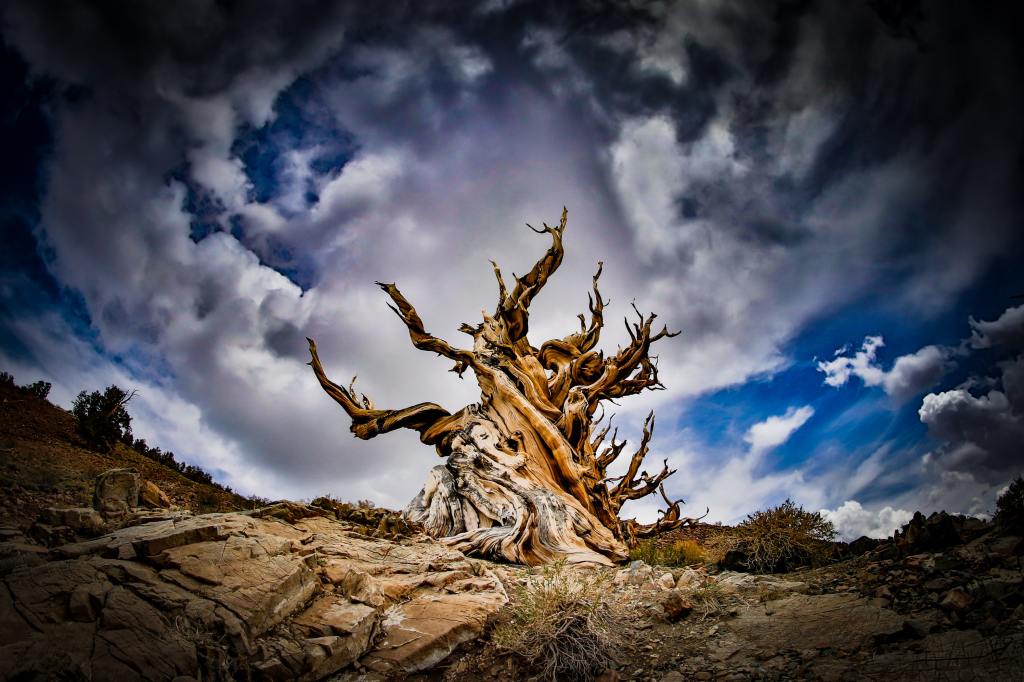
Bristlecone pine in the White Mountains (Unsplash)

Interestingly, it wasn’t until 1953 that we found out just how ancient these trees are. Credit for this breakthrough goes to Edmund Schulman, a dendrochronologist. Schulman and his colleague Frits Went stumbled upon an ancient limber pine while conducting research in Sun Valley, Idaho. This tree, which they found to be around 1,650 years old, got them thinking: could there be even older trees hidden away in the mountains?

Shulman then traveled to the White Mountains and began a long-term exploration of the Bristlecone forest. He took core samples from many trees and made a startling discovery. At night, at his camp, he began counting the annual growth rings on a slender piece of wood. He counted and counted, not daring to believe what was unfolding before his eyes. When he finally put down his magnifying glass in the enveloping darkness, he had counted rings that went back past the year 2046 BCE. Schulman had stumbled upon a tree that had been alive for over four millennia. Not only alive, but continuing to grow!

Schulman had effectively expanded our understanding of how long a single tree can endure—providing key insights into environmental longevity, climate history, and even the resilience of life on Earth.
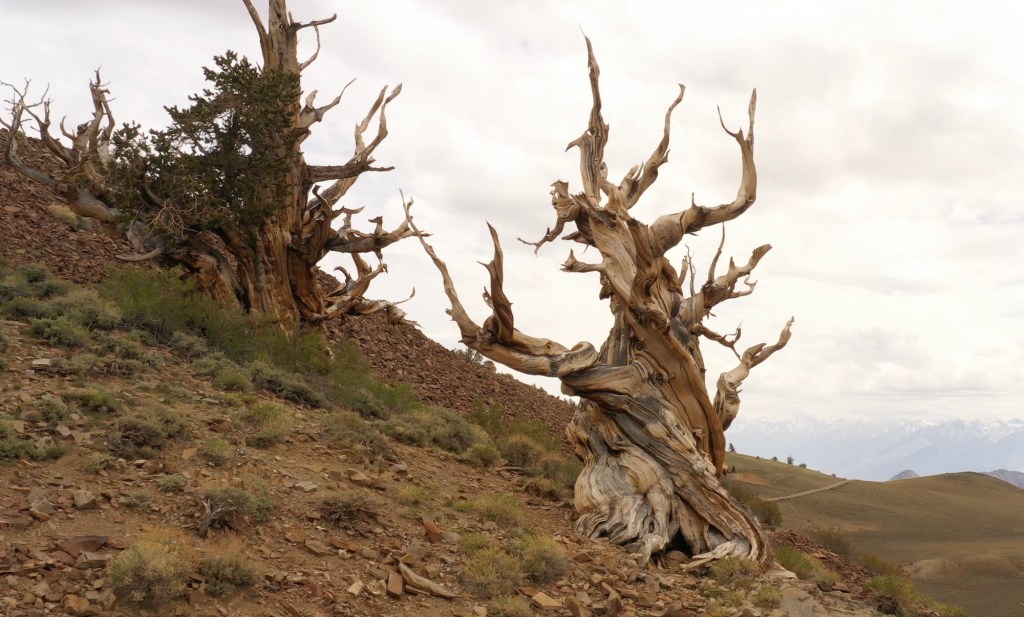
Bristlecone forest in the White Mountains of California (Erik Olsen)

In tribute to the momentous find, he dubbed the tree “Pine Alpha,” a name that’s as much a testament to the tree’s age as it is to the groundbreaking nature of Schulman’s work. Until then, no one knew a living tree could be that old. The discovery was a pivotal moment that opened up a new frontier in the study of dendrochronology, and it became a cornerstone example of how trees serve as living records of Earth’s history.

It should be said that the trees themselves, in their gnarled, frozen posture, are truly are beautiful. They should be protected and preserved, admired and adulated. Indeed, Federal law prohibits any attempt to damage the trees, including taking a mere splinter from the forest floor. The trees have also become an obsession for photographers, particularly those who favor astrophotography. A quick search on Instagram reveals a stunning collection of images showing the majesty and haunting beauty of these ancient trees. 

So, if you are ever headed up Highway 395 into the Sierras, it is well worth the effort to make the right-hand turn out of Big Pine to visit the Ancient Bristlecone Pine Forest. The air is thin, but the views are spectacular. And where else can you walk among the oldest living things on the planet?

Note: there is a wonderful video produced by Patagonia on the bristlecones and some of the scientists who study them. It’s well worth watching. 

The Man Who Saved the Owens Pupfish

51 years ago today a man named Edwin Philip Pister rescued an entire species from extinction.

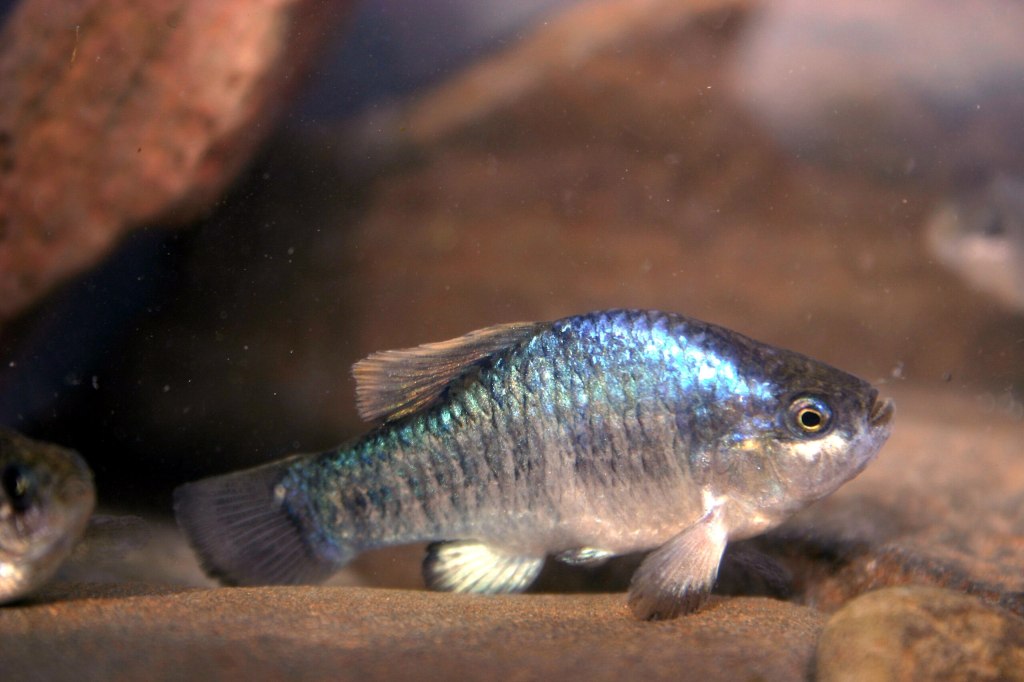
Less than 2.5 inches in length, the Owens pupfish is a silvery-blue fish in the family Cyprinodontidae. Endemic to California’s Owens Valley, 200 miles north of Los Angeles, the fish has lived on the planet since the Pleistocene, becoming a new species when its habitat was divided by changing climatic conditions, 60,000 years ago.

For thousands of years, the Owens Valley was largely filled with water, crystal-clear snowmelt that still streams off the jagged, precipitous slab faces of the Sierra Nevada mountains. Pupfish were common, with nine species populating various lakes and streams from Death Valley to an ara just south of Mammoth Lakes. The Paiute people scooped them out of the water and dried them for the winter.

In the late 19th century, Los Angeles was a rapidly growing young metropolis, still in throes of growing pains that would last decades. While considered an ugly younger sibling to the city of San Francisco, Los Angeles had the appeal of near year-round sunshine and sandy beaches whose beauty that rivaled those of the French Riviera.

Owens pupfish (California Department of Fish and Wildlife)

But by the late 1900s, the city began outgrowing its water supply. Fred Eaton, mayor of Los Angeles, and his water czar, William Mulholland, hatched a plan to build an aqueduct from Owens Valley to Los Angeles. Most Californians know the story. Through a series of shady deals, Mulholland and Eaton managed to get control of the water in the Owens Valley and, in 1913, the aqueduct was finished. It was great news for the new city, but terrible news for many of the creatures (not to mention the farmers) who depended on the water flowing into and from the Owens Lake to survive.

So named because they exhibit playful, puppy-like behavior, the Owens pupfish rapidly began to disappear. Pupfish are well-known among scientists for being able to live in extreme and isolated situations. They can tolerate high levels of salinity. Some live in water that exceeds 100° Fahrenheit, and they can even tolerate up to 113° degrees for short periods. They are also known to survive in near-freezing temperatures common in the lower desert.

Owens River in the Eastern Sierra (Erik Olsen)

One of those animals is the Owens pupfish.

But hot or cold are one thing. The disappearance of water altogether is another.

As California has developed, and as climate change has caused temperatures to rise, thus increasing evaporation, all of California’s pupfish populations have come under stress. Add to these conditions, the early 20th-century introduction by the California Department of Fish and Wildlife of exotic species like largemouth bass and rainbow trout to lakes and streams in the eastern Sierras, and you get a recipe for disaster. And disaster is exactly what happened.

Several species of pupfish in the state have been put on the endangered species list. Several species, including the Owens pupfish, the Death Valley Pupfish and the Devils Hole pupfish are some of the rarest species of fish on the planet. The Devils Hole pupfish recently played the lead role in a recent story about a man who accidentally killed one of the fish during a drunken spree. According to news stories, he stomped on the fish when he tried to swim in a fenced-off pool in Death Valley National Park. He went to jail.

The remains of the Owens River flowing through Owens Valley in California. Credit: Erik Olsen

The impact on the Owens pupfish habitat was so severe that in 1948, just after it was scientifically described, it was declared extinct.

That is, until one day in 1964, when researchers discovered a remnant population of Owens pupfish in a desert marshland called Fish Slough, a few miles from Bishop, California. Wildlife officials immediately began a rescue mission to save the fish and reintroduce them into what were considered suitable habitats. Many were not, and by the late 1960s, the only remaining population of Owens pupfish, about 800 individuals, barely hung on in a “room-sized” pond near Bishop.

On August 18, 1969, a series of heavy rains caused foliage to grow and clog the inflow of water into the small pool. It happened so quickly, that when scientists learned of the problem, they realized they had just hours to save the fish from extinction.

Edwin Philip Pister
Edwin Philip Pister

Among the scientists who came to the rescue that day was a stocky, irascible 40-year-old fish biologist named Phil Pister. Pister had worked for the California Department of Fish and Game (now the California Department of Fish and Wildlife) most of his career. An ardent acolyte of Aldo Leopold, regarded as one of the fathers of American conservation, Pister valued nature on par, or even above, human needs. As the Los Angeles Times put it in a 1990 obituary, “The prospect of Pister off the leash was fearsome.”

“I was born on January 15, 1929, the same day as Martin Luther King—perhaps this was a good day for rebels,” he once said.

Pister had few friends among his fellow scientists. Known for being argumentative, disagreeable, and wildly passionate about the protection of California’s abundant, but diminishing, natural resources, Pister realized that immediate action was required to prevent the permanent loss of the Owens pupfish. He rallied several of his underlings and rushed to the disappearing pool with buckets, nets, and aerators.

Within a few hours, the small team was able to capture the entire remaining population of Owens pupfish in two buckets, transporting them to a nearby wetland. However, as Pister himself recalls in an article for Natural History Magazine:

“In our haste to rescue the fish, we had unwisely placed the cages in eddies away from the influence of the main current. Reduced water velocity and accompanying low dissolved oxygen were rapidly taking their toll.”

Los Angeles Aqueduct. Credit: Erik Olsen

As noted earlier, pupfish are amazingly tolerant of extreme conditions, but like many species, they can also be fragile, and within a short amount of time, many of the pupfish Pister had rescued were dying, floating belly up in the cages. Pister realized immediate action was required, lest the species disappear from the planet forever. Working alone, he managed to net the remaining live fish into the buckets and then carefully carried them by foot across an expanse of marsh. “I realized that I literally held within my hands the existence of an entire vertebrate species,” he wrote.

Pister managed to get the fish into cool, moving water where the fish could breathe and move about. He says about half the the population survived, but that was enough.

Today, the Owens pupfish remains in serious danger of extinction. On several occasions over the last few decades, the Owens pupfish have suffered losses by largemouth bass that find their way into the pupfish’s refuges, likely due to illegal releases by anglers. In 2009, the US Fish and Wildlife Service estimated that five populations totaling somewhere between 1,500 and 20,000 Owens pupfish live in various springs, marshes, and sloughs in the Owens Valley, where they are federally protected.

by Erik Olsen

Additional material:

Oral history video featuring Phil Pister recounting his career and that fateful day.

Read previous articles in the California Science Weekly.

https://atomic-temporary-158141606.wpcomstaging.com/2020/03/04/why-are-californias-redwoods-and-sequoias-so-big/

Beautiful, but Deadly: Painting the Coronavirus

Pandemic as art.

You’ve seen it. Probably a thousand or more times by now. It’s the image of a greyish sphere, hanging in space, barbed with blood-red spikes. It looks like an undersea Navy mine… or perhaps a dog’s chew toy. The Covid-19 coronavirus illustration is one of the best known and most viewed scientific illustrations in history. Released in early February by the Centers for Disease Control and Prevention, the image has been seen on news sites, in magazines, even on SNL.

That digital illustration, created by two medical illustrators at the CDC’s Graphic Services Branch — Alissa Eckert and Dan Higgins — will forever be the iconic image of the current pandemic. As a piece of digital art, it is lovely. As a piece of science, it is terrifying.

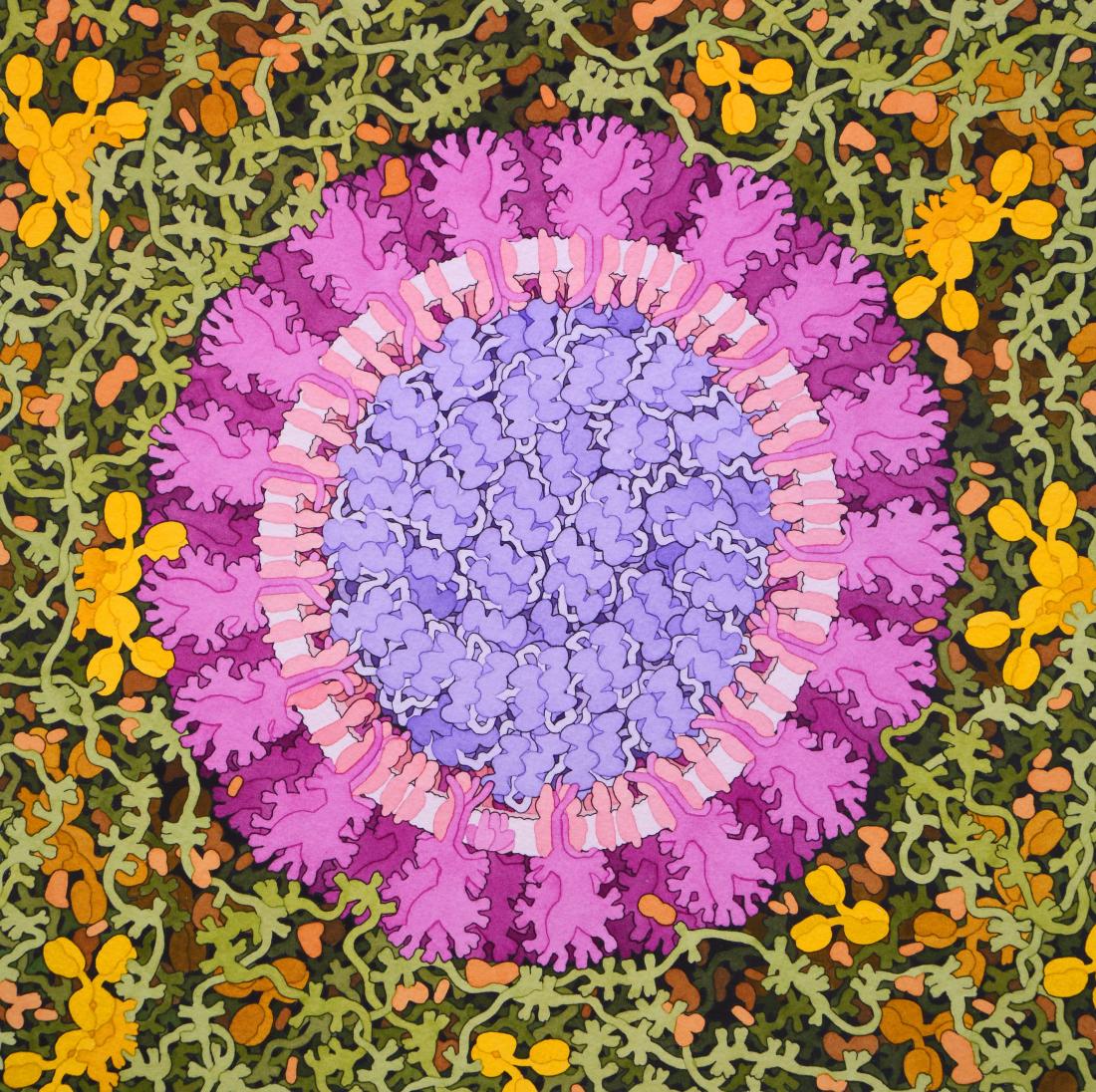
But another image of the virus was painted in watercolor by the San Diego-based scientist and biological artist David Goodsell, one of the most famous and accomplished scientific illustrators alive today. Goodsell has published several books of his illustrations, and many of his lavishly colored paintings can be found in medical school textbooks. A few have won awards. Some have even hung in museums. Goodsell’s coronavirus image is not nearly as famous, but as a work of art — and a work of science — it is just as mesmerizing. And more lovely.

Goodsell is an Associate Professor in the Department of Integrative Structural and Computational Biology at the Scripps Research Institute in San Diego. Most of the time, he works as a scientific illustrator (or molecular artist), a growing field in science, with numerous university programs available around the country. While the CDC image was created entirely within a computer, Goodsell’s work tends to be done in watercolor, a much older medium, but one that gives his images a vibrant beauty, making terrible pathogens like E-coli, Ebola and HIV, not to mention coronavirus, look like a psychedelic dream or a candy-colored nightmare.

Ebola virus: David Goodsell

Goodsell says that creating images like these serve a very important purpose: allowing people to picture something that otherwise would be unseeable.

“I was trying to put a face on the virus, so it’s not invisible, so we can see what we’re fighting,” Goodsell told California Science Weekly.

Because there are so many other images out there of the virus, it might seem like creating an illustration of it would be simple, but Goodsell says that there’s a tremendous amount of science involved, and that he strives to be as technically accurate as possible, showing only the known proteins in the virus and how they might be organized within the virion, the technical term for a virus particle.

David Goodsell in his home studio.

At the time that the painting was made, says Goodsell, not much was known about the virus. Its genetic structure was still being figured out. But since the virus is so similar to the SARS virome, Goodsell used a lot of the information from existing data on that virus, to create his work of art. Like most molecular artists, Goodsell draws from existing information about the proteins that make up a virus, much of which is freely available in the Protein Data Bank, a global online repository of genetic and structural data on thousands of the proteins which make up all living things.

“I want it to be something that people want to look at. I don’t particularly want it to look scary or monsterish.”

David Goodsell

The Protein Data Bank contains “some really nice structures of the spike protein on the outside of the virus.” Those spike proteins (colored a deep blood-red in the CDC image, but a bubblegum pink in Goodsell’s painting) are the means by which the virus attaches itself to our own cells before injecting them with its RNA, which will rapidly replicate inside and potentially wreak havoc in our bodies.

“If you Google coronavirus, people are using a whole range of different amounts of data, and most of the pictures are total garbage. Somebody has heard there are spikes on the virus, so they put things that look like big nails on the surface,” says Goodsell. “The CDC’s and my picture are much more tied to the data.”

Since creating the image in February, however, more information has come out about the virus’s genetic composition, and Goodsell may revisit his image, although he thinks it remains accurate. Little was known, for example, about the RNA contents of the virus, the genetic information that invades human cells. He also notes that the virus’s shape is not as uniform as depicted in most illustrations, and that any effort to create an image of it requires a significant amount of artistic license. For example, the CDC image, while accurate in terms of various proteins pictured, is likely not the neatly organized spiked ball floating in space that most people have come to know.

“I was trying to put a face on the virus, so it’s not invisible, so we can see what we’re fighting.”

David Goodsell

“It’s not a perfect sphere and it comes in a range of different sizes,” says Goodsell. “All of my reading is that the spikes are arranged randomly on the surface.”

Another quality that is entirely up to the artist is color. None of the molecules in the virus have much color, so molecular artists like Goodsell (and Alissa Eckert and Dan Higgins at the CDC), choose colors that they believe will be both pleasing and informative, helping to differentiate the various structures within the virus particle. “Color is used to help improve the clarity of what the structures are. The CDC has used that bright red to show what they think is the most important part, the spike on the surface,” says Goodsell.

For Goodsell’s part, his palette is far less sinister. He favors delicate pastels and swooping forms over the stark primary colors and jagged spikes of most coronavirus images. “I want it to be something that people want to look at. I don’t particularly want it to look scary or monsterish.”

That said, Goodsell says he’s been getting a lot of comments about the painting on Twitter. “Invariably, they say it’s beautiful but deadly.”