The Man Who Saved the Owens Pupfish

51 years ago today a man named Edwin Philip Pister rescued an entire species from extinction.

Less than 2.5 inches in length, the Owens pupfish is a silvery-blue fish in the family Cyprinodontidae. Endemic to California’s Owens Valley, 200 miles north of Los Angeles, the fish has lived on the planet since the Pleistocene, becoming a new species when its habitat was divided by changing climatic conditions, 60,000 years ago.

For thousands of years, the Owens Valley was largely filled with water, crystal-clear snowmelt that still streams off the jagged, precipitous slab faces of the Sierra Nevada mountains. Pupfish were common, with nine species populating various lakes and streams from Death Valley to an ara just south of Mammoth Lakes. The Paiute people scooped them out of the water and dried them for the winter.

In the late 19th century, Los Angeles was a rapidly growing young metropolis, still in throes of growing pains that would last decades. While considered an ugly younger sibling to the city of San Francisco, Los Angeles had the appeal of near year-round sunshine and sandy beaches whose beauty that rivaled those of the French Riviera.
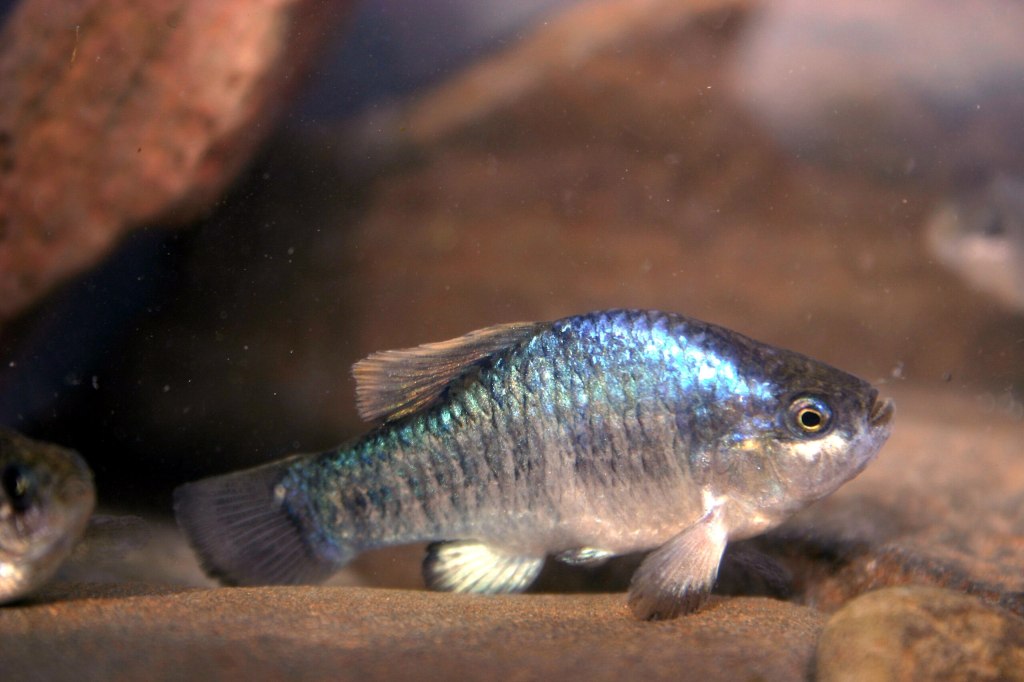
Owens pupfish (California Department of Fish and Wildlife)

But by the late 1900s, the city began outgrowing its water supply. Fred Eaton, mayor of Los Angeles, and his water czar, William Mulholland, hatched a plan to build an aqueduct from Owens Valley to Los Angeles. Most Californians know the story. Through a series of shady deals, Mulholland and Eaton managed to get control of the water in the Owens Valley and, in 1913, the aqueduct was finished. It was great news for the new city, but terrible news for many of the creatures (not to mention the farmers) who depended on the water flowing into and from the Owens Lake to survive.

So named because they exhibit playful, puppy-like behavior, the Owens pupfish rapidly began to disappear. Pupfish are well-known among scientists for being able to live in extreme and isolated situations. They can tolerate high levels of salinity. Some live in water that exceeds 100ยฐ Fahrenheit, and they can even tolerate up to 113ยฐ degrees for short periods. They are also known to survive in near-freezing temperatures common in the lower desert.

Owens River in the Eastern Sierra (Erik Olsen)

One of those animals is the Owens pupfish.

But hot or cold are one thing. The disappearance of water altogether is another.

As California has developed, and as climate change has caused temperatures to rise, thus increasing evaporation, all of California’s pupfish populations have come under stress. Add to these conditions, the early 20th-century introduction by the California Department of Fish and Wildlife of exotic species like largemouth bass and rainbow trout to lakes and streams in the eastern Sierras, and you get a recipe for disaster. And disaster is exactly what happened.

Several species of pupfish in the state have been put on the endangered species list. Several species, including the Owens pupfish, the Death Valley Pupfish and the Devils Hole pupfish are some of the rarest species of fish on the planet. The Devils Hole pupfish recently played the lead role in a recent story about a man who accidentally killed one of the fish during a drunken spree. According to news stories, he stomped on the fish when he tried to swim in a fenced-off pool in Death Valley National Park. He went to jail.

The remains of the Owens River flowing through Owens Valley in California. Credit: Erik Olsen

The impact on the Owens pupfish habitat was so severe that in 1948, just after it was scientifically described, it was declared extinct.

That is, until one day in 1964, when researchers discovered a remnant population of Owens pupfish in a desert marshland called Fish Slough, a few miles from Bishop, California. Wildlife officials immediately began a rescue mission to save the fish and reintroduce them into what were considered suitable habitats. Many were not, and by the late 1960s, the only remaining population of Owens pupfish, about 800 individuals, barely hung on in a “room-sized” pond near Bishop.

On August 18, 1969, a series of heavy rains caused foliage to grow and clog the inflow of water into the small pool. It happened so quickly, that when scientists learned of the problem, they realized they had just hours to save the fish from extinction.

Edwin Philip Pister
Edwin Philip Pister

Among the scientists who came to the rescue that day was a stocky, irascible 40-year-old fish biologist named Phil Pister. Pister had worked for the California Department of Fish and Game (now the California Department of Fish and Wildlife) most of his career. An ardent acolyte of Aldo Leopold, regarded as one of the fathers of American conservation, Pister valued nature on par, or even above, human needs. As the Los Angeles Times put it in a 1990 obituary, “The prospect of Pister off the leash was fearsome.”

“I was born on January 15, 1929, the same day as Martin Luther Kingโ€”perhaps this was a good day for rebels,” he once said.

Pister had few friends among his fellow scientists. Known for being argumentative, disagreeable, and wildly passionate about the protection of California’s abundant, but diminishing, natural resources, Pister realized that immediate action was required to prevent the permanent loss of the Owens pupfish. He rallied several of his underlings and rushed to the disappearing pool with buckets, nets, and aerators.

Within a few hours, the small team was able to capture the entire remaining population of Owens pupfish in two buckets, transporting them to a nearby wetland. However, as Pister himself recalls in an article for Natural History Magazine:

“In our haste to rescue the fish, we had unwisely placed the cages in eddies away from the influence of the main current. Reduced water velocity and accompanying low dissolved oxygen were rapidly taking their toll.”

Los Angeles Aqueduct. Credit: Erik Olsen

As noted earlier, pupfish are amazingly tolerant of extreme conditions, but like many species, they can also be fragile, and within a short amount of time, many of the pupfish Pister had rescued were dying, floating belly up in the cages. Pister realized immediate action was required, lest the species disappear from the planet forever. Working alone, he managed to net the remaining live fish into the buckets and then carefully carried them by foot across an expanse of marsh. “I realized that I literally held within my hands the existence of an entire vertebrate species,” he wrote.

Pister managed to get the fish into cool, moving water where the fish could breathe and move about. He says about half the the population survived, but that was enough.

Today, the Owens pupfish remains in serious danger of extinction. On several occasions over the last few decades, the Owens pupfish have suffered losses by largemouth bass that find their way into the pupfish’s refuges, likely due to illegal releases by anglers. In 2009, the US Fish and Wildlife Service estimated that five populations totaling somewhere between 1,500 and 20,000 Owens pupfish live in various springs, marshes, and sloughs in the Owens Valley, where they are federally protected.

by Erik Olsen

Additional material:

Oral history video featuring Phil Pister recounting his career and that fateful day.

Read previous articles in the California Science Weekly.
https://atomic-temporary-158141606.wpcomstaging.com/2020/03/04/why-are-californias-redwoods-and-sequoias-so-big/

Beautiful, but Deadly: Painting the Coronavirus

Pandemic as art.

You’ve seen it. Probably a thousand or more times by now. It’s the image of a greyish sphere, hanging in space, barbed with blood-red spikes. It looks like an undersea Navy mine… or perhaps a dog’s chew toy. The Covid-19 coronavirus illustration is one of the best known and most viewed scientific illustrations in history. Released in early February by the Centers for Disease Control and Prevention, the image has been seen on news sites, in magazines, even on SNL.

That digital illustration, created by two medical illustrators at the CDC’s Graphic Services Branch — Alissa Eckert and Dan Higgins — will forever be the iconic image of the current pandemic. As a piece of digital art, it is lovely. As a piece of science, it is terrifying.

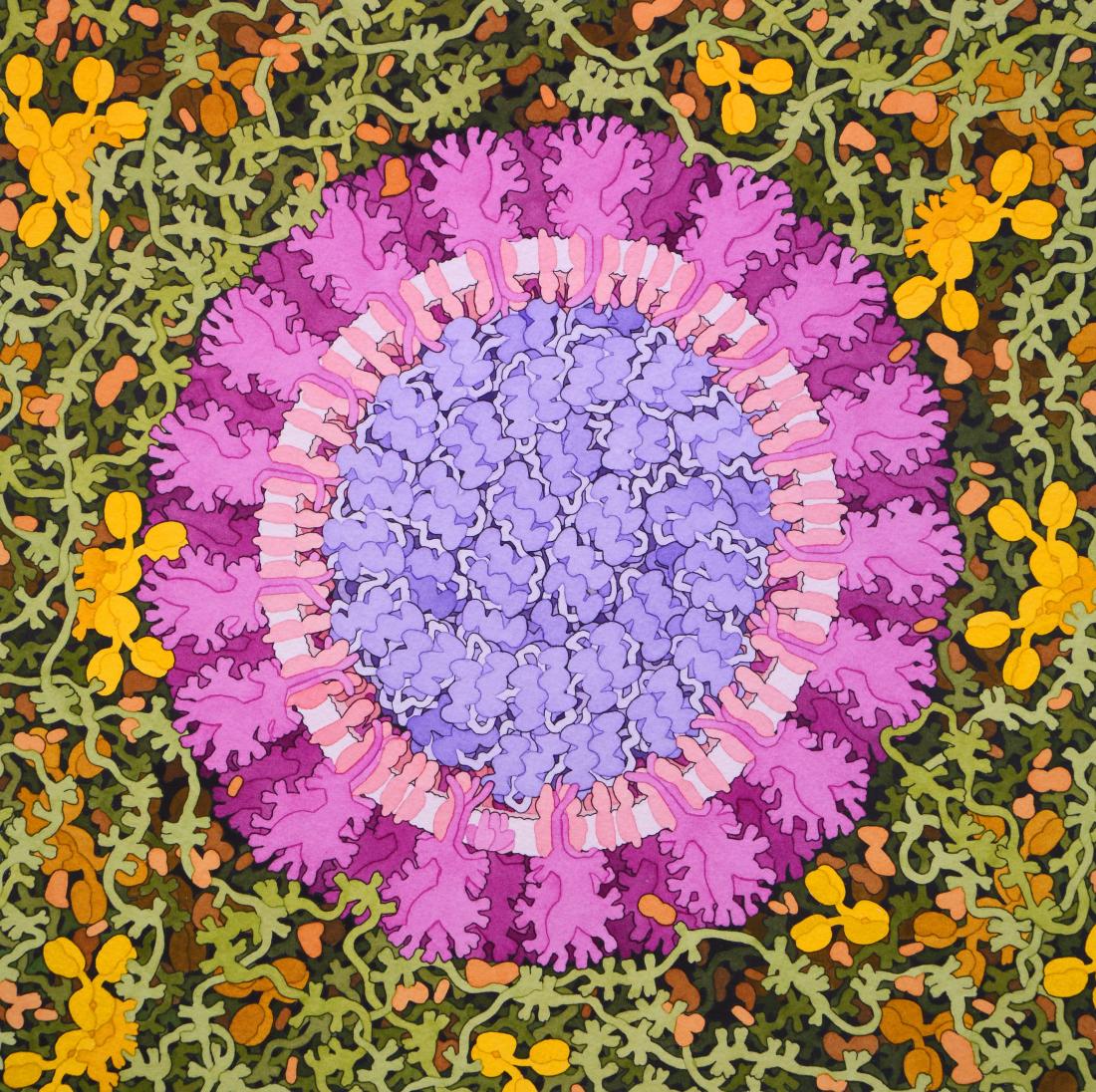
But another image of the virus was painted in watercolor by the San Diego-based scientist and biological artist David Goodsell, one of the most famous and accomplished scientific illustrators alive today. Goodsell has published several books of his illustrations, and many of his lavishly colored paintings can be found in medical school textbooks. A few have won awards. Some have even hung in museums. Goodsellโ€™s coronavirus image is not nearly as famous, but as a work of art — and a work of science — it is just as mesmerizing. And more lovely.

Goodsell is an Associate Professor in the Department of Integrative Structural and Computational Biology at the Scripps Research Institute in San Diego. Most of the time, he works as a scientific illustrator (or molecular artist), a growing field in science, with numerous university programs available around the country. While the CDC image was created entirely within a computer, Goodsell’s work tends to be done in watercolor, a much older medium, but one that gives his images a vibrant beauty, making terrible pathogens like E-coli, Ebola and HIV, not to mention coronavirus, look like a psychedelic dream or a candy-colored nightmare.

Ebola virus: David Goodsell

Goodsell says that creating images like these serve a very important purpose: allowing people to picture something that otherwise would be unseeable.

“I was trying to put a face on the virus, so it’s not invisible, so we can see what we’re fighting,” Goodsell told California Science Weekly.

Because there are so many other images out there of the virus, it might seem like creating an illustration of it would be simple, but Goodsell says that there’s a tremendous amount of science involved, and that he strives to be as technically accurate as possible, showing only the known proteins in the virus and how they might be organized within the virion, the technical term for a virus particle.

David Goodsell in his home studio.

At the time that the painting was made, says Goodsell, not much was known about the virus. Its genetic structure was still being figured out. But since the virus is so similar to the SARS virome, Goodsell used a lot of the information from existing data on that virus, to create his work of art. Like most molecular artists, Goodsell draws from existing information about the proteins that make up a virus, much of which is freely available in the Protein Data Bank, a global online repository of genetic and structural data on thousands of the proteins which make up all living things.

“I want it to be something that people want to look at. I don’t particularly want it to look scary or monsterish.”

David Goodsell

The Protein Data Bank contains “some really nice structures of the spike protein on the outside of the virus.” Those spike proteins (colored a deep blood-red in the CDC image, but a bubblegum pink in Goodsell’s painting) are the means by which the virus attaches itself to our own cells before injecting them with its RNA, which will rapidly replicate inside and potentially wreak havoc in our bodies.

“If you Google coronavirus, people are using a whole range of different amounts of data, and most of the pictures are total garbage. Somebody has heard there are spikes on the virus, so they put things that look like big nails on the surface,” says Goodsell. “The CDC’s and my picture are much more tied to the data.”

Since creating the image in February, however, more information has come out about the virus’s genetic composition, and Goodsell may revisit his image, although he thinks it remains accurate. Little was known, for example, about the RNA contents of the virus, the genetic information that invades human cells. He also notes that the virus’s shape is not as uniform as depicted in most illustrations, and that any effort to create an image of it requires a significant amount of artistic license. For example, the CDC image, while accurate in terms of various proteins pictured, is likely not the neatly organized spiked ball floating in space that most people have come to know.

“I was trying to put a face on the virus, so it’s not invisible, so we can see what we’re fighting.”

David Goodsell

“It’s not a perfect sphere and it comes in a range of different sizes,” says Goodsell. “All of my reading is that the spikes are arranged randomly on the surface.”

Another quality that is entirely up to the artist is color. None of the molecules in the virus have much color, so molecular artists like Goodsell (and Alissa Eckert and Dan Higgins at the CDC), choose colors that they believe will be both pleasing and informative, helping to differentiate the various structures within the virus particle. “Color is used to help improve the clarity of what the structures are. The CDC has used that bright red to show what they think is the most important part, the spike on the surface,” says Goodsell.

For Goodsell’s part, his palette is far less sinister. He favors delicate pastels and swooping forms over the stark primary colors and jagged spikes of most coronavirus images. “I want it to be something that people want to look at. I don’t particularly want it to look scary or monsterish.”

That said, Goodsell says he’s been getting a lot of comments about the painting on Twitter. “Invariably, they say it’s beautiful but deadly.”

The genius of Luther Burbank, father of the most famous potato in the world

Luther Burbank created some of the world’s most commercially successful fruits and vegetables, all from his Santa Rosa, California farm.

luther burbank - Library of Congress
Luther Burbank in his garden – Credit: Library of Congress

Editor’s note: This article is part of an ongoing series about lesser-known Californians who have made a significant impact on the state. California Characters seeks to bring their stories to light, highlighting voices and achievements that history has often overlooked. Through this series, we aim to celebrate the individuals who have shaped California in ways both big and small, ensuring their contributions are recognized and remembered.

The Los Angeles Times recently ran a review of fast-food french fries that caused a stir because the writer placed fries made at Californiaโ€™s beloved In-N-Out burger somewhere near the bottom. This infuriated the stateโ€™s rabid fan base for what is arguably one of the best burger joints in America. (Raises hand in support). But one interesting side story, the ideal kind of story we cover here, is this: if it were not for the work of one Californian farmer, we would likely not have french fries at all, or at least not as we know them today.ย 

Russet Burbank potato. Credit Wikipedia

That is because most french fries today are made with a particular strain of potato –  the Russet Burbank – that exists largely because of one man: Luther Burbank. Burbank is a little-known Californian (part of an ongoing series) whose contributions to science, in particular botany, have had an outsized impact on much of the fresh produce we consume today. 

Burbank is a towering figure in horticulture, credited with creating the science of modern plant breeding. For decades in the late 19th, early 20th centuries, his experimental farm in Santa Rosa, California, was famous throughout the world for the stunning variety of new fruit and vegetable varieties that emerged from the farmโ€™s fertile soil. 

Luther Burbank - Library of Congress
Luther Burbank. (Library of Congress)

Born in 1849 in Lancaster, Massachusetts, Burbank came to California in 1875, buying a four-acre plot of land to start a nursery and garden in order to breed edible crops. While not a trained scientist, Burbank had a preternatural knack for identifying desirable characteristics in plants, which he selected for through an arduous, time-consuming, and oftentimes brilliantly intuitive series of techniques that led to the creation of some of our most cherished strains of fruits and vegetables. 

Over the course of his 55-year career, Burbank developed more than 800 new strains and varieties of plants, including flowers, grains, grasses, vegetables, cacti, and fruits. These include 113 varieties of plums, 20 of which remain commercially valuable, especially in California and South Africa. He also developed 10 commercial varieties of berries (including the oxymoronically-named white blackberry) as well as more than 50 varieties of lilies

Amazingly, Burbank was able to achieve all this without direct knowledge of plant genetics, pioneered by the Augustinian friar Gregor Mendel in what is now the Czech Republic in the mid-1800s (and whose papers on growing pea plants were brought to light in 1901, long after his death in 1884). Burbankโ€™s lack of precise record-keeping and somewhat unorthodox — some would say sloppy — record-keeping, has led some modern scientists to criticize his credentials. Purdue University professor Jules Janick, wrote that “Burbank cannot be considered a scientist in the academic sense.” 

Luther Burbank with spineless cactus that he developed.
Luther Burbank with spineless cactus that he developed. (Library of Congress)

That said, Burbankโ€™s innovations in Santa Rosa were revolutionary and garnered him worldwide attention, as well as financial support from benefactors like Andrew Carnegie, who supported Burbank because he believed the work was of great potential benefit to humanity. 

Burbank perfected techniques in common use today such as grafting, hybridization, and cross-breeding. At the time, his efforts resulted in large yield increases for numerous edible species in the United States in the early 20th century. 

But perhaps Burbankโ€™s most lasting achievement was the Russet Burbank potato, which first came on the scene around 1902. Burbank bred the new stain from an unusual “seedball” he found on his farm, which came from a strain called Early Rose. Burbank planted the seeds, chose the most select fruits and further hybridized those. Soon, he had a wonderfully robust and hearty potato that he could sell.  

This large, brown-skinned, fleshy-white tuber is now the world’s predominant potato in food processing. The Russet Burbank is ideal for baking, mashing, and french fries. It is now grown predominantly in Idaho, the top potato-growing state in the US, where the variety makes up more than 55% of the stateโ€™s potato production. 

Burbank came up with the Russet Burbank potato to help with the devastating situation in Ireland following the Irish potato famine. His aim was to help “revive the country’s leading crop” due to the fact that it is โ€œLate blight-resistantโ€. Late blight disease destroyed potato crops across Europe and led to a devastating famine in Ireland because the country was so dependent on potatoes as a common foodstuff. Unfortunately, Burbank did not patent the Russet Burbank because plant tubers, of which the potato is one, were not granted patents in the United States. 

But the Russet Burbank was such a hearty strain, and so nutritious and flavorful (though some disagree), that it became the potato of choice for many grocery stores and restaurants. This did not happen automatically, but took about two decades to catch on. In fact, in 1930, the Russet Burbank accounted for just 4% of potatoes in the US. But things would quickly change with the advent of frozen french fries in the 1940s and the subsequent emergence of fast-food restaurants like McDonaldโ€™s in the 1950s. The Russet Burbank was perfectly suited for french fries and remains the worldโ€™s most popular potato by a long shot.  

Unfortunately, Luther Burbank had a dark side, especially by modern mores. He believed in eugenics, the idea that human beings should be selectively bred like produce. He was a member of a national eugenicist group, which promoted anti-miscegenation laws, segregation, involuntary sterilization, and other discrimination by race.

Luther Burbank home in Santa Rosa, California. Credit: Library of Congress

Luther Burbank died after a heart attack and gastrointestinal illness in 1926. His name is known in certain regions of California, in and around Santa Rosa, although if you asked the average person who he was, few would be able to say. The Luther Burbank Home and Gardens, in downtown Santa Rosa, are designated as a National Historic Landmark.

Southern California’s unheralded role in Apollo 11

For the 50th Anniversary of Apollo 11, we bring you a story about our state’s contribution to that great historical event.

Buzz Aldrin standing on the moon during Apollo 11 (NASA)

This summer Americans have Apollo fever. July 20, as most everyone knows, is the 50th anniversary of the Apollo moon landing, when astronauts Neil Armstrong and Buzz Aldrin became the first humans to set foot on the moon. Many people, including some of our most eminent historians, have called it the greatest achievement in the history of mankind. 

But when we think about Apollo and attempt to place it here on earth, we typically think about Apollo Mission Control Center in Houston, Texas. Who can forget Neil Armstrongโ€™s famous words: “Houston, Tranquility Base here. The Eagle has landed.”

So what did this experiment accomplish? A great deal, it turns out. 

Or maybe we think of the fiery liftoff of the Saturn V rocket from Kennedy Space Center on Merritt Island, Florida. And in the Northeast, many are also aware of the Massachusetts Institute of Technology’s huge contribution to the software written for the Apollo mission. A wonderful new book about the Apollo mission by Charles Fishman titled One Giant Leap: The Impossible Mission That Flew Us to the Moon, discusses at length the challenges faced by MIT computer programmers in the very early days of software development.ย 

But few people probably realize that Southern California can lay claim to a lot of Apollo 11 history. Where, you might ask?

First of all, there is Downey.ย ย 

North American Aviation factory in Downey, California

Both the New York Times and KCRW have interesting stories about how the Apollo 11 command module and the accompanying service module were actually built on a 160-acre swath of land in Downey called the North American Aviation Factory. The site is now home to a strip mall with a Wal-Mart, TJ Maxx and 24-hour Fitness. Turns out, too, that the camera systems that flew on Apollo were also developed in Southern California, as was the second stage of the gigantic Saturn 5 rocket. The backstory of 84-year-old Shelby Jacobs, who helped develop the camera system that captured iconic scenes of the separation of the first and second stages of the Saturn 5 rocket, is heart-breaking. Jacobs, who is black, couldnโ€™t live in Downey, as most black NASA employees lived in Watts.ย 

But thereโ€™s more to Californiaโ€™s role in Apollo. In La Canada Flintridge, home of the Jet Propulsion Laboratory, one of the most important experiments of the whole mission was developed.

The Apollo 11 Laser Ranging Retroreflector Experiment was one of several major scientific endeavors that were part of the epic space mission. Developed and monitored at JPL, it consisted of a reflector that was positioned on the moon by Armstrong and Aldrin and aimed back at Earth. Lasers here on Earth fired pulses of concentrated light that were then reflected and detected by special receivers on the ground. The laser reflector consisted of 100 fused silica half-cubes, called corner cubes, mounted in a 46-centimeter (18-inch) square aluminum panel. Later, on Apollo 14 and 15 missions, two additional reflectors were set up on the surface of the moon.  

“Itโ€™s very exciting,” says Turyshev. “This is the longest continuing experiment in the history of space science.”

Slava G. Turyshev, NASA’s Jet Propulsion Laboratory

The reflectors are too small to be seen from Earth, and the task of actually hitting them was a major technical challenge. Even though a laser is highly concentrated light, by the time the light reaches the moon, the beam is roughly 2.5 kilometers (1.5 miles) wide, and detecting the light that reflected back was very difficult. Scientists back then likened the effort to using a rifle to hit a moving dime two miles away. Like the moon landing itself, it was audacious.

โ€œIt was a very clever experiment that changed the way we think about the moon,โ€ Slava G. Turyshev, an astrophysicist at JPL involved with instrument design for the new generation of lunar laser operations, told California Curated.

Laser Ranging Retroreflector - NASA
Laser Ranging Retroreflector – NASA

After the laser beam bounced off a reflector (it takes about 1.3 seconds for light to make the round trip), it came back to earth and was detected by ranging observatories in Texas, Hawaii and France, that use extremely sensitive amplification equipment. Even under the best atmospheric viewing conditions, just one photon hits the observatory every few seconds. But that one photon tells us a lot.

So what did this experiment accomplish? A great deal, it turns out. 

Before the experiment, we had a decent idea how far the Moon is from Earth within a few feet. But based on data gathered from the Lunar Laser Ranging Experiment, we were able to determine that distance with amazing precision, down to under 5mm. The level of accuracy, said Dr. Jean Dickey, who was the Jet Propulsion Laboratory team investigator at the time (and who died in 2018), โ€œrepresents one of the most precise distance measurements ever made. The degree of accuracy is equivalent to determining the distance between Los Angeles and New York to one-fiftieth of an inch.” 

Lunar laser reflector
Lunar laser reflector on the moon. Credit: NASA

The experiment also verified Einstein’s theory of relativity, which states that all bodies fall with the same acceleration regardless of their mass. It determined that there are small scale variations in the length of an Earth day, changing by about one-thousandth of a second over the course of a year. The changes are caused by the atmosphere, tides, and the Earth’s core. The experiment also discovered that the Moon probably has a liquid and a solid core comprising some 20% of the Moon’s radius.

We all know that the moon causes tides on earth, but it turns out the tides also have a direct influence on the moon’s orbit, and measurements from the Lunar Laser Ranging Experiment showed that the moon is receding from Earth at a rate of about 3.8 centimeters (1.5 inches) per year. โ€œThatโ€™s a big number, says Turyshev. “Initially, it puzzled people, but now itโ€™s well understood and its an effect weโ€™d expect.โ€

The reason that the moon is receding from earth has to do with what’s known as tidal energy dissipation. It takes gravitational energy to hold the moon in place, and over time, some of that energy dissipates, causing the moon to slowly slip away. That’s no cause for alarm in our lifetimes, but over millions of years, it means there will be an impact on the Earth’s tides and more.

Each of the two laser arrays that were left on the moon during later Apollo missions improved on the one that came before it. In fact, the array left behind by Apollo 15 is three times the size of the array left by Apollo 11. The Russians also placed two laser arrays on the moon called Lunokhod 1 and Lunokhod 2 in 1973.

Model of a Soviet Lunokhod program rover (Wikipedia)

The arrays from those Apollo missions and the Russian landers continue to provide valuable data to scientists here on earth, including tests of general relativity and other theories of gravity. New measurements are taken every year by several countries, all of whom regularly take ranging measurements for different experiments. JPL’s Turyshev estimates that more than 25,000 final range measurements have been taken since 1969.

“Itโ€™s very exciting,” says Turyshev. “This is the longest continuing experiment in the history of space science.”

And just in time for this yearโ€™s Apollo 11 anniversary, more arrays are being developed at JPL and elsewhere that will fly on upcoming lander missions to the moon as part of NASA’s ambitious Artemis program. The old reflectors are still working, says Turyshev, but they are losing their reflectance, and advances in laser technology and materials science will allow future reflectors to be a thousand times more powerful than the ones they replace.

NASA says it hopes to put a man on the moon by 2024 and have a sustained presence there by 2028, but several lander missions are planned sooner than that, and NASA expects each one may carry a laser ranging device designed to bring a flood of new science back to earth.

“We’re in a renaissance [of ranging technology],” says Turyshev.

Towing an iceberg from Antarctica isn’t a new idea.

It was proposed 70 years ago by a maverick California scientist at Scripps.

Sign up for the California Science Weekly newsletter. Fresh California science every Friday!

Annie Spratt on Unsplash

A year ago, Cape Town, South Africa was suffering one of the worst droughts in its history. The city of 4 million made headlines by being one of the first major cities on the planet to run out of municipal water, and entering a so-called Zero-Day status that seemed a harbinger of things to come for many other cities (Los Angeles included) facing dire water shortages.

Cape Town averted disaster by orchestrating a series of conservation and water diversion measures that helped in the short term. However, the water supply situation is still tenuous, and many people believe that similar Zero-Day scenarios could become a part of the new normal, an era when drastic, some might say crazy solutions enter the realm of the possible.

Enter the Antarctic iceberg idea. Bloomberg has a wonderful story this week about Nicholas Sloane, a 56-year-old South African marine-salvage expert who is developing a plan to tow an iceberg from Antarctica to the South African city, where it would be moored off-shore and hacked and “mined” for fresh water.

One problem with the idea is that to make any dent in a large city’s water supply, the iceberg will have to be big. Very big.

โ€œTo make it economically feasible,” Sloane tells Bloomberg. the iceberg would measure about 1,000 meters (3,281 feet) long, 500 meters wide, and 250 meters deep, and weigh 125 million tons. โ€œThat would supply about 20% of Cape Townโ€™s water needs for a year.โ€

As outlandish as the idea seems, some scientists think it’s possible, or at least worth a try. Sloane’s company Iceberg Towing International has hired some of the most reputable names in iceberg transport (not a long list), and feasibility studies are underway.

But one interesting footnote to all of this is that the idea of towing icebergs is not new. In fact, one of the early proponents of towing icebergs was an iconoclastic ocean scientist from the Scripps Oceanographic Institute in San Diego. In the late 1940s, John Isaacs proposed transporting an 8 billion-ton iceberg to San Diego to relieve California droughts.

The idea was to capture “an eight-billion ton iceberg, 20 miles long, 3000 feet wide, and 1000 feet deep in the Antarctic and towing it up to San Clemente Island off San Diego in a matter of 200 days.” That’s thinking outside the box.

Speaking of a box, one of the interesting details of the story is how much better Antarctic icebergs are for this kind of thing than those in the Arctic. Arctic icebergs are the pinnacled, mountainous type that we are most familiar with from photos, and the kind that likely sunk the Titanic. Antarctic icebergs are “tabular”, big and flat, not soaring blue spires like those from Greenland. This makes them far easier to transport and less likely to fall to pieces while being pulled across vast ocean distances.

Credit: Erik Olsen

By most accounts, Isaacs was an odd, but brilliant character. He was also a well-known polymath who became a world-renowned scientist, engineer, teacher, naturalist, fisherman, author, inventor, and Scripps professor. His colleagues called him a โ€œgiant of scienceโ€ and an “idea man”, willing to take on most any problem that interested him with implacable energy and often unorthodox solutions. Over the course of his career, he was elected to the American Geophysical Union, the National Academy of Sciences, the National Academy of Engineering, and the American Academy of Arts and Sciences.

After he died, the iceberg towing idea came up several additional times, including a wonderful 1973 Rand study titled “Antarctic Icebergs as a Global Fresh Water Source” that proposed creating an “iceberg train”, essentially a series of icebergs tied together like boxcars. In the paper, RAND gave a nod to Isaacs idea and tried to flesh out the details of how such a scheme would actually work.

As recent as 1978, California’s legislature endorsed the idea of towing two icebergs to southern California for drought relief. 

Isaacs died in 1980. Needless to say, in the age of climate change, it would be nice to have a man like him around again. However, his legacy does live on: Through the California Sea Grant program Scripps awards six Undergraduate Research Assistantships each summer.


Sign up for the California Science Weekly newsletter. Fresh California science every Friday!

Lithium in Death Valley, Frogs making comeback, JPL’s Climate Elvis, Science of traffic jams, Mono Lake’s gulls, Amazing scallop eyes, Cow burps, Bee thieves

Sign up for the California Science Weekly newsletter. Fresh California science every Friday!

Week of May 10, 2019


Editor’s note: We’re heading to Indonesia next week on an assignment, so we’ll miss an issue of California Science Weekly. But keep an eye on our Twitter feed for posts.

A war is brewing over lithium mining near Death Valley

Lithium. It is one of the world’s most valuable elements, allowing batteries to be more powerful and longer-lasting than ever before. Right now, most lithium is mined in the high deserts of South America, but a new battle is being waged between battery companies and environmentalists over whether to mine lithium in Panamint Valley in California, right on the edge of Death Valley. There are strong arguments to be made that having a large domestic source of lithium is key to a carbon-free future, but some are saying that mining would potentially despoil one of California’s most treasured natural areas.

The LA Times has a story on how Australia-based firm Battery Mineral Resources Ltd. is seeking permission to drill four exploratory wells beneath the valley floor to see if enough lithium is there to make a mine economically viable. 


Environment / Animals

The comeback of Mark Twain’s frogs

Red-Legged Frog Release.

The California red-legged frog is said to be the species featured in Twain’s short story “The Celebrated Jumping Frog of Calaveras County.”

They began to disappear decades ago due to disease and habitat destruction, but a recent program to reintroduce them back in Yosemite Valley is seeing some progress. The program reintroduced about 4,000 California red-legged frog eggs and tadpoles and 500 adult frogs, into Yosemite and near the Merced River. For the first time, biologists have found eggs from the reintroduced frogs. That’s great news, given the rapidly declining state of frogs around the globe. The recent IPBES UN report says that more than 40 percent of amphibian species around the world are threatened with extinction.

KQED 


Space / Climate Change

Climate Elvis at JPL

Josh Willis works at the Jet Propulsion Laboratory in La Canada Flintridge, California. He’s a scientist studying the change in ocean temperatures and how they impact Greenlandโ€™s melting glaciers. He’s also an Elvis impersonator and a comedian, who hopes to make people aware of the perils we face if we don’t change our behavior towards the changing climate, but getting a laugh along the way. Laughter is, after all, the best medicine. That said, we won’t be laughing much if climate change gets as bad as many scientists say. See the UN report referenced above.  

Grist


Infrastructure

Science of traffic jams

Credit: Erik Olsen

Traffic jams. They are the bane of California drivers. But what causes them, and is there any way to lessen their severity? Mathematicians have developed all sorts of models to better understand how traffic forms, and some of them has been helpful to improve flow. For example, extra-long freeway entry lanes (take a drive on Highway 110, the old Route 66, which has very short entry lanes, to see what I’m talking about.) An interesting story in Nautilus examines how fluid models are being used to better predict and reduce traffic jams. It’s complicated, but you will learn about the jamiton. And we’re not holding our breath that things will improve in places like LA anytime soon. 

Nautilus


Animals

Gulls of Mono Lake

Kristie Nelson studies seagulls at Mono Lake, home to massive colonies of gulls. Her Mono Lake Gull Project examines how gulls serve as an indicator of ecosystem health. The gulls spend most of their time at the coast, but during breeding season they make fly to saline places like Mono Lake where the population can reach up to 65,000 birds. 

A video at Science Friday looks at her work and has some great scenes of the voracious birds going after the lake’s insanely numerous Alkali Flies, moving across the bazillions of them, beaks open, like a lawnmower.

Science Friday


Marine science / Animals

Scallop eyes surprise scientists

Wikipedia

Many people know that scallops have eyes, blue ones, in fact. But their eyes function a bit differently than our own. As light enters into the scallop eye, it goes through the pupil and then a lens. Interestingly, the scallop has two retinas, and when the light hits them it strikes a crystal mirror made of guanine at the back of the eye. 

A study in Current Biology looks at two species: the bay scallop Argopecten irradians and the sea scallop Placopecten magellanicus, and reveals that scallops have a novel way of focusing light. They have no irises like ours and so they use their pupils to dilate and contract, and this, along with changes to the curvature of the cornea, improves resolution and forms crisper images. Vision is such an amazingly complex ability, yet it has likely evolved 50 times among animals, a process called convergent evolution. There are several scallop species in California, and the next time you are diving and see one, remember that it probably sees you right back.

Current Biology Smithsonian


Climate Change

Reducing cow burps with seaweed

UC Davis

You’ve seen Harris Ranch on I5? Did you know that California is a major producer of beef and dairy. Cows produce prodigious amounts of methane, one of the most potent greenhouse gases. In fact, methane is 30 times worse than CO2. Meanwhile, more than halfย of all methane emissions in California come from the burps, farts, and exhalations of livestock. And belches are the worst, accounting for roughly 95% of the methane released into the environment. Worldwide, livestock accounts for 16% of our greenhouse gas emissions. A fascinating new approach at Scripps Institution of Oceanography proposes using seaweed as cow feed. Scripps notes that “just a small amount ofย Asparagopsisย seaweed to cattle feed can dramatically reduce methane emissions from dairy cows by more than 50 percent”.


Agriculture

Bee thieves in California

National Geographic

It’s no longer cattle rustling and horse stealing. Bee thieves are threatening almond growers in California. A lucrative bee rental industry has surged.


MORE

Scientists have identified 67 marine species in California moving north from their commonly known habitat due to severe marine heatwaves from 2014-2016.

The Keeling Curve has been called one of the most important scientific works of the 20th century. Developed by Charles Keeling at the Scripps Institute of Oceanography in San Diego, California, it is a measurement of the concentration of carbon dioxide in the atmosphere from Hawaiiโ€™s Mauna Loa since 1958. Here’s why it’s so important.   

Thanks to the rains the areas where the Woolsey burned outdoor areas, scorched an Old West film set and Jewish summer camps in the Santa Monica Mountains, there is lush green and wildflowers.

Once a Gold Rush boomtown, Bodie, California, is now an isolated ghost town. Meet one of the five people who still live there in the winter.

Lovely pictures of a sunrise. On Mars.

HUGE Basking sharks are swimming around and feeding right off the coast of California.

Design by Luis Ramirez

Strange new sea life in California, Magnificent murres, Eagle cam at Big Bear, Going to prison for killing a fish, Oral history of the Keck observatory

Sign up for the California Science Weekly newsletter. Fresh California science every Friday!

Week of April 19, 2019

Here at the California Science Weekly, we are working hard to bring you the most interesting, informative and entertaining stories about science in the state of California. Every week, we pore through hundreds of articles and Web sites to find the top stories that we believe are worthy of your time. We hope you’ll stay with us and share our work with others via Twitter and Facebook. If there is anything you’d be interested in learning more about, send us a note, and let us know.


Environment

Something’s happening here. Sea life around California is changing.

Hakai Magazine

This time of year, it is normal to see whales – grays and humpbacks among them – migrating north to cooler climes and nutrient-rich waters in Alaska. But it’s not normal for them to hang around for a long time, nor is it normal to see them frolicking together in San Francisco Bay.

โ€œThis was like opening a door temporarily for southern species to move northward,โ€ Eric Sanford, a professor of biological sciences at the University of California at Davisโ€™s Bodega Marine Laboratory told the Washington Post.

Welcome to the new normal. The new hotter normal. As climate change brings floods, higher sea levels, drought and more severe storms, it is also leading to strange behavior in the animal world. Species that once lived much further south around Mexico are now finding their way into California waters, surprising and also concerning scientists who say that these migrations are a sign of bad things to come.

The whales are likely hanging around, say scientists, because they are hungry, meaning that something is happening to their food supplies.

But we’ve also witnessed other species on the coast that are rarely or never before seen. A yellow-bellied sea snake washed up on Newport Beach. A very rare olive Ridley sea turtle was seen near Capistrano Beach. And who can forget the huge hoodwinker sunfish that made headlines last month.

It is likely just the beginning of a massive change in our local ecosystems, and the consequences could be especially severe for the species that already live here, whose habitats are changing. Case in point, the massive die off of starfish caused by an infectious wasting disease that reduces these beautiful creatures to mush. A new report published in the journal Science Advances lays much of the blame on the changing climate. Check out the video by Hakai Magazine.

Science Advances Hakai Magazine


Animals / History of Science

Behold the magnificent murre

Creative Commons: Didier Descouens

During the California gold rush, the rocky volcanic Farallon Islands off the coast of San Francisco became a kind of war zone, as groups of men battled over a precious resource: birds eggs. In particular, the eggs of the common murre, a sharp-beaked black and white bird whose eggs are curiously conical. Scientists speculate the reason for the rather odd shape is that evolution designed them to roll in circles, instead of tumbling into the sea.

The marine science magazine Hakai has a great piece on the common murre and the work being done to better understand their biology and evolutionary history. One recently discovered fact is that common murre females lay eggs with different colors and reflectance, allowing the parent murres to specifically identify it as their own offspring. Wow! Johnny, that IS you!

But back to the so-called eggs wars of the late 1850s. Smithsonian magazine has a wonderful story by Paige Blankenbuehler about the conflict, which arose because so many people had come to California in search of gold, and of course they had to eat. Food production, in some cases, could not keep up with demand. Certain foods, in particular, chicken eggs, became so scarce that enterprising poachers went to the Farallones to collect the eggs for sale to hungry 49ers. The competition to collect them became so fierce that “brawls broke out constantly between rival gangs, ranging in brutality from threats and shell-throwing to stabbings and shootouts.”

Yikes. All over some colorful, conical eggs.

Smithsonian Magazine Hakai Magazine


Animals

Big Bear Lake’s adorable new Eaglets

Eagle cam Friends of Big Bear Valley

Though indigenous to California, bald eagles are not often seen around the state, at least near our big cities. It used to be common to see them, but in the early 1970s, after the bald eagle numbers declined dramatically due to impacts from insecticides, the bird was listed as an endangered species. In fact, in the 80s, there were fewer than 30 nesting pairs in the state. Today, they’ve recovered somewhat and can occasionally be seen at lakes, reservoirs, rivers, and some rangelands and coastal wetlands. 

But now, you can see two baby bald eagles that just hatched at Big Bear Lake. A live cam put up by Friends of Big Bear Valley allows you to ogle them live from the comfort of your computer screen or device.

Eagle Cam


Animals

Going to prison for killing a rare fish

Death Valley National Park

In April 2016, three drunk men broke into a fenced-in limestone cavern at Death Valley National Park, home of the endangered Devils Hole pupfish, one of the rarest fish in the world. The fish has evolved in extreme desert conditions and has been isolated for tens of thousands of years, and this is one of the only places they live. Thinking it was a nice night for a swim, one of the men plunged into the warm pool where, it so happened, the pupfish were breeding. One of the fish died.

The men were caught (an excellent tale told by High Country News), and Trenton Sargent, the guy who jumped into the pool, pleaded guilty to violating the Endangered Species Act, destruction of federal property, and possessing a firearm while a felon. He was sentenced to a year in prison.

Folks, leave endangered species alone. And don’t trespass on or destroy federal property.

High Country News


Space / History of Science

An oral history of the Keck Observatory

Credit: California Institute of Technology

One of the amazing lesser-known repositories of the history of science is the vast oral history project at the California Institute of Technology.

Since 1978, the esteemed scientific school has been collecting the stories of some of its most distinguished names, many of them Nobel Prize winners. Others, hardly known at all, have made huge contributions to human health and they deserve greater attention.

A recent oral history from the archive is actually an edited compendium of interviews that tells the story of the Keck Observatory. The Keck Observatory near the summit of Mauna Kea Hawaii consists of two telescopes peering into the heavens from 13,600 ft. above sea level. A major advance of the telescope (and some of the details of how are covered in the oral history) was the ability to operate using 36 hexagonal segments as a single, contiguous mirror. Each telescope weighs 300 tons and operates with nanometer precision. Scientists using the Keck have made major discoveries about exoplanets, star formation, and dark matter.

There’s a ton of great information about the telescope and the discoveries being made at the Keck site.

Cal Tech


MORE

Keep Fluffy indoors! Growing urban coyote populations are feasting on pets, especially in LA County.

The Red Hot Chili Pepper’s bassist is a bee keeper. Go, Flea, go!

Sand artist makes amazing art. Then it washes away.

Beautiful posters of the Most Endangered Wildlife in Every US State. California? The Point Arena Mountain Beaver.

The magnificent BLDGBLOG looks at the San Andreas Fault.

More on the Lassen County raptor poacher.

Design by Luis Ramirez