The Happy Nut: Californiaโ€™s Rise to Pistachio Power

Pistachios grow on a tree in the Central Valley (Photo: Erik Olsen)

I just got back from a filming assignment in Californiaโ€™s Central Valley. That drive up I-5 and Highway 99 is always a strange kind of pleasure. After climbing over the Grapevine, the landscape suddenly flattens and opens into a vast plain where farmland and dry earth stretch endlessly in every direction. A pumpjack. A dairy farm. Bakersfield. Thereโ€™s a mysterious, almost bleak beauty to it. Then come the long stretches where the view shifts from dust to trees: pistachio trees. Especially through the San Joaquin Valley, miles of low, gray-green orchards extend to the horizon. At various points, I busted out a drone and took a look, and as far as I could see, it was pistachio trees. A colorful cluster of pistachios hung from a branch and I picked on and peeled off the fruity outer layer. There was that familiar nut with the curved cracked opening. The smiling nut.

California now grows more pistachios than any place on Earth, generating nearly $3 billion in economic value in the state. Nearly every nut sold in the United States, and most shipped abroad, comes from orchards in the Central Valley. The state produces about 99 percent of Americaโ€™s pistachios, and the U.S. itself accounts for roughly two-thirds of the global supply. And that all happened relatively quickly.

When the U.S. Department of Agriculture began searching for crops suited to the arid West in the early 1900s, the pistachio was an obvious choice. In 1929, a USDA plant explorer named William E. Whitehouse traveled through Persia collecting seeds. Most failed to germinate, but one, gathered near the city of Kerman, produced trees that thrived in Californiaโ€™s dry heat. The resulting Kerman cultivar, paired with a compatible male variety named Peters, became the foundation of the modern industry. Every commercial orchard in California today descends from those early seeds.

For decades, pistachios were sold mainly to immigrants from the Middle East and Mediterranean. It wasnโ€™t until the 1970s that California growers, backed by UC Davis researchers and improved irrigation, began planting on a large scale. By the early 1980s, they had found their perfect home in the southern San Joaquin Valleyโ€”Kern, Tulare, Kings, Fresno, and Madera Countiesโ€”a region with crazy hot summers, crisp winters…according to researchers, the kind of stress the trees need to flourish.

Pistachio trees in the Central Valley of California (Photo: Erik Olsen)

Then came The Wonderful Company, founded in 1979 by Los Angeles billionaires Stewart and Lynda Resnick. From a handful of orchards, they built an empire of more than 125,000 acres, anchored by a vast processing plant in Lost Hills. Their bright-green โ€œWonderful Pistachiosโ€ bags and silly โ€œGet Crackinโ€™โ€ ads turned what was once an exotic import into a billion-dollar staple.

But the companyโ€™s success is riddled with controversy. Mark Arax wrote a scathing piece a few years ago about the Resnicks in the (now, sadly defunct) California Sunday Magazine. The Resnicks have been criticized for their immense control over Californiaโ€™s water and agriculture, using their political influence and vast network of wells to secure resources that many see as public goods. Arax described how the couple transformed the arid west side of the San Joaquin Valley into a private agricultural empire, while smaller farmers struggled through droughts and groundwater depletion. โ€œMost everything that can be touched in this corner of California belongs to Wonderful,โ€ Arax writes. (Side note: Araxโ€™s The Dreamt Land made our recent Ten Essential Books About Californiaโ€™s Nature, Science, and Sense of Place.)

And yes, pistachios have been immensely profitable for the Resnicks. Arax write: โ€œAll told, 36 men operating six machines will harvest the orchard in six days. Each tree produces 38 pounds of nuts. Typically, each pound sells wholesale for $4.25. The math works out to $162 a tree. The pistachio trees in Wonderful number 6 million. Thatโ€™s a billion-dollar crop.โ€

Pistachios at golden hour. (Photo: Erik Olsen)

Alas, Californiaโ€™s pistachio boom carries contradictions. The crop is both water-hungry and drought-tolerant, a paradox in a state defined by water scarcity. Each pound of nuts requires around 1,400 gallons of water, less than almonds, but still a heavy draw from aquifers and canals. Pistachio trees can survive in poor, salty soils and endure dry years better than most crops, yet once established, they canโ€™t be left unwatered without risking long-term damage. Growers call them a โ€œforever crop.โ€ Plant one, and youโ€™re committed for decades.

The pistachio has reshaped the Central Valleyโ€™s landscape. Once a patchwork of row crops and grazing land, vast acres are now covered in pistachio orchards, the ones I was recently driving through.

Pretty much everyone growing anything in California – pistachios, almonds, strawberries (especially strawberries) – can thank the University of California at Davis for help in improving their crops and managing problems like climate change and pests. Davis is a HUGE agricultural school and has many programs to help California farmers.

UC Davis is one of the worldโ€™s leading research centers for nuts, especially pistachios, almonds, and walnuts. Scientists here study everything from drought-tolerant rootstocks to disease resistance and pollination, making it the quiet engine behind Californiaโ€™s multibillion-dollar nut industry. (Photo: Erik Olsen)

In the case of the pistachio, recent research at UC Davis has shed new light on the treeโ€™s genetic makeup. Scientists there recently completed a detailed DNA map of the Kerman variety, unlocking the genetic controls of kernel size, flavor compounds, shell-splitting behaviour and climate resilience. The idea is to help growers by making pistachios adapt to hotter, drier conditions. UC Davis is now one of the worldโ€™s leading centers for pistachio and nut science.

Hereโ€™s something Iโ€™ll bet you didnโ€™t know: pistachios can spontaneously combust. Pistachios are rich in unsaturated oils that can slowly oxidize, generating enough heat to ignite large piles if ventilation is poor. Shipping manuals classify them as a โ€œspontaneous-combustion hazardโ€, a rare but real risk for warehouses and freighters hauling tons of California pistachios across the world. Encyclopedia Britannica notes they are often treated as โ€œdangerous cargoโ€ at sea.

Now, some pistachio biology: The pistachio is dioecious, meaning male and female flowers grow on separate trees. Almonds are not. Farmers plant one male for every eight to ten females, relying on wind for pollination. The trees follow an alternate-bearing cycle, heavy one season, light the next. They donโ€™t produce a profitable crop for about seven years, but once mature, they can keep producing for half a century or more.

California grows nearly all of Americaโ€™s pistachios, and most of them come from the empire built by Lynda and Stewart Resnick, the power couple behind the Wonderful Company. Their orchards stretch across hundreds of thousands of acres in the Central Valley, transforming a desert landscape into one of the most lucrative nut operations in the world.

Another strange quirk of pistachios is that they are green and, if you look closely, streaked with a faint violet hue. The green comes from chlorophyll, the same pigment that gives leaves their color, which in pistachios lingers unusually long into the nutโ€™s maturity. Most seeds lose chlorophyll as they ripen, but pistachios retain it, especially in the outer layers of the kernel. The purple tint, meanwhile, comes from anthocyanins, antioxidant pigments also found in blueberries and grapes.

As I walked among the pistachio trees recently, I marveled at how alone I was on one of the dirt roads off Highway 99. Not a soul in sight, only the hum of irrigation pumps and the rattle of dry leaves in the breeze. I like to write about the things we all see and experience in California but rarely stop to look at closely. Pistachios are one of those things. If youโ€™ve ever driven through the San Joaquin Valley, youโ€™ve seen how the landscape stretches for miles in orderly rows of pistachio trees. Itโ€™s easy to forget, amid the fame of Silicon Valley and Hollywood, that so much of Californiaโ€™s wealth still comes from the land itself, from agriculture and other extractive industries. The pistachio boom is a story of astonishing scale, but itโ€™s also riven with the contradictions and complexities of modern California itself, where innovation and exploitation often grow from the same soil.

Get California wildlife gifts at our Etsy store. It helps support us!

Ten Essential Books About Californiaโ€™s Nature, Science, and Sense of Place

You can scroll endlessly through TikTok and Instagram for quick bursts of Californiaโ€™s beauty, but to truly sink into a subject, and to savor the craft of a great writer, you need a book. Iโ€™m an avid reader, and over the past decade Iโ€™ve dedicated a large section of my bookshelf to books about California: its wild side, its nature, and its scientific wonders.

There are surely many other books that could be included in this top ten list, but these are the finest Iโ€™ve come across in the years since returning to live in the state.They capture the extraordinary diversity of Californiaโ€™s landscapes and wildlife, found nowhere else on Earth, and many also explore issues and themes that hold deep importance for the state and its people. Although Iโ€™ve read some of these titles digitally, I love having many of them in print, because there are few things more satisfying than settling into a beach, a forest campsite, or a favorite chair at home with a beautifully made book in hand.


California Against the Sea: Visions for Our Vanishing Coastline by Rosanna Xia

I first discovered Rosanna Xiaโ€™s work through her stunning exposรฉ on the thousands of DDT barrels found dumped on the seafloor near Catalina Island. It remains one of the most shocking, and yet not technically illegal, environmental scandals in Californiaโ€™s history.

Her recent book, California Against the Sea: Visions for Our Vanishing Coastline, is a beautifully written and deeply reported look at how Californiaโ€™s coastal communities are confronting the realities of climate change and rising seas. Xia travels the length of the state, from Imperial Beach to Pacifica, weaving together science, policy, and personal stories to show how erosion, flooding, and climate change are already reshaping lives. What makes the book stand out is its relative balance; itโ€™s not a screed, nor naรฏvely hopeful. It nicely captures the tension between human settlement — our love and need to be near the ocean — and the coastโ€™s natural (and unnatural, depending on how you look at it) cycles of change.

Xia is at her best when exploring adaptation and equity. She reminds us that even if emissions stopped today, the ocean will keep rising, and that not all communities have equal means to respond. The stories of engineers, Indigenous leaders, and ordinary residents highlight how resilience and adaptation must be rooted in local realities. I was especially drawn to Xiaโ€™s account of the California Coastal Commission, a wildly controversial agency that wields immense power over the future of the shoreline. Yet it was the commission and its early champions, such as Peter Douglas, who ensured that Californiaโ€™s coast remained open and accessible to all, a decision I consider one of the greatest legislative achievements in modern conservation history.

Thoughtful, accessible, and rooted in the coast we all care about, California Against the Sea challenges us to ask a pressing question: how can we live wisely, and with perspective, at the edge of a changing world?

The High Sierra: A Love Story by Kim Stanley Robinson

Kim Stanley Robinsonโ€™s The High Sierra: A Love Story is an expansive, heartfelt tribute to Californiaโ€™s most iconic mountain range. Because of the Sierraโ€™s vast internal basins, which are missing from many of the worldโ€™s other great mountain ranges, Robinson argues they are among the best mountains on Earth. His point is hard to refute. He makes a convincing case that the Sierra Nevada may be the greatest range in the world, formed from the planetโ€™s largest single block of exposed granite and lifted over millions of years into its dramatic present shape.

Blending memoir, geology (my favorite part of the book), and adventure writing, Robinson chronicles his own decades of exploration in the Sierra Nevada while tracing the forces — glacial, tectonic, and emotional, that shaped both the landscape and his own life.

Considered one of our greatest living science fiction writers (Iโ€™ve read Red Mars — long, but superb — and am currently reading The Ministry for the Future — the opening chapter is gripping and terrifying), Robinson might seem an unlikely guide to the granite heights of California. Yet reading The High Sierra: A Love Story reveals how naturally his fascination with imagined worlds extends into this very real one. The drama of the range, with its light, vastness, and sculpted peaks and basins, feels like raw material for his other universes.

The Dreamt Land by Mark Arax

The Dreamt Land is a portrait of Californiaโ€™s Central Valley, where the control of water has defined everything from landscape to power (power in the form of hydroelectric energy and human control over who gets to shape and profit from the valleyโ€™s vast resources). Blending investigative journalism, history, and memoir, Arax explores how the stateโ€™s rivers, dams, and aqueducts turned desert into farmland and how that transformation came at immense ecological and social cost.

Iโ€™ve read several Arax books, but this one is my favorite. Heโ€™s one of the finest writers California has produced. He writes with passion and clarity, grounding his ideas in decades of firsthand experience with Californiaโ€™s land and water. His focus on the fertile Central Valley, where he grew up as a reporter and farmerโ€™s son, gives the book both intimacy and authority, revealing how decisions about water shape not just the landscape but the people who depend on it. There are heroes and villains, plenty of the latter, and all of them unmistakably real. Yet Araxโ€™s prose is so fluid and eloquent that youโ€™ll keep reading not only for the story, but for the sheer pleasure of his writing.

Assembling California by John McPhee (1993)

If youโ€™re at all fascinated by Californiaโ€™s wild geology — and it truly is wild, just ask any geologist — this classic from one of the finest nonfiction writers alive is a must-read. McPhee takes readers on a geological road-trip through California, from the uplifted peaks of the Sierra Nevada to the fault-riven terrain of the San Andreas zone. He teams up with UC Davis geologist Eldridge Moores to explain how oceanic plates, island arcs, and continental blocks collided over millions of years to โ€œassembleโ€ the landmass we now call California. His prose is classic McPhee: clean, vivid, perhaps sometimes overly technical, as he turns terms like โ€œophioliteโ€ and โ€œbatholithโ€ into aspects of a landscape you can picture and feel.

What makes the book especially rewarding, especially for someone interested in earth systems, mapping, and the deep time, is how McPhee seamlessly links everyday places with deep-time events. Youโ€™ll read about gold-rush mining camps and vineyard soils, but all of it is rooted in tectonics, uplift, erosion, and transformation. Iโ€™ve gotten some of my favorite stories here on California Curated from the pages of this book. It can be ponderous at times, but youโ€™ll not regret giving it a try.

The California Lands Trilogy by Obi Kaufman

The Forests of California (2020)

The Coasts of California (2022)

The Deserts of California (2023)

Obi Kaufmanโ€™s California Lands Trilogy is one of the most visually stunning and ambitious projects in California natural history publishing. Beginning with The Forests of California, the first of three volumes that reimagine the state not through its highways or cities but through its living systems, Kaufman invites readers to see California as a vast and interconnected organism, a place defined by its natural rhythms rather than human boundaries. Each book is filled with delicate watercolor maps and diagrams by the author himself. The result is part art book and part ecological manifesto, a celebration of the interconnectedness of Californiaโ€™s natural world. Kaufmanโ€™s talents as an artist are breathtaking. If he ever offered his original watercolors for sale, Iโ€™d be among the first in line to buy them. Taken together, the series forms a panoramic vision of the stateโ€™s natural environments.

That said, Kaufmanโ€™s books can be dense, filled with data, maps, and cross-references that reward slow reading more than quick browsing. If Iโ€™m honest, I tend to dip in and out of them, picking them up when Iโ€™m bored or need a break from the latest political bombshell. Every page offers something to linger over, whether itโ€™s a river system painted like a circulatory map or a meditation on the idea of rewilding. For anyone fascinated by Californiaโ€™s natural systems, all Kaufmanโ€™s Field Atlases are invaluable companions endlessly worth revisiting.

The Enduring Wild: A Journey Into Californiaโ€™s Public Lands by Josh Jackson

My first job out of college was with the Department of the Interior in Washington, D.C., by far by the nation’s largest land management agency. A big part of that work involved traveling to sites managed by Interior across the country. I came to understand just how vast Americaโ€™s public lands are and how much of that expanse, measured in millions of acres, is under the care of the Bureau of Land Management (BLM).

Josh Jackson takes readers on a road trip across Californiaโ€™s often overlooked public wilderness, focusing on the lands managed by the BLM, an agency once jokingly referred to as the Bureau of Livestock and Mining. He shows how these so-called โ€œleftover landsโ€ hold stories of geology, Indigenous presence, extraction, and conservation.

His prose and photography (he has a wonderful eye for landscapes) together invite the reader to slow down, look closely at the subtleties of desert mesas, sagebrush plains, and coastal bluffs, and reckon with what it means to protect places many people have never heard of. His use of the environmental psychology concept of โ€œplace attachmentโ€ struck a chord with me. The theory suggests that people form deep emotional and psychological bonds with natural places, connections that shape identity, memory, and a sense of belonging. As a frequent visitor to the Eastern Sierra, especially around Mammoth Lakes and Mono Lake, I was particularly drawn to Jacksonโ€™s chapter on that region. His account of the lingering impacts of the Mining Act of 1872, and how its provisions still allow for questionable practices today, driven by high gold prices, was eye-opening. I came away with new insights, which is always something I value in a book.

I should mention that I got my copy of the book directly from Josh, who lives not far from me in Southern California. We spent a few hours at a cafe in Highland Park talking about the value and beauty of public lands, and as I sat there flipping through the book, I couldnโ€™t help but acknowledge how striking it is. Part of that comes from Heyday Booksโ€™ exceptional attention to design and production. Heyday also publishes Obi Kaufmanโ€™s work and they remain one of Californiaโ€™s great independent publishers. But much my appreciation for the book also comes from from Jackson himself, whose photographs are simply outstanding.

Get California wildlife gifts at our Etsy store. It helps support us!

What makes this book especially compelling is its blend of adventure and stewardship. Jackson doesnโ€™t simply celebrate wildness; he also lays out the human and institutional connections that shape (and threaten) these public lands, from grazing rights to mining to climate-change impacts. Some readers may find the breadth of landscapes and stories a little ambitious for a first book, yet the richness of the journey and the accessibility of the writing make it a strong addition for anyone interested in Californiaโ€™s endless conflict over land use: what should be used for extraction and what should be preserved? While I donโ€™t fully agree with Jackson on the extent to which certain lands should be preserved, I still found the book a wonderful exploration of that question.

The Backyard Bird Chronicles by Amy Tan

Amy Tanโ€™s The Backyard Bird Chronicles is a charming and unexpectedly personal journal of bird-watching, set in the yard of Tanโ€™s Bay Area home. Tan is an excellent writer, as one would expect from a wildly successful novelist (The Joy Luck Club, among others). But she also brings a curiosity and wonder to the simple act of looking across oneโ€™s backyard. I loved it. Who among us in California doesnโ€™t marvel at the sheer diversity of birds we see every day? And who hasnโ€™t wondered about the secret lives they lead? A skilled illustrator as well as a writer, she studies the birds she observes by sketching them, using art as a way to closely connect with the natural world around her.

What begins as a peaceful retreat during the Covid catastrophe becomes an immersive odyssey of observation and drawing. Tan captures the comings and goings of more than sixty bird species, sketches their lively antics, as she reflects on how these small winged neighbors helped calm her inner world when the larger world felt unsteady.

My only quibble is that I was hoping for more scientific depth; the book is more of a meditation than a field study. Still, for anyone who loves birds, sketching, or the quiet beauty of everyday nature, it feels like a gentle invitation to slow down and truly look.

โ€œTrees in Paradiseโ€ by Jared Farmer

California is the most botanically diverse state in the U.S. (by a long shot), home to more than 6,500 native plant species, about a third of which exist nowhere else on Earth. Jared Farmerโ€™s Trees in Paradise: A California History follows four key tree species in California: the redwood, eucalyptus, orange, and palm. Through these examples, Farmer reveals how Californians have reshaped the stateโ€™s landscape and its identity. Itโ€™s rich in scientific and historical detail. I have discovered several story ideas in the book for California Curated and learned a great deal about the four trees that we still see everywhere in the California landscape.

In telling the story of these four trees (remember, both the eucalyptus and the palm were largely brought here from other places), Farmer avoids easy sentimentality or harsh judgment, instead exploring how the creation of a โ€œparadiseโ€ in California came with ecological costs and profoundly shaped the stateโ€™s identity. While the book concentrates on those four tree categories, its detailed research and insight make it a compelling read for anyone interested in the stateโ€™s environment, history, and the ways people shape and are shaped by land.

Manzanitas are California’s Sculptured Survivors

At Inspiration Point, Yosemite, sticky whiteleaf manzanita tends to occupy south slopes, greenleaf manzanita tends to occupy north slopes. (Photo: NPS)

As an avid hiker in Southern California, Iโ€™ve become a deep admirer of the chaparral that carpets so many of the hills and mountains in the region. When I was younger, I didnโ€™t think much of these plants. They seemed dry, brittle, and uninviting, and theyโ€™d often leave nasty red scrapes on your legs if you ever ventured off-trail.

But Iโ€™ve come to respect them, not only because theyโ€™ve proven to be remarkably hardy, but because when you look closer, they reveal a kind of beauty I failed to appreciate when I was younger. Iโ€™ve written here and elsewhere about a few of them: the fascinating history of the toyon (Heteromeles arbutifolia), also known as California holly, which likely inspired the name Hollywood and is now officially recognized as Los Angeles’ native city plant; the incredible durability of creosote bush, featured in a recent Green Planet episode with David Attenborough; and the laurel sumac, whose taco-shaped leaves help it survive the regionโ€™s brutal summer heat.

Manzanita branches in the high Sierra. The deep red colored bark enhanced by water. (Photo: Erik Olsen)

But thereโ€™s another plant Iโ€™ve come to admire, one that stands out not just for its resilience but for its deep red bark and often gnarled, sculptural form. Itโ€™s manzanita, sometimes called the Jewel of the Chaparral, and it might be one of the most quietly extraordinary plants in California.

If youโ€™ve ever hiked a sun-baked ridge or wandered a chaparral trail, chances are youโ€™ve brushed past a manzanita. With twisting, muscular limbs the color of stained terra cotta and bark so smooth it looks hand-polished, manzanita doesnโ€™t just grow. It sculpts itself into the landscape, twisting and bending with the contours of hillsides, rocks, and other plants.

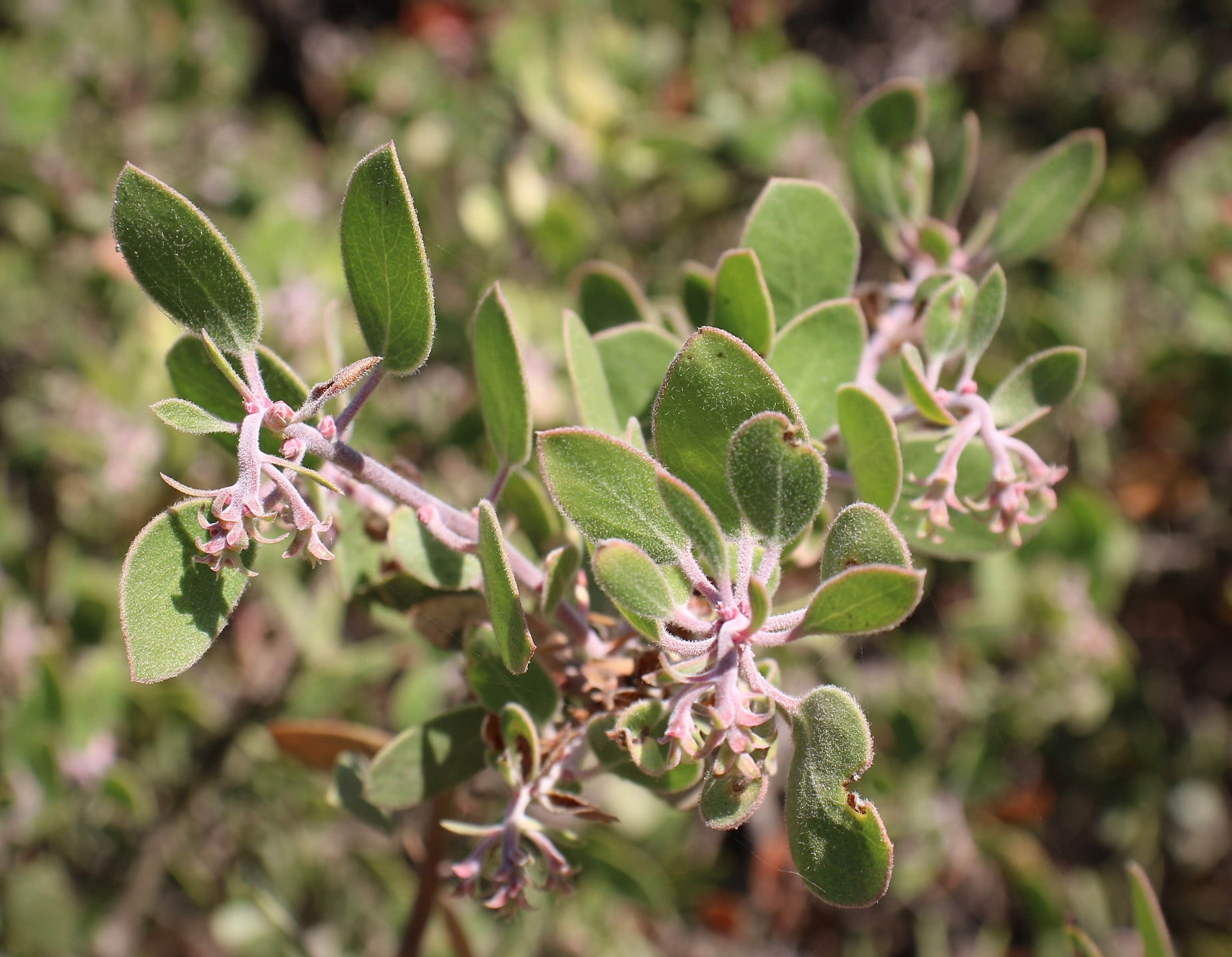
There are more than 60 species and subspecies of manzanita (Arctostaphylos), and most are found only in California. Some stand tall like small trees as much as 30 feet high; others crawl low along rocky slopes. But all of them are masters of survival. Their small, leathery leaves are coated with a waxy film to lock in moisture during the long dry seasons. They bloom in late winter with tiny pink or white bell-shaped flowers, feeding early pollinators when little else is flowering. By springtime, those flowers ripen into red fruits: the โ€œlittle applesโ€ that give the plant its name.

Manzanita flowers (Santa Barbara Botanical Garden)

One of manzanitaโ€™s more fascinating traits is how it deals with dead wood. Instead of dropping old branches, it often retains them, letting new growth seal off or grow around the dead tissue. Youโ€™ll see branches striped with gray and red, or dead limbs still anchored to the plant. Itโ€™s a survival strategy, conserving water, limiting exposure, and creating the twisted, sculptural forms that make manzanita distinctive.

And fire is key to understanding manzanitaโ€™s world. Like many California plants, many manzanita species are fire-adapted: some die in flames but leave behind seeds that only germinate after exposure to heat or smoke. Others resprout from underground burls after burning. Either way, manzanita is often one of the first plants to return to the land after a wildfire, along with laurel sumac, stabilizing the soil, feeding animals (and people), and shading the way for the next wave of regrowth.

Manzanita’s astonishing red bark The reddish color of manzanita bark is primarily due to tannins, naturally occurring compounds that also contribute to the bark’s bitter taste and deter insects and other organisms from feeding on it. (Photo: NPS)

Botanically, manzanitas are a bit of a mystery. They readily hybridize and evolve in isolation, which means there are tiny populations of hyper-local species, some found only on a single hill or canyon slope. That makes them incredibly interesting to scientists and especially vulnerable to development and climate change.

Their red bark is the result of high concentrations of tannins, bitter compounds that serve as a natural defense. Tannins are present in many plants like oaks, walnuts and grapes, and in manzanitas, they make the bark unpalatable to insects and animals and help resist bacteria, fungi, and decay. The bark often peels away in thin sheets, shedding microbes and exposing fresh layers underneath. Itโ€™s a protective skin, both chemical and physical, built for survival in the dry, fire-prone landscapes of California.

Whiteleaf manzanita leaves and berries (Photo: NPS)

The plants still have mysteries that are being uncovered. For example, a new species of manzanita was only just discovered in early 2024, growing in a rugged canyon in San Diego County. Named Arctostaphylos nipumu to honor the Nipomo Mesa where it was discovered and its indigenous heritage, it had gone unnoticed despite being located just 35 miles from the coast and not far from populated areas. The discovery, announced by botanists at UC Riverside, highlights that unique species localization, as the plants are found sometimes growing only on a single ridge or in a specific type of soil. Unfortunately, this newly identified species is already at risk due to development pressures and habitat loss. According to researchers, only about 50 individuals are known to exist in the wild, making A. nipumu one of Californiaโ€™s rarest native plants, and a reminder that the story of manzanita is still unfolding, even in places we think we know well.

A new species of manzanita – A. nipumu – was discovered in San Diego County last year (2024), surprising reserachers. (Photo: UCR)

For hikers, photographers, and anyone with an eye for the unusual, manzanita is a cool plant to stumble upon. I will often stop and admire a particularly striking plant. I love when its smooth bark peels back in delicate curls, looking like sunburned skin or shavings of polished cinnamon. Itโ€™s hard to walk past a manzanita without reaching out to touch that smooth, cool bark. That irresistible texture may not serve any evolutionary purpose for the plant, but itโ€™s one more reason to wander into Californiaโ€™s fragrant chaparral, where more species of manzanita grow than anywhere else on Earth.

California Curated Etsy

Californiaโ€™s Wild Laboratory and The Evolutionary Wonders of the Channel Islands

Anacapa Island in California’s Channel Islands (Photo: Erik Olsen)

I recently took two scuba diving trips out to the Channel Islands to investigate and help remove ghost lobster traps: abandoned or lost gear that poses a serious threat to marine life. While out there, I also had a chance to explore the marine protected areas surrounding Anacapa and Santa Cruz Islands, getting a firsthand look at how these underwater reserves are helping to restore ocean health and marine life (another story on that coming). Diving in the Channel Islands is a great way for certified divers to experience the incredible biodiversity of Californiaโ€™s coastal waters, even if the water is cold as hell.

The Channel Islands are actually relatively close to the California mainland, just 12 miles from Ventura in the case of Anacapa. But the wild and windswept chain feels like a world apart. On a clear day, you can see them from Ventura or Santa Barbara, but oddly, few people actually visit. Compared to other national parks, they remain relatively unknown, which only adds to their quiet allure. Sometimes called the โ€œGalรกpagos of North America,โ€ these eight islands are a refuge for wildlife and a place where evolution unfolds before your eyes.

U.S. Park Service rangers patrol the marine protected area off of Anacapa Island in Californiaโ€™s Channel Islands
(Photo: Erik Olsen)

(Hereโ€™s a cool bit of history: there are eight Channel Islands today, but 20,000 years ago, during the last ice age when sea levels were much lower, four of themโ€”San Miguel, Santa Rosa, Santa Cruz, and Anacapaโ€”were connected as a single landmass called Santarosae.)

For scientists and nature lovers, the Channel Islands are more than just scenic, theyโ€™re a natural laboratory. Each island has its own shape, size, and ecological personality, shaped by millions of years of isolation. That makes them an ideal setting for the study of island biogeography, the branch of biology that looks at how species evolve and interact in isolated environments. What happens here offers insight into how life changes and adapts not just on islands, but across the planet.

Sea lions on the Channel Islands (NPS)

Island biogeography is anchored in the theory proposed by E.O. Wilson and Robert MacArthur in the 1960s. Their theory, focusing on the balance between immigration and extinction of species on islands, is brilliantly exemplified in the Channel Islands.

The Channel Islands’ rich mosaic of habitats, from windswept cliffs and rocky shores to chaparral-covered hillsides and dense offshore kelp forests, provides an ideal setting for studying how species adapt to varied and changing conditions. Each island functions like a separate ecological experiment, shaped by isolation, resource limits, and time. Evolution has had free rein here, tweaking species in subtle ways and, occasionally, producing striking changes.

One of the most significant studies conducted in the Channel Islands focused on the island fox (Urocyon littoralis), a species found nowhere else on Earth. Research led by the late evolutionary biologist Robert Wayne at UCLA and others showed that the fox populations on each of the six islands they inhabit have evolved in isolation, with distinct genetic lineages and physical traits. This makes them a remarkable example of rapid evolution and adaptive divergence, core processes in island biogeography.

Genetic analyses revealed that each islandโ€™s fox population carries unique genetic markers, shaped by long-term separation and adaptation to local environments. These differences arenโ€™t just genetic, theyโ€™re physical and behavioral too. Foxes on smaller islands, for instance, tend to be smaller in body size, likely an evolutionary response to limited resources, a phenomenon known as insular dwarfism. Variations in diet, foraging behavior, and even coat coloration have been documented, offering scientists an unparalleled opportunity to study evolutionary processes in a real-world, relatively contained setting.

Excavation of pygmy mammoth bones on the Channel Islands (Photo: National Park Service)

This phenomenon of insular dwarfism isn’t unique to the island fox. One of the most striking examples from the Channel Islands is the pygmy mammoth (Mammuthus exilis), whose fossilized remains were discovered on Santa Rosa Island. Evolving from the much larger Columbian mammoth, these ancient giants shrank to about half their original size after becoming isolated on the islands during the last Ice Age. Limited food, reduced predation, and restricted space drove their dramatic transformation, a powerful illustration of how isolation and environmental pressures can reshape even the largest of species.

Furthermore, the Channel Islands have been instrumental in studying plant species’ colonization and adaptation. Due to their isolation, the islands host a variety of endemic plant species. Research by Kaius Helenurm, including genetic studies on species such as the Santa Cruz Island buckwheat (Eriogonum arborescens) and island mallow (Malva assurgentiflora), has shown how these plants have adapted to the islands’ unique environmental pressures and limited gene flow.

Island mallow (Malva assurgentiflora), a vibrant flowering plant found only on the Channel Islands, thrives in the harsh coastal environmentโ€”its striking blooms a testament to the power of isolation and adaptation. (Photo: Curtis Clark)

The islands have been a scientific boon to researchers over the decades because they are not only home to many diverse and endemic species, but their proximity to the urban centers and the universities of California make them amazingly accessible. It’s been suggested that if Darwin had landed on the Channel Islands, he arguably could have come up with the theory of natural selection off of California, rather than happening upon the Galapagos. A 2019 book about the islands, titled North Americaโ€™s Galapagos: The Historic Channel Islands Biological Survey recounts the story of a group of researchers, naturalists, adventurers, cooks, and scientifically curious teenagers who came together on the islands in the late 1930s to embark upon a series of ambitious scientific expeditions never before attempted. 

The Channel Islands are renowned for their high levels of endemism โ€” species that are found nowhere else in the world. This is a hallmark of island biogeography, as isolated landmasses often lead to the development of unique species. Darwin’s On the Origin of Species was one of the first extensive efforts to describe this phenomenon. For example, as mentioned above, the Channel Islands are home to the island fox (Urocyon littoralis), a small carnivore found only here. Each island has its own subspecies of the fox, differing slightly in size and genetics, a striking example of adaptive radiation, where a single species gives rise to multiple different forms in response to isolation and environmental pressures. That said, the foxes are also incredibly cute, but can be rather annoying if you are camping on the islands because they will ransack your food stores if you do not keep them tightly closed.

Island Fox on Santa Cruz Island (photo: Erik Olsen)

Bird life on the Channel Islands also reveals remarkable diversity and endemism. Much like the finches of the Galรกpagos, these islands are home to distinct avian species shaped by isolation and adaptation. The Santa Cruz Island Scrub Jay, for instance, is noticeably larger and more vividly colored than its mainland relatives, a reflection of its unique island habitat. Also, jays in pine forests tend to have longer, shallower bills, while those in oak woodlands have shorter, deeper bills. Evolutionary adaptations right out of the Darwinian playbook. Likewise, the San Clemente House Finch has evolved traits suited to its specific environment, illustrating how even common species can diverge dramatically when given time and separation.

The Island Scrub-Jay (Aphelocoma insularis), found only on Santa Cruz Island, is larger and more vividly colored than its mainland cousinโ€”an unmistakable symbol of how isolation shapes evolution. (Photo: National Park Service)

The impacts of invasive species on island ecosystems, another critical aspect of island biogeography, are also evident in the Channel Islands. The islands have been an superb laboratory for the practice of conservation and human-driven species recovery. For example, efforts to remove invasive species, like pigs and rats, and the subsequent recovery of native species, like the island fox, provide real-time insights into ecological restoration and the resilience of island ecosystems.

These efforts at conservation and species recovery extend beyond the island fox. In 1997, the U.S. Fish and Wildlife Service identified that 13 plant species native to the northern Channel Islands in California were in dire need of protection under the Endangered Species Act. This need arose due to several decades of habitat degradation, primarily attributed to extensive sheep grazing. These conservation efforts have yielded good news. For instance, the island bedstraw (Galium buxifolium) expanded from 19 known sites with approximately 500โ€“600 individuals in 1997 to 42 sites with over 15,700 individuals. Similarly, the Santa Cruz Island dudleya (Dudleya nesiotica) population stabilized at around 120,000 plants. As a result of these recoveries, both species were removed from the federal endangered species list in 2023, coinciding with the 50th anniversary of the Endangered Species Act.

Santa Cruz Island Dudleya (Photo: National Park Service)

Conservation efforts at the Channel Islands extend beneath the waves, where marine protected areas (MPAs) have played a crucial role in restoring the rich biodiversity of the underwater world. Iโ€™ve seen the rich abundance of sea life firsthand on several dives at the Channel Islands, where the biodiversity feels noticeably greater than at many mainland dive sites in Southern California.

The Channel Islands Marine Protected Areas (MPAs), established in 2003, were among the first of their kind in California. The MPAs around Anacapa, Santa Cruz, and other islands act as refuges where fishing and other extractive activities are limited or prohibited, allowing marine ecosystems to recover and thrive. Over the past two decades, scientists have documented increases in the size and abundance of key species such as kelp bass, lobsters, and sheephead, alongside the resurgence of lush kelp forests that anchor a vibrant web of marine life. These protections have not only benefited wildlife but have also created living laboratories for researchers to study ecological resilience, predator-prey dynamics, and the long-term impacts of marine conservation, all taking place in the context of island biogeography.

Kelp bass in the kelp forest at the Channel Islands (Photo: Erik Olsen)

What makes all of this possible is the remarkable decision to keep these islands protected and undeveloped. Unlike much of the California coast, the Channel Islands were set aside, managed by the National Park Service and NOAA as both a national park and a marine sanctuary. These protections have preserved not just the landscapes, but the evolutionary stories still unfolding in real time. Itโ€™s a rare and precious thing to have a living laboratory of biodiversity right in our backyard, and a powerful reminder of why preserving wild places matters.

Creosote Bushes Are the Mojave Desert’s Time Travelers 

Scene from BBC’s Green Planet in California’s Mojave Desert (BBC)

The creosote bush, a seemingly unassuming plant that dots the arid expanses of North American deserts, holds secrets to aging that would make Silicon Valley longevity bros green with envy. In the Mojave Desert, one creosote plant known as “King Clone” is estimated to be over 12,000 years old, making it one of the oldest living clonal organisms on Earth. This astonishing fact was highlighted in the BBC series The Green Planet, where Sir David Attenborough brought the extraordinary resilience and survival strategies of desert flora to a broad public audience. The series as a whole is excellent, but the episode on desert plants, Desert Worlds, was especially fascinating and enlighteningโ€”particularly for a dedicated succulent fan like me. Watching it inspired me to research and write this article.

While many of the other filming locations were far-flung landscapes like the Succulent Karoo Desert in South Africa, one story unfolds in California’s Mojave Desert, where Attenborough, with his signature mellifluous voice, marvels at the remarkable longevity of the creosote bush. In a compelling scene, Attenborough revisits “King Clone” in the Mojave that he first filmed in 1982 for “The Living Planet.” Despite the four-decade interval, the bush had grown less than one inch, highlighting its incredibly slow growth rate.

King Clone, the 11,700-year-old creosote bush ring in the Mojave Desert (Wikipedia)

Creosote bushes, or Larrea tridentata, are native to the deserts of the southwestern United States and northern Mexico. Though often associated with arid landscapes, they are also a defining species of desert chaparral. Much of Southern Californiaโ€™s landscape is dominated by chaparral, a diverse and resilient plant community adapted to dry summers, periodic wildfires, and nutrient-poor soils. This ecosystem, characterized by drought-resistant shrubs like manzanita, chamise, and scrub oak, extends from coastal foothills to inland mountains, shaping the regionโ€™s ecology and fire cycles.

Creosote bushes thrive in some of the harshest environments on the planet, enduring scorching temperatures, relentless sunlight, and prolonged droughts. Few other plants are so hardy. The secret to their survival lies in their evolutionary adaptations, honed over millennia to combat the unforgiving desert landscape.

CALIFORNIA CURATED ON ETSY

Purchase stunning art prints of iconic California scenes.
Check out our Etsy store.

As climate change intensifies heatwaves and disrupts rainfall patterns, even these desert survivors are showing signs of stress. Rising temperatures accelerate evapotranspiration, pushing groundwater further out of reach, while prolonged droughts hinder seedling establishment, threatening the species’ long-term viability. Scientists are studying how creosote’s resilience is being tested, and whether its decline could signal deeper ecological shifts in desert ecosystems already on the edge of survival. A 2021 University of California, Irvine study observed a 35% decrease in vegetation cover, including creosote bushes, in Southern California deserts between 1984 and 2017, attributing this decline to rising temperatures and increased aridity.

Golden bursts of resilienceโ€”creosote in bloom, thriving in the heart of the desert. (Erik Olsen)

Despite its usual appearance as a dry, uninviting shrub, the creosote bush surprises with delicate bursts of yellow when it blooms. After rainfall, its tough, resinous branches come alive with small, waxy flowers, adding a rare vibrancy to the desert. Unlike many plants that follow a strict seasonal cycle, creosote can bloom multiple times a year whenever moisture allows, a testament to its adaptability.

As mentioned, one of the most fascinating aspects of the creosote bush is its strategy of slow growth. This deliberate pace is not a sign of fragility but an ingenious response to scarcity. By growing slowly, creosote bushes conserve precious resources like water and nutrients, ensuring their survival even in the driest years. Few plants are quite so good at this feat. Their roots extend deep into the ground, tapping into hidden water reserves, while their leaves are coated in a waxy layer to minimize water loss through evaporation. This slow-and-steady approach has allowed them to outlast countless environmental changes and competitors. As a result of this unique adaptation, the creosote largely dominates much of the desert landscape, particularly in the Mojave. If you’ve ever driven along Highway 395 through the desert, creosote bushes often dot the landscape for as far as the eye can see.

Creosote in the Mojave desert (Photo: Erik Olsen)

The creosote bushโ€™s longevity also owes much to its clonal growth pattern, where new stems sprout from the same root system, allowing the plant to persist for thousands of years. King Clone, for instance, is not a single plant but a massive clonal colony that spans over 11 meters in diameter. Each stem may live for decades before dying off, but new stems sprout from the same root system, creating a continuous cycle of renewal. This clonal reproduction ensures genetic stability and resilience, enabling the plant to survive for thousands of years. While King Clone represents one of the oldest clonal organisms, it is important to distinguish this from the bristlecone pine (see our story), which holds the title for the oldest singular organism. Unlike the creosote bush, which survives through clonal reproduction by sprouting new stems from a shared root system, the bristlecone pineโ€”like the renowned “Methuselah“โ€”is a single tree that has endured for nearly 5,000 years as an individual entity. (Ponder that for a moment).

Beyond its impressive age and survival strategies, the creosote bush plays a vital ecological role. It provides shelter and sustenance for desert wildlife, including insects, rodents, and birds. Its resinous leaves emit a distinctive odor after rainโ€”a smell that is deeply evocative of the desert and beloved by many who live near these arid regions. Indigenous peoples have long used the plant for medicinal purposes, creating teas and poultices from its leaves to treat ailments such as colds, wounds, and infections.

A vast expanse of chaparral stretches endlessly across the eastern Sierra, its rugged shrubs and hardy vegetation thriving in the dry, windswept landscape. (Erik Olsen)

Recent scientific studies have uncovered more about the creosote bush’s unique chemistry. The plant produces a range of compounds to deter herbivores and pathogens, many of which have potential applications in medicine and agriculture. These secondary metabolites are a testament to the plantโ€™s evolutionary ingenuity, further demonstrating how it has carved out a niche in an inhospitable environment. Researchers at the Skaggs School of Pharmacy and Pharmaceutical Sciences at the University of California San Diego and the University of Colorado Anschutz Medical Campus have discovered that compounds from the creosote bush possess strong anti-parasitic properties. These compounds effectively target the protozoa responsible for giardia infections and an amoeba that causes a potentially deadly form of encephalitis. Similarly, The creosote bush contains the antioxidant nordihydroguaiaretic acid (NDGA), which has been extensively studied for its potential anti-carcinogenic, bactericidal, and preservative properties.

Creosote in the Mojave Desert (Photo: Erik Olsen)

Creosote has played a starring role in the cultural mythology of the American Southwest, serving as a symbol of endurance, isolation, and the stark beauty of the desert. In Edward Abbeyโ€™s Desert Solitaire, the tough shrub embodies the rugged resilience of the land, surviving in the harshest conditions with roots that tap deep into the earth. Similarly, in Blood Meridian, Cormac McCarthyโ€™s sun-scorched landscapes are often sprawling with creosote, reinforcing the novelโ€™s themes of violence and survival. The plant also makes its way into music, as seen in Tom Russellโ€™s song Creosote, where it becomes a poetic stand-in for the rough, untamed spirit of the Southwest. Even in visual media like Breaking Bad, the ever-present creosote in the barren New Mexico desert could be interpreted as a symbol of the transformation of Walter White, mirroring the showโ€™s themes of survival at any cost. Across literature, music, and film, creosote remains an enduring emblem of the Southwest, its gnarled branches and pungent scent evoking both the loneliness and allure of the desert frontier.

By the time the animals were secured and they had thrown themselves on the ground under the creosote bushes with their weapons readied the riders were beginning to appear far out on the lake bed, a thin frieze of mounted archers that trembled and veered in the rising heat.

Blood Meridian by Cormac McCarthy

One aim of this publication is to illuminate the mystery and wonder of the world around us. For those of us who call California home, as I have for most of my life (including being born here), we are constantly surrounded by a powerful, awe-inspiring natureโ€”one that is both captivating and exhilarating. Yet, truly grasping the uniqueness of this place often requires more than a passing glance. Even a plant as seemingly ordinary as the creosote bush holds something extraordinary, a blend of magic and science waiting to be recognized. My hope is that on your next drive through the desert, you see that stark landscape with fresh eyes, with a little more respect, a little more wonder, and a deeper sense of admiration.

How a Tiny Beetle Helped Save California

California’s citrus industry confronted a deadly challenge, leading to a groundbreaking innovation in pest control.

Cottony Cushion Scale (Public Domain)

In the sun-drenched orchards of late 19th-century California, a crisis was unfolding that threatened to decimate the state’s burgeoning citrus industry. The culprit was a small sap-sucking insect native to Australia called the cottony cushion scale (Icerya purchasi). First identified in New Zealand in 1878, this pest had made its way to California by the early 1880s, wreaking havoc on citrus groves. The pest is believed to have arrived in the United States through the global trade of plants, a common vector for invasive species during the 19th century. As horticulture expanded globally, ornamental plants and crops were frequently shipped between countries without the quarantine measures we have today. Once established in the mild climate of California, the cottony cushion scale found ideal conditions to thrive, spreading rapidly and wreaking havoc on the citrus industry.

The cottony cushion scale infested trees with a vengeance, covering branches and leaves with a white, cotton-like secretion. This not only weakened the trees by extracting vital sap but also led to the growth of sooty mold on the honeydew excreted by the insects, further impairing photosynthesis. Growers employed various methods to combat the infestation, including washing trees with whale oil, applying blistering steam, and even detonating gunpowder in the orchards. Despite these efforts, the pest continued its relentless spread, causing citrus exports to plummet from 2,000 boxcars in 1887 to just 400 the following year. This decline translated to millions of dollars in lost revenue, threatening the livelihoods of countless farmers and jeopardizing the state’s citrus economy, which was valued at over $10 million annually (approx. $627 million in today’s dollars) during this period.

Orange and lemon groves, along with the home of citrus pioneer William Wolfskill, circa 1882. (California Historical Society)

In 1885, the independent growers across Southern California banded together in response to the insect invasion and the broader difficulties facing citrus growers at the time, forming the stateโ€™s first fruit cooperative, which would later become Sunkist. Despite their efforts, homemade mixtures of kerosene, acids, and other chemicals failed to halt the relentless spread of Icerya purchasi. The pests, with an endless supply of citrus trees to feed on, continued to multiply unchecked. New laws mandated growers to uproot and burn infected orange trees, but the devastation was widespread. By 1888, real estate values, which had soared by 600 percent since 1877, had plummeted.

Enter Charles Valentine Riley, the Chief Entomologist for the U.S. Department of Agriculture. A visionary in the field of entomology, Riley had previously attempted biological control by introducing predatory mites to combat grape phylloxera in France, albeit with limited success. Undeterred, he proposed a similar strategy for the cottony cushion scale crisis. In 1888, Riley dispatched his trusted colleague, a fellow entomologist named Albert Koebele, to Australia to identify natural enemies of the pest.

The cottony cushion scale infestations were so severe that citrus trees appeared as though they had been coated with artificial snow, resembling Christmas flocking. Fruit production sharply declined, and many trees succumbed to the damage. (UC Riverside)

Interestingly, Valentine resorted to subterfuge to send an entomologist to Australia despite Congress’s objections. Lawmakers had prohibited foreign travel by the Agriculture Department to curb Rileyโ€™s frequent European excursions. However, Riley, well-versed in navigating political obstacles, cleverly arranged for an entomologist to join a State Department delegation heading to an international exposition in Melbourne.

Charles Valentine Riley (Wikipedia)

Koebele’s expedition proved fruitful. He worked with Australian experts to locate the pest in its rare habitats along with its natural enemies, including a parasitic fly and approximately the Vedalia beetle. The vedalia beetle (Rodolia cardinalis) is a small ladybird with a voracious appetite for the cottony cushion scale. Koebele collected and shipped hundreds of these beetles back to California. Upon their release into infested orchards, the vedalia beetles rapidly established themselves, feasting on the scales and reproducing prolifically. Within months, the cottony cushion scale populations had diminished dramatically, and by 1890, the pest was largely under control across the state. This 1888-89 campaign marked the beginning of biological control in the United States, a strategy involving the introduction of natural predators to manage invasive pests.

In her 1962 classic Silent Spring, Rachel Carson described the Novius beetle’s work in California as โ€œthe worldโ€™s most famous and successful experiment in biological control.โ€

Novius ladybug devours an Icerya.  (UC Riverside)

This was far from the last time California employed such measures. It became a relatively common practice to introduce new species to control those that posed threats to the stateโ€™s economically vital crops, but not always successfully.

In the 1940s, California introduced parasitic wasps such as Trioxys pallidus to control the walnut aphid, a pest threatening the state’s walnut orchards. These tiny wasps laid their eggs inside the aphids, killing them and dramatically reducing infestations, saving the industry millions of dollars. Decades later, in the 1990s, the state faced an invasive glassy-winged sharpshooter, a pest that spread Pierce’s disease in grapevines. (Interesting fact: The glassy-winged sharpshooter drinks huge amounts of water and thus pees frequently, expelling as much as 300 times its own body weight in urine every day.) To combat this, scientists introduced Gonatocerus ashmeadi, a parasitic wasp that targets the pestโ€™s eggs. This biological control effort helped protect California’s wine industry from devastating losses.

The Vedalia beetle (novius cardinalis) also known as the cardinal ladybird (Katja Schulz Wikipedia)

While the introduction of the vedalia beetle was highly effective and hailed as a groundbreaking success, biological control efforts are not without risks, often falling prey to the law of unintended consequences. Although no major ecological disruptions were recorded in the case of the cottony cushion scale, similar projects have shown how introducing foreign species can sometimes lead to unforeseen negative impacts. For example, the cane toad in Australia, introduced to combat beetles in sugarcane fields, became a notorious ecological disaster as it spread uncontrollably, preying on native species and disrupting ecosystems. Similarly, the mongoose introduced to control rats in sugarcane fields in Hawaii also turned predatory toward native birds. These examples highlight the need for meticulous study and monitoring when implementing biological control strategies. Today, regulatory frameworks require rigorous ecological assessments to minimize such risks.

The glassy-winged sharpshooter (Georgia Tech)

In the case of the Vedalia beetle, its precise and targeted predation led to a highly successful outcome in California. Citrus quickly became one of the stateโ€™s most dominant and profitable crops, helping to establish California as a leader in agricultural productionโ€”a position it continues to hold firmly today.

This groundbreaking use of biological control not only rescued California’s citrus industry but also established a global precedent for environmentally sustainable pest management. The success of the Vedalia beetle’s introduction showcased the power of natural predators in managing agricultural pests, offering an alternative to chemical pesticides. While pesticides remain widely used in California and across the world, this effort underscores the value of understanding ecological relationships, evolutionary biology, and the benefits of international scientific collaboration.

Visit the California Curated store on Etsy for original prints showing the beauty and natural wonder of California.

The story of the Vedalia beetle and the cottony cushion scale highlights human ingenuity and the effectiveness of nature’s own checks and balances. It stands as an early example of integrated pest management, a method that continues to grow and adapt to meet modern agricultural challenges. This successful intervention underscores the importance of sustainable practices in protecting both our food systems and the environment.

Laurel Sumac, the Resilient Beauty of Southern California’s Chaparral

Laurel sumac in the San Gabriel Mountains (Erik Olsen)

Here’s another article exploring some of California’s native plants. With a remarkable abundance of flora, California is home to over 6,500 species that play a vital role in shaping its diverse and iconic landscapes.

While hiking through the chaparral-covered hills of Southern California, from the Santa Monica to the San Bernardino and San Gabriel Mountains, youโ€™ll encounter a rich variety of plants, each adapted to thrive in the harsh, dry conditions. Some of them will inevitably be foreign, as California’s mild Mediterranean climate is a perfect incubator for invasive species. But there are many indigenous plants (aka: endemic) that are touchstones of resilience, survivors that thrive here and help make the California chaparral ecosystem incredibly diverse and hearty. Among these is the laurel sumac, a stalwart of the coastal sage scrub, its waxy, aromatic leaves adapted to withstand the sun-baked hillsides and dry seasons that define so much of Californiaโ€™s natural landscape.

Laurel sumac (Malosma laurina) is a large, rounded evergreen shrub or small tree that can grow up to 20 feet tall and wide. When in bloom (late spring through summer), it gives off a strong, aromatic scent that can be very pleasant. The plant is native to southern California and Baja California, and is also found on the southern Channel Islands.

The plant is characterized by lance-shaped leaves with reddish veins and stems, adding a touch of color to the landscape. Laurel sumac has a unique ability to curl its leaves upward when exposed to extreme heat. This reduces the surface area exposed to the sun, minimizing water loss and preventing overheating. This trait has earned the plant the nickname “taco plant,” as its leaves often fold up like a taco shell. The clusters of small white flowers that bloom at the tips of its branches resemble lilac blossoms. After blooming, the small, creamy-white flowers develop into clusters of tiny, reddish-brown, berry-like fruits known as drupes. Each drupe contains a single seed and is covered with a thin, leathery skin.

From a hike in the San Gabriel Mountains. Most of the large clumpy bushes are Laurel sumac (Erik Olsen)

Although named “laurel” for its resemblance to bay laurel, laurel sumac actually belongs to the cashew family (Anacardiaceae). This family includes other well-known plants like poison oak, mango, and pistachio, highlighting the diverse characteristics within this botanical group. Laurel sumac is a vital species in the coastal sage scrub and chaparral ecosystems, offering habitat and food for wildlife. Its berries are particularly enjoyed by songbirds, including warblers. The plant blooms from late spring to early summer, producing clusters of small, white flowers that attract various pollinators, including bees and butterflies.

After flowering, it produces small, reddish-brown fruits that are a food source for birds and other wildlife. Interestingly, the shrubโ€™s ability to thrive in the arid conditions of Southern California, combined with its distinctive red stems and fragrant blooms, make it a key contributor to the regionโ€™s natural beauty and biodiversity.

Laurel sumac along a trail in the San Gabriel Mountains (Erik Olsen)

The plant is amazingly drought-tolerant, with deep roots that allow it to access water during dry periods, making it a critical species in fire-prone environments. In fact, its ability to quickly resprout after fire is one reason it’s so prevalent in chaparral communities.

CALIFORNIA CURATED ART ON ETSY

Purchase stunning art prints of iconic California scenes.
Check out our Etsy store.

Laurel sumac is also notable for its role in traditional indigenous practices. Native peoples of the region used various parts of the plant for medicinal purposes, including treating skin conditions and respiratory ailments. Known as โ€œektiiโ€ by the Kumeyaay people, Laurel sumac held a prominent place in their traditional practices. The Kumeyaay are indigenous to the region that spans southern California, including San Diego County, and northern Baja California, Mexico. After childbirth, a tea or wash made from the plant was used for its soothing and medicinal properties, demonstrating its role in maternal care.

Laurel sumac with its fragrant white blossoms.

Beyond its medicinal uses, the sturdy wood of laurel sumac was utilized in construction, reflecting its practical value to the Kumeyaay. In a modern twist, the dried flower clusters of the plant have found a niche in model railroading, where enthusiasts often paint them and use them as miniature trees to create realistic landscapes.

Laurel sumac is just one of the many incredible native plant species that contribute to California’s rich biodiversity. Its abundance in some of the southern mountain ranges makes it a quintessential part of the landscape and an essential topic when exploring native flora. Stay tuned as we continue to highlight more species that make California such a unique and extraordinary place.