J. Robert Oppenheimer: The Berkeley Era and The Birth of the Manhattan Project

With the release of the movie Oppenheimer, it’s worth taking a look at the role that California played in one of the most important technological developments of the 20th century: the making of the atomic bomb. The Manhattan Project, the prodigious scientific endeavor that produced the world’s first nuclear weapons, cast a long, dark shadow over the mid-20th century. But amid the mushroom clouds, there lies a tale of innovation and scientific genius that originated from an unlikely source—the University of California, Berkeley.

The film team filmed several scenes at Berkeley, adding a vintage car and 1940s-era lampposts to the campus. Oppenheimer taught at UC Berkeley from 1929 to 1943 — his office was on the third floor of Physics North (then named LeConte Hall) 

For years, America’s physics powerhouse resided in the East. But in the post-WWI era, the western horizon blazed with opportunity. Visionary administrators at Caltech and UC Berkeley threw financial muscle behind their bold mission: to make physics research a priority.

By the dawn of the 1930s, their investments bore fruit. The American Physical Society‘s president hailed California as a hotbed of physics innovation, equating it with the East in the academic landscape of the discipline. Universities played high-stakes poker for the talents of up-and-coming physicists like Oppenheimer and Ernest Lawrence, known for his groundbreaking work in photoelectricity and ionization.

Visit the California Curated store on Etsy for original prints showing the beauty and natural wonder of California.

J. Robert Oppenheimer, one of the leading physicists of the 20th century, is often remembered as the ‘father of the atomic bomb’. However, his journey toward this formidable title began at Berkeley, an intellectual crucible where his talent for theoretical physics was honed, ultimately leading him to oversee the Manhattan Project, a scientific endeavor that would change the world.

J. Robert Oppenheimer, Enrico Fermi and Ernest O. Lawrence at UC Berkeley in 1940. Courtesy: Lawrence Berkeley National Laboratory

Oppenheimer’s relationship with Berkeley began in 1929 when he joined as an Assistant Professor of Physics. This was an exciting period in the realm of science. Quantum mechanics was in its infancy and a new breed of scientists was emerging, eager to unlock the secrets of the universe. Oppenheimer, with his insatiable curiosity and infectious enthusiasm, was just the right person for this time of exploration.

During his years at Berkeley, Oppenheimer made significant contributions to quantum mechanics, notably his work on the Oppenheimer-Phillips process. This theory describes a particular type of nuclear reaction that occurs during the absorption of a neutron by a nucleus, an understanding that would later prove pivotal to the development of nuclear energy.

Outside the laboratory, Oppenheimer was an adored figure, known for his quick wit and charismatic teaching style. He was instrumental in building the physics program at Berkeley into perhaps the finest in the country by attracting some of the brightest minds of the time. Together, they would be known as dubbed the “luminaries”.

J. Robert Oppenheimer (Ed Westcott/U.S. Department of Energy via Bay City News)

“The group met secretly in his office at the northwest corner of the top floor of ‘old’ LeConte Hall. This office, like others on the top floor, has glass doors opening out onto a balcony,” wrote Raymond T. Birge, former chair of the Berkeley physics department at the time. “This balcony is readily accessible from the roof. To prevent this method of entry, a very heavy iron netting was placed over the balcony. A special lock was placed on the door to the office and only Oppenheimer had the key. No janitor could enter the office, nor could I, as chairman of the department,”

Hans Bethe, one of the great German-American theoretical physicists of the age said Oppenheimer established UC Berkeley as the “greatest school of theoretical physics the United States has ever known.”

Although he was increasingly recognized as a pivotal figure in theoretical physics, former students say he remained accessible, consistently urging his students to question norms and extend limits. He actively promoted a culture of inquiry among his students, even if his responses occasionally seemed harsh. However, Oppenheimer’s questions to his student speakers were meant to clarify rather than to humiliate, often aimed more at enlightening the audience than himself. His rapport with his students was unexpectedly casual. He provided an open-door policy, inviting his students to visit his office anytime to utilize the physics resources within his personal collection.

J. Robert Oppenheimer with Glenn T. Seaborg and Ernest O. Lawrence in early 1946. (Photo courtesy of Berkeley Lab)

Oppenheimer’s life at Berkeley wasn’t all physics. A man of varied interests, he was an avid hiker, horseback rider, and aficionado of literature, poetry, and art. These varied interests made him a multifaceted character and helped him foster connections with many prominent figures across different fields. His unique combination of scientific genius, humanity, and leadership qualities made him a standout candidate for the enormous task that lay ahead – the Manhattan Project.

While no major Manhattan Project facilities graced the Golden State, Berkeley, nestled in the heart of California, emerged as an unsung hero of the project. Berkeley offered more than a tranquil academic setting; it provided an assembly line of experts that would revolutionize nuclear science. Not only was Berkeley home to Oppenheimer the university also attracted other nuclear-era luminaries like Ernest Lawrence, and chemists Glenn Seaborg.

Berkeley had always been special. California’s first land-grant university, founded in 1868, Berkeley underwent a metamorphosis under the leadership of Robert Sproul. From 1930 to 1958, Sproul spearheaded the transformation of Berkeley into a hub of intellectual firepower. The University of California system burgeoned across the state, with Berkeley, the original campus, earning a reputation as one of the nation’s foremost research institutions. Its powerhouse physics department became a beacon in the dark world of the Manhattan Project.

Berkeley’s list of accomplishments in physics is long and distinguished, but one discovery stands out – the identification of plutonium. Edwin McMillan, a promising physicist at Berkeley, ventured into the wilderness of uranium fission products. In 1940, he stumbled upon an unknown substance – element 93, or as he named it, “neptunium,” a hat tip to the distant planet Neptune. McMillan predicted that neptunium decayed into plutonium, the elusive element 94.

Glenn Seabord – Wikipedia

Glenn Seaborg, another Berkeley savant, picked up where McMillan left off when the latter migrated east to work at MIT. Seaborg unveiled the heart of plutonium, exposing its fundamental chemical and nuclear properties, including its high propensity for fission. As the world’s leading expert on plutonium, Seaborg directed the ambitious effort to separate plutonium from uranium and other reactor products.

Meanwhile, Ernest Lawrence led a research group that broke boundaries with the cyclotrons at the Rad Lab. They used the 60-inch cyclotron to bombard uranium with neutrons, producing plutonium for scrutiny. But Lawrence had a revelation. In 1941, he realized the cyclotron could also operate as a mass spectrometer, effectively isolating uranium-235 from uranium-238. This technique was later adopted at Oak Ridge’s Y-12 Separation Plant, enabling large-scale separation. The cyclotron, rechristened as a “Calutron” in a nod to the University of California, had revolutionized nuclear science.

Recording of the “Rainier” shot, Nevada Test Site, Sept. 19, 1957.
Atomic Energy Commission/U.S. Department of Energy via Wikipedia Commons

While these figures were all played prominent roles in the development of the atomic bomb dropped on Hiroshima and Nagasaki in 1945, it is Oppenheimer who is best remembered. After fourteen years at Berkeley, Oppenheimer was plucked from the physics department at Berkeley by General Leslie Groves to assume leadership of the research program at Los Alamos. Even after his move, Oppenheimer fostered a close alliance between Berkeley and the Manhattan Project. In a shroud of secrecy, the University of California took on the management of the operations at Los Alamos. The university even set up a Los Angeles office that handled material logistics for the lab.

Despite decades passing and the veils of secrecy lifting, the legacy endures. The Los Alamos lab continues to operate under the University of California’s management, preserving Berkeley’s indelible imprint on the atomic age. It’s a testament to the institution’s groundbreaking contributions and a tribute to the remarkable scientists who once walked its hallowed halls.

Maybe You’ve heard of Josiah Whitney, Mt. Whitney’s Namesake

Mount Whitney, the highest mountain in the contiguous United States, is one of the great peaks in California. A wildly popular destination for hikers, climbers, and backpackers, Whitney is located in Inyo National Forest and Sequoia National Park, California.

But how did Mt. Whitney get its name?

“The culminating peak of the Sierra” was identified in 1864 by a team from the California Geological Survey and named Mount Whitney in honor of the team’s leader, State Geologist Josiah Whitney. During that same expedition, survey member Clarence King made two attempts to reach the summit but did not succeed.

But Whitney wasn’t the mountain’s only name. When a group of fishermen made the first recorded ascent in 1873, they called it “Fisherman’s Peak,” a name that stuck locally for some time before Mount Whitney became the official designation. Long before that, the Indigenous Paiute people called the mountain Too-man-i-goo-yah, meaning “the very old man” or “the guardian spirit,” reflecting its towering presence and cultural significance.

Josiah Dwight Whitney was an American geologist and surveyor who made significant contributions to the field of geology in California. Born in Northampton, Massachusetts, in 1819, Whitney became interested in science at an early age and studied geology and mineralogy at Yale University. In 1860, he was appointed the State Geologist of California and founded the California Geological Survey, one of the oldest geological surveys in the nation.

Because gold fever still gripped much of the world at that time, most people assumed Whitney’s work would focus on locating valuable mineral resources, but Whitney instead pursued a broader scientific agenda—paleontology, historical geology, petrology, stratigraphy, and tectonics. He delivered meticulous studies of mineralogy and placed California’s geology within a global framework, prioritizing knowledge over immediate economic gain. The state, unimpressed by his academic approach, eventually cut his funding.

Whitney’s work in California was groundbreaking and helped establish the state as a hub of geological research. He conducted extensive surveys of the state’s natural resources, including minerals, soils, and water sources. He was also instrumental in mapping the state’s topography and geology, including the Sierra Nevada mountain range, where he made several important discoveries.

One of Whitney’s most significant contributions to California’s geology was the discovery of the existence of glacial action in the Sierra Nevada mountains. In 1864, he published a report describing the glacial formations he had observed in the mountains, including the formation of Yosemite Valley, which he attributed to the action of glaciers. This report was groundbreaking at the time and helped establish the study of glacial geology as a major area of research.

In addition to his work as a geologist, Whitney was also a skilled surveyor and cartographer. He was responsible for creating some of the first accurate maps of California, which were used by explorers, settlers, and scientists alike. His maps were highly detailed and included information about the state’s geology, topography, and natural resources.

Photo of the author at the top of Mount Whitney (Heidi Schumann for the New York Times)

In 1875, Whitney was elected to the National Academy of Sciences, and in 1880, he was awarded the Wollaston Medal by the Geological Society of London. Perhaps the most enduring recognition of his work is the fact that the highest peak in the contiguous United States is named after him. Mount Whitney, which stands at 14,505 feet, was named in his honor in 1896.

Whitney’s legacy lives on through the California Geological Survey, which he founded and served as its first director. The survey played an important role in the development of California, providing valuable information about the state’s natural resources and geology. It continues to operate today, providing information and expertise to policymakers, scientists, and the public.

The Man Who Saved the Owens Pupfish

51 years ago today a man named Edwin Philip Pister rescued an entire species from extinction.

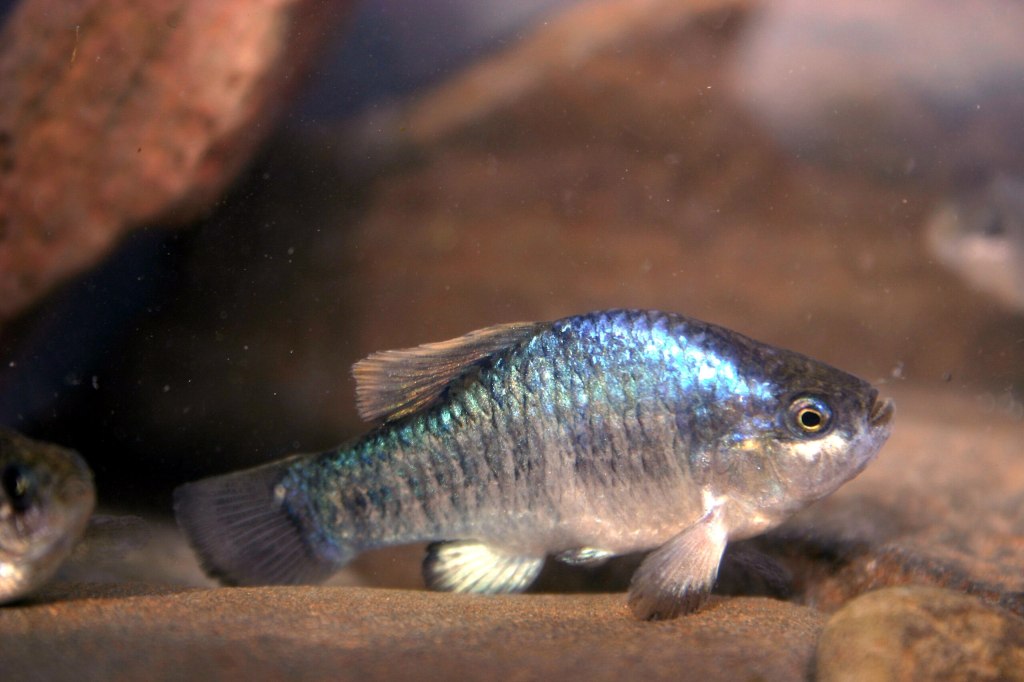
Less than 2.5 inches in length, the Owens pupfish is a silvery-blue fish in the family Cyprinodontidae. Endemic to California’s Owens Valley, 200 miles north of Los Angeles, the fish has lived on the planet since the Pleistocene, becoming a new species when its habitat was divided by changing climatic conditions, 60,000 years ago.

For thousands of years, the Owens Valley was largely filled with water, crystal-clear snowmelt that still streams off the jagged, precipitous slab faces of the Sierra Nevada mountains. Pupfish were common, with nine species populating various lakes and streams from Death Valley to an ara just south of Mammoth Lakes. The Paiute people scooped them out of the water and dried them for the winter.

In the late 19th century, Los Angeles was a rapidly growing young metropolis, still in throes of growing pains that would last decades. While considered an ugly younger sibling to the city of San Francisco, Los Angeles had the appeal of near year-round sunshine and sandy beaches whose beauty that rivaled those of the French Riviera.

Owens pupfish (California Department of Fish and Wildlife)

But by the late 1900s, the city began outgrowing its water supply. Fred Eaton, mayor of Los Angeles, and his water czar, William Mulholland, hatched a plan to build an aqueduct from Owens Valley to Los Angeles. Most Californians know the story. Through a series of shady deals, Mulholland and Eaton managed to get control of the water in the Owens Valley and, in 1913, the aqueduct was finished. It was great news for the new city, but terrible news for many of the creatures (not to mention the farmers) who depended on the water flowing into and from the Owens Lake to survive.

So named because they exhibit playful, puppy-like behavior, the Owens pupfish rapidly began to disappear. Pupfish are well-known among scientists for being able to live in extreme and isolated situations. They can tolerate high levels of salinity. Some live in water that exceeds 100° Fahrenheit, and they can even tolerate up to 113° degrees for short periods. They are also known to survive in near-freezing temperatures common in the lower desert.

Owens River in the Eastern Sierra (Erik Olsen)

One of those animals is the Owens pupfish.

But hot or cold are one thing. The disappearance of water altogether is another.

As California has developed, and as climate change has caused temperatures to rise, thus increasing evaporation, all of California’s pupfish populations have come under stress. Add to these conditions, the early 20th-century introduction by the California Department of Fish and Wildlife of exotic species like largemouth bass and rainbow trout to lakes and streams in the eastern Sierras, and you get a recipe for disaster. And disaster is exactly what happened.

Several species of pupfish in the state have been put on the endangered species list. Several species, including the Owens pupfish, the Death Valley Pupfish and the Devils Hole pupfish are some of the rarest species of fish on the planet. The Devils Hole pupfish recently played the lead role in a recent story about a man who accidentally killed one of the fish during a drunken spree. According to news stories, he stomped on the fish when he tried to swim in a fenced-off pool in Death Valley National Park. He went to jail.

The remains of the Owens River flowing through Owens Valley in California. Credit: Erik Olsen

The impact on the Owens pupfish habitat was so severe that in 1948, just after it was scientifically described, it was declared extinct.

That is, until one day in 1964, when researchers discovered a remnant population of Owens pupfish in a desert marshland called Fish Slough, a few miles from Bishop, California. Wildlife officials immediately began a rescue mission to save the fish and reintroduce them into what were considered suitable habitats. Many were not, and by the late 1960s, the only remaining population of Owens pupfish, about 800 individuals, barely hung on in a “room-sized” pond near Bishop.

On August 18, 1969, a series of heavy rains caused foliage to grow and clog the inflow of water into the small pool. It happened so quickly, that when scientists learned of the problem, they realized they had just hours to save the fish from extinction.

Edwin Philip Pister
Edwin Philip Pister

Among the scientists who came to the rescue that day was a stocky, irascible 40-year-old fish biologist named Phil Pister. Pister had worked for the California Department of Fish and Game (now the California Department of Fish and Wildlife) most of his career. An ardent acolyte of Aldo Leopold, regarded as one of the fathers of American conservation, Pister valued nature on par, or even above, human needs. As the Los Angeles Times put it in a 1990 obituary, “The prospect of Pister off the leash was fearsome.”

“I was born on January 15, 1929, the same day as Martin Luther King—perhaps this was a good day for rebels,” he once said.

Pister had few friends among his fellow scientists. Known for being argumentative, disagreeable, and wildly passionate about the protection of California’s abundant, but diminishing, natural resources, Pister realized that immediate action was required to prevent the permanent loss of the Owens pupfish. He rallied several of his underlings and rushed to the disappearing pool with buckets, nets, and aerators.

Within a few hours, the small team was able to capture the entire remaining population of Owens pupfish in two buckets, transporting them to a nearby wetland. However, as Pister himself recalls in an article for Natural History Magazine:

“In our haste to rescue the fish, we had unwisely placed the cages in eddies away from the influence of the main current. Reduced water velocity and accompanying low dissolved oxygen were rapidly taking their toll.”

Los Angeles Aqueduct. Credit: Erik Olsen

As noted earlier, pupfish are amazingly tolerant of extreme conditions, but like many species, they can also be fragile, and within a short amount of time, many of the pupfish Pister had rescued were dying, floating belly up in the cages. Pister realized immediate action was required, lest the species disappear from the planet forever. Working alone, he managed to net the remaining live fish into the buckets and then carefully carried them by foot across an expanse of marsh. “I realized that I literally held within my hands the existence of an entire vertebrate species,” he wrote.

Pister managed to get the fish into cool, moving water where the fish could breathe and move about. He says about half the the population survived, but that was enough.

Today, the Owens pupfish remains in serious danger of extinction. On several occasions over the last few decades, the Owens pupfish have suffered losses by largemouth bass that find their way into the pupfish’s refuges, likely due to illegal releases by anglers. In 2009, the US Fish and Wildlife Service estimated that five populations totaling somewhere between 1,500 and 20,000 Owens pupfish live in various springs, marshes, and sloughs in the Owens Valley, where they are federally protected.

by Erik Olsen

Additional material:

Oral history video featuring Phil Pister recounting his career and that fateful day.

Read previous articles in the California Science Weekly.

https://atomic-temporary-158141606.wpcomstaging.com/2020/03/04/why-are-californias-redwoods-and-sequoias-so-big/

Beautiful, but Deadly: Painting the Coronavirus

Pandemic as art.

You’ve seen it. Probably a thousand or more times by now. It’s the image of a greyish sphere, hanging in space, barbed with blood-red spikes. It looks like an undersea Navy mine… or perhaps a dog’s chew toy. The Covid-19 coronavirus illustration is one of the best known and most viewed scientific illustrations in history. Released in early February by the Centers for Disease Control and Prevention, the image has been seen on news sites, in magazines, even on SNL.

That digital illustration, created by two medical illustrators at the CDC’s Graphic Services Branch — Alissa Eckert and Dan Higgins — will forever be the iconic image of the current pandemic. As a piece of digital art, it is lovely. As a piece of science, it is terrifying.

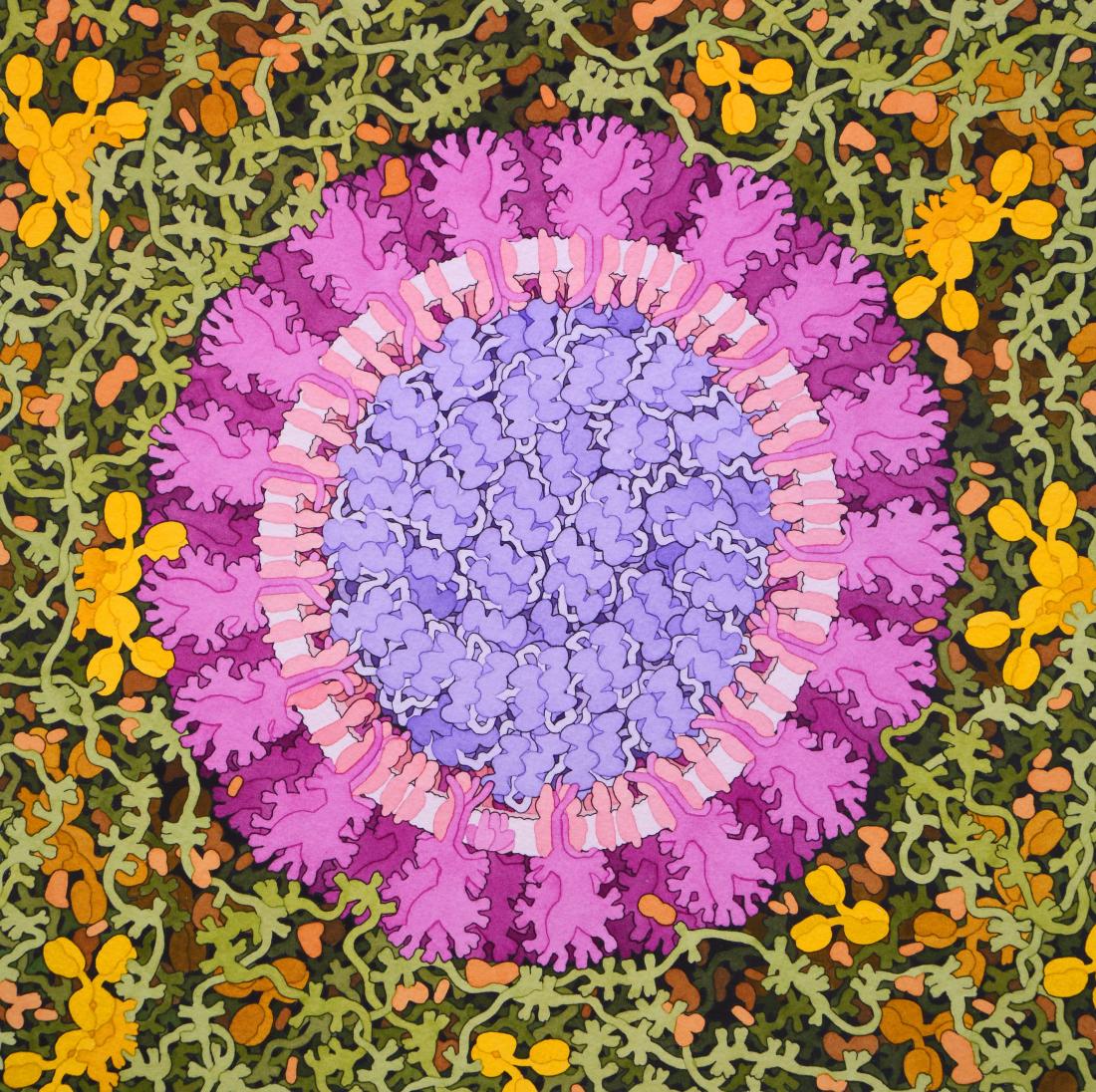
But another image of the virus was painted in watercolor by the San Diego-based scientist and biological artist David Goodsell, one of the most famous and accomplished scientific illustrators alive today. Goodsell has published several books of his illustrations, and many of his lavishly colored paintings can be found in medical school textbooks. A few have won awards. Some have even hung in museums. Goodsell’s coronavirus image is not nearly as famous, but as a work of art — and a work of science — it is just as mesmerizing. And more lovely.

Goodsell is an Associate Professor in the Department of Integrative Structural and Computational Biology at the Scripps Research Institute in San Diego. Most of the time, he works as a scientific illustrator (or molecular artist), a growing field in science, with numerous university programs available around the country. While the CDC image was created entirely within a computer, Goodsell’s work tends to be done in watercolor, a much older medium, but one that gives his images a vibrant beauty, making terrible pathogens like E-coli, Ebola and HIV, not to mention coronavirus, look like a psychedelic dream or a candy-colored nightmare.

Ebola virus: David Goodsell

Goodsell says that creating images like these serve a very important purpose: allowing people to picture something that otherwise would be unseeable.

“I was trying to put a face on the virus, so it’s not invisible, so we can see what we’re fighting,” Goodsell told California Science Weekly.

Because there are so many other images out there of the virus, it might seem like creating an illustration of it would be simple, but Goodsell says that there’s a tremendous amount of science involved, and that he strives to be as technically accurate as possible, showing only the known proteins in the virus and how they might be organized within the virion, the technical term for a virus particle.

David Goodsell in his home studio.

At the time that the painting was made, says Goodsell, not much was known about the virus. Its genetic structure was still being figured out. But since the virus is so similar to the SARS virome, Goodsell used a lot of the information from existing data on that virus, to create his work of art. Like most molecular artists, Goodsell draws from existing information about the proteins that make up a virus, much of which is freely available in the Protein Data Bank, a global online repository of genetic and structural data on thousands of the proteins which make up all living things.

“I want it to be something that people want to look at. I don’t particularly want it to look scary or monsterish.”

David Goodsell

The Protein Data Bank contains “some really nice structures of the spike protein on the outside of the virus.” Those spike proteins (colored a deep blood-red in the CDC image, but a bubblegum pink in Goodsell’s painting) are the means by which the virus attaches itself to our own cells before injecting them with its RNA, which will rapidly replicate inside and potentially wreak havoc in our bodies.

“If you Google coronavirus, people are using a whole range of different amounts of data, and most of the pictures are total garbage. Somebody has heard there are spikes on the virus, so they put things that look like big nails on the surface,” says Goodsell. “The CDC’s and my picture are much more tied to the data.”

Since creating the image in February, however, more information has come out about the virus’s genetic composition, and Goodsell may revisit his image, although he thinks it remains accurate. Little was known, for example, about the RNA contents of the virus, the genetic information that invades human cells. He also notes that the virus’s shape is not as uniform as depicted in most illustrations, and that any effort to create an image of it requires a significant amount of artistic license. For example, the CDC image, while accurate in terms of various proteins pictured, is likely not the neatly organized spiked ball floating in space that most people have come to know.

“I was trying to put a face on the virus, so it’s not invisible, so we can see what we’re fighting.”

David Goodsell

“It’s not a perfect sphere and it comes in a range of different sizes,” says Goodsell. “All of my reading is that the spikes are arranged randomly on the surface.”

Another quality that is entirely up to the artist is color. None of the molecules in the virus have much color, so molecular artists like Goodsell (and Alissa Eckert and Dan Higgins at the CDC), choose colors that they believe will be both pleasing and informative, helping to differentiate the various structures within the virus particle. “Color is used to help improve the clarity of what the structures are. The CDC has used that bright red to show what they think is the most important part, the spike on the surface,” says Goodsell.

For Goodsell’s part, his palette is far less sinister. He favors delicate pastels and swooping forms over the stark primary colors and jagged spikes of most coronavirus images. “I want it to be something that people want to look at. I don’t particularly want it to look scary or monsterish.”

That said, Goodsell says he’s been getting a lot of comments about the painting on Twitter. “Invariably, they say it’s beautiful but deadly.”