California’s SLAC and the Mission to Unveil the Mysteries of Matter and the Cosmos

The BaBar Detector at SLAC with physicist Michael Kelsey inside wearing a red hard hat, 2002. 
(Peter Ginter/SLAC National Accelerator Laboratory)

The SLAC National Accelerator Laboratory in Menlo Park, California, is a testament to human curiosity and the pursuit of the unknown. Since its inception in 1962, originally as the Stanford Linear Accelerator Center (as it was previously known), it has been on the forefront of scientific discovery in numerous scientific disciplines. It is truly one of the nationโ€™s great scientific institutions, being at the forefront of numerous major discoveries that have deeply impacted – and will impact – the world. 

Six scientists have received four Nobel prizes for their groundbreaking research conducted at SLAC, which led to the discovery of two elementary particles, confirmed that protons consist of quarks, and elucidated the process by which DNA orchestrates the synthesis of proteins in cells.

Stanfordโ€™s Roger Kornberg received the 2006 chemistry Nobel for work on RNA transcriptase, shown on screens.  
(Peter Ginter/SLAC National Accelerator Laboratory)

Administered by Stanford University and sponsored by the U.S. Department of Energy, SLAC has grown into a multifaceted research institution that explores a broad program in atomic and solid-state physics, chemistry, biology, and medicine. The lab employs the use of X-rays generated from synchrotron radiation and a free-electron laser, among other tools, to push the boundaries of our understanding in areas ranging from elementary particle physics to cosmologyโ€‹โ€‹.

CALIFORNIA CURATED ART ON ETSY

Purchase stunning coffee mugs and art prints of iconic California species.
Check out our Etsy store.

SLAC’s roots can be traced back to the construction of the 3.2-kilometer Stanford Linear Accelerator in 1966, the world’s longest linear accelerator at the time. This remarkable structure has been pivotal in fundamental research that led to the discovery of the charm quark in 1976, the quark structure inside protons and neutrons in 1990, and the tau lepton in 1995, each discovery earning a Nobel Prize in Physicsโ€‹โ€‹. This pioneering spirit is also embedded in SLAC’s cultural heritage, having provided a meeting space for the Homebrew Computer Club, which significantly contributed to the home computer revolution of the late 1970s and early 1980sโ€‹โ€‹. For example, Steve Wozniak debuted the prototype Apple-1 at the Homebrew Computer Club in 1976. 

Steve Jobs and Steve Wozniak
Apple 1

SLAC has also played a significant role in the digital age, hosting the first World Wide Web server outside of Europe in December 1991, a milestone that underscores its contribution beyond the realm of physicsโ€‹โ€‹. In the 1990s, the Stanford Linear Collider delved into the properties of the Z boson, further cementing SLAC’s position at the cutting edge of particle physics researchโ€‹โ€‹.

New projects and experiments are undertaken at SLAC all the time, and new discoveries are constantly being made to help us understand the nature of matter, biological processes and the evolution of the universe, as well as to help bring us into a greener future. In November 2023, a team at SLAC along with the Toyota Motor Company made significant advances in fuel cell efficiency.

The Linac Coherent Light Source (LCLS), a free-electron laser facility, has been a highlight of SLAC’s facilities, providing intense X-ray radiation for diverse research areas since 2009. In September 2023, SLAC fired up the worldโ€™s most powerful X-ray laser, the LCLS-II, to explore atomic-scale, ultrafast phenomena that are key to a broad range of applications, from quantum materials to clean energy technologies and medicine.

โ€œThis achievement marks the culmination of over a decade of work,โ€ said LCLS-II Project Director Greg Hays. โ€œIt shows that all the different elements of LCLS-II are working in harmony to produce X-ray laser light in an entirely new mode of operation.โ€  

It was in the facility that scientists and researchers developed the first X-ray free-electron lasers (XFELs). XFELs are like X-ray microscopes, and generate exceptionally bright and fleeting bursts of X-ray light, enabling researchers to observe the dynamics of molecules, atoms, and electrons with unparalleled clarity, exactly as these events unfold in their native, rapid timescalesโ€”a realm where the intricacies of chemistry, biology, and materials science play out. These facilities have played a pivotal role in numerous scientific breakthroughs, such as producing the first “molecular movie” that reveals the intricacies of complex chemical reactions, capturing the precise moments when plants and algae harness solar energy to generate the oxygen we rely on, and probing the intense conditions that shape the formation of planets and extraordinary events like diamond precipitation.

Over the years, SLAC has evolved to support a growing community of scientists. As of 2021, the lab employs approximately 1,600 staff members from 55 different countries, in addition to 470 postdoctoral researchers and graduate students. The center welcomes over 3,000 visiting researchers annuallyโ€‹โ€‹. This community has access to facilities such as the Stanford Synchrotron Radiation Lightsource for materials science and biology experiments and the Fermi Gamma-ray Space Telescope for astrophysics researchโ€‹โ€‹.

After decades of effort and help from SLAC’s X-ray laser, scientists have finally seen the process by which nature creates the oxygen we breathe. (SLAC)

The lab is also working at the forefront of astronomy and imaging. The SLAC National Accelerator Laboratory is at the helm of an ambitious project, crafting the worldโ€™s largest digital camera for the Vera Rubin Observatory’s Legacy Survey of Space and Time (LSST). Set to capture the southern sky from high on a mountaintop in Chile, this camera is a marvel of engineering and scientific collaboration. Its 3.2-gigapixel capacity allows it to snap detailed images every 15 seconds, offering an unprecedented window into the cosmos. The camera’s wide field of view can image an area 40 times larger than the full moon in one shot, and its advanced filters enable astronomers to probe the universe across a range of wavelengths. As part of the decade-long LSST, it will gather vast amounts of data, propelling our understanding of dark matter, dark energy, galaxy formation, and moreโ€‹

SLAC has developed the worldโ€™s largest digital camera for the Vera Rubin Observatory’s Legacy Survey of Space and Time (LSST)

In 2008, the lab was renamed from the Stanford Linear Accelerator Center to SLAC National Accelerator Laboratory, reflecting a broader scientific mission. Since then, the lab has continued to receive significant funding, including $68.3 million in Recovery Act Funding in 2009โ€‹โ€‹. Notably, SLAC and Stanford University initiated the Bits and Watts project to develop better, greener electric grids, although SLAC later withdrew due to concerns over an industry partnerโ€‹โ€‹.

SLAC’s current endeavors include the Facility for Advanced Accelerator Experimental Tests (FACET), where research on plasma acceleration continues to advance the fieldโ€‹โ€‹. Theoretical research at the lab spans quantum field theory, collider physics, astroparticle physics, and particle phenomenologyโ€‹โ€‹. Moreover, SLAC has contributed to the development of the klystron, a high-power microwave amplification tube that amplifies high radio frequencies and has aided in archaeological discoveries such as revealing hidden text in the Archimedes Palimpsestโ€‹โ€‹.

Archimedes Palimpsest (Wikipedia)

Other recent updates from SLAC include a new system for turning seawater into hydrogen fuelโ€‹โ€‹โ€‹โ€‹. They have also made advancements in understanding the production of nitroxide, a molecule with potential biomedical applications, and the operation of superconducting X-ray lasers at temperatures colder than outer spaceโ€‹โ€‹โ€‹โ€‹.

The SLAC National Accelerator Laboratory’s legacy is rich with scientific triumphs, and its future beckons with the promise of unraveling more of the universe’s deepest secrets. Whether through peering into the atomic structure or probing the vast cosmos, SLAC remains a beacon of discovery and innovation.

Journey to the Iron Giant: NASA’s Psyche Mission Could Unlock the Secrets of a Metallic World

The Psyche spacecraft in the clean room of the Jet Propulsion Laboratory in La Canada Flintridge, CA

A NOVEL PROPULSION SYSTEM WILL TAKE US TO A MASSIVE METAL ASTEROID IN DEEP SPACE

Imagine being able to move your car with your breath. One long blow out the back window, and your car begins speeding down the highway. Now imagine that if you keep blowing, your car accelerates to over 124,000 miles per hour. 

Of course, if you actually did this on Earth, you would turn blue in the face and your car would remain still. But in the vast vacuum of empty space where there is little gravity and no atmospheric drag, that tiny amount of thrust can be very effective. 

On October 12, NASAโ€™s Jet Propulsion Laboratory in La Caรฑada Flintridge will launch a spacecraft toward Mars and Saturn that will put this idea to the test. The agency is sending a 3,600-pound vehicle into space propelled by futuristic solar electric thrusters that deliver a force equivalent to the mass of about two quarters. They also happen to emit a cool blue glow that looks like something out of Blade Runner. 

The Hall Thruster’s eerie blue glow is due to it’s emission of Xenon gas

The spacecraft, called Psyche, launched aboard a SpaceX Falcon Heavy rocket from the historic Launch Complex 39 at NASAโ€™s Kennedy Space Center. The spacecraft will initially be set on a trajectory to fly by Mars, where it will receive a gravity assist, catapulting it further out into the solar system. In late 2026, the spacecraft will enter into orbit around a rare metal asteroid called Psyche 16 (hence the spacecraftโ€™s name). The journey to the asteroid will take over three and a half years and cover over 1.5 billion miles.ย 

Perhaps the most intriguing — and ultimately beneficial — components of the Psyche mission will be its use of solar electric thrusters. Also known as Hall Effect thrusters, the novel propellant system was designed to be efficient and cost-effective. Solar energy will be generated from a five-panel, cross-shaped solar array that will unfold and immediately begin harvesting energy from the sun. At 800 square feet, they are the largest panels ever installed at JPL, and when fully deployed, will extend about the area of a singles tennis court.  

The resulting energy will be used to turn xenon, a dense, colorless, odorless noble gas into xenon ions, atoms that carry a charge because the number of electrons does not equal the number of protons. Xenon is found in Earth’s atmosphere in trace amounts and is used in car headlights and plasma TVs. As the xenon ions are accelerated out of the thruster, they create thrust, propelling the spacecraft forward. The amount of thrust, however, will be minuscule compared to that of chemical-based propulsion systems normally employed on missions like those to Mars, Jupiter, and Saturn. 

โ€They operate at a low thrust level,โ€ says David Oh, Psycheโ€™s project system engineering manager. โ€œYou canโ€™t use it to launch from the earth. But in space, you operate these thrusters over a long period of time and you can get to very high speeds.โ€ 

Psyche spacecraft inside the NASA JPL clean room (Erik Olsen)

In other words, in space, a force equivalent to a hastily expelled deep breath is enough to move a ton and a half of metal through space at a speed more than one hundred times that of a fired bullet. 

Psyche will carry over 1000 kilograms of xenon in its tanks, more than enough to get the spacecraft to Psyche and complete its 21-month mission. JPL engineers estimate that the spacecraft would burn through about 15 times that amount of propellant by weight if it had to use traditional chemical thrusters.  

โ€œWe did try conventional chemical propulsion, and we determined if we did that, we would have quadrupled the mass of the spacecraft. It would have been very difficult to launch and very expensive to build. But this technology was mature and ready to go,โ€ says Oh.

This is not the first time an ion propulsion system has been used in space. Communication satellites orbiting the earth use them regularly. Colorado-based company Maxar Technologies developed and built the Hall thrusters for near-earth orbit, and NASA has purchased them from the company and made some modifications, but this will be the first time they will be used to venture into deep space.

Psyche asteroid (JPL)

โ€œWe needed advanced propulsion to get into orbit. We were looking at what could we buy rather than building our own thruster from scratch,โ€ says Oh.

Because theyโ€™re so efficient, Psycheโ€™s Hall thrusters can operate nearly nonstop for years without running out of fuel, says Oh. When its mission is over, the spacecraft might have lots of fuel left over, and they will have to decide whether to find other puzzles to solve. If the mission proves a success, Psyche’s Hall thrusters could play a major role in propelling future missions into deep space. 

A Metal Asteroid?

Scientists are giddy at what they might find once Psyche, propelled by the Hall Thruster system, arrives at the asteroid.  

โ€œItโ€™s a kind of world that humans have never visited before,โ€ says Arizona State Universityโ€™s Lindy Elkins-Tanton, principal investigator in charge of the mission. โ€œMost of the exploration we do is going and learning more about a body weโ€™ve already visited. Psyche, we have no photos of it, no one has ever done a flyby or really studied it. Itโ€™s unlike every asteroid we know, as far as we can tell.โ€   

Astronomers have been aware of Psyche’s existence ever since since it was first discovered on March 17, 1852, by the Italian astronomer Annibale de Gasparis. The asteroid, computer models of which resemble a potato, was named after the Greek mythological figure Psyche, the goddess of the soul. It is the largest and most massive of the known M-type asteroids (M stands for metal), and is one of a dozen of the most massive objects in the asteroid belt between Mars and Saturn. 

Scientists believe that Psyche may be part of the core of a body called an early planetesimalโ€”, a moon-sized type of protoplanet that may have once been much larger, but was perhaps struck many years ago by other heavy orbiting objects, shattering it into pieces, but leaving this particular blob of metal and rock behind. Such collisions were common when the early solar system was forming.

If Psyche was once the heart of a planet with a strong convective current and a molten iron-nickel core at its center, then scientists expect it will still have a magnetic field. A magnetometer aboard the spacecraft will measure its pull, while cameras will photograph and map the surface, collecting high-resolution multispectral images. Because of the asteroidโ€™s unique composition, scientists have no idea what to expect when the images first start rolling in. 

โ€œWhat does an impact crater into metal look like? We do not know?โ€ says Elkins-Tanton. 

In a unique twist for this mission, JPL plans to release the images captured by Psyche immediately onto the internet so that anyone can view them within a half-hour of being received. 

โ€œWeโ€™re not going to edit them or curate them. Weโ€™re going to send them out so that everyone can be looking at this funny object for the first time,โ€ says Elkins-Tanton.

In addition, a series of spectrometers will help us understand what the asteroid is made of by measuring the gamma rays and neutrons emitted from it. Depending on what scientists discover, the mission could help answer fundamental questions about the formation of our solar system. 

That will depend, of course, on whether the propulsion system functions as designed. As we stand on the precipice of a new era in space exploration, Hall thrusters aren’t just rocket scienceโ€”they’re the closest thing we have to cosmic alchemy, promising to redefine how we navigate the vast tapestry of our solar system.

Hey there! If you enjoy California Curated, consider donating the price of a coffee to support its creation!

Mt. Wilson Observatory in Los Angeles is a Celestial Time Capsule

Mt. Wilson Observatory (Erik Olsen)

Perched atop a lofty peak in the San Gabriel Mountains of California sits a historic treasure, one of the great astronomical tools of the 20th century: the Mt. Wilson Observatory. For more than 100 years, it has been a centerpiece for major astronomical discoveries, playing a pivotal role in our understanding of the universe. The observatory, with its rich history shaped by devoted scientists, advanced technology, and revolutionary discoveries, stands as a testament to humanity’s relentless pursuit of knowledge.

The story of the Mt. Wilson Observatory begins with the visionary astronomer George Ellery Hale. Recognizing the importance of location, Hale selected Mt. Wilson for its elevation of 5,710 feet and its proximity to the Pacific Ocean, which provided consistently stable, clear skiesโ€”perfect conditions for astronomical observations. In 1904, he installed the first telescope at the site, the Snow Solar Telescope, specifically designed for studying the Sun. This telescope marked the beginning of groundbreaking solar research at the observatory and set the stage for future advancements in astronomy.

Many brilliant minds walked the halls and explored domes of Mt. Wilson, but few shone as brightly as Edwin Hubble. In the 1920s, using the Hooker Telescope โ€“ then the largest in the world โ€“ Hubble made two groundbreaking discoveries:

Before Hubble’s observations at Mt. Wilson, the prevailing belief was that our galaxy, the Milky Way, constituted the entirety of the universe. The existence of other galaxies was not yet confirmed, and what we now know as galaxies were often referred to as “nebulae” and thought to be part of the Milky Way.

Hubble’s groundbreaking discovery in 1923-1924, using the 100-inch Hooker telescope at Mt. Wilson, revealed that the Andromeda Nebula (now known as the Andromeda Galaxy) was far beyond the Milky Way, providing the first concrete evidence that the universe extended far beyond our own galaxy. This discovery fundamentally altered our understanding of the cosmos, leading to the realization that the universe is vast and filled with countless galaxies.

Expanding Universe

Using the powerful Hooker telescope once again, Hubble carefully observed distant galaxies and made a groundbreaking discovery: these galaxies were moving away from us. Even more astonishing was that the farther a galaxy was, the faster it was receding. This finding provided clear evidence that the universe itself was expanding. Hubbleโ€™s revelation shattered the long-held belief in a static universe and laid the groundwork for the Big Bang theory, suggesting that the universe had a specific beginning and has been expanding ever since. Through Hubble’s meticulous observations, humanity gained a new understanding of a dynamic, ever-evolving cosmos, far more vast and mysterious than anyone had previously imagined.

Edwin Hubble

Many other scientists have also made major discoveries at Mt. Wilson. One luminary, Harlow Shapley, used the observatory to gauge more specifically our place in the Milky Way. Before Shapley, Earth was believed to be at the galaxy’s center. However, through his observations of globular clusters, he pinpointed our more humble location on a distant spiral arm.

Another notable scientists who made significant contributions at Mt. Wilson Observatory was Walter Baade. Baade, a German-American astronomer, played a key role in refining our understanding of the universe by studying stars in different populations. During World War II, when Los Angeles experienced blackout conditions, Baade took advantage of the clearer skies at Mt. Wilson to observe celestial objects with unprecedented clarity. He discovered that there were two distinct types of stars in the Milky Way, which led to the realization that galaxies had different stellar populations. This breakthrough allowed Baade to correct the scale of the universe, doubling the previously estimated size of galaxies and distances to them. His work helped refine Hubble’s expanding universe theory and provided a deeper understanding of the evolutionary stages of stars. Baade’s observations were critical in the advancement of modern cosmology and our comprehension of the vastness of space.

Instruments of Enlightenment

Over the years, Mt. Wilson has housed a suite of powerful telescopes:

  • The Hooker Telescope: At 100-inches, it was the world’s largest when it was installed in 1917. It’s the very instrument Hubble used for his revolutionary work.
  • The Snow Solar Telescope: The observatory’s inaugural instrument remains crucial for solar studies.
  • The CHARA Array: The Center for High Angular Resolution Astronomy array is an impressive configuration of six telescopes that function as an interferometer. It allows for sharper images of stars than even the Hubble Space Telescope. The CHARA Array has a spatial resolution equivalent to a single telescope 331 meters (over 1000 ft) in diameter. Light from each of the six telescopes is transported through fiber optics to a special beam-combining room. 

Not only has Mt. Wilson been instrumental in observing distant stars, but it also has a unique device: the Snow Horizontal Solar Telescope. This apparatus, combined with the spectrograph, was used to study the sun’s magnetic fields. It has since been fundamental in understanding solar cycles and the impact of solar phenomena on Earth’s climate.

Mt. Wilson Observatory

In 2020, the Bobcat Fire, the second largest fire on record in Los Angeles County to date, burned over 115,000 acres and was active for more than three months. Annually, the team at Mount Wilson Observatory takes measures against potential forest fires, removing fire-hazardous invasive plants and ensuring their extensive water tanks are full for the fire suppression system. Just a few months prior to the blaze, they had fitted new high-capacity hydrants. These proactive steps played a pivotal role in safeguarding the Observatory when the Bobcat Fire flames approached within a mere 20 feet of its perimeter. A dozen fire squads, each consisting of 40 to 50 firefighters from various units, tirelessly worked day and night to protect this cherished landmark.

Scene at Mt. Wilson after the 2020 Bobcat Fire (Erik Olsen)

Visitors to the Mt. Wilson Observatory have a rare chance to not only tour the grounds but also look through the same telescopes that revolutionized astronomy. Public “Telescope Nights” offer the exciting opportunity to observe the night sky through the famous 60-inch or 100-inch telescopes, the latter being the largest in the world open to the public. These sessions allow people to view celestial objects like planets, star clusters, and nebulae in stunning detail. Reservations are necessary for these events, as spots fill up quickly due to high demand. Additionally, private group sessions and special events can be arranged, providing an unforgettable, up-close experience with the universe. Guided tours are also available for those who want to dive into the observatory’s rich history, tracing the steps of astronomers who made some of the greatest discoveries of the 20th century.
Hey there! If you enjoy California Curated, consider donating the price of a coffee to support its creation!

Einstein in Pasadena: Three Wonderful Winters in Paradise

Einstein at the Santa Barbara home of Caltech trustee Ben Meyer on Feb. 6, 1933.
(The Caltech Archives)

“Here in Pasadena, it is like Paradise. Always sunshine and clear air, gardens with palms and pepper trees and friendly people who smile at one and ask for autographs.” – Albert Einstein (U.S. Travel Diary, 1930-31, p. 28)

Albert Einstein is often associated with Princeton, where he spent his later years as a towering intellectual figure, and with Switzerland, where he worked as a young patent clerk in Bern. It was in that spartan, dimly lit office, far from the great universities of the time, that Einstein quietly transformed the world. In 1905, his annus mirabilis or “miracle year,” he published a series of four groundbreaking papers that upended physics and reshaped humanityโ€™s understanding of space, time, and matter. With his insights into the photoelectric effect, Brownian motion, special relativity, and the equivalence of mass and energy (remember E=mc2?), he not only laid the foundation for quantum mechanics and modern physics but also set in motion technological revolutions that continue to shape the future. Pretty good for a guy who was just 26.

Albert Einstein spent his later years as a world-famous scientist traveling the globe and drawing crowds wherever he went. His letters and travel diaries show how much he loved exploring new places, whether it was the mountains of Switzerland, the temples of Japan, or the intellectual circles of his native Germany. In 1922, while on his way to accept the Nobel Prize, he and his wife, Elsa, arrived in Japan for a six-week tour, visiting Tokyo, Kyoto, and Osaka.

But of all the places he visited, one city stood out for him in particular. Pasadena, with its warm weather, lively culture, and, most importantly, its reputation as a scientific hub, had a deep personal appeal to Einstein. โ€‹He visited Pasadena during the winters of 1931, 1932, and 1933, each time staying for approximately two to three months. These stays were longer than many of his other travels, giving him time to fully immerse himself in the city. He spent time at Caltech, exchanging ideas with some of the brightest minds in physics, and fully embraced the California experience, rubbing elbows with Hollywood stars (Charlie Chapman among them), watching the Rose Parade, and even tutoring local kids. Einstein may have only been a visitor, but his time in Pasadena underscores how deeply rooted science was in the city then, and how strongly that legacy endures today. Pasadena remains one of the rare places in the country where scientific inquiry and creative spirit continue to thrive side by side. Pasadena was among the earliest cities to get an Apple Store, with its Old Pasadena location opening in 2003.

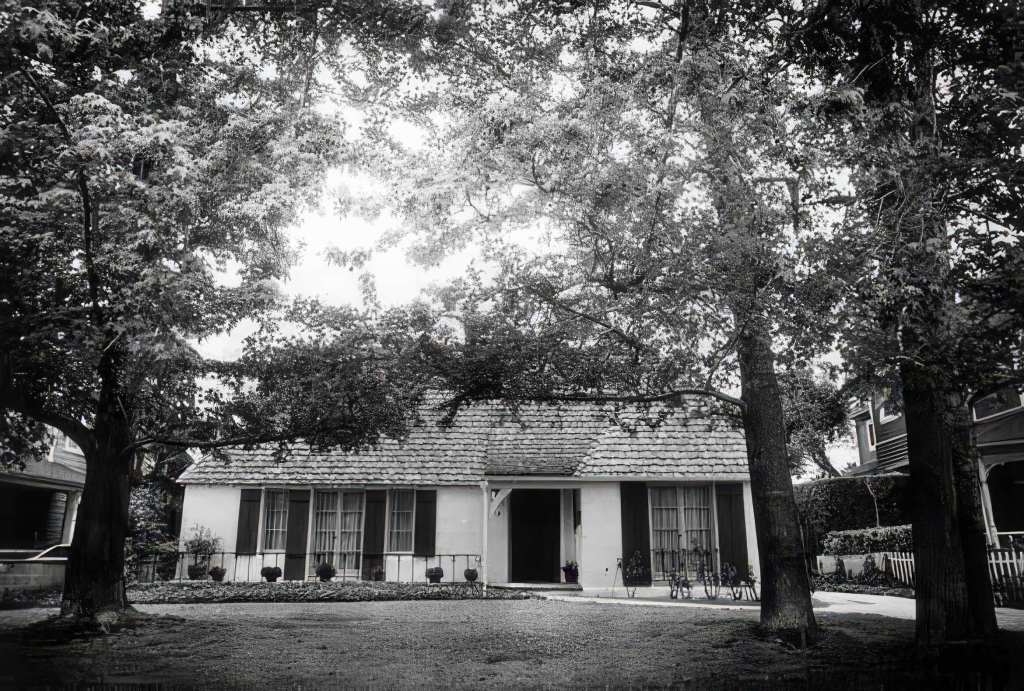
Einstein’s residence at 707 South Oakland Avenue in Pasadena, where he stayed his first winter in California (CalTech Archives)

Few scientists have received the public adulation that Einstein did during his winter stays in Pasadena. As a hobbyist violinist, he engaged in one-on-one performances with the conductor of the Los Angeles Philharmonic. Local artists not only painted his image and cast him in bronze but also transformed him into a puppet figure. Frank J. Callier, a renowned violin craftsman, etched Einstein’s name into a specially carved bow and case.

During his first winter of residence in 1931, Einstein lived in a bungalow at 707 South Oakland Avenue. During the following two winters, he resided at Caltech’s faculty club, the Athenaeum, a faculty and private social club that is still there today.

Yet, the FBI was keeping a watchful eye on Einstein as well. He was one of just four German intellectuals, including Wilhelm Foerster, Georg Nicolai, and Otto Buek, to sign a pacifist manifesto opposing Germanyโ€™s entry into World War I. Later, Einstein aligned himself with Labor Zionism, a movement that supported Jewish cultural and educational development in Palestine, but he opposed the formation of a conventional Jewish state, instead calling for a peaceful, binational arrangement between Jews and Arabs.

In front of the Athenaeum Faculty Club, Caltech, 1932. 
(Courtesy of the Caltech Archives.)

After his annus mirabilis in 1905, Einstein’s influence grew rapidly. In 1919, his theory of relativity was confirmed during a solar eclipse by the English astronomer Sir Arthur Eddington. The announcement to the Royal Society made Einstein an overnight sensation among the general public, and in 1922, he was awarded the 1921 Nobel Prize in Physics. While teaching at the University of Berlin in 1930, Arthur H. Fleming, a lumber magnate and president of Caltech’s board, successfully persuaded him to visit the university during the winter. The visit was intended to remain a secret, but Einstein’s own travel arrangements inadvertently made it public knowledge.

Einstein speaking at the dedication of the Pasadena Junior College (now PCC) astronomy building, February 1931. 
(Courtesy of the Caltech Archives)

After arriving in San Diego on New Year’s Eve 1930, following a month-long journey on the passenger ship Belgenland, Einstein was swarmed by reporters and photographers. He and his second wife, Elsa, were greeted with cheers and Christmas carols. Fleming then drove them to Pasadena, where they settled into the bungalow on S Oakland Ave.

Albert Einstein and his violin (Caltech Archives)

During their first California stay, the Einsteins attended Charlie Chaplin’s film premiere and were guests at his Beverly Hills home. “Here in Pasadena, it is like Paradise,” Einstein wrote in a letter. He also visited the Mt. Wilson Observatory high in the San Gabriel Mountains. Einstein’s intellectual curiosity extended far beyond his scientific endeavors, leading him to explore the Huntington Library in San Marino, delighting in its rich collections. At the Montecito home of fellow scientist Ludwig Kast, he found comfort in being treated more as a tourist than a celebrity, relishing a brief respite from the spotlight.

In Palm Springs, Einstein relaxed at the winter estate of renowned New York attorney and human rights advocate Samuel Untermeyer. He also embarked on a unique adventure to the date ranch of King Gillette, the razor blade tycoon, where he left with a crate of dates and an intriguing observation. He noted that female date trees thrived with nurturing care, while male trees fared better in tough condition: โ€œI discovered that date trees, the female, or negative, flourished under coddling and care, but in adverse conditions the male, or positive trees, succeeded best,โ€ he said in a 1933 interview.

CALIFORNIA CURATED ON ETSY

Purchase stunning coffee mugs and art prints of California icons.
Check out our Etsy store.

Not exactly relativity, but a curiosity-driven insight reflecting his ceaseless fascination with the world.

During his three winters in Pasadena, Einstein’s presence was a source of intrigue and inspiration. Students at Caltech were treated to the sight of the disheveled-haired genius pedaling around campus on a bicycle, launching paper airplanes from balconies, and even engaging in a heated debate with the stern Caltech president and Nobel laureate, Robert A. Millikan, on the steps of Throop Hall. Precisely what they debated remains a mystery. (Maybe something about the dates?)

Einstein with Robert A. Millikan, a prominent physicist who served as the first president of Caltech from 1921 to 1945 and won the Nobel Prize in Physics in 1923.ย (Courtesy of the Caltech Archives.)

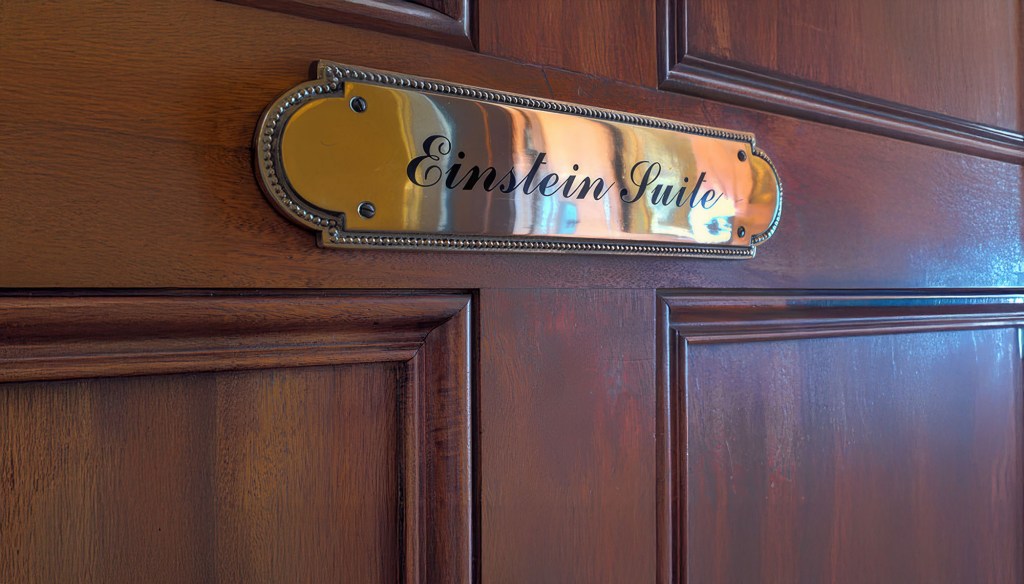
During his final winter in California, a near-accident led the couple to move into Caltech’s Athenaeum. His suite, No. 20, was marked with a distinctive mahogany door, a personal touch from his sponsor, Fleming. In 1933, as Nazi power intensified in Germany, Einstein began searching for a safe place to continue his work. Although Caltech made an offer, it was Princeton University‘s proposal that ultimately won him over. Einstein relocated to Princeton that same year, where he played a significant role in the development of the Institute for Advanced Study and remained there until his death in 1955.

Suite No. 20, Einstein’s mahogany door at the Caltech Athenaeum

Today, a large collection of Einstein’s papers are part of the Einstein Papers Project at Caltech. And Einstein’s suite at Caltech’s Athenaeum, still displaying the mahogany door, serves as a physical reminder of his visits.

During his third and final visit to Caltech in 1933, Hitler rose to power as Chancellor of Germany. Realizing that, as a Jew, he could not safely return home, Einstein lingered in Pasadena a little longer before traveling on to Belgium and eventually Princeton, where he received tenure. He never returned to Germany, or to Pasadena. Yet he often spoke fondly of the California sunshine, which he missed, and in its own way, the sunshine seemed to miss him too.

J. Robert Oppenheimer: The Berkeley Era and The Birth of the Manhattan Project

With the release of the movie Oppenheimer, it’s worth taking a look at the role that California played in one of the most important technological developments of the 20th century: the making of the atomic bomb. The Manhattan Project, the prodigious scientific endeavor that produced the world’s first nuclear weapons, cast a long, dark shadow over the mid-20th century. But amid the mushroom clouds, there lies a tale of innovation and scientific genius that originated from an unlikely sourceโ€”the University of California, Berkeley.

The film team filmed several scenes at Berkeley, adding a vintage car and 1940s-era lampposts to the campus. Oppenheimer taught at UC Berkeley from 1929 to 1943 โ€” his office was on the third floor of Physics North (then named LeConte Hall) 

For years, America’s physics powerhouse resided in the East. But in the post-WWI era, the western horizon blazed with opportunity. Visionary administrators at Caltech and UC Berkeley threw financial muscle behind their bold mission: to make physics research a priority.

By the dawn of the 1930s, their investments bore fruit. The American Physical Society‘s president hailed California as a hotbed of physics innovation, equating it with the East in the academic landscape of the discipline. Universities played high-stakes poker for the talents of up-and-coming physicists like Oppenheimer and Ernest Lawrence, known for his groundbreaking work in photoelectricity and ionization.

Visit the California Curated store on Etsy for original prints showing the beauty and natural wonder of California.

J. Robert Oppenheimer, one of the leading physicists of the 20th century, is often remembered as the ‘father of the atomic bomb’. However, his journey toward this formidable title began at Berkeley, an intellectual crucible where his talent for theoretical physics was honed, ultimately leading him to oversee the Manhattan Project, a scientific endeavor that would change the world.

J. Robert Oppenheimer, Enrico Fermi and Ernest O. Lawrence at UC Berkeley in 1940. Courtesy: Lawrence Berkeley National Laboratory

Oppenheimer’s relationship with Berkeley began in 1929 when he joined as an Assistant Professor of Physics. This was an exciting period in the realm of science. Quantum mechanics was in its infancy and a new breed of scientists was emerging, eager to unlock the secrets of the universe. Oppenheimer, with his insatiable curiosity and infectious enthusiasm, was just the right person for this time of exploration.

During his years at Berkeley, Oppenheimer made significant contributions to quantum mechanics, notably his work on the Oppenheimer-Phillips process. This theory describes a particular type of nuclear reaction that occurs during the absorption of a neutron by a nucleus, an understanding that would later prove pivotal to the development of nuclear energy.

Outside the laboratory, Oppenheimer was an adored figure, known for his quick wit and charismatic teaching style. He was instrumental in building the physics program at Berkeley into perhaps the finest in the country by attracting some of the brightest minds of the time. Together, they would be known as dubbed the โ€œluminariesโ€.

J. Robert Oppenheimer (Ed Westcott/U.S. Department of Energy via Bay City News)

โ€œThe group met secretly in his office at the northwest corner of the top floor of โ€˜oldโ€™ LeConte Hall. This office, like others on the top floor, has glass doors opening out onto a balcony,” wrote Raymond T. Birge, former chair of the Berkeley physics department at the time. “This balcony is readily accessible from the roof. To prevent this method of entry, a very heavy iron netting was placed over the balcony. A special lock was placed on the door to the office and only Oppenheimer had the key. No janitor could enter the office, nor could I, as chairman of the department,โ€

Hans Bethe, one of the great German-American theoretical physicists of the age said Oppenheimer established UC Berkeley as the โ€œgreatest school of theoretical physics the United States has ever known.”

Although he was increasingly recognized as a pivotal figure in theoretical physics, former students say he remained accessible, consistently urging his students to question norms and extend limits. He actively promoted a culture of inquiry among his students, even if his responses occasionally seemed harsh. However, Oppenheimer’s questions to his student speakers were meant to clarify rather than to humiliate, often aimed more at enlightening the audience than himself. His rapport with his students was unexpectedly casual. He provided an open-door policy, inviting his students to visit his office anytime to utilize the physics resources within his personal collection.

J. Robert Oppenheimer with Glenn T. Seaborg and Ernest O. Lawrence in early 1946. (Photo courtesy of Berkeley Lab)

Oppenheimer’s life at Berkeley wasn’t all physics. A man of varied interests, he was an avid hiker, horseback rider, and aficionado of literature, poetry, and art. These varied interests made him a multifaceted character and helped him foster connections with many prominent figures across different fields. His unique combination of scientific genius, humanity, and leadership qualities made him a standout candidate for the enormous task that lay ahead – the Manhattan Project.

While no major Manhattan Project facilities graced the Golden State, Berkeley, nestled in the heart of California, emerged as an unsung hero of the project. Berkeley offered more than a tranquil academic setting; it provided an assembly line of experts that would revolutionize nuclear science. Not only was Berkeley home to Oppenheimer the university also attracted other nuclear-era luminaries like Ernest Lawrence, and chemists Glenn Seaborg.

Berkeley had always been special. California’s first land-grant university, founded in 1868, Berkeley underwent a metamorphosis under the leadership of Robert Sproul. From 1930 to 1958, Sproul spearheaded the transformation of Berkeley into a hub of intellectual firepower. The University of California system burgeoned across the state, with Berkeley, the original campus, earning a reputation as one of the nation’s foremost research institutions. Its powerhouse physics department became a beacon in the dark world of the Manhattan Project.

Berkeley’s list of accomplishments in physics is long and distinguished, but one discovery stands out – the identification of plutonium. Edwin McMillan, a promising physicist at Berkeley, ventured into the wilderness of uranium fission products. In 1940, he stumbled upon an unknown substance – element 93, or as he named it, “neptunium,” a hat tip to the distant planet Neptune. McMillan predicted that neptunium decayed into plutonium, the elusive element 94.

Glenn Seabord – Wikipedia

Glenn Seaborg, another Berkeley savant, picked up where McMillan left off when the latter migrated east to work at MIT. Seaborg unveiled the heart of plutonium, exposing its fundamental chemical and nuclear properties, including its high propensity for fission. As the world’s leading expert on plutonium, Seaborg directed the ambitious effort to separate plutonium from uranium and other reactor products.

Meanwhile, Ernest Lawrence led a research group that broke boundaries with the cyclotrons at the Rad Lab. They used the 60-inch cyclotron to bombard uranium with neutrons, producing plutonium for scrutiny. But Lawrence had a revelation. In 1941, he realized the cyclotron could also operate as a mass spectrometer, effectively isolating uranium-235 from uranium-238. This technique was later adopted at Oak Ridge’s Y-12 Separation Plant, enabling large-scale separation. The cyclotron, rechristened as a “Calutron” in a nod to the University of California, had revolutionized nuclear science.

Recording of the โ€œRainierโ€ shot, Nevada Test Site, Sept. 19, 1957.
Atomic Energy Commission/U.S. Department of Energy via Wikipedia Commons

While these figures were all played prominent roles in the development of the atomic bomb dropped on Hiroshima and Nagasaki in 1945, it is Oppenheimer who is best remembered. After fourteen years at Berkeley, Oppenheimer was plucked from the physics department at Berkeley by General Leslie Groves to assume leadership of the research program at Los Alamos. Even after his move, Oppenheimer fostered a close alliance between Berkeley and the Manhattan Project. In a shroud of secrecy, the University of California took on the management of the operations at Los Alamos. The university even set up a Los Angeles office that handled material logistics for the lab.

Despite decades passing and the veils of secrecy lifting, the legacy endures. The Los Alamos lab continues to operate under the University of California’s management, preserving Berkeley’s indelible imprint on the atomic age. It’s a testament to the institution’s groundbreaking contributions and a tribute to the remarkable scientists who once walked its hallowed halls.

How one building survived the San Francisco earthquake and changed the world.

The Bekins Warehouse following the 1906 San Francisco earthquake

When the 1906 earthquake struck San Francisco, most of the buildings at the time in the city were made of wood (like redwood harvested from the once vast stands of coastal redwood that grew in Northern California). This did not bode well for San Franciscans because immediately after the earthquake, a series of fires spread quickly over the city, largely razing to the ground almost every wooden structure that withstood the tremblor.

But curiously, a few structures did survive largely intact. Among them, are the Old United States Mint (also known asย The Granite Lady) and a half-finished warehouse built for the Bekins Van and Storage Company at Mission and Thirteenth. Although the brick facade cracked, the interior steel framing remained intact, according to a U.S. Geographical Report issued in 1907.

Rebar – used for steel reinforced concrete – being used in a high-rise building.

The Bekins warehouse survived because it was made of a relatively new material that had largely been ignored (and vigorously opposed) in California. That material is reinforced concrete, and its use in this instance played a crucial role in demonstrating the practicality and benefits of reinforced concrete in large-scale urban buildings around the world.

A problem with concrete is that it has great compressive strength. It can withstand high pressure without cracking. But it lacks tensile strength, meaning it cannot bend without shattering. Throughout the late 1800s, various builders tried to strengthen concrete with metal, mostly iron. With the advent of steel, which was becoming increasingly cheap to manufacture, and with a new technique based on twisting the metal to allow it to adhere better to the liquid concrete, a new era of construction was born.

US Mint Building in San Francisco

In the years before the 1906 earthquake, the use of concrete was resisted by the legions of bricklayers, masons, and powerful builders’ unions that saw the material as a threat to their survival. Others called the material ugly and not worthy of a great city like San Francisco.

One trade publication at the time wrote: โ€œa city of the dull grayness of concrete would defy all laws of beauty. Concrete does not lend itself architecturally to anything that appeals to the eye. Let us pause a moment before we transform our city into such hideousness as has been suggested by concrete engineers and others interested in its introduction.โ€

The novel shape of the Philips Pavilion built in Brussels for Expo 58 was achieved using reinforced concrete. (Wikipedia)

The resistance against concrete was formidable enough that the material was not used widely in the city. Even after the earthquake, it took a while for people to grasp its value. Despite the overwhelming evidence that this new building material could dramatically help a city not only withstand an earthquake but fire as well, San Francisco building codes still forbade the use of concrete in high, load-bearing walls.

The Bekins Warehouse itself was designed to serve as a storage building and office for the Bekins Van and Storage Company, a firm specializing in moving and storage services. The choice of reinforced concrete was strategic, as warehouses of the era required robust structures that could withstand the heavy loads associated with storage, as well as offer protection against fire, a common hazard in densely packed urban centers.

Moreover, the use of reinforced concrete allowed for the construction of large, open interior spaces without the obstruction of support columns. This architectural freedom not only facilitated the efficient organization and movement of goods within the warehouse but also allowed for the adaptation of the building to various uses over time.

San Francisco today. Unsplash: Jared Erondu

It wasn’t until two years later, in a contentious San Francisco board of supervisors meeting, that the city changed its building codes to allow the widespread use of reinforced concrete. By 1910, the city had issued permits for 132 new reinforced concrete buildings. The science of building advanced hugely in the wake of the disaster.

As urban areas continued to grow and evolve, the principles demonstrated by the construction of the Bekins Warehouseโ€”such as the emphasis on durability, fire safety, and spatial efficiencyโ€”became increasingly central to architectural and urban planning philosophies. The building not only serves as a testament to the innovative use of materials and techniques in early 20th-century architecture but also as a precursor to modern construction practices where reinforced concrete remains a fundamental building block.

Today, most every tall building in the world makes use of steel-reinforced concrete. The survival of the Bekins building was transformational for not only the city of San Francisco but in many ways, it heralded a watershed moment in the history of architecture, construction, and the planet’s cities.

CalTech’s famous fly lab, Saving California’s rare fruit, Atomic microscope, Winter snowfall earthquakes, Brain enhancement drugs, Mars copter

Week of April 5, 2019


Here at the California Science Weekly, we are working hard to bring you the most interesting, informative and entertaining stories about science in the state of California. Every week, we pore through hundreds of articles and Web sites to find the top stories that we believe are worthy of your time. We will also be writing feature stories, developing a podcast and producing a video series that will take our content offerings to a whole new level. We hope you’ll stay with us and share our work with others via Twitter and Facebook. If there is anything you’d be interested in learning more about, send us a note, and let us know.

Biology

An homage to Cal Tech’s fly lab

Credit: Sanjay Acharya

Few critters in the history of science have been as important to our understanding of life as the humble fruit fly. The genus Drosophila melanogaster holds a particularly esteemed spot among the dozens of model organisms that provide insight into life’s inner workings. Much of the work has taken place, and is taking place now, right here in California.

CalTech Magazine has a wonderful story by Lori Dajose about the crucial role the fruit fly has played in science and why we should all revere this underappreciated insect.

The story begins in 1906 at Columbia University in the fly lab Thomas Hunt Morgan, whose work with white-eyed mutants established chromosomes as the pathway of inheritance for genes. Morgan made his way to CalTech in 1928 to found the school’s Division of Biology, and ever since then, the school has been a launching pad for ground-breaking research (and a few Nobel Prizes) using fruit flies.

Other notable names involved in fruit fly research include Ed Lewis, who helped standardize fruit fly food, but more importantly discovered how Hox genes control embryonic development (for which he won the 1995 Nobel Prize) and Seymour Benzer, a pioneer the field of neurogenetics and the subject of one of our favorite science books of all time here at the CSW: Jonathan Weiner’s Time, Love, Memory: A Great Biologist and His Quest for the Origins of Behavior. The breakthroughs made in Benzer’s Fly Rooms form the basis of much of our current understanding of genes and behavior.

The essay goes on to describe the great work that continues at CalTech with researchers like Elizabeth Hong, who is investigating how the brain orders and encodes complex odors, David Anderson, who studies emotions and behaviors, and Michael Dickinson, whose lab investigates how the tiny fruit fly brain gives rise to flight. So much to learn from one little insect and one great institution.

CalTech Magazine


Agriculture

Saving California’s fruit

Credit: C. Todd Kennedy

Two hours south of San Francisco, a lawyer turned horticulturalist named C. Todd Kennedy is helping preserve Americaโ€™s agricultural legacy.  Todd is one of Californiaโ€™s premier experts on fruit. As a co-founder of the Arboreum Company, he has single-handedly saved numerous rare varieties of so-called stone fruit like peaches, plums, and apricots from possibly disappearing forever.

Atlas Obscura


Physics

UCI researchers see life’s vibrations

ย“Credit: Steve Zylius / UCI

Using a cutting edge new type of microscope, scientists at the University of California, Irvine have for the first time captured images of the way that a molecule vibrates down at the atomic level. These vibrations drive the chemistry of all matter, including the function of living cells. โ€œFrom structural changes in chemistry to molecular signaling, all dynamical processes in life have to do with molecular vibrations, without which all would be frozen,โ€ said co-author V. Ara Apkarian, a UCI Distinguished Professor of chemistry. 

The breakthrough was published in a paper in the science journal Nature. The advance could open up new ways of seeing and understanding the sub-microscopic/ atomic world. The research was conducted at UCIโ€™s Center for Chemistry at the Space-Time Limit, maybe the coolest name for a lab ever.

UCI


Geology and earthquakes

Could winter storms cause earthquakes?

All the snow we’ve been getting in the high Sierras may cause skiers and farmers to rejoice, but a new study from Emily Montgomery-Brown at the US Geological Survey in Menlo Park, California, suggests a connection between the heavy runoff following record snowfall in the Sierra Nevada and small earthquakes. Using historical records, Montgomery-Brown and others have determined that small earthquakes occur 37 times more often when there is high runoff from melting snowpack. One theory is that the water permeates the ground and changes pressures deep down within faults, leading to small quakes.

Nature


Health

Are we ready for brain enhancement?

You have probably never heard of Klotho, but according to a story by Carl Zimmer in the New York Times, this mysterious hormone could one day lead to a way to prevent, or even enhance, cognitive ability.

Research on mice by Dr. Dena Dubal at the University of California, San Francisco, suggests that Klotho protects mice from cognitive decline, likely due to Alzheimerโ€™s disease. The mice bred to make extra Klotho also performed better running mazes and in other cognitive tests. “Klotho didnโ€™t just protect their brains, the researchers concluded โ€” it enhanced them,” writes Zimmer. Further research suggests that Klotho could also extend life.

In March, Dr. Dubal released a study suggesting that Klotho may also protect people from Alzheimerโ€™s disease. The Alzheimer’s Association says that 5.8 million Americans are currently living with the debilitating disease.

The bigger question that the piece raises is whether Klotho pills or gene manipulation techniques like Crispr that might stimulate Klotho production, could someday be available to humans for cognitive enhancement. In other words, brain boosting. The idea raises numerous ethical questions such as who would get access and how much would it cost? What if you could pass these enhancements on to your children? “If people could raise their SAT scores by taking a pill the night before an exam,” writes Zimmer, “that might not seem fair.”

The New York Times


Space

NASA’s JPL tests new Mars copter

It’s mind-boggling enough that we’ve been able to explore Mars using rovers big and small. But what if the next step is navigating the red planet with a vehicle that can lift off and soar above the dusty surface?

NASA’s Jet Propulsion Laboratory (JPL) is testing a new helicopter, a small, autonomous rotorcraft weighing about four pounds, that will travel with the Mars 2020 rover, one of JPL’s most ambitious projects ever. The 2020 rover is currently scheduled to launch in July 2020 and is expected to reach Mars in February 2021. The vehicle has been in development since August 2013 at JPL’s testing facility in La Canada Flintridge, California.

Flying a copter on Mars is a lot more challenging than doing so on earth. The thin atmosphere means that the copter’s blades will have to spin at almost 3,000 rpm, about 10 times the rate of a helicopter on Earth. Then there is the Martian climate with dust storms and temperatures that can fall as low as minus 130 degrees Fahrenheit.

The copter project is only one small part of the larger Mars 2020 mission, and is considered a high-risk, high-reward project. If it fails, it won’t impact the mission’s larger goals, including answering key questions about the potential for life on Mars.

Last year, JPL released this informative video about the project.

JPL


Design by Luis Ramirez