The Man Who Saved the Owens Pupfish

51 years ago today a man named Edwin Philip Pister rescued an entire species from extinction.

Less than 2.5 inches in length, the Owens pupfish is a silvery-blue fish in the family Cyprinodontidae. Endemic to California’s Owens Valley, 200 miles north of Los Angeles, the fish has lived on the planet since the Pleistocene, becoming a new species when its habitat was divided by changing climatic conditions, 60,000 years ago.

For thousands of years, the Owens Valley was largely filled with water, crystal-clear snowmelt that still streams off the jagged, precipitous slab faces of the Sierra Nevada mountains. Pupfish were common, with nine species populating various lakes and streams from Death Valley to an ara just south of Mammoth Lakes. The Paiute people scooped them out of the water and dried them for the winter.

In the late 19th century, Los Angeles was a rapidly growing young metropolis, still in throes of growing pains that would last decades. While considered an ugly younger sibling to the city of San Francisco, Los Angeles had the appeal of near year-round sunshine and sandy beaches whose beauty that rivaled those of the French Riviera.
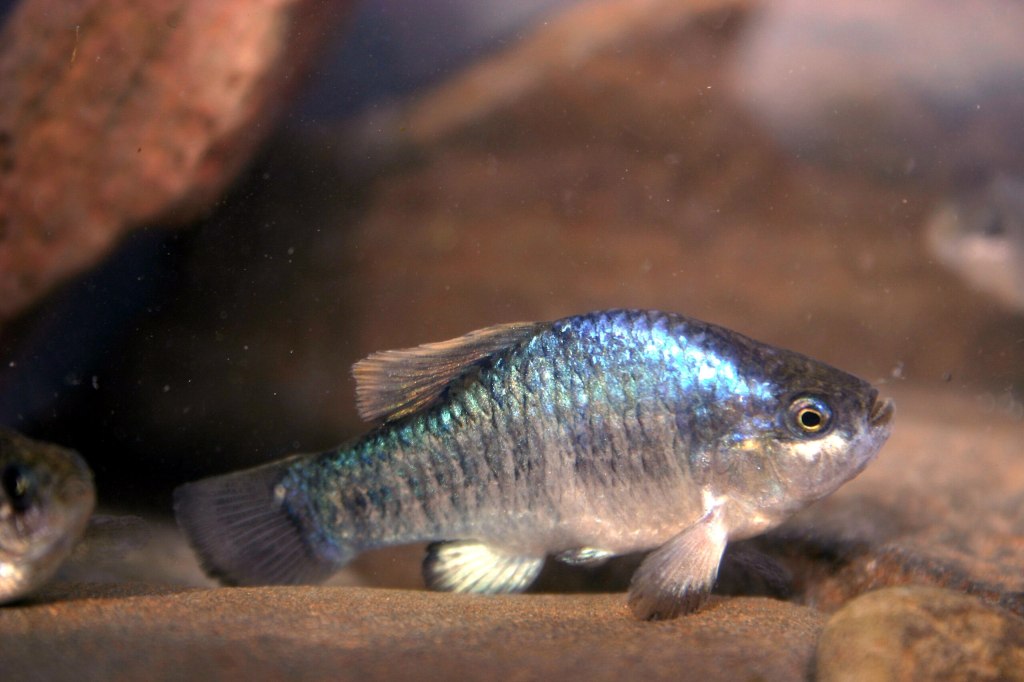
Owens pupfish (California Department of Fish and Wildlife)

But by the late 1900s, the city began outgrowing its water supply. Fred Eaton, mayor of Los Angeles, and his water czar, William Mulholland, hatched a plan to build an aqueduct from Owens Valley to Los Angeles. Most Californians know the story. Through a series of shady deals, Mulholland and Eaton managed to get control of the water in the Owens Valley and, in 1913, the aqueduct was finished. It was great news for the new city, but terrible news for many of the creatures (not to mention the farmers) who depended on the water flowing into and from the Owens Lake to survive.

So named because they exhibit playful, puppy-like behavior, the Owens pupfish rapidly began to disappear. Pupfish are well-known among scientists for being able to live in extreme and isolated situations. They can tolerate high levels of salinity. Some live in water that exceeds 100ยฐ Fahrenheit, and they can even tolerate up to 113ยฐ degrees for short periods. They are also known to survive in near-freezing temperatures common in the lower desert.

Owens River in the Eastern Sierra (Erik Olsen)

One of those animals is the Owens pupfish.

But hot or cold are one thing. The disappearance of water altogether is another.

As California has developed, and as climate change has caused temperatures to rise, thus increasing evaporation, all of California’s pupfish populations have come under stress. Add to these conditions, the early 20th-century introduction by the California Department of Fish and Wildlife of exotic species like largemouth bass and rainbow trout to lakes and streams in the eastern Sierras, and you get a recipe for disaster. And disaster is exactly what happened.

Several species of pupfish in the state have been put on the endangered species list. Several species, including the Owens pupfish, the Death Valley Pupfish and the Devils Hole pupfish are some of the rarest species of fish on the planet. The Devils Hole pupfish recently played the lead role in a recent story about a man who accidentally killed one of the fish during a drunken spree. According to news stories, he stomped on the fish when he tried to swim in a fenced-off pool in Death Valley National Park. He went to jail.

The remains of the Owens River flowing through Owens Valley in California. Credit: Erik Olsen

The impact on the Owens pupfish habitat was so severe that in 1948, just after it was scientifically described, it was declared extinct.

That is, until one day in 1964, when researchers discovered a remnant population of Owens pupfish in a desert marshland called Fish Slough, a few miles from Bishop, California. Wildlife officials immediately began a rescue mission to save the fish and reintroduce them into what were considered suitable habitats. Many were not, and by the late 1960s, the only remaining population of Owens pupfish, about 800 individuals, barely hung on in a “room-sized” pond near Bishop.

On August 18, 1969, a series of heavy rains caused foliage to grow and clog the inflow of water into the small pool. It happened so quickly, that when scientists learned of the problem, they realized they had just hours to save the fish from extinction.

Edwin Philip Pister
Edwin Philip Pister

Among the scientists who came to the rescue that day was a stocky, irascible 40-year-old fish biologist named Phil Pister. Pister had worked for the California Department of Fish and Game (now the California Department of Fish and Wildlife) most of his career. An ardent acolyte of Aldo Leopold, regarded as one of the fathers of American conservation, Pister valued nature on par, or even above, human needs. As the Los Angeles Times put it in a 1990 obituary, “The prospect of Pister off the leash was fearsome.”

“I was born on January 15, 1929, the same day as Martin Luther Kingโ€”perhaps this was a good day for rebels,” he once said.

Pister had few friends among his fellow scientists. Known for being argumentative, disagreeable, and wildly passionate about the protection of California’s abundant, but diminishing, natural resources, Pister realized that immediate action was required to prevent the permanent loss of the Owens pupfish. He rallied several of his underlings and rushed to the disappearing pool with buckets, nets, and aerators.

Within a few hours, the small team was able to capture the entire remaining population of Owens pupfish in two buckets, transporting them to a nearby wetland. However, as Pister himself recalls in an article for Natural History Magazine:

“In our haste to rescue the fish, we had unwisely placed the cages in eddies away from the influence of the main current. Reduced water velocity and accompanying low dissolved oxygen were rapidly taking their toll.”

Los Angeles Aqueduct. Credit: Erik Olsen

As noted earlier, pupfish are amazingly tolerant of extreme conditions, but like many species, they can also be fragile, and within a short amount of time, many of the pupfish Pister had rescued were dying, floating belly up in the cages. Pister realized immediate action was required, lest the species disappear from the planet forever. Working alone, he managed to net the remaining live fish into the buckets and then carefully carried them by foot across an expanse of marsh. “I realized that I literally held within my hands the existence of an entire vertebrate species,” he wrote.

Pister managed to get the fish into cool, moving water where the fish could breathe and move about. He says about half the the population survived, but that was enough.

Today, the Owens pupfish remains in serious danger of extinction. On several occasions over the last few decades, the Owens pupfish have suffered losses by largemouth bass that find their way into the pupfish’s refuges, likely due to illegal releases by anglers. In 2009, the US Fish and Wildlife Service estimated that five populations totaling somewhere between 1,500 and 20,000 Owens pupfish live in various springs, marshes, and sloughs in the Owens Valley, where they are federally protected.

by Erik Olsen

Additional material:

Oral history video featuring Phil Pister recounting his career and that fateful day.

Read previous articles in the California Science Weekly.

https://atomic-temporary-158141606.wpcomstaging.com/2020/03/04/why-are-californias-redwoods-and-sequoias-so-big/

California’s unheralded role in Apollo 11 // Wildfires, climate change and atmospheric rivers // Marine reserves working even better than thoughtย ย // California science news roundup

Sign up for the California Science Weekly newsletter. Fresh California science every Friday!

Week of July 19, 2019

Space

California’s unheralded role in Apollo 11

Buzz Aldrin on the moon - NASA
NASA

When we think about Apollo and attempt to localize it here on earth in our minds, we typically think about Apollo Mission Control Center in Houston, Texas. Who can forget Neil Armstrongโ€™s famous words: “Houston, Tranquillity Base here. The Eagle has landed.”

But thereโ€™s more to Californiaโ€™s role in Apollo. In La Canada Flintridge, home of the Jet Propulsion Laboratory, one of the most important experiments of the whole mission was developed, and it changed the way we look at the moon and its relationship to our planet.

The Lunar Laser Ranging Experiment consisted of a reflector that was positioned on the moon by Armstrong and Aldrin. It was aimed back at the earth, where lasers fired pulses of laser light that were then reflected and detected by special receivers here on the ground. 

The reflectors are too small to be seen from Earth, and the task of actually hitting them was a major technical challenge. Even though a laser is a highly concentrated light, by the time the light reaches the moon, the beam is roughly four miles wide. Scientists back then likened the effort to using a rifle to hit a moving dime two miles away.

Here’s more of the story. 

California Science Weekly


Environment

Wildfires, climate change, and atmospheric rivers

Let’s talk about the weather, water and climate change in California. Lots of stories this week on these subjects. First of all, a big report came out in journal Earthโ€™s Future this week, and it says that the stateโ€™s wildfire issues are clearly being driven by climate change. It points to the fact that in the past decade, we have experienced half of the stateโ€™s 10 largest wildfires and seven of its 10 most destructive fires. That includes last year’s Camp Fire, the stateโ€™s deadliest wildfire ever. The study found that the area burned in California’s forest fires – the annual burned area – has increased in size by 500 percent. The cause, says the paper: more heat, more dryness, more fuel. All of these things can be tied to climate change, it says. 

And then there’s this, which seems a bit contradictory, but here you go: another study from Scripps Institution of Oceanography at UC San Diego says that we will also be seeing more of those atmospheric-river storms that deluged the state earlier this year. It looked at 16 global climate models focusing on western North America and found that most of the heavy precipitation that the West will get in the future will come from these so-called atmospheric rivers. That is to say, when we have rain, it will be more intense and more deluge-like. So, start building those arks. The point here seems to be that when it’s wet, it’s going to be really wet. And when it’s dry, it’s going to be really dry. Like the American electorate today, everything is going to the extremes. 

Ok, moving on. While this may seem contradictory, our big winter storms dumped so much snow that safety officials in the state are warning people about using the rivers that carry all that snow melt out of the mountains. The rivers are raging. This may be great for kayakers and rafters, it can also be dangerous. At least six people have died on the Kern River already this year. On a similar note, Mammoth Mountain, which is almost always closed by now, will be open until for skiing until July 28. Earlier the mountain had said August, but they changed their minds. That said, there is still 60 feet of snow at the summit. Wha?

Earthโ€™s Future      Scripps Institution of Oceanography


Ocean Science

Marine reserves are working even better than we thought  

Rockfish

California has one of the largest, most robust marine protected area systems in the world, covering about 18 percent of the stateโ€™s waters. The system is vast, stretching down the entire coast from Crescent City to San Diego. It has been phased in over the years, but most of the areas are now firmly in place with severe restrictions on fishing and any kind of “taking”, like rocks shells, etc. And while many studies have been done to show that MPAs work to bring back animals life, there has long been a question whether they lead to a so-called “spillover effect”, that is, whether animals breed and multiply and then move out of the areas, enriching other zones.

Well, a new study shows that there is a spill-over effect. Scientists from the National Oceanic and Atmospheric Administrationโ€™s (NOAA) Southwest Fisheries Science Center used genetics to track kelp rockfish, a species in California that tends to remain in the same location their entire adult lives. The key word here is “adult,” because the kids move around. By following counting fish and analyzing DNA, the scientists showed that juvenile kelp rockfish actually do move out of marine reserves sometimes as far as about 20 kilometers away. This suggests that there is, in fact, a spillover effect taking place in the reserves. This is very good news for ecologists, but also for fishermen, who could see more fish showing up in non-restricted areas.  

Hakai


California science news roundup

The cracks left behind by the recent Southern California earthquakes have become tourist attractions. Of course they have. (SF Gate)

There are ten Apollo “moon trees” in California (NatGeo

This very cool video shows what happens when scientists from MBARI shine blue light on the deep-sea squid Histioteuthis. Its green eye glows with fluorescence like something otherworldly. Scientists are not sure why, but think it may have something to do with absorbing light. (YouTube)  

The Mount Wilson Observatory recently opened the doors to its 100-inch telescope to the public for stargazing. Get the kids and go! (Mt. Wilson)

A marine biologist who studies porpoises mating says one of the best places to observe them is…the Golden Gate Bridge. (MEL Magazine)

The U.S. Department of Transportation has selected San Diego as the location for a major drone testing program that will include high-altitude mapping of the U.S.-Mexico border, package deliveries, and first responder operations. (SDNews)

Speaking of cool video, NASA’s Jet Propulsion Laboratory released this very impressively produced piece about their new climbing robot LEMUR, designed to work in extreme terrain. It can scale rock walls. Wow, JPL, keep it up. (YouTube)

A coal plant in Utah has been L.A.โ€™s single-largest power source for three decades. The plant is closing in 2025 and the state will move to natural gas. But that has some clean energy folks upset.  (LA Times)

Valley fever, a dangerous fungal disease, may be striking California farmworkers. Rates of new cases rose 10 percent between 2017 and 2018, according to the California Department of Public Health. https://www.nbcnews.com/news/amp/ncna1017806

We loved this video about the recovery of the Channel Island fox by SkunkBear. (YouTube) 

Lake Tahoe, the second deepest in the U.S., is 7/10 of an inch away from it’s legally allowed capacity. It’s risen 8 feet in 3 years, all thanks to this year’s big winter storms. (NNBN) 

Elon Musk’s Neuralink made a big announcement about its brain-computer interface system, that will dramatically increase the number of electrodes that can connect to a brain. But one of the most interesting goals is that it may allow paraplegic patients to use their thoughts to type at a rate of 40 words per minute. 

California produces the vast majority of the world’s sunflower seeds, but farmers in one county are asking visitors to stop taking selfies in sunflower fields because they are causing damage. (Guardian)

A potential crisis for stem cell research: since 2004, scientists have benefited from a $3 billion state research agency called the California Institute for Regenerative Medicine. But now the agency says it is no longer funding new projects. (ScienceMag)

In a new 440,000-square-foot fulfillment center in Los Angeles, robots are working furiously to get stuff to you faster. (LA Times)

Not news: People are fishing in the LA River. News: they’re eating lots of them

Remember that great story about the guy who killed the endangered fish in Death Valley? Well hereโ€™s a video of that same underwater pond called Devils Hole during the earthquake. (NPS)

That’s it! Have a great week, and please send your friends an invitation to sign up for the California Science Weekly newsletter. 

Design by Luis Ramirez