California’s Eye on the Cosmos: The SLAC-Built Camera That Will Time-Lapse the Universe

Images from the most powerful astronomical discovery machine ever created, and built in California

A breathtaking zoomed-in glimpse of the cosmos: this first image from the Vera C. Rubin Observatory reveals a deep field crowded with galaxies, offering just a taste of the observatory’s power to map the universe in unprecedented detail.
(Credit: NSF–DOE Vera C. Rubin Observatory)

I woke up this morning to watch a much-anticipated press conference about the release of the first images from the Vera Rubin Telescope and Observatory. It left me flabbergasted: not just for what we saw today, but for what is still to come. The images weren’t just beautiful; they hinted at a decade of discovery that could reshape what we know about the cosmos.I just finished watching and have to catch my breath. What lies ahead is very, very exciting. 

The first images released today mark the observatory’s “first light,” the ceremonial debut of a new telescope. These images are the result of decades of effort by a vast and diverse global team who together helped build one of the most advanced scientific instruments ever constructed. In the presser, Željko Ivezić, Director of the Rubin Observatory and the guy who revealed the first images, called it “the greatest astronomical discovery machine ever built.”

This image combines 678 separate images taken by NSF–DOE Vera C. Rubin Observatory in just over seven hours of observing time. Combining many images in this way clearly reveals otherwise faint or invisible details, such as the clouds of gas and dust that comprise the Trifid nebula (top) and the Lagoon nebula, which are several thousand light-years away from Earth.
(Credit: NSF–DOE Vera C. Rubin Observatory)

The images shown today are a mere hors d’oeuvre of what’s to come, and you could tell by the enthusiasm and giddiness of the scientists involved how excited they are about what lies ahead. Here’s a clip of Željko Ivezić as the presser ended. It made me laugh.

So, that first image you can see above. Check out the detail. What would normally be perceived as black, empty space to us star-gazing earthlings shows anything but. It shows that in each tiny patch of sky, if you look deep enough, galaxies and stars are out there blazing. If you know the famous Hubble Deep Field image, later expanded by NASA’s James Webb Space Telescope, you may already be aware that there is no such thing as empty sky. The universe contains so much stuff, it is truly impossible for our brains (or at least my brain) to comprehend. Vera Rubin will improve our understanding of what’s out there and what we’ve seen before by orders of magnitude.   
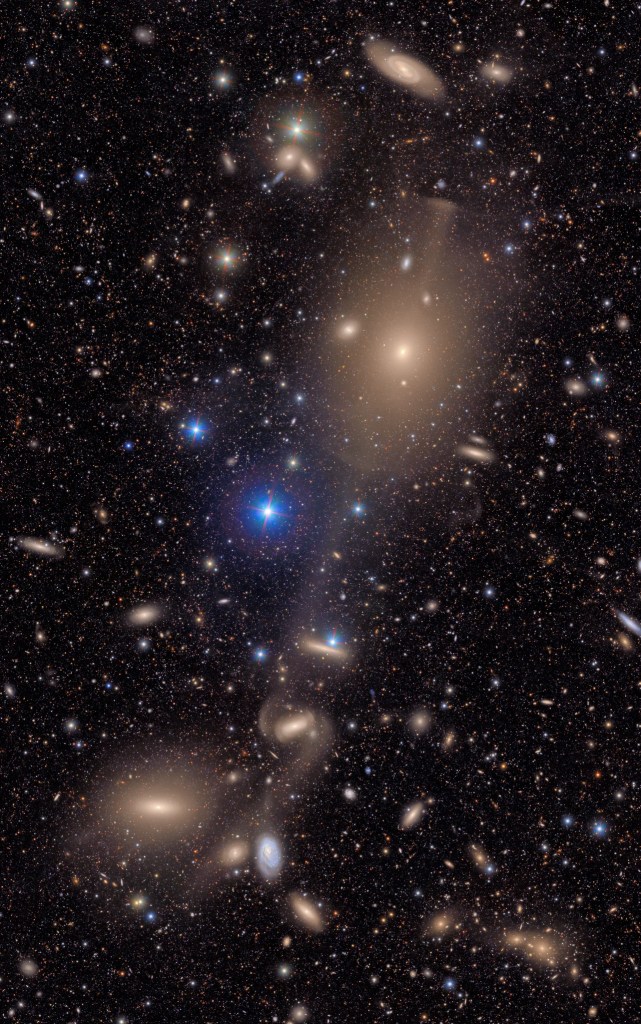
This image captures a small section of NSF–DOE Vera C. Rubin Observatory’s view of the Virgo Cluster, revealing both the grand scale and the faint details of this dynamic region of the cosmos. Bright stars from our own Milky Way shine in the foreground, while a sea of distant reddish galaxies speckle the background.
(Credit: NSF–DOE Vera C. Rubin Observatory)

I’ve been following the Rubin Observatory for years, ever since I first spoke with engineers at the SLAC National Accelerator Laboratory about the digital camera they were building for a potential story for an episode of the PBS show NOVA that I produced (sadly, the production timeline ultimately didn’t work out). SLAC is one of California’s leading scientific institutions, known for groundbreaking work across fields from particle physics to astrophysics. (We wrote about it a while back.)
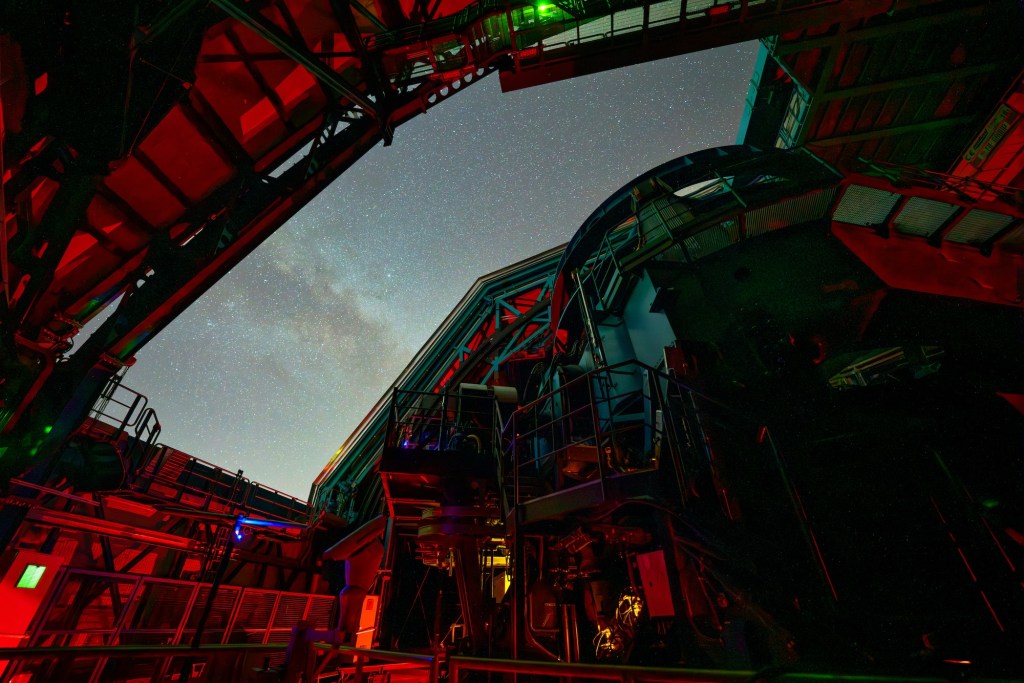
The night sky seen from inside the Vera Rubin Observatory (Credit: NSF–DOE Vera C. Rubin Observatory)

Now fully assembled atop Chile’s Cerro Pachón, the Vera C. Rubin Observatory is beginning its incredible and ambitious mission. Today’s presser focused on unveiling the first images captured by its groundbreaking camera, offering an early glimpse of the observatory’s vast potential. At the heart of the facility is SLAC’s creation: the world’s largest digital camera, a 3.2-gigapixel behemoth developed by the U.S. Department of Energy.

This extraordinary instrument is the central engine of the Legacy Survey of Space and Time (LSST), a decade-long sky survey designed to study dark energy, dark matter, and the changing night sky with unprecedented precision and frequency. We are essentially creating a decade-long time-lapse of the universe in detail that has never been captured before, revealing the dynamic cosmos in ways previously impossible. Over the course of ten years, it will catalog 37 billion individual astronomical objects, returning to observe each one every three nights to monitor changes, movements, and events across the sky. I want to learn more about how Artificial Intelligence and machine learning are being brought to bear to help scientists understand what they are seeing.

The camera, over 5 feet tall and weighing about three tons, took more than a decade to build. Its focal plane is 64 cm wide-roughly the size of a small coffee table-and consists of 189 custom-designed charge-coupled devices (CCDs) stitched together in a highly precise mosaic. These sensors operate at cryogenic temperatures to reduce noise and can detect the faintest cosmic light, comparable to spotting a candle from thousands of miles away.
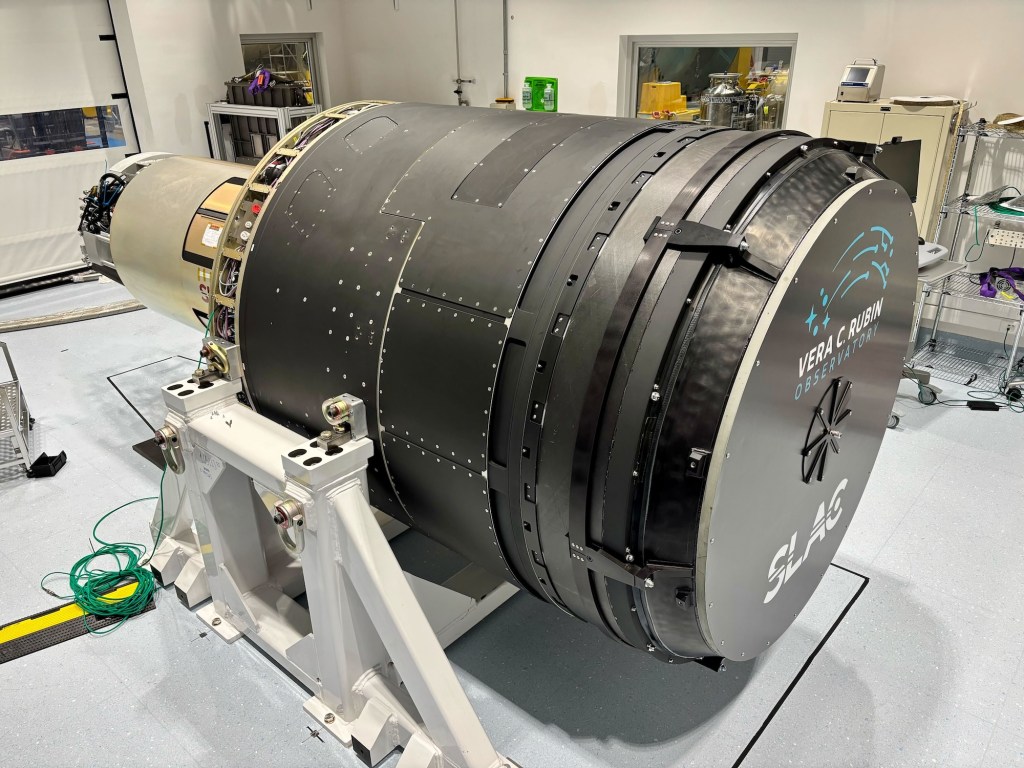
The LSST Camera was moved from the summit clean room and attached to the camera rotator for the first time in February 2025. (Credit: RubinObs/NOIRLab/SLAC/DOE/NSF/AURA)

Rubin’s camera captures a massive 3.5-degree field of view-more than most telescopes can map in a single shot. That’s about seven times the area of the full moon. Each image takes just 15 seconds to capture and only two seconds to download. A single Rubin image contains roughly as much data as all the words The New York Times has published since 1851. The observatory will generate about 20 terabytes of raw data every night, which will be transmitted via a high-speed 600 Gbps link to processing centers in California, France, and the UK. The data will then be routed through SLAC’s U.S. Data Facility for full analysis.
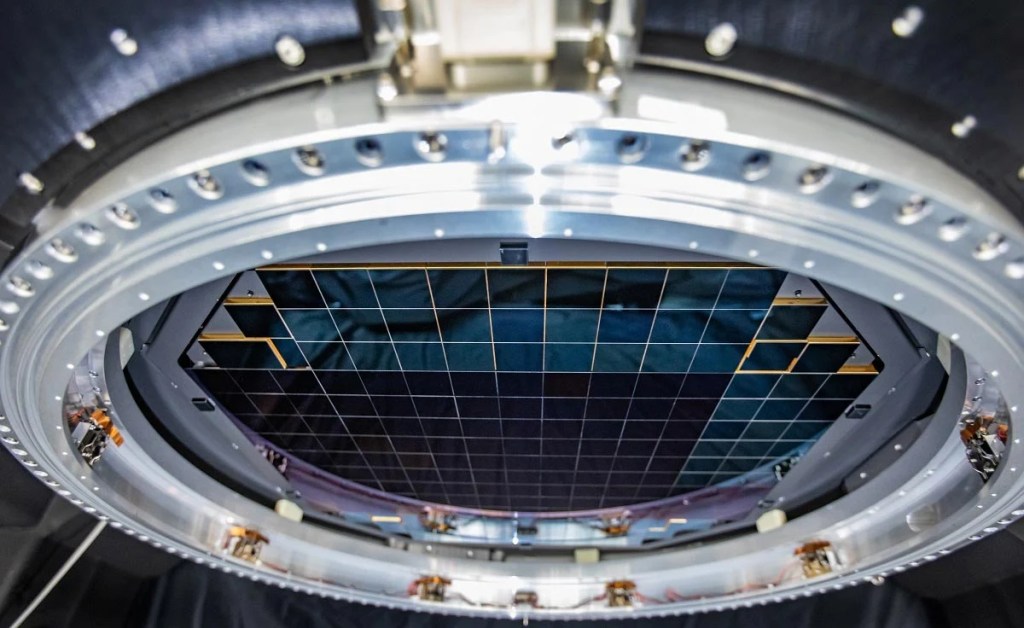
The complete focal plane of the future LSST Camera is more than 2 feet wide and contains 189 individual sensors that will produce 3,200-megapixel images. Crews at SLAC have now taken the first images with it. Explore them in full resolution using the links at the bottom of the press release. (Credit: Jacqueline Orrell/SLAC National Accelerator Laboratory)

The images produced will be staggering in both detail and scale. Each exposure will be sharp enough to reveal distant galaxies, supernovae, near-Earth asteroids, and other transient cosmic phenomena in real time. By revisiting the same patches of sky repeatedly, the Rubin Observatory will produce an evolving map of the dynamic universe-something no previous observatory has achieved at this scale.

What sets Rubin apart from even the giants like Hubble or James Webb is its speed, scope, and focus on change over time. Where Hubble peers deeply at narrow regions of space and Webb focuses on the early universe in infrared, Rubin will cast a wide and persistent net, watching the night sky for what moves, vanishes, appears, or explodes. It’s designed not just to look, but to watch. Just imaging the kind of stuff we will see!
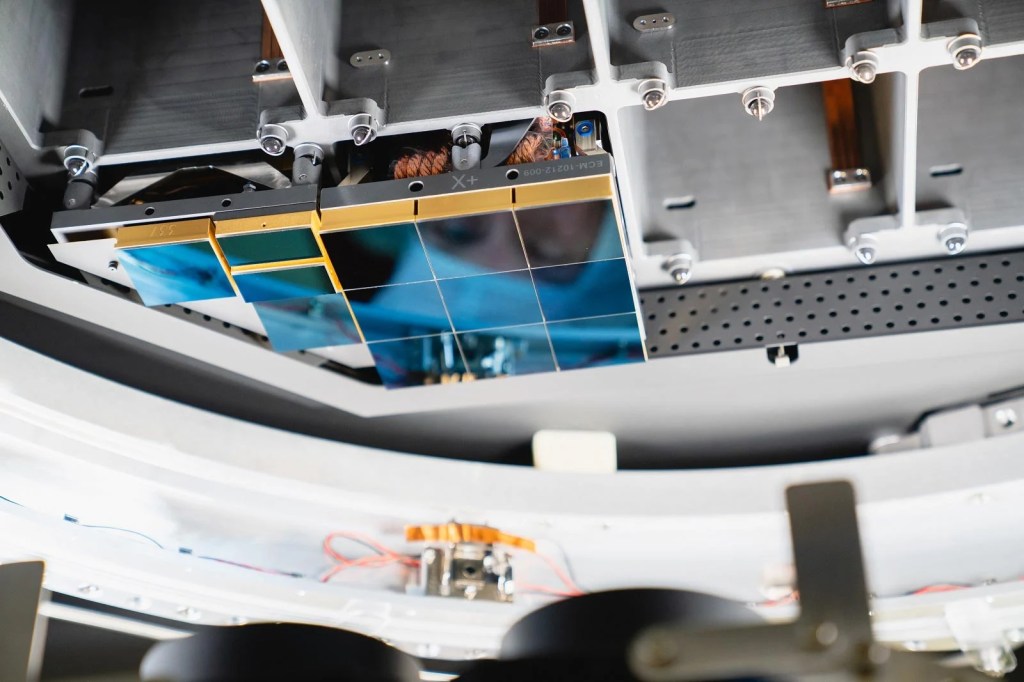
The LSST Camera’s imaging sensors are grouped into units called “rafts.” Twenty-one square rafts, each with nine sensors, will capture science images, while four smaller rafts with three sensors each handle focus and telescope alignment. (Credit: Farrin Abbott/SLAC National Accelerator Laboratory)

This means discoveries won’t just be about what is out there, but what happens out there. Astronomers expect Rubin to vastly expand our knowledge of dark matter by observing how mass distorts space through gravitational lensing. It will also help map dark energy by charting the expansion of the universe with unprecedented precision. Meanwhile, its real-time scanning will act as a planetary defense system, spotting potentially hazardous asteroids headed toward Earth.

But the magic lies in the possibility of the unexpected. Rubin may detect rare cosmic collisions, unknown types of supernovae, or entirely new classes of astronomical phenomena. Over ten years, it’s expected to generate more than 60 petabytes of data-more than any other optical astronomy project to date. Scientists across the globe are already preparing for the data deluge, building machine learning tools to help sift through the torrent of discovery.

And none of it would be possible without SLAC’s camera. A triumph of optics, engineering, and digital sensor technology, the camera is arguably one of the most complex and capable scientific instruments ever built. I don’t care if you’re a Canon or a Sony person, this is way beyond all that. It’s a monument to what happens when curiosity meets collaboration, with California’s innovation engine powering the view.

As first light filters through the Rubin Observatory’s massive mirror and into SLAC’s camera, we are entering a new era of astronomy-one where the universe is not just observed, but filmed, in exquisite, evolving detail. This camera won’t just capture stars. It will reveal how the universe dances.

Mt. Wilson Observatory in Los Angeles is a Celestial Time Capsule

Mt. Wilson Observatory (Erik Olsen)

Perched atop a lofty peak in the San Gabriel Mountains of California sits a historic treasure, one of the great astronomical tools of the 20th century: the Mt. Wilson Observatory. For more than 100 years, it has been a centerpiece for major astronomical discoveries, playing a pivotal role in our understanding of the universe. The observatory, with its rich history shaped by devoted scientists, advanced technology, and revolutionary discoveries, stands as a testament to humanity’s relentless pursuit of knowledge.

The story of the Mt. Wilson Observatory begins with the visionary astronomer George Ellery Hale. Recognizing the importance of location, Hale selected Mt. Wilson for its elevation of 5,710 feet and its proximity to the Pacific Ocean, which provided consistently stable, clear skies—perfect conditions for astronomical observations. In 1904, he installed the first telescope at the site, the Snow Solar Telescope, specifically designed for studying the Sun. This telescope marked the beginning of groundbreaking solar research at the observatory and set the stage for future advancements in astronomy.

Many brilliant minds walked the halls and explored domes of Mt. Wilson, but few shone as brightly as Edwin Hubble. In the 1920s, using the Hooker Telescope – then the largest in the world – Hubble made two groundbreaking discoveries:

Before Hubble’s observations at Mt. Wilson, the prevailing belief was that our galaxy, the Milky Way, constituted the entirety of the universe. The existence of other galaxies was not yet confirmed, and what we now know as galaxies were often referred to as “nebulae” and thought to be part of the Milky Way.

Hubble’s groundbreaking discovery in 1923-1924, using the 100-inch Hooker telescope at Mt. Wilson, revealed that the Andromeda Nebula (now known as the Andromeda Galaxy) was far beyond the Milky Way, providing the first concrete evidence that the universe extended far beyond our own galaxy. This discovery fundamentally altered our understanding of the cosmos, leading to the realization that the universe is vast and filled with countless galaxies.

Expanding Universe

Using the powerful Hooker telescope once again, Hubble carefully observed distant galaxies and made a groundbreaking discovery: these galaxies were moving away from us. Even more astonishing was that the farther a galaxy was, the faster it was receding. This finding provided clear evidence that the universe itself was expanding. Hubble’s revelation shattered the long-held belief in a static universe and laid the groundwork for the Big Bang theory, suggesting that the universe had a specific beginning and has been expanding ever since. Through Hubble’s meticulous observations, humanity gained a new understanding of a dynamic, ever-evolving cosmos, far more vast and mysterious than anyone had previously imagined.

Edwin Hubble

Many other scientists have also made major discoveries at Mt. Wilson. One luminary, Harlow Shapley, used the observatory to gauge more specifically our place in the Milky Way. Before Shapley, Earth was believed to be at the galaxy’s center. However, through his observations of globular clusters, he pinpointed our more humble location on a distant spiral arm.

Another notable scientists who made significant contributions at Mt. Wilson Observatory was Walter Baade. Baade, a German-American astronomer, played a key role in refining our understanding of the universe by studying stars in different populations. During World War II, when Los Angeles experienced blackout conditions, Baade took advantage of the clearer skies at Mt. Wilson to observe celestial objects with unprecedented clarity. He discovered that there were two distinct types of stars in the Milky Way, which led to the realization that galaxies had different stellar populations. This breakthrough allowed Baade to correct the scale of the universe, doubling the previously estimated size of galaxies and distances to them. His work helped refine Hubble’s expanding universe theory and provided a deeper understanding of the evolutionary stages of stars. Baade’s observations were critical in the advancement of modern cosmology and our comprehension of the vastness of space.

Instruments of Enlightenment

Over the years, Mt. Wilson has housed a suite of powerful telescopes:

  • The Hooker Telescope: At 100-inches, it was the world’s largest when it was installed in 1917. It’s the very instrument Hubble used for his revolutionary work.
  • The Snow Solar Telescope: The observatory’s inaugural instrument remains crucial for solar studies.
  • The CHARA Array: The Center for High Angular Resolution Astronomy array is an impressive configuration of six telescopes that function as an interferometer. It allows for sharper images of stars than even the Hubble Space Telescope. The CHARA Array has a spatial resolution equivalent to a single telescope 331 meters (over 1000 ft) in diameter. Light from each of the six telescopes is transported through fiber optics to a special beam-combining room. 

Not only has Mt. Wilson been instrumental in observing distant stars, but it also has a unique device: the Snow Horizontal Solar Telescope. This apparatus, combined with the spectrograph, was used to study the sun’s magnetic fields. It has since been fundamental in understanding solar cycles and the impact of solar phenomena on Earth’s climate.

Mt. Wilson Observatory

In 2020, the Bobcat Fire, the second largest fire on record in Los Angeles County to date, burned over 115,000 acres and was active for more than three months. Annually, the team at Mount Wilson Observatory takes measures against potential forest fires, removing fire-hazardous invasive plants and ensuring their extensive water tanks are full for the fire suppression system. Just a few months prior to the blaze, they had fitted new high-capacity hydrants. These proactive steps played a pivotal role in safeguarding the Observatory when the Bobcat Fire flames approached within a mere 20 feet of its perimeter. A dozen fire squads, each consisting of 40 to 50 firefighters from various units, tirelessly worked day and night to protect this cherished landmark.

Scene at Mt. Wilson after the 2020 Bobcat Fire (Erik Olsen)

Visitors to the Mt. Wilson Observatory have a rare chance to not only tour the grounds but also look through the same telescopes that revolutionized astronomy. Public “Telescope Nights” offer the exciting opportunity to observe the night sky through the famous 60-inch or 100-inch telescopes, the latter being the largest in the world open to the public. These sessions allow people to view celestial objects like planets, star clusters, and nebulae in stunning detail. Reservations are necessary for these events, as spots fill up quickly due to high demand. Additionally, private group sessions and special events can be arranged, providing an unforgettable, up-close experience with the universe. Guided tours are also available for those who want to dive into the observatory’s rich history, tracing the steps of astronomers who made some of the greatest discoveries of the 20th century.

Hey there! If you enjoy California Curated, consider donating the price of a coffee to support its creation!