Pasadena: City of Science

How Pasadena Became a Hub of Scientific Endeavor

Pasadena and Colorado Boulevard (Erik Olsen)

Yeah, yeah, you know the Rose Bowl.

But Pasadena isnโ€™t just about pretty streets and historic buildingsโ€”itโ€™s also a powerhouse of scientific discovery. Tucked between its tree-lined avenues and old-town charm is a city buzzing with innovation, home to some of the most groundbreaking research and brilliant minds in the world. Ask Einstein.

All right. Let’s keep going. While the climate of Southern California, with its mild weather and clear skies, was advantageous for astronomical observations and outdoor research, the city’s location also played a role in attracting scientists and researchers seeking a desirable living environment. The pleasant climate and natural beauty of the region were significant draws for many. But the city also owes much of its scientific prestige to the Second World War, when the city emerged as a pivotal intellectual and manufacturing hub for aeronautics and space, driven by its strategic location, advanced research institutions like the California Institute of Technology (Caltech), and an influx of skilled labor. The region’s aerospace industry, including companies such as Hughes Aircraft, Douglas Aircraft, Lockheed and North American Aviation, all of which played a crucial role in producing military aircraft and pioneering advancements in aerospace technology. By the end of World War II, 60 to 70 percent of the American aerospace industry was located in Southern California;
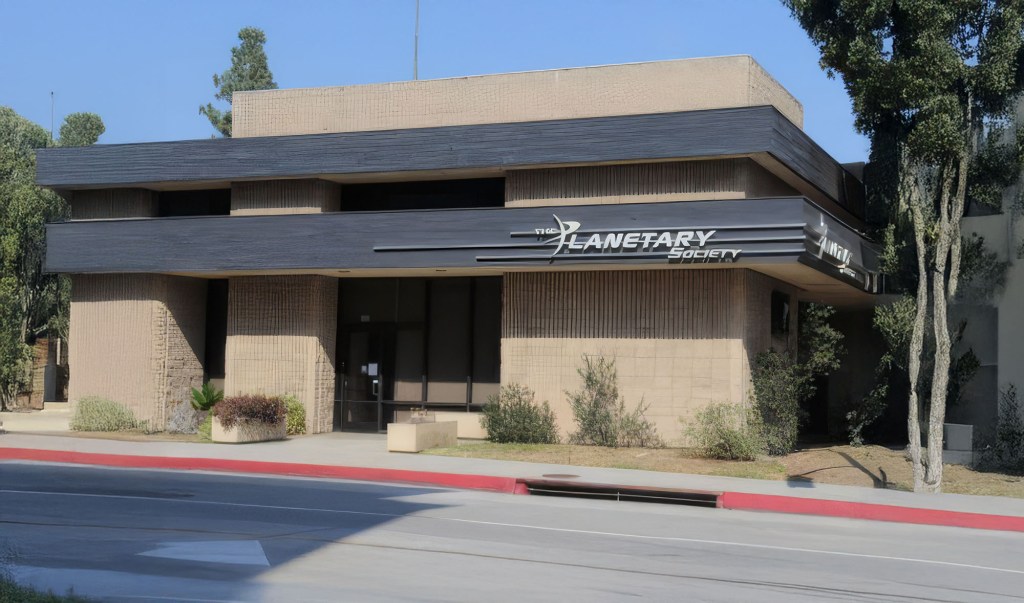
Planetary Society Headquarters in Pasadena (Erik Olsen)

The scientific pedigree of Pasadena can be traced back to notable historical figures, among them the great Richard Feynman, a theoretical physicist known for his work in quantum mechanics and his Nobel Prize-winning contributions to quantum electrodynamics. Feynman was a long-time faculty member at the California Institute of Technology (Caltech) and left an indelible mark on both physics and science education. 

Richard Feynman (Caltech Archives)

In engineering, there is Theodore von Kรกrmรกn, a Hungarian-American mathematician, aerospace engineer, and physicist, who is remembered for his pioneering work in aerodynamics and astronautics. He was responsible for crucial advances in aerodynamics characterizing supersonic and hypersonic airflow. He is best known for the von Kรกrmรกn vortex street, a pattern of vortices caused by the unsteady separation of flow of a fluid around a cylinder, which has applications in meteorology, oceanography, and engineering. Von Kรกrmรกn was also a key figure in the establishment of the Jet Propulsion Laboratory (JPL), which is managed by Caltech (see below).

Cal Tech (Erik Olsen)

In the mid-20th century, Albert Einstein spent several winters at CalTech, further solidifying the cityโ€™s reputation as a center of scientific thought. During his stays from 1931 to 1933, Einstein delivered lectures and collaborated with some of the brightest minds in physics, which had a lasting impact on the scientific community in Pasadena and beyond.

Albert Einstein in Pasadena (CalTech Archives)

CalTech itself is a cornerstone of Pasadenaโ€™s scientific community. As one of the premier science and engineering institutes globally, it has been at the forefront of numerous breakthroughs in various fields including physics, biology, and engineering. The university is not only a powerhouse of innovation but also a nurturing ground for future scientists, evidenced by its association with 39 Nobel laureates.

Similarly, the Jet Propulsion Laboratory (JPL), which is technically located in La Canada Flintridge (geographically), but has a Pasadena mailing address, is a unique collaboration between NASA and CalTech. JPL is the leading US center for the robotic exploration of the solar system. Its engineers and scientists have been behind some of the most successful interplanetary missions, including the Mars Rover landings, the Juno spacecraft currently exploring Jupiter, and the Voyager probes that have ventured beyond our solar system. 

NASA’s Jet Propulsion Laboratory (Erik Olsen)

Further enriching Pasadenaโ€™s scientific landscape is the Carnegie Observatories, part of the Carnegie Institution for Science. This establishment has been a pivotal site for astronomical discoveries since the early 20th century. Today, it continues to push the boundaries of astronomical science by managing some of the most advanced telescopes in the world and conducting cutting-edge research in cosmology and astrophysics.

Jupiter as captured by NASA JPL’s Juno spacecraft (NASA/JPL-Caltech/SwRI/MSSS/David Marriott)

Though in the mountains above Pasadena, the Mt. Wilson Observatory, founded by George Ellery Hale, was home to some of the world’s most powerful telescopes in the early 20th century, including the 60-inch and 100-inch Hooker telescopes. (See our feature). These instruments were integral to groundbreaking discoveries, such as Edwin Hubbleโ€™s revelation of the expanding universe, which was supported by data from Mt. Wilson’s telescopes.

The Planetary Society, also headquartered in Pasadena, adds to the cityโ€™s scientific aura. Co-founded by Carl Sagan, Bruce Murray, and Louis Friedman in 1980, this nonprofit organization advocates for space science and exploration. It engages the public and global community in space missions and the search for extraterrestrial life, demonstrating the cityโ€™s commitment to fostering a broader public understanding of science.

Mt. Wilson Observatory (Erik Olsen)

Pasadenaโ€™s prowess in scientific innovation is further amplified by the presence of numerous high-tech companies and startups that reside in the city. These range from aerospace giants to biotech firms, many of which collaborate closely with local institutions like CalTech and JPL. Moreover, incubators such as IdeaLab and Honeybee Robotics (there are numerous robotics companies…which I think we will do a stand alone story about in the future) have been instrumental in fostering a culture of innovation and entrepreneurship in the city. Founded in 1996 by Bill Gross, IdeaLab has helped launch companies that have had significant impacts on technology and science, from energy solutions to internet technologies.

Pasadena’s status as a city of science is not just rooted in its institutions but also in its history and the ongoing contributions of its residents and thinkers. The city continues to be a fertile ground for scientific discovery and technological innovation, reflecting a deep-seated culture that celebrates curiosity and the pursuit of knowledge. This environment not only attracts some of the brightest minds from around the globe but also supports them in pushing the boundaries of what is possible, making Pasadena a true city of science.
JPL and the Voyager Golden Record: Humanityโ€™s A Cosmic Mixtape in Space

The Jet Propulsion Laboratory (JPL) in La Canada Flintridge, California is well-known for building and sending spacecraft far into the cosmos to help us better understand the universe. But the agency was also extensively involved in one of the most ambitious and symbolic projects in the history of space exploration, one that in many ways was more art than science: the Voyager Golden Record.

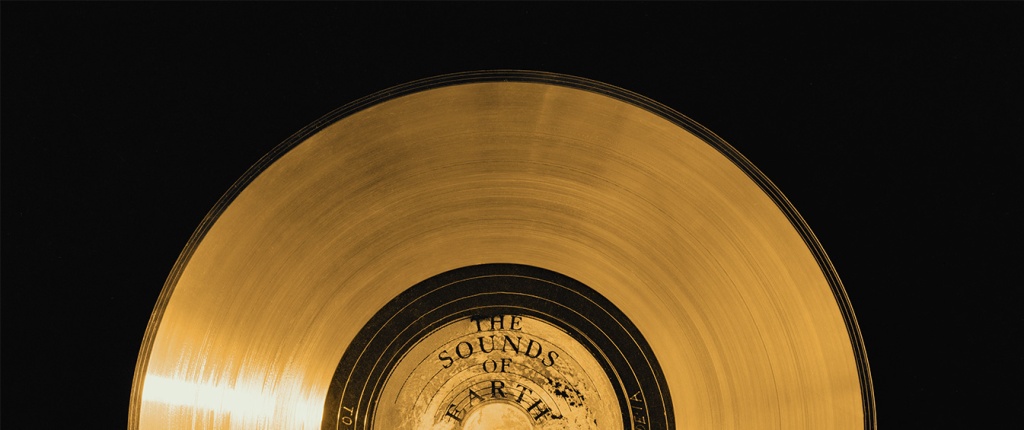
In 1977, as the twin Voyager spacecraft prepared to journey beyond the confines of our solar system, they carried with them what might be the most profound artifacts ever created by humanity: the Voyager Golden Records. These records, designed to last a billion years, are time capsules intended not for Earthlings but for potential extraterrestrial finders or future humans. Engraved in gold-plated copper discs, the records encapsulate the Earth’s diverse cultural and natural heritageโ€”from music to languages to sounds of nature.

Photo: NASA/JPL-Cal Tech

The idea of the Golden Record was developed by a talented team led by Carl Sagan, the renowned astronomer and science communicator. Sagan, alongside other prominent figures such as Frank Drake, Ann Druyan, science journalist Jon Lomberg, and Linda Salzman Sagan, crafted a selection that aimed to represent the entirety of Earth. The content ranged from classical music by Bach and Beethoven to greetings in 55 languages, natural sounds like thunderstorms and whales, and a diverse set of 115 images depicting life and culture on Earth.

But producing a record that could survive the harsh environment of space, while also being understandable and playable by beings of unknown technology, posed unique challenges. This is where the Jet Propulsion Laboratory (JPL) stepped in, playing a pivotal role in transforming this ambitious vision into a tangible, durable artifact capable of traversing the cosmos.

Inspection of the engraving of the Voyager Golden Record.
Photo: NASA/JPL-Cal Tech

JPL, managed by Caltech under a NASA contract, was primarily responsible for the construction and operation of the Voyager spacecraft. Their expertise was crucial not just in the scientific instrumentation and engineering of the spacecraft but also in integrating the Golden Records. The labโ€™s engineers worked meticulously to ensure that the records were equipped with everything needed for potential playback: a cartridge, a needle, and symbolic instructions detailing their use. These instructions, etched onto the recordโ€™s cover, provided a universal map indicating Earthโ€™s location in relation to pulsar stars, which are highly stable and can be used as galactic landmarks.

JPLโ€™s involvement extended to the actual physical preparation of the records. They coordinated closely with RCA Records to produce the master disc from which the Voyager records were replicated. The final products were then plated in gold and encased in a protective aluminum jacket, designed to withstand the vacuum of space, cosmic rays, and extreme temperatures.

Photo: NASA/JPL-Cal Tech

The technical contributions of JPL ensured that the Golden Records were not only a feat of cultural expression but also a marvel of scientific and engineering ingenuity. By equipping the Voyager spacecraft with these messages, JPL helped bridge the human desire to explore and communicate with the tangible reality of space travel. The records, mounted aboard Voyagers 1 and 2, continue to be ambassadors of Earth, carrying sounds, music, and images intended to convey the story of our world to whoever, or whatever, might find them.

Today, both Voyager spacecraft, with their Golden Records, have entered interstellar space, marking them as the most distant human-made objects in existence. They serve as reminders of humanityโ€™s ambition to reach beyond our immediate grasp and to communicate across vast cosmic distances. JPLโ€™s role in this historic endeavor highlights the profound connection between human creativity and technological advancement, ensuring that our message to the cosmos will endure long after the original voices have faded.

JPL written on the Voyager Golden Record
Photo: NASA/JPL-Cal Tech

As these records voyage through the cosmos, they remind us not just of where we have been, but also of the far reaches that our curiosity can take us. Through the combined efforts of visionaries like Carl Sagan and the engineering prowess of JPL, the Voyager Golden Record stands as a testament to the best of human knowledge, culture, and technological achievement.


The Voyager Golden Records are phonograph records, much like the vinyl records used to listen to music before digital media became widespread. They are constructed from copper discs coated in gold to withstand the harsh environment of space. Each record is encased in a protective aluminum jacket, along with a cartridge and a needle. Instructions in symbolic language explain the origin of the spacecraft and indicate how the record should be played. The playback speed (16 2/3 revolutions per minute) is much slower than typical records, which typically spin at 33 1/3 or 45 rpm.

The content of the Golden Record is a meticulously curated selection intended to represent the diversity of life and culture on Earth:

Sounds of Earth: The records include audio of nature sounds like thunder, wind, and animals (including the songs of birds and whales). Human sounds like footsteps, a heartbeat, and laughter are also embedded, capturing the biological and social essence of Earth.

The DNA structure magnified, light hit image is one of the pictures electronically placed on the phonograph records which are carried onboard the Voyager 1 and 2 spacecraft. Credit: Jon Lomberg

Musical Selections: There are 27 musical tracks from different cultures and eras, ranging from classical pieces by Bach and Beethoven to traditional songs from various cultures, including a Navajo chant and a Peruvian wedding song. These selections were intended to showcase the diversity of musical expression on Earth.

Greetings in 55 Languages: A variety of spoken greetings from “Hello” in English to ancient languages like Akkadian. The inclusion of a broad range of languages aims to depict the linguistic diversity of humanity.

Images: The record also contains 115 analog-encoded photographs and diagrams. These images show a wide range of subjects, including humans of different sexes and races, everyday activities, scientific knowledge like mathematical definitions, and the Solar System. The intent was to offer a visual summary of our planet and its inhabitants.

CALIFORNIA CURATED ART ON ETSY

Purchase stunning art prints of iconic California scenes.
Check out our Etsy store.

Message from the UN Secretary-General and the President of the United States: There are also printed messages from prominent global leaders at the time, including U.S. President Jimmy Carter and United Nations Secretary-General Kurt Waldheim.

Sounds of Human Origin: Beyond natural and environmental sounds, the record also includes a montage of the sounds of Earth, a screaming chimpanzee, a medley of human-originated noises like tools, vehicles, and a kiss, among others.

The idea behind the Voyager Golden Record is not just to communicate where and who we are but also to share a message of hope and peace with any possible recipient, even if that recipient is far in the future. The chances of the Voyager spacecraft actually being found by extraterrestrial life are slim, but the Golden Record serves as a profound gesture of goodwill and a testament to the human spirit’s longing to reach out and explore the universe.

Journey to the Iron Giant: NASA’s Psyche Mission Could Unlock the Secrets of a Metallic World

The Psyche spacecraft in the clean room of the Jet Propulsion Laboratory in La Canada Flintridge, CA

A NOVEL PROPULSION SYSTEM WILL TAKE US TO A MASSIVE METAL ASTEROID IN DEEP SPACE

Imagine being able to move your car with your breath. One long blow out the back window, and your car begins speeding down the highway. Now imagine that if you keep blowing, your car accelerates to over 124,000 miles per hour. 

Of course, if you actually did this on Earth, you would turn blue in the face and your car would remain still. But in the vast vacuum of empty space where there is little gravity and no atmospheric drag, that tiny amount of thrust can be very effective. 

On October 12, NASAโ€™s Jet Propulsion Laboratory in La Caรฑada Flintridge will launch a spacecraft toward Mars and Saturn that will put this idea to the test. The agency is sending a 3,600-pound vehicle into space propelled by futuristic solar electric thrusters that deliver a force equivalent to the mass of about two quarters. They also happen to emit a cool blue glow that looks like something out of Blade Runner. 

The Hall Thruster’s eerie blue glow is due to it’s emission of Xenon gas

The spacecraft, called Psyche, launched aboard a SpaceX Falcon Heavy rocket from the historic Launch Complex 39 at NASAโ€™s Kennedy Space Center. The spacecraft will initially be set on a trajectory to fly by Mars, where it will receive a gravity assist, catapulting it further out into the solar system. In late 2026, the spacecraft will enter into orbit around a rare metal asteroid called Psyche 16 (hence the spacecraftโ€™s name). The journey to the asteroid will take over three and a half years and cover over 1.5 billion miles.ย 

Perhaps the most intriguing — and ultimately beneficial — components of the Psyche mission will be its use of solar electric thrusters. Also known as Hall Effect thrusters, the novel propellant system was designed to be efficient and cost-effective. Solar energy will be generated from a five-panel, cross-shaped solar array that will unfold and immediately begin harvesting energy from the sun. At 800 square feet, they are the largest panels ever installed at JPL, and when fully deployed, will extend about the area of a singles tennis court.  

The resulting energy will be used to turn xenon, a dense, colorless, odorless noble gas into xenon ions, atoms that carry a charge because the number of electrons does not equal the number of protons. Xenon is found in Earth’s atmosphere in trace amounts and is used in car headlights and plasma TVs. As the xenon ions are accelerated out of the thruster, they create thrust, propelling the spacecraft forward. The amount of thrust, however, will be minuscule compared to that of chemical-based propulsion systems normally employed on missions like those to Mars, Jupiter, and Saturn. 

โ€They operate at a low thrust level,โ€ says David Oh, Psycheโ€™s project system engineering manager. โ€œYou canโ€™t use it to launch from the earth. But in space, you operate these thrusters over a long period of time and you can get to very high speeds.โ€ 

Psyche spacecraft inside the NASA JPL clean room (Erik Olsen)

In other words, in space, a force equivalent to a hastily expelled deep breath is enough to move a ton and a half of metal through space at a speed more than one hundred times that of a fired bullet. 

Psyche will carry over 1000 kilograms of xenon in its tanks, more than enough to get the spacecraft to Psyche and complete its 21-month mission. JPL engineers estimate that the spacecraft would burn through about 15 times that amount of propellant by weight if it had to use traditional chemical thrusters.  

โ€œWe did try conventional chemical propulsion, and we determined if we did that, we would have quadrupled the mass of the spacecraft. It would have been very difficult to launch and very expensive to build. But this technology was mature and ready to go,โ€ says Oh.

This is not the first time an ion propulsion system has been used in space. Communication satellites orbiting the earth use them regularly. Colorado-based company Maxar Technologies developed and built the Hall thrusters for near-earth orbit, and NASA has purchased them from the company and made some modifications, but this will be the first time they will be used to venture into deep space.

Psyche asteroid (JPL)

โ€œWe needed advanced propulsion to get into orbit. We were looking at what could we buy rather than building our own thruster from scratch,โ€ says Oh.

Because theyโ€™re so efficient, Psycheโ€™s Hall thrusters can operate nearly nonstop for years without running out of fuel, says Oh. When its mission is over, the spacecraft might have lots of fuel left over, and they will have to decide whether to find other puzzles to solve. If the mission proves a success, Psyche’s Hall thrusters could play a major role in propelling future missions into deep space. 

A Metal Asteroid?

Scientists are giddy at what they might find once Psyche, propelled by the Hall Thruster system, arrives at the asteroid.  

โ€œItโ€™s a kind of world that humans have never visited before,โ€ says Arizona State Universityโ€™s Lindy Elkins-Tanton, principal investigator in charge of the mission. โ€œMost of the exploration we do is going and learning more about a body weโ€™ve already visited. Psyche, we have no photos of it, no one has ever done a flyby or really studied it. Itโ€™s unlike every asteroid we know, as far as we can tell.โ€   

Astronomers have been aware of Psyche’s existence ever since since it was first discovered on March 17, 1852, by the Italian astronomer Annibale de Gasparis. The asteroid, computer models of which resemble a potato, was named after the Greek mythological figure Psyche, the goddess of the soul. It is the largest and most massive of the known M-type asteroids (M stands for metal), and is one of a dozen of the most massive objects in the asteroid belt between Mars and Saturn. 

Scientists believe that Psyche may be part of the core of a body called an early planetesimalโ€”, a moon-sized type of protoplanet that may have once been much larger, but was perhaps struck many years ago by other heavy orbiting objects, shattering it into pieces, but leaving this particular blob of metal and rock behind. Such collisions were common when the early solar system was forming.

If Psyche was once the heart of a planet with a strong convective current and a molten iron-nickel core at its center, then scientists expect it will still have a magnetic field. A magnetometer aboard the spacecraft will measure its pull, while cameras will photograph and map the surface, collecting high-resolution multispectral images. Because of the asteroidโ€™s unique composition, scientists have no idea what to expect when the images first start rolling in. 

โ€œWhat does an impact crater into metal look like? We do not know?โ€ says Elkins-Tanton. 

In a unique twist for this mission, JPL plans to release the images captured by Psyche immediately onto the internet so that anyone can view them within a half-hour of being received. 

โ€œWeโ€™re not going to edit them or curate them. Weโ€™re going to send them out so that everyone can be looking at this funny object for the first time,โ€ says Elkins-Tanton.

In addition, a series of spectrometers will help us understand what the asteroid is made of by measuring the gamma rays and neutrons emitted from it. Depending on what scientists discover, the mission could help answer fundamental questions about the formation of our solar system. 

That will depend, of course, on whether the propulsion system functions as designed. As we stand on the precipice of a new era in space exploration, Hall thrusters aren’t just rocket scienceโ€”they’re the closest thing we have to cosmic alchemy, promising to redefine how we navigate the vast tapestry of our solar system.

Hey there! If you enjoy California Curated, consider donating the price of a coffee to support its creation!

Mars helicopter Ingenuity is ready for its “Wright Brothers” moment

If all goes well, in late July, NASA will do something it’s never done before. The agency will launch a new mission to Mars with the aim of landing a small helicopter on the surface that will perform several test missions to see if we can fly on the surface of the Red Planet.

This is not an easy task, but it will be massively historic.

โ€œThis is very analogous to the Wright brothers moment, but on another planet,โ€ MiMi Aung, the project manager of the Mars helicopter told the New York Times.

The helicopter will be aboard the Perseverance, the fifth robotic rover NASA has sent to Mars. The copter and the rover were both designed and built at at at NASAโ€™s Jet Propulsion Laboratory in La Canada Flintridge. The project has been in development over the past six years.

Credit: JPL

If successful, the small helicopter will initiate a new era for robotic exploration, with the opportunity to get an aerial view of Mars and possibly other worlds in the solar system.

Flying on Mars is not the same as doing so here on earth. There is little atmosphere on Mars, and so taking off requires more power and larger helicopter blades than here on earth. In fact, the atmosphere on the red planet is just 1/100th as dense as Earthโ€™s. Scientists say that flying on Mars is the same as flying at an altitude of 100,000 feet on Earth. That’s three Mount Everests. No helicopter on earth has ever flown higher than 45,000 feet.

JPL scientists say that the project would have been impossible just 10 years ago, but a revolution in the miniaturization of electronics, high-powered batteries and lightweight materials for rotor blades has made the new mission possible.

It took several iterations and experiments to get the copter to lift off in s straight line inside a specially-designed chamber that simulated the Mars atmosphere.

Over 30 days, the helicopter will make up to five flights. For most of the time, however, the copter will remain still, waiting for solar panels to recharge the batteries.

The first is to go up about a few feet and hover for up to 30 seconds, then land. Subsequent flights will be longer, higher, farther. The plan is to test the copter on several short liftoffs on Mars, reaching perhaps just a few feet above the dusty plain where it will be released from the Perseverance. On the fifth flight, assuming all systems are go, the copter will lift off to 15 feet and fly out about 500 feet and come back. Two cameras will help the copter navigate and the flight will last a minute and a half.

This is an extremely exciting time for JPL’s planetary exploration project. The Juno project has been sending back stunning images of Jupiter, including strange hexagonal cloud formations at the poles of the giant planet.

Credit: JPL

Enjoying the California Science Weekly? Check out our weekly newsletter that comes out every Friday.

Also, check out one of our recent features on the California scientific illustrator David Goodsell whose watercolor painting of the coronavirus is “beautiful, but deadly”.