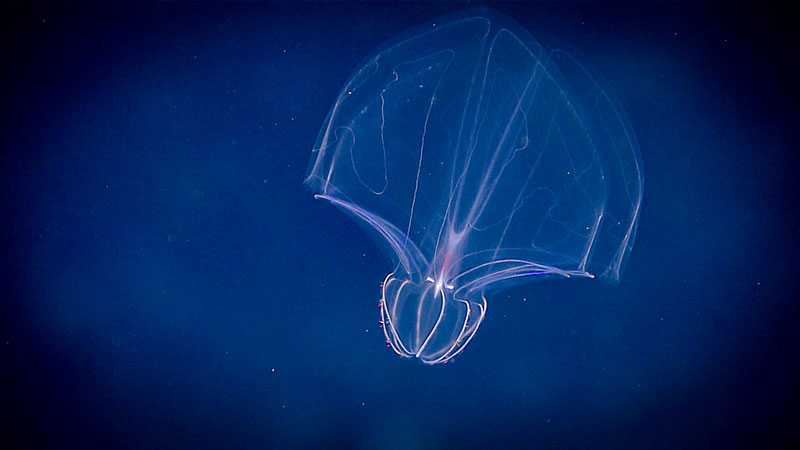
A lobate ctenophore in the ocean twilight zone. (Photo: NOAA)
If you’ve been reading this newsletter for a while, you already know I’m obsessed with submarines and undersea life. I believe we’re at the beginning of a new era of ocean discovery, driven by small personal submersibles, remotely operated vehicles (ROVS), and autonomous explorers (AUVs) that can roam the deep on their own. Add AI into the mix, and our ability to see, map, and understand the ocean is about to expand dramatically.
One phenomenon we are only beginning to fully understand also happens to be one of the most extraordinary animal events on Earth. It unfolds every single night, just a few miles offshore, in a region known as the ocean twilight zone about 650 to 3,300 feet below the ocean surface. Twice a day, billions of tons of marine organisms, from tiny crustaceans to massive schools of squid, traverse the water column in what researchers call the Diel Vertical Migration (DVM), the largest mass migration of animals on Earth. A heaving, planetary-scale pulse of biomass rising and falling through the dark.
It happens everywhere, in every ocean. But California is special for several reasons. California’s cold, southward-flowing current and seasonal upwelling flood coastal waters with nutrients that feed dense plankton blooms. These blooms provide food for thick layers of migrating animals. California has one of the most robust and productive ocean ecosystems on the planet. (Take a read of the piece I did about life on some of our oil rigs.) When you add Monterey Canyon into the mix, which funnels and concentrates life, this global phenomenon becomes more compressed and visible. In fact, with Monterey Bay Aquarium Research Institute (MBARI) based at Moss Landing near the head of the canyon, Monterey Bay has become one of the most intensively studied midwater ecosystems on the planet.
Monterey Bay Aquarium Research Institute (MBARI) in Moss Landing, perched at the edge of Monterey Canyon, one of the deepest submarine canyons in North America. (Photo: Erik Olsen)
This “tidal cycle of shifting biomass” is not driven by gravity, but by the rising and setting sun. Animals rise by the trillions during the evening to escape predation, then settle during the day, when light would otherwise make them visible to hungry predators.
The discovery of this phenomenon reads like a Tom Clancy novel and took place just off our coast. During World War II, U.S. Navy sonar operators working off San Diego and the Southern California Bight began detecting what looked like a “false seafloor” hovering 300 to 500 meters down during the day, only to sink or vanish each night. The mystery lingered for years, until the late 1940s, when scientist Martin Johnson and others at Scripps Institution of Oceanography showed that the phantom bottom was not seafloor, but vast layers of living animals rising and falling with the sun. We now know this as the Deep Scattering Layer (DSL), so named because the gas-filled swim bladders of millions of small fish, primarily lanternfish which number into the quadrillions around the globe, reflect sonar pings like a solid wall.
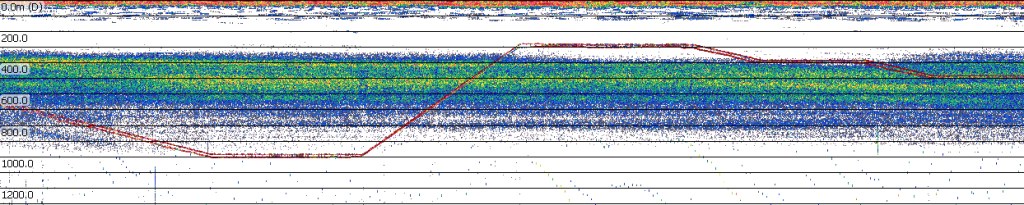
The deep-scattering layer (DSL) graphed as an echogram, or a plot of active acoustic data. Warmer colors indicate more backscatter, meaning that more (or stronger) echoes were received back from the organisms at that depth. The red line indicates the remotely operated vehicle (ROV) trajectory as it performs transects throughout the layer. (Source: NOAA)
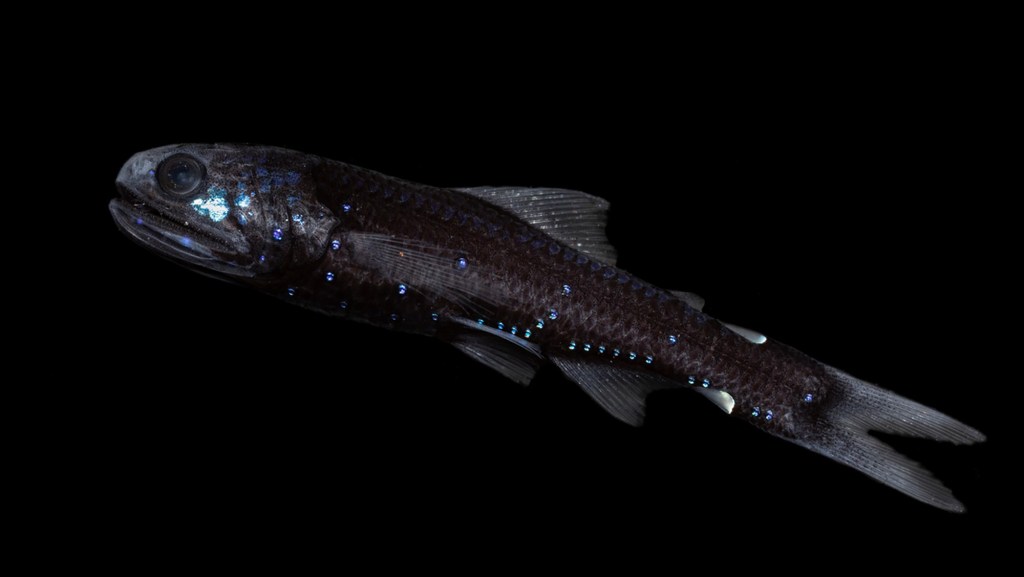
So let’s talk about those amazing lanternfish, aka myctophids, a species that many peole have likely never heard of. These small fish may make up as much as 65 percent of all deep-sea fish biomass and are a major food source for whales, dolphins, salmon, and squid. They use tiny light organs called photophores to match faint surface light, a camouflage strategy known as counterillumination that helps hide them from predators below. These are just one of the many different species that inhabit the twilight zone as part of the DVM.
A lanternfish photographed in the ocean twilight zone, its body dotted with tiny light organs called photophores that help it blend into faint surface light as it migrates toward the surface at night. (Photo: NOAA)
Monterey Bay is arguably the world’s most important laboratory for DVM research, thanks to the Monterey Canyon, and several ground-breaking discoveries have come out of MBARI. For example, scientists at MBARI, including the legendary Bruce Robison, have used ROVs to document what they call “running the gauntlet,” when these migrators pass through layers of hungry, waiting predators. They encounter giant siphonophores with stinging tentacles, squids snag lanternfish, and giant larvaceans that build sprawling mucus “houses” that trap smaller animals. It’s like an epic battle scene out of Lord of the Rings, every single day.
This migration is also a key part of the ocean’s carbon cycle, which includes a scientific process known as the biological pump. When larger animals eat carbon-rich plankton at the surface, they eventually defecate all that carbon into the water, aka the “active transport” mechanism. Much of that carbon sinks to the bottom, sequestering it for decades or even centuries. In some regions, DVM accounts for one-third of the total carbon transport to the deep ocean. MBARI has a very interesting, long-term deep-ocean observatory called the Station M research site and observatory located nearly 12,000 feet below the surface off Santa Barbara. This site has been continuously monitored for more than three decades to track how organic matter produced near the surface eventually reaches the abyssal seafloor and feeds deep communities. I did a video about it for MBARI a few years ago.
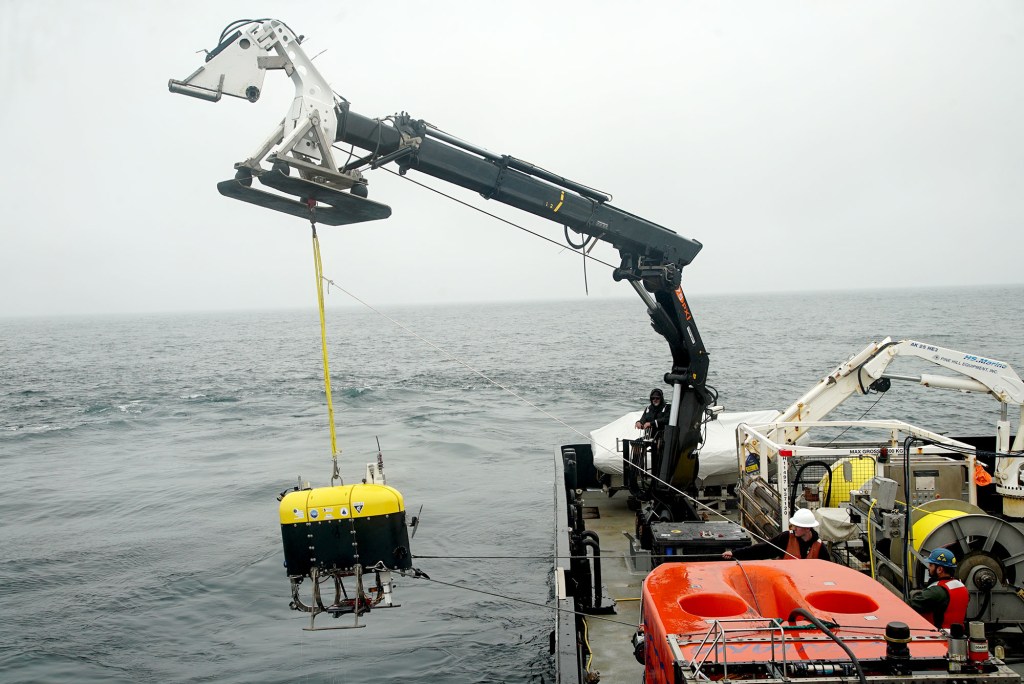
Deployment of Mesobot, an autonomous midwater robot developed by Monterey Bay Aquarium Research Institute and Woods Hole Oceanographic Institution, for exploration of the ocean twilight zone above Monterey Canyon, California. (Photo: Erik Olsen)
Other cutting-edge technology is being brought to bear as well to help us better understand what life exists in the deep waters off California. A UC San Diego study shows that we can now use low-volume environmental DNA (eDNA) to detect the genetic signatures of huge numbers of different animals, even if we can’t see them. This free-floating DNA moves with ocean currents and can be sequenced to identify species ranging from copepods to dolphins, allowing researchers to track who is participating in the migration even when organisms are too small, fragile, or fast for traditional nets.
All of this plays out each day and night off our coast, a vast symphony of animal movement and deadly combat that, until recently, was not only poorly understood but largely invisible to science. And it’s all happening right off our shores
If I told you that some of the richest, densest communities of marine life anywhere in the world thrive off California, you might not be surprised. We all know California has a vibrant marine ecosystem offshore. But if I told you that much of that life clings to the submerged steel legs of offshore oil rigs, you might pause, blink, and say: really?
The answer is yes.
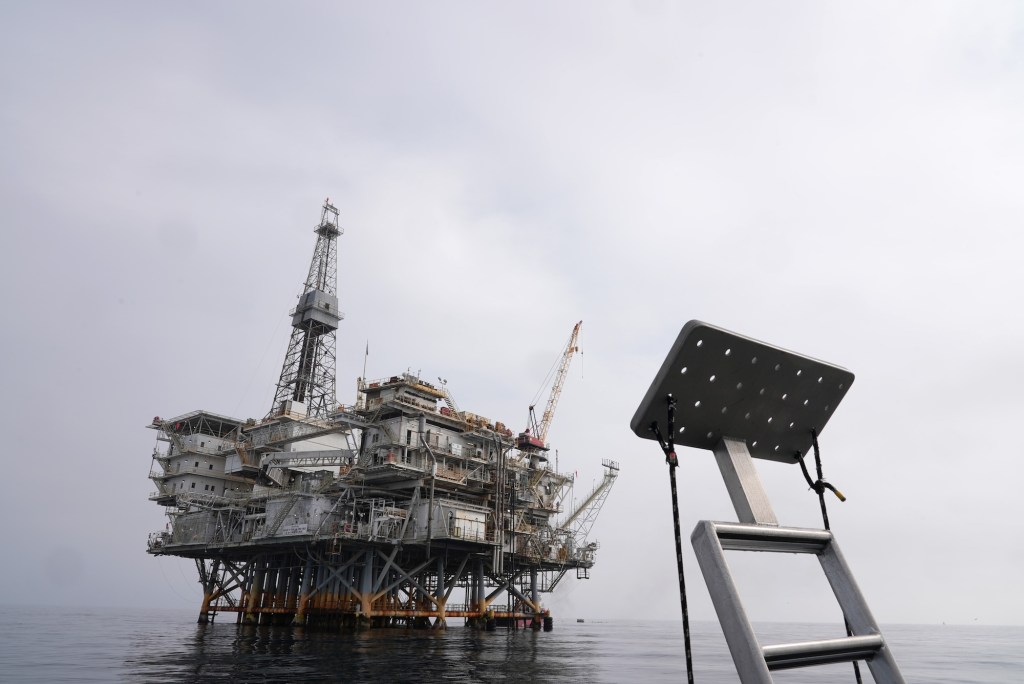
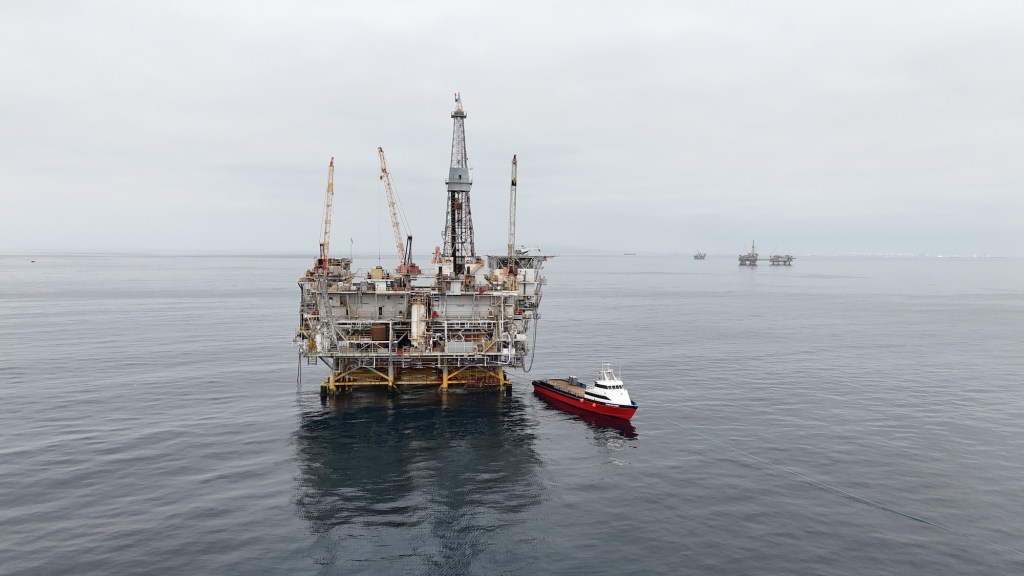
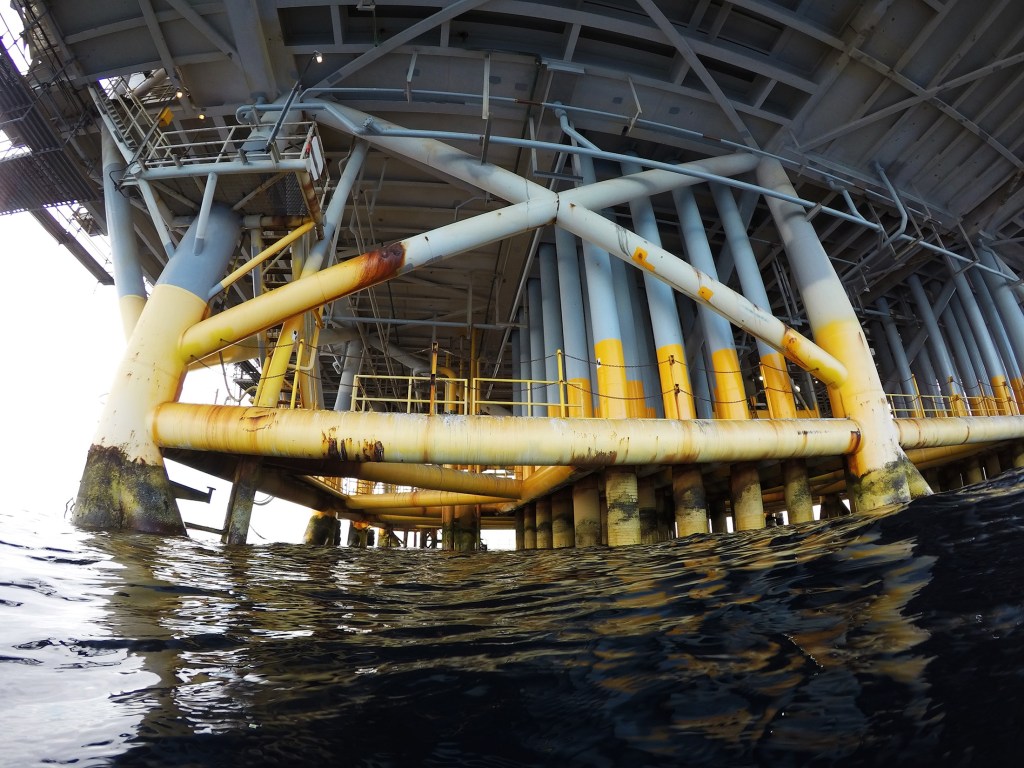
I know because I have dived a few of them several times. Most recently this November, when I took a dive boat called the Giant Stride out of San Pedro and motored 12 miles out to the Eureka platform, which sits in 700 feet of water. From the deck, the rig looms like a floating city of steel and shadow, its massive pylon legs disappearing into the depths below.
The Eureka oil rig off the coast of California from the Giant Stride dive boat. An industrial behemoth above water, beneath, it is home to an immense diversity of sea life. (Photo: Erik Olsen)
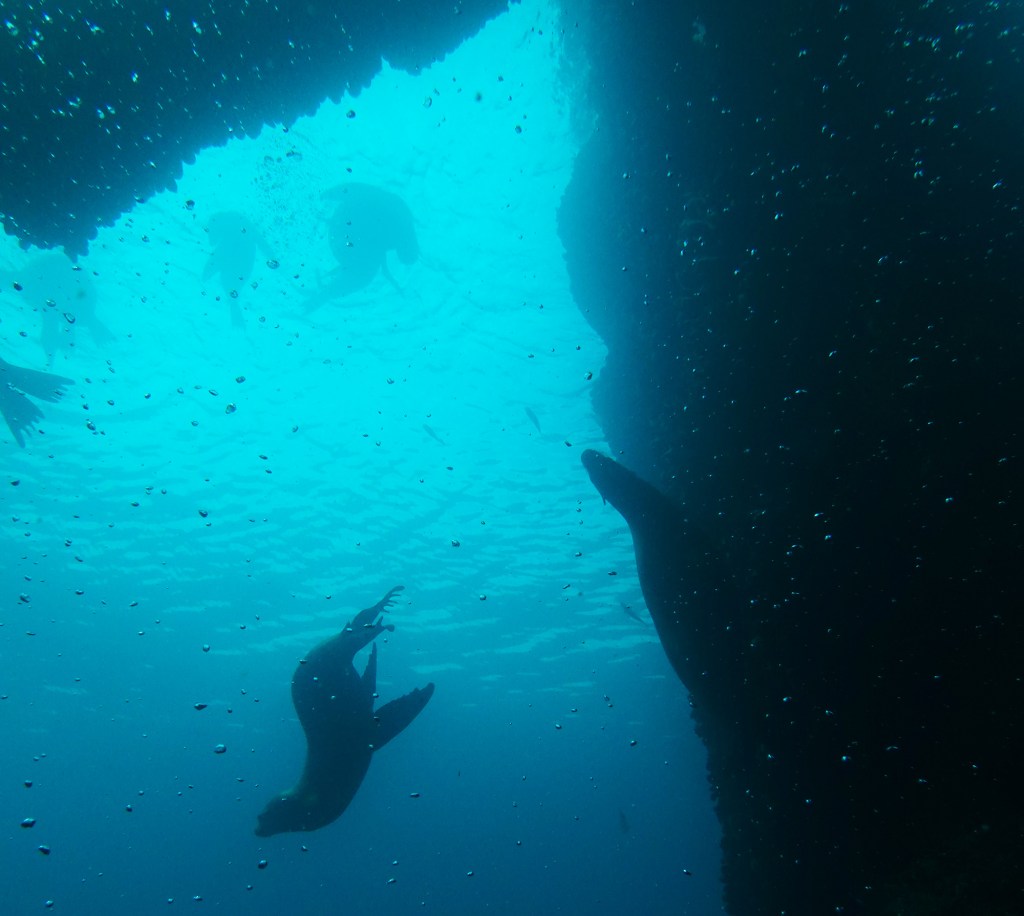
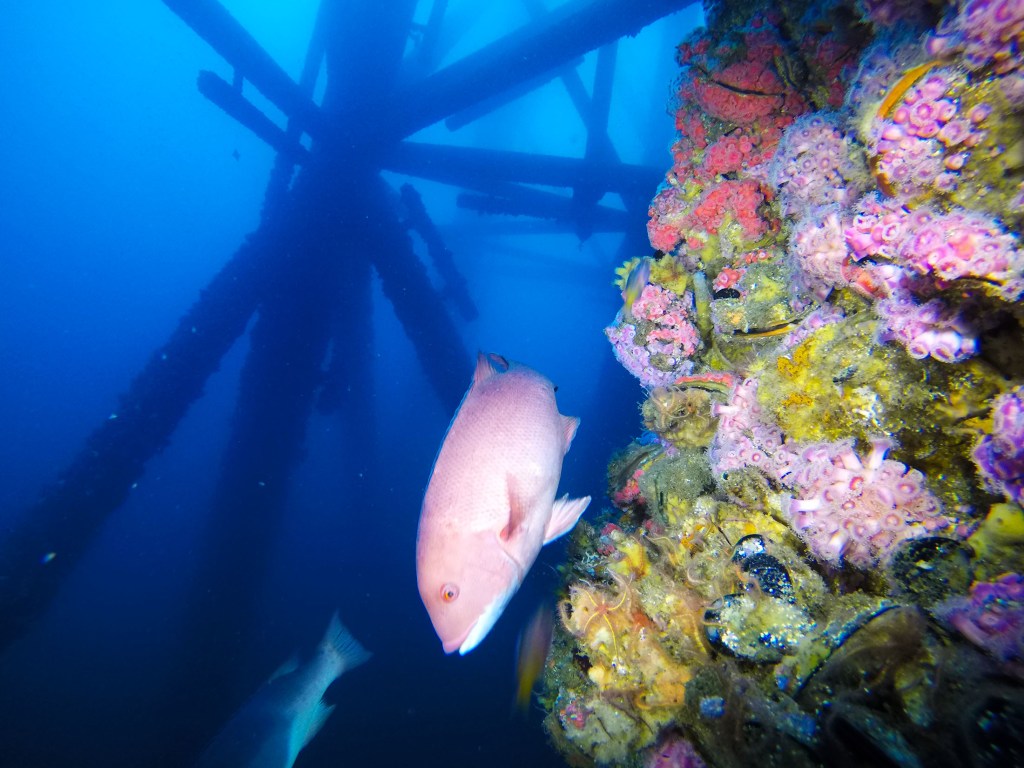
But below the surface is another world, one teeming with millions of colorful fish, including blazing orange garibaldi, schools of dark blue blacksmiths, halfmoons, calico bass, yellowtail, and even the occasional mola mola or sunfish. A few rigs are the playground of scores of jubilant sea lions, many of them precocious youngsters that swoop and spin in the waters beneath the massive structure of the rigs like children let loose in a grassy park.
Playful sea lions frolic around the rigs beneath the surface. (Photo: Erik Olsen)
And then there are the pylons themselves and the life they support. Made of welded steel, these massive structures hold the entire oil platform above the water, millions of tons of machinery and deck space, often topped by a helicopter pad, all balanced on the integrity of engineering. Some descend straight down into the darkening waters, while others are reinforced by diagonal braces and horizontal crossbeams, a lattice of intersecting steel that keeps the rig steady against waves and wind.
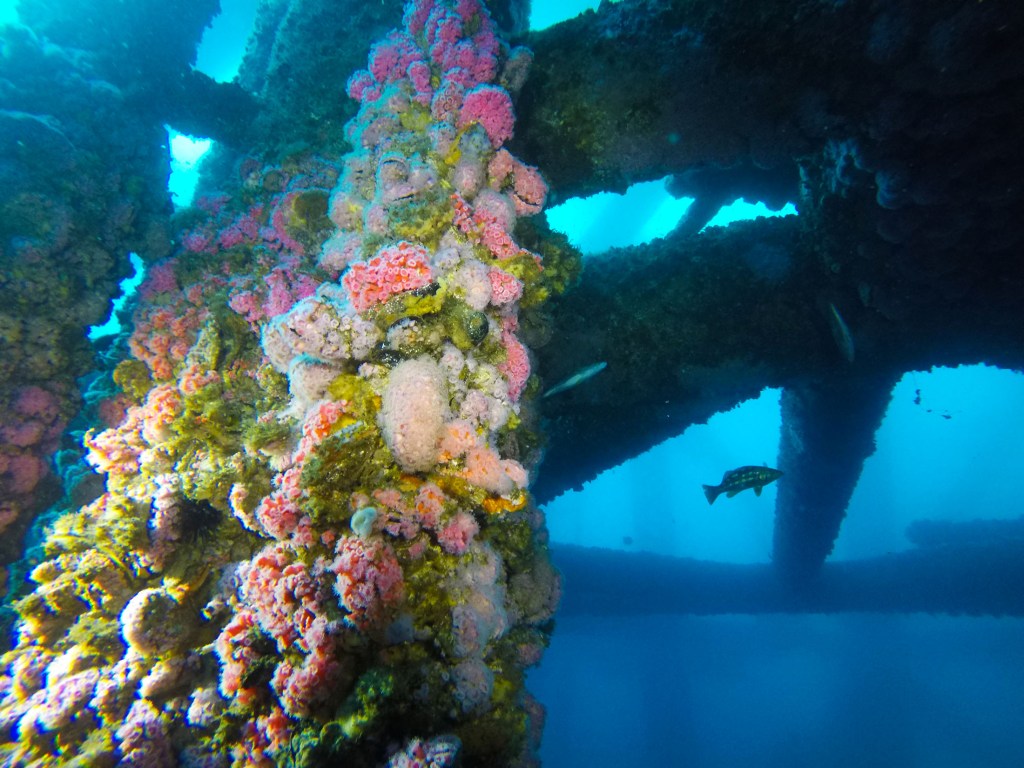
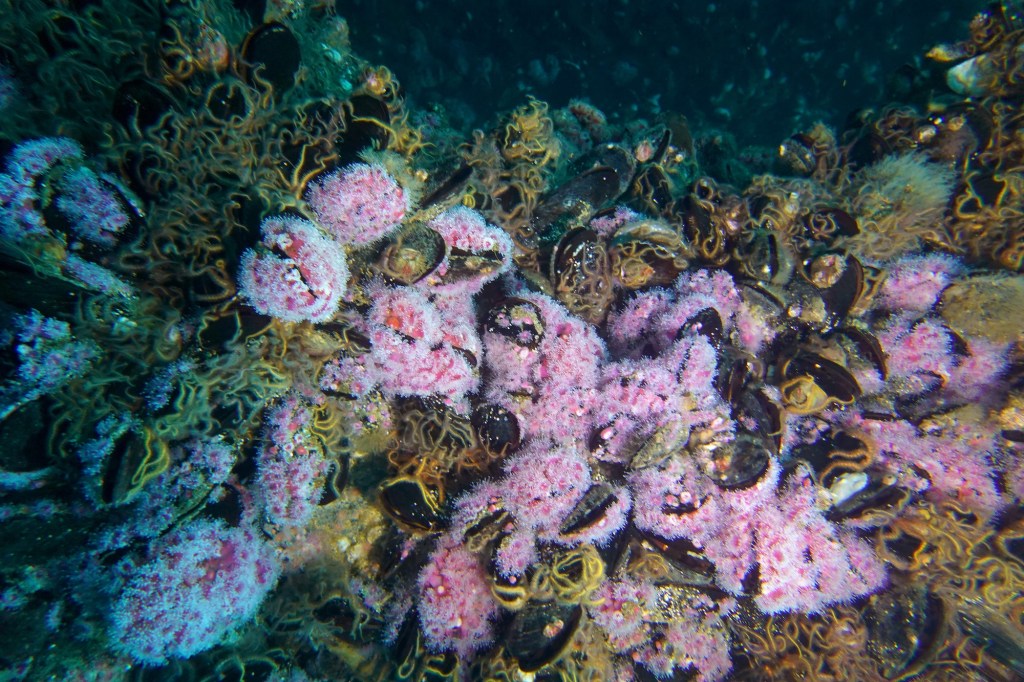
But up close, you can hardly make out the metal. The substructure is so encrusted with life, layers of scallops, brittle stars, mussels, anemones, barnacles, and sponges, that the steel beneath has vanished into a living reef. In some areas, there are thousands of brittle stars clinging to the structure, they lie so thick on it that it’s hard to imagine how they compete for food. But food here is plentiful, and that abundance is one reason these rigs harbor so much life. They stand near the edge of the continental shelf, where the seafloor plunges into deeper water and cold, nutrient-rich currents surge upward toward the light. Those nutrients ignite blooms of plankton, feeding swarms of tiny crustaceans and filter feeders that coat the rig’s pilings. Those smaller creatures, in turn, sustain fish, sea lions, and even passing seabirds, a food web in full expression, built around the steel spine of an oil platform.
Brittle stars, mussels and other oprganisms blanket the rig supports in incredible numbers. (Photo: Erik Olsen)
All of this is not just my observation, however. Numerous studies have been done about the life on the rigs and most of them point to an astonishing fact: these rigs are some of the most productive ecosystems on the planet. In one study, University of California Santa Barbara marine biologist Milton Love and his colleagues found that certain platforms, including Eureka, produced more fish biomass per square meter than even the most productive natural environments in the world. More than mangroves, coral reefs, estuaries, etc.
The Eureka rig off the coast of Southern California. Once built to pump oil, it’s now also home to sea lions, fish, and a reef of life growing on its legs below the waves. (Photo: Erik Olsen)
This is good news for everyone. But there’s more. Other research suggests that the life flourishing on these offshore rigs doesn’t stay confined to them; it drifts, swims, and spawns its way back toward the coast, helping to replenish nearshore habitats. Rockfish are a perfect example. Once severely overfished, several species have made a remarkable comeback in California waters, perhaps due in part to these structures. As we wrote recently, the recovery of rockfish is one of the state’s quiet success stories.
But there’s a hitch.
Pick up some California wildlife gifts at our Etsy store. Seriously, they’re cool.
Several of these rigs are now nearing, or have already reached, the end of their productive lifespan, meaning that they no longer produce much oil. What should be done with them? In California, when offshore oil rigs reach the end of their productive life, state law mandates their decommissioning, which involves safely plugging wells, dismantling structures, and restoring the environment. Traditionally, this has meant full removal of the platform and associated infrastructure: a very expensive proposition, likely costing in the billions of dollars.
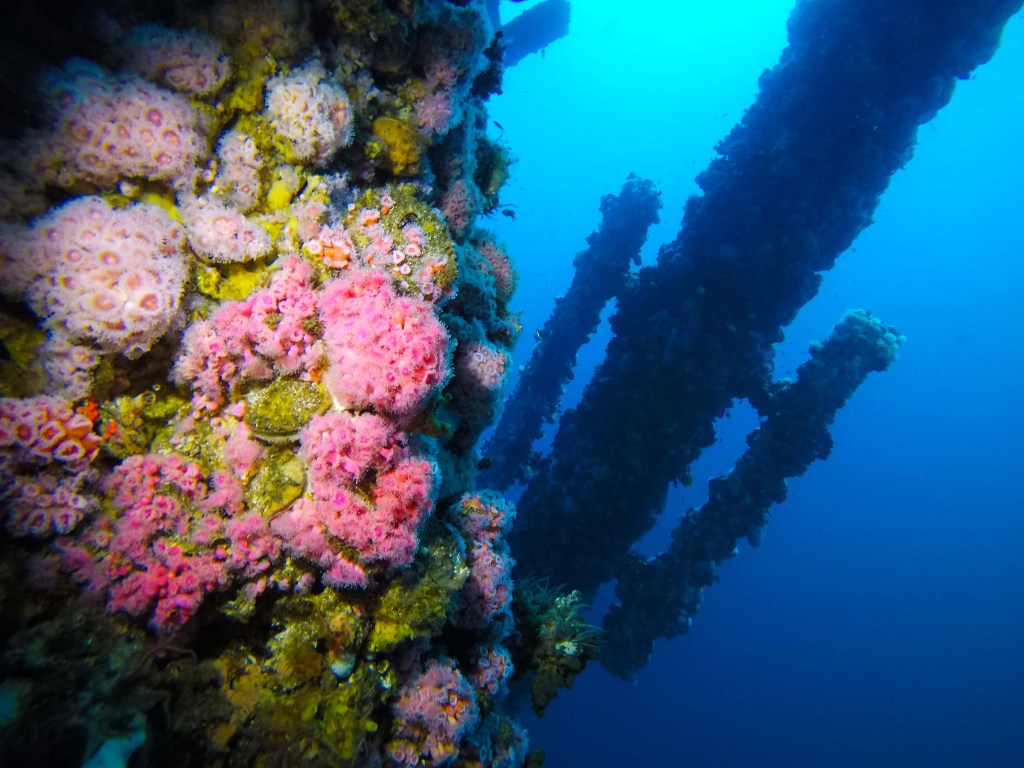
Clusters of mussels and strawberry anemones (Corynactis californica) coat the rig’s submerged structure in a dense mosaic of color. They form living carpets over the steel, while mussels, bryozoans, and brittle stars fill the gaps between them. (Photo: Erik Olsen)
However, the California Marine Resources Legacy Act (AB 2503), enacted in 2010, introduced an alternative known as the “rigs-to-reefs” program. This legislation allows oil companies to apply for permits to partially remove decommissioned rigs, essentially shearing off the part of the structure above water and leaving a portion of it underwater to serve as artificial reefs. Obviously they’d do it deep enough, about 80 feet, that the structure would not become a hazard to ship traffic. The goal is to enhance marine habitats by preserving the ecosystems that have developed around these structures over time. Rig removal is a growing billion-dollar-a-year business, and by removing only part of the rig and leaving behind the rest, an oil company can save millions in decommissioning costs.
As of January 2024, there are eight offshore production platforms in various stages of decommissioning; several have had multiple owners and operators. It’s complicated, but the biggest issue is liability. That is, what happens down the line when there is a leak, or if the plugging of the wells was done improperly? Who pays for that? This is all being hashed out, as it has been for some 20 years now. Californians hate oil washing up on their beaches. Many hate the idea of the oil companies getting a financial break after plundering the sea floor for oil. But there is no denying that all that life is there. You can see it. And, as Milton Love said: “If you remove a platform, you may be killing tens of millions of animals because they happened to settle on steel instead of a rock. Which I think is a tragedy.”
Substructure of the Eureka rig above water in California (Erik Olsen)
Oil companies have not used California’s Rigs-to-Reefs law because it leaves them financially and legally burdened. They must keep long-term liability for the structures and give up to 80 percent of their cost savings to the state, which makes full removal simpler and less risky than the complex and politically sensitive reefing process.
And so, as some of these platforms near the end of their productive lives, a significant debate has emerged over their future. Should they be removed entirely, or could they be repurposed into artificial reefs that continue to support marine biodiversity? The discussion is not just about engineering challenges or environmental concerns; it’s about reimagining the relationship between human infrastructure and the natural world.
Amber Sparks led the expedition I took out to the rigs. I’ve dived with her several times before and believe she’s a passionate advocate for sea life and for a healthy offshore California marine ecosystem. She and her co-founder Emily Hazelwood are strong supporters of reefing the rigs, and through their work with Blue Latitudes, they collaborates with scientists, government agencies, and oil companies to explore ways decommissioned platforms could be transformed into permanent marine habitats rather than dismantled and removed.
“The big question is, are these structures good habitat that should be left in place to continue to thrive as reefs, or should they be removed? In my opinion, they would be really valuable to be left in place as reefs.”
A brittle star falls through the water column beneath the Eureka rig (Erik Olsen)
So where do things stand today? A December 2023 Public Environmental Impact Statement (PEIS) from the Bureau of Safety and Environmental Enforcement and Bureau of Ocean Energy Management marks the most recent major development in the offshore rig debate, and it could significantly shape future decommissioning of California’s oil platforms. Though the PEIS identifies partial removal as the environmentally preferable option (italics mine) because it would preserve the habitat of existing biological communities, the agencies involved selected “Alternative 1a”, mandating complete removal of platform jackets and associated infrastructure offshore southern California. The final decision over what to do with the rigs has not yet been made, but the current wisdom suggests that they may have to go. As a diver and novice fisherman, I consider this a shame.
Public opposition to “big oil” remains strong in California, fueling demands among small but vocal groups for the complete removal of oil rigs, despite the potential loss of coral-like ecosystems. Environmental groups like the Natural Resources Defense Council argue that retaining any portion of these structures enables the oil industry to persist as an environmental threat.
Beneath the surface of a California oil rig, a vibrant colony of pink strawberry anemones transforms industrial infrastructure into an underwater oasis. (Erik Olsen)
“People here have been waiting for these oil platforms to go away,” Linda Krop, an environmental lawyer with the Environmental Defense Center, an advocacy group based in Santa Barbara, told the me when I reported on this for the New York Times. Ms. Krop challenged the notion that the science definitively supports the role of rigs in fostering marine life. She argued that leaving the rigs in place would effectively reward polluters by allowing them to avoid the expense of removal.
Globally, the concept of Rigs-to-Reefs has seen success, particularly in the Gulf of Mexico, where over 500 platforms have been converted into artificial reefs. These structures have become magnets for fish and invertebrates, supporting commercial and recreational fishing and diving industries. However, critics argue that not all programs are created equal. In some regions, lax regulations have allowed oil companies to avoid fully addressing environmental risks, leaving behind structures that degrade over time and release pollutants. California’s approach, with its stringent oversight and commitment to environmental benefits, aims to avoid these pitfalls while maximizing ecological gains.
The oil rigs substructure provides a fascinating contrast to the life on large sections of it. (Erik Olsen)
What happens to California’s oil platforms will reveal how the state chooses to balance economic legacy with ecological responsibility. Few would argue that oil companies deserve further rewards after decades of drilling and profits, yet the decision ahead is not so simple, it is about what becomes of the ecosystems that have grown around their steel foundations. There should be a way to move forward responsibly, one that removes the risk and legacy of drilling while preserving the thriving marine life that has made these structures their home.
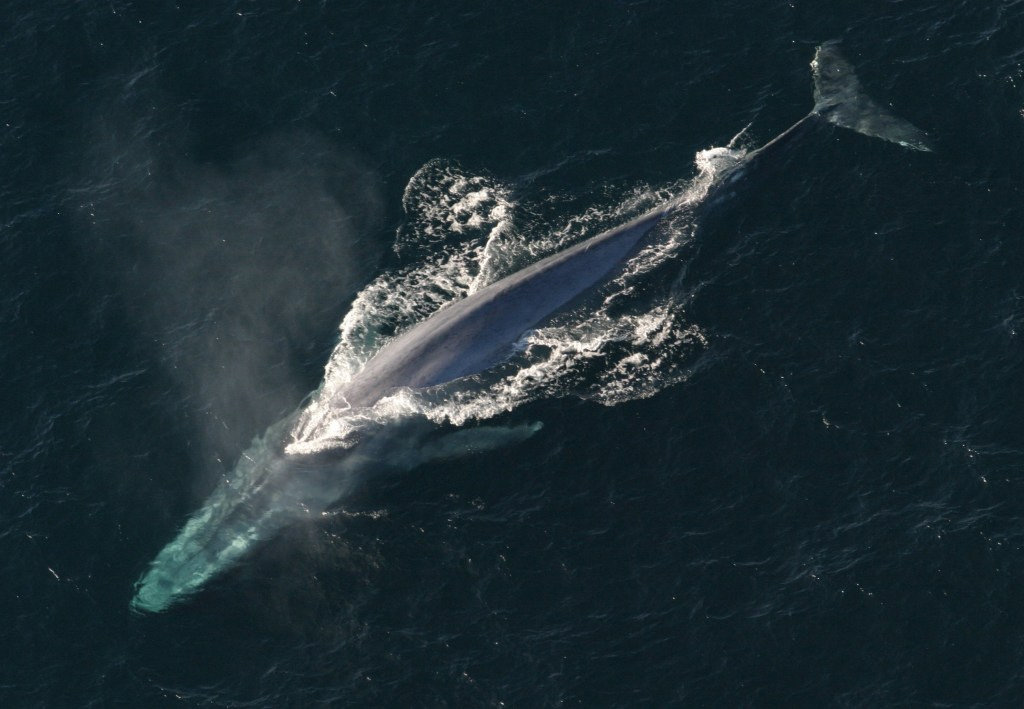
Blue whale off the California coast. (Photo: Erik Olsen)
Not So Big: How We Overstate the Length of the Blue Whale, Earth’s Largest Creature
One of the most extraordinary privileges of living in California, especially near the coast, is witnessing the annual arrival of blue whales. I’ve been at sea on several occasions when these giants surfaced nearby, and to see one in person, or even through my drone RC, is astonishing and unforgettable. I once had the rare and mind-blowing opportunity to swim with and film blue whales off the southern tip of Sri Lanka for a story I wrote and produced, an experience that will forever be seared into memory.
For decades, the blue whale has been celebrated as the largest creature ever to exist (Bigger than dinosaurs! True.), with many popular accounts claiming that these animals can reach lengths of 100 feet or more. Yet in all the videos, photographs, and encounters I’ve seen, not a single whale has come close to that. Still, article after article and documentary after documentary continues to repeat the claim that blue whales “reach 100 feet or more.” Nearly every whale-watching company in California repeats the claim, echoed endlessly across Instagram and TikTok.
But is it true? Most blue whales I’ve seen off the coast of California are half that size or maybe 2/3. It felt misleading to say so otherwise. And so I did a lot of digging: reading, reaching out to experts, poring over historical records, and the fact is that no single blue whale has ever been scientifically measured at 100 feet. Close, as you will soon read, but not 100 feet or more. Especially not off the coast of California.
This discrepancy not only distorts our understanding of these magnificent creatures, but also highlights the broader issue of how media can shape and sometimes mislead public perception of scientific facts.
Blue whale tail fluke in Sri Lanka. (Photo: Erik Olsen)
In other words: the perception that blue whales commonly reach lengths of 100 feet or more likely stems from a combination of historical anecdotes, estimation errors, and a tendency to highlight extreme examples.
All that said, the blue whale (Balaenoptera musculus) is a truly magnificent creature. Hunted nearly to extinction in the 17th to 19th centuries, the blue whale has staged a hopeful recovery in the last five decades, since commercial whaling was outlawed by the international community in 1966 (although some Soviet whale hunting continued into the early 1970s). And California, in particular, has been blessed with the annual appearance of the largest population of blue whales in the world, called the Eastern North Pacific population, consisting of some 2,000 animals. That population makes an annual migration from the warm waters of Baja California to Alaska and back every year. This is the group I’ve seen off Newport Beach.
These numbers are painfully, tragically small compared to what existed before commercial whaling began. Prior to that, it was estimated that there were some 400,000 blue whales on earth. 360,000 were killed in the Antarctic alone. (IMO: this stands as one of the most shameful acts in human history).
The International Union for Conservation of Nature estimates that there are probably between 5,000 to 15,000 blue whales worldwide today, divided among some five separate populations or groups, including the Eastern North Pacific population. Many now swim so close to shore that an entire whale-watching industry has flourished along the California coast, especially in the south, with many former fishing boats converted into whale-watching vessels..
But back to size, or, more specifically, length: there are two credible references in scientific papers of blue whales that are near 100 feet. The first is a measurement dating back to 1937. This was at an Antarctic whaling station where the animal was said to measure 98 feet. But even that figure is shrouded in some suspicion. First of all, 1937 was a long time ago, and while the size of a foot or meter has not changed, a lot of record-keeping during that time is suspect, as whales were not measured using standard zoological measurement techniques (see below). The 98-foot specimen was recorded by Lieut. Quentin R. Walsh of the US Coast Guard, who was acting as a whaling inspector of the factory ship Ulysses. Sadly, there is scant detail available about this measurement and it remains suspect in the scientific community.
The second is from a book and a 1973 paper by the late biologist Dale W. Rice, who references a single female in Antarctica whose “authenticated” measurement was also 98 feet. The measurement was conducted by the late Japanese biologist Masaharu Nishiwaki. Nishiwaki and Rice were friends, and while both are deceased, a record of their correspondence exists in a collection of Rice’s papers held by Sally Mizroch, co-trustee of the Dale W. Rice Research Library in Seattle. Reached by email, Dr. Mizroch said that Nishiwaki, who died in 1984, was a very well-respected scientist and that the figure he cited should be treated as reliable.
According to Mizroch, who has reviewed many of the Antarctic whaling records from the whaling era, whales were often measured in pieces after they were cut up, which greatly introduces the possibility for error. That is likely not the case with the 98-foot measurement, which took place in 1947 at a whaling station in Antarctica where Nishiwaki was stationed as a scientific observer.
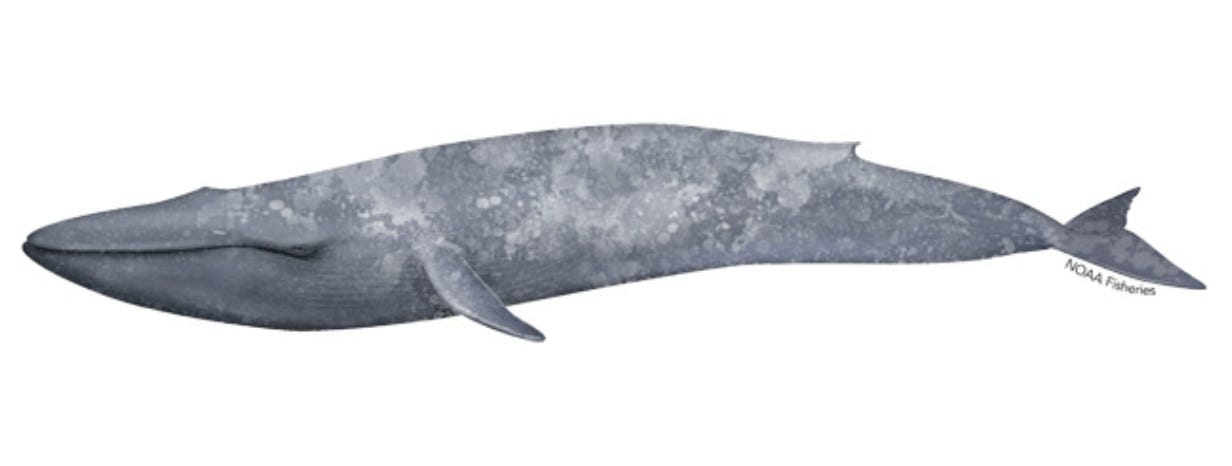
Blue whale (NOAA)
Proper scientific measurements, the so-called “standard method”, are taken by using a straight line from the tip of the snout to the notch in the tail flukes. This technique was likely not used until well into the 20th century, said Mizroch. In fact, it wasn’t until the 1940s that the use of a metal tape measure became commonplace. According to Dan Bortolotti, author of Wild Blue: A Natural History of the World’s Largest Animal, many of the larger whales in the whaling records — especially those said to be over 100 feet — were probably measured incorrectly or even deliberately exaggerated because bonus money was paid to whalers based on the size of the animal caught.
So, according to the best records we have, the largest blue whale ever properly measured was 98 feet long. Granted, 98 feet is close to 100 feet, but it’s not 100 feet, and it’s certainly not over 100 feet, as so many otherwise reputable references state.
So, setting aside the fact that so many sources say the blue whale has reached 100 feet or more, and that there is no scientific evidence proving this, a key question to ask is how large can whales become?
Blue whale from the National Oceanic and Atmospheric Administration
Most baleen whales are so-called lunge feeders. They open their mouths wide and lunge at prey like krill or copepods, drawing in hundreds of pounds of food at a time. Lunge-feeding baleen whales, it turns out, are wonderfully efficient feeders. The larger they become, the larger their gulps are, and the more food they draw in. But they also migrate vast distances, and oftentimes have to dive deep to find prey, both of which consume a large amount of energy.
A 2019 scientific paper in Science described how a team of researchers used an ocean-going Fitbit-like tag to track whales’ foraging patterns, hoping to measure the animals’ energetic efficiency, or the total amount of energy gained from foraging, relative to the energy expended in finding and consuming prey. The team concluded that there are likely ecological limits to how large a whale can become and that maximum size in filter feeders “is likely constrained by prey availability across space and time.” That is especially the case in today’s era, when overfishing and illegal fishing, including krill harvesting in Antarctica, have reduced the amount of prey available even in regions that used to be very prolific.
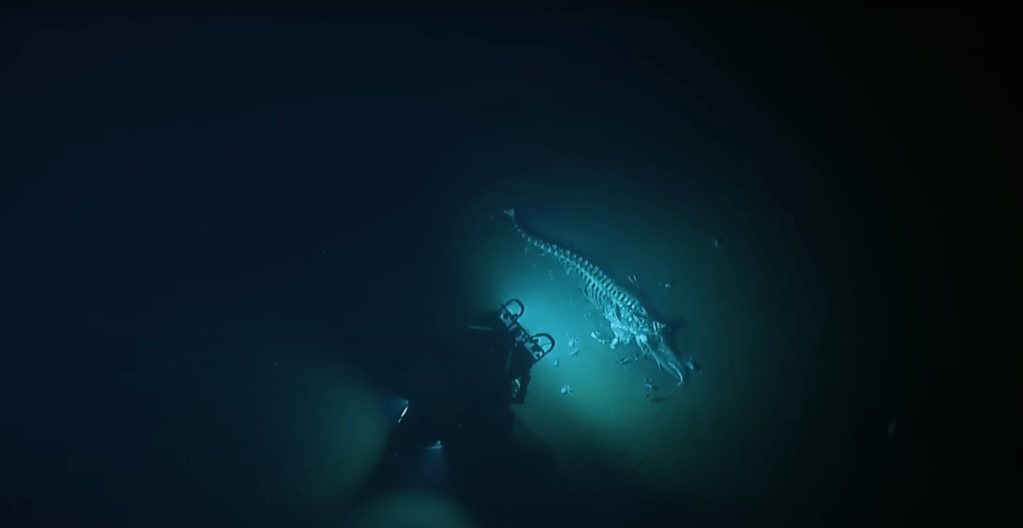
Whale fall off the California Coast (Ocean Exploration Trust)
John Calambokidis, a Senior Research Biologist and co-founder of Cascadia Research, a non-profit research organization formed in 1979 based in Olympia, Washington, has studied blue whales up and down the West Coast for decades. He told California Curated that the persistent use of the 100-foot figure can be misleading, especially when the number is used as a reference to blue whales off the coast of California.
The sizes among different blue whale groups differ significantly depending on their location around the globe. Antarctic whales tend to be much bigger, largely due to the amount of available food in cold Southern waters. The blue whales we see off the coast of California, Oregon, Washington and Alaska, are part of a different group from those in Antarctica. They differ both morphologically and genetically, and they consume different types and quantities of food. North Pacific blue whales, our whales, tend to be smaller and likely have always been so. Calambokidis believes that the chances any blue whales off the West Coast of the US ever reaching anything close to 100 feet is “almost non-existent”.
I emailed Regina Asmutis-Silvia, Executive Director North America of Whale and Dolphin Conservation, to ask about this discrepancy among so many seemingly authoritative outlets. She wrote: “While it appears biologically possible for blue whales to reach or exceed lengths of 100’, the current (and limited) photogrammetry data suggest that the larger blue whales which have been more recently sampled are under 80 feet.” Photogrammetry is the process of using several photos of an object — like a blue whale — to extract a three-dimensional measurement from two-dimensional data. It is widely used in biology, as well as engineering, architecture, and many other disciplines. Photogrammetry measurements are now often acquired by drones and have proven to be a more accurate means of measuring whale size at sea.
Antarctic whaling station.
Here’s a key point: In the early part of the 20th century and before, whales were measured by whalers for the purpose of whaling, not measured by scientists for the purpose of science. Again, none of this is to say that blue whales aren’t gargantuan animals. They are massive and magnificent, but if we are striving for precision, it is not accurate to declare, as so many articles and other media do, that blue whales reach lengths of 100 feet or more. Or to insinuate that this size is in any way common. This is not to say it’s impossible that whales grew to or above 100 feet, it’s that, according to the scientific records, none ever has.
A relevant point from Dr. Asmutis-Silvia about the early days of Antarctic whaling: “Given that whales are long-lived and we don’t know at what age each species reaches its maximum length, it is possible that we took some very big, very old whales before we started to measure what we were taking.”
In an email exchange with Jeremy Goldbogen, the scientist at Stanford who authored the study in Science above, he says that measurements with drones off California “have been as high as 26 meters” or 85 feet.
So, why does nearly every citation online and elsewhere regularly cite the 100-foot number? It probably has to do with our love of superlatives and round numbers. We have a deep visceral NEED to be able to say that such and such animal is the biggest or the heaviest or the smallest or whatever. And, when it comes down to it, 100 feet is a nice round number that rolls easily off the tongue or typing fingers.
All said, blue whales remain incredible and incredibly large animals, and deserve our appreciation and protection. Their impressive rebound over the last half-century is to be widely celebrated, but let’s not, in the spirit of scientific inquiry, overstate their magnificence. They are magnificent enough.
Off the coast of Monterey, California, researchers captured rare footage of one of the deep sea’s strangest residents: the Barreleye fish. With a see-through head and upward-facing, tube-shaped eyes, it looks like something dreamt up for a sci-fi film. Officially called Macropinna microstoma, this bizarre little fish is a real reminder of how much mystery still lies beneath the surface of the ocean and how otherworldly life can get down there.
First described in 1939, the fish astonished scientists who were stunned by its unique optical anatomy. The barreleye is found in the Pacific Ocean, with sightings ranging from the coasts of California, particularly around Monterey Canyon, to the mid-Pacific near Hawaii. Most commonly, it resides between 400 to 2,500 feet below the surface, a region known as the mesopelagic or “twilight” zone. At these depths, little light penetrates, making the area a seemingly inhospitable place for most life forms. But the Barreleye fish thrives here, adapting to its surroundings in the most bizarre ways.
Its most distinctive features, and the ones that give it its name, are its transparent head and barrel-shaped eyes that are usually directed upwards. These eyes are extremely sensitive to light, which is a scarce commodity where it lives. Interestingly, the eyes are encased in a dome-shaped, transparent head. This clear cranium allows the fish to capture as much light as possible, increasing its visual field. The upward-facing eyes allow the Barreleye fish to see silhouettes of prey or predators against the faint light filtering down from the surface. It’s like a built-in periscope for scanning the world above, allowing it to spot the bioluminescent glow of jellies or small fish that meander above it.
In 2009, researchers at the Monterey Bay Aquarium Research Institute elucidated a longstanding mystery surrounding the barreleye. For many years, marine biologists were under the impression that these specialized eyes were immobile and only provided the fish with a limited, tunnel-vision perspective, focused solely on the waters above its transparent head. Such a constraint would significantly limit the fish’s situational awareness, making it highly dependent on what occurs directly above it for both prey detection and predator evasion.
However, a groundbreaking paper by researchers Bruce Robison and Kim Reisenbichler overturned this conventional wisdom. Their findings reveal that the eyes of the barreleye fish are not static but can actually rotate within a transparent protective shield that envelops the fish’s head. This adaptation enables the fish not only to look upwards to identify potential prey but also to focus forward, thereby expanding its field of vision and facilitating more effective foraging.
A remotely operated vehicle or ROV named Doc Ricketts (MBARI)
Robison and Reisenbichler conducted their research using footage obtained from the Monterey Bay Aquarium Research Institute’s remotely operated vehicles (ROVs) to investigate the barreleye fish in the deep-sea regions adjacent to Central California. Situated at depths ranging from 600 to 800 meters (approximately 2,000 to 2,600 feet) beneath the ocean’s surface, the ROVs’ cameras typically captured images of these fish in a state of immobility, floating like zeppelins with their eyes radiating an intense green hue due to the illumination provided by the ROV’s powerful lighting system. The remotely captured video data also divulged a hitherto undocumented anatomical feature—namely, that the eyes of the barreleye fish are encased in a transparent, fluid-filled protective shield that encompasses the upper region of the fish’s cranial structure.
Celebrate California’s incredible birdlife one mug at a time. Each design features a native species illustrated in vivid detail, Check out our Etsy store.
The implications of this discovery extend beyond mere academic curiosity. Understanding the unique visual system of the barreleye fish provides crucial insights into the mechanisms of evolutionary adaptation. It showcases how even seemingly minor anatomical modifications can result in significant survival advantages in the highly competitive and challenging marine environment. Moreover, it challenges our existing perceptions and encourages scientists to revisit and reevaluate other long-standing assumptions in marine biology.
The Barreleye isn’t just a pair of eyes swimming around in the ocean, though. It has a suite of other adaptations to its challenging environment. For instance, it has large, flat fins that let it remain almost motionless in the water, conserving energy in an environment where every calorie counts. Also, it’s got a small mouth. This mouth is adapted to consume tiny organisms, like zooplankton, that are abundant in the deep ocean. So while the Barreleye may not be the apex predator down there, it has carved out its own unique niche.
Monterey Bay Aquarium Research Institute (MBARI) in Moss Landing, California
The fish also has what are called “lateral line canals” that are filled with fluid and are sensitive to changes in pressure. This allows the Barreleye to detect movement in the water, effectively giving it a “sixth sense” to sense prey or predators around it. Imagine you’re trying to navigate a pitch-black room—every little bit of extra information helps.
Despite its enigmatic nature, we know relatively little about its breeding habits, lifespan, or social interactions. Part of the reason is the difficulty in studying a creature that lives in such an extreme environment. Researchers have managed to capture only a few specimens, and observations in their natural habitat are relatively scarce.
While the Barreleye fish might look like a figment of a wild imagination, it’s very much a real creature, adeptly adapted to its harsh surroundings. It represents the myriad ways life can evolve to meet the unique challenges of extreme environments. As we continue to explore the depths of our oceans, who knows what other fantastical creatures we might find? That said, the Barreleye fish remains one of the most compelling arguments for the strange and wondrous biodiversity hidden in the ocean’s twilight zone, a testament to the endless creativity of evolution.