The Unsung California Labs That Powered the Digital Revolution

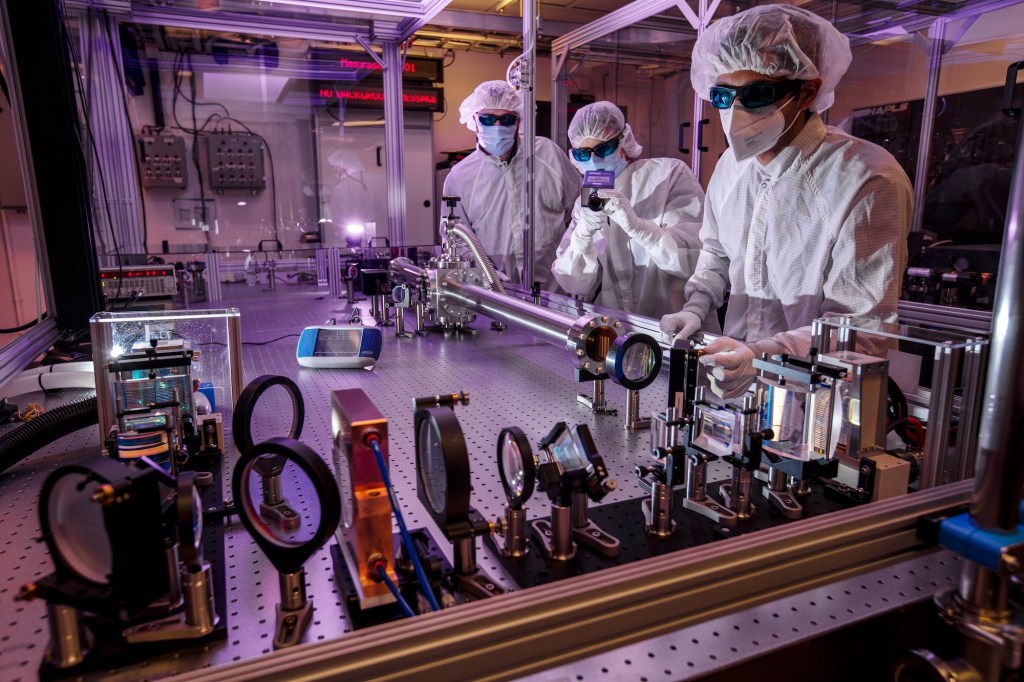
Researchers at Lawrence Livermore National Laboratory working with the Big Aperture Thulium (BAT) laser system, part of the laser and plasma research that laid the groundwork for generating the extreme ultraviolet light at the heart of today’s most advanced chipmaking machines. (Photo: Jason Laurea/LLNL)

When I started this Website, my hope was to share California’s astonishing range of landscapes, laboratories, and ideas. This state is overflowing with scientific discovery and natural marvels, and I want readers to understand, and enjoy, how unusually fertile this state is for discovery. If you’re not curious about the world, then this Website is definitely not for you. If you are, then I hope you get something out of it when you step outside and look around. 

I spend a lot of time in the California mountains and at sea, and I am endlessly amazed by the natural world at our doorstep. I am also fascinated by California’s industrial past, the way mining, oil, and agriculture built its wealth, and how it later became a cradle for the technologies and industries now driving human society forward. Of course, some people see technologies like gene editing and AI as existential risks. I’m an optimist. I see tools that, while potentially dangerous, used wisely, expand what is possible.
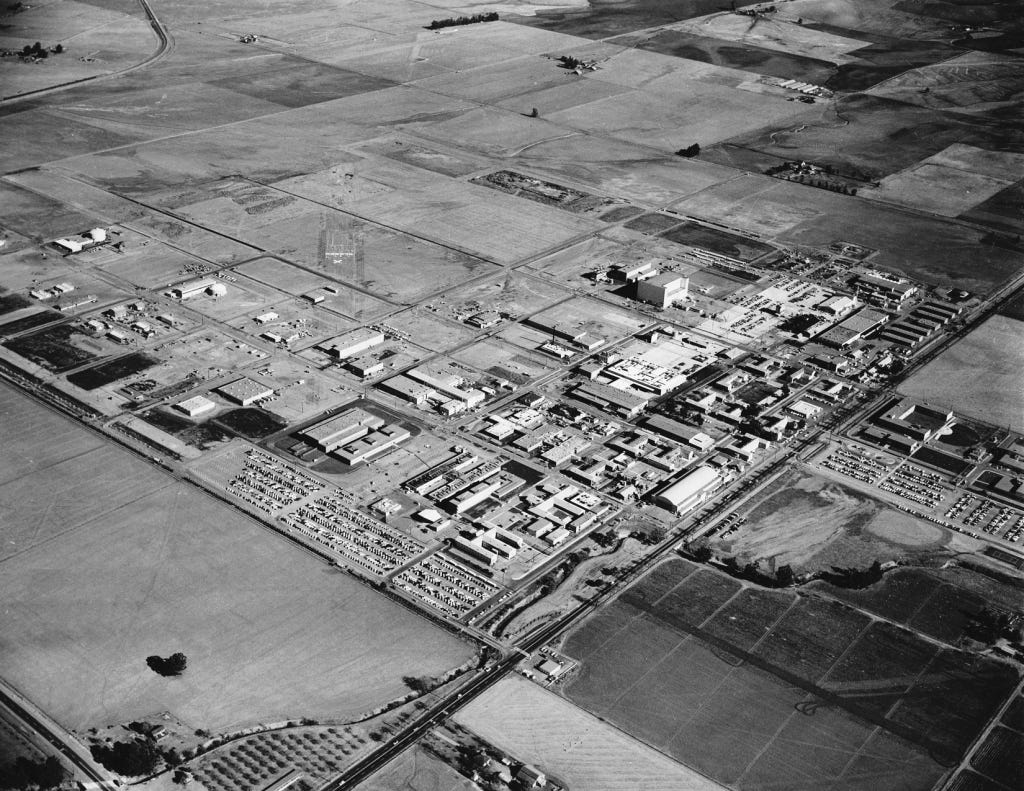
An aerial view of Lawrence Livermore National Laboratory in 1960, when the Cold War spurred rapid expansion of America’s nuclear and scientific research campus east of San Francisco Bay. (Photo: LLNL Public Domain)

Today’s story turns toward technology, and one breakthrough in particular that has reshaped the modern world. It is not just in the phone in your pocket, but in the computers that train artificial intelligence, in advanced manufacturing, and in the systems that keep the entire digital economy running. The technology is extreme ultraviolet lithography (EUV). And one of the most important points I want to leave you with is that the origins of EUV are not found in Silicon Valley startups or corporate boardrooms but in California’s national laboratories, where government-funded science made the impossible possible.

This article is not a political argument, though it comes at a time when government funding is often questioned or dismissed. My purpose is to underscore how much California’s national labs have accomplished and to affirm their value.

This story begins in the late 1980s and 1990s, when it became clear that if Moore’s Law was going to hold, chipmakers would need shorter and shorter wavelengths of light to keep shrinking transistors. Extreme ultraviolet light, or EUV, sits way beyond the visible spectrum, at a wavelength far shorter than ordinary ultraviolet lamps. That short wavelength makes it possible to draw patterns on silicon at the tiniest scales…and I mean REALLY tiny.
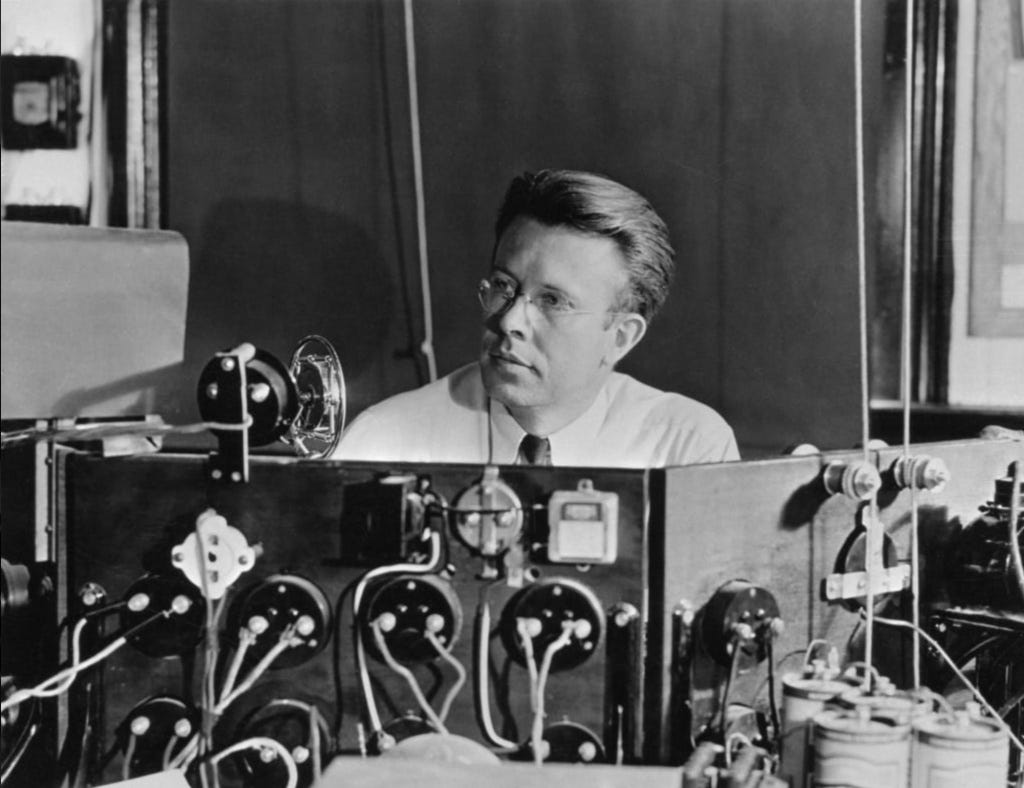
Ernest Orlando Lawrence at the controls of the 37-inch cyclotron in 1938. A Nobel Prize–winning physicist and co-founder of Lawrence Livermore National Laboratory, Lawrence’s legacy in nuclear science and high-energy research paved the way for the laboratory’s later breakthroughs in lasers and plasma physics — work that ultimately fed into the extreme ultraviolet light sources now powering the world’s most advanced chipmaking machines. (LLNL Public Domain)

At Lawrence Berkeley National Laboratory, researchers with expertise in lasers and plasmas were tasked with figuring out how to generate a powerful, reliable source of extreme ultraviolet light for chipmaking. Their solution was to fire high-energy laser pulses at microscopic droplets of tin, creating a superheated plasma that emits at just the right (tiny) wavelength for etching circuits onto silicon.
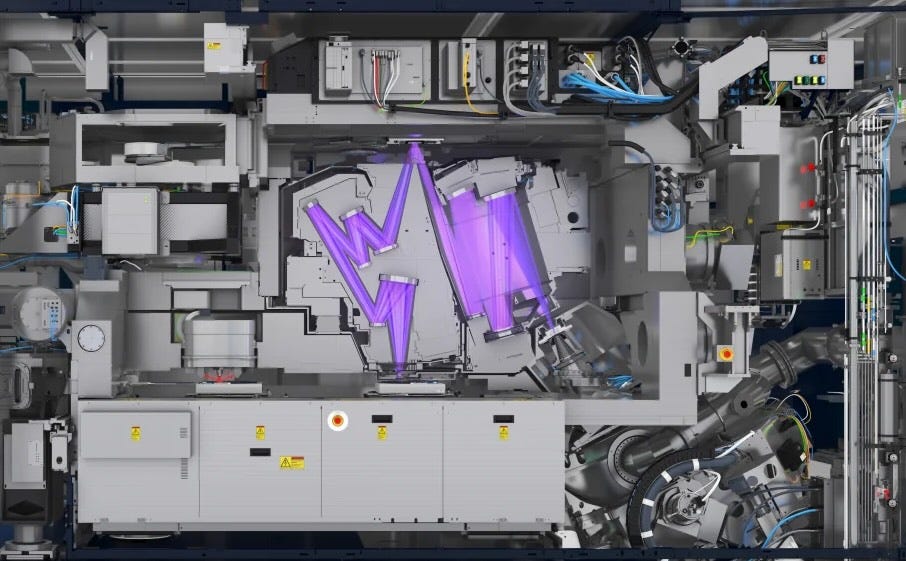
The movement of light on mirrors in an ASML EUV lithography machine. More on it below.

Generating the light was only the first step. To turn it into a working lithography system required other national labs to solve equally daunting problems. Scientists at Berkeley’s Center for X Ray Optics developed multilayer mirrors that could reflect the right slice of light with surprising efficiency. A branch of Sandia National Laboratories located in Livermore, California, worked on the pieces that translate light into patterns. So, in all: Livermore built and tested exposure systems, Berkeley measured and perfected optics and materials, and Sandia helped prove that the whole chain could run as a single machine.
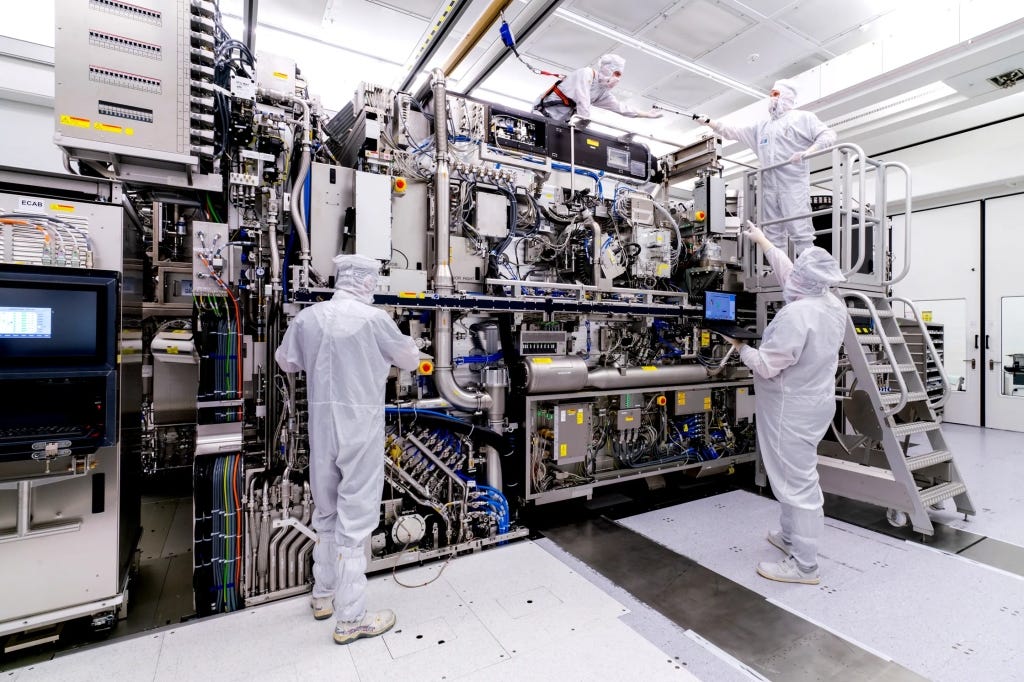
Each EUV lithography machine is about the size of a bus, costs more than $150 million, and shipping one requires 40 freight containers, three cargo planes, and 20 trucks. (Photo: ASML)

It matters that this happened in public laboratories. The labs had the patient funding and the unusual mix of skills to attempt something that might not pay off for many years. The Department of Energy supported the facilities and the people. DARPA helped connect the labs with industry partners and kept the effort moving when it was still risky. There was no guarantee that the plasma would be bright enough, that the mirrors would reflect cleanly, or that the resists (the light-sensitive materials coated onto silicon wafers) would behave. The national labs could take that on because they are designed to tackle long horizon problems that industry would otherwise avoid.

Only later did private industry scale the laboratory breakthroughs into the giant tools that now anchor modern chip factories. The Dutch company ASML became the central player, building the scanners that move wafers with incredible precision under the fragile EUV light. Those systems are now capable of etching transistor features as small as 5 nanometers…5 billionths of a meter. You really can’t even use the “smaller than a human hair” comparison here since human hair variation is so large at this scale as to render that comparison kind of useless. However, many people still do.

The ASML machines are marvels of tech and engineering. Truly amazing feats human design. And they integrate subsystems from all over the world: Zeiss in Germany manufactures the mirrors, polished to near-atomic perfection, while San Diego’s Cymer (now part of ASML) supplies the laser-driven plasma light sources. The technology is so complex that a single scanner involves hundreds of thousands of components and takes months to assemble.
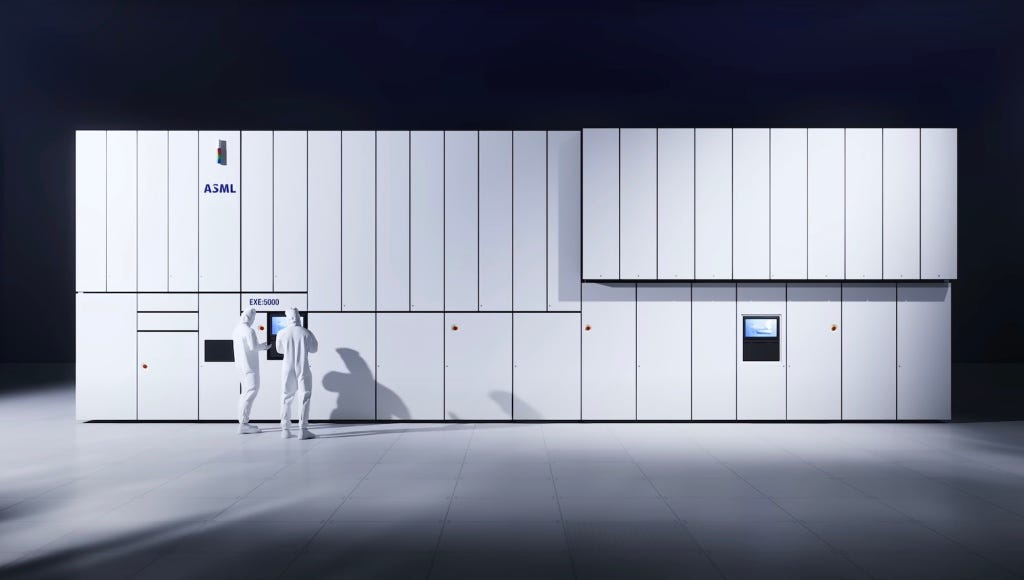
ASML’s EXE:5000 High-NA EUV lithography machine — a room-sized tool that etches the tiniest features on the world’s most advanced computer chips. (ASML)

It was TSMC and Samsung that then poured billions of dollars into making these tools reliable at scale, building the factories that now turn EUV light into the chips powering AI and smartphones and countless other devices. Trillions of dollars are at stake. Some say the fate of humanity lies in balance should Artificial General Intelligence eventually emerge (again, I don’t say that, but some do). All of this grew from the ingenuity and perseverance, along with the public funding, that sustained these California labs.

It’s disappointing that many of the companies profiting most from these technological breakthroughs are not based in the United States, even though the core science was proven here in California. That is fodder for a much longer essay, and perhaps even for a broader conversation about national industrial policy, something the CHIPS Act is only beginning to deal with.

However, if you look closely at the architecture of those monster machines, you can still see the fingerprints of the California work. A tin plasma for the light. Vacuum chambers that keep the beam alive. Reflective optics that never existed at this level before EUV research made them possible.

A photorealistic rendering of an advanced microprocessor, etched in silicon with extreme ultraviolet light — the kind of breakthrough technology pioneered in U.S. national labs, but now fabricated almost entirely in Taiwan, where the future of digital society is being made.

We often celebrate garages, founders, and the venture playbook. Those are real parts of the California story. This is a different part, just as important. The laboratories in Livermore, Berkeley, and Sandia are public assets. They exist because voters and policymakers chose to fund places where hard problems can be worked on for as long as it takes. The payoff can feel distant at first, then suddenly it is in your pocket. Like EUV. Years of quiet experiments on lasers, mirrors, and materials became the hidden machinery of the digital age.

Understanding the Impact of Santa Ana Winds in the Eaton Fire

Homes in Altadena destroyed by the Eaton Fire (Erik Olsen)

The recent fires that swept through sections of Los Angeles will be remembered as some of the most destructive natural disasters in the city’s history—a history already marked by earthquakes, floods, and the potential for tsunamis. Yet, even a week later, confusion persists about what happened. Predictably, the finger-pointing has begun, with political opportunism often overshadowing rational analysis. This is, unfortunately, emblematic of our current climate, where facts are sometimes twisted to suit individual agendas. What we need now is a sound, scientific examination of the factors that led to this catastrophe—not just to better prepare for future disasters, but to deepen our understanding of the natural forces that shape our world.

One fact is indisputable: the fires were unusual in their ferocity and destruction. While studies, debates, and expert analyses following the disaster are inevitable, the immediate aftermath offers one clear conclusion—this fires were driven, in large part, by the extraordinary winds that descended on Los Angeles that night. On January 8th, Santa Ana winds roared through the chaparral-covered canyons of the San Gabriel Mountains like a relentless tidal wave of warm air. I witnessed this firsthand, standing outside on my porch as 100-foot trees bent under the gale forces, their massive branches snapped like twigs and flung into streets, homes, and vehicles. A few of them toppled entirely. Having lived in Los Angeles for most of my life, I can confidently say I had never experienced winds of this intensity.

Altadena Community Church. The church was a progressive Christian and open and affirming church and was the thirteenth church in the United Church of Christ that openly accepted LGBTQ people. (Erik Olsen)

The conditions were ripe for disaster. Southern California had not seen significant rainfall since May, leaving the chaparral bone dry. According to Daniel Swain, a climate scientist at UCLA and the University of California Agriculture and Natural Resources, this year marks either the driest or second-driest start to the rainy season in over a century. Dry chaparral burns quickly, and with the powerful winds driving the flames, the fire transitioned from a wildland blaze to an urban inferno. When the flames reached residential areas, entire neighborhoods of mostly wood-frame homes became fuel for the firestorm. In the lower foothills, it wasn’t just the vegetation burning—it was block after block of homes reduced to ash.

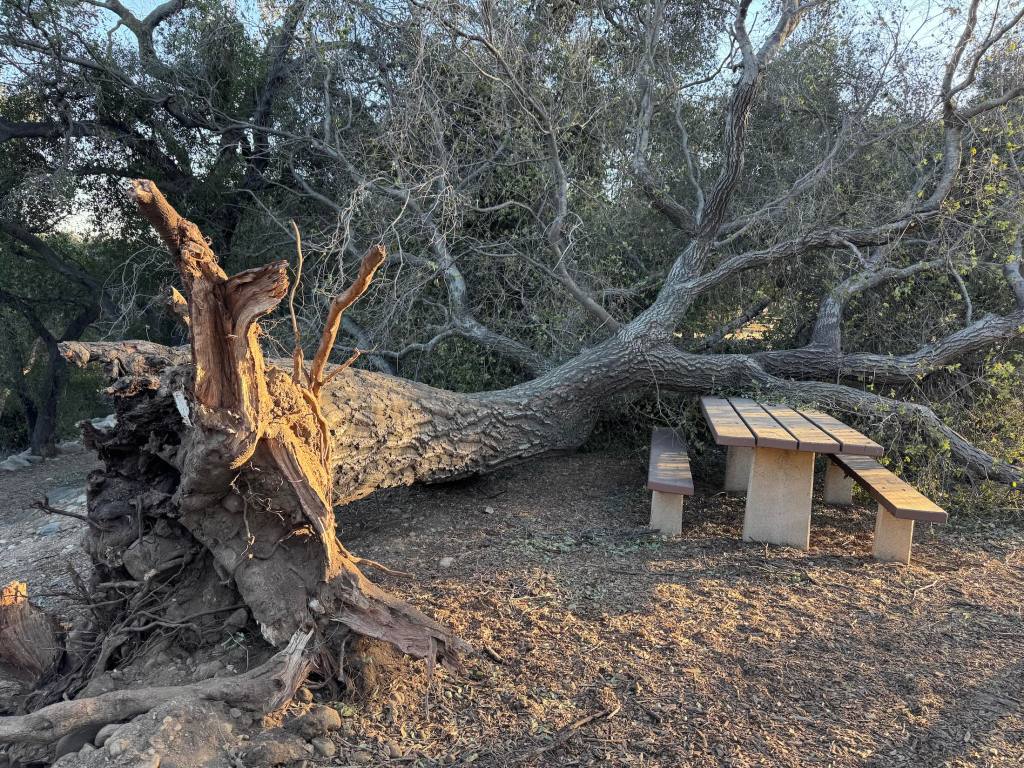
The wind was the true accelerant of this tragedy. Yesterday, I walked through the Hahamongna Watershed Park, formerly known as Oak Grove Park, renamed in the late 20th century to honor the Tongva people. In just 15 minutes, I passed more than a dozen massive oaks—centuries-old trees ripped from the ground, their intricate root systems exposed like nerves. These trees had withstood centuries of Southern California’s extremes—droughts, floods, heat waves—only to be toppled by this extraordinary wind event. Climate change undoubtedly influences fire conditions, but the immediate culprit here was the unrelenting, pulsating winds.

Downed oak tree after the Eaton Fire in Hahamonga watershed park (Erik Olsen)

Meteorologists had accurately predicted the intensity of this event, issuing warnings days in advance. Many residents took those warnings seriously, evacuating their homes before the fire reached its peak destruction. While the loss of 25+ lives is tragic, it is worth noting how many lives were saved by timely evacuations—a stark contrast to the devastating loss of life in the Camp Fire in Paradise a few years ago. Though the terrain and infrastructure of the two locations differ, the success of the evacuations in Los Angeles deserves recognition.

The winds of January 8th and 9th were exceptional, even by the standards of Southern California’s fire-prone history. They tore through canyons, uprooted trees, and transformed a wildfire into an urban disaster. Understanding these winds—their causes, their predictability, and their impacts—is essential not only to prevent future tragedies but to grasp the powerful natural forces that define life in Southern California. As the city rebuilds, let us focus on learning from this disaster, guided by science, reason, and a determination to adapt to a future where such events may become increasingly common.

Southern Californians know the winds by many names: the “devil winds,” the “Santa Anas,” or simply the harbingers of fire season. Dry, relentless, and ferocious, Santa Ana winds have long been a defining feature of autumn and winter in the region. This past season, they roared to life with exceptional vigor, whipping through Altadena and the Pacific Palisades, fanning flames that turned neighborhoods into tinderboxes. As these winds carried ash and terror across Southern California, a question lingered in the smoky air: what made this Santa Ana event so severe, and was climate change somehow to blame?

Home destroyed in Eaton Fire in Altadena (Erik Olsen)

To understand the recent fires, one must first understand the mechanics of the Santa Ana winds. They begin far inland, in the arid Great Basin, a sprawling high-altitude desert region encompassing parts of Nevada, Utah, and eastern California. Here, in the shadow of towering mountain ranges, a high-pressure system often takes hold in the fall and winter. This system is driven by cold, dense air that sinks toward the ground and piles up over the desert. When a contrasting low-pressure system develops offshore over the Pacific Ocean, it creates a steep pressure gradient that propels the cold air westward, toward the coast. 

The high-pressure system over the Great Basin in January, which fueled the devastating fires in Los Angeles, was unusual in several ways. While these systems often dominate in the fall and winter, this particular event stood out for its intensity, prolonged duration, and timing. High-pressure systems in the Great Basin drive Santa Ana winds by forcing cold, dense air to sink and flow toward lower-pressure areas along the coast. In this case, the pressure gradient between the Great Basin and the coast was extraordinarily steep, generating winds of unprecedented strength. As the air descended, it warmed through compression, becoming hotter and drier than usual, amplifying fire risks in an already parched landscape.

Winds ravage a McDonalds in Altadena (Instagram)

As this air moves, it descends through mountain passes and canyons, accelerating and compressing as it drops to lower altitudes. This compression heats the air, causing it to become warmer and drier. By the time the winds reach urban areas like Altadena or the Pacific Palisades, they are hot, parched, and moving with hurricane-force gusts. The result is a perfect storm of conditions for wildfire: low humidity, high temperatures, and gale-force winds that can carry embers miles from their source.

In the case of the recent fires, these dynamics played out in particularly dramatic fashion. Winds clocked in at speeds exceeding 70 miles per hour, snapping tree branches and downing power lines—common ignition sources for wildfires.

CALIFORNIA CURATED ON ETSY

Purchase stunning art prints of iconic California scenes.
Check out our Etsy store.

The cold air over the Great Basin didn’t appear out of nowhere. Its origins lay in the Arctic, where polar air was funneled southward by a wavering jet stream. The jet stream, a high-altitude ribbon of fast-moving air that encircles the globe, has become increasingly erratic in recent years, a phenomenon many scientists attribute to climate change. The Arctic is warming faster than the rest of the planet, reducing the temperature difference between the poles and the equator. This weakening of the temperature gradient slows the jet stream, allowing it to meander in large, looping patterns. One such loop likely brought Arctic air into the Great Basin, setting the stage for the ferocious winds. While much is known about these patterns, it’s an emerging area of research with compelling evidence but not yet universal consensus.

As these winds swept across Southern California, they encountered vegetation primed for combustion. Years of drought, exacerbated by rising temperatures, had left the region’s chaparral and scrubland desiccated. When embers landed in this brittle fuel, the flames spread with devastating speed, aided by the winds that acted as bellows.

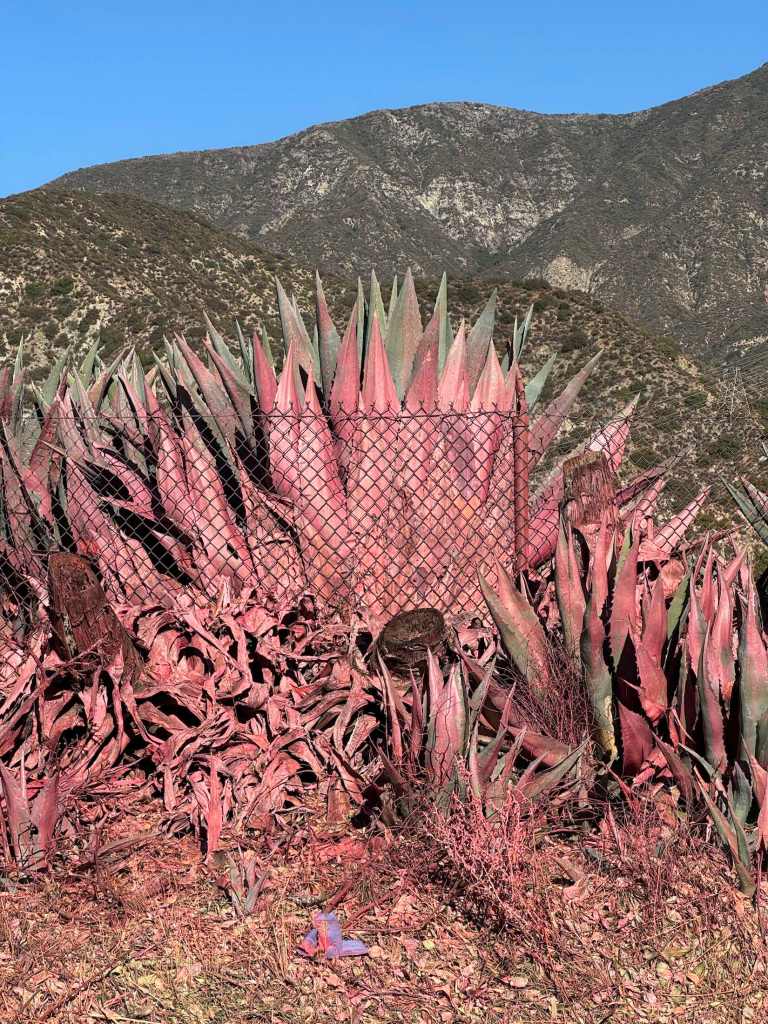
Agave covered in Phos Chek fire retardant (Erik Olsen)

While the direct cause of the fires was likely human—downed power lines or another ignition source—the conditions that turned a spark into an inferno were shaped by the interplay of natural and human-influenced factors. Climate change didn’t create the Santa Ana winds, but it likely amplified their effects. Warmer global temperatures have extended droughts, dried out vegetation, and created longer, more intense fire seasons. Meanwhile, the erratic jet stream may make extreme high-pressure events over the Great Basin more likely, intensifying the winds themselves.

This intersection of natural weather patterns and climate change creates a troubling new normal for Southern California. The Santa Ana winds, once a predictable seasonal nuisance, are now agents of destruction in an era of heightened fire risk. Their devilish power, long mythologized in Southern California lore, is now being reframed as a warning sign of a climate in flux.

As the smoke clears and communities begin to rebuild, the lessons from these fires are stark. Reducing fire risk will require not only better management of power lines and vegetation but also a reckoning with the larger forces at play. The Santa Anas will continue to howl, but their fury need not be a death sentence. To live in harmony with these winds, Californians must confront the deeper currents shaping their world. The question is whether we can act before the next spark ignites the next inferno.

The Great Los Angeles Flood of 1934 was a Disaster That Shaped California’s Approach to Flood Control

A house in the La Crescenta-Montrose area was swept off its foundation and carried several hundred feet by the
New Year’s Eve floodwaters. (LA Times)

In early 1934, Southern California experienced one of the most tragic and devastating natural disasters in its history as a populated region: the Los Angeles flood of 1934. This flood, largely forgotten today outside of the areas directly affected, struck La Crescenta, Montrose, and other foothill communities with devastating force, reshaping not just the landscape but the way California approached flood management and disaster preparedness. It was one of the deadliest floods in Los Angeles history.

The catastrophe took shape in early January after a period of intense rainfall, likely the product of an atmospheric river, a weather phenomenon that can deliver extreme, concentrated rainfall over a short period. In this case, a series of storms in early 1934 carried moisture from the Pacific Ocean directly into Southern California. The storms brought unusually heavy rain to the region, especially to the steep, fire-scarred San Gabriel Mountains.

Nearly 12 inches of rain poured over the foothills in a span of a few days, saturating the steep slopes of the San Gabriel Mountains. The natural landscape was already vulnerable, scarred by wildfires that had burned through the mountains in recent years, leaving slopes exposed and unable to hold the sudden deluge. At this time, the practice of fire suppression had only just begun, meaning that the region’s dry, chaparral-covered mountainsides were naturally prone to burns, which often created perfect conditions for flash floods in winter. Once the rainfall reached a critical level, water, mud, and debris barreled down the mountains, channeled by steep canyons that funneled the destructive flow toward the communities below.

A worker digs out a car and the remains of a home on Glenada Ave. in Montrose. (LA Times)

La Crescenta and Montrose were hit hardest, with residents astonished by walls of mud and rock rushing down their streets. Homes were swept from their foundations; trees, rocks, and debris clogged roadways, and massive boulders tumbled down, crushing cars, smashing into homes and rolling into the middle of once-busy streets. The disaster destroyed over 400 homes and claimed dozens of lives, and numerous people were injured. The streets were piled with silt and debris, several feet thick, which made rescue efforts nearly impossible at first. Additionally, infrastructure like power lines and bridges was obliterated, leaving the communities isolated and in darkness. The floodwaters, swollen with debris, rushed into homes, sweeping families out into the chaos, while cars and buildings alike were left buried or carried off entirely.

Visit the California Curated store on Etsy for original prints showing the beauty and natural wonder of California.

Believing it to be a secure shelter for the night, a dozen people took refuge in the local American Legion Post 288. Tragically, the building lay squarely in the path of a powerful debris flow that swept down from Pickens Canyon. The force of the flood shattered the hall’s walls, filling it with thick mud that buried everyone inside before surging on its destructive path. Today, a modest memorial honors those lost to the 1934 flood, overlooking the site of the former hall, which has since been converted into part of the flood control infrastructure.

American Legion Hall damaged by flood and mudslide, La Crescenta-Montrose, 1934 (LA Times)

In the aftermath of the tragedy, local and state governments were forced to confront the region’s vulnerability to such floods. At that time, Los Angeles was in the throes of rapid expansion, with more people moving to suburban areas near the San Gabriel Mountains. The flood, along with an even more destructive one in 1938, firmly swayed public opinion toward a comprehensive flood control strategy. The concrete channels that cut through Los Angeles today are part of this system, designed to swiftly carry water past the city and out to the ocean. brought a clear message: these communities needed better protection. As a result, California embarked on an ambitious flood control plan that would shape Los Angeles County’s infrastructure for decades. Engineers and city planners constructed a network of dams, basins, and concrete channels, including structures like the Big Tujunga Dam, to control water flow from the mountains. The Los Angeles River was channeled and paved, transforming it from a meandering, unpredictable river into the hard-lined, brutalist urban waterway we see today. The Arroyo Seco and other channels were also developed as part of this system to divert stormwater, preventing future flood damage in surrounding communities.

People survey the damage to their cars and roads in the aftermath of the flood. (LA Times)

Over the years, this engineering effort proved largely effective in preventing a recurrence of the devastation that struck La Crescenta and Montrose. However, modern critics argue that these concrete channels, while functional, have disconnected Los Angeles from its natural water systems, affecting both wildlife habitats and the local ecosystem. In recent years, the focus has shifted toward exploring more sustainable flood management techniques, with an eye toward revitalizing some of the natural waterways. This includes restoring parts of the Los Angeles River with green spaces, enhancing biodiversity, and creating flood basins that can handle overflow while supporting ecosystems. In this way, the 1934 flood has left a long-lasting impact, as it continues to influence flood control policies and urban planning in the region.

Mud, rocks, and wrecked cars littered Montrose Avenue in Montrose after the New Year’s flooding. (LA Times)

Today, with climate change bringing more extreme weather, Los Angeles is once again reflecting on its flood infrastructure. The LA River Restoration Master Plan is an ambitious project aimed at transforming the Los Angeles River from a concrete flood channel back into a vibrant, naturalized waterway that serves as a green space for local communities. The plan envisions revitalizing the river’s ecosystems, improving water quality, and creating public parks, walking trails, and recreation areas along the river’s 51-mile stretch. By reconnecting neighborhoods and restoring wildlife habitats, it seeks to bring nature back into the urban core. However, the plan comes with significant challenges, including an estimated cost of up to $1.5 billion and complex engineering demands to ensure flood safety while restoring the river’s natural flow and ecology.

Rendering of a section of the LA River part of the Los Angeles River Revitalization Master Plan (Wenk Associates)

The 1934 flood serves as a sobering reminder of the dangers posed by sudden, intense rainfall in fire-prone mountainous regions. As California experiences more intense wildfire seasons, the cycle of fire followed by flood continues to be a significant threat. The legacy of the Los Angeles flood of 1934 underscores the delicate balance required in managing natural landscapes and urban expansion and remains a critical part of understanding how communities can—and must—adapt to an unpredictable climate future.

A Massive Aircraft Carrier called the USS Independence Rests in Deep Waters off the Coast of California

From Battlefront to Atomic Legacy: The Journey of the USS Independence to Its Final Resting Place off Northern California

The U.S. Navy light aircraft carrier USS Independence (CVL-22) in San Francisco Bay (USA) on 15 July 1943. Note that she still carries Douglas SBD Dauntless dive bombers. Before entering combat the air group would only consist of Grumman F6F Hellcat fighters and TBF Avenger torpedo bombers. (Wikipedia)

The waters off California’s coast are scattered with relics of wartime history, each telling its own story of conflict and survival. Among these wrecks is the USS Independence, a WWII aircraft carrier whose journey took it from the heights of naval warfare to the depths of nuclear experimentation. Today, it lies as an underwater monument to both wartime heroics and the nascent atomic age.

Converted from the hull of a Cleveland-class light cruiser, the USS Independence was built by the New York Shipbuilding Corporation and commissioned in January 1943. She quickly became a key player in the Pacific Theater. She took part in early attacks on Rabaul and Tarawa before being torpedoed by Japanese aircraft, necessitating repairs in San Francisco from January to July 1944. After these repairs, the Independence launched strikes against targets in Luzon and Okinawa, and was part of the carrier group that sank remnants of the Japanese Mobile Fleet during the Battle of Leyte Gulf, as well as several other Japanese ships in the Surigao Strait.

Visit the California Curated store on Etsy for original prints showing the beauty and natural wonder of California.

It took part in pivotal operations such as those at Tarawa, Kwajalein, and the Marianas, contributing significantly to the success of Allied forces. Until the surrender of Japan, she was assigned to strike duties against targets in the Philippines and Japan, and she completed her operational duty off the coast of Japan, supporting occupation forces until being assigned to be a part of Operation Magic Carpet, an operation by the U.S. War Shipping Administration to repatriate over eight million American military personnel from the European, Pacific, and Asian theaters. The ship’s role in supporting invasions and launching strikes helped secure a strategic advantage in the Pacific, establishing the Independence as an integral part of the U.S. Navy’s war effort.

Aerial view of ex-USS Independence at anchor in San Francisco Bay, California, January 1951. There is visible damage from the atomic bomb tests at Bikini Atoll. (San Francisco Maritime National Historical Park)

After WWII ended, the Independence was not destined for a peaceful decommissioning like many of her sister ships. Instead, it was selected for an unprecedented mission: to test the effects of nuclear explosions on naval vessels. In 1946, the Independence became part of Operation Crossroads at Bikini Atoll, a series of nuclear tests aimed at understanding the power of atomic bombs. Positioned near ground zero for the “Able” and “Baker” detonations, the carrier survived but sustained heavy radioactive contamination. Towed back to the United States, it became the subject of further scientific study, focusing on radiation’s effects on naval ships.

Thermonuclear blast part of Operation Crossroads

Ultimately, in 1951, the Navy decided to scuttle the Independence off the coast of California, within what is now the Monterey Bay National Marine Sanctuary and near the Farallon Islands. The ship was intentionally sunk in deep waters, where it would remain hidden for over sixty years. In 2015, researchers from NOAA, in partnership with Boeing and other organizations, used advanced sonar technology to locate the wreck. Lying nearly 2,600 feet below the surface and approximately 30 miles off the coast of San Francisco, the Independence was found in remarkably good condition. The cold, dark waters of the Pacific had preserved much of its hull and flight deck, leaving a ghostly relic that continued to capture the imagination of historians and marine scientists alike.

The U.S. Navy light aircraft carrier USS Independence (CVL-22) afire aft, soon after the atomic bomb air burst test “Able”
at Bikini Atoll on 1 July 1946. (US NAVY)

In 2016, the exploration vessel Nautilus, operated by the Ocean Exploration Trust, conducted detailed dives to study the wreck. The exploration utilized remotely operated vehicles (ROVs), equipped with high-definition cameras and scientific tools, to capture extensive footage and data. The mission was led by a multidisciplinary team of researchers, including marine biologists, archaeologists, and oceanographers from NOAA and the Ocean Exploration Trust, highlighting the collaborative effort necessary for such an in-depth underwater expedition. Remotely operated vehicles (ROVs) provided stunning footage of the carrier, revealing aircraft remnants on the deck and bomb casings that hinted at its atomic test history.

Part of an aircraft on the USS Independence seen during the NOAA / Nautilus expedition off the coast of California. (NOAA)

Despite its radioactive past, the wreck had transformed into a thriving artificial reef. Marine life, including fish, crustaceans, and corals, had made the irradiated structure their home, providing researchers with a valuable opportunity to study how marine ecosystems adapt to and flourish on man-made, contaminated structures. Among the biological discoveries, researchers noted a variety of resilient species that had colonized the wreck, including deep-sea corals that appeared to be unaffected by the radiation levels. Additionally, biologists observed that some fish populations had become more abundant due to the complex structure offered by the wreck, which provided shelter and new breeding grounds. This adaptation indicates that artificial reefs—even those with a history of contamination—can become crucial havens for marine biodiversity. Studies also identified microorganisms capable of thriving in irradiated environments, which could help inform future research into bioremediation and the impact of radiation on biological processes. These findings collectively reveal the remarkable ability of marine life to adapt, demonstrating resilience even in challenging conditions shaped by human activities.

The shipwreck site of the former aircraft carrier, Independence, is located in the northern region of Monterey Bay National Marine Sanctuary. 

The ship’s resting place has also become an important case study for understanding the long-term effects of radiation in marine environments. Researchers have found that despite the contamination from the atomic tests, the marine life around the Independence has flourished, suggesting a remarkable resilience in the face of human-induced challenges. This has provided invaluable information on how marine ecosystems can adapt and endure even in seemingly inhospitable conditions, shedding light on ecological processes that could inform conservation efforts in other marine environments.

Guns on the USS Independence off the coast of California. An array of corals sponges and fish life are a remarkable testament to manmade reefs to attract sea life (NOAA)

The exploration of the Independence also stands as a technological achievement. The discovery and study of the wreck required advanced sonar imaging and remotely operated vehicle technology, showcasing the capabilities of modern marine archaeology. The collaboration between NOAA, the Ocean Exploration Trust, and other organizations has underscored the importance of interdisciplinary approaches in uncovering and preserving underwater cultural heritage.

Ultimately, the USS Independence is more than just a sunken warship—it is a chapter of American history frozen in time beneath the waves of the Pacific. As a subject of study, it bridges past conflicts with modern scientific inquiry, providing a rich narrative that combines warfare, innovation, and nature’s adaptability. Its story continues to evolve as researchers uncover more about the vessel and the surrounding ecosystem, making it not only a relic of history but also a symbol of discovery and resilience.