The Physics and Geology of The Wedge, California’s Most Dangerous Wave

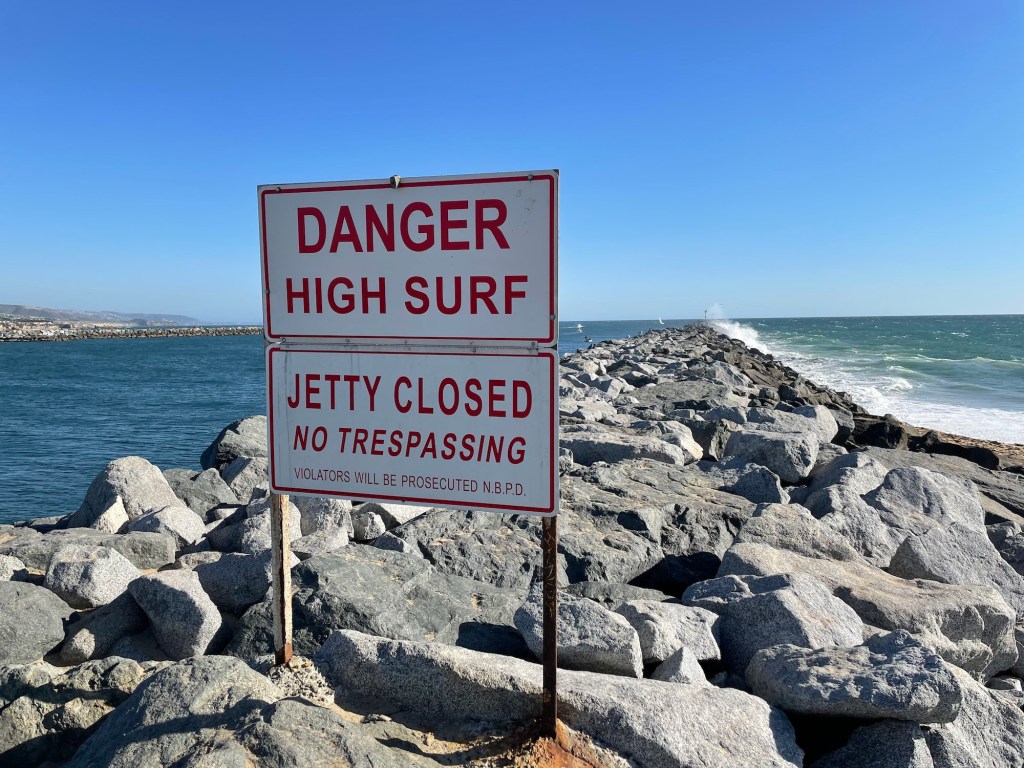
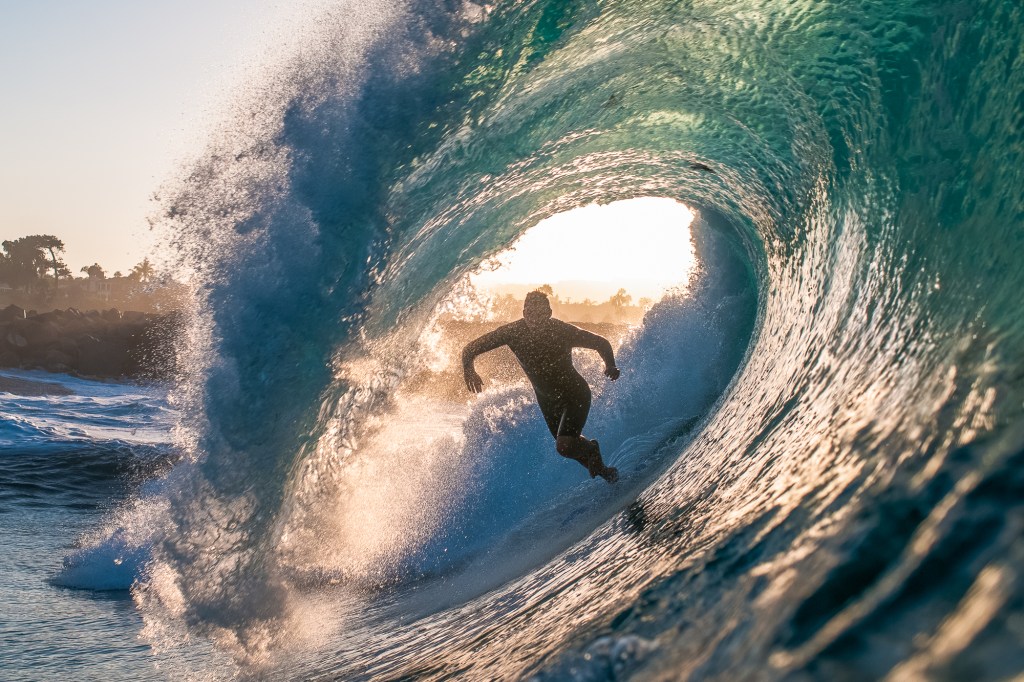
Dangerous surf at The Wedge in Newport Beach, California (Photo: Erik Olsen)

Having spent much of my youth in Newport Beach, my life was shaped by the ocean. I spent countless days in the surf, bodyboarding, bodysurfing, or playing volleyball on the sand with friends. When a southern storm rolled through, we’d rush to Big Corona and throw ourselves into the heavy swells, often getting slammed hard and learning deep respect for the ocean, a respect that I still harbor today. Sometimes the waves were so large they were genuinely terrifying, the kind of surf that would have made my mother gasp, had this not been an era when parents rarely knew what their kids were doing from dawn to dusk. That freedom, especially in Southern California, made the ocean feel like both a playground and a proving ground.

Across the channel at the Newport jetty was where the action was most intense. The surf was bigger, louder. We sat on the sand and held back, watching the brave and sometimes the foolish throw themselves into the water. That place, then and now, is called the Wedge.

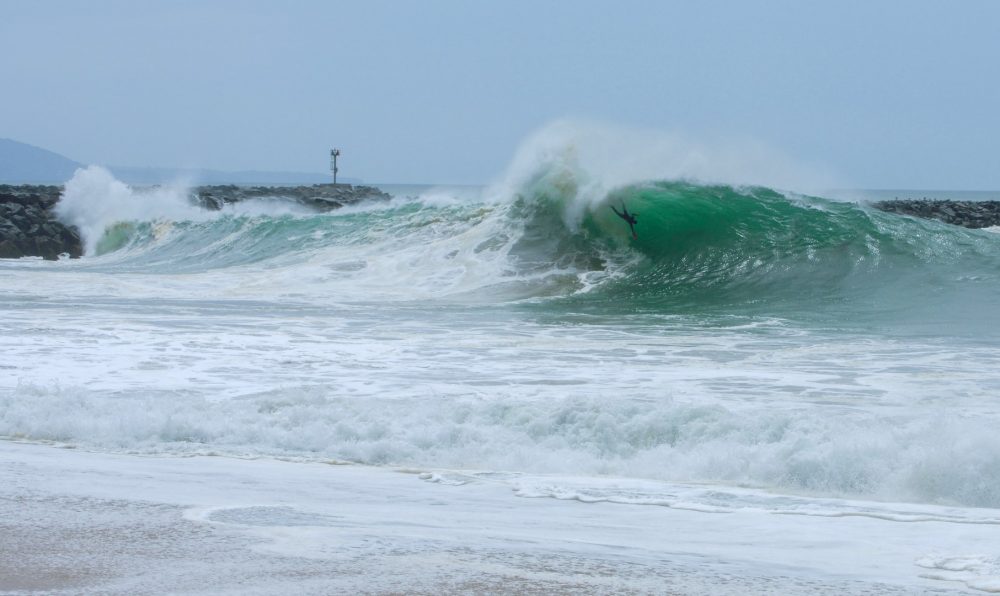
The Wedge in Newport Beach, California (Photo: Alex Verharst 2016)

There is something unforgettable about the Wedge and the way its waves crash with such raw force. Sometimes they detonate just offshore, sending water skyrocketing into the air; other times they slam thunderously against the sand, eliciting groans and whoops from bystanders. The waves behave strangely at the Wedge, smashing into one another, often combining their force, and creating moments of exquisite chaos.

These colliding waves are what make the place both spectacular and dangerous, the result of a unique mix of physics and geology that exists almost nowhere else on earth. That combination has made it, to this day, one of the world’s most famous surf and bodysurfing spots. If you want a glimpse of what I mean, just search YouTube, where the insanity speaks for itself. This compilation is from earlier this year.

And of course, who could forget this one surfer’s unique brand of SoCal eloquence.

So how did the Wedge turn into one of the most famous and dangerous surf spots? The truth is, it’s mostly the result of human engineering.

The Wedge with Newport Harbor’s West Jetty in the background (Photo: California Beaches)

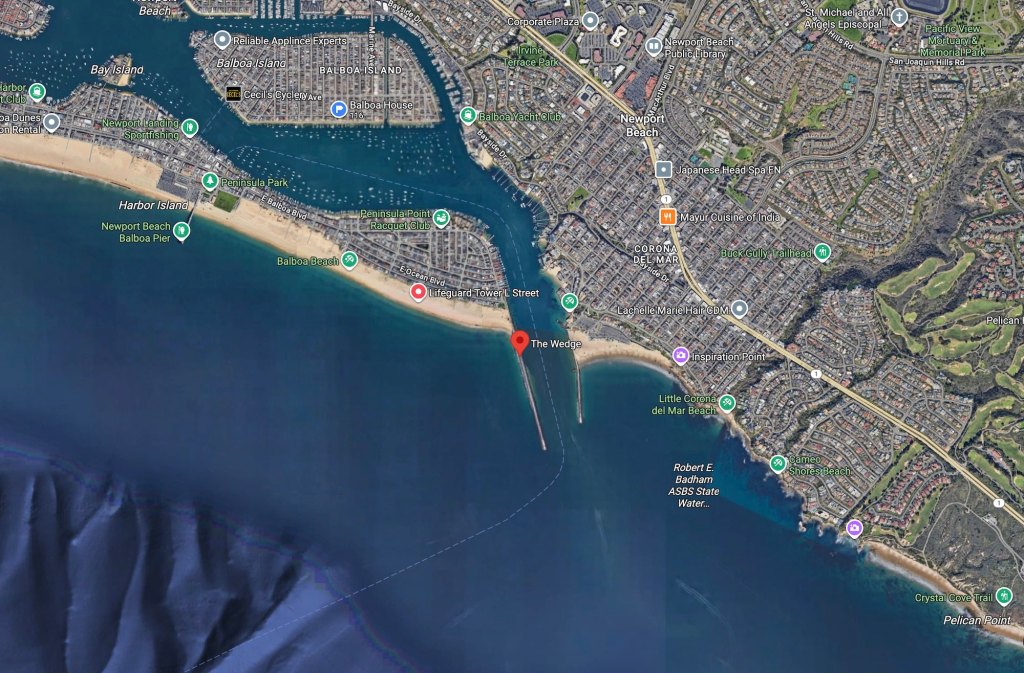
The Wedge’s origin story begins in the 1930s, when the U.S. Army Corps of Engineers extended Newport Harbor’s West Jetty to protect the harbor mouth from sand buildup and currents. What no one anticipated was that this angled wall of rock would create a perfect mirror for waves arriving from the south and southwest. Instead of dispersing, these waves slam into the jetty and reflect diagonally back toward the shore. The reflected energy doesn’t dissipate, it collides with the next incoming wave. When the two wave crests line up in phase, their energies combine, and the result is a much steeper, taller, and more powerful wave. In physics this is known as constructive interference: two sets of energy stacking into a single, towering peak.

This wave-doubling effect only works under specific conditions. Long-period south swells, often generated by hurricanes off Mexico or storms deep in the South Pacific, line up nearly parallel to the jetty. Their orientation means maximum contact and reflection. Surfers and bodysurfers describe the result as a pyramid-shaped breaker, or wedge, rising steeply before collapsing with extraordinary force. On the biggest days, these waves can reach 20 to 30 feet, twice the size of surrounding surf.

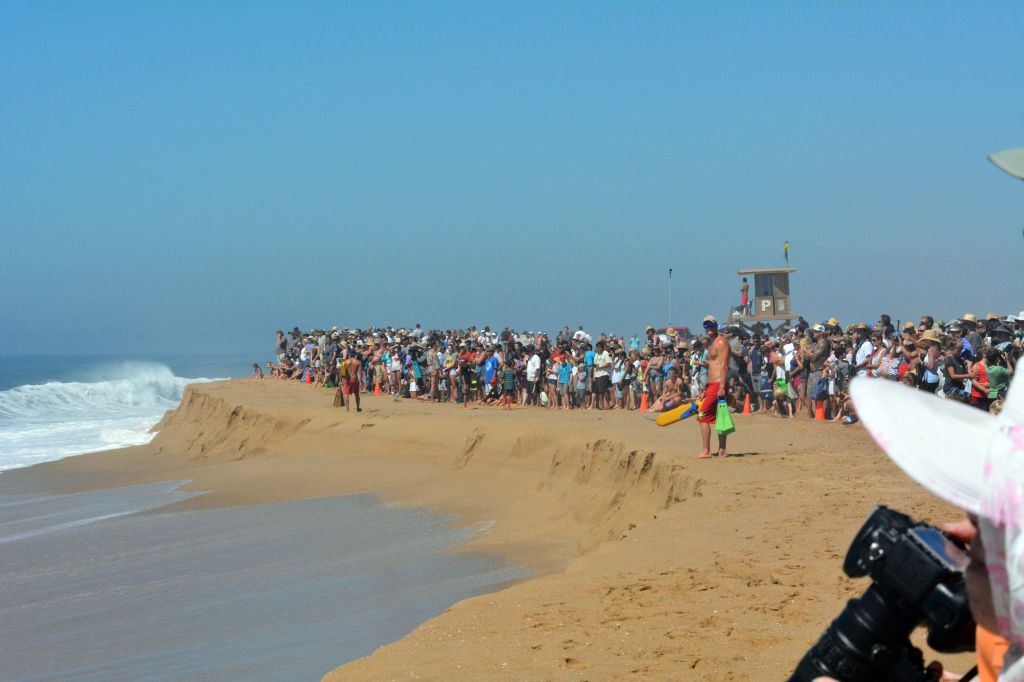
Crowds gather to watch the carnage at The Wedge in Newport Beach (Photo by D Ramey Logan)

Geology and geography make the situation even more dramatic. The seafloor near The Wedge slopes upward very steeply into a narrow strip of beach. Instead of allowing waves to break gradually, the bathymetry forces them to jack up suddenly, creating a thick lip that pitches forward into shallow water. It’s called a shorebreak, and man, they can be dangerous. More on that in a moment.

Unlike classic point breaks such as Malibu, where waves peel cleanly along a gradual reef, The Wedge produces brutal closeouts: vertical walls of water that crash all at once, leaving no escape route.

It actually can get worse. After each wave explodes on the beach, the backwash races seaward, colliding with the next incoming swell and adding more turbulence. Surfers call it chaos; lifeguards call it dangerous, even life-threatening. Spinal injuries, broken bones, and concussions are common at The Wedge. By 2013, the Encyclopedia of Surfing estimated that the Wedge had claimed eight lives, left 35 people paralyzed, and sent thousands more to the hospital with broken bones, dislocations, and other trauma—making it the most injury-prone wave break in the world. A 2020 epidemiological survey places The Wedge among the most lethal surf breaks globally (alongside Pipeline and Teahupo’o), largely due to head-first “over the falls” impacts on the shallow sea floor.

The Wedge in Google Maps

Interesting fact: Long before the Wedge was built, the waves pounding that corner of the Newport Beach jetty were already fierce. In 1926, Hollywood icon John Wayne (then still Marion Morrison) tried bodysurfing there while he was a USC football player. He was slammed into the sand, shattering his shoulder and ending his athletic scholarship. The accident closed the door on his football career but opened the one that led him to Hollywood stardom.

Oceanographers have studied the physics behind the Wedge’s unique surfbreak in broader terms. Research into wave reflection and interference confirms what locals have known for decades: man-made structures like jetties can redirect swell energy in ways that amplify, rather than reduce, wave height. Studies on steep nearshore bathymetry show how sudden shoaling increases the violence of breaking waves. The Wedge combines both effects in one location, making it a rare and extreme case study in coastal dynamics. In other words, yes, it’s gnarly.

Of course, with all that danger comes spectacle, and when the Wedge is firing, it’s not unusual for hundreds of spectators to line the sand and jetty to watch. In August 2025, the California Coastal Commission approved plans for a 200-foot ADA-compliant concrete pathway and a 10-foot-wide viewing pad along the northern jetty, designed to make the experience safer and more inclusive. The project will provide better access for people using wheelchairs, walkers, and strollers, while also giving life guards and first responders improved vantage points when the surf turns chaotic.

I still get to the Wedge on occasion to watch the carnage. And while in my younger years, I might have ventured out to catch a wave or two if the conditions were relatively mellow, today, I prefer the view from shore, leaving the powerful surf to the younger bodysurfers hungry for a rush.

Navigating the Unseen Current: How the California Current System Shapes Our Ocean, Climate, and Future

The stretch of water hugging the western shores of North America is a biological powerhouse, teeming with life and considered one of the most fertile marine environments on the planet. The California Current, originating from the colder regions up near British Columbia, sweeps its way down toward Baja California, extending laterally several hundred miles offshore into deep oceanic waters off the continental shelf. The current brings with it not just frigid waters but also a richness of life. As if choreographed, winds usually gust from the land towards the ocean, nudging surface waters away from the coastline. This displacement makes room for deeper, nutrient-packed waters to ascend, in a phenomenon aptly termed upwelling. Coastal upwelling is the dominant physical forcing affecting production in the California Current System.

This blend of icy waters and nutrient wealth sparks a bloom of marine vegetation, ranging from minuscule phytoplankton to sprawling underwater forests of kelp. These plants, often dubbed the “primary producers,” act as the nucleus of an intricate food web. The bounty includes thriving fisheries, generous populations of marine mammals like whales, seals, and dolphins, as well as a multitude of seabirds. The breadth of this fecund ecosystem can span an astonishing distance—up to 300 miles from the shoreline, enveloping a rich diversity of life within its aquatic embrace.

Phytoplankton are a critical part of the ocean’s food web.

The California Current System (CCS) is one of those natural phenomena that don’t often make headlines but quietly shape life as we know it on the West Coast. It’s like the unsung hero of the Pacific, affecting everything from marine biodiversity to our climate, even having a say in whether you’ll need to pack sunscreen or an umbrella for your beach day.

At its core, the California Current is a cold, southward-flowing oceanic current that starts from the Gulf of Alaska and hugs the western coastline of North America. Picture a river within the ocean, except this river is carrying cold, nutrient-rich water from the North Pacific all the way down to the southern tip of Baja California in Mexico. The California Current is part of a broader gyre system that also includes the North Pacific Current, the California Undercurrent, and the Davidson Current. Together, they create a dynamic dance of currents that provide a lifeline to a host of marine species and play a significant role in weather patterns.

The dynamics of the California Current result in abundant wildlife, like these common dolphins, off the coast of California.

The CCS owes its formation to a combination of factors like Earth’s rotation, the prevailing westerly winds, and the shape of the coastline. These elements work in concert to set up a sort of “conveyor belt” for water, funneling it down from higher latitudes. Over millions of years, this system has become a finely tuned natural mechanism that has shaped the ecology and climate of the region in profound ways.

The cold, nutrient-rich waters of the California Current serve as a veritable buffet for marine life. When we talk about nutrients, we’re primarily talking about nitrates and phosphates that act like fertilizer for phytoplankton, the microscopic plants at the base of the marine food web. As phytoplankton bloom, they become a food source for zooplankton, which in turn are gobbled up by larger fish. This cascade effect supports a rich, biodiverse ecosystem that includes everything from sardines and anchovies to humpback whales and even great white sharks. Even seabirds get in on the action, relying on the abundant marine life for nourishment.

The cold, nutrient-rich waters of the California Current serve as a veritable buffet for marine life.

But the California Current doesn’t stop at influencing marine biology; it’s a key player in regional climate as well. For example, the current helps moderate coastal temperatures by funneling cooler air inland. This has a ripple effect on weather patterns and even contributes to the famous “June Gloom” that Angelenos love to lament. Ever wonder why California’s coastal cities have relatively mild, Mediterranean climates while just a short drive inland can bring you much hotter conditions? Tip your hat to the CCS.

CALIFORNIA CURATED ON ETSY

Purchase stunning coffee mugs and art prints of Californian icons.
Check out our Etsy store.

Climate change is, of course, the elephant in the room. A study published in the journal “Geophysical Research Letters” in 2019 highlighted a gradual weakening of the California Current due to warming ocean temperatures. As the current weakens, there’s potential for less upwelling, which means fewer nutrients reaching the surface. Less nutrient-rich water could be a gut punch to the marine food web, affecting fish populations and, by extension, the larger predators and human industries that rely on them.

The cold, nutrient-rich waters of the California Current serve as a veritable buffet for marine life.

Another concern is ocean acidification. The same cold, nutrient-rich waters that make the CCS a hotspot for marine life also make it more susceptible to acidification as they absorb more CO2 from the atmosphere. According to a 2020 study in the journal “Nature,” this could have far-reaching consequences for shell-forming organisms like mollusks and some types of plankton, which play crucial roles in the ecosystem.

So why is all of this important? Well, the California Current is a vital cog in the machinery of our planet. It supports rich biodiversity, influences climate, and even has economic implications, given the commercial fisheries that rely on its abundant marine life. A healthy CCS is good news for everyone, from the weekend beachgoer to scientists concerned about biodiversity.

But as we confront a changing climate, the CCS is a poignant reminder that even the most stable and established natural systems are not immune to disruption. Therefore, understanding it is not just an academic exercise, but a necessary step in safeguarding the fragile balance of life along the western edge of North America.

The Garibaldi’s Dance of Color and Character in California’s Coastal Ballet

California Garibaldi

Underwater photos of California’s coast featured in books and magazines almost always showcase a certain fish: the garibaldi. Within the underwater kaleidoscope of California’s coastal waters, the Garibaldi fish stands out with its fiery orange hue. The garibaldi, a member of the damselfish family, is the California State marine fish, and its possession is illegal.

The fish is likely named after the 19th-century Italian revolutionary Giuseppe Garibaldi, whose army wore bright red shirts, or after the “garibaldi”, a woman’s red blouse worn in the 1890’s.

Biologically speaking, the Garibaldi fish owe their orange coloring mainly to pigments called carotenoids. These carotenoids are pretty interesting; you’ll find them in many fruits and vegetables, like carrots, for example, where they give off that familiar orange glow. Garibaldi eat a diet rich in crustaceans, such as crabs and shrimps, which are packed with these pigments. When the fish ingest them, the carotenoids are absorbed and deposited into the skin tissues.

Carotenoids can also act as antioxidants, which means they might even play a role in protecting the fish’s cells from damage. This is a bit of a two-for-one deal: not only do they get to look good, but they also get some potential health benefits as well.

Interestingly, there’s a bit of a territorial aspect to the bright orange coloration. Garibaldi fish are known to be quite territorial, and the males are especially flashy. They use their bright coloration to ward off rivals and also to attract mates.

California Garibaldi

The color isn’t just a superficial beauty mark; it plays a significant role in the fish’s survival and reproductive strategies. The orange hue signals strength, dominance, and overall fitness. It’s like a badge of honor they wear to proclaim, “Look at me, I’m strong, healthy, and in charge here!”

The Garibaldi is more than just a pretty face in the crowd. This fish, found from Monterey Bay down to Baja California, displays behaviors and characteristics that make it a subject of intrigue for marine biologists and diving enthusiasts alike.

One of the best places to see Garibaldi if you are a diver or enjoy snorkeling is off the coast of Catalina Island, about 20 miles from Long Beach. One particularly popular spot is Casino Point in the city of Avalon on the island.

Known for being highly territorial, the male Garibaldi is an underwater homeowner, meticulously crafting nests from red algae during mating season. This homemaking process is not just about building; it’s about showmanship. The males showcase their algae-laden nests to prospective females in an underwater dance, swimming around their creation with pride, hoping to entice the females to lay their eggs there.

A California Garibaldi protecting its nest.

But the courtship doesn’t end with the dance. Once the female is wooed and the eggs are laid, the male Garibaldi takes on the role of a nurturing parent. He stands guard over the eggs, fanning them with his pectoral fins to ensure they are well-oxygenated. He even goes to the extent of confronting divers or other fish that venture too close to his precious brood.

The Garibaldi’s territorial nature also extends to a curious interaction with humans. Despite their fierceness in protecting their domain, these fish are known to approach divers, examining them with an inquisitive gaze. This friendliness, coupled with their radiant color, makes them a favorite subject among underwater photographers.

“The only thing that seems to affect their fearless behavior is the color of the animal that’s approaching them,” said Cabrillo Marine Aquarium (CMA) Research Curator Dr. Kiersten Darrow. “They will attack everybody else, but if they see that it’s a garibaldi fish of a certain type then they will back away.”

Female California Garibaldi

Perhaps even more fascinating is the Garibaldi’s voice – a distinctive thumping sound that some divers have reported hearing. Though the exact reason for this sound is not entirely understood, it’s believed to be related to their territorial behavior, adding another layer to the mystique of this remarkable fish.

Beyond its engaging behaviors, the Garibaldi’s story carries a note of triumph in conservation. Its popularity led to overfishing in the past, which spurred protective measures. Today, the Garibaldi enjoys protected status in California waters, safeguarding it from harm and allowing it to thrive.

A testament to resilience, the Garibaldi can live for over 20 years, growing slowly and reaching full maturity at about six years of age. This longevity, coupled with its unique characteristics, makes it a symbol of the diverse and vibrant marine life that graces California’s coastline.

Catalina Island and Casino Point (Erik Olsen)

In the world of marine biology, where hidden wonders often lie beneath the waves, the Garibaldi emerges as a charismatic star. With its bold color, intricate courtship rituals, protective parenting, and friendly curiosity, it captures the imagination, not just as a beautiful spectacle but as a complex character in the grand tapestry of ocean life. Whether seen during a dive or behind the glass of an aquarium, the Garibaldi remains a fascinating glimpse into the rich and often surprising world beneath the sea.

Hey there! If you enjoy California Curated, consider donating the price of a coffee to support its creation!