California’s Daily Tidal Wave of Life

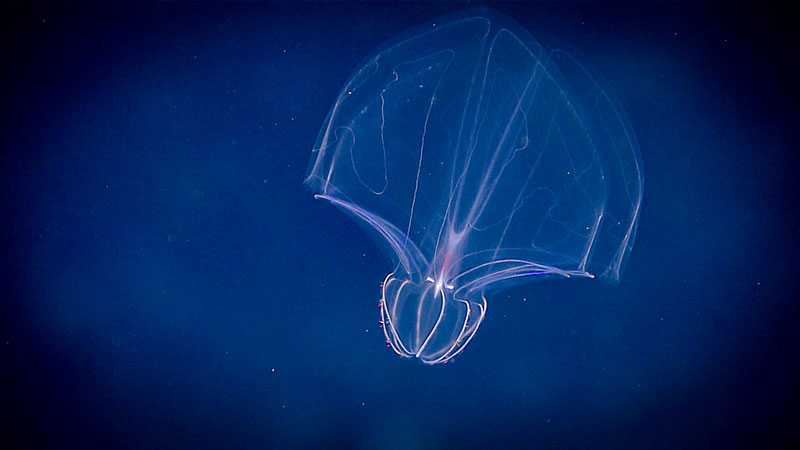
A lobate ctenophore in the ocean twilight zone. (Photo: NOAA)

If you’ve been reading this newsletter for a while, you already know I’m obsessed with submarines and undersea life. I believe we’re at the beginning of a new era of ocean discovery, driven by small personal submersibles, remotely operated vehicles (ROVS), and autonomous explorers (AUVs) that can roam the deep on their own. Add AI into the mix, and our ability to see, map, and understand the ocean is about to expand dramatically.

One phenomenon we are only beginning to fully understand also happens to be one of the most extraordinary animal events on Earth. It unfolds every single night, just a few miles offshore, in a region known as the ocean twilight zone about 650 to 3,300 feet below the ocean surface. Twice a day, billions of tons of marine organisms, from tiny crustaceans to massive schools of squid, traverse the water column in what researchers call the Diel Vertical Migration (DVM), the largest mass migration of animals on Earth. A heaving, planetary-scale pulse of biomass rising and falling through the dark.

Please check out our California wildlife shop for great gifts!

It happens everywhere, in every ocean. But California is special for several reasons. California’s cold, southward-flowing current and seasonal upwelling flood coastal waters with nutrients that feed dense plankton blooms. These blooms provide food for thick layers of migrating animals. California has one of the most robust and productive ocean ecosystems on the planet. (Take a read of the piece I did about life on some of our oil rigs.) When you add Monterey Canyon into the mix, which funnels and concentrates life, this global phenomenon becomes more compressed and visible. In fact, with Monterey Bay Aquarium Research Institute (MBARI) based at Moss Landing near the head of the canyon, Monterey Bay has become one of the most intensively studied midwater ecosystems on the planet.

Monterey Bay Aquarium Research Institute (MBARI) in Moss Landing, perched at the edge of Monterey Canyon, one of the deepest submarine canyons in North America. (Photo: Erik Olsen)

This “tidal cycle of shifting biomass” is not driven by gravity, but by the rising and setting sun. Animals rise by the trillions during the evening to escape predation, then settle during the day, when light would otherwise make them visible to hungry predators.

The discovery of this phenomenon reads like a Tom Clancy novel and took place just off our coast. During World War II, U.S. Navy sonar operators working off San Diego and the Southern California Bight began detecting what looked like a “false seafloor” hovering 300 to 500 meters down during the day, only to sink or vanish each night. The mystery lingered for years, until the late 1940s, when scientist Martin Johnson and others at Scripps Institution of Oceanography showed that the phantom bottom was not seafloor, but vast layers of living animals rising and falling with the sun. We now know this as the Deep Scattering Layer (DSL), so named because the gas-filled swim bladders of millions of small fish, primarily lanternfish which number into the quadrillions around the globe, reflect sonar pings like a solid wall.
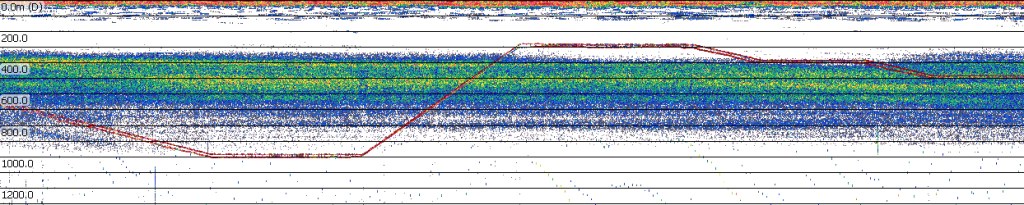
The deep-scattering layer (DSL) graphed as an echogram, or a plot of active acoustic data. Warmer colors indicate more backscatter, meaning that more (or stronger) echoes were received back from the organisms at that depth. The red line indicates the remotely operated vehicle (ROV) trajectory as it performs transects throughout the layer. (Source: NOAA)

So let’s talk about those amazing lanternfish, aka myctophids, a species that many peole have likely never heard of. These small fish may make up as much as 65 percent of all deep-sea fish biomass and are a major food source for whales, dolphins, salmon, and squid. They use tiny light organs called photophores to match faint surface light, a camouflage strategy known as counterillumination that helps hide them from predators below. These are just one of the many different species that inhabit the twilight zone as part of the DVM. 
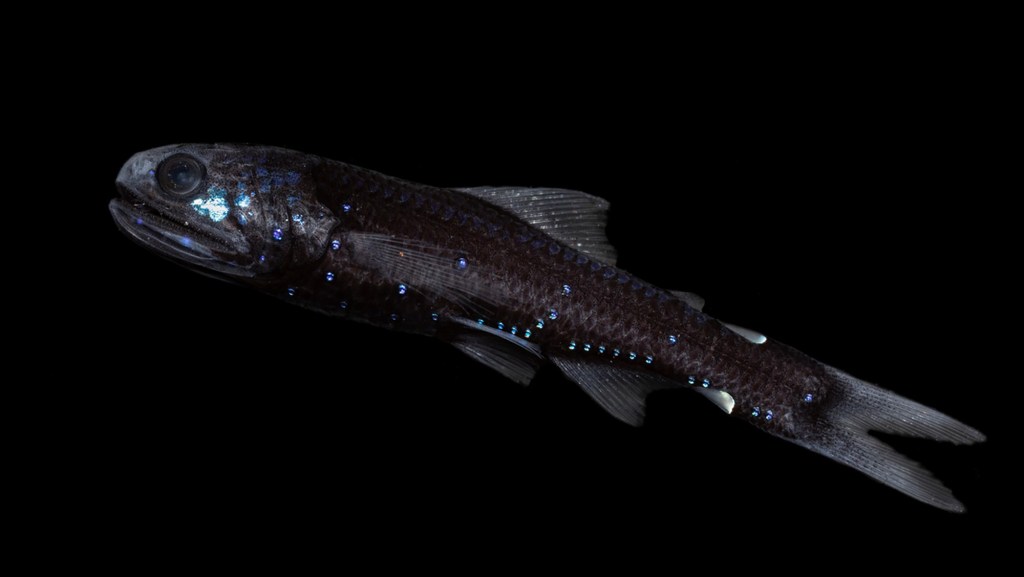
A lanternfish photographed in the ocean twilight zone, its body dotted with tiny light organs called photophores that help it blend into faint surface light as it migrates toward the surface at night. (Photo: NOAA)

Monterey Bay is arguably the world’s most important laboratory for DVM research, thanks to the Monterey Canyon, and several ground-breaking discoveries have come out of MBARI. For example, scientists at MBARI, including the legendary Bruce Robison, have used ROVs to document what they call “running the gauntlet,” when these migrators pass through layers of hungry, waiting predators. They encounter giant siphonophores with stinging tentacles, squids snag lanternfish, and giant larvaceans that build sprawling mucus “houses” that trap smaller animals. It’s like an epic battle scene out of Lord of the Rings, every single day.

This migration is also a key part of the ocean’s carbon cycle, which includes a scientific process known as the biological pump. When larger animals eat carbon-rich plankton at the surface, they eventually defecate all that carbon into the water, aka the “active transport” mechanism. Much of that carbon sinks to the bottom, sequestering it for decades or even centuries. In some regions, DVM accounts for one-third of the total carbon transport to the deep ocean. MBARI has a very interesting, long-term deep-ocean observatory called the Station M research site and observatory located nearly 12,000 feet below the surface off Santa Barbara. This site has been continuously monitored for more than three decades to track how organic matter produced near the surface eventually reaches the abyssal seafloor and feeds deep communities. I did a video about it for MBARI a few years ago.
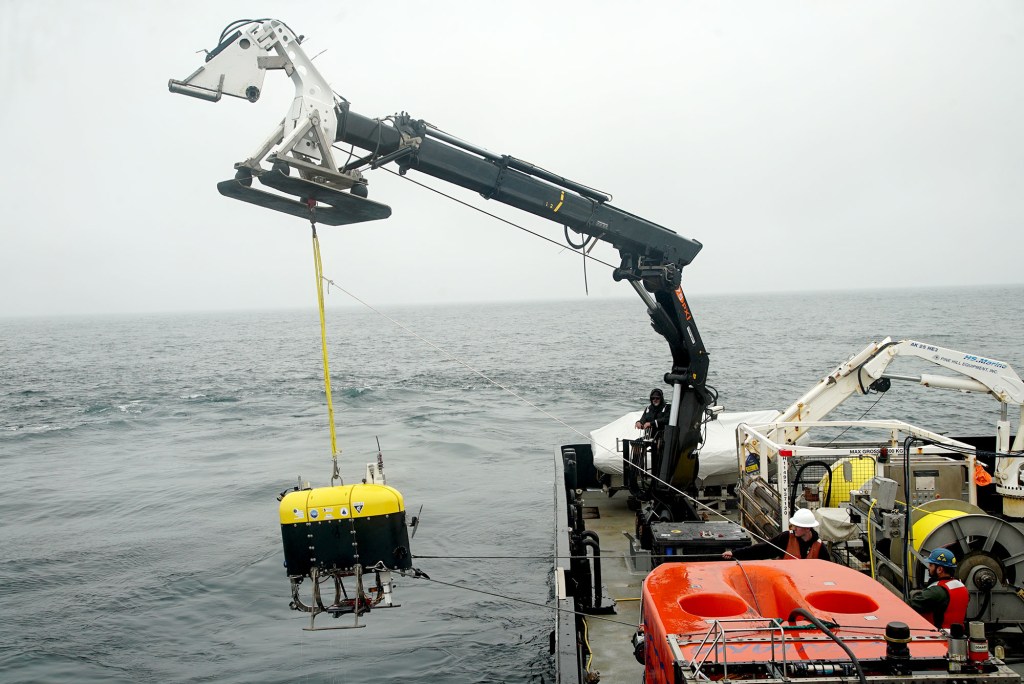
Deployment of Mesobot, an autonomous midwater robot developed by Monterey Bay Aquarium Research Institute and Woods Hole Oceanographic Institution, for exploration of the ocean twilight zone above Monterey Canyon, California. (Photo: Erik Olsen)

Other cutting-edge technology is being brought to bear as well to help us better understand what life exists in the deep waters off California. A UC San Diego study shows that we can now use low-volume environmental DNA (eDNA) to detect the genetic signatures of huge numbers of different animals, even if we can’t see them. This free-floating DNA moves with ocean currents and can be sequenced to identify species ranging from copepods to dolphins, allowing researchers to track who is participating in the migration even when organisms are too small, fragile, or fast for traditional nets.

All of this plays out each day and night off our coast, a vast symphony of animal movement and deadly combat that, until recently, was not only poorly understood but largely invisible to science. And it’s all happening right off our shores

Walter Munk was a Californian Oceanographer Who Changed Our Understanding of the Seas

Photo: Erik Jepsen (UC San Diego)

Walter Munk, often referred to as the “Einstein of the Oceans,” was one of the most influential oceanographers of the 20th century. Over a career that spanned more than 70 years, Munk fundamentally altered how we think about the oceans, contributing to our understanding of everything from wave prediction during World War II to deep-sea drilling in California. His work at the Scripps Institution of Oceanography in La Jolla, California, was groundbreaking and continues to influence scientific thinking to this day.

Walter Heinrich Munk was born in Vienna, Austria, on October 19, 1917. At 14, he moved to New York, where he later pursued physics at Columbia University. He became a U.S. citizen in 1939 and earned a bachelor’s degree in physics from the California Institute of Technology the same year, followed by a master’s in geophysics in 1940. Munk then attended the Scripps Institution of Oceanography and completed his Ph.D. in oceanography from the University of California in 1947.

Dr. Walter Munk in 1952. (Scripps Institution of Oceanography Archives/UC San Diego Libraries)

In the early 1940s, Munk’s career took a defining turn when the United States entered World War II. At the time, predicting ocean conditions was largely guesswork, and this posed a significant challenge for military operations. Munk, a PhD student at Scripps at the time, was recruited by the U.S. Army to solve a problem that could make or break military strategy—accurate wave prediction for amphibious landings.

CALIFORNIA CURATED ART ON ETSY

Purchase stunning art prints of iconic California scenes.
Check out our Etsy store.

One of his most famous contributions during the war came in 1944, ahead of the Allied invasion of Normandy. Alongside fellow oceanographer Harald Sverdrup, Munk developed a method to predict the size and timing of ocean waves, ensuring that troops could land safely during the D-Day invasion. Using their model, the Allied forces delayed the invasion by one day, a move that proved crucial in reducing casualties and securing the beachhead. This same wave prediction work was used again in the Pacific theater, particularly for landings on islands like Iwo Jima and Eniwetok. Munk’s contributions not only helped win the war but also laid the foundation for modern oceanography. Wave forecasting is now a standard tool for naval operations, shipping, and even recreational surfers.

Landing craft pass supporting warships in the Battle of Eniwetok, 19 February 1944. (U.S. Army)

After the war, Munk returned to Scripps, a place that would remain central to his career. Established in 1903, Scripps had been growing into a major center for oceanographic research, and Munk’s work helped elevate it to new heights. Located in La Jolla, just north of San Diego, Scripps was perfectly positioned on the California coastline to be at the forefront of oceanographic studies. Scripps is one of the premier oceanographic institutions in the world.

During the post-war years, Munk helped pioneer several new areas of research, from the study of tides and currents to the mysteries of the deep sea. California, with its rich marine ecosystems and coastal access, became the perfect laboratory. In La Jolla, Munk studied the Southern California Current and waves that originated across the Pacific, bringing new understanding to local coastal erosion and long-term climate patterns like El Niño. His research had a direct impact on California’s relationship with its coastline, from naval operations to public policy concerning marine environments.

Walter Munk in 1963 with a tide capsule. The capsule was dropped to the seafloor to measure deep-sea tides before such measurements became feasible by satellite. Credit Ansel Adams, University of California

While Munk’s contributions to wave forecasting may be his most widely recognized work, one of his boldest projects came in the 1960s with Project Mohole. It was an ambitious scientific initiative to drill into the Earth’s mantle, the layer beneath the Earth’s crust. The project was named after the Mohorovičić Discontinuity (named after the pioneering Croatian seismologist Andrija Mohorovičić), the boundary between the Earth’s crust and mantle. The boundary is often referred to as the “Moho”. The goal was revolutionary: to retrieve a sample from the Earth’s mantle, a feat never before attempted.

The idea was to drill through the ocean floor, where the Earth’s crust is thinner than on land, and reach the mantle, providing geologists with direct insights into the composition and dynamics of our planet. The project was largely conceived by American geologists and oceanographers, including Munk, who saw this as an opportunity to leapfrog the Soviet Union in the ongoing Cold War race for scientific supremacy.

The Glomar Challenger, launched in 1968, was the drill ship for NSF’s Deep Sea Drilling Project. (Public Domain)

California was again the backdrop for this audacious project. The drilling took place off the coast of Guadalupe Island, about 200 miles from the Mexican coast, and Scripps played a key role in organizing and coordinating the scientific work. The project succeeded in drilling deeper into the ocean floor than ever before, reaching 600 feet into the seabed. However, funding issues and technical challenges caused the U.S. Congress to abandon the project before the mantle could be reached. Despite its early end, Project Mohole is considered a precursor to modern deep-sea drilling efforts, and it helped pave the way for initiatives like the Integrated Ocean Drilling Program, which continues to explore the ocean’s depths today. For example, techniques for dynamic positioning for ships at sea were largely developed for the Mohole Project.

Munk’s work was deeply tied to California, a state whose coastlines and oceanography provided a wealth of data and opportunities for study. Scripps itself is perched on a stunning bluff overlooking the Pacific Ocean, a setting that greatly inspired Munk and his colleagues. Throughout his career, Munk worked on understanding the coastal dynamics of California, from studying the erosion patterns of beaches to analyzing how global warming might impact the state’s famous coastal cliffs.

Scripps Institution of Oceanography

His legacy continues to shape how California manages its vast coastline. The methodologies and insights he developed in wave prediction are now used in environmental and civil engineering projects that protect harbors, beaches, and coastal infrastructure from wave damage. As climate change accelerates the rate of sea level rise, Munk’s work on tides, ocean currents, and wave dynamics is more relevant than ever for California’s future.

Walter Munk’s contributions to oceanography stretched well beyond his wartime work and Project Mohole. He was instrumental in shaping how we understand everything from deep-sea currents to climate patterns, earning him numerous awards and accolades. His work at Scripps set the stage for the institution’s current status as a world leader in oceanographic research.

One of the most notable examples of this work was an experiment led by Munk to determine whether acoustics could be used to measure ocean temperatures on a global scale, offering insights into the effects of global warming. In 1991, Munk’s team transmitted low-frequency underwater acoustic signals from a remote site near Heard Island in the southern Indian Ocean. This location was strategically chosen because sound waves could travel along direct paths to listening stations in both the Pacific and Atlantic Oceans. The experiment proved successful, with signals detected as far away as Bermuda, New Zealand, and the U.S. West Coast. The time it took for the sound to travel was influenced by the temperature of the water, confirming the premise of the study.

Walter Munk in 2010 after winning the Crafoord Prize. (Crafoord Prize)

Munk passed away in 2019 at the age of 101, but his influence lives on. His approach to science—marked by curiosity, boldness, and a willingness to take on complex, high-risk projects—remains an inspiration for generations of scientists. He was a giant not only in oceanography but also in shaping California’s role in global scientific innovation. As the state faces the challenges of a changing climate, Munk’s legacy as the “Einstein of the Oceans” continues to be felt along its shores and beyond.