California’s SLAC and the Mission to Unveil the Mysteries of Matter and the Cosmos

The BaBar Detector at SLAC with physicist Michael Kelsey inside wearing a red hard hat, 2002. 
(Peter Ginter/SLAC National Accelerator Laboratory)

The SLAC National Accelerator Laboratory in Menlo Park, California, is a testament to human curiosity and the pursuit of the unknown. Since its inception in 1962, originally as the Stanford Linear Accelerator Center (as it was previously known), it has been on the forefront of scientific discovery in numerous scientific disciplines. It is truly one of the nation’s great scientific institutions, being at the forefront of numerous major discoveries that have deeply impacted – and will impact – the world. 

Six scientists have received four Nobel prizes for their groundbreaking research conducted at SLAC, which led to the discovery of two elementary particles, confirmed that protons consist of quarks, and elucidated the process by which DNA orchestrates the synthesis of proteins in cells.

Stanford’s Roger Kornberg received the 2006 chemistry Nobel for work on RNA transcriptase, shown on screens.  
(Peter Ginter/SLAC National Accelerator Laboratory)

Administered by Stanford University and sponsored by the U.S. Department of Energy, SLAC has grown into a multifaceted research institution that explores a broad program in atomic and solid-state physics, chemistry, biology, and medicine. The lab employs the use of X-rays generated from synchrotron radiation and a free-electron laser, among other tools, to push the boundaries of our understanding in areas ranging from elementary particle physics to cosmology​​.

CALIFORNIA CURATED ART ON ETSY

Purchase stunning coffee mugs and art prints of iconic California species.
Check out our Etsy store.

SLAC’s roots can be traced back to the construction of the 3.2-kilometer Stanford Linear Accelerator in 1966, the world’s longest linear accelerator at the time. This remarkable structure has been pivotal in fundamental research that led to the discovery of the charm quark in 1976, the quark structure inside protons and neutrons in 1990, and the tau lepton in 1995, each discovery earning a Nobel Prize in Physics​​. This pioneering spirit is also embedded in SLAC’s cultural heritage, having provided a meeting space for the Homebrew Computer Club, which significantly contributed to the home computer revolution of the late 1970s and early 1980s​​. For example, Steve Wozniak debuted the prototype Apple-1 at the Homebrew Computer Club in 1976. 

Steve Jobs and Steve Wozniak
Apple 1

SLAC has also played a significant role in the digital age, hosting the first World Wide Web server outside of Europe in December 1991, a milestone that underscores its contribution beyond the realm of physics​​. In the 1990s, the Stanford Linear Collider delved into the properties of the Z boson, further cementing SLAC’s position at the cutting edge of particle physics research​​.

New projects and experiments are undertaken at SLAC all the time, and new discoveries are constantly being made to help us understand the nature of matter, biological processes and the evolution of the universe, as well as to help bring us into a greener future. In November 2023, a team at SLAC along with the Toyota Motor Company made significant advances in fuel cell efficiency.

The Linac Coherent Light Source (LCLS), a free-electron laser facility, has been a highlight of SLAC’s facilities, providing intense X-ray radiation for diverse research areas since 2009. In September 2023, SLAC fired up the world’s most powerful X-ray laser, the LCLS-II, to explore atomic-scale, ultrafast phenomena that are key to a broad range of applications, from quantum materials to clean energy technologies and medicine.

“This achievement marks the culmination of over a decade of work,” said LCLS-II Project Director Greg Hays. “It shows that all the different elements of LCLS-II are working in harmony to produce X-ray laser light in an entirely new mode of operation.”  

It was in the facility that scientists and researchers developed the first X-ray free-electron lasers (XFELs). XFELs are like X-ray microscopes, and generate exceptionally bright and fleeting bursts of X-ray light, enabling researchers to observe the dynamics of molecules, atoms, and electrons with unparalleled clarity, exactly as these events unfold in their native, rapid timescales—a realm where the intricacies of chemistry, biology, and materials science play out. These facilities have played a pivotal role in numerous scientific breakthroughs, such as producing the first “molecular movie” that reveals the intricacies of complex chemical reactions, capturing the precise moments when plants and algae harness solar energy to generate the oxygen we rely on, and probing the intense conditions that shape the formation of planets and extraordinary events like diamond precipitation.

Over the years, SLAC has evolved to support a growing community of scientists. As of 2021, the lab employs approximately 1,600 staff members from 55 different countries, in addition to 470 postdoctoral researchers and graduate students. The center welcomes over 3,000 visiting researchers annually​​. This community has access to facilities such as the Stanford Synchrotron Radiation Lightsource for materials science and biology experiments and the Fermi Gamma-ray Space Telescope for astrophysics research​​.

After decades of effort and help from SLAC’s X-ray laser, scientists have finally seen the process by which nature creates the oxygen we breathe. (SLAC)

The lab is also working at the forefront of astronomy and imaging. The SLAC National Accelerator Laboratory is at the helm of an ambitious project, crafting the world’s largest digital camera for the Vera Rubin Observatory’s Legacy Survey of Space and Time (LSST). Set to capture the southern sky from high on a mountaintop in Chile, this camera is a marvel of engineering and scientific collaboration. Its 3.2-gigapixel capacity allows it to snap detailed images every 15 seconds, offering an unprecedented window into the cosmos. The camera’s wide field of view can image an area 40 times larger than the full moon in one shot, and its advanced filters enable astronomers to probe the universe across a range of wavelengths. As part of the decade-long LSST, it will gather vast amounts of data, propelling our understanding of dark matter, dark energy, galaxy formation, and more​

SLAC has developed the world’s largest digital camera for the Vera Rubin Observatory’s Legacy Survey of Space and Time (LSST)

In 2008, the lab was renamed from the Stanford Linear Accelerator Center to SLAC National Accelerator Laboratory, reflecting a broader scientific mission. Since then, the lab has continued to receive significant funding, including $68.3 million in Recovery Act Funding in 2009​​. Notably, SLAC and Stanford University initiated the Bits and Watts project to develop better, greener electric grids, although SLAC later withdrew due to concerns over an industry partner​​.

SLAC’s current endeavors include the Facility for Advanced Accelerator Experimental Tests (FACET), where research on plasma acceleration continues to advance the field​​. Theoretical research at the lab spans quantum field theory, collider physics, astroparticle physics, and particle phenomenology​​. Moreover, SLAC has contributed to the development of the klystron, a high-power microwave amplification tube that amplifies high radio frequencies and has aided in archaeological discoveries such as revealing hidden text in the Archimedes Palimpsest​​.

Archimedes Palimpsest (Wikipedia)

Other recent updates from SLAC include a new system for turning seawater into hydrogen fuel​​​​. They have also made advancements in understanding the production of nitroxide, a molecule with potential biomedical applications, and the operation of superconducting X-ray lasers at temperatures colder than outer space​​​​.

The SLAC National Accelerator Laboratory’s legacy is rich with scientific triumphs, and its future beckons with the promise of unraveling more of the universe’s deepest secrets. Whether through peering into the atomic structure or probing the vast cosmos, SLAC remains a beacon of discovery and innovation.

Einstein in Pasadena: Three Wonderful Winters in Paradise

Einstein at the Santa Barbara home of Caltech trustee Ben Meyer on Feb. 6, 1933.
(The Caltech Archives)

“Here in Pasadena, it is like Paradise. Always sunshine and clear air, gardens with palms and pepper trees and friendly people who smile at one and ask for autographs.” – Albert Einstein (U.S. Travel Diary, 1930-31, p. 28)

Albert Einstein is often associated with Princeton, where he spent his later years as a towering intellectual figure, and with Switzerland, where he worked as a young patent clerk in Bern. It was in that spartan, dimly lit office, far from the great universities of the time, that Einstein quietly transformed the world. In 1905, his annus mirabilis or “miracle year,” he published a series of four groundbreaking papers that upended physics and reshaped humanity’s understanding of space, time, and matter. With his insights into the photoelectric effect, Brownian motion, special relativity, and the equivalence of mass and energy (remember E=mc2?), he not only laid the foundation for quantum mechanics and modern physics but also set in motion technological revolutions that continue to shape the future. Pretty good for a guy who was just 26.

Albert Einstein spent his later years as a world-famous scientist traveling the globe and drawing crowds wherever he went. His letters and travel diaries show how much he loved exploring new places, whether it was the mountains of Switzerland, the temples of Japan, or the intellectual circles of his native Germany. In 1922, while on his way to accept the Nobel Prize, he and his wife, Elsa, arrived in Japan for a six-week tour, visiting Tokyo, Kyoto, and Osaka.

But of all the places he visited, one city stood out for him in particular. Pasadena, with its warm weather, lively culture, and, most importantly, its reputation as a scientific hub, had a deep personal appeal to Einstein. ​He visited Pasadena during the winters of 1931, 1932, and 1933, each time staying for approximately two to three months. These stays were longer than many of his other travels, giving him time to fully immerse himself in the city. He spent time at Caltech, exchanging ideas with some of the brightest minds in physics, and fully embraced the California experience, rubbing elbows with Hollywood stars (Charlie Chapman among them), watching the Rose Parade, and even tutoring local kids. Einstein may have only been a visitor, but his time in Pasadena underscores how deeply rooted science was in the city then, and how strongly that legacy endures today. Pasadena remains one of the rare places in the country where scientific inquiry and creative spirit continue to thrive side by side. Pasadena was among the earliest cities to get an Apple Store, with its Old Pasadena location opening in 2003.

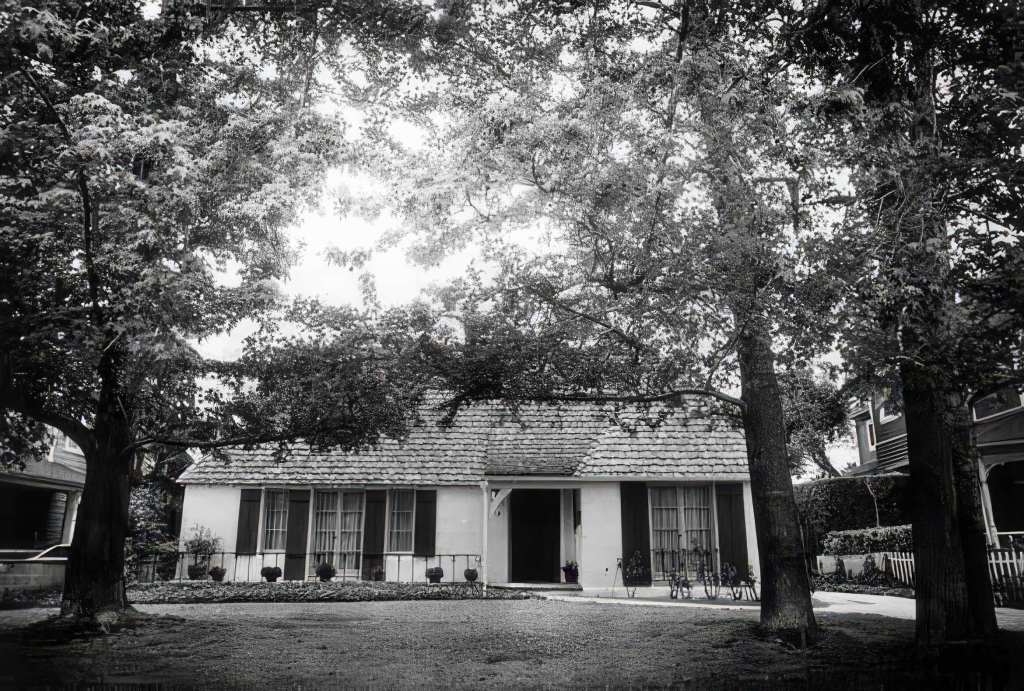
Einstein’s residence at 707 South Oakland Avenue in Pasadena, where he stayed his first winter in California (CalTech Archives)

Few scientists have received the public adulation that Einstein did during his winter stays in Pasadena. As a hobbyist violinist, he engaged in one-on-one performances with the conductor of the Los Angeles Philharmonic. Local artists not only painted his image and cast him in bronze but also transformed him into a puppet figure. Frank J. Callier, a renowned violin craftsman, etched Einstein’s name into a specially carved bow and case.

During his first winter of residence in 1931, Einstein lived in a bungalow at 707 South Oakland Avenue. During the following two winters, he resided at Caltech’s faculty club, the Athenaeum, a faculty and private social club that is still there today.

Yet, the FBI was keeping a watchful eye on Einstein as well. He was one of just four German intellectuals, including Wilhelm Foerster, Georg Nicolai, and Otto Buek, to sign a pacifist manifesto opposing Germany’s entry into World War I. Later, Einstein aligned himself with Labor Zionism, a movement that supported Jewish cultural and educational development in Palestine, but he opposed the formation of a conventional Jewish state, instead calling for a peaceful, binational arrangement between Jews and Arabs.

In front of the Athenaeum Faculty Club, Caltech, 1932. 
(Courtesy of the Caltech Archives.)

After his annus mirabilis in 1905, Einstein’s influence grew rapidly. In 1919, his theory of relativity was confirmed during a solar eclipse by the English astronomer Sir Arthur Eddington. The announcement to the Royal Society made Einstein an overnight sensation among the general public, and in 1922, he was awarded the 1921 Nobel Prize in Physics. While teaching at the University of Berlin in 1930, Arthur H. Fleming, a lumber magnate and president of Caltech’s board, successfully persuaded him to visit the university during the winter. The visit was intended to remain a secret, but Einstein’s own travel arrangements inadvertently made it public knowledge.

Einstein speaking at the dedication of the Pasadena Junior College (now PCC) astronomy building, February 1931. 
(Courtesy of the Caltech Archives)

After arriving in San Diego on New Year’s Eve 1930, following a month-long journey on the passenger ship Belgenland, Einstein was swarmed by reporters and photographers. He and his second wife, Elsa, were greeted with cheers and Christmas carols. Fleming then drove them to Pasadena, where they settled into the bungalow on S Oakland Ave.

Albert Einstein and his violin (Caltech Archives)

During their first California stay, the Einsteins attended Charlie Chaplin’s film premiere and were guests at his Beverly Hills home. “Here in Pasadena, it is like Paradise,” Einstein wrote in a letter. He also visited the Mt. Wilson Observatory high in the San Gabriel Mountains. Einstein’s intellectual curiosity extended far beyond his scientific endeavors, leading him to explore the Huntington Library in San Marino, delighting in its rich collections. At the Montecito home of fellow scientist Ludwig Kast, he found comfort in being treated more as a tourist than a celebrity, relishing a brief respite from the spotlight.

In Palm Springs, Einstein relaxed at the winter estate of renowned New York attorney and human rights advocate Samuel Untermeyer. He also embarked on a unique adventure to the date ranch of King Gillette, the razor blade tycoon, where he left with a crate of dates and an intriguing observation. He noted that female date trees thrived with nurturing care, while male trees fared better in tough condition: “I discovered that date trees, the female, or negative, flourished under coddling and care, but in adverse conditions the male, or positive trees, succeeded best,” he said in a 1933 interview.

CALIFORNIA CURATED ON ETSY

Purchase stunning coffee mugs and art prints of California icons.
Check out our Etsy store.

Not exactly relativity, but a curiosity-driven insight reflecting his ceaseless fascination with the world.

During his three winters in Pasadena, Einstein’s presence was a source of intrigue and inspiration. Students at Caltech were treated to the sight of the disheveled-haired genius pedaling around campus on a bicycle, launching paper airplanes from balconies, and even engaging in a heated debate with the stern Caltech president and Nobel laureate, Robert A. Millikan, on the steps of Throop Hall. Precisely what they debated remains a mystery. (Maybe something about the dates?)

Einstein with Robert A. Millikan, a prominent physicist who served as the first president of Caltech from 1921 to 1945 and won the Nobel Prize in Physics in 1923. (Courtesy of the Caltech Archives.)

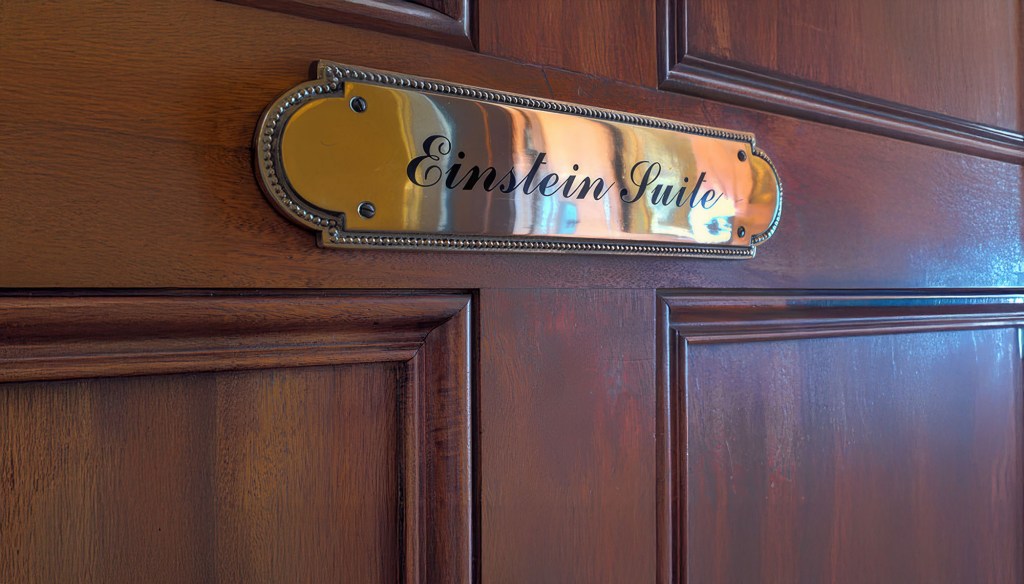
During his final winter in California, a near-accident led the couple to move into Caltech’s Athenaeum. His suite, No. 20, was marked with a distinctive mahogany door, a personal touch from his sponsor, Fleming. In 1933, as Nazi power intensified in Germany, Einstein began searching for a safe place to continue his work. Although Caltech made an offer, it was Princeton University‘s proposal that ultimately won him over. Einstein relocated to Princeton that same year, where he played a significant role in the development of the Institute for Advanced Study and remained there until his death in 1955.

Suite No. 20, Einstein’s mahogany door at the Caltech Athenaeum

Today, a large collection of Einstein’s papers are part of the Einstein Papers Project at Caltech. And Einstein’s suite at Caltech’s Athenaeum, still displaying the mahogany door, serves as a physical reminder of his visits.

During his third and final visit to Caltech in 1933, Hitler rose to power as Chancellor of Germany. Realizing that, as a Jew, he could not safely return home, Einstein lingered in Pasadena a little longer before traveling on to Belgium and eventually Princeton, where he received tenure. He never returned to Germany, or to Pasadena. Yet he often spoke fondly of the California sunshine, which he missed, and in its own way, the sunshine seemed to miss him too.

J. Robert Oppenheimer: The Berkeley Era and The Birth of the Manhattan Project

With the release of the movie Oppenheimer, it’s worth taking a look at the role that California played in one of the most important technological developments of the 20th century: the making of the atomic bomb. The Manhattan Project, the prodigious scientific endeavor that produced the world’s first nuclear weapons, cast a long, dark shadow over the mid-20th century. But amid the mushroom clouds, there lies a tale of innovation and scientific genius that originated from an unlikely source—the University of California, Berkeley.

The film team filmed several scenes at Berkeley, adding a vintage car and 1940s-era lampposts to the campus. Oppenheimer taught at UC Berkeley from 1929 to 1943 — his office was on the third floor of Physics North (then named LeConte Hall) 

For years, America’s physics powerhouse resided in the East. But in the post-WWI era, the western horizon blazed with opportunity. Visionary administrators at Caltech and UC Berkeley threw financial muscle behind their bold mission: to make physics research a priority.

By the dawn of the 1930s, their investments bore fruit. The American Physical Society‘s president hailed California as a hotbed of physics innovation, equating it with the East in the academic landscape of the discipline. Universities played high-stakes poker for the talents of up-and-coming physicists like Oppenheimer and Ernest Lawrence, known for his groundbreaking work in photoelectricity and ionization.

Visit the California Curated store on Etsy for original prints showing the beauty and natural wonder of California.

J. Robert Oppenheimer, one of the leading physicists of the 20th century, is often remembered as the ‘father of the atomic bomb’. However, his journey toward this formidable title began at Berkeley, an intellectual crucible where his talent for theoretical physics was honed, ultimately leading him to oversee the Manhattan Project, a scientific endeavor that would change the world.

J. Robert Oppenheimer, Enrico Fermi and Ernest O. Lawrence at UC Berkeley in 1940. Courtesy: Lawrence Berkeley National Laboratory

Oppenheimer’s relationship with Berkeley began in 1929 when he joined as an Assistant Professor of Physics. This was an exciting period in the realm of science. Quantum mechanics was in its infancy and a new breed of scientists was emerging, eager to unlock the secrets of the universe. Oppenheimer, with his insatiable curiosity and infectious enthusiasm, was just the right person for this time of exploration.

During his years at Berkeley, Oppenheimer made significant contributions to quantum mechanics, notably his work on the Oppenheimer-Phillips process. This theory describes a particular type of nuclear reaction that occurs during the absorption of a neutron by a nucleus, an understanding that would later prove pivotal to the development of nuclear energy.

Outside the laboratory, Oppenheimer was an adored figure, known for his quick wit and charismatic teaching style. He was instrumental in building the physics program at Berkeley into perhaps the finest in the country by attracting some of the brightest minds of the time. Together, they would be known as dubbed the “luminaries”.

J. Robert Oppenheimer (Ed Westcott/U.S. Department of Energy via Bay City News)

“The group met secretly in his office at the northwest corner of the top floor of ‘old’ LeConte Hall. This office, like others on the top floor, has glass doors opening out onto a balcony,” wrote Raymond T. Birge, former chair of the Berkeley physics department at the time. “This balcony is readily accessible from the roof. To prevent this method of entry, a very heavy iron netting was placed over the balcony. A special lock was placed on the door to the office and only Oppenheimer had the key. No janitor could enter the office, nor could I, as chairman of the department,”

Hans Bethe, one of the great German-American theoretical physicists of the age said Oppenheimer established UC Berkeley as the “greatest school of theoretical physics the United States has ever known.”

Although he was increasingly recognized as a pivotal figure in theoretical physics, former students say he remained accessible, consistently urging his students to question norms and extend limits. He actively promoted a culture of inquiry among his students, even if his responses occasionally seemed harsh. However, Oppenheimer’s questions to his student speakers were meant to clarify rather than to humiliate, often aimed more at enlightening the audience than himself. His rapport with his students was unexpectedly casual. He provided an open-door policy, inviting his students to visit his office anytime to utilize the physics resources within his personal collection.

J. Robert Oppenheimer with Glenn T. Seaborg and Ernest O. Lawrence in early 1946. (Photo courtesy of Berkeley Lab)

Oppenheimer’s life at Berkeley wasn’t all physics. A man of varied interests, he was an avid hiker, horseback rider, and aficionado of literature, poetry, and art. These varied interests made him a multifaceted character and helped him foster connections with many prominent figures across different fields. His unique combination of scientific genius, humanity, and leadership qualities made him a standout candidate for the enormous task that lay ahead – the Manhattan Project.

While no major Manhattan Project facilities graced the Golden State, Berkeley, nestled in the heart of California, emerged as an unsung hero of the project. Berkeley offered more than a tranquil academic setting; it provided an assembly line of experts that would revolutionize nuclear science. Not only was Berkeley home to Oppenheimer the university also attracted other nuclear-era luminaries like Ernest Lawrence, and chemists Glenn Seaborg.

Berkeley had always been special. California’s first land-grant university, founded in 1868, Berkeley underwent a metamorphosis under the leadership of Robert Sproul. From 1930 to 1958, Sproul spearheaded the transformation of Berkeley into a hub of intellectual firepower. The University of California system burgeoned across the state, with Berkeley, the original campus, earning a reputation as one of the nation’s foremost research institutions. Its powerhouse physics department became a beacon in the dark world of the Manhattan Project.

Berkeley’s list of accomplishments in physics is long and distinguished, but one discovery stands out – the identification of plutonium. Edwin McMillan, a promising physicist at Berkeley, ventured into the wilderness of uranium fission products. In 1940, he stumbled upon an unknown substance – element 93, or as he named it, “neptunium,” a hat tip to the distant planet Neptune. McMillan predicted that neptunium decayed into plutonium, the elusive element 94.

Glenn Seabord – Wikipedia

Glenn Seaborg, another Berkeley savant, picked up where McMillan left off when the latter migrated east to work at MIT. Seaborg unveiled the heart of plutonium, exposing its fundamental chemical and nuclear properties, including its high propensity for fission. As the world’s leading expert on plutonium, Seaborg directed the ambitious effort to separate plutonium from uranium and other reactor products.

Meanwhile, Ernest Lawrence led a research group that broke boundaries with the cyclotrons at the Rad Lab. They used the 60-inch cyclotron to bombard uranium with neutrons, producing plutonium for scrutiny. But Lawrence had a revelation. In 1941, he realized the cyclotron could also operate as a mass spectrometer, effectively isolating uranium-235 from uranium-238. This technique was later adopted at Oak Ridge’s Y-12 Separation Plant, enabling large-scale separation. The cyclotron, rechristened as a “Calutron” in a nod to the University of California, had revolutionized nuclear science.

Recording of the “Rainier” shot, Nevada Test Site, Sept. 19, 1957.
Atomic Energy Commission/U.S. Department of Energy via Wikipedia Commons

While these figures were all played prominent roles in the development of the atomic bomb dropped on Hiroshima and Nagasaki in 1945, it is Oppenheimer who is best remembered. After fourteen years at Berkeley, Oppenheimer was plucked from the physics department at Berkeley by General Leslie Groves to assume leadership of the research program at Los Alamos. Even after his move, Oppenheimer fostered a close alliance between Berkeley and the Manhattan Project. In a shroud of secrecy, the University of California took on the management of the operations at Los Alamos. The university even set up a Los Angeles office that handled material logistics for the lab.

Despite decades passing and the veils of secrecy lifting, the legacy endures. The Los Alamos lab continues to operate under the University of California’s management, preserving Berkeley’s indelible imprint on the atomic age. It’s a testament to the institution’s groundbreaking contributions and a tribute to the remarkable scientists who once walked its hallowed halls.