
Imagine a world lost in deep time. The atmosphere held less oxygen than at any point since the Cambrian explosion, and the land was dominated by iconic dinosaurs like Allosaurus, Brachiosaurus, Archaeopteryx, and Stegosaurus. It was an era poised for a new type of plant life that would come to define the landscape—cycads. While Jurassic forests are often depicted as dense with ferns, with their coiled fronds and lush foliage, these plants were not the sole stars of the ancient botanical world.
The true giants of the Jurassic flora were the cycads, seed-bearing plants with stout, woody trunks and crowns of stiff, feather-like evergreen leaves. In fact, the Jurassic is often referred to as the “Age of Cycads”. Cycads thrived during this period, approximately 280 to 145 million years ago, as evidenced by abundant fossils. These resilient plants, which once dominated prehistoric landscapes, have remarkably endured the passage of time, remaining largely unchanged (although this is now disputed) and offering a living glimpse into a world ruled by dinosaurs.
One of the most remarkable features of cycads is the toughness of their leaves. Touch them with your fingers. They have a much greater stiffness than most other plants. Cycad leaves are thick, leathery, and often waxy to the touch, with a heavy cuticle, a protective outer layer that makes them remarkably durable. Unlike the soft, broad leaves of many modern plants, cycad fronds are built to withstand intense sunlight, conserve water in dry environments, and deter herbivores. The stiff, sometimes spiny edges of the leaves would have made them a difficult meal, offering a critical evolutionary advantage during a time when giant plant-eating dinosaurs roamed the Earth.
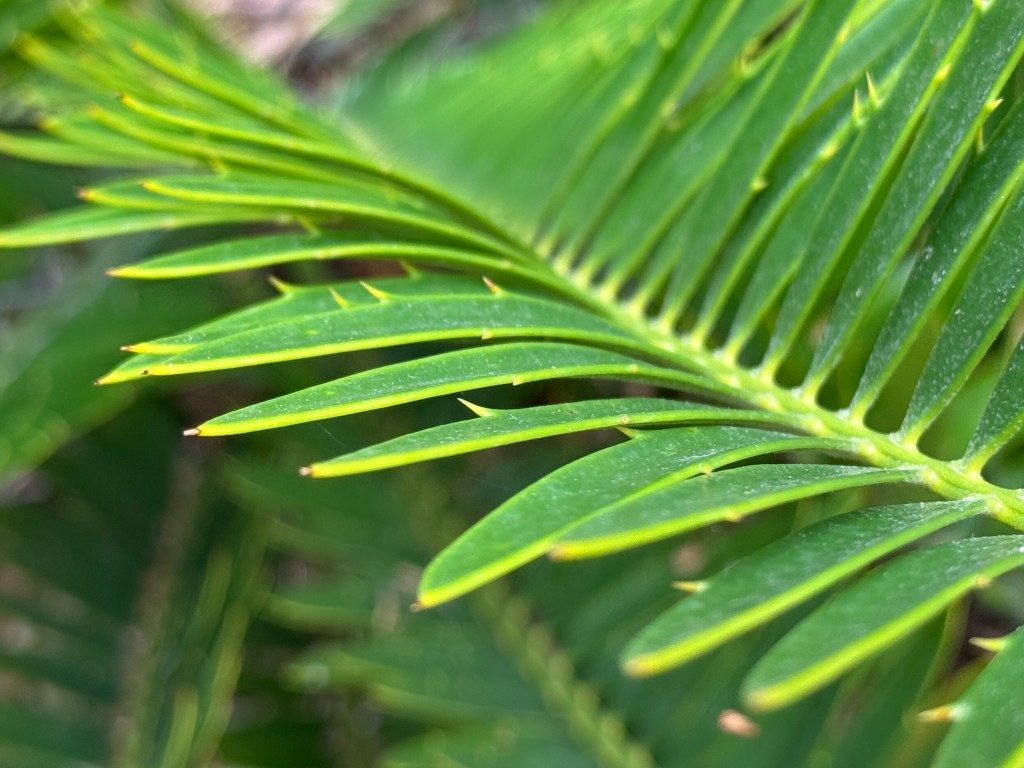
Despite their formidable defenses, evidence shows that dinosaurs did in fact eat cycads. Fossilized dinosaur dung, known as coprolites, has been found containing fragments of cycad tissues and pollen. Some herbivorous dinosaurs like Stegosaurus and Ankylosaurus are believed to have browsed on cycads, along with other tough plants of the Mesozoic landscape. These animals likely evolved strong jaws and specialized teeth capable of grinding down fibrous, sturdy plant material. In turn, the resilience of cycad leaves helped the plants survive repeated grazing and harsh environmental stresses, allowing them to persist across millions of years into the present day. FYI: Flowering plants, or angiosperms, only came into being during the late reign of the dinosaurs, during the Cretaceous Period (145–66 million years ago).
Recent fossil discoveries are also reshaping how scientists view cycads. In 2023, researchers uncovered an 80-million-year-old fossilized cycad cone in Silverado Canyon, California, revealing that ancient cycads were far more diverse than their modern descendants. Previously thought to be “living fossils” that had remained largely unchanged since the dinosaur era, cycads now appear to have undergone significant evolutionary changes during the Cretaceous period. The find, assigned to a new genus called Skyttegaardia, highlights how much more dynamic and complex cycad history may be than once believed.
Cycads are cool to look at and examine closely, and it turns out that one of the best places in the United States to see actual living cycads in Descanso Gardens in La Canada Flintridge. But how’d they get there?
In 2014, La Canada Flintridge residents Katia and Frederick Elsea called the city’s Descanso Gardens with an odd proposal: would the famous horticultural center take their collection of over 180 rare cycads, a fern-like plant from the days of the dinosaurs?
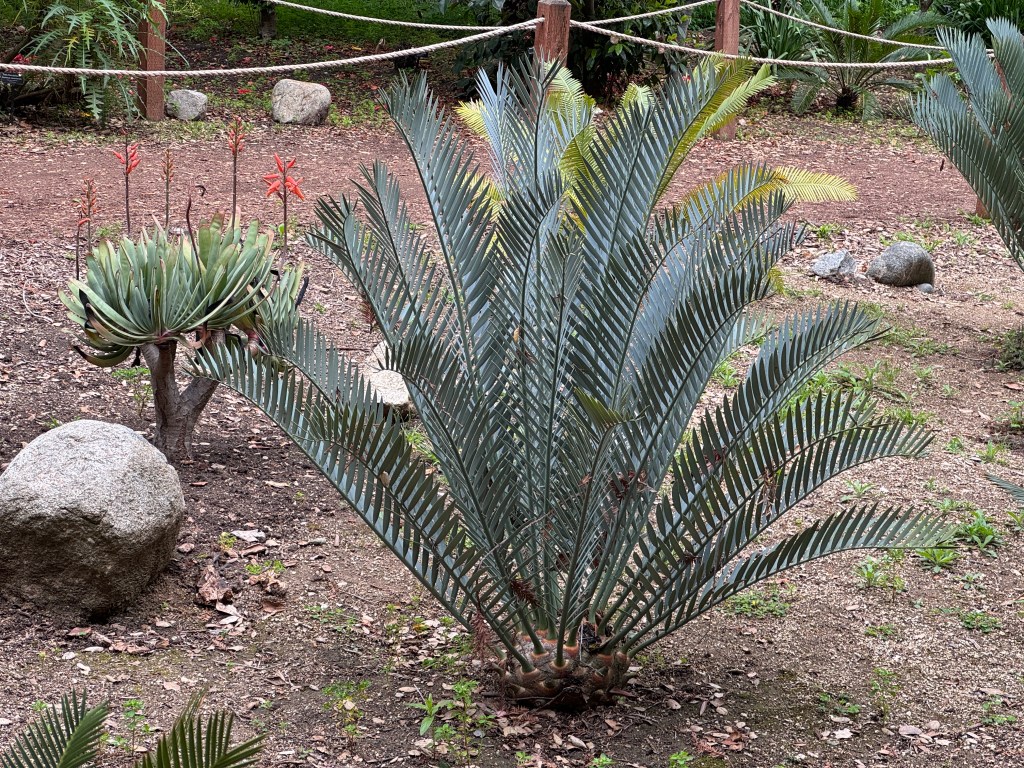
The garden said yes, and now those plants are part of an effort to recreate a prehistoric landscape. Sixty-six species were transplanted from the Elsea collection to the garden’s Ancient Forest. Cycads form the heart of the forest, but there are also Tree ferns, with feathery fronds, and Ginkgo biloba, known for its distinctive fan-shaped leaves. This area, dedicated to showcasing some of the world’s oldest and most primitive plant species, highlights the remarkable resilience and beauty of plants that have survived for millions of years.
Cycads are a type of gymnosperm. Gymnosperms are a group of seed-producing plants that includes cycads, conifers, ginkgoes, and gnetophytes. Unlike angiosperms (flowering plants), gymnosperms do not produce flowers or fruits; instead, their seeds are exposed or “naked,” typically held in cones or on the surface of scales. They also have a unique structure, with a large crown of stiff, fern-like leaves arising from a stout trunk. They may look like palms or ferns, but they are actually their own distinct group of plants, with over 300 species in the world.
In contrast, flowering plants have been far more evolutionary successful. Angiosperms dominate most of the planet’s ecosystems, with an estimated 300,000 species, vastly outnumbering the gymnosperms. Their ability to form flowers and fruits has allowed them to diversify into nearly every terrestrial habitat on Earth.

The cycads at Descanso Gardens come from all over the globe, including Africa, Australia, and the Americas. They are part of the International Palm Society’s Cycad Collection, one of the largest and most diverse collections of cycads in the world. The collection at Descanso Gardens features over 200 cycad specimens, including rare and endangered species.
One of the fascinating plants showcased in the garden is the Sago Palm (not actually a palm), Cycas revoluta, a dioecious species, meaning it has separate male and female plants. Male Sago Palms produce multiple cones at their center, releasing pollen that insects carry to the female plants. The female plants develop a single, large cone in the center, which contains seeds. When the pollen fertilizes these seeds, a new plant can grow, continuing the cycle of this ancient species.
Another fitting addition to the Ancient Forest is the monkey puzzle tree, Araucaria araucana. This small, spiky tree is entirely covered with sharp, scale-like leaves that resemble thick, dense pine needles but are much tougher. Known as one of the earliest living conifers, the monkey puzzle tree stands as a living relic from the time when these ancient trees dominated prehistoric landscapes.
Cycads are fascinating not just for their ancient history, but also for their unique biology. Unlike most plants, which have a single apical meristem (a region of cell division at the growing tip), cycads have multiple meristems, which allows them to produce new leaves even if the growing tip is damaged. They also have a symbiotic relationship with cyanobacteria, which live in their roots and fix nitrogen from the air, allowing the plant to grow in nutrient-poor soils.
Despite their ancient origins, cycads are facing modern-day threats. Many species are endangered due to habitat loss and over-collection for the horticultural trade. The cycad collection at Descanso Gardens is not just a beautiful display, but also an important conservation effort to preserve these ancient plants for future generations.
At Descanso Gardens, the cycads have been planted according to the geographic region where they originate: Africa, Asia, Madagascar, Australia and Mexico. Some of the plants no longer exist in the wild.
“For a really long time, this was plant life on Earth,” the former director, David R. Brown told the Los Angeles Times. “This helps remind me that, for as self-absorbed as we are often, we’re but a part of a story that has been going on for a very, very long time.”
If you’d like to learn more about Descanso Gardens, it’s collections and how it came into being check out this episode of Lost LA. And if you’re interested in seeing the cycad collection at Descanso Gardens for yourself, try visiting during the late afternoon, when the golden hour light heightens the beauty and mystery of these cool plants.
