The Physics and Geology of The Wedge, California’s Most Dangerous Wave

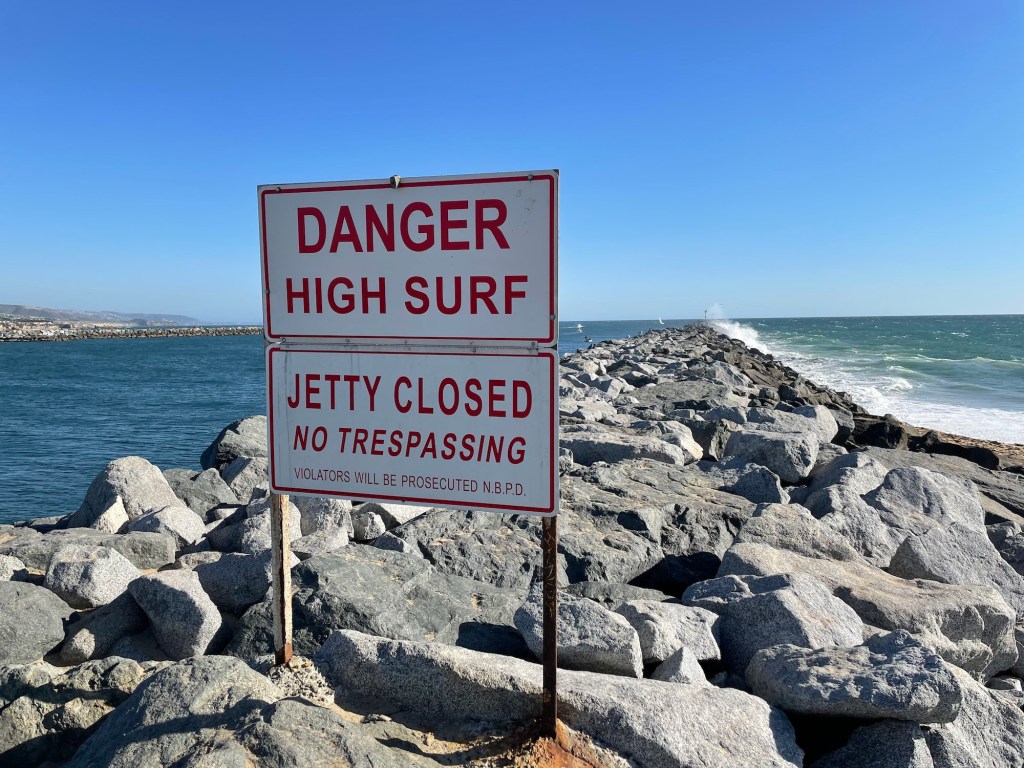
Dangerous surf at The Wedge in Newport Beach, California (Photo: Erik Olsen)

Having spent much of my youth in Newport Beach, my life was shaped by the ocean. I spent countless days in the surf, bodyboarding, bodysurfing, or playing volleyball on the sand with friends. When a southern storm rolled through, we’d rush to Big Corona and throw ourselves into the heavy swells, often getting slammed hard and learning deep respect for the ocean, a respect that I still harbor today. Sometimes the waves were so large they were genuinely terrifying, the kind of surf that would have made my mother gasp, had this not been an era when parents rarely knew what their kids were doing from dawn to dusk. That freedom, especially in Southern California, made the ocean feel like both a playground and a proving ground.

Across the channel at the Newport jetty was where the action was most intense. The surf was bigger, louder. We sat on the sand and held back, watching the brave and sometimes the foolish throw themselves into the water. That place, then and now, is called the Wedge.
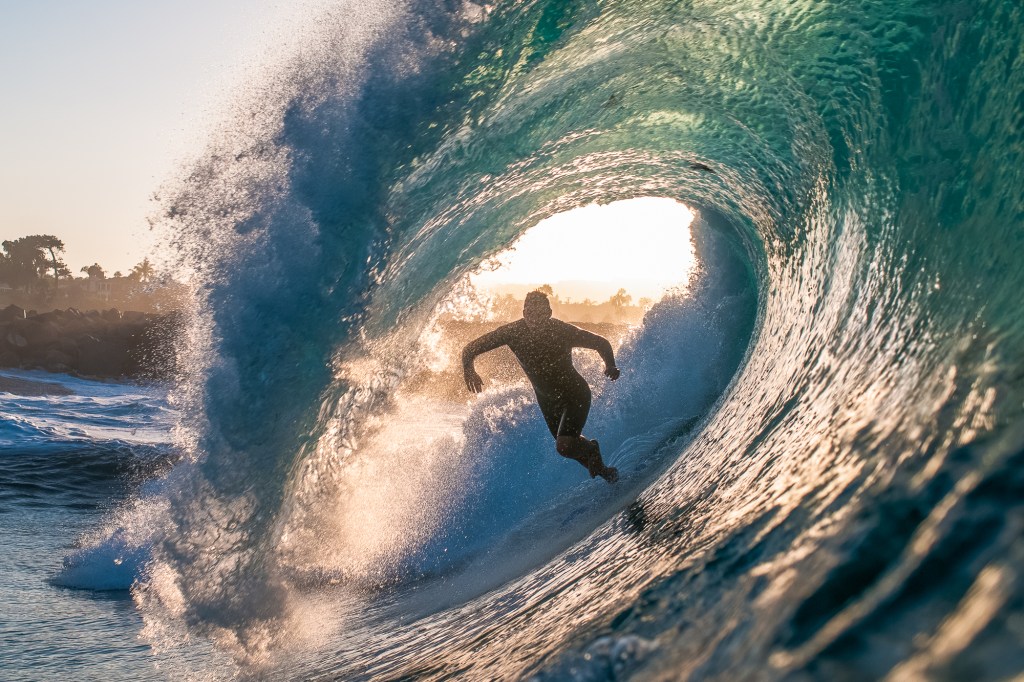
The Wedge in Newport Beach, California (Photo: Alex Verharst 2016)

There is something unforgettable about the Wedge and the way its waves crash with such raw force. Sometimes they detonate just offshore, sending water skyrocketing into the air; other times they slam thunderously against the sand, eliciting groans and whoops from bystanders. The waves behave strangely at the Wedge, smashing into one another, often combining their force, and creating moments of exquisite chaos.

These colliding waves are what make the place both spectacular and dangerous, the result of a unique mix of physics and geology that exists almost nowhere else on earth. That combination has made it, to this day, one of the world’s most famous surf and bodysurfing spots. If you want a glimpse of what I mean, just search YouTube, where the insanity speaks for itself. This compilation is from earlier this year.

And of course, who could forget this one surfer’s unique brand of SoCal eloquence.

So how did the Wedge turn into one of the most famous and dangerous surf spots? The truth is, it’s mostly the result of human engineering.
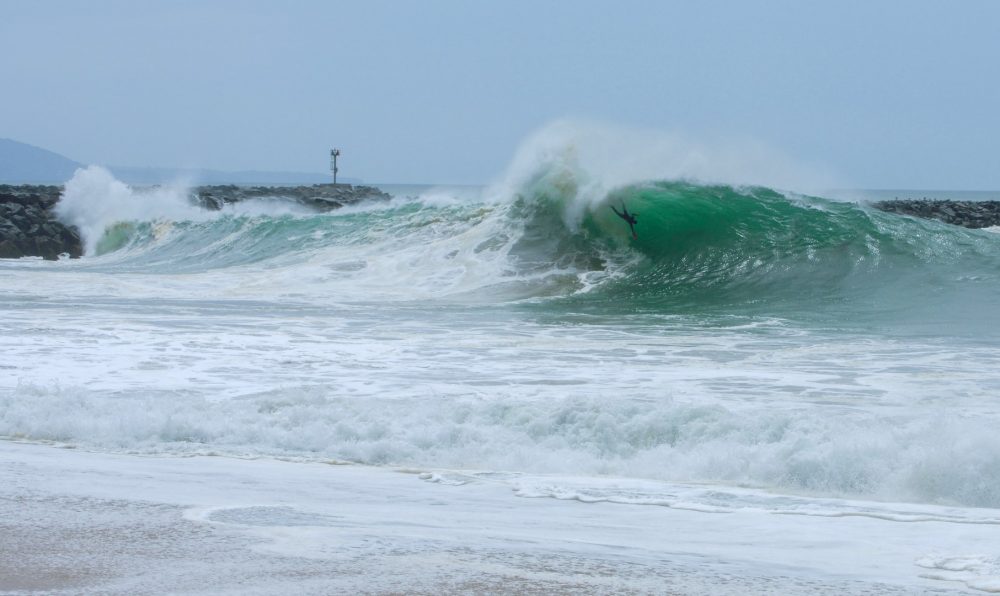
The Wedge with Newport Harbor’s West Jetty in the background (Photo: California Beaches)

The Wedge’s origin story begins in the 1930s, when the U.S. Army Corps of Engineers extended Newport Harbor’s West Jetty to protect the harbor mouth from sand buildup and currents. What no one anticipated was that this angled wall of rock would create a perfect mirror for waves arriving from the south and southwest. Instead of dispersing, these waves slam into the jetty and reflect diagonally back toward the shore. The reflected energy doesn’t dissipate, it collides with the next incoming wave. When the two wave crests line up in phase, their energies combine, and the result is a much steeper, taller, and more powerful wave. In physics this is known as constructive interference: two sets of energy stacking into a single, towering peak.

This wave-doubling effect only works under specific conditions. Long-period south swells, often generated by hurricanes off Mexico or storms deep in the South Pacific, line up nearly parallel to the jetty. Their orientation means maximum contact and reflection. Surfers and bodysurfers describe the result as a pyramid-shaped breaker, or wedge, rising steeply before collapsing with extraordinary force. On the biggest days, these waves can reach 20 to 30 feet, twice the size of surrounding surf.
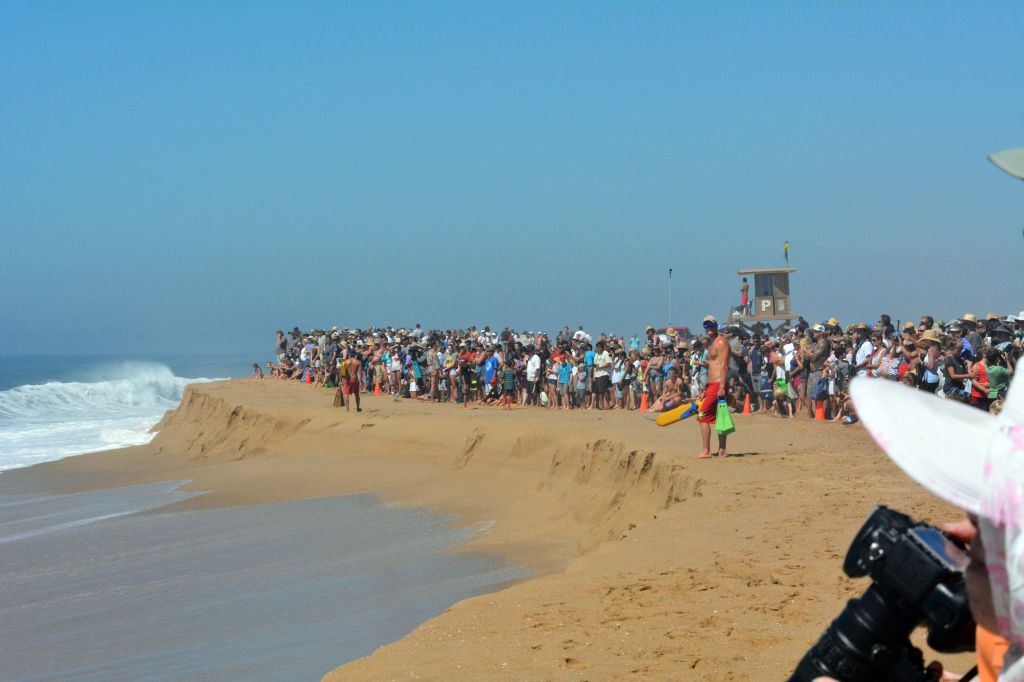
Crowds gather to watch the carnage at The Wedge in Newport Beach (Photo by D Ramey Logan)

Geology and geography make the situation even more dramatic. The seafloor near The Wedge slopes upward very steeply into a narrow strip of beach. Instead of allowing waves to break gradually, the bathymetry forces them to jack up suddenly, creating a thick lip that pitches forward into shallow water. It’s called a shorebreak, and man, they can be dangerous. More on that in a moment.

Unlike classic point breaks such as Malibu, where waves peel cleanly along a gradual reef, The Wedge produces brutal closeouts: vertical walls of water that crash all at once, leaving no escape route.

It actually can get worse. After each wave explodes on the beach, the backwash races seaward, colliding with the next incoming swell and adding more turbulence. Surfers call it chaos; lifeguards call it dangerous, even life-threatening. Spinal injuries, broken bones, and concussions are common at The Wedge. By 2013, the Encyclopedia of Surfing estimated that the Wedge had claimed eight lives, left 35 people paralyzed, and sent thousands more to the hospital with broken bones, dislocations, and other trauma—making it the most injury-prone wave break in the world. A 2020 epidemiological survey places The Wedge among the most lethal surf breaks globally (alongside Pipeline and Teahupo’o), largely due to head-first “over the falls” impacts on the shallow sea floor.
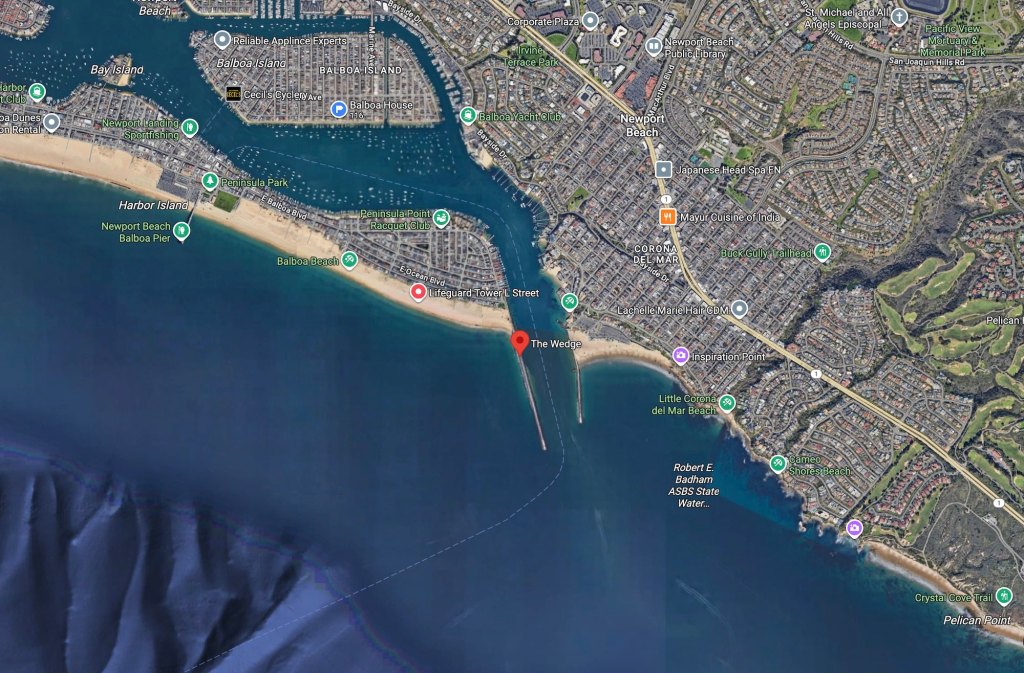
The Wedge in Google Maps

Interesting fact: Long before the Wedge was built, the waves pounding that corner of the Newport Beach jetty were already fierce. In 1926, Hollywood icon John Wayne (then still Marion Morrison) tried bodysurfing there while he was a USC football player. He was slammed into the sand, shattering his shoulder and ending his athletic scholarship. The accident closed the door on his football career but opened the one that led him to Hollywood stardom.

Oceanographers have studied the physics behind the Wedge’s unique surfbreak in broader terms. Research into wave reflection and interference confirms what locals have known for decades: man-made structures like jetties can redirect swell energy in ways that amplify, rather than reduce, wave height. Studies on steep nearshore bathymetry show how sudden shoaling increases the violence of breaking waves. The Wedge combines both effects in one location, making it a rare and extreme case study in coastal dynamics. In other words, yes, it’s gnarly.

Of course, with all that danger comes spectacle, and when the Wedge is firing, it’s not unusual for hundreds of spectators to line the sand and jetty to watch. In August 2025, the California Coastal Commission approved plans for a 200-foot ADA-compliant concrete pathway and a 10-foot-wide viewing pad along the northern jetty, designed to make the experience safer and more inclusive. The project will provide better access for people using wheelchairs, walkers, and strollers, while also giving life guards and first responders improved vantage points when the surf turns chaotic.

I still get to the Wedge on occasion to watch the carnage. And while in my younger years, I might have ventured out to catch a wave or two if the conditions were relatively mellow, today, I prefer the view from shore, leaving the powerful surf to the younger bodysurfers hungry for a rush.

The Magic, Wonder, and Science of Ocean Bioluminescence in Southern California

How and why so many of earth’s creatures make their own light.

Bioluminescent waves in Southern California

Last month, a video went viral showing a small pod of dolphins swimming at night off the coast of Newport Beach. Seeing dolphins off Southern California is not particularly unusual, but this was a very special moment. In the video, the dolphins appear to be swimming through liquid light, their torpedo-shaped bodies generating an ethereal blue glow like a scene straight out of Avatar. The phenomenon that causes the blue glow has been known for centuries, but that in no way detracts from its wonder and beauty. The phenomenon is called bioluminescence, and it is one of nature’s most magical and interesting phenomena. 

A Caridean shrimp, Parapandalus sp., enveloped in bioluminescent spew emitted during an escape response. (NOAA/OER)

Bioluminescence is the production and emission of light by a living organism, and it is truly one of the great magical properties of nature. At its core, bioluminescence is the way animals can visually sense the world around them. It’s all built on vision, one of the most fascinating and useful senses in the animal kingdom. Seeing is impossible without light, and so it makes sense that in the absence of sunlight, some animals created a way to make their own light. 

I have been fascinated by bioluminescence since I was a child growing up near Newport Beach when the occasional nearshore red tide bloom would illuminate the waves like a high tech LED light show. It’s a truly magical experience. I’ve also experienced bioluminescence in various places around the world, including Thailand, Mexico, and Puerto Rico. In fact, 13 years ago, I made the trip to Puerto Rico’s Vieques Island and its world-famous Mosquito Bay, for the sole purpose of seeing the bay in person and swimming and kayaking in its warm, glowing waters (there is a rental outfit there that does tours at night…it’s amazing. Trust me.)

The phenomenon of bioluminescence is surprisingly common in nature. Both terrestrial and sea animals do it, as do plants, insects (for example, fireflies), and fungi. Curiously, no mammals bioluminesce. That we know of, although several species fluoresce, which is when organisms absorb light at one wavelength and emit it at another, often under ultraviolet (UV) light. The platypus is an example. But the ocean is definitely the place that animals and plants bioluminesce the most. Which makes sense because deep in the ocean, there is little or no light. Light is absorbed very quickly in the water, so while on land you might be able to see a single streetlight miles away, after about 800 feet, light largely disappears in the depths of the ocean. I know. I’ve been there

It’s estimated that nearly 90 percent of the animals living in the open ocean, in waters below 1,500 feet, make their own light. Why they do this is in part a mystery, but scientists are pretty sure they understand the basic reasons animals do it: to eat, to not be eaten, and to mate. In other words, to survive. And to communicate. 

Credit: NOAA

The angler fish dangles a lighted lure in front of its face to attract prey. Some squid expel bioluminescent liquid, rather than ink, to confuse their predators. A few shrimp do too. Worms and small crustaceans use bioluminescence to attract mates. When it is attacked, the Atolla jellyfish (Atolla wyvillei) broadcasts a vivid, circular display of bioluminescent light, which scientists believe may be a kind of alarm system. The theory is that the light will attract a larger predator to go after whatever is attacking the jellyfish. While this is still a theory, a 2019 expedition that took the very first images of the giant squid used a fake Atolla jellyfish designed by the scientist Edith Widder to lure the squid into frame. I had the fortune of interviewing Dr. Widder, one of the world’s top experts on bioluminescence, several years ago for the New York Times.   

Edith Widder holds a vial of bioluminescent plankton. Credit: Erik Olsen

Making light is clearly beneficial. That’s why, say evolutionary biologists, it appears that bioluminescence has arisen over forty separate times in evolutionary history. The process is called convergent evolution and is the same reason that bats and birds and insects all evolved to fly independently. Clearly, flying confers a major advantage. So does making light.

While the Internet is awash in images of bioluminescent creatures, very often the term is confused with fluorescence (mentioned above). Even reputable science organizations sometimes do this. Bioluminescence is not the same thing as fluorescence. Fluorescence is the emission of light by a substance that has absorbed light or other electromagnetic radiation. Many animals like scorpions and coral fluoresce, meaning that they appear to glow a bright otherworldly color when blue light is shone on them. The key idea here is that the animals are not generating their own light, but rather contain cells that reflect light in fluorescence.  

Fluorescent (not bioluminescent) scorpion in Baja California, Mexico. Credit: Erik Olsen

So what about the recent explosion of bioluminescence in Southern California? The light we are seeing is made by tiny organisms, type of plankton called dinoflagellates (Lingulodinium polyedra) that occasionally “bloom” off-shore. Often, this is the result of recent storms that bring tons of nutrient-laden runoff into the ocean. The tiny plankton feed on nitrogen and other nutrients that enter the ocean from rivers and streams and city streets. A lot of the nutrients come from California’s vast farms, specifically the fertilizer used to grow California’s fruits and vegetables. With all that “food” coming into the ocean system, the algae rapidly multiply, creating red tides, or vast patches of ocean that turn dark brownish red, the color of pigment in the algae that helps protect it from sunlight. Michael Latz, a scientist at Scripps Institution of Oceanography at UC San Diego, says that the animals use bioluminescence as a predator avoidance behavior. 

Sometimes red tides are toxic and can kill animals and make people sick who swim in the ocean. (That does not appear to be the case in California right now). At night, when they are still, the animals can’t be seen. But when the water is disturbed, which adds oxygen into the mix, a chemical reaction takes place in their bodies that causes luciferin (from the Latin lucifer or ‘light-bearer’) to oxidize and becomes catalyzed to make luciferase, which emits photons or particles of light. It’s not understood exactly how or why this happens, but we do know there are many kids of luciferase. In fact, scientists know the genes that create luciferases and have implanted them into organisms like mice, silkworms, and potatoes so that they glow. They’ve made bioluminescent plants, too. An Idaho-based start up called Light Bio, in fact, sells bioluminescent petunias that you can purchase.


Light Bio’s genetically engineered petunias glow green thanks to DNA added from bioluminescent mushrooms. Photo (Light Bio)

Perhaps the most magical thing about bioluminescence is that it doesn’t create heat. Almost all the lights we are familiar with, particularly incandescent light, like that from generic light bubs, generate a tremendous amount of heat. Of course, we have learned how to make this heatless chemical light ourselves, easily experienced when you crack and shake a glow stick, mixing together several chemicals in a process similar to the one animals in the ocean use to create bioluminescent light. But the light from glow sticks is not nearly strong enough to illuminate your back yard. In the last few decades, we’ve learned how to make another kind of light that produces little heat: LEDs. Though the process is very different, the concept is the same: talking a molecule or a material and promoting it to an excited state. Where electricity is used, in the case of LEDs, it’s called electroluminescence, where it’s a chemical reaction it’s chemiluminescence, of which bioluminescence is one form. 

Whether you are a religious person or not (I’m not) it’s no coincidence that one of the first things God said was, “Let there be light!” Light and light energy give us plants and animals to eat, and allows us to see. It heats our world, it fuels our cars (oil is really just dead organic material compressed over time, and that organic material would not have existed without sunlight). While some animals deep in the ocean can live without light, most of us cannot. And it’s a rather astounding feat of nature than when there is no light, many of the earth’s creatures have evolved to produce it themselves. If you don’t believe me, just go down to the Southern California shore in the evening when there is a red tide. Leave your flashlight at home. You won’t need it.