Californiaโ€™s Eye on the Cosmos: The SLAC-Built Camera That Will Time-Lapse the Universe

Images from the most powerful astronomical discovery machine ever created, and built in California

A breathtaking zoomed-in glimpse of the cosmos: this first image from the Vera C. Rubin Observatory reveals a deep field crowded with galaxies, offering just a taste of the observatoryโ€™s power to map the universe in unprecedented detail.
(Credit: NSFโ€“DOE Vera C. Rubin Observatory)

I woke up this morning to watch a much-anticipated press conference about the release of the first images from the Vera Rubin Telescope and Observatory. It left me flabbergasted: not just for what we saw today, but for what is still to come. The images werenโ€™t just beautiful; they hinted at a decade of discovery that could reshape what we know about the cosmos.I just finished watching and have to catch my breath. What lies ahead is very, very exciting. 

The first images released today mark the observatoryโ€™s “first light,” the ceremonial debut of a new telescope. These images are the result of decades of effort by a vast and diverse global team who together helped build one of the most advanced scientific instruments ever constructed. In the presser, ลฝeljko Iveziฤ‡, Director of the Rubin Observatory and the guy who revealed the first images, called it “the greatest astronomical discovery machine ever built.”

This image combines 678 separate images taken by NSFโ€“DOE Vera C. Rubin Observatory in just over seven hours of observing time. Combining many images in this way clearly reveals otherwise faint or invisible details, such as the clouds of gas and dust that comprise the Trifid nebula (top) and the Lagoon nebula, which are several thousand light-years away from Earth.
(Credit: NSFโ€“DOE Vera C. Rubin Observatory)

The images shown today are a mere hors d’oeuvre of what’s to come, and you could tell by the enthusiasm and giddiness of the scientists involved how excited they are about what lies ahead. Here’s a clip of ลฝeljko Iveziฤ‡ as the presser ended. It made me laugh.

So, that first image you can see above. Check out the detail. What would normally be perceived as black, empty space to us star-gazing earthlings shows anything but. It shows that in each tiny patch of sky, if you look deep enough, galaxies and stars are out there blazing. If you know the famous Hubble Deep Field image, later expanded by NASAโ€™s James Webb Space Telescope, you may already be aware that there is no such thing as empty sky. The universe contains so much stuff, it is truly impossible for our brains (or at least my brain) to comprehend. Vera Rubin will improve our understanding of what’s out there and what we’ve seen before by orders of magnitude.   
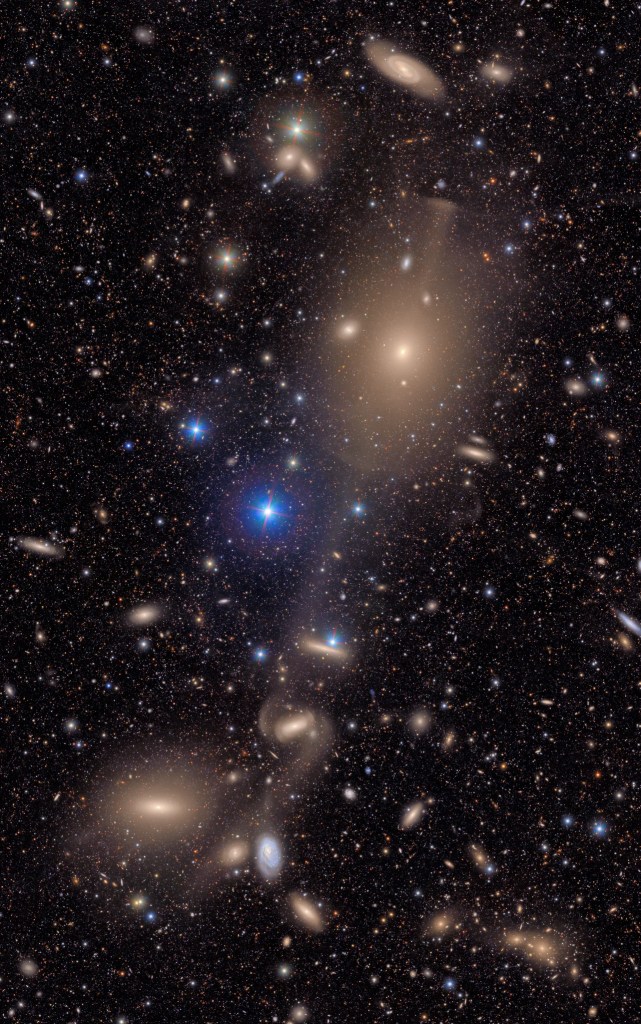
This image captures a small section of NSFโ€“DOE Vera C. Rubin Observatoryโ€™s view of the Virgo Cluster, revealing both the grand scale and the faint details of this dynamic region of the cosmos. Bright stars from our own Milky Way shine in the foreground, while a sea of distant reddish galaxies speckle the background.
(Credit: NSFโ€“DOE Vera C. Rubin Observatory)

Iโ€™ve been following the Rubin Observatory for years, ever since I first spoke with engineers at the SLAC National Accelerator Laboratory about the digital camera they were building for a potential story for an episode of the PBS show NOVA that I produced (sadly, the production timeline ultimately didn’t work out). SLAC is one of California’s leading scientific institutions, known for groundbreaking work across fields from particle physics to astrophysics. (We wrote about it a while back.)
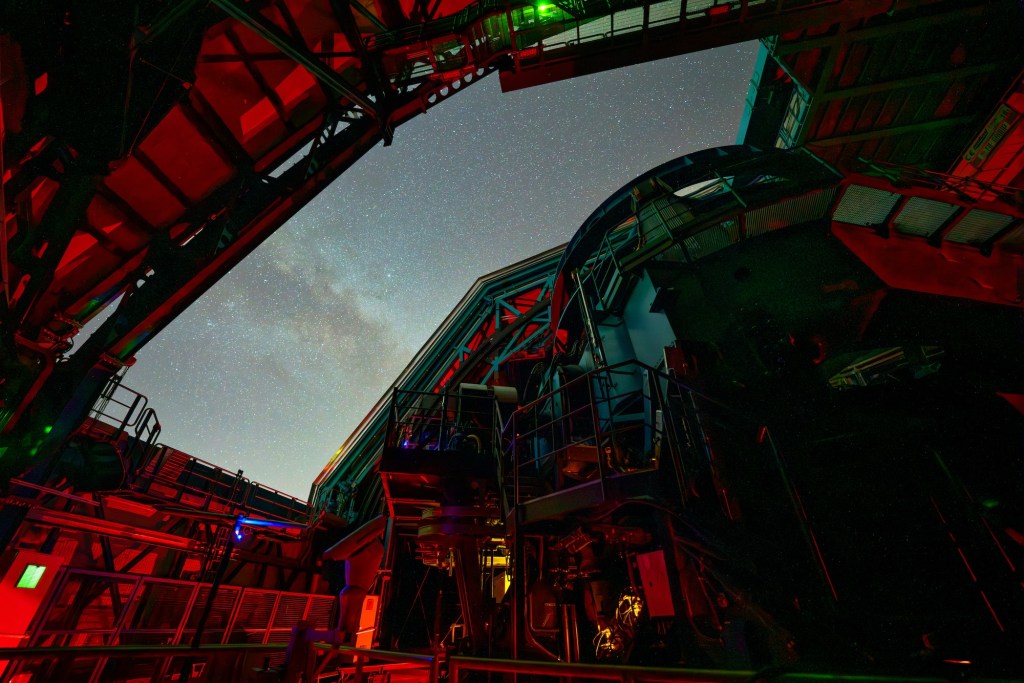
The night sky seen from inside the Vera Rubin Observatory (Credit: NSFโ€“DOE Vera C. Rubin Observatory)

Now fully assembled atop Chileโ€™s Cerro Pachรณn, the Vera C. Rubin Observatory is beginning its incredible and ambitious mission. Todayโ€™s presser focused on unveiling the first images captured by its groundbreaking camera, offering an early glimpse of the observatoryโ€™s vast potential. At the heart of the facility is SLACโ€™s creation: the worldโ€™s largest digital camera, a 3.2-gigapixel behemoth developed by the U.S. Department of Energy.

This extraordinary instrument is the central engine of the Legacy Survey of Space and Time (LSST), a decade-long sky survey designed to study dark energy, dark matter, and the changing night sky with unprecedented precision and frequency. We are essentially creating a decade-long time-lapse of the universe in detail that has never been captured before, revealing the dynamic cosmos in ways previously impossible. Over the course of ten years, it will catalog 37 billion individual astronomical objects, returning to observe each one every three nights to monitor changes, movements, and events across the sky. I want to learn more about how Artificial Intelligence and machine learning are being brought to bear to help scientists understand what they are seeing.

The camera, over 5 feet tall and weighing about three tons, took more than a decade to build. Its focal plane is 64 cm wide-roughly the size of a small coffee table-and consists of 189 custom-designed charge-coupled devices (CCDs) stitched together in a highly precise mosaic. These sensors operate at cryogenic temperatures to reduce noise and can detect the faintest cosmic light, comparable to spotting a candle from thousands of miles away.
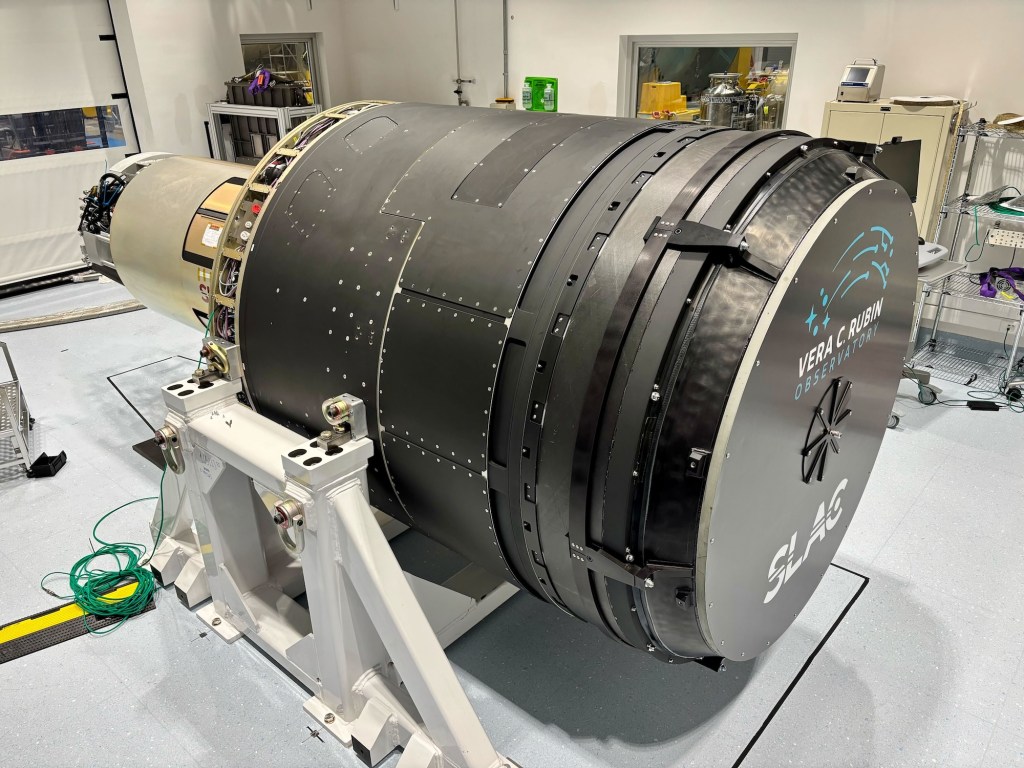
The LSST Camera was moved from the summit clean room and attached to the camera rotator for the first time in February 2025. (Credit: RubinObs/NOIRLab/SLAC/DOE/NSF/AURA)

Rubinโ€™s camera captures a massive 3.5-degree field of view-more than most telescopes can map in a single shot. Thatโ€™s about seven times the area of the full moon. Each image takes just 15 seconds to capture and only two seconds to download. A single Rubin image contains roughly as much data as all the words The New York Times has published since 1851. The observatory will generate about 20 terabytes of raw data every night, which will be transmitted via a high-speed 600 Gbps link to processing centers in California, France, and the UK. The data will then be routed through SLACโ€™s U.S. Data Facility for full analysis.
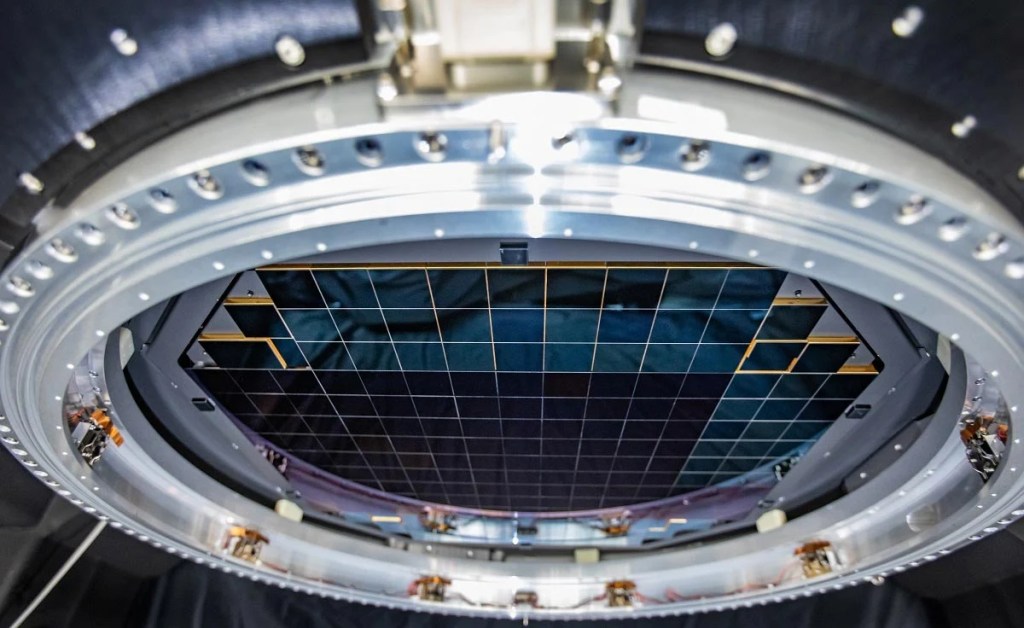
The complete focal plane of the future LSST Camera is more than 2 feet wide and contains 189 individual sensors that will produce 3,200-megapixel images. Crews at SLAC have now taken the first images with it. Explore them in full resolution using the links at the bottom of the press release. (Credit: Jacqueline Orrell/SLAC National Accelerator Laboratory)

The images produced will be staggering in both detail and scale. Each exposure will be sharp enough to reveal distant galaxies, supernovae, near-Earth asteroids, and other transient cosmic phenomena in real time. By revisiting the same patches of sky repeatedly, the Rubin Observatory will produce an evolving map of the dynamic universe-something no previous observatory has achieved at this scale.

What sets Rubin apart from even the giants like Hubble or James Webb is its speed, scope, and focus on change over time. Where Hubble peers deeply at narrow regions of space and Webb focuses on the early universe in infrared, Rubin will cast a wide and persistent net, watching the night sky for what moves, vanishes, appears, or explodes. It’s designed not just to look, but to watch. Just imaging the kind of stuff we will see!
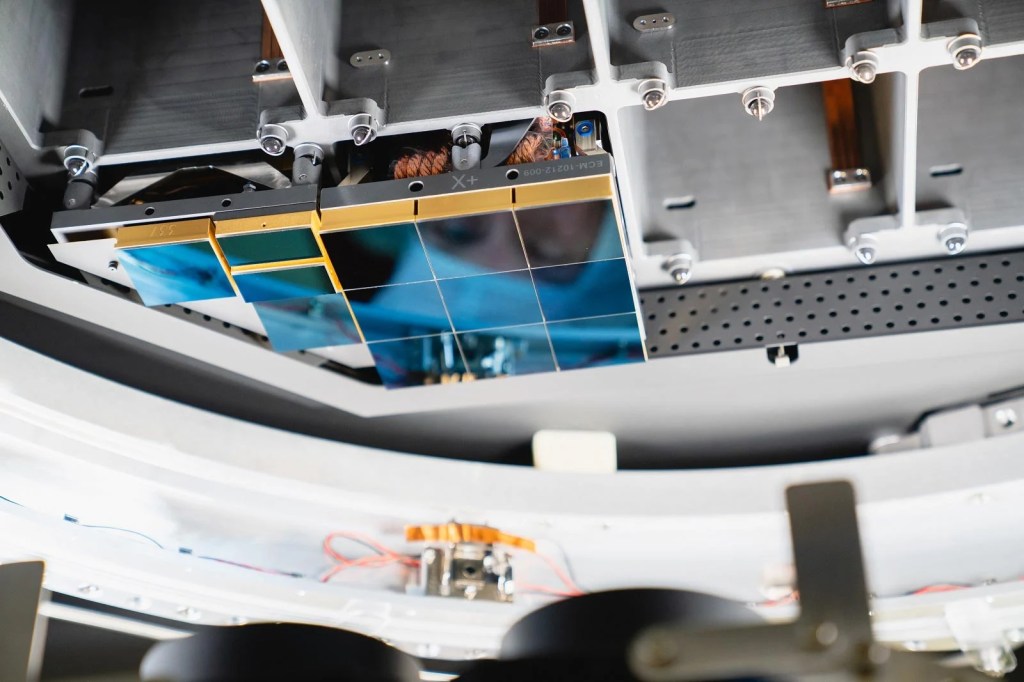
The LSST Cameraโ€™s imaging sensors are grouped into units called โ€œrafts.โ€ Twenty-one square rafts, each with nine sensors, will capture science images, while four smaller rafts with three sensors each handle focus and telescope alignment. (Credit: Farrin Abbott/SLAC National Accelerator Laboratory)

This means discoveries wonโ€™t just be about what is out there, but what happens out there. Astronomers expect Rubin to vastly expand our knowledge of dark matter by observing how mass distorts space through gravitational lensing. It will also help map dark energy by charting the expansion of the universe with unprecedented precision. Meanwhile, its real-time scanning will act as a planetary defense system, spotting potentially hazardous asteroids headed toward Earth.

But the magic lies in the possibility of the unexpected. Rubin may detect rare cosmic collisions, unknown types of supernovae, or entirely new classes of astronomical phenomena. Over ten years, itโ€™s expected to generate more than 60 petabytes of data-more than any other optical astronomy project to date. Scientists across the globe are already preparing for the data deluge, building machine learning tools to help sift through the torrent of discovery.

And none of it would be possible without SLACโ€™s camera. A triumph of optics, engineering, and digital sensor technology, the camera is arguably one of the most complex and capable scientific instruments ever built. I don’t care if you’re a Canon or a Sony person, this is way beyond all that. Itโ€™s a monument to what happens when curiosity meets collaboration, with Californiaโ€™s innovation engine powering the view.

As first light filters through the Rubin Observatoryโ€™s massive mirror and into SLACโ€™s camera, we are entering a new era of astronomy-one where the universe is not just observed, but filmed, in exquisite, evolving detail. This camera wonโ€™t just capture stars. It will reveal how the universe dances.
JPL and the Voyager Golden Record: Humanityโ€™s A Cosmic Mixtape in Space

The Jet Propulsion Laboratory (JPL) in La Canada Flintridge, California is well-known for building and sending spacecraft far into the cosmos to help us better understand the universe. But the agency was also extensively involved in one of the most ambitious and symbolic projects in the history of space exploration, one that in many ways was more art than science: the Voyager Golden Record.

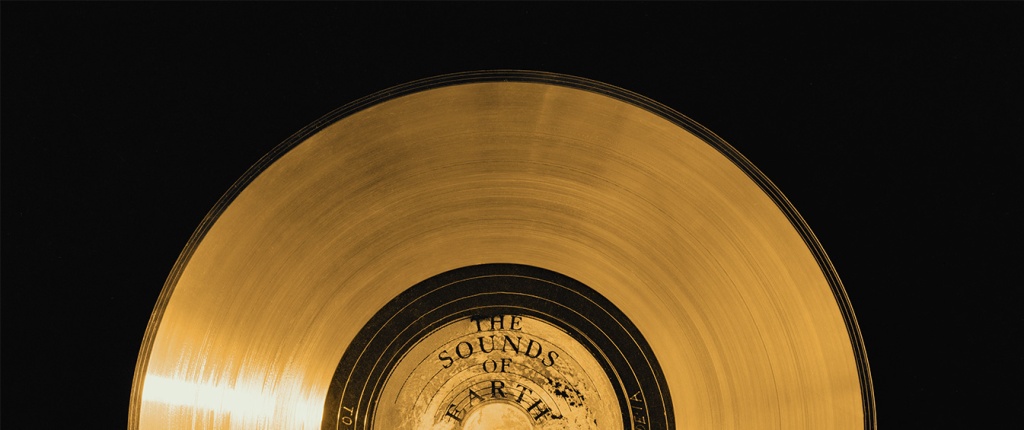
In 1977, as the twin Voyager spacecraft prepared to journey beyond the confines of our solar system, they carried with them what might be the most profound artifacts ever created by humanity: the Voyager Golden Records. These records, designed to last a billion years, are time capsules intended not for Earthlings but for potential extraterrestrial finders or future humans. Engraved in gold-plated copper discs, the records encapsulate the Earth’s diverse cultural and natural heritageโ€”from music to languages to sounds of nature.

Photo: NASA/JPL-Cal Tech

The idea of the Golden Record was developed by a talented team led by Carl Sagan, the renowned astronomer and science communicator. Sagan, alongside other prominent figures such as Frank Drake, Ann Druyan, science journalist Jon Lomberg, and Linda Salzman Sagan, crafted a selection that aimed to represent the entirety of Earth. The content ranged from classical music by Bach and Beethoven to greetings in 55 languages, natural sounds like thunderstorms and whales, and a diverse set of 115 images depicting life and culture on Earth.

But producing a record that could survive the harsh environment of space, while also being understandable and playable by beings of unknown technology, posed unique challenges. This is where the Jet Propulsion Laboratory (JPL) stepped in, playing a pivotal role in transforming this ambitious vision into a tangible, durable artifact capable of traversing the cosmos.

Inspection of the engraving of the Voyager Golden Record.
Photo: NASA/JPL-Cal Tech

JPL, managed by Caltech under a NASA contract, was primarily responsible for the construction and operation of the Voyager spacecraft. Their expertise was crucial not just in the scientific instrumentation and engineering of the spacecraft but also in integrating the Golden Records. The labโ€™s engineers worked meticulously to ensure that the records were equipped with everything needed for potential playback: a cartridge, a needle, and symbolic instructions detailing their use. These instructions, etched onto the recordโ€™s cover, provided a universal map indicating Earthโ€™s location in relation to pulsar stars, which are highly stable and can be used as galactic landmarks.

JPLโ€™s involvement extended to the actual physical preparation of the records. They coordinated closely with RCA Records to produce the master disc from which the Voyager records were replicated. The final products were then plated in gold and encased in a protective aluminum jacket, designed to withstand the vacuum of space, cosmic rays, and extreme temperatures.

Photo: NASA/JPL-Cal Tech

The technical contributions of JPL ensured that the Golden Records were not only a feat of cultural expression but also a marvel of scientific and engineering ingenuity. By equipping the Voyager spacecraft with these messages, JPL helped bridge the human desire to explore and communicate with the tangible reality of space travel. The records, mounted aboard Voyagers 1 and 2, continue to be ambassadors of Earth, carrying sounds, music, and images intended to convey the story of our world to whoever, or whatever, might find them.

Today, both Voyager spacecraft, with their Golden Records, have entered interstellar space, marking them as the most distant human-made objects in existence. They serve as reminders of humanityโ€™s ambition to reach beyond our immediate grasp and to communicate across vast cosmic distances. JPLโ€™s role in this historic endeavor highlights the profound connection between human creativity and technological advancement, ensuring that our message to the cosmos will endure long after the original voices have faded.

JPL written on the Voyager Golden Record
Photo: NASA/JPL-Cal Tech

As these records voyage through the cosmos, they remind us not just of where we have been, but also of the far reaches that our curiosity can take us. Through the combined efforts of visionaries like Carl Sagan and the engineering prowess of JPL, the Voyager Golden Record stands as a testament to the best of human knowledge, culture, and technological achievement.


The Voyager Golden Records are phonograph records, much like the vinyl records used to listen to music before digital media became widespread. They are constructed from copper discs coated in gold to withstand the harsh environment of space. Each record is encased in a protective aluminum jacket, along with a cartridge and a needle. Instructions in symbolic language explain the origin of the spacecraft and indicate how the record should be played. The playback speed (16 2/3 revolutions per minute) is much slower than typical records, which typically spin at 33 1/3 or 45 rpm.

The content of the Golden Record is a meticulously curated selection intended to represent the diversity of life and culture on Earth:

Sounds of Earth: The records include audio of nature sounds like thunder, wind, and animals (including the songs of birds and whales). Human sounds like footsteps, a heartbeat, and laughter are also embedded, capturing the biological and social essence of Earth.

The DNA structure magnified, light hit image is one of the pictures electronically placed on the phonograph records which are carried onboard the Voyager 1 and 2 spacecraft. Credit: Jon Lomberg

Musical Selections: There are 27 musical tracks from different cultures and eras, ranging from classical pieces by Bach and Beethoven to traditional songs from various cultures, including a Navajo chant and a Peruvian wedding song. These selections were intended to showcase the diversity of musical expression on Earth.

Greetings in 55 Languages: A variety of spoken greetings from “Hello” in English to ancient languages like Akkadian. The inclusion of a broad range of languages aims to depict the linguistic diversity of humanity.

Images: The record also contains 115 analog-encoded photographs and diagrams. These images show a wide range of subjects, including humans of different sexes and races, everyday activities, scientific knowledge like mathematical definitions, and the Solar System. The intent was to offer a visual summary of our planet and its inhabitants.

CALIFORNIA CURATED ART ON ETSY

Purchase stunning art prints of iconic California scenes.
Check out our Etsy store.

Message from the UN Secretary-General and the President of the United States: There are also printed messages from prominent global leaders at the time, including U.S. President Jimmy Carter and United Nations Secretary-General Kurt Waldheim.

Sounds of Human Origin: Beyond natural and environmental sounds, the record also includes a montage of the sounds of Earth, a screaming chimpanzee, a medley of human-originated noises like tools, vehicles, and a kiss, among others.

The idea behind the Voyager Golden Record is not just to communicate where and who we are but also to share a message of hope and peace with any possible recipient, even if that recipient is far in the future. The chances of the Voyager spacecraft actually being found by extraterrestrial life are slim, but the Golden Record serves as a profound gesture of goodwill and a testament to the human spirit’s longing to reach out and explore the universe.

Journey to the Iron Giant: NASA’s Psyche Mission Could Unlock the Secrets of a Metallic World

The Psyche spacecraft in the clean room of the Jet Propulsion Laboratory in La Canada Flintridge, CA

A NOVEL PROPULSION SYSTEM WILL TAKE US TO A MASSIVE METAL ASTEROID IN DEEP SPACE

Imagine being able to move your car with your breath. One long blow out the back window, and your car begins speeding down the highway. Now imagine that if you keep blowing, your car accelerates to over 124,000 miles per hour. 

Of course, if you actually did this on Earth, you would turn blue in the face and your car would remain still. But in the vast vacuum of empty space where there is little gravity and no atmospheric drag, that tiny amount of thrust can be very effective. 

On October 12, NASAโ€™s Jet Propulsion Laboratory in La Caรฑada Flintridge will launch a spacecraft toward Mars and Saturn that will put this idea to the test. The agency is sending a 3,600-pound vehicle into space propelled by futuristic solar electric thrusters that deliver a force equivalent to the mass of about two quarters. They also happen to emit a cool blue glow that looks like something out of Blade Runner. 

The Hall Thruster’s eerie blue glow is due to it’s emission of Xenon gas

The spacecraft, called Psyche, launched aboard a SpaceX Falcon Heavy rocket from the historic Launch Complex 39 at NASAโ€™s Kennedy Space Center. The spacecraft will initially be set on a trajectory to fly by Mars, where it will receive a gravity assist, catapulting it further out into the solar system. In late 2026, the spacecraft will enter into orbit around a rare metal asteroid called Psyche 16 (hence the spacecraftโ€™s name). The journey to the asteroid will take over three and a half years and cover over 1.5 billion miles.ย 

Perhaps the most intriguing — and ultimately beneficial — components of the Psyche mission will be its use of solar electric thrusters. Also known as Hall Effect thrusters, the novel propellant system was designed to be efficient and cost-effective. Solar energy will be generated from a five-panel, cross-shaped solar array that will unfold and immediately begin harvesting energy from the sun. At 800 square feet, they are the largest panels ever installed at JPL, and when fully deployed, will extend about the area of a singles tennis court.  

The resulting energy will be used to turn xenon, a dense, colorless, odorless noble gas into xenon ions, atoms that carry a charge because the number of electrons does not equal the number of protons. Xenon is found in Earth’s atmosphere in trace amounts and is used in car headlights and plasma TVs. As the xenon ions are accelerated out of the thruster, they create thrust, propelling the spacecraft forward. The amount of thrust, however, will be minuscule compared to that of chemical-based propulsion systems normally employed on missions like those to Mars, Jupiter, and Saturn. 

โ€They operate at a low thrust level,โ€ says David Oh, Psycheโ€™s project system engineering manager. โ€œYou canโ€™t use it to launch from the earth. But in space, you operate these thrusters over a long period of time and you can get to very high speeds.โ€ 

Psyche spacecraft inside the NASA JPL clean room (Erik Olsen)

In other words, in space, a force equivalent to a hastily expelled deep breath is enough to move a ton and a half of metal through space at a speed more than one hundred times that of a fired bullet. 

Psyche will carry over 1000 kilograms of xenon in its tanks, more than enough to get the spacecraft to Psyche and complete its 21-month mission. JPL engineers estimate that the spacecraft would burn through about 15 times that amount of propellant by weight if it had to use traditional chemical thrusters.  

โ€œWe did try conventional chemical propulsion, and we determined if we did that, we would have quadrupled the mass of the spacecraft. It would have been very difficult to launch and very expensive to build. But this technology was mature and ready to go,โ€ says Oh.

This is not the first time an ion propulsion system has been used in space. Communication satellites orbiting the earth use them regularly. Colorado-based company Maxar Technologies developed and built the Hall thrusters for near-earth orbit, and NASA has purchased them from the company and made some modifications, but this will be the first time they will be used to venture into deep space.

Psyche asteroid (JPL)

โ€œWe needed advanced propulsion to get into orbit. We were looking at what could we buy rather than building our own thruster from scratch,โ€ says Oh.

Because theyโ€™re so efficient, Psycheโ€™s Hall thrusters can operate nearly nonstop for years without running out of fuel, says Oh. When its mission is over, the spacecraft might have lots of fuel left over, and they will have to decide whether to find other puzzles to solve. If the mission proves a success, Psyche’s Hall thrusters could play a major role in propelling future missions into deep space. 

A Metal Asteroid?

Scientists are giddy at what they might find once Psyche, propelled by the Hall Thruster system, arrives at the asteroid.  

โ€œItโ€™s a kind of world that humans have never visited before,โ€ says Arizona State Universityโ€™s Lindy Elkins-Tanton, principal investigator in charge of the mission. โ€œMost of the exploration we do is going and learning more about a body weโ€™ve already visited. Psyche, we have no photos of it, no one has ever done a flyby or really studied it. Itโ€™s unlike every asteroid we know, as far as we can tell.โ€   

Astronomers have been aware of Psyche’s existence ever since since it was first discovered on March 17, 1852, by the Italian astronomer Annibale de Gasparis. The asteroid, computer models of which resemble a potato, was named after the Greek mythological figure Psyche, the goddess of the soul. It is the largest and most massive of the known M-type asteroids (M stands for metal), and is one of a dozen of the most massive objects in the asteroid belt between Mars and Saturn. 

Scientists believe that Psyche may be part of the core of a body called an early planetesimalโ€”, a moon-sized type of protoplanet that may have once been much larger, but was perhaps struck many years ago by other heavy orbiting objects, shattering it into pieces, but leaving this particular blob of metal and rock behind. Such collisions were common when the early solar system was forming.

If Psyche was once the heart of a planet with a strong convective current and a molten iron-nickel core at its center, then scientists expect it will still have a magnetic field. A magnetometer aboard the spacecraft will measure its pull, while cameras will photograph and map the surface, collecting high-resolution multispectral images. Because of the asteroidโ€™s unique composition, scientists have no idea what to expect when the images first start rolling in. 

โ€œWhat does an impact crater into metal look like? We do not know?โ€ says Elkins-Tanton. 

In a unique twist for this mission, JPL plans to release the images captured by Psyche immediately onto the internet so that anyone can view them within a half-hour of being received. 

โ€œWeโ€™re not going to edit them or curate them. Weโ€™re going to send them out so that everyone can be looking at this funny object for the first time,โ€ says Elkins-Tanton.

In addition, a series of spectrometers will help us understand what the asteroid is made of by measuring the gamma rays and neutrons emitted from it. Depending on what scientists discover, the mission could help answer fundamental questions about the formation of our solar system. 

That will depend, of course, on whether the propulsion system functions as designed. As we stand on the precipice of a new era in space exploration, Hall thrusters aren’t just rocket scienceโ€”they’re the closest thing we have to cosmic alchemy, promising to redefine how we navigate the vast tapestry of our solar system.

Hey there! If you enjoy California Curated, consider donating the price of a coffee to support its creation!

Mt. Wilson Observatory in Los Angeles is a Celestial Time Capsule

Mt. Wilson Observatory (Erik Olsen)

Perched atop a lofty peak in the San Gabriel Mountains of California sits a historic treasure, one of the great astronomical tools of the 20th century: the Mt. Wilson Observatory. For more than 100 years, it has been a centerpiece for major astronomical discoveries, playing a pivotal role in our understanding of the universe. The observatory, with its rich history shaped by devoted scientists, advanced technology, and revolutionary discoveries, stands as a testament to humanity’s relentless pursuit of knowledge.

The story of the Mt. Wilson Observatory begins with the visionary astronomer George Ellery Hale. Recognizing the importance of location, Hale selected Mt. Wilson for its elevation of 5,710 feet and its proximity to the Pacific Ocean, which provided consistently stable, clear skiesโ€”perfect conditions for astronomical observations. In 1904, he installed the first telescope at the site, the Snow Solar Telescope, specifically designed for studying the Sun. This telescope marked the beginning of groundbreaking solar research at the observatory and set the stage for future advancements in astronomy.

Many brilliant minds walked the halls and explored domes of Mt. Wilson, but few shone as brightly as Edwin Hubble. In the 1920s, using the Hooker Telescope โ€“ then the largest in the world โ€“ Hubble made two groundbreaking discoveries:

Before Hubble’s observations at Mt. Wilson, the prevailing belief was that our galaxy, the Milky Way, constituted the entirety of the universe. The existence of other galaxies was not yet confirmed, and what we now know as galaxies were often referred to as “nebulae” and thought to be part of the Milky Way.

Hubble’s groundbreaking discovery in 1923-1924, using the 100-inch Hooker telescope at Mt. Wilson, revealed that the Andromeda Nebula (now known as the Andromeda Galaxy) was far beyond the Milky Way, providing the first concrete evidence that the universe extended far beyond our own galaxy. This discovery fundamentally altered our understanding of the cosmos, leading to the realization that the universe is vast and filled with countless galaxies.

Expanding Universe

Using the powerful Hooker telescope once again, Hubble carefully observed distant galaxies and made a groundbreaking discovery: these galaxies were moving away from us. Even more astonishing was that the farther a galaxy was, the faster it was receding. This finding provided clear evidence that the universe itself was expanding. Hubbleโ€™s revelation shattered the long-held belief in a static universe and laid the groundwork for the Big Bang theory, suggesting that the universe had a specific beginning and has been expanding ever since. Through Hubble’s meticulous observations, humanity gained a new understanding of a dynamic, ever-evolving cosmos, far more vast and mysterious than anyone had previously imagined.

Edwin Hubble

Many other scientists have also made major discoveries at Mt. Wilson. One luminary, Harlow Shapley, used the observatory to gauge more specifically our place in the Milky Way. Before Shapley, Earth was believed to be at the galaxy’s center. However, through his observations of globular clusters, he pinpointed our more humble location on a distant spiral arm.

Another notable scientists who made significant contributions at Mt. Wilson Observatory was Walter Baade. Baade, a German-American astronomer, played a key role in refining our understanding of the universe by studying stars in different populations. During World War II, when Los Angeles experienced blackout conditions, Baade took advantage of the clearer skies at Mt. Wilson to observe celestial objects with unprecedented clarity. He discovered that there were two distinct types of stars in the Milky Way, which led to the realization that galaxies had different stellar populations. This breakthrough allowed Baade to correct the scale of the universe, doubling the previously estimated size of galaxies and distances to them. His work helped refine Hubble’s expanding universe theory and provided a deeper understanding of the evolutionary stages of stars. Baade’s observations were critical in the advancement of modern cosmology and our comprehension of the vastness of space.

Instruments of Enlightenment

Over the years, Mt. Wilson has housed a suite of powerful telescopes:

  • The Hooker Telescope: At 100-inches, it was the world’s largest when it was installed in 1917. It’s the very instrument Hubble used for his revolutionary work.
  • The Snow Solar Telescope: The observatory’s inaugural instrument remains crucial for solar studies.
  • The CHARA Array: The Center for High Angular Resolution Astronomy array is an impressive configuration of six telescopes that function as an interferometer. It allows for sharper images of stars than even the Hubble Space Telescope. The CHARA Array has a spatial resolution equivalent to a single telescope 331 meters (over 1000 ft) in diameter. Light from each of the six telescopes is transported through fiber optics to a special beam-combining room. 

Not only has Mt. Wilson been instrumental in observing distant stars, but it also has a unique device: the Snow Horizontal Solar Telescope. This apparatus, combined with the spectrograph, was used to study the sun’s magnetic fields. It has since been fundamental in understanding solar cycles and the impact of solar phenomena on Earth’s climate.

Mt. Wilson Observatory

In 2020, the Bobcat Fire, the second largest fire on record in Los Angeles County to date, burned over 115,000 acres and was active for more than three months. Annually, the team at Mount Wilson Observatory takes measures against potential forest fires, removing fire-hazardous invasive plants and ensuring their extensive water tanks are full for the fire suppression system. Just a few months prior to the blaze, they had fitted new high-capacity hydrants. These proactive steps played a pivotal role in safeguarding the Observatory when the Bobcat Fire flames approached within a mere 20 feet of its perimeter. A dozen fire squads, each consisting of 40 to 50 firefighters from various units, tirelessly worked day and night to protect this cherished landmark.

Scene at Mt. Wilson after the 2020 Bobcat Fire (Erik Olsen)

Visitors to the Mt. Wilson Observatory have a rare chance to not only tour the grounds but also look through the same telescopes that revolutionized astronomy. Public “Telescope Nights” offer the exciting opportunity to observe the night sky through the famous 60-inch or 100-inch telescopes, the latter being the largest in the world open to the public. These sessions allow people to view celestial objects like planets, star clusters, and nebulae in stunning detail. Reservations are necessary for these events, as spots fill up quickly due to high demand. Additionally, private group sessions and special events can be arranged, providing an unforgettable, up-close experience with the universe. Guided tours are also available for those who want to dive into the observatory’s rich history, tracing the steps of astronomers who made some of the greatest discoveries of the 20th century.

Hey there! If you enjoy California Curated, consider donating the price of a coffee to support its creation!

California’s unheralded role in Apollo 11 // Wildfires, climate change and atmospheric rivers // Marine reserves working even better than thoughtย ย // California science news roundup

Sign up for the California Science Weekly newsletter. Fresh California science every Friday!

Week of July 19, 2019

Space

California’s unheralded role in Apollo 11

Buzz Aldrin on the moon - NASA
NASA

When we think about Apollo and attempt to localize it here on earth in our minds, we typically think about Apollo Mission Control Center in Houston, Texas. Who can forget Neil Armstrongโ€™s famous words: “Houston, Tranquillity Base here. The Eagle has landed.”

But thereโ€™s more to Californiaโ€™s role in Apollo. In La Canada Flintridge, home of the Jet Propulsion Laboratory, one of the most important experiments of the whole mission was developed, and it changed the way we look at the moon and its relationship to our planet.

The Lunar Laser Ranging Experiment consisted of a reflector that was positioned on the moon by Armstrong and Aldrin. It was aimed back at the earth, where lasers fired pulses of laser light that were then reflected and detected by special receivers here on the ground. 

The reflectors are too small to be seen from Earth, and the task of actually hitting them was a major technical challenge. Even though a laser is a highly concentrated light, by the time the light reaches the moon, the beam is roughly four miles wide. Scientists back then likened the effort to using a rifle to hit a moving dime two miles away.

Here’s more of the story. 

California Science Weekly


Environment

Wildfires, climate change, and atmospheric rivers

Let’s talk about the weather, water and climate change in California. Lots of stories this week on these subjects. First of all, a big report came out in journal Earthโ€™s Future this week, and it says that the stateโ€™s wildfire issues are clearly being driven by climate change. It points to the fact that in the past decade, we have experienced half of the stateโ€™s 10 largest wildfires and seven of its 10 most destructive fires. That includes last year’s Camp Fire, the stateโ€™s deadliest wildfire ever. The study found that the area burned in California’s forest fires – the annual burned area – has increased in size by 500 percent. The cause, says the paper: more heat, more dryness, more fuel. All of these things can be tied to climate change, it says. 

And then there’s this, which seems a bit contradictory, but here you go: another study from Scripps Institution of Oceanography at UC San Diego says that we will also be seeing more of those atmospheric-river storms that deluged the state earlier this year. It looked at 16 global climate models focusing on western North America and found that most of the heavy precipitation that the West will get in the future will come from these so-called atmospheric rivers. That is to say, when we have rain, it will be more intense and more deluge-like. So, start building those arks. The point here seems to be that when it’s wet, it’s going to be really wet. And when it’s dry, it’s going to be really dry. Like the American electorate today, everything is going to the extremes. 

Ok, moving on. While this may seem contradictory, our big winter storms dumped so much snow that safety officials in the state are warning people about using the rivers that carry all that snow melt out of the mountains. The rivers are raging. This may be great for kayakers and rafters, it can also be dangerous. At least six people have died on the Kern River already this year. On a similar note, Mammoth Mountain, which is almost always closed by now, will be open until for skiing until July 28. Earlier the mountain had said August, but they changed their minds. That said, there is still 60 feet of snow at the summit. Wha?

Earthโ€™s Future      Scripps Institution of Oceanography


Ocean Science

Marine reserves are working even better than we thought  

Rockfish

California has one of the largest, most robust marine protected area systems in the world, covering about 18 percent of the stateโ€™s waters. The system is vast, stretching down the entire coast from Crescent City to San Diego. It has been phased in over the years, but most of the areas are now firmly in place with severe restrictions on fishing and any kind of “taking”, like rocks shells, etc. And while many studies have been done to show that MPAs work to bring back animals life, there has long been a question whether they lead to a so-called “spillover effect”, that is, whether animals breed and multiply and then move out of the areas, enriching other zones.

Well, a new study shows that there is a spill-over effect. Scientists from the National Oceanic and Atmospheric Administrationโ€™s (NOAA) Southwest Fisheries Science Center used genetics to track kelp rockfish, a species in California that tends to remain in the same location their entire adult lives. The key word here is “adult,” because the kids move around. By following counting fish and analyzing DNA, the scientists showed that juvenile kelp rockfish actually do move out of marine reserves sometimes as far as about 20 kilometers away. This suggests that there is, in fact, a spillover effect taking place in the reserves. This is very good news for ecologists, but also for fishermen, who could see more fish showing up in non-restricted areas.  

Hakai


California science news roundup

The cracks left behind by the recent Southern California earthquakes have become tourist attractions. Of course they have. (SF Gate)

There are ten Apollo “moon trees” in California (NatGeo

This very cool video shows what happens when scientists from MBARI shine blue light on the deep-sea squid Histioteuthis. Its green eye glows with fluorescence like something otherworldly. Scientists are not sure why, but think it may have something to do with absorbing light. (YouTube)  

The Mount Wilson Observatory recently opened the doors to its 100-inch telescope to the public for stargazing. Get the kids and go! (Mt. Wilson)

A marine biologist who studies porpoises mating says one of the best places to observe them is…the Golden Gate Bridge. (MEL Magazine)

The U.S. Department of Transportation has selected San Diego as the location for a major drone testing program that will include high-altitude mapping of the U.S.-Mexico border, package deliveries, and first responder operations. (SDNews)

Speaking of cool video, NASA’s Jet Propulsion Laboratory released this very impressively produced piece about their new climbing robot LEMUR, designed to work in extreme terrain. It can scale rock walls. Wow, JPL, keep it up. (YouTube)

A coal plant in Utah has been L.A.โ€™s single-largest power source for three decades. The plant is closing in 2025 and the state will move to natural gas. But that has some clean energy folks upset.  (LA Times)

Valley fever, a dangerous fungal disease, may be striking California farmworkers. Rates of new cases rose 10 percent between 2017 and 2018, according to the California Department of Public Health. https://www.nbcnews.com/news/amp/ncna1017806

We loved this video about the recovery of the Channel Island fox by SkunkBear. (YouTube) 

Lake Tahoe, the second deepest in the U.S., is 7/10 of an inch away from it’s legally allowed capacity. It’s risen 8 feet in 3 years, all thanks to this year’s big winter storms. (NNBN) 

Elon Musk’s Neuralink made a big announcement about its brain-computer interface system, that will dramatically increase the number of electrodes that can connect to a brain. But one of the most interesting goals is that it may allow paraplegic patients to use their thoughts to type at a rate of 40 words per minute. 

California produces the vast majority of the world’s sunflower seeds, but farmers in one county are asking visitors to stop taking selfies in sunflower fields because they are causing damage. (Guardian)

A potential crisis for stem cell research: since 2004, scientists have benefited from a $3 billion state research agency called the California Institute for Regenerative Medicine. But now the agency says it is no longer funding new projects. (ScienceMag)

In a new 440,000-square-foot fulfillment center in Los Angeles, robots are working furiously to get stuff to you faster. (LA Times)

Not news: People are fishing in the LA River. News: they’re eating lots of them

Remember that great story about the guy who killed the endangered fish in Death Valley? Well hereโ€™s a video of that same underwater pond called Devils Hole during the earthquake. (NPS)

That’s it! Have a great week, and please send your friends an invitation to sign up for the California Science Weekly newsletter. 

Design by Luis Ramirez