
I often discover these stories not from full articles, books, or podcasts, but from a single paragraph, or even a sentence, in them that makes me pause and think, I want to know more. That’s exactly how this week’s story about One Wilshire in downtown Los Angeles began. I was listening to a wonderful podcast called Stepchange, which mentioned One Wilshire in passing during a larger discussion about data centers (it was excellent, I swear). That brief moment sent me down a rabbit hole, uncovering a remarkable chapter in the history of the internet, one that unfolded not in Silicon Valley, like you’d think, but right here in Los Angeles.
When you consider the modern internet, you might think of Silicon Valley campuses, data centers along the Columbia River in Oregon, or snaky undersea cables crossing the Pacific. You probably don’t envision a 1960s office building in downtown Los Angeles. Yet, the seemingly nondescript tower known as One Wilshire is, in fact, one of the most critical pieces of digital real estate on Earth. What does that mean? It is the main connection point for the entire Pacific Rim, acting as a core gateway where great rivers of trans-Pacific data first enter or leave the United States.
If this single facility were to fail, vast swaths of California and potentially parts of the rest of the world could lose the ability to connect to the internet. At the very least it would likely cause major disruption, particularly in California and along Pacific-Asia routes.
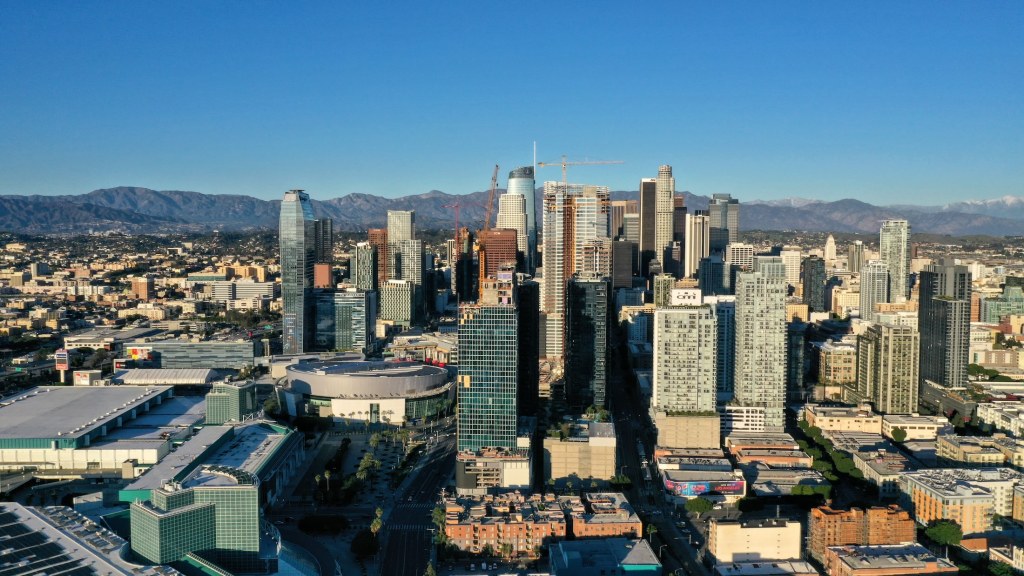
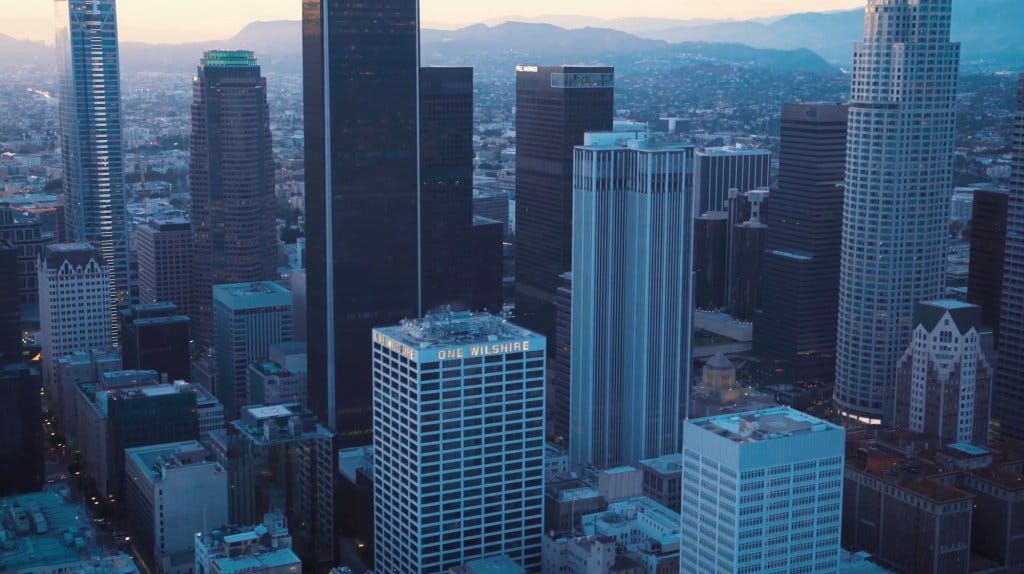
Built in 1966 by Skidmore Owings and Merrill, One Wilshire was originally an average, blocky corporate address at Wilshire Boulevard and Grand Avenue. It housed law firms and accounting practices. Three decades later, it had transformed into the Internet’s western nerve center.
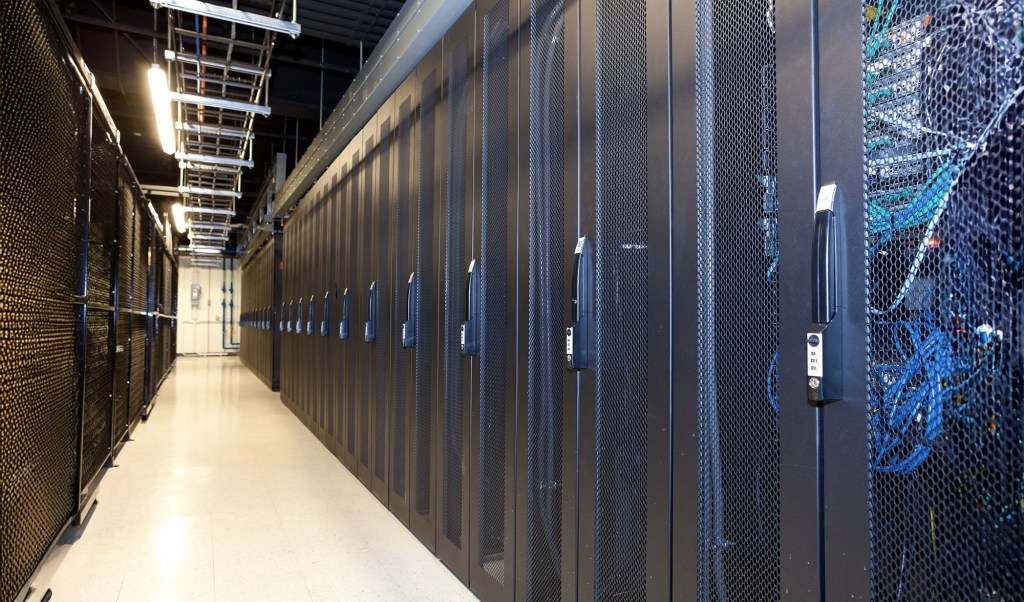
The shift began quietly in the late 1980s. Before “data center” was even a thing, telephone companies and early network providers needed places to house switching equipment and to interconnect their lines. One Wilshire was perfect: its roof offered line-of-sight to Mount Lee, home to microwave and radio relays, and it sat beside Pacific Bell’s main switching hub for Los Angeles, now the AT&T Madison Complex. By the early 1990s, the building had become known as the West Coast’s “carrier hotel,” a neutral site where dozens, and eventually hundreds, of companies physically linked their networks. Like a massive bundle of neurons. The heart of all the action was the fourth floor in the Meet-Me Room, a tangle of cables, routers, and blinking lights where data from around the world converged. The building is now also known as CoreSite LA1.
The Wired team that toured the site in 2008 described it as “the world’s most densely populated Meet-Me Room”, home to more than 260 ISPs. The ceiling was so packed with cable trays that wiring spilled from every intersection. Copper wires entering the building were quickly converted to fiber-optic strands for long-haul transmission. And the data they can carry? Oof, that’s a story in and of itself.
The process that takes place, known as peering, lets networks connect and share traffic, again, like a neuron. Without it, users could only reach sites hosted by their own ISP. Before One Wilshire (and similar interconnection hubs) existed, internet service providers (ISPs) were like isolated islands. Users could connect only to sites hosted on their own network (also, remember AOL?). One Wilshire changed that by allowing networks to physically link to each other, creating the backbone of the modern internet. Telecom titans like AT&T, Verizon, China Telecom, Amazon, Google, and Netflix exchange data packets in unimaginable quantities. I tried to find an estimate of the total throughput capacity of One Wilshire and the best answer I could find was hundreds of terabytes per second which, while vague, is still a lot.
At its peak, One Wilshire carried an estimated one-third of all Internet traffic between North America and Asia. Undersea fiber-optic cables land in places like Hermosa Beach and the Manchester/Point Arena station. From there, terrestrial backhaul lines carry the data inland directly into One Wilshire, where it may be exchanged or forwarded onto international routes like Tokyo, Singapore, Hong Kong, Sydney, etc. All in the matter of milliseconds. It’s amazing.

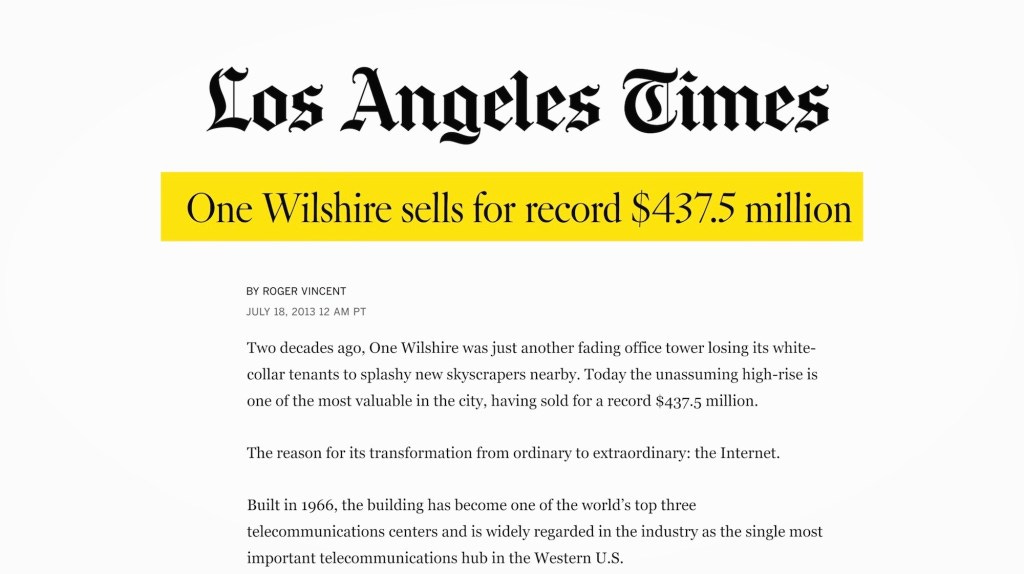
By the dot-com boom, One Wilshire was less interesting as a basic real estate play and far more valuable for its network density, which was still growing. A single rack of servers or cross-connect could rent for tens of thousands of dollars a month. As its power draw and cooling needs surged, engineers retrofitted entire floors with industrial-grade infrastructure to keep pace with the growth of the internet. Of course, investors took notice. In 2013, GI Partners purchased the building for $437 million, a record $660 per square foot, then the highest price ever paid for any office property in downtown Los Angeles. By then it wasn’t really an office building at all, but a data fortress housing the infrastructure of hundreds of companies connected by thousands of miles of fiber.
Another story to tell at some point is the incredible advance in how much data a single strand of fiber can carry. A technology called dense wavelength division multiplexing (DWDM), allows each fiber to carry dozens of individual light “channels,” each at its own wavelength, dramatically increasing the capacity of a single fiber. Those fibers are bundled a larger cable (usually 12 pairs) that can carry 400–600 terabytes per second. We’re talking 60–90 million Netflix movies per second. Mind-blowing technology.
Today, One Wilshire remains a 664,000-square-foot communications hub, the core exchange center for trans-Pacific data and inter-carrier routing. It’s the West Coast’s counterpart to New York’s 60 Hudson Street, also a nondescript, but vital physical part of the Internet.
So, yeah, the internet, and all the information you doom scroll and the Netflix videos you binge, are not only in reality “a series of tubes,” as Senator Stevens once put it. It’s physical. It’s real infrastructure, built of concrete, cables, and air-conditioned rooms full of servers. And one of the most important pieces of it all sits on a busy, traffic-clogged street in downtown Los Angeles.
