
Andrew Innerarity / California Department of Water Resources.
Water, water, every where, nor any drop to drink. — Samuel Taylor Coleridge’s poem The Rime of the Ancient Mariner.
The ocean covers about 70 percent of Earth’s surface and holds 96 percent of its water. But because it’s saturated with salt, it isn’t drinkable. Sailors have known this for centuries, and that’s a profound challenge for California, with more than 800 miles of coastline and a history of drought that has persisted for over two decades despite occasional relief from heavy rains.
Remember those rains?
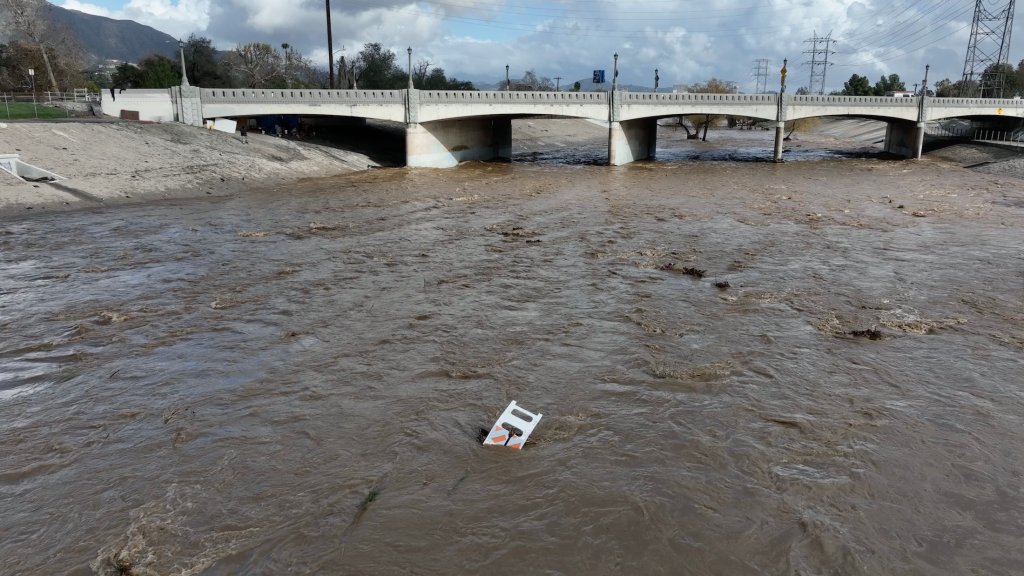
The atmospheric rivers of 2024 in California briefly filled reservoirs and restored snowpack, but drought has already returned to parts of the state, underscoring the state’s precarious water future and fueling renewed debate over desalination as a long-term water solution.
Several regions facing severe drought have turned to desalination with notable success. Israel now supplies up to 40 percent of its domestic water through desalination and is widely recognized as a global leader in technological innovation. In the Gulf, countries like Saudi Arabia, the United Arab Emirates, Kuwait, and Qatar depend heavily on desalinated water, with the region producing roughly 40 percent of the world’s supply of desal. Saudi Arabia’s Ras Al-Khair plant, for example, is the largest hybrid desalination facility in the world. Australia has also invested heavily, with Adelaide’s desalination plant able to provide up to half of the city’s water and ramping up to full capacity during the 2024–2025 drought.
By contrast, California, the world’s fourth-largest economy, continues to struggle with recurring droughts despite some relief from those recent rains.
Many new projects are underway to recycle and store water, but desalination remains an important option that could play a larger role in how California manages supplies for its residents and farmers. For now, the state has only a handful of desalination plants, with just two operating at significant scale, leaving California far behind global leaders.
California will keep bouncing between wet and dry years, and that reality has pushed seawater and brackish-water desalination from a thought experiment into a real, if specialized, tool. It’s a big deal: The promise is reliable “drought-proof” supply. The tradeoffs are clear: high costs, heavy energy demands, and the challenge of careful siting. California has pushed the frontier of desalination technology, but it remains far from being an integral or dependable part of the state’s supply. Many observers doubt it ever will be.
But let’s take a look at where we are.
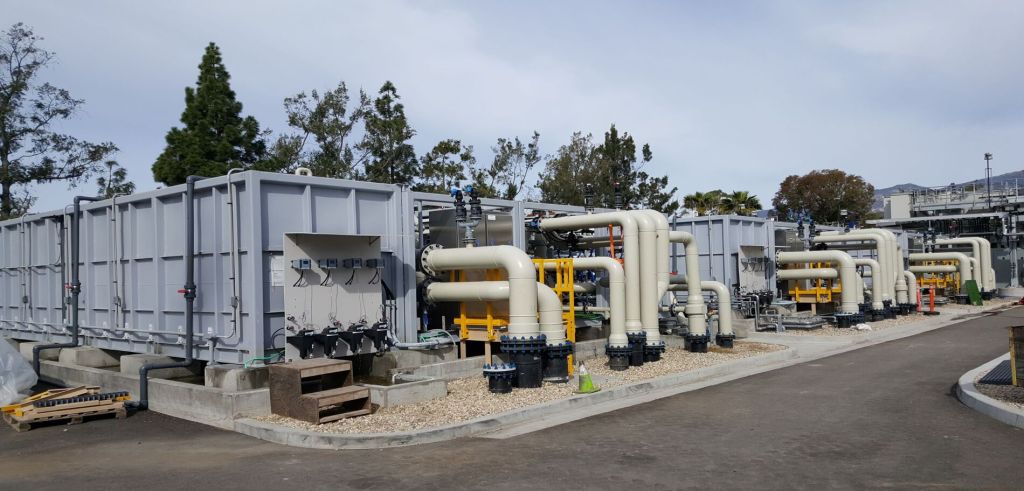
Desalination is already part of daily life in a few places. The 50-million-gallon-per-day Claude “Bud” Lewis Carlsbad Desalination Plant supplies roughly a tenth of the San Diego region’s potable demand, making it the largest seawater desalination facility in the United States. Water from Carlsbad is reliable during drought, but that reliability carries a premium: Recent public figures put its delivered cost in the low-to-mid $3,000s per acre-foot, higher than most imported supplies when those are plentiful. Even advocates frame the key tradeoff as price and energy intensity in exchange for certainty.

Rules matter as much as membranes. Since 2015, California has required new ocean desal plants to use the best available site, design, technology, and mitigation measures to minimize marine life mortality at intakes and to limit brine impacts at outfalls. These standards make facilities gentler on the ocean and they shape where plants can be built and what they cost. But it’s complicated.
The permitting bar is real, some say too onerous. In May 2022 the California Coastal Commission unanimously denied the proposed Huntington Beach seawater desalination plant after staff raised concerns about high costs, harm to marine life from an open-ocean intake, exposure to sea-level rise, and a lack of demonstrated local demand. That decision did not end desalination, but it clarified where and how it can pencil out. The same year, the Commission unanimously approved the smaller Doheny project in Dana Point because it uses subsurface intake wells and showed stronger local need and siting.

Doheny is frequently described as a late-2020s project, but its official timeline has slipped as partners and financing have taken longer to come together. That’s so California. The South Coast Water District has projected completion and operations in 2029, with key procurement milestones running through 2025. Given California’s regulatory climate, I’d say these dates are optimistic rather than bankable.
Elsewhere on the coast, the California American Water project for the Monterey Peninsula cleared a major hurdle in November 2022. Designed to add about 4.8 million gallons per day and pair with recycled water to replace over-pumping groundwater (a huge issue), it underscored desal’s role where other options are limited. In August 2025, the CPUC projected a 2050 supply deficit of 815 million gallons per year and cleared the way for construction to begin by year’s end. So, yeah. We’ll see.

Desalination is not only ocean-sourced. Several California systems quietly run on brackish water, which is less salty and cheaper to treat than seawater. Antioch’s brackish plant on the San Joaquin River is designed for about 6 million gallons per day to buffer the city against salinity spikes during drought. It was slated to come online this year, but operations have yet to begin (at least, I could not find any new info to this effect). Up the coast, Fort Bragg installed a small reverse-osmosis system in 2021 to deal with high-tide salt intrusion in the Noyo River during critically low flows, and it has piloted wave-powered desal buoys for emergency resilience.

Santa Barbara’s Charles E. Meyer plant was reactivated in 2017 after years in standby and now functions as a reliability supply the city can dial into. In 2024 it contributed a meaningful slice of deliveries.
These are targeted, local solutions, not silver bullets, and that is the point.
Energy remains the biggest driver of desalination costs. Even with modern technology cutting usage to 2.5 to 4 kilowatt-hours per cubic meter, desal still requires far more power and therefore higher expense than water recycling or imported supplies. Beyond cost, desalination also brings added challenges, from greenhouse gas emissions tied to electricity use to the disposal of concentrated brine back into the ocean.
But the reality today is that the biggest additions to statewide water supply are coming from large-scale potable reuse, aka recycling. San Diego’s Pure Water program begins adding purified water to the drinking system in 2026 and scales toward about 83 million gallons per day by 2035. Metropolitan Water District’s Pure Water Southern California is planning up to roughly 150 million gallons per day at full build-out. These projects do not replace desal everywhere, but they change the calculus in big metro areas by creating local, drought-resilient supplies with generally lower energy and environmental footprints.
With most desalination projects carrying steep costs, success may hinge on innovation. Several new approaches now being tested in California waters are showing early promise. In 2025, OceanWell began testing underwater desalination pods in a reservoir near Malibu. These cylindrical units are designed to test how membranes perform when microorganisms are present in the water, since bacteria and algae can grow on the surfaces and form biofilms that clog the system.

The longer-term vision is “water farms” made up of subsea pods tethered 1,300 feet down, where natural hydrostatic pressure does much of the work. Each pod could produce up to a million gallons of fresh water per day with roughly 40 percent less energy than a conventional onshore plant. Because the brine would be released gradually at depth, the approach could also reduce ecological impacts. OceanWell has said its first commercial-scale project, called Water Farm 1, could be operating by 2030 if tests and permitting go as planned. It’s interesting, for sure, but in the end, we’re talking long-shot here.
Big picture, desalination works best as a specialty tool—it’s not the answer everywhere, but it can be a game-changer in the right spots. Think coastal towns with little groundwater, islands or peninsulas with fragile aquifers, or inland areas that get hit with salty water now and then. California’s rules now push projects toward gentler ocean intakes and better brine disposal, but the real strategy is a mix: conservation, stormwater capture, groundwater banking, recycled water, and just the right amount of desal. Those huge atmospheric river storms are not predictable. Who knows if we’ll get another next year or the year after that? The next drought will come, and the communities that invested in a full toolkit will be the ones that hold up the best.
——
Hey readers — we’re working on ways to keep California Curated going, and one new effort is our Etsy shop. It’s filled with science-inspired fish and bird designs that make great gifts for friends, family, or even yourself. Check it out and help support our work!

Discover more from California Curated
Subscribe to get the latest posts sent to your email.

