The 26th President of the United States was a soldier, a historian, an amateur scientist, a best-selling writer, an avid outdoorsman and much much more. He has been called the “father of conservation,” because, as president, he authorized the creation of 150 national forests, 18 national monuments, 5 national parks, 4 national game preserves, and 51 federal bird reservations. We think he deserves the moniker.
President Roosevelt and John Muir at the base of the Grizzly Giant. Credit: Photographer: Joseph Nisbet LeConte; Yosemite NP Archives
But many people may be unaware that TR has a very important California connection. 121 years ago, in 1903, just two years after becoming our nation’s youngest president at the age of forty-two, following the assassination of President William McKinley, Roosevelt embarked on one of the most important Presidential trips in the history of America.
In 1903, President Theodore Roosevelt embarked on a grand tour of the western United States. At the time, Roosevelt was already known for his passion for the outdoors and his desire to protect the nation’s natural resources. This trip would cement his legacy as a conservationist and lead to the expansion of America’s national parks.
The impact of his trip to California is still being felt today.
The trip, taken by railroad, took Roosevelt across the American continent. The 3,000-mile journey began in April from Washington D.C., and took TR through twenty-five states, and lasted nine weeks. He traveled through the American West and stopped at Yellowstone National Park for a hiking and camping trip with naturalist and essayist John Burroughs. He continued on and ended up touring a large swath of the state of California, including Yosemite, which had been declared a national park in 1890.
Yellowstone National Park (National Park Service)
It was a tenuous time for the American environment. Millions of buffalo had been slaughtered across the plains, often for sport, their carcasses left to rot in the sun. The passenger pigeon, a bird that once filled the skies by the billions, had been exterminated. But America was also in the midst of a nature renaissance, and Roosevelt was one of its pivotal figures. The impact of his trip to California is still felt today.
Millions of buffalo were slaughtered during the western expansion of the United States (Wikipedia)
In California, Teddy Roosevelt’s journey was a mix of official duties and personal exploration, reflecting his dual role as a statesman and an outdoorsman. After arriving in San Francisco, Roosevelt was greeted with great fanfare, delivering speeches to large crowds and meeting with local dignitaries. His visit to the city included a tour of its bustling port, symbolizing the growing importance of California as a gateway to the Pacific. Roosevelt also visited Stanford University, where he spoke about education, progress, and the future of the American West. His time in the urban centers highlighted California’s rapid development and its significance in the nation’s expansion.
However, the most profound part of Roosevelt’s time in California came during his visit to Yosemite National Park. He met with naturalist John Muir on May 15th, 1903. The meeting took place on a train in the dusty town of Raymond, California, the closest station to Yosemite. From there, the men traveled 40 miles (about 8 hours) by stagecoach, which gave them the opportunity to get acquainted. They stopped in Mariposa Grove, where TR saw his first sequoia and had his picture taken driving through the “Tunnel Tree,” which no longer stands.
That first night, President Roosevelt dismissed his aides and the press, which was unusual for him because he was a publicity hound. In the wilds of Yosemite, he and Muir spent three days “roughing it,” camping beneath the stars and enjoying conversation around a campfire. It was during those conversations that Muir made the case for the preservation of forests and other natural resources. Likely, these talks created the impetus for Roosevelt’s support for the 1906 Antiquities Act, arguably one of the most important pieces of conservation law in the United States. With the power to proclaim lands as monuments in the public interest, Roosevelt in 1908 set aside some 800,000 acres as Grand Canyon National Monument. Congress later gave it a national park status.
Arguably, no other President has had such a singular impact on protecting American lands, and it’s fair to say, we think, that his visit to California had a lot to do with it.
Oak trees hold a profound presence in the landscape of California, constituting a living link between the state’s rich biodiversity and cultural history. Approximately 20 species of oak trees have been recorded in California, each playing a vital role in the ecosystem and making these trees an essential part of the state’s natural landscape.
Among the most significant species are the Coast Live Oak, the Valley Oak, the Blue Oak, and the California Black Oak. The Coast Live Oak, resilient against the salty sea breeze, thrives along California’s coastal regions. The Valley Oak, a symbol of endurance, dominates the fertile inner valleys, while the Blue Oak’s blue-green foliage characterizes the hot, dry foothills of the Sierra Nevada and Coast Ranges. Meanwhile, the California Black Oak, found primarily in mountain regions, is appreciated for its vibrant autumnal foliage and acorns, an essential food source for various wildlife. (Most oak species, particularly those in California, tend to have evergreen foliage or don’t exhibit the same dramatic autumn color change as the black oak.)
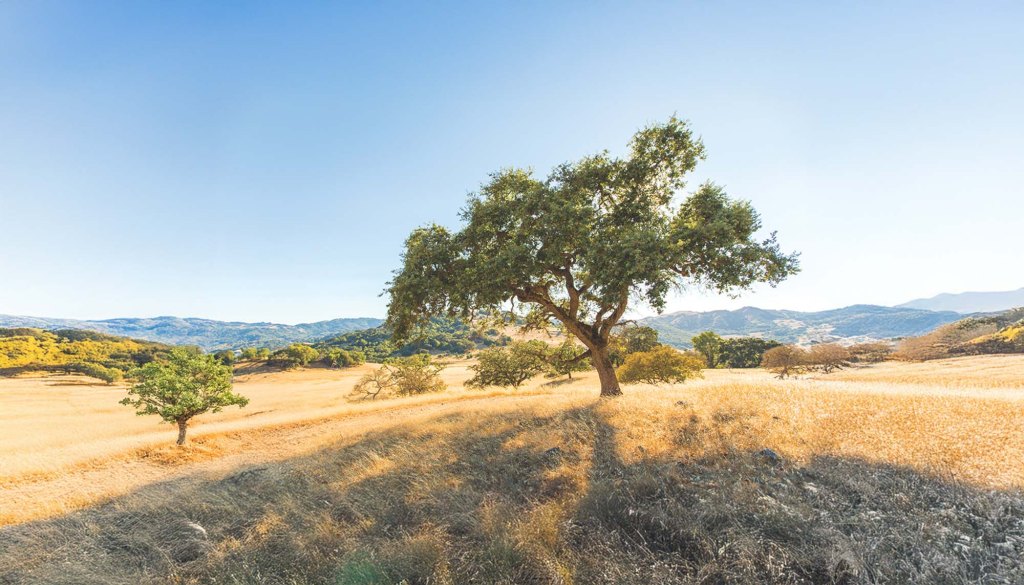
Oak tree in Descanso Gardens in La Cañada Flintridge
Oaks in California boast a rich history that dates back millions of years, with fossil records suggesting their presence since the Miocene epoch. This rich lineage is intertwined with the tree’s biological traits, with each species evolving to inhabit specific ecosystems. As a result, oak trees have managed to extend their reach across the state’s diverse terrain, from the sun-bathed coasts to the crisp mountain ranges. Whether deciduous or evergreen – with most species in California being the latter – oaks have a remarkable ability to withstand the dry summer months as well as the occasional harsh winter. This resilience can be attributed to their deep root systems and hardy leaves, allowing them to survive and thrive in the region’s unique climate.
Oak Tree in California
Genetics plays a huge role as well: Oaks have a robust genetic makeup that equips them with resilience against various environmental stresses. A study published in the journal “Nature Plants” in 2020, led by researchers at the University of California, Davis, revealed that the genome of the oak tree contains a rich diversity of genes involved in resistance to diseases and stresses. This genetic diversity allows oaks to adapt and survive in different environments and against various threats.
One of the most intriguing findings from the study is the presence of duplicated genes in the oak genome. These gene duplications have occurred over millions of years and are associated with enhanced disease resistance, essentially they get more than the regular protection. This genetic diversity allows oak trees to adapt to various threats, such as pests and pathogens, over time. The study also suggests that these somatic mutations—genetic changes that occur in the cells over the tree’s lifetime—are heritable, contributing to the ongoing evolution of the species and its capacity to survive in changing environments.
Oaks are also remarkably adept at withstanding environmental stresses such as drought, extreme temperatures, and poor soil conditions. Research in forest ecology, including studies published in journals like Trees and Forest Ecosystems, has shown that oaks’ physiological adaptability to different environmental conditions is a crucial factor in their long lifespan. These studies highlight how oaks exhibit significant plasticity in their physiological traits, allowing them to adjust to varying levels of water availability, temperature, and other environmental factors.
California oaks are not just a testament to natural resilience; they are an ecosystem unto themselves. They are the cornerstone of a vibrant biodiversity that encompasses hundreds of animal species. The trees provide shelter and serve as breeding habitats for various animals, from squirrels and deer to a myriad of bird species. The acorn, in particular, play a vital role as a food source. Insects, too, have carved out an existence around the oaks, with some species laying their eggs within the tree’s bark.
This intrinsic connection between the oaks and the animal kingdom extends to humans as well. Historical records show that indigenous tribes in the region used acorns as a staple food. In modern times, the strength and durability of oak wood have made it a preferred choice for construction and furniture-making. Oak is also used in the production of high-quality wine barrels, lending its unique character to the Californian wine industry. The top fifty most expensive wines in the world are oak-aged in some way.
The oak trees of California are renowned for their impressive size and longevity. The Valley Oak, the largest of California’s native oaks, can reach over 100 feet in height and live for several centuries. These grand trees also contribute significantly to carbon sequestration. A mature oak has the capacity to absorb up to 50 pounds of CO2 annually, thus helping mitigate climate change while improving air quality. A mature oak forest can store up to 50% more carbon than an equally-sized forest of other trees.
Despite their remarkable resilience, oaks in California face a myriad of challenges. Threats stem from habitat loss, climate change, and diseases such as Sudden Oak Death. Urban development often comes at the expense of oak woodlands, while shifts in climate patterns pose potential risks to the growth and distribution of oaks.
Coast Live Oak (Erik Olsen)
Conservation efforts to protect California’s majestic oaks have become increasingly critical in recent years, shaped by a heightened understanding of the tree’s ecological significance and the mounting threats they face. Various local, state, and federal entities, as well as numerous non-profit organizations, have joined forces in these endeavors, harnessing a broad array of strategies to ensure the survival and thriving of California’s oaks. The Oak Woodlands Conservation Act is a key legislative effort, providing funding to conserve oak habitats. Additionally, various organizations, such as the California Oak Foundation, run planting and restoration projects, as well as research initiatives to combat threats like Sudden Oak Death and climate change.
One of the primary conservation strategies involves the protection of oak habitats, specifically oak woodlands. These regions are often hotspots of biodiversity, and their preservation is crucial for the health of many interconnected species, including oaks themselves. For example, the Oak Woodlands Conservation Act, mentioned above and enacted by the state of California, provides funding to acquire oak woodland habitats for conservation purposes, ensuring these areas remain untouched by urban development or agriculture.
Leaves of California Black Oak
In addition to the legal protection of existing oak habitats, restoration projects are an important aspect of conservation efforts. These projects involve the replanting of oaks in areas where they have been lost due to disease, development, or other causes. The California Oak Foundation runs regular planting programs, involving local communities in the process to raise awareness about the importance of oaks and fostering a sense of responsibility for their protection.
Research also plays a vital role in oak conservation. Scientists are continually studying the threats faced by oaks, including diseases like Sudden Oak Death, and developing ways to mitigate them. They are also exploring the potential impacts of climate change on California’s oaks, seeking strategies to bolster their resilience against rising temperatures and shifting weather patterns. This research informs management strategies and policy-making, ensuring conservation efforts are based on the best available science.
By fostering a deeper connection between the people of California and their native oaks, these initiatives cultivate a broader culture of conservation that can help ensure the survival of these majestic trees for generations to come. The collective aim of these diverse conservation strategies is not merely the survival, but the flourishing of California’s oaks, securing their rightful place in the state’s rich and dynamic ecosystems.
The current effort to bring back the white abalone is one of numerous projects underway in California to revive the state’s once-thriving marine environment.
White abalone
If you grew up in Southern California in the 1970s, there were a few things that defined California: surfing, skateboarding, the Eagles (preferably on the radio while driving down the Pacific Coast Highway) and abalone.
The abalone was an icon of beach culture, celebrated in poetry and song, a wondrous gift from Mother Nature. Almost every house near the coast had upturned abalone shells on the coffee table or as decorative items in a garden, their opalescent mother-of-pearl interior shells glistening jewel-like beneath the warm California sun. They hung near front doors or in backyards by the half dozen from string or fishing line, acting as wind chimes when the cool breezes blew in from the Pacific. Our air, our light is different than other places.
They once numbered in the millions off the California coast, but now they are endangered. As the Los Angeles Times put it in 2019, “Abalone once were to California what lobster is to Maine and blue crab to Maryland, so plentiful they stacked one on top of another like colorful paving stones.”
But then something terrible happened.
The white abalone (Haliotis sorenseni) fishery, in particular, went out of control. Commercial abalone fishing from 1969–1972 was so lucrative and so unrestrained that the catch went from roughly 143,000 pounds per year to just 5,000 pounds per year in less than a decade. Millions of pounds were harvested by commercial fishermen, and diving for abalone was a common and favored pastime. In 1997, state officials in California ceased all white abalone fishing because population levels had reached perilous lows. By 2001, the numbers of white abalone found along the coast were so low that they became the first marine invertebrate listed as endangered on the Endangered Species Act. But it was too late. The population had declined by almost 99 percent.
It is estimated that around 1,600 individuals remain, and at one point, it was feared the species would go extinct by 2010 without intervention. Currently, there is growing concern that the small populations still surviving in the wild may be highly vulnerable to withering syndrome disease.
California is home to seven species of abalone (red, pink, black, green, white, pinto, and flat), none of them are plentiful any longer in California waters, but it is the white abalone, in particular, that became the most prized for its tender, flavorful flesh. We loved white abalone. And then they were gone.
White abalone. Credit: NOAA
Despite a fishing ban for over two decades, wild populations of white abalone have not shown signs of recovery. Abalone reproduce through broadcast spawning, where they release their gametes into the water. This method requires a certain population density to be effective, but current wild populations of white abalone are too sparse for successful natural reproduction.
In 2019, scientists at UC Davis’ Bodega Marine Lab in Bodega Bay launched one of the most important species restoration efforts in the history of the state. On November 18, 2019, researchers from the marine lab, in cooperation with the National Oceanic and Atmospheric Administration (NOAA) carefully released thousands of baby white abalone into the waters of Southern California. Biologists measured and marked each one with a unique numbered tag affixed to their shell to distinguish them from wild white abalone (of which there are perilously few). This marked the first release of endangered white abalone into the wild in coastal waters. What’s crazy is that the white abalone that have been bred in the lab constitute the largest population of the slow-moving mollusks in the world. That’s right, there are more white abalone living in captivity than there are in the wild. Until now.
“Early on we knew that this species was really in danger of going extinct and that the only viable alternative to save it was starting a captive breeding program,” said Ian Taniguchi, a biologist with the California Department of Fish and Wildlife (CDFW) who has been involved in white abalone restoration since 1992.
The White Abalone Restoration Program in California has made significant progress in recent years, although challenges remain. The program, now led by a coalition of organizations including NOAA Fisheries, the University of California, Davis, and The Bay Foundation, focuses on restoring the population of this critically endangered species through captive breeding and outplanting efforts.
Currently, the program has successfully bred and outplanted thousands of juvenile white abalone into the wild, particularly along the Southern California coast. These efforts are part of a broader strategy that includes improving spawning techniques, monitoring wild populations, and enhancing habitat conditions. Despite these efforts, white abalone populations in the wild are still vulnerable due to factors like disease, warming waters, and low population densities that hinder natural reproduction.
The program’s ongoing efforts include monitoring environmental conditions that affect abalone habitats, such as oxygen levels and temperature, to optimize outplanting strategies. Additionally, the restoration efforts are expanding, with new techniques and partnerships aimed at increasing the resilience of outplanted populations and ultimately ensuring the species’ survival in the wild
Cultured Abalone Farm (Photo: Jennifer Boyce)
“Early on we knew that this species was really in danger of going extinct and that the only viable alternative to save it was starting a captive breeding program.”
Ian Taniguchi, a biologist with the California Department of Fish and Wildlife (CDFW)
Abalone are far more valuable than merely as a food item. They are keepers of the kelp forest. According to scientists, the abalone eat kelp, but they also clear rocks of any dominant species and thus increase kelp diversity so that multiple kelp species can flourish. When the kelp is healthy and diverse, coastal waters see an explosion of diversity in fish and other animals that depend on kelp forest habitat.
While the success of the abalone recovery program hangs in the balance, its mere existence needs to be recognized as part of a much larger tapestry of species and ecosystem recovery projects currently underway that are aimed at restoring California’s coastal ecosystem to some semblance of what it was centuries ago.
That is, of course, impossible. The numerous written accounts by early California settlers (many of them Spanish) describe plants and animals in such unfathomable abundances, the likes of which we will never be able to return. But we can reclaim some of it. And after decades of witnessing severe declines in fish species, kelp, water quality and coastal habitat, it seems we may be finally turning a corner. Maybe.
Alone, each of these efforts is a small step in the right direction in making our seas healthy and fruitful. Together, they represent the most significant set of achievements to reverse the impact of human settlement on the ocean environment in the history of the world. Of course, we are nowhere near done, and the growing (and terrifying) threats from climate change could render all of this moot. Warming seas, the spread of new diseases (and old ones), acidification, all these things together could unravel these accomplishments in mere decades.
There are still many challenges ahead. Recent kelp die-offs in Northern California due to the explosion in purple urchin populations are extremely worrisome. Phenomena like sea star wasting disease and the marine heatwave of 2013-2015 may have wrought permanent change to our marine ecosystem. But the fact that we are now acting so aggressively to apply science and ingenuity to solve the myriad problems we ourselves caused should give us some hope that positive change is possible.
There is no time for rest. If anything now is the time to redouble our efforts to make our oceans cleaner, to help species recover and to restore the lost balance so that future generations can experience the incredible beauty and bounty of the sea.
When people think of Santa Monica, images of sun-soaked beaches, the iconic pier, and leisurely strolls along the Pacific Coast Highway often come to mind. It’s a city synonymous with surf, sand, and a laid-back California lifestyle. Yet, bunkered within this seaside haven is an institution far removed from the carefree spirit of the shore: RAND Corporation, one of the world’s most influential think tanks, with deep ties to the Department of Defense. While tourists flock to the hot sands and the 3rd Street Promenade, behind the walls of RAND’s headquarters, some of the nation’s brightest minds have quietly shaped U.S. policy and technology for decades.
The RAND Corporation, originally an acronym for “Research ANd Development,” is a think tank that has had a profound impact on policy and decision-making in various fields, including national security, science, technology, and social policy.
RAND emerged from the devastation of World War II, inspired by the success of the Manhattan Project, a $2 billion effort that produced the first atomic bomb. Seeing this achievement, five-star Air Force General Henry “Hap” Arnold recognized the need for a group of brilliant minds to keep America at the forefront of technological innovation. In 1946, Arnold assembled a small team of scientists with $10 million in funding to create RAND, short for Research and Development. He persuaded a family friend, aircraft mogul Donald Douglas, to host the project at his factory in Santa Monica.
Within months, RAND captured the attention of academics, politicians, and military leaders with its groundbreaking report, “Preliminary Design of an Experimental World-Circling Spaceship.” At a time when rocket science was in its infancy, the think tank’s vision of an orbiting space station was revolutionary. The report not only detailed the type of fuel needed and the feasibility of constructing the station but also highlighted its potential to revolutionize weather forecasting, long-distance communication, and most crucially, its ability to intimidate America’s adversaries. If America could launch a satellite into space, what else might it achieve?
Although President Truman decided against pursuing the space station, the military quickly embraced RAND. Thanks to Hap Arnold’s connections, the Air Force became RAND’s primary contractor, and the think tank began consulting on a wide range of projects, from propeller turbines to missile defense systems. The influx of contracts soon overwhelmed RAND, prompting the need to hire hundreds of additional researchers. In its recruitment ads, RAND proudly highlighted its intellectual pedigree, even drawing a direct line from its president, Frank Collbohm, to Isaac Newton. Whether or not that claim held water, the institute rapidly earned a reputation as the go-to place for envisioning innovative strategies to wage wars and deter adversaries.
In fact, in 1960s the Soviet newspaper Pravda nicknamed RAND “the academy of science and death and destruction.” American media outlets preferred to call them the “wizards of Armageddon.” The Atlantic called them “the paramilitary academy of United States strategic thinking”.
RAND’s strategic theories, including the concept of Mutually Assured Destruction (MAD), were born from the devastating potential of atomic weapons, aiming to prevent nuclear war through deterrence.
But where is RAND located? When RAND was first established in 1946, it was housed in a building provided by Donald Douglas at his aircraft factory in Santa Monica. However, as RAND grew, it eventually moved to its own dedicated headquarters.
In 1953, RAND moved to a new building on a site provided by the city of Santa Monica. This building was designed specifically for RAND’s needs and became a recognizable landmark near the beach. In 2004, RAND moved again to a newly constructed headquarters in Santa Monica, located at 1776 Main Street. This modern facility was designed to better accommodate RAND’s evolving research activities and staff. So while RAND has always been in Santa Monica, it has moved to different buildings over the years.
Hand-tinted photo of the original RAND building at 1700 Main Street in Santa Monica, California, circa 1960s RAND Archives
During the early years, RAND’s work was heavily focused on military and defense issues, reflecting the geopolitical climate of the Cold War. One of RAND’s most significant early contributions was the development of game theory and its application to military strategy. Pioneers like John Nash, who would later win the Nobel Prize in Economics, conducted seminal work at RAND during this period.
RAND’s analysts played a crucial role in the development of nuclear strategy, including the doctrine of mutually assured destruction (MAD). The think tank’s work on systems analysis, a method for evaluating complex systems, became a cornerstone of U.S. defense planning. RAND’s analysts developed strategies for deterrence, nuclear war scenarios, and the implications of various levels of nuclear arsenals.
“This was a very smart bunch,” said Ellsberg, just before his death on June 16, 2023. “The smartest group of people I ever did associate with. It turns out, by the way, intelligence is not a very good guarantee of wisdom.”
Daniel Ellsberg
Two key figures at the time, Albert Wohlstetter and Herman Kahn, were both pivotal figures at the RAND Corporation, where they contributed significantly to the development of U.S. nuclear strategy during the Cold War. Wohlstetter, known for his rigorous and analytical approach, emphasized the importance of maintaining a credible deterrent to Soviet aggression, which he articulated in his influential work, “The Delicate Balance of Terror.” Herman Kahn, another RAND was renowned for his work on nuclear warfare scenarios and is often credited with popularizing the concept of “mutual assured destruction” (MAD).
Albert Wohlstetter (Wikipedia)
Their paths intersected with Daniel Ellsberg, who also worked at RAND as an analyst. Ellsberg, who later became famous for leaking the Pentagon Papers, was influenced by both Wohlstetter’s strategic insights and Kahn’s scenarios, but the resulting plans for how America would manage a nuclear war with the Russians terrified Ellsberg. As he recounted in the Netflix Documentary Turning Point, Ellsberg revealed that serious plans at RAND estimated a nuclear war with Russia and China could result in 600 million casualties, highlighting the catastrophic consequences that were considered in Cold War strategic planning. These revelations, along with his evolving moral stance, eventually led Ellsberg to become a vocal critic of U.S. military policies.
“This was a very smart bunch,” said Ellsberg, before his death on June 16, 2023. “The smartest group of people I ever did associate with. It turns out, by the way, intelligence is not a very good guarantee of wisdom.”
RAND’s current headquarters in Santa Monica (Erik Olsen)
By the 1960s, RAND began to diversify its research agenda. The think tank started to tackle a wider array of issues, including healthcare, education, and social policy. In 1968, RAND established the Health Insurance Experiment, a landmark study that explored the effects of different levels of health insurance coverage on medical spending and health outcomes. This study had a lasting impact on health policy and remains one of the largest and most comprehensive studies of its kind.
Although Silicon Valley is given most of the credit, RAND also contributed to the development of the internet. In the 1960s, RAND researchers, including Paul Baran, were instrumental in developing the concept of packet-switching networks, which later became a fundamental technology underlying the internet. The key idea (which Baran worked on with others) was to develop a communication system that could withstand potential disruptions, such as those caused by a nuclear attack. His concept of breaking data into small packets and routing them through a decentralized network was groundbreaking, ensuring that information could still be transmitted even if parts of the network were compromised.
Paul Baran presents his work at a RAND in 2009 Photo by Diane Baldwin/RAND
In the 1980s and 1990s, RAND continued to expand its global influence. The organization opened offices in Europe and started collaborating with international governments and institutions. RAND’s research began to encompass global security, international development, and global health issues. RAND also pioneered the study of terrorism in the 1970s, well before the United Nations had even defined the term. Today, the RAND Terrorism Chronology Database, tracking all terrorist acts since 1968, is a crucial resource for the military and government.
One notable area of RAND’s recent work is in the field of education. RAND has conducted extensive research on educational policies and practices, including studies on school choice, teacher effectiveness, and the impacts of educational technology.
Despite its many contributions, RAND has faced criticisms and challenges. Some have argued that the think tank’s close ties to the military and government agencies may bias its research. Others have pointed out that, like any large organization, RAND’s influence can sometimes lead to the prioritization of certain agendas over others.
A British MQ-9A Reaper operating over Afghanistan in 2009 (Wikipedia)
One of RAND’s more controversial recent activities involved its research on U.S. drone warfare. Critics have raised concerns that RAND’s analyses have sometimes downplayed the ethical and civilian impact of drone strikes, focusing instead on the strategic advantages for the U.S. military. This has sparked debates about whether RAND’s close ties to the Department of Defense might influence the objectivity of its findings, particularly in areas where the moral and humanitarian implications are significant.
As of the most recent data, RAND Corporation employs approximately 1,950 people, including researchers, analysts, and support staff. The think tank operates with an annual budget of around $390 million, funding a wide array of research projects across various disciplines, including national security, health, education, and more. These figures can fluctuate based on the specific projects and funding sources in any given year.
Despite concerns about its influence, the RAND Corporation has remained a significant player in policy research. Its ability to adapt and broaden its focus has helped it stay relevant over the years. RAND’s work continues to inform policies that affect many aspects of public life, reflecting the ongoing role of independent research in policy-making.
So the next time you take a trip to the beach, take a moment to consider that just a short distance from the waves, some of the nation’s most critical and controversial policy decisions are being shaped at RAND’s headquarters in Santa Monica.
Few organisms in the history of science have been as important to our understanding of life as the humble fruit fly. The genus Drosophila melanogaster holds a particularly esteemed spot among the dozens of model organisms that provide insight into life’s inner workings. For more than 100 years, this tiny, but formidable creature has allowed scientists to unwind the infinitesimal mechanisms that make every living creature on the planet what it is.
And much of the work to understand the fruit fly has taken place and is taking place now, right here in California at the Cal Tech fly labs.
Over the decades, Drosophila have been key in studying brain, behavior, development, flight mechanics, genetics, and more in many labs across the globe. These tiny, round-bodied, (usually) red-eyed flies might appear irrelevant, but their simplicity makes them ideal models. They’re easy to breed—mix males and females in a test tube, and in 10 days, you have new flies. Their 14,000-gene DNA sequence is relatively short, but extremely well-studied and there are some 8,000 genes which have human analogs. (The fly’s entire genome was fully sequenced in 2000.) Crucially, a century of fruit fly research, much of it led by Caltech, has produced genetic tools for precise genome manipulation and shed light on the act of flight itself.
But how did Drosophila become the darling of genetics?
In the early 20th century, the field of genetics was still in its infancy. Thomas Hunt Morgan, a biologist at Columbia University with a background in embryology and a penchant for skepticism began with an effort to find a simple, cheap, easy-to-breed model organism. At Columbia, he established a laboratory in room 613 of Schermerhorn Hall. This cramped space became famous for groundbreaking research in genetics, with Morgan making innovative use of the common fruit fly.
Thomas Hunt Morgan in the Fly Room at Columbia, 1922 (Cal Tech Archives)
Morgan, who joined Columbia University after teaching at Bryn Mawr College, chose the fruit fly for its ease of breeding and rapid reproduction cycle. Morgan observed a male fly with white eyes instead of the usual red. Curious about this trait’s inheritance, he conducted breeding experiments and discovered that eye color is linked to the X chromosome. He realized a male fly, with one X and one Y chromosome, inherits the white-eye trait from its mother, who provides the X chromosome. This led him to conclude that other traits might also be linked to chromosomes. His extensive experiments in this lab confirmed the chromosomal theory of inheritance, demonstrating that genes are located on chromosomes and that some genes are linked and inherited together.
After his groundbreaking research in genetics at Columbia University, Morgan moved to Pasadena and joined the faculty at CalTech in 1928, where he became the first chairman of its Biology Division and continued his influential work in the field of genetics establishing a strong genetics research program. Morgan’s work, supported by notable students like Alfred Sturtevant and Hermann Muller, laid the foundation for modern genetics and earned him the Nobel Prize in 1933.
CalTech then became a world center for genetics research using the fruit fly. Other notable names involved in fruit fly research at CalTech include Ed Lewis, a student of Morgan, who focused his research on the bithorax complex, a cluster of genes responsible for the development of body segments in Drosophila. His meticulous work over several decades revealed the existence of homeotic and Hox genes, which control the basic body plan of an organism (for which he won the 1995 Nobel Prize).
Seymour Benzer, another luminary at CalTech, shifted the focus from genes to behavior. Benzer’s innovative experiments in the 1960s and 1970s sought to understand how genes influence behavior. His work demonstrated that mutations in specific genes could affect circadian rhythms, courtship behaviors, and learning in fruit flies. Benzer’s approach was revolutionary, merging genetics with neurobiology and opening new avenues for exploring the genetic basis of behavior. His contributions are chronicled in Jonathan Weiner’s “Time, Love, Memory: A Great Biologist and His Quest for the Origins of Behavior,” a riveting account of Benzer’s quest to uncover the genetic roots of behavior. Lewis Wolpert in his review for the New York Times wrote, “Benzer has many gifts beyond cleverness. He has that special imagination and view of the world that makes a great scientist.”
Since Benzer’s retirement in 1991, new vanguard in genetics research has taken over at CalTech, which continues to be at the forefront of scientific discovery, driven by a new generation of researchers who are unraveling the complexities of the brain and behavior with unprecedented precision.
Elizabeth Hong is a rising star in biology, with her Hong lab investigating how the brain orders and encodes complex odors. Her research focuses on the olfactory system of Drosophila, which, despite its simplicity, shares many features with the olfactory systems of more complex organisms. Hong’s work involves mapping the synapses and neural circuits that process olfactory information, seeking to understand how different odors are represented in the brain and how these representations influence behavior. Her findings could have profound implications for understanding sensory processing and neural coding in general.
David Anderson, another prominent figure at Caltech, studies the neural mechanisms underlying emotions and behaviors. While much of Anderson’s work now focuses on mice as a model organism, the lab’s research explores how different neural circuits contribute to various emotional states, such as fear, aggression, and pleasure, essentially how emotions are encoded in the circuitry and chemistry of the brain, and how they control animal behavior. Using advanced techniques like optogenetics and calcium imaging, Anderson’s lab can manipulate specific neurons and observe the resulting changes in behavior. This work aims to bridge the gap between neural activity and complex emotional behaviors, providing insights into mental health disorders and potential therapeutic targets.
In 2018, the Anderson laboratory identified a cluster of just three neurons in the fly brain that controls a “threat display” — a specific set of behaviors male fruit flies exhibit when facing a male challenger. During a threat display, a fly will extend its wings, make quick, short lunges forward, and continually reorient itself to face the intruder.
California Institute of Technology (Photo: Erik Olsen)
Michael Dickinson is renowned for his studies on the biomechanics and neural control of flight in Drosophila. In the Dickenson Lab, researchers combine behavioral experiments with computational models and robotic simulations, seeking to understand how flies execute complex flight maneuvers with such precision. His work has broader applications in robotics and may inspire new designs for autonomous flying robots.
“He’s a highly original scientist,” Alexander Borst, a department director at the Max Planck Institute of Neurobiology in Germany, told the New York Times.
Fruit fly scientific illustration
Dickinson’s investigations also delve into how sensory information is integrated and processed to guide flight behavior, offering insights into the general principles of motor control and sensory integration.
As science advances, Caltech’s Fly Lab’s remind us of the power of curiosity, perseverance, and the endless quest to uncover the mysteries of life. The tiny fruit fly, with its simple elegance, remains a powerful model organism, driving discoveries that illuminate the complexities of biology and behavior. Just recently, scientists (though not at CalTech) unveiled the first fully image of the fruit fly brain. Smaller than a poppy seed, the brain is an astonishingly complex tangle of 140,000 neurons, joined together by more than 490 feet of wiring.
In essence, the fruit fly remains a key to unlocking the wonders and intricacies of life, and in the Fly Labs at Caltech, that spirit of discovery thrives, ensuring that the legacy of Morgan, Lewis, Benzer, and their successors will continue to inspire generations of scientists to come.
In the depths of the ocean, when a whale dies, its carcass sinks to the seafloor, creating a unique and rich ecosystem known as a whale fall. Recently, scientists have discovered an extraordinary number of these whale falls off the coast of Los Angeles—over 60 skeletons, a number that surpasses the total found worldwide since 1977. This remarkable density of whale falls has turned the region into a hotspot for marine biologists and ecologists eager to study these deep-sea oases. A recent video (2019) from the Exploration Vessel (E/V) Nautilus captured the excitement as scientists came upon a whale fall on the Davidson Seamount off California.
(The Davidson Seamount, which we have written about before, is a hotbed of biological activity, a deep sea oasis of life, providing habitat for millions of creatures, including the famous gathering of brooding ocotpus (Muusoctopus robustus) known as the Octopus Garden, seen in video here.)
Photo: Ocean Exploration Trust
Whale falls provide a dramatic example of how death can foster life. When a whale carcass settles on the ocean floor, it becomes a feast for a variety of marine creatures. Initially, scavengers like hagfish, sharks, and crabs strip the soft tissues. Over time, the remaining bones support a succession of organisms, including bone-eating worms called Osedax, which bore into the bones and extract lipids. These processes can sustain life for decades, creating a complex and dynamic micro-ecosystem.
The discovery off Los Angeles is attributed to several factors. Detailed surveys of the area have been conducted, coupled with the region’s oxygen-poor waters, which slow decomposition and preserve the skeletons longer. Additionally, the lack of heavy sedimentation ensures that the whale bones remain exposed and easier to find. However, the proximity to busy shipping lanes raises concerns about the potential role of ship strikes in the high number of whale deaths.
Blue whale (Photo: Erik Olsen)
Eric Terrill and Sophia Merrifield, oceanographers from the Scripps Institution of Oceanography at UCSD, led surveys in 2021 and 2023 to assess waste spread across 135 square miles of seafloor in the San Pedro Basin. This area, twice the size of Washington, D.C., and located about 15 miles offshore, was used as an industrial dumping ground in the early to mid-1900s. Many of the objects discovered during the survey were barrels containing the banned pesticide DDT and its toxic byproducts.
Researchers consider it unlikely that the toxic waste and discarded weapons in the area are causing whale deaths. Instead, the high volume of ship traffic is a probable factor, as this area might see more whales killed by ship strikes compared to other regions. The Los Angeles and Long Beach ports, the two busiest in the United States, are located just northeast of the study site, with shipping lanes spreading throughout the area. Additionally, thousands of gray whales migrate through these waters each year, and blue whales regularly feed here, John Calambokidis, a marine biologist with Cascadia Research Collective, a nonprofit in Washington State, told The Atlantic.
Blue whale off the coast of Los Angeles (Photo: Erik Olsen)
Whale falls are crucial not only for the biodiversity they support but also for their role in carbon sequestration. When a whale dies and sinks, it transfers a significant amount of carbon to the deep sea, where it can be stored for centuries. This process helps mitigate the effects of climate change by reducing the amount of carbon dioxide in the atmosphere. The impact is not huge, but scientists say it is significant.
The size of whales plays a significant role in the extent of these ecosystems. Blue whales, the largest animals on Earth, are now seen regularly off the coast. The population of blue whales off the coast of California (as well as Oregon, Washington and Alaska) is known as the Eastern North Pacific blue whale population. This group is one of the largest populations of blue whales globally and migrates between feeding grounds off the coast of California and breeding grounds in the tropical waters of the Pacific Ocean. Their massive bodies provide an abundant food source, supporting a greater diversity and number of species at whale fall sites.
(It should be noted that many articles and Web sites regularly claim that blue whales often reach 100 feet or more. That is false. It is unlikely any blue whale over 80 feet has plied California waters in modern history. John Calambokidis told California Curated that the persistent use of the 100-foot figure can be misleading, especially when the number is used as a reference to all blue whales.)
Ocean Exploration Trust (OET)
As many who spend time along the shore know, the waters off California are home to a variety of whale species, including blue whales, humpback whales, gray whales, and fin whales. Blue whale populations, although still endangered, have shown signs of recovery due to conservation efforts. Humpback whales, known for their acrobatic breaches and complex songs, undertake one of the longest migrations of any mammal, traveling between feeding grounds in the Arctic and breeding grounds in Mexico. Fin whales, the second-largest whale species, are also present in these waters, though their populations are also still recovering from historic whaling.
The newfound whale falls off Los Angeles offer a unique opportunity to study these deep-sea ecosystems in greater detail. Researchers are particularly interested in understanding the succession of species that colonize these sites and the overall impact on deep-sea biodiversity. Furthermore, studying whale falls can provide insights into the health of whale populations and the broader marine environment.
The discovery of whale falls in the deep sea reveals the remarkable interdependence of life in our oceans. These massive carcasses, sinking silently to the ocean floor, become rich oases that sustain a diverse array of creatures—from giant scavengers to microscopic bone-eating worms. This cycle of life and death highlights the ocean’s intricate balance, where even in the darkest depths, every organism contributes to a larger, interconnected web. Gaining a deeper understanding of these hidden processes is vital, not just for the sake of marine conservation, but for preserving the overall health and resilience of our planet’s ecosystems.
But Pasadena isn’t just about pretty streets and historic buildings—it’s also a powerhouse of scientific discovery. Tucked between its tree-lined avenues and old-town charm is a city buzzing with innovation, home to some of the most groundbreaking research and brilliant minds in the world. Ask Einstein.
All right. Let’s keep going. While the climate of Southern California, with its mild weather and clear skies, was advantageous for astronomical observations and outdoor research, the city’s location also played a role in attracting scientists and researchers seeking a desirable living environment. The pleasant climate and natural beauty of the region were significant draws for many. But the city also owes much of its scientific prestige to the Second World War, when the city emerged as a pivotal intellectual and manufacturing hub for aeronautics and space, driven by its strategic location, advanced research institutions like the California Institute of Technology (Caltech), and an influx of skilled labor. The region’s aerospace industry, including companies such as Hughes Aircraft, Douglas Aircraft, Lockheed and North American Aviation, all of which played a crucial role in producing military aircraft and pioneering advancements in aerospace technology. By the end of World War II, 60 to 70 percent of the American aerospace industry was located in Southern California;
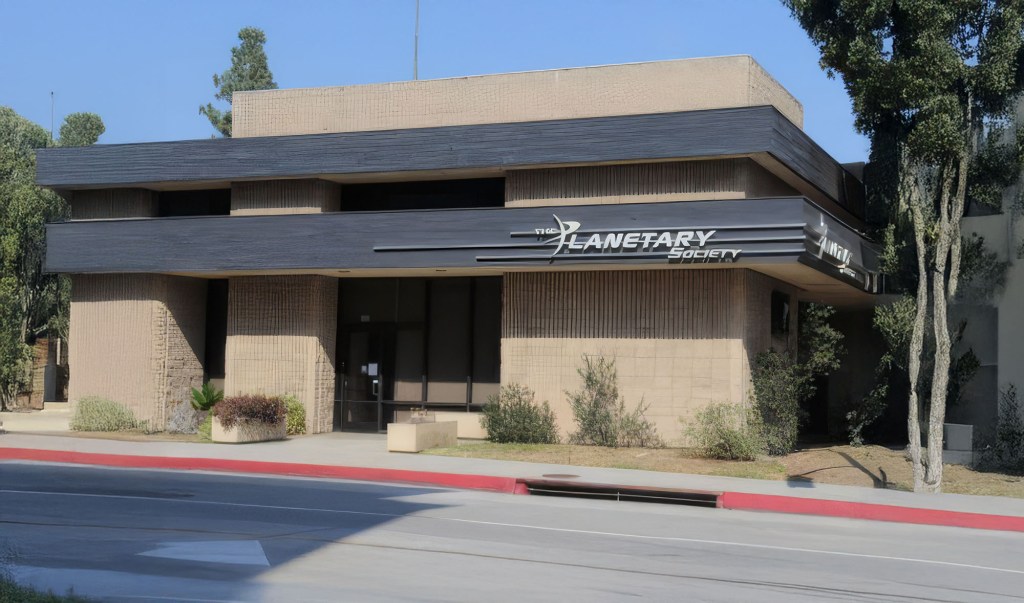
Planetary Society Headquarters in Pasadena (Erik Olsen)
The scientific pedigree of Pasadena can be traced back to notable historical figures, among them the great Richard Feynman, a theoretical physicist known for his work in quantum mechanics and his Nobel Prize-winning contributions to quantum electrodynamics. Feynman was a long-time faculty member at the California Institute of Technology (Caltech) and left an indelible mark on both physics and science education.
In engineering, there is Theodore von Kármán, a Hungarian-American mathematician, aerospace engineer, and physicist, who is remembered for his pioneering work in aerodynamics and astronautics. He was responsible for crucial advances in aerodynamics characterizing supersonic and hypersonic airflow. He is best known for the von Kármán vortex street, a pattern of vortices caused by the unsteady separation of flow of a fluid around a cylinder, which has applications in meteorology, oceanography, and engineering. Von Kármán was also a key figure in the establishment of the Jet Propulsion Laboratory (JPL), which is managed by Caltech (see below).
Cal Tech (Erik Olsen)
In the mid-20th century, Albert Einstein spent several winters at CalTech, further solidifying the city’s reputation as a center of scientific thought. During his stays from 1931 to 1933, Einstein delivered lectures and collaborated with some of the brightest minds in physics, which had a lasting impact on the scientific community in Pasadena and beyond.
Albert Einstein in Pasadena (CalTech Archives)
CalTech itself is a cornerstone of Pasadena’s scientific community. As one of the premier science and engineering institutes globally, it has been at the forefront of numerous breakthroughs in various fields including physics, biology, and engineering. The university is not only a powerhouse of innovation but also a nurturing ground for future scientists, evidenced by its association with 39 Nobel laureates.
Similarly, the Jet Propulsion Laboratory (JPL), which is technically located in La Canada Flintridge (geographically), but has a Pasadena mailing address, is a unique collaboration between NASA and CalTech. JPL is the leading US center for the robotic exploration of the solar system. Its engineers and scientists have been behind some of the most successful interplanetary missions, including the Mars Rover landings, the Juno spacecraft currently exploring Jupiter, and the Voyager probes that have ventured beyond our solar system.
NASA’s Jet Propulsion Laboratory (Erik Olsen)
Further enriching Pasadena’s scientific landscape is the Carnegie Observatories, part of the Carnegie Institution for Science. This establishment has been a pivotal site for astronomical discoveries since the early 20th century. Today, it continues to push the boundaries of astronomical science by managing some of the most advanced telescopes in the world and conducting cutting-edge research in cosmology and astrophysics.
Jupiter as captured by NASA JPL’s Juno spacecraft (NASA/JPL-Caltech/SwRI/MSSS/David Marriott)
Though in the mountains above Pasadena, the Mt. Wilson Observatory, founded by George Ellery Hale, was home to some of the world’s most powerful telescopes in the early 20th century, including the 60-inch and 100-inch Hooker telescopes. (See our feature). These instruments were integral to groundbreaking discoveries, such as Edwin Hubble’s revelation of the expanding universe, which was supported by data from Mt. Wilson’s telescopes.
The Planetary Society, also headquartered in Pasadena, adds to the city’s scientific aura. Co-founded by Carl Sagan, Bruce Murray, and Louis Friedman in 1980, this nonprofit organization advocates for space science and exploration. It engages the public and global community in space missions and the search for extraterrestrial life, demonstrating the city’s commitment to fostering a broader public understanding of science.
Mt. Wilson Observatory (Erik Olsen)
Pasadena’s prowess in scientific innovation is further amplified by the presence of numerous high-tech companies and startups that reside in the city. These range from aerospace giants to biotech firms, many of which collaborate closely with local institutions like CalTech and JPL. Moreover, incubators such as IdeaLab and Honeybee Robotics (there are numerous robotics companies…which I think we will do a stand alone story about in the future) have been instrumental in fostering a culture of innovation and entrepreneurship in the city. Founded in 1996 by Bill Gross, IdeaLab has helped launch companies that have had significant impacts on technology and science, from energy solutions to internet technologies.
Pasadena’s status as a city of science is not just rooted in its institutions but also in its history and the ongoing contributions of its residents and thinkers. The city continues to be a fertile ground for scientific discovery and technological innovation, reflecting a deep-seated culture that celebrates curiosity and the pursuit of knowledge. This environment not only attracts some of the brightest minds from around the globe but also supports them in pushing the boundaries of what is possible, making Pasadena a true city of science.