Davidson Seamount and the Unseen Mountains and Hidden Treasures Off California’s Coast
Perhaps the most astonishing discovery at Davidson Seamount occurred in 2018, when scientists discovered the “Octopus Garden,” the largest known aggregation of octopuses in the world. The garden is about two miles deep and was discovered by researchers on the research vessel (RV) Nautilus.
Updated
If you’ve ever looked out at the vastness of the ocean, you might think it’s a uniformly barren and flat landscape below the tranquil or tempestuous waves. But you’d be mistaken. Imagine for a moment a hidden world of underwater mountains, volcanoes that never broke the water’s surface, all lying in the mysterious depths of the ocean. They’re called seamounts, and there are a lot of them off California.
Interestingly, a lot of these seamounts off California are actually relatively new to science. According to Robert Kunzig and his book Mapping the Deep: “In 1984, a sidescan survey off southern California revealed a hundred uncharted seamounts, or undersea volcanoes, in a region that had been thought to be flat.”
Seamounts form where magma rises up through the seafloor, at spreading ridges where plates pull apart and at hotspots. The lava cools as it hits the cold seawater and slowly piles up into an undersea mountain. Most of California’s seamounts are conical in shape, though erosion and other geological forces can turn them into more complex formations over time.

Each seamount is a world unto itself, with distinct mineral compositions, shapes, and ecosystems. The Davidson Seamount is the most well-known of these volcanoes and was the first underwater peak to be named a seamount. The seamount is named for George Davidson, an English-born scientist who mapped much of the West Coast for the U.S. Coast Survey. Located about 80 km (50 miles) off the coast of Big Sur, it’s shaped like an elongated arrowhead made up of several parallel ridges of sheer volcanic cones. Most of these erupted about 10-15 million years ago, and are made up 320 cubic km of hawaiite, mugearite, and alkalic basalt. It erupted on top of an old, abandoned spreading ridge.
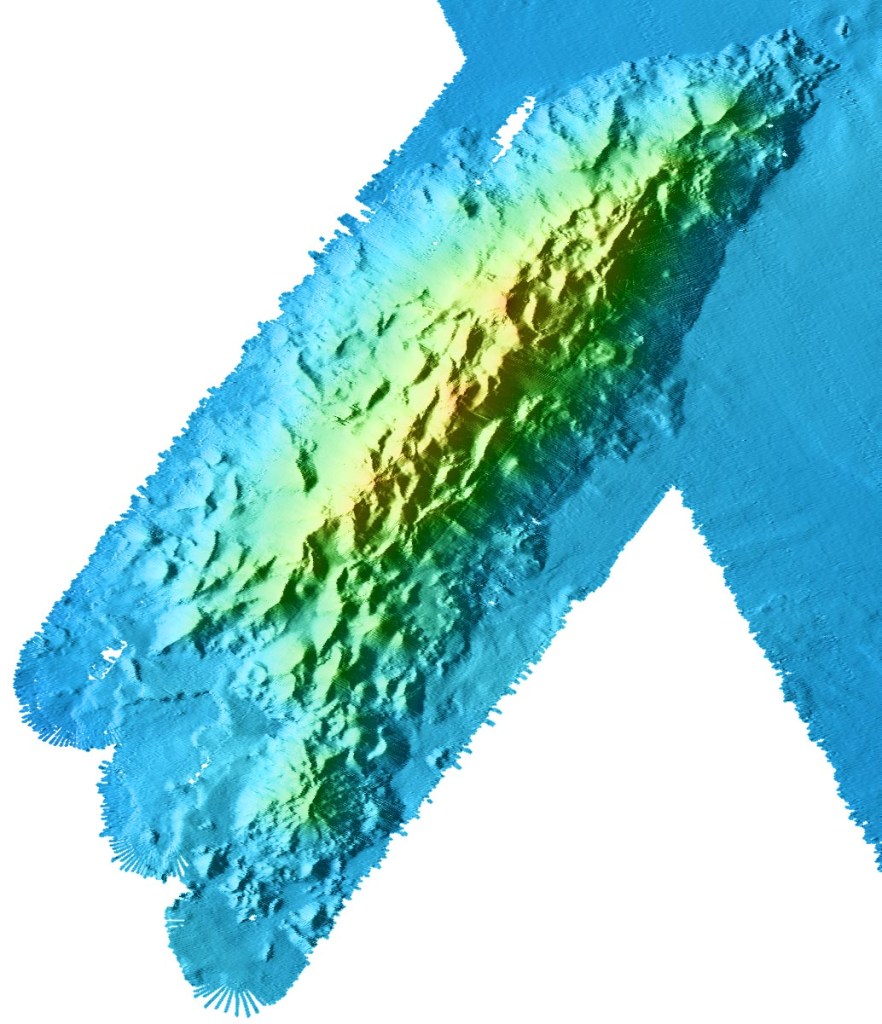 Davidson Seamount, Wikipedia
The sheer number of seamounts only began to emerge when new detection methods were developed, including the ability to spot them from space. These underwater mountains are so massive that they create a gravitational pull, drawing seawater slightly toward their center of mass, much like the moon’s pull generates tides. Since seawater is incompressible, it doesn’t compress around the seamounts but instead forms slight bulges on the ocean surface. Satellites can detect these bulges, helping locate the hidden, basaltic peaks below. Satellite studies suggest that the largest seamounts—those over 5,000 feet—may number anywhere from thirty thousand to over one hundred thousand worldwide, with high concentrations in the central Pacific, Indian, and Atlantic Oceans, around Antarctica, and in the Mediterranean. Each of these seamounts is an underwater volcano, typically lining mid-ocean ridges, subduction zones, or one of the forty to fifty oceanic hot spots where the earth’s crust is thin and magma rises from the mantle.
Davidson Seamount is by far the best-studied of the many seamounts off the California coast. It’s 26 miles long and 8 miles wide, one of the largest seamounts in U.S. waters. It rises 7,480 feet from its base, and its summit is still 4,101 feet below the surface. Studies have indicated that some seamounts contain deposits of rare earth elements, which could have potential economic importance in the future.
 A rorqual whale fall found near Davidson Seamount at a depth of 3,200 meters. **Photo Credit: **Chad King / OET, NOAA
Seamounts are biodiversity hotspots. Davidson Seamount is covered in deep-sea corals. Often referred to as “An Oasis in the Deep,” it has huge coral forests and sponge fields, plus crabs, deep-sea fishes, shrimp, basket stars, and a host of rare and still-unidentified bottom-dwelling creatures also call this place home.
 Map of seamounts along the California coast. (Marine Conservation Institute)
Perhaps the most astonishing discovery at Davidson Seamount occurred in 2018, when scientists discovered the “Octopus Garden,” the largest known aggregation of octopuses in the world. The garden is about two miles deep and was discovered by researchers on the research vessel (RV) Nautilus. The team of scientists initially spotted a pair of octopuses through a camera on a remotely operated vehicle (ROV). Amanda Kahn, an ecologist at Moss Landing Marine Laboratories and San Jose State University, who was on the Nautilus during the discovery, told Scientific American that after observing the pair for a bit, the operators started to drift away from the rocks to move on, but immediately saw something unusual. “Up ahead of us were streams of 20 or more octopuses nestled in crevices,” Kahn says.
https://www.youtube.com/watch?v=RHR70lVy79Y
Typically lone wanderers of the ocean, octopuses aren’t known for their social gatherings. So, when researchers stumbled upon more than just one or two of these creatures, they knew something out of the ordinary was afoot. The team changed plans and went in for a closer look. What they found was a community of these grapefruit-sized, opalescent octopuses, along with something even more mysterious—unusual shimmers in the surrounding water, hinting at the existence of some kind of underwater fluid seeps or springs. It turns out the octopuses migrate to deep-sea hydrothermal springs to breed. The females brood their eggs in the garden, where it is warmer than surrounding waters.
“This Octopus Garden is by far the largest aggregate of octopuses known anywhere in the world, deep-sea or not,” James Barry, a benthic ecologist at the Monterey Bay Aquarium Research Institute told Scientific American. Barry is the leader of the new study, published on in August in Science Advances, that reveals why the animals are gathering. The researchers have observed over 5,700 Pearl octopuses (Muusoctopus robustus) breeding near Davidson Seamount, 3,200 meters below the ocean’s surface. In this deep-sea nursery, octopus mothers keep their eggs warm in 5°C waters flowing from a hydrothermal spring. The water is more than 3°C warmer than the surrounding ocean. This added warmth accelerates the embryos’ development, allowing them to fully mature in just under two years on average.
The Octopuses Garden was studied over the course of 14 dives with MBARI’s remotely operated vehicle (ROV) Doc Ricketts. It is within the Monterey Bay National Marine Sanctuary, so it is federally protected against exploitation and extraction, although many scientists are concerned that global warming could end up having a deleterious impact on the biological life found around seamounts.

Scientists have since found other deep-sea octopus nurseries, including two off Costa Rica.
Discoveries like this depend on robots. Remotely operated vehicles with high-definition cameras let scientists, and the rest of us, see what lives in this cold, dark world.
 Depth color-coded map of Monterey Canyon. (Monterey Bay Aquarium Research Institute)
It helps that Davidson Seamount is close to Monterey Bay, one of the world’s great centers of ocean research. One of the world’s preeminent ocean research organizations, the Monterey Bay Aquarium Research Institute (MBARI), is located in Moss Landing, California, right at the spot where the magnificent Monterey Canyon runs out to sea for nearly 100 miles.

Beyond being hubs of biodiversity, seamounts also serve as waypoints for migratory species. Just like rest stops along a highway, these underwater mountains provide food and shelter for creatures like whales and tuna on their long journeys. Understanding seamounts could give us insights into climate change. They play a role in ocean circulation patterns, which, in turn, affect global weather systems. They are also excellent “archives” of long-term climate data, which could help us understand past climate variations and predict future trends.
Advances in underwater technology, like ROVs, autonomous submersibles and better remote sensing methods, are making it easier to study these mysterious mountains. But many questions still remain unanswered. For instance, how exactly do seamount ecosystems interact with surrounding marine environments? What are the long-term impacts of human activities, like deep-sea mining or overfishing, on these fragile habitats? And what untapped resources, both biological and mineral, lie waiting in these submerged summits?
 A time-lapse camera designed by MBARI engineers allowed researchers to observe activity at the
Octopus Garden between research expeditions. (Photo: MBARI)
So the next time you’re driving down Highway 1 through Big Sur, look out past the horizon. Somewhere out there, two miles down, thousands of octopus mothers are guarding their eggs on the side of an old volcano.
More information:
Video about California seamounts
Recent discovery of the Octopuses garden (MBARI).
.
More California science, photography and wild places on Instagram @californiacuratedus