Maybe You’ve heard of Josiah Whitney, Mt. Whitney’s Namesake

Mount Whitney, the highest mountain in the contiguous United States, is one of the great peaks in California. A wildly popular destination for hikers, climbers, and backpackers, Whitney is located in Inyo National Forest and Sequoia National Park, California.

But how did Mt. Whitney get its name?

“The culminating peak of the Sierra” was identified in 1864 by a team from the California Geological Survey and named Mount Whitney in honor of the team’s leader, State Geologist Josiah Whitney. During that same expedition, survey member Clarence King made two attempts to reach the summit but did not succeed.

But Whitney wasn’t the mountain’s only name. When a group of fishermen made the first recorded ascent in 1873, they called it “Fisherman’s Peak,” a name that stuck locally for some time before Mount Whitney became the official designation. Long before that, the Indigenous Paiute people called the mountain Too-man-i-goo-yah, meaning “the very old man” or “the guardian spirit,” reflecting its towering presence and cultural significance.

Josiah Dwight Whitney was an American geologist and surveyor who made significant contributions to the field of geology in California. Born in Northampton, Massachusetts, in 1819, Whitney became interested in science at an early age and studied geology and mineralogy at Yale University. In 1860, he was appointed the State Geologist of California and founded the California Geological Survey, one of the oldest geological surveys in the nation.

Because gold fever still gripped much of the world at that time, most people assumed Whitney’s work would focus on locating valuable mineral resources, but Whitney instead pursued a broader scientific agenda—paleontology, historical geology, petrology, stratigraphy, and tectonics. He delivered meticulous studies of mineralogy and placed California’s geology within a global framework, prioritizing knowledge over immediate economic gain. The state, unimpressed by his academic approach, eventually cut his funding.

Whitney’s work in California was groundbreaking and helped establish the state as a hub of geological research. He conducted extensive surveys of the state’s natural resources, including minerals, soils, and water sources. He was also instrumental in mapping the state’s topography and geology, including the Sierra Nevada mountain range, where he made several important discoveries.

One of Whitney’s most significant contributions to California’s geology was the discovery of the existence of glacial action in the Sierra Nevada mountains. In 1864, he published a report describing the glacial formations he had observed in the mountains, including the formation of Yosemite Valley, which he attributed to the action of glaciers. This report was groundbreaking at the time and helped establish the study of glacial geology as a major area of research.

In addition to his work as a geologist, Whitney was also a skilled surveyor and cartographer. He was responsible for creating some of the first accurate maps of California, which were used by explorers, settlers, and scientists alike. His maps were highly detailed and included information about the state’s geology, topography, and natural resources.

Photo of the author at the top of Mount Whitney (Heidi Schumann for the New York Times)

In 1875, Whitney was elected to the National Academy of Sciences, and in 1880, he was awarded the Wollaston Medal by the Geological Society of London. Perhaps the most enduring recognition of his work is the fact that the highest peak in the contiguous United States is named after him. Mount Whitney, which stands at 14,505 feet, was named in his honor in 1896.

Whitney’s legacy lives on through the California Geological Survey, which he founded and served as its first director. The survey played an important role in the development of California, providing valuable information about the state’s natural resources and geology. It continues to operate today, providing information and expertise to policymakers, scientists, and the public.

Serpentine is the Geological Gem of California

Serpentine (Wikipedia)

Ask anyone what the California state rock is, and I doubt whether many people would answer correctly. Is it granite, the magnificent slabby stone that creates the sheer face of Half Dome and El Capitan in Yosemite? Is it obsidian, the glinty black stone so favored by some Native American tribes that they would walk hundreds of miles to collect it and bring home to make tools and weapons?

No, the state rock of California is neither of these. The state rock of California is serpentine.

Serpentine is more than just a pretty rock—it tells a fascinating geological story. Found in many parts of California, particularly in the Coast Ranges and the Sierra Nevada foothills, serpentine is a direct link to the deep, dynamic forces that shape the planet. Because it originates from the mantle, serpentine represents a rare glimpse into Earth’s interior, a reminder that what lies beneath us is always in motion. Beyond its aesthetic appeal, serpentine plays an important role in the environment. The soils that develop from serpentine rock are famously inhospitable to many plants due to their high levels of magnesium and low levels of essential nutrients like calcium. Yet, these tough conditions have led to the evolution of specialized plants—some of which are found nowhere else on Earth. California’s serpentine landscapes, with their sparse but highly adapted plant life, are home to unique ecological communities that have fascinated scientists for decades.

serpentine
A piece of polished serpentine reveals its beauty. (gemstones.com)

Serpentine is formed through the metamorphic process, where pre-existing rocks are transformed into new types under high temperatures, pressures, and chemical processes. Serpentine is primarily composed of hydrous magnesium silicate minerals, such as antigorite, chrysotile, and lizardite (yes, lizardite). Its distinct, vibrant green color and serpent-like appearance make it easily recognizable and intriguing to rock enthusiasts and casual observers alike. It is also widely collected and used as jewelry.

Serpentine is predominantly found in the coastal ranges of California, particularly in the Klamath Mountains and the Sierra Nevada foothills. It is also present in smaller quantities throughout the state. The prevalence of Serpentine in California is a result of the state’s complex geological history, which includes the subduction of oceanic plates beneath the continental North American Plate. This tectonic activity created ideal conditions for the formation of Serpentine. The recognition and study of serpentine in California contributed to the understanding of modern plate tectonic theory.

Serpentine (Wikipedia)

While not considered a precious gemstone, Serpentine holds significant value due to its unique aesthetic and limited distribution. It is often used as an ornamental stone for jewelry, sculptures, and architectural elements. In addition, Serpentine is historically known for its use in carving, particularly by Native American tribes in California. Serpentine’s low hardness and smooth texture make it ideal for intricate carvings and designs. In recent years, Serpentine has gained popularity among collectors and as a decorative addition to gardens and landscaping.

Serpentine was designated as California’s state rock in 1965, thanks to the efforts of state Assemblyman John Knox. This choice was influenced by the rock’s unique beauty, the significant role it played in California’s geological history, and its importance in the state’s mining industry during the late 19th and early 20th centuries. Asbestos, a fibrous mineral found in some forms of Serpentine, was once highly sought after for its heat-resistant properties. However, due to its association with health risks (asbestos is a known carcinogen that has long been associated with lung cancer), the use of asbestos has significantly declined, and current appreciation of Serpentine is largely focused on its aesthetic qualities.

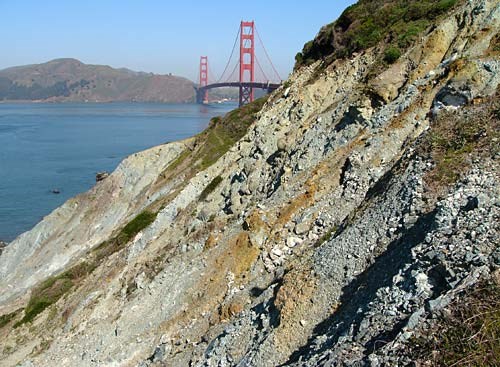
Serpentinite outcrop on the coastal bluffs of the Presidio (National Park Service)

However, the state almost dropped serpentine from its state rock designation due to the high relative quantity of asbestos that serpentine contains. Asbestos occurs naturally in many minerals and in many places. And in fact some serpentine rocks do host chrysotile, a form of asbestos. But geologists say chrysotile is less harmful than some other forms of asbestos and would be a danger — like scores of other rocks — only if a person were to breathe its dust repeatedly.

Fascinatingly, serpentine landscapes host a rare and diverse range of plant species adapted to its high magnesium and low calcium environment, often thriving in soils toxic to other vegetation. This peculiar combination of geology and ecology makes California’s serpentine areas not just a subject of geological interest, but also a haven for biological research, offering insights into how life adapts to extreme conditions.

One well-studied group of organisms are plants that display serpentine endemism, meaning they are specially adapted to survive in these harsh soils. A key adaptation in plants involves tolerating high levels of toxic metals and nutrient deficiencies, which can drive speciation and lead to unique ecological communities. Studies on species like Arabidopsis arenosa have shown that genetic variation plays a crucial role in these adaptations, with gene flow and mutations contributing to their survival strategies in serpentine soils​.

Serpentine rock (Wikipedia)

Native Americans in California found a variety of practical and cultural uses for serpentine, a mineral abundant in the state and prized for its unique properties. It was particularly valued for its distinctive greenish color, soft texture, and ability to be easily shaped and polished. These qualities made it a favored material for crafting tools, ornaments, and ceremonial objects. Tribes used serpentine to create beads, pendants, and pipes, all of which could be intricately carved and polished to a smooth finish.

In addition to its practical uses, serpentine held significant spiritual and healing value for some Native American groups. The rock’s cool, smooth surface and striking color were believed to possess special properties, and it was often used in rituals or as a symbol of protection and healing. The association with spiritual energy likely contributed to its use in ceremonies or as amulets meant to bring good fortune or ward off harm.

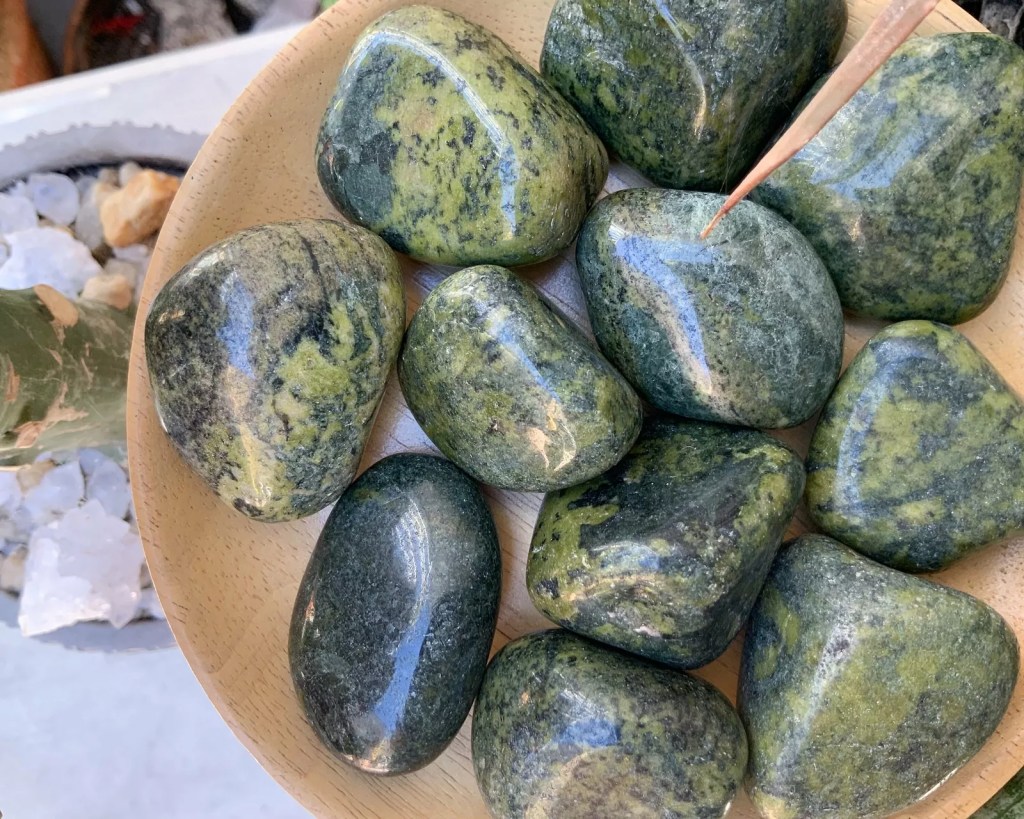
Serpentine stones available for purchase on Ebay (Ebay)

Serpentine also played a role in trade among tribes. Crafted serpentine objects, such as polished ornaments and ceremonial items, were valuable trade goods. These items could be exchanged for other resources, reflecting the mineral’s cultural and economic importance. The widespread availability of serpentine in California’s unique geological landscape made it an accessible yet valuable material for Native American communities, shaping both their daily lives and spiritual practices.

Serpentine is not just a beautiful rock; it is a symbol of California’s rich geological and cultural heritage. By understanding the origins and significance of Serpentine, we can appreciate the complex processes that have shaped our planet and the remarkable diversity of its natural resources. Furthermore, the presence of Serpentine in California is an excellent example of the interconnectedness of geology, ecology, and human history, as the unique habitats it creates support rare plant species and have inspired the artistic endeavors of numerous cultures throughout time.

The return of Lake Tulare – once the largest lake West of the Mississippi

The massive atmospheric snowstorms that pummeled California this year have been a boon to ski slopes throughout the Sierra Nevada mountains. But the rains have had an unusual result: The torrents of rain have drowned thousands of acres of farmland in California’s Central Valley and resuscitated a lake that vanished decades ago. Standing in an area that was dry as a bone just a year ago, right now, as far as the eye can see, water stretches to the horizon. It has covered roads, and crop fields, and submerged homes and buildings.

The lake is called Lake Tulare.

Lake Tulare, once the largest freshwater lake west of the Mississippi River, is a compelling example of the delicate balance between human activity and natural forces. Located east of Interstate 5 from Kettleman City, Lake Tulare was also the second-largest freshwater lake in the United States, based on surface area. At its peak, Lake Tulare covered an area of nearly 700 square miles and was a critical component of the region’s complex hydrological system.

The lake’s disappearance over a century ago can be traced back to multiple factors, including agricultural development, water diversion, and climate. Fed by the Kaweah, Tule, and Kern Rivers, the lake supported a vibrant ecosystem teeming with fish, waterfowl, and other wildlife. Native American tribes, including the Yokuts, relied on the lake’s abundant resources for sustenance and trade.

Lake Tulare began to shrink in the late 19th century as European settlers moved into the area and agriculture took hold. The burgeoning need for water to support the growing agricultural industry led to the construction of canals and dams, which diverted water away from the lake. As a result, the lake’s surface area shrank rapidly, and by the early 20th century, it had disappeared almost entirely.

Spanish captain Pedro Fages led the first excursions to the southern San Joaquin Valley in 1773 and wrote this account:

This plain will exceed one hundred and twenty leagues in length and in parts is twenty, fifteen and even less in width. It is all a labyrinth of lakes and tulares, and the river San Francisco, divided into several branches, winding in the middle of the plain, now enters and now flows out of the lakes, until very near to the place where it enters into the estuary of the river.

Pedro Fages
Fulvous whistling-duck

Today alfalfa is grown on the southern basin and there is invasive saltcedar, a common species that has also impacted regions of the Colorado River Delta. Animal life includes the Buena Vista Lake shrew (Sorex ornatus relictus), the southwestern pond turtle (Actinemys pallida), fulvous whistling-duck (Dendrocygna bicolor), and the California red-legged frog (Rana aurora draytonii). Other species native or present in the area are sandhill cranes and tricolored blackbird.

But what is the future of Lake Tulare?

Last summer, UCLA climate scientist Dan Swain published a paper that predicted more intense weather patterns on a gradually warming planet. He told CNN that the worst-case scenario of relentless atmospheric rivers could actually make Tulare Lake permanent again, turning it into a vast, inland sea.

We’ll have to wait and see.

And in the meantime, check ut this recent before and after satellite image of the central valley and Lake Tulare.

The Los Angeles Aqueduct Cascades is a Monument to Human Ingenuity and the Lifeblood of a Megacity

Los Angeles is home to nearly four million people, but this bustling metropolis would not have been possible without a vital resource: water. While the city’s origins can be traced back to the humble Los Angeles River, it was the Los Angeles Aqueduct that allowed the city to grow exponentially. This article will delve into the history of the Los Angeles Aqueduct, the monumental cascades that make it an engineering marvel, and the key people involved in its conception and construction.

William Mulholland and Fred Eaton scout the Owens River as a potential source of water for Los Angeles

In the early 20th century, the population of Los Angeles was growing rapidly, and city leaders recognized that the existing water supply from the Los Angeles River would not be sufficient to support the city’s future growth. Thus, in 1905, the city embarked on a quest to secure a new water source to sustain its increasing population.

Engineer and visionary William Mulholland was tasked with finding a solution to the city’s water woes. He discovered the Owens River, located more than 200 miles away, which had an abundant supply of fresh water. In 1906, Los Angeles voters approved the bonds necessary to construct a massive aqueduct system that would transport water from the Owens River to the thirsty city.

Construction of the Los Angeles Aqueduct began in 1908 and was completed in November 5, 1913, a remarkable achievement for its time. The aqueduct spans 233 miles, making it one of the largest engineering projects in the United States. It was an impressive display of human ingenuity and perseverance, as it required the construction of 142 tunnels, numerous reservoirs, and the iconic cascades.

CALIFORNIA CURATED ON ETSY

Purchase stunning art prints of iconic California scenes.
Check out our Etsy store.

The Cascades rely on gravity to create a stunning visual display while serving a functional purpose. As the water flows over the series of terraced steps, its velocity increases, allowing it to mix with air and become oxygenated. This natural aeration process helps to maintain water quality and reduce the presence of unwanted gases, such as hydrogen sulfide, which can cause a foul odor.

The cascading waterfall serves as the point where water from the aqueduct is released into the L.A. basin, traveling the final stretch through a series of tunnels and pipelines to reach its ultimate destination: the taps of millions of Los Angeles residents.

William Mulholland opens the Cascades on November 5, 1913.

The Los Angeles Aqueduct was the brainchild of William Mulholland, a self-taught engineer who served as the head of the Los Angeles Department of Water and Power. He was responsible for overseeing the project and ensuring its timely completion.

Fred Eaton, the sixth Anglo child to be born in Los Angeles, was the first “Native Son” Engineer in Los Angeles. As the former mayor of Los Angeles, Eaton played a crucial role in securing the rights to the water in the Owens Valley, which was essential to the aqueduct’s construction. He collaborated with Mulholland in the early stages of planning and development.

Thousands of workers were involved in the construction of the Los Angeles Aqueduct, including laborers, engineers, and surveyors. They toiled under challenging conditions, facing harsh weather, and rough terrain.

The Los Angeles Aqueduct Cascades are an essential part of the aqueduct system. They serve both a practical and symbolic purpose.

The practical function of the cascades is to release the water from the aqueduct at a controlled rate, allowing it to flow into the city’s water distribution system. The cascades rely on gravity to transport water through the system, helping to minimize the need for pumping stations and thereby reducing energy consumption.

Wide shot of the Cascades from Interstate 5 in Southern California

The cascades also serve a symbolic purpose, representing the triumphant arrival of water in Los Angeles. They are a monument to the human spirit and the ingenuity required to bring life-sustaining water to a burgeoning city. The aqueduct allowed Los Angeles to become the thriving metropolis it is today, providing a reliable water supply to millions of residents. The cascades have become a popular tourist destination, allowing visitors to witness firsthand the impressive engineering feat that made the growth of Los Angeles possible.

California’s Common, but Lovely, Birds: the House Finch

House Finch

California is home to an impressive number of bird species, with over 700 recorded throughout the state. From the rocky shores of the Pacific coast to the towering peaks of the Sierra Nevada, California’s diverse landscapes provide habitats for a wide range of birdlife. Many of these species are endemic to California, meaning they are found nowhere else in the world. The state’s unique geography and climate, as well as its location on the Pacific Flyway migration route, make it a haven for birdwatchers and ornithologists alike.

One of the most common birds in California, probably familiar to anyone whether a backyard enthusiast or committed ornithologist is the house finch. The house finch (Haemorhous mexicanus) is a small passerine (perching) bird that is native to western North America, including California. This bird is widely known for its vibrant red plumage and melodic song, making it a beloved sight and sound in backyards across the state.

House finches are a member of the finch family, Fringillidae, which includes all true finches. They are thought to have originated from the deserts of Mexico and the southwestern United States. Their range has since expanded to cover much of North America.

Finches are famously associated with Charles Darwin and his theory of evolution by natural selection. During his voyage on the HMS Beagle, Darwin observed finches on the Galápagos Islands, noting the significant variations in their beak shapes and sizes. These differences were adaptations to the specific diets available on their respective islands. Darwin’s study of these finches helped him develop the concept that species evolve over time through natural selection, where advantageous traits become more common in a population. This observation provided crucial evidence for his groundbreaking work, “On the Origin of Species.”

House finches are small birds, measuring about 5-6 inches in length and weighing between 0.6-1.0 ounces. They have a stout, conical beak that is adapted for cracking open seeds, their primary source of food. The male house finch is easily recognizable by its bright red head and breast, while the female has a duller brownish-gray coloration. However, in some areas, there are color variations in the males, such as yellow, orange, or even a rose-pink color.

House finches primarily feed on seeds, including those from sunflowers, dandelions, thistles, and various grasses. They are also known to eat some fruits and insects, particularly during the breeding season when protein is essential for the growth of their young. House finches have a unique feeding habit in that they use their tongue to extract seeds from the seed capsules, which they then crush with their beaks.

House finches are monogamous and form pair bonds during the breeding season, which typically starts in late winter and lasts through early summer. The male house finch will sing and perform courtship displays to attract a mate, often presenting the female with a gift of food. Once the pair has formed, they will work together to build a small nest using grass, twigs, and other plant materials.

House finches are a common sight in backyards, parks, and other areas with ample vegetation. They are often seen perched on wires, branches, or feeders, where they will socialize with other birds, including other finches, sparrows, and juncos. House finches are also known for their acrobatic abilities, often clinging to branches and twigs while feeding.

In addition to their acrobatics, house finches are known for their melodic song. Males will sing throughout the day, particularly during the breeding season, to attract mates and establish territories. The song of the house finch is a warbling melody that can be heard from a considerable distance.

House finch (Erik Olsen)

Research has shown that male house finches learn their songs from adult males, typically their fathers, during a critical period in their early life. This learning process is akin to how humans acquire language, involving both genetic predisposition and environmental influences. A study published in the journal “Animal Behaviour” found that house finch songs are composed of a variety of syllables that can be combined in numerous ways, leading to a wide range of unique songs within populations.

Interestingly, these songs play a crucial role in mate attraction and territorial defense. Females tend to prefer males with more complex and diverse songs, which are indicative of the male’s overall health and genetic fitness. Moreover, regional dialects have been observed, with finches in different geographic locations exhibiting distinct song patterns. This geographic variation is believed to result from both cultural transmission and genetic drift, making the house finch’s song an excellent model for studying the evolution of communication and social behavior in birds.

House finch painting

In California, house finches are a common sight and have adapted well to urban and suburban environments. They are often attracted to bird feeders, particularly those filled with sunflower seeds, which they can easily crack open with their beaks.

The house finch’s vibrant plumage, melodic song, and acrobatic abilities make it a joy to observe in the wild or in our own backyards. As with many bird species, it is essential that we continue to protect their habitats and ensure that they have access to adequate food sources to thrive.

Ten Little-Known Facts About California

Giant Sequoia

California is known for its sunny beaches, bustling cities, and iconic landmarks such as the Golden Gate Bridge and Hollywood sign. However, the state is also home to a wealth of scientific discoveries and phenomena that are not as well-known. From ancient fossils to cutting-edge research, California has a lot to offer in the realm of science. In this list, we’ll explore ten of the most fascinating scientific things that you probably didn’t know about California. Get ready to be amazed by the natural wonders and innovative research that make this state such a unique and exciting place for science enthusiasts.

  1. California is home to the tallest tree in the world, a coastal redwood named Hyperion that measures 379.7 feet (115.7 meters) in height. The state is also home to the largest (by volume) tree, named General Sherman in Sequoia National Park. General Sherman is 274.9 feet high and has a diameter at its base of 36 feet, giving it a circumference of 113 feet. General Sherman’s estimated volume is around 52,508 cubic feet (1,487 cubic meters), which would correspond to an estimated weight of around 2.7 million pounds.
  2. The Salton Sea, a large inland lake in southern California, is actually an accidental body of water that was created by a flood in 1905 when Colorado River floodwater breached an irrigation canal being constructed in the Imperial Valley and flowed into the Salton Sink.
  3. The San Andreas Fault, the state’s best-known and most dangerous fault that runs through the middle of California and to the coast, moves about 2 inches (5 centimeters) per year (or, so they say, the speed that a fingernail grows).
  4. The state of California has more national parks than any other state in the US, with nine in total. Among them is one of the crown jewels of the National Park system: Yosemite National Park.
  5. California is one of the only places in the world where you can find naturally occurring asphalt, at the La Brea Tar Pits in Los Angeles. 
  6. The oldest living organism on Earth, a bristlecone pine tree named Methuselah, can be found in the White Mountains of California and is over 4,800 years old.
  7. The Monterey Bay Aquarium in Monterey, California was the first aquarium to successfully keep a great white shark in captivity for more than 16 days. The first great white that the aquarium tried to display died after 11 days in 1984 because it would not eat.
  8. The Joshua Tree, a type of yucca plant (NOT a tree) found in the Mojave Desert, is named after the biblical figure Joshua because of its outstretched branches that resemble a person reaching up to the sky in prayer.
  9. The California grizzly bear, which appears on the state flag, went extinct in the early 1900s due to hunting and habitat loss. The last California grizzly was seen near Yosemite in 1924, going extinct after decades of hunting. Fossils of the California grizzly can be seen at the La Brea tar Pits.  
  10. The California Institute of Technology, also known as Caltech, is one of the world’s leading scientific research institutions and has produced 39 Nobel laureates, more than any other university in the world.

California is a dolphin paradise

A Pacific White-Sided Dolphin swims alongside a boat off Newport Beach, California

For those who are fortunate enough to live near the coast of California, Dolphin sightings are a frequent delight. Dolphins are a diverse group of marine mammals found in all of the world’s oceans, but they are especially abundant in California. The California coast is home to numerous species of dolphins, each with their own unique characteristics and behaviors. An afternoon spent at the beach will very often result in a sighting of these magnificent and majestic animals frolicking in the waves.

For those who may not know, dolphins and porpoises are toothed whales. Both porpoises and dolphins are members of the same scientific order, Cetacea, which includes all whales, including the magnificent blues, grey whales and humpbacks that also ply the California coast. 

The exact number of dolphins off the California coast is impossible to know since many species migrate and no authoritative study of their total numbers has ever been published. But one estimate of the dolphin population in Southern California suggests that well over half a million live between the frigid, rocky coastal waters of Monterey and San Diego. Scientists have documented 11 species of dolphins in California’s waters alone. We take a look at a few of those here.

One of the most common, and beautiful, dolphins found off the coast of California is the Pacific White-Sided Dolphin (Lagenorhyncus obliquidens). These dolphins are easily recognized by their distinctive markings, which include a white underbelly and gray and white stripes along the sides. White-Sided Dolphins can reach up to 400 pounds and can grow to 8 feet in length, with males typically being larger than females. They are also known for their energetic and playful behavior, often bow-riding the waves alongside boats and performing wonderful acrobatics in the air. Boaters and whale watchers can witness pods of these animals following their boat for half an hour or more, often swimming on their sides near the surface and gazing up with attentive eyes.

White-sided dolphins feed on a variety of prey, but mostly consume fish and squid. They are skilled hunters and have been known to work together in groups to corral and capture their meals.

Another species found off the California coast is the Common Dolphin (Delphinus delphis). These dolphins have a distinctive sleek, hydrodynamic shape, with a dark gray or black dorsal region and a light gray or white underbelly. Common Dolphins are also known for their high level of activity, often seen jumping and playing in the water. Common dolphins can travel 100 miles in a single day. 

This species is one of the most well-known and widely distributed marine mammals, and is often associated with playful acrobatics and a high level of intelligence. California is home to several large “super pods” or “megapods” of Common Dolphins that are often seen by boaters or whale-watching tours. As the American Cetacean Society explains, common dolphins typically travel and hunt in large herds of hundreds or even thousands. One resident megapod frequently forages between Ventura and Dana Point.

A Pacific White-Sided Dolphin

Common dolphins have been the subject of numerous studies examining their cognitive abilities. They are known to have complex social relationships and to exhibit behaviors that suggest a high level of problem-solving ability and adaptability. In addition, they are capable of using tools, such as seaweed, to herd fish and protect themselves from predators. They also have excellent memories and are able to recognize individual dolphins and remember past experiences.

The Bottlenose Dolphin (Tursiops truncatus) is another species that can be found off the coast of California. This species is easily recognizable due to its large size and beak-like snout. Bottlenose Dolphins are known for their intelligence and playful nature, and are often (unfortunately) used in marine mammal shows and research programs.

Bottlenose dolphins have a complex mating system that involves a variety of behaviors, including courtship displays, vocalizations, and physical contact. Female Bottlenose dolphins give birth to a single calf every three to five years, and the calves are nursed by their mothers for up to a year. Male Bottlenose dolphins compete for access to females, and the strongest and most dominant males are the most successful at mating.

A lesser-known (and seen) species found in the waters of California is the Risso’s Dolphin (Grampus griseus). These dolphins are identified by their tall, curved, sickle-shaped dorsal fin located mid-way down their back. Often they also have distinctive scars and scratches, which are believed to be caused by “teeth raking” between other dolphins. They also frequently have circular markings, likely from encounters with squid or lampreys. Risso’s Dolphins are generally less active than the other species found in the area, and are often seen alone or in small groups.

Finally, the Dall’s Porpoise (Phocoenoides dalli) is another species that can be found in the waters off the California coast. These dolphins are identified by their short, stocky bodies and small triangular dorsal fins. Dall’s Porpoises are known for their speed and agility, and are often seen riding the bow waves of boats.

Few places on earth match the coast of California for the sheer number and variety of dolphins that swim in the cool, nutrient-rich waters that well up from the state’s deep canyons. So next time you’re near the coast, keep an eye out for these incredible creatures and enjoy the show!