
Serpentine, California’s Slippery, Controversial State Rock
California’s state rock is a chunk of the Earth’s mantle that ended up in the hills. Here’s how serpentine forms, why it nearly lost its title over asbestos and why rare plants love it.
Updated
Quick, what’s California’s state rock? Granite, the stone that makes the sheer faces of Half Dome and El Capitan? Obsidian, the glassy black rock that Native Americans walked hundreds of miles to collect for tools and weapons?
Nope. It’s serpentine. California was the first state to pick an official rock, and it picked a slippery green stone most people have never heard of. It’s a better choice than it sounds.
Serpentine is a piece of the Earth’s mantle, the layer under the crust, that ended up at the surface. You can find it all over the Coast Ranges, the Klamath Mountains and the Sierra Nevada foothills, and it’s usually some shade of green, often mottled like snakeskin, which is where the name comes from. It feels a little waxy or soapy in your hand.
 A piece of polished serpentine reveals its beauty. (gemstones.com)
It forms when rock from the mantle meets water. Deep under the ocean, seawater seeps into mantle rock and reacts with it, turning it into a new set of minerals: antigorite, chrysotile and lizardite. (Yes, lizardite.) Geologists call the rock serpentinite and the minerals serpentine, but most people just say serpentine.
So why is there so much of it in California? Because for millions of years, the edge of California was a subduction zone, where ocean plates slid under North America. Along the way, slices of ocean floor and the mantle below got scraped off and shoved up onto the land, and serpentine came with them. Finding mantle rock sitting in the hills helped geologists piece together the theory of plate tectonics.
 Serpentine (Wikipedia, Tiia Monto, CC BY-SA 3.0)
It’s not a precious gem, but people have always liked it. Serpentine is soft and polishes well, so it’s been used for carvings, jewelry, sculpture and decorative stone, and California’s Native peoples carved it too. These days, plenty of it ends up in gardens and rock collections.
Serpentine became the state rock in 1965, pushed by Assemblyman John Knox. Part of the reason was mining. Serpentine is linked to deposits that California miners went after in the late 1800s and early 1900s, including asbestos, which was prized for being fireproof. That’s also where the trouble starts. Asbestos causes cancer, and these days nobody is mining it.
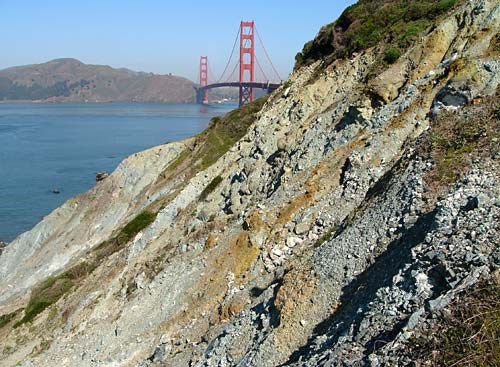 Serpentinite outcrop on the coastal bluffs of the Presidio (National Park Service)
In 2010, California almost dumped serpentine as its state rock because of asbestos. Some serpentine does contain chrysotile, a type of asbestos. But geologists pushed back. They said chrysotile is less dangerous than other kinds of asbestos, and that serpentine is only a hazard, like plenty of other rocks, if you breathe its dust over and over. The rock kept its title.
Serpentine is also great for plants, or at least for some of them. Soil that forms from it is lousy for most plants. It’s loaded with magnesium and heavy metals like nickel, and short on calcium and other nutrients. You can often spot a serpentine outcrop from a distance because the vegetation suddenly gets thin and scrubby.
But the plants that can handle it have the place to themselves. California has a lot of serpentine endemics, plants that grow on serpentine soil and almost nowhere else, which makes these patches a favorite of botanists studying how new species form. Research on plants elsewhere, like the European mustard relative Arabidopsis arenosa, has shown that adapting to serpentine soil takes genetic changes, and that those changes can help split one species into two.
 Serpentine rock (Wikipedia)
California’s Native peoples made good use of serpentine. It’s soft, easy to shape and polishes to a nice shine, so it was carved into beads, pendants and pipes, as well as other ornaments and ceremonial objects. Some groups may have valued it for protection or healing, and carved serpentine objects were traded between tribes.
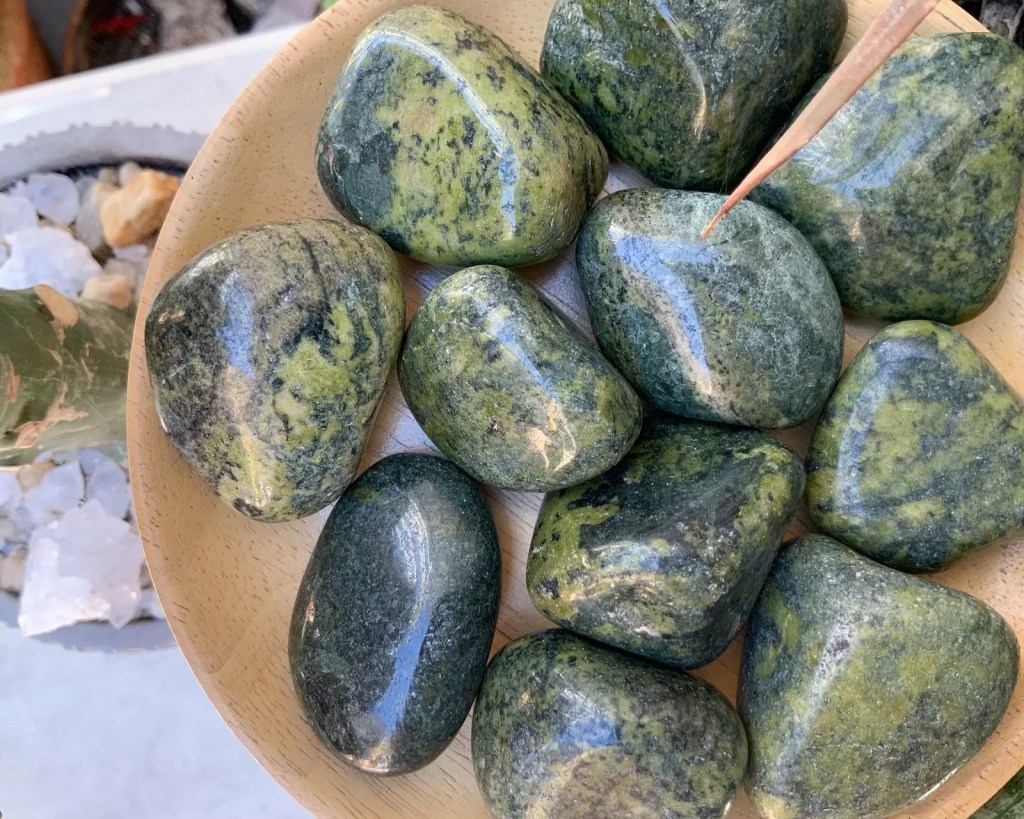 Serpentine stones available for purchase on Ebay (Ebay)
So California’s state rock is soft, green, a little slippery, a little controversial and a piece of the planet’s interior that ended up in the hills. That actually sounds pretty Californian. If you’re curious about how the rest of the state’s mountains came together, check out our story on the San Gabriel Mountains.
More California science, photography and wild places on Instagram @californiacuratedus