If all goes well, in late July, NASA will do something it’s never done before. The agency will launch a new mission to Mars with the aim of landing a small helicopter on the surface that will perform several test missions to see if we can fly on the surface of the Red Planet.
This is not an easy task, but it will be massively historic.
“This is very analogous to the Wright brothers moment, but on another planet,” MiMi Aung, the project manager of the Mars helicopter told the New York Times.
The helicopter will be aboard the Perseverance, the fifth robotic rover NASA has sent to Mars. The copter and the rover were both designed and built at at at NASA’s Jet Propulsion Laboratory in La Canada Flintridge. The project has been in development over the past six years.
Credit: JPL
If successful, the small helicopter will initiate a new era for robotic exploration, with the opportunity to get an aerial view of Mars and possibly other worlds in the solar system.
Flying on Mars is not the same as doing so here on earth. There is little atmosphere on Mars, and so taking off requires more power and larger helicopter blades than here on earth. In fact, the atmosphere on the red planet is just 1/100th as dense as Earth’s. Scientists say that flying on Mars is the same as flying at an altitude of 100,000 feet on Earth. That’s three Mount Everests. No helicopter on earth has ever flown higher than 45,000 feet.
JPL scientists say that the project would have been impossible just 10 years ago, but a revolution in the miniaturization of electronics, high-powered batteries and lightweight materials for rotor blades has made the new mission possible.
It took several iterations and experiments to get the copter to lift off in s straight line inside a specially-designed chamber that simulated the Mars atmosphere.
Over 30 days, the helicopter will make up to five flights. For most of the time, however, the copter will remain still, waiting for solar panels to recharge the batteries.
The first is to go up about a few feet and hover for up to 30 seconds, then land. Subsequent flights will be longer, higher, farther. The plan is to test the copter on several short liftoffs on Mars, reaching perhaps just a few feet above the dusty plain where it will be released from the Perseverance. On the fifth flight, assuming all systems are go, the copter will lift off to 15 feet and fly out about 500 feet and come back. Two cameras will help the copter navigate and the flight will last a minute and a half.
This is an extremely exciting time for JPL’s planetary exploration project. The Juno project has been sending back stunning images of Jupiter, including strange hexagonal cloud formations at the poles of the giant planet.
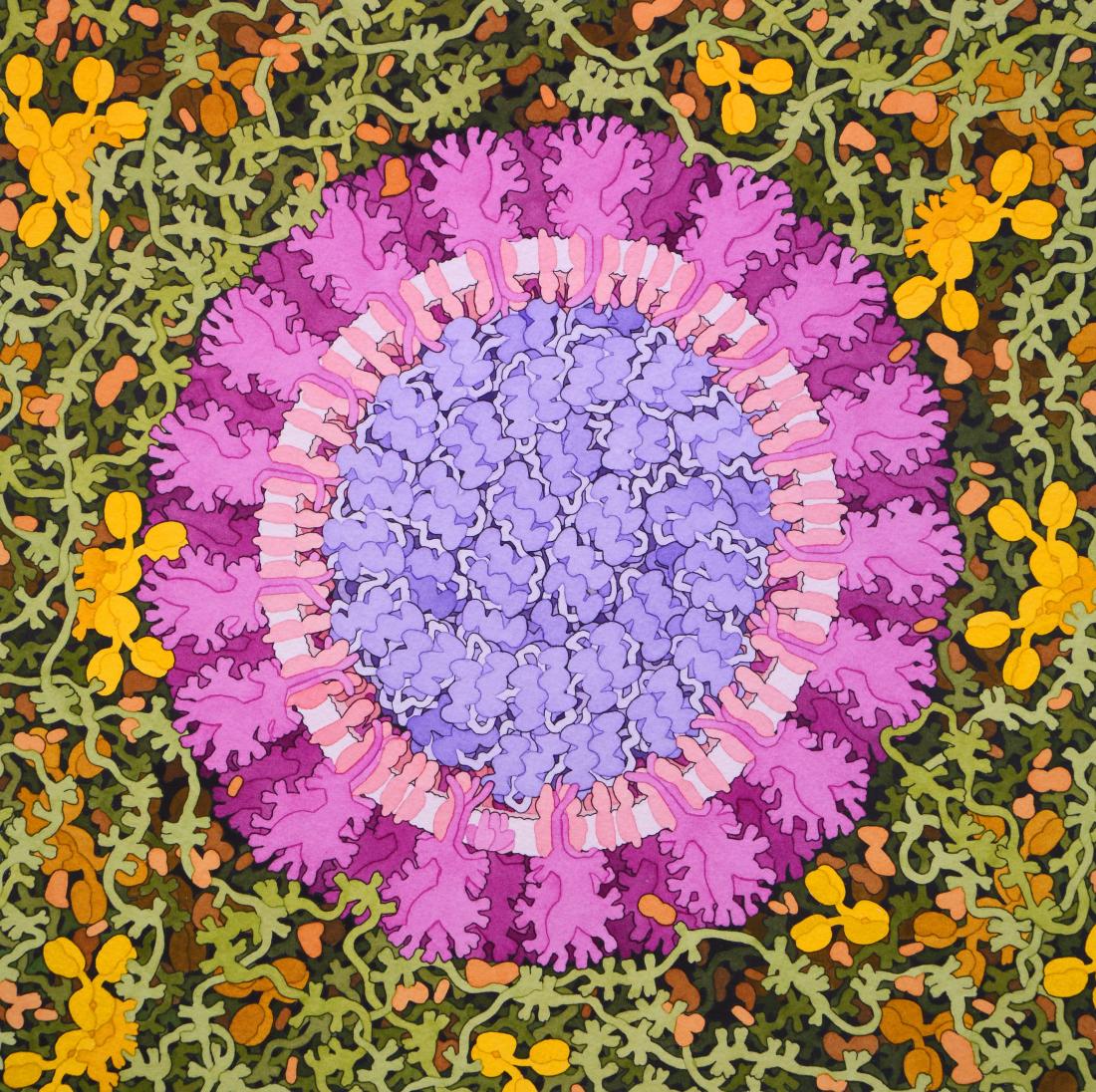
Also, check out one of our recent features on the California scientific illustrator David Goodsell whose watercolor painting of the coronavirus is “beautiful, but deadly”.
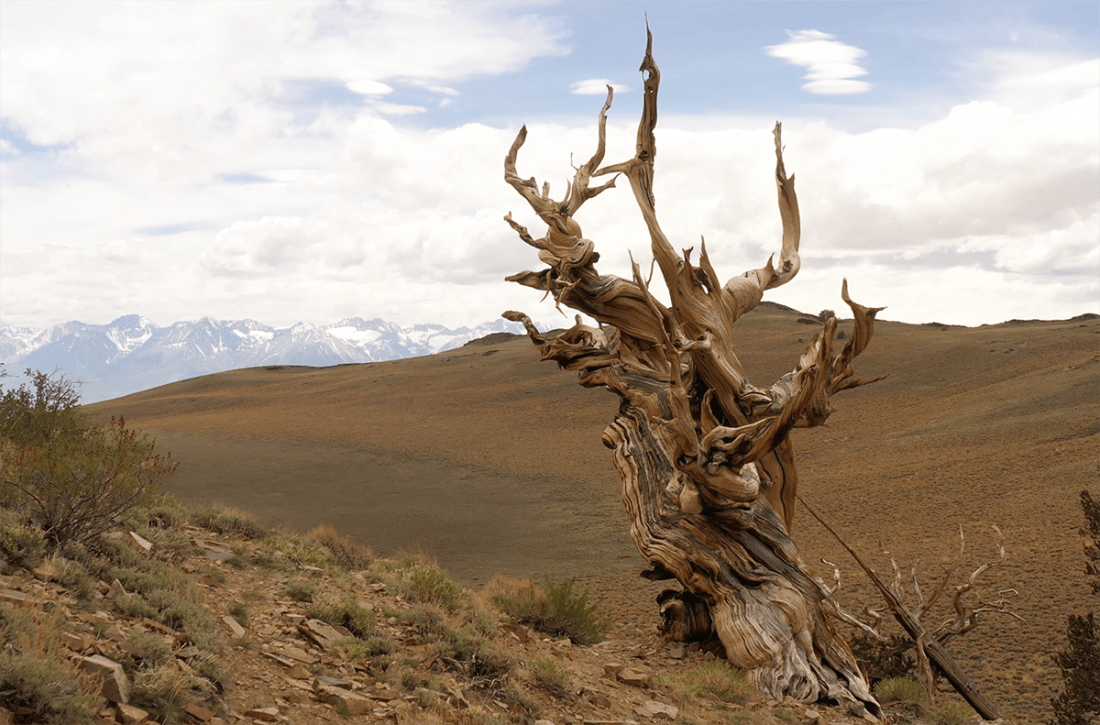
Last week we had the opportunity to head up Highway 395 into Big Pine where we made a left up to the Ancient Bristlecone Pine Forest. Because of the coronavirus, the place was empty. Not a soul to be seen anywhere.
We did a feature on bristlecones a few months ago in which we marveled at the majesty and seeming immortality of these incredible organisms, probably the longest living things on the planet. We brought along a drone to get some shots of these trees, whose gnarled, swirling branches are like something out of a fantasy novel. Take a minute (literally a minute) to enjoy.
You’ve seen it. Probably a thousand or more times by now. It’s the image of a greyish sphere, hanging in space, barbed with blood-red spikes. It looks like an undersea Navy mine… or perhaps a dog’s chew toy. The Covid-19 coronavirus illustration is one of the best known and most viewed scientific illustrations in history. Released in early February by the Centers for Disease Control and Prevention, the image has been seen on news sites, in magazines, even on SNL.
That digital illustration, created by two medical illustrators at the CDC’s Graphic Services Branch — Alissa Eckert and Dan Higgins — will forever be the iconic image of the current pandemic. As a piece of digital art, it is lovely. As a piece of science, it is terrifying.
But another image of the virus was painted in watercolor by the San Diego-based scientist and biological artist David Goodsell, one of the most famous and accomplished scientific illustrators alive today. Goodsell has published several books of his illustrations, and many of his lavishly colored paintings can be found in medical school textbooks. A few have won awards. Some have even hung in museums. Goodsell’s coronavirus image is not nearly as famous, but as a work of art — and a work of science — it is just as mesmerizing. And more lovely.
Goodsell is an Associate Professor in the Department of Integrative Structural and Computational Biology at the Scripps Research Institute in San Diego. Most of the time, he works as a scientific illustrator (or molecular artist), a growing field in science, with numerous university programs available around the country. While the CDC image was created entirely within a computer, Goodsell’s work tends to be done in watercolor, a much older medium, but one that gives his images a vibrant beauty, making terrible pathogens like E-coli, Ebola and HIV, not to mention coronavirus, look like a psychedelic dream or a candy-colored nightmare.
Ebola virus: David Goodsell
Goodsell says that creating images like these serve a very important purpose: allowing people to picture something that otherwise would be unseeable.
“I was trying to put a face on the virus, so it’s not invisible, so we can see what we’re fighting,” Goodsell told California Science Weekly.
Because there are so many other images out there of the virus, it might seem like creating an illustration of it would be simple, but Goodsell says that there’s a tremendous amount of science involved, and that he strives to be as technically accurate as possible, showing only the known proteins in the virus and how they might be organized within the virion, the technical term for a virus particle.
David Goodsell in his home studio.
At the time that the painting was made, says Goodsell, not much was known about the virus. Its genetic structure was still being figured out. But since the virus is so similar to the SARS virome, Goodsell used a lot of the information from existing data on that virus, to create his work of art. Like most molecular artists, Goodsell draws from existing information about the proteins that make up a virus, much of which is freely available in the Protein Data Bank, a global online repository of genetic and structural data on thousands of the proteins which make up all living things.
“I want it to be something that people want to look at. I don’t particularly want it to look scary or monsterish.”
David Goodsell
The Protein Data Bank contains “some really nice structures of the spike protein on the outside of the virus.” Those spike proteins (colored a deep blood-red in the CDC image, but a bubblegum pink in Goodsell’s painting) are the means by which the virus attaches itself to our own cells before injecting them with its RNA, which will rapidly replicate inside and potentially wreak havoc in our bodies.
“If you Google coronavirus, people are using a whole range of different amounts of data, and most of the pictures are total garbage. Somebody has heard there are spikes on the virus, so they put things that look like big nails on the surface,” says Goodsell. “The CDC’s and my picture are much more tied to the data.”
Since creating the image in February, however, more information has come out about the virus’s genetic composition, and Goodsell may revisit his image, although he thinks it remains accurate. Little was known, for example, about the RNA contents of the virus, the genetic information that invades human cells. He also notes that the virus’s shape is not as uniform as depicted in most illustrations, and that any effort to create an image of it requires a significant amount of artistic license. For example, the CDC image, while accurate in terms of various proteins pictured, is likely not the neatly organized spiked ball floating in space that most people have come to know.
“I was trying to put a face on the virus, so it’s not invisible, so we can see what we’re fighting.”
David Goodsell
“It’s not a perfect sphere and it comes in a range of different sizes,” says Goodsell. “All of my reading is that the spikes are arranged randomly on the surface.”
Another quality that is entirely up to the artist is color. None of the molecules in the virus have much color, so molecular artists like Goodsell (and Alissa Eckert and Dan Higgins at the CDC), choose colors that they believe will be both pleasing and informative, helping to differentiate the various structures within the virus particle. “Color is used to help improve the clarity of what the structures are. The CDC has used that bright red to show what they think is the most important part, the spike on the surface,” says Goodsell.
For Goodsell’s part, his palette is far less sinister. He favors delicate pastels and swooping forms over the stark primary colors and jagged spikes of most coronavirus images. “I want it to be something that people want to look at. I don’t particularly want it to look scary or monsterish.”
That said, Goodsell says he’s been getting a lot of comments about the painting on Twitter. “Invariably, they say it’s beautiful but deadly.”
The Bekins Warehouse following the 1906 San Francisco earthquake
When the 1906 earthquake struck San Francisco, most of the buildings at the time in the city were made of wood (like redwood harvested from the once vast stands of coastal redwood that grew in Northern California). This did not bode well for San Franciscans because immediately after the earthquake, a series of fires spread quickly over the city, largely razing to the ground almost every wooden structure that withstood the tremblor.
But curiously, a few structures did survive largely intact. Among them, are the Old United States Mint (also known as The Granite Lady) and a half-finished warehouse built for the Bekins Van and Storage Company at Mission and Thirteenth. Although the brick facade cracked, the interior steel framing remained intact, according to a U.S. Geographical Report issued in 1907.
Rebar – used for steel reinforced concrete – being used in a high-rise building.
The Bekins warehouse survived because it was made of a relatively new material that had largely been ignored (and vigorously opposed) in California. That material is reinforced concrete, and its use in this instance played a crucial role in demonstrating the practicality and benefits of reinforced concrete in large-scale urban buildings around the world.
A problem with concrete is that it has great compressive strength. It can withstand high pressure without cracking. But it lacks tensile strength, meaning it cannot bend without shattering. Throughout the late 1800s, various builders tried to strengthen concrete with metal, mostly iron. With the advent of steel, which was becoming increasingly cheap to manufacture, and with a new technique based on twisting the metal to allow it to adhere better to the liquid concrete, a new era of construction was born.
US Mint Building in San Francisco
In the years before the 1906 earthquake, the use of concrete was resisted by the legions of bricklayers, masons, and powerful builders’ unions that saw the material as a threat to their survival. Others called the material ugly and not worthy of a great city like San Francisco.
One trade publication at the time wrote: “a city of the dull grayness of concrete would defy all laws of beauty. Concrete does not lend itself architecturally to anything that appeals to the eye. Let us pause a moment before we transform our city into such hideousness as has been suggested by concrete engineers and others interested in its introduction.”
The resistance against concrete was formidable enough that the material was not used widely in the city. Even after the earthquake, it took a while for people to grasp its value. Despite the overwhelming evidence that this new building material could dramatically help a city not only withstand an earthquake but fire as well, San Francisco building codes still forbade the use of concrete in high, load-bearing walls.
The Bekins Warehouse itself was designed to serve as a storage building and office for the Bekins Van and Storage Company, a firm specializing in moving and storage services. The choice of reinforced concrete was strategic, as warehouses of the era required robust structures that could withstand the heavy loads associated with storage, as well as offer protection against fire, a common hazard in densely packed urban centers.
Moreover, the use of reinforced concrete allowed for the construction of large, open interior spaces without the obstruction of support columns. This architectural freedom not only facilitated the efficient organization and movement of goods within the warehouse but also allowed for the adaptation of the building to various uses over time.
San Francisco today. Unsplash: Jared Erondu
It wasn’t until two years later, in a contentious San Francisco board of supervisors meeting, that the city changed its building codes to allow the widespread use of reinforced concrete. By 1910, the city had issued permits for 132 new reinforced concrete buildings. The science of building advanced hugely in the wake of the disaster.
As urban areas continued to grow and evolve, the principles demonstrated by the construction of the Bekins Warehouse—such as the emphasis on durability, fire safety, and spatial efficiency—became increasingly central to architectural and urban planning philosophies. The building not only serves as a testament to the innovative use of materials and techniques in early 20th-century architecture but also as a precursor to modern construction practices where reinforced concrete remains a fundamental building block.
Today, most every tall building in the world makes use of steel-reinforced concrete. The survival of the Bekins building was transformational for not only the city of San Francisco but in many ways, it heralded a watershed moment in the history of architecture, construction, and the planet’s cities.
For decades, the majestic blue whale has been celebrated as the largest animal ever to have existed, with popular claims frequently stating that these marine giants can reach lengths of 100 feet or more. However, no single blue whale has ever been scientifically measured at 100 feet. Mainstream media, in its quest for sensational stories, has perpetuated this myth, overshadowing scientific data that places the average size much lower. This discrepancy not only distorts our understanding of these magnificent creatures but also highlights the broader issue of how media can shape and sometimes mislead public perception of scientific facts.
The perception that blue whales commonly reach lengths of 100 feet or more likely stems from a combination of historical anecdotes, estimation errors, and a tendency to highlight extreme examples.
The blue whale (Balaenoptera musculus) is a truly magnificent creature. Hunted nearly to extinction in the 19th and 19th centuries, the blue whale has staged a hopeful recovery in the last five decades, since commercial whaling was outlawed by the international community in 1966 (although some Soviet whale hunting continued into the early 1970s).
Blue whale tail fluke in Sri Lanka. Credit: Erik Olsen
Before commercial whaling began, it was estimated that there were some 400,000 blue whales on earth. 360,000 were killed in the Antarctic alone. The International Union for Conservation of Nature estimates that there are probably between 10,000 and 25,000 blue whales worldwide today, divided among some five separate populations or groups. One of those groups, the largest in the world, is called the Eastern North Pacific population, consists of some 2,000 animals and makes an annual migration from the warm waters of Baja California to Alaska and back every year. Many swim so close to shore that a lucrative whale-watching industry has emerged in places like Southern California, where numerous fishing vessels have been converted into whale-watching ships.
But here’s the problem: not a single blue whale has ever been scientifically verified as being 100 feet long. That’s right. Not one.
Blue whales were in the news recently with the publication of two papers by Stanford’s Jeremy Goldbogen at the Hopkins Marine Station in Pacific Grove, California. The first paper recorded a leviathan’s heartbeat at great depths in Monterey Bay, revealing the somewhat astonishing fact that the whales’ heart rate slows significantly the deeper they go, reaching an average minimum of about four to eight beats per minute, with a low of two beats per minute. That figure was about 30 to 50 percent lower than predicted, said the researchers. The second paper looked at the blue whale’s size, and attempted to quantify how whales got so big and, well, why they are not bigger.
So let’s talk further about size because there are some misconceptions out there about how big these animals can get.
The blue whale is frequently cited as the largest animal to have ever lived. That’s true (so far as we know) if by size we mean weight. The largest dinosaur that we’ve ever found fossils for is the Argentinosaurus. The Argentinosaurus lived about 100 million to 93 million years ago during the Cretaceous period in what is now Argentina and is part of a group of dinosaurs known as titanosaurs. Titanosaurs were long-necked sauropods, four-legged, herbivorous animals that often grew to extraordinary sizes. We can only speculate about the actual size of Argentinosaurus since all that we know comes from just 13 bones. Scientists estimate that the Argentinosaurus probably weighed somewhere around 70-80 tons, maybe reaching as much as 90 tons. The Natural History Museum in London suggests the animal may have been as long as 115 feet.
Argentinosaurus: Nobu Tamura
Another contender for the world’s largest dinosaur is Dreadnoughtus, and in this case, the fossil record is a bit more informative. The fossils for Dreadnoughtus contained 115 bones, representing roughly 70 percent of the dinosaur’s skeleton behind its head. Dreadnoughtus was said to reach lengths of about 85 feet with an estimated mass of about 65 tons.
However, estimates for the top size of blue whales go up to 200 tons. And, as many articles and references about blue whales will tell you, blue whales can reach lengths of up to 100 feet long or more. The number of legitimate science books, articles, Web sites and even esteemed science journals that quote this number is in the thousands. Google it.
But here’s the problem: not a single blue whale has ever been scientifically verified as being 100 feet long. That’s right. Not one.
That said, there are two references in scientific papers of blue whales that are near 100 feet. The first is a measurement dating back to 1937. This was at an Antarctic whaling station where the animal was said to measure 98 feet. But even that figure is shrouded in some suspicion. First of all, 1937 was a long time ago, and while the size of a foot or meter has not changed, a lot of record-keeping during that time is suspect, as whales were not measured using standard zoological measurement techniques. The 98-foot specimen was recorded by Lieut. Quentin R. Walsh of the US Coast Guard, who was acting as a whaling inspector of the factory ship Ulysses. Sadly, there is scant detail available about this measurement and it remains suspect in the scientific community.
The second is from a book and a 1973 paper by the late biologist Dale W. Rice, who references a single female in Antarctica whose “authenticated” measurement was also 98 feet. The measurement was conducted by the late Japanese biologist Masaharu Nishiwaki. Nishiwaki and Rice were friends, and while both are deceased, a record of their correspondence exists in a collection of Rice’s papers held by Sally Mizroch, co-trustee of the Dale W. Rice Research Library in Seattle. Reached by email, Dr. Mizroch said that Nishiwaki, who died in 1984, was a very well-respected scientist and that the figure he cited should be treated as reliable.
According to Mizroch, who has reviewed many of the Antarctic whaling records from the whaling era, whales were often measured in pieces after they were cut up, which greatly introduces the possibility for error. That is likely not the case with the 98-foot measurement, which took place in 1947 at a whaling station in Antarctica where Nishiwaki was stationed as a scientific observer.
Proper scientific measurements, the so-called “standard method”, are taken by using a straight line from the tip of the snout to the notch in the tail flukes. This technique was likely not used until well into the 20th century, said Mizroch. In fact, it wasn’t until the 1940s that the use of a metal tape measure became commonplace. According to Dan Bortolotti, author of Wild Blue: A Natural History of the World’s Largest Animal, many of the larger whales in the whaling records — especially those said to be over 100 feet — were probably measured incorrectly or even deliberately exaggerated because bonus money was paid to whalers based on the size of the animal caught.
So, according to the best records we have, the largest blue whale ever properly measured ws 98 feet long. Granted, 98 feet is close to 100 feet, but it’s not 100 feet and it’s certainly not over 100 feet, as so many otherwise reputable references state.
So setting aside the fact that so many sources say the blue whale has reached 100 feet or more, and that there is no scientific evidence proving this, a key question to ask is how large can whales become. The second scientific paper cited above in Science looked at energetics, the study of how efficiently animals ingest prey and turn the energy it contains into body mass.
National Oceanic and Atmospheric Administration
Most baleen whales are so-called lunge feeders. They open their mouths wide and lunge at prey like krill or copepods, drawing in hundreds of pounds of food at a time. Lunge-feeding baleen whales, it turns out, are wonderfully efficient feeders. The larger they become, the larger their gulps are, and the more food they draw in. But they also migrate vast distances, and oftentimes have to dive deep to find prey, both of which consume a large amount of energy.
Using an ocean-going Fitbit-like tag, the scientists tracked whales’ foraging patterns, hoping to measure the animals energetic efficiency, or the total amount of energy gained from foraging, relative to the energy expended in finding and consuming prey. Using data from numerous expeditions around the globe that involved tens of thousands of hours of fieldwork at sea on living whales from pole to pole, the team concluded that there are likely ecological limits to how large a whale can become and that they are likely constrained by the amount of food available in their specific habitat.
Whale fall off the California Coast (Ocean Exploration Trust)
John Calambokidis, a Senior Research Biologist and co-founder of Cascadia Research, a non-profit research organization formed in 1979 based in Olympia, Washington, has studied blue whales up and down the West Coast for decades. He told California Curated that the persistent use of the 100-foot figure can be misleading, especially when the number is used as a reference to all blue whales.
The sizes among different blue whale groups differ significantly depending on their location around the globe. Antarctic whales tend to be much bigger, largely due to the amount of available food in cold Southern waters. The blue whales we see off the coast of California, Oregon, Washington and Alaska, are part of a different group from those in the North Pacific. They differ slightly both morphologically and genetically, and they consume different types and quantities of food. North Pacific blue whales tend to be smaller, and likely have always been so. Calambokidis believes that the chances any blue whales off the West Coast of the US ever reaching anything close to 100 feet is “almost non-existent”.
We emailed Regina Asmutis-Silvia, Executive Director North America of Whale and Dolphin Conservation, to ask about this discrepancy among so many seemingly authoritative outlets. She wrote: “While it appears biologically possible for blue whales to reach or exceed lengths of 100’, the current (and limited) photogrammetry data suggest that the larger blue whales which have been more recently sampled are under 80 feet.” (Photogrammetry is the process of using several photos of an object (like a blue whale) to extract a three-dimensional measurement. from two-dimensional data. It is widely used in biology, as well as engineering, architecture and many other disciplines.) Photogrammetry measurements are now often acquired by drones and have proven to be a more accurate means of measuring whale size at sea.
Antarctic whaling station.
Here’s a key point: In the early part of the 20th century and before, whales were measured by whalers for the purpose of whaling, not measured by scientists for the purpose of science. Again, none of this is to say that blue whales aren’t gargantuan animals. They are massive and magnificent, but if we are striving for precision, it is not accurate to declare, as so many articles do, that blue whales reach lengths of 100 feet or more. This is not to say it’s impossible that whales grew to or above 100 feet, it’s that, according to the scientific records, none ever has.
A relevant point from Dr. Asmutis-Silvia about the early days of Antarctic whaling: “Given that whales are long-lived and we don’t know at what age each species reaches its maximum length, it is possible that we took some very big, very old whales before we started to measure what we were taking.”
This seems entirely reasonable, but the fact still remains that we still do not have a single verified completely reliable account of any blue whale, any animal for that matter, ever growing to 100 feet. References to the 100-foot number, which we reiterate are found everywhere, also seem to suggest that blue whales today reach that length, and this is not backed up by a shred of evidence. The largest blue whales measured using the modern photogrammetry techniquesmentioned above have never surpassed 90 feet.
In an email exchange with Jeremy Goldbogen, the scientist at Stanford who authored the two studies above, he says that measurements with drones off California “have been as high as 26 meters” or 85 feet.
So, why does nearly every citation online and elsewhere regularly cite the 100-foot number? It probably has to do with our love of superlatives and round numbers. We have a deep visceral NEED to be able to say that such and such animal is the biggest or the heaviest or the smallest or whatever. And, when it comes down to it, 100 feet is a nice round number that rolls easily off the tongue or typing fingers.
All said, blue whales remain incredible and incredibly large animals, and deserve our appreciation and protection. Their impressive rebound over the last half-century is to be widely celebrated, but let’s not, in the spirit of scientific inquiry, overstate their magnificence. They are magnificent enough.
It’s not every day that you can drive down the highway and personally witness one of the great tectonic collisions in Earth’s history. But, if you happen to be motoring along Highway 14, the Antelope Valley Freeway, towards Palmdale near Santa Clarita, there they are: great slabs of rock stretching skyward at steep angles out of the dirt and scrub brush, creating dramatic formations that seem otherworldly.
This is Vasquez Rocks, one of California’s most interesting and dramatic geologic formations.
In a way, the rocks are otherworldly. Widely used as a setting for Westerns and space dramas, they have been seen in more than 200 films and television shows. But this is no ordinary set, erected for a few months and taken down. Vasquez Rocks have taken shape over 25 million years, erected through the violent, but slow, tectonic forces of two continental plates crashing into one another. This is near the top of the San Andreas Fault, at the juncture of the North American and Pacific continental plates.
Vasquez Rocks’ tallest peak juts 150 feet above the canyon floor, offering spectacular views to those courageous (or foolhardy) enough to scramble up it’s steep and treacherous face. (I’ve done it. Many times) The fact is, though, that the rock above ground is like an iceberg. The rock below extends an extra 22,000 feet into the earth.
Credit: Erik Olsen
Over the last half-century, Vasquez Rocks have been a stage for episodes of the TV series “Star Trek: The Next Generation,” “Star Trek: Voyager” and “Star Trek: Enterprise” as well as the films, including “Star Trek VI: The Undiscovered Country” and J.J. Abrams’ 2009 “Star Trek” reboot. They served as part of the planet Vulcan landscape, home to Spock. Abrams said that the site was chosen in homage to the site’s use in the original, including the classic episode of the original Star Trek series “Arena” which pit Kirk against an ambling, hissing, intelligent lizard creature on a foreign world.
The original Star Trek TV series made use of Vasquez Rocks as an other worldly setting. 
There’s a reason that Vasquez Rocks is so often chosen as a set. The site lies at the edge of what’s known as the Thirty Mile Zone, a region around Los Angeles and Hollywood where those in the Screen Actors Guild and technical crew can report for work without paying higher premiums which dramatically increase the costs of production.
Named for Tiburcio Vásquez, a notorious California Bandit who used the formation to elude officials in 1873-1874, the rocks have made it a favorite filming location going back to the Saturday-morning westerns of the 1920s and ’30s like “The Texas Ranger” in 1931 and “The Girl and the Bandit” in 1939. Other, non-Star Trek productions include the 1994 film version of “The Flintstones” and “The Big Bang Theory.”
Most people are aware of the rocks’ fame in cinema, but its geological history is in many ways even more interesting. Vasquez Rocks sit astride or are near several other faults. The Elkhorn Fault, an offshoot of the San Andreas Fault, runs right through the Vasquez Rocks Natural Area Park, administered by LA County. Other faults, such as the Pelona, Vasquez Canyon, Soledad, and San Gabriel Faults, all lie near to the formation, making it a boon for geologists hoping to better understand California’s geological and seismographic history.
(Hikers: It should also be noted that the site also serves as a small section of The Pacific Crest Trail.)
The rocks consist mainly of sandstone that accumulated over millions of years from the erosion of the nearby San Gabriel Mountains. Rain, landslides, wind, flooding, and earthquakes, all played a role, depositing vast amounts of sand and gravel in the region.
Over time, two continental plates – the North American and the Pacific plates – crashed into one another, consuming another plate called the Farallon Plate, which has since disappeared. The process led to an uplifting of the giant slabs that now rise above the otherwise flat terrain. The same process also created California’s best-known fault: the San Andreas, which lies only miles away and slices the state California, finally heading into the Pacific Ocean near San Francisco.
The region is a hotbed of geological activity. Two major quakes have taken place in the last 50 years: the Sylmar earthquake of 1971, which killed 64 people, and the 6.7 magnitude 1994 Northridge earthquake, which killed 57 people and injured another 8,700. Most scientists believe we are due for another big earthquake in the relative near future (geologically-speaking).
Credit: Erik Olsen
The rocks at Vaquez point at angles between 45-52 degrees, looking at times like huge ships under sail. In fact, formations of this type are known as “hogs back ridges” since they also resemble an arching backbone. Scientists believe they vary in age from 10 to 40 million years old.
Geologists estimate that the rocks sink deep into the earth, perhaps as far as 4 miles. What we see is very much the tip of the iceberg.
For hundreds of millions of years, most of California was found beneath the sea. Very few dinosaur bones have ever been found in California. One exception is the hadrosaur (which also happens to be the state dinosaur). Hadrosaurs were large herbivorous dinosaurs that lived near the end of the Cretaceous. However, marine fossils are plentiful in the region.
There are plenty of wonderful hikes around Vasquez rocks, but seeing them up close is easy, with parking directly beneath some of the most impressive formations. They are very simple to reach from LA, located just off Highway 14. So the next time you happen to be out there, take a moment to gaze and ponder the strange, lovely rocks that have played such a big role in California’s deep geological and cinematographic history.
Editor’s note: This article is part of an ongoing series about lesser-known Californians who have made a significant impact on the state. California Characters seeks to bring their stories to light, highlighting voices and achievements that history has often overlooked. Through this series, we aim to celebrate the individuals who have shaped California in ways both big and small, ensuring their contributions are recognized and remembered.
The Los Angeles Times recently ran a review of fast-food french fries that caused a stir because the writer placed fries made at California’s beloved In-N-Out burger somewhere near the bottom. This infuriated the state’s rabid fan base for what is arguably one of the best burger joints in America. (Raises hand in support). But one interesting side story, the ideal kind of story we cover here, is this: if it were not for the work of one Californian farmer, we would likely not have french fries at all, or at least not as we know them today.
Russet Burbank potato. Credit Wikipedia
That is because most french fries today are made with a particular strain of potato – the Russet Burbank – that exists largely because of one man: Luther Burbank. Burbank is a little-known Californian (part of an ongoing series) whose contributions to science, in particular botany, have had an outsized impact on much of the fresh produce we consume today.
Burbank is a towering figure in horticulture, credited with creating the science of modern plant breeding. For decades in the late 19th, early 20th centuries, his experimental farm in Santa Rosa, California, was famous throughout the world for the stunning variety of new fruit and vegetable varieties that emerged from the farm’s fertile soil.
Luther Burbank. (Library of Congress)
Born in 1849 in Lancaster, Massachusetts, Burbank came to California in 1875, buying a four-acre plot of land to start a nursery and garden in order to breed edible crops. While not a trained scientist, Burbank had a preternatural knack for identifying desirable characteristics in plants, which he selected for through an arduous, time-consuming, and oftentimes brilliantly intuitive series of techniques that led to the creation of some of our most cherished strains of fruits and vegetables.
Over the course of his 55-year career, Burbank developed more than 800 new strains and varieties of plants, including flowers, grains, grasses, vegetables, cacti, and fruits. These include 113 varieties of plums, 20 of which remain commercially valuable, especially in California and South Africa. He also developed 10 commercial varieties of berries (including the oxymoronically-named white blackberry) as well as more than 50 varieties of lilies.
Amazingly, Burbank was able to achieve all this without direct knowledge of plant genetics, pioneered by the Augustinian friar Gregor Mendel in what is now the Czech Republic in the mid-1800s (and whose papers on growing pea plants were brought to light in 1901, long after his death in 1884). Burbank’s lack of precise record-keeping and somewhat unorthodox — some would say sloppy — record-keeping, has led some modern scientists to criticize his credentials. Purdue University professor Jules Janick, wrote that “Burbank cannot be considered a scientist in the academic sense.”
Luther Burbank with spineless cactus that he developed. (Library of Congress)
That said, Burbank’s innovations in Santa Rosa were revolutionary and garnered him worldwide attention, as well as financial support from benefactors like Andrew Carnegie, who supported Burbank because he believed the work was of great potential benefit to humanity.
Burbank perfected techniques in common use today such as grafting, hybridization, and cross-breeding. At the time, his efforts resulted in large yield increases for numerous edible species in the United States in the early 20th century.
But perhaps Burbank’s most lasting achievement was the Russet Burbank potato, which first came on the scene around 1902. Burbank bred the new stain from an unusual “seedball” he found on his farm, which came from a strain called Early Rose. Burbank planted the seeds, chose the most select fruits and further hybridized those. Soon, he had a wonderfully robust and hearty potato that he could sell.
This large, brown-skinned, fleshy-white tuber is now the world’s predominant potato in food processing. The Russet Burbank is ideal for baking, mashing, and french fries. It is now grown predominantly in Idaho, the top potato-growing state in the US, where the variety makes up more than 55% of the state’s potato production.
Burbank came up with the Russet Burbank potato to help with the devastating situation in Ireland following the Irish potato famine. His aim was to help “revive the country’s leading crop” due to the fact that it is “Late blight-resistant”. Late blight disease destroyed potato crops across Europe and led to a devastating famine in Ireland because the country was so dependent on potatoes as a common foodstuff. Unfortunately, Burbank did not patent the Russet Burbank because plant tubers, of which the potato is one, were not granted patents in the United States.
But the Russet Burbank was such a hearty strain, and so nutritious and flavorful (though some disagree), that it became the potato of choice for many grocery stores and restaurants. This did not happen automatically, but took about two decades to catch on. In fact, in 1930, the Russet Burbank accounted for just 4% of potatoes in the US. But things would quickly change with the advent of frozen french fries in the 1940s and the subsequent emergence of fast-food restaurants like McDonald’s in the 1950s. The Russet Burbank was perfectly suited for french fries and remains the world’s most popular potato by a long shot.
Unfortunately, Luther Burbank had a dark side, especially by modern mores. He believed in eugenics, the idea that human beings should be selectively bred like produce. He was a member of a national eugenicist group, which promoted anti-miscegenation laws, segregation, involuntary sterilization, and other discrimination by race.
Luther Burbank home in Santa Rosa, California. Credit: Library of Congress
Luther Burbank died after a heart attack and gastrointestinal illness in 1926. His name is known in certain regions of California, in and around Santa Rosa, although if you asked the average person who he was, few would be able to say. The Luther Burbank Home and Gardens, in downtown Santa Rosa, are designated as a National Historic Landmark.