The Mojave Desert, a harsh yet strikingly beautiful landscape that extends across four western U.S. states, is home to an equally fascinating and resilient creature: the desert tortoise (Gopherus agassizii). This fascinating reptile has evolved to survive in one of the world’s most inhospitable environments, but today, it faces numerous threats that are jeopardizing its existence.
The desert tortoise is a tortoise species in the family Testudinidae native to the Mojave and Sonoran deserts. They are specially adapted to withstand the extreme conditions of their desert habitat. Desert tortoises can tolerate water, salt, and energy imbalances on a daily basis, which increases their lifespans. On average, adult desert tortoises measure between 10 to 14 inches in shell length and weigh from 8 to 15 pounds. They have a high-domed shell, typically brownish in color, which serves as protection from predators. Their strong, stocky limbs are adapted for digging, an essential behavior for both foraging and creating burrows for shelter.
One of the desert tortoise’s most fascinating adaptations is its ability to store water. They have a large urinary bladder that can store over 40% of the tortoise’s body weight in water, urea, uric acid, and nitrogenous wastes. During the hot, dry summer months, this stored water can be reabsorbed back into the tortoise’s system, effectively allowing them to survive up to a year without access to fresh water.
a close-up of a desert tortoise
Desert tortoises are a testament to survival, with their lineage dating back 15 to 20 million years. They are primarily herbivorous, with a diet consisting of a variety of desert grasses, herbs, and wildflowers, along with the occasional consumption of insects and new growth of cacti.
Tortoises spend much of their lives in burrows, which provide refuge from extreme heat, cold, and predators. They are most active during the cooler hours of the day, and their activity pattern shifts with the changing seasons. Mating typically occurs in the spring and fall, with females laying a clutch of up to 15 eggs, though the survival rate of these hatchlings is low due to predation and harsh environmental conditions.
In 2011, on the basis of DNA, geographic, and behavioral differences between desert tortoises east and west of the Colorado River, it was decided that two species of desert tortoises exist: Agassiz’s desert tortoise (Gopherus agassizii) and Morafka’s desert tortoise (Gopherus morafkai). The new species name is in honor of the late Professor David Joseph Morafka of California State University, Dominguez Hills.
Desert tortoises spend 95% of their lives in their burrow. Seeing them on the landscape is a rare treat.
Estimates suggest that the population of desert tortoises has plummeted by as much as 90% since the mid-20th century. This decline is due to a variety of factors, including habitat loss from urban development and agriculture, road mortality, predation by dogs and other introduced species, and disease. In particular, upper respiratory tract disease (URTD), caused by the bacterium Mycoplasma agassizii, has been responsible for significant mortality.
Recognizing the threats faced by the desert tortoise, the U.S. Fish and Wildlife Service listed the species as threatened under the Endangered Species Act in 1990. This has led to numerous conservation efforts aimed at preserving the desert tortoise and its habitat.
Habitat conservation is a key focus, with several Desert Wildlife Management Areas established to protect crucial tortoise habitats. Efforts are also being made to reduce the impact of roads and highways on tortoise populations, such as the construction of underpasses and fencing along known tortoise crossing areas.
Education and public engagement are also critical components of conservation efforts. Initiatives are underway to educate the public about the desert tortoise and the importance of not removing them from their natural environment, a practice that can lead to population decline and the spread of disease.
Over the past few decades, desert tortoise populations have declined significantly, with estimates suggesting a staggering 90% reduction in some areas of the Mojave Desert. This decline has led to the desert tortoise being listed as “threatened” under the U.S. Endangered Species Act.
Desert tortoise facts Lifespan: 30-50 years, but some can live to be over 80 years old Weight: 8-15 pounds (3.5-7 kilograms) Length: 9-15 inches (23-38 centimeters) Range: Only found in the Mojave Desert in California, Nevada, Arizona, and Utah Conservation status: Listed as threatened under the Endangered Species Act
Nature Conservancy
Numerous factors contribute to this decline, including habitat loss due to urbanization, off-road vehicle use, and livestock grazing. Additionally, the introduction of non-native predators, such as the common raven, has led to increased predation on juvenile tortoises.
Conservation organizations, government agencies, and local communities have come together to implement various strategies aimed at protecting and preserving the desert tortoise. These efforts include habitat restoration, fencing off sensitive areas, and developing educational programs to raise awareness about the species.
One such initiative is the “Adopt-a-Tortoise” program, which allows individuals and organizations to symbolically adopt a tortoise, with the proceeds going towards conservation efforts. Another important initiative is the “Head Start” program, which raises hatchlings in captivity until they reach a size less vulnerable to predators before releasing them into the wild.
The massive atmospheric snowstorms that pummeled California this year have been a boon to ski slopes throughout the Sierra Nevada mountains. But the rains have had an unusual result: The torrents of rain have drowned thousands of acres of farmland in California’s Central Valley and resuscitated a lake that vanished decades ago. Standing in an area that was dry as a bone just a year ago, right now, as far as the eye can see, water stretches to the horizon. It has covered roads, and crop fields, and submerged homes and buildings.
The lake is called Lake Tulare.
Lake Tulare, once the largest freshwater lake west of the Mississippi River, is a compelling example of the delicate balance between human activity and natural forces. Located east of Interstate 5 from Kettleman City, Lake Tulare was also the second-largest freshwater lake in the United States, based on surface area. At its peak, Lake Tulare covered an area of nearly 700 square miles and was a critical component of the region’s complex hydrological system.
The lake’s disappearance over a century ago can be traced back to multiple factors, including agricultural development, water diversion, and climate. Fed by the Kaweah, Tule, and Kern Rivers, the lake supported a vibrant ecosystem teeming with fish, waterfowl, and other wildlife. Native American tribes, including the Yokuts, relied on the lake’s abundant resources for sustenance and trade.
Lake Tulare began to shrink in the late 19th century as European settlers moved into the area and agriculture took hold. The burgeoning need for water to support the growing agricultural industry led to the construction of canals and dams, which diverted water away from the lake. As a result, the lake’s surface area shrank rapidly, and by the early 20th century, it had disappeared almost entirely.
Spanish captain Pedro Fages led the first excursions to the southern San Joaquin Valley in 1773 and wrote this account:
This plain will exceed one hundred and twenty leagues in length and in parts is twenty, fifteen and even less in width. It is all a labyrinth of lakes and tulares, and the river San Francisco, divided into several branches, winding in the middle of the plain, now enters and now flows out of the lakes, until very near to the place where it enters into the estuary of the river.
Today alfalfa is grown on the southern basin and there is invasive saltcedar, a common species that has also impacted regions of the Colorado River Delta. Animal life includes the Buena Vista Lake shrew (Sorex ornatus relictus), the southwestern pond turtle (Actinemys pallida), fulvous whistling-duck (Dendrocygna bicolor), and the California red-legged frog (Rana aurora draytonii). Other species native or present in the area are sandhill cranes and tricolored blackbird.
But what is the future of Lake Tulare?
Last summer, UCLA climate scientist Dan Swain published a paper that predicted more intense weather patterns on a gradually warming planet. He told CNN that the worst-case scenario of relentless atmospheric rivers could actually make Tulare Lake permanent again, turning it into a vast, inland sea.
We’ll have to wait and see.
And in the meantime, check ut this recent before and after satellite image of the central valley and Lake Tulare.
We also have the world’s tallest and biggest trees.
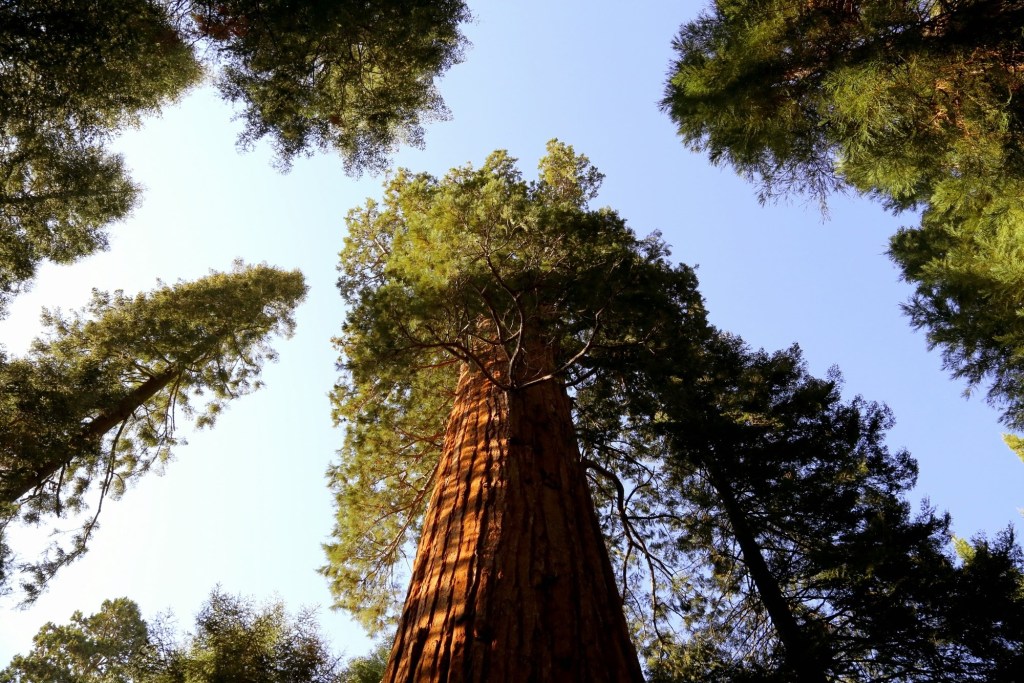
California’s giant sequoias and redwoods are nature’s skyscrapers. Redwoods exist in a few narrow pockets in Northern and Central California and into Southern Oregon. Sequoias live exclusively in small groves in central and Northern California with the largest grouping of them found in Sequoia National Park. These two tree species are wonders of the biological world. They are also some of the most magnificent things to behold on the planet.
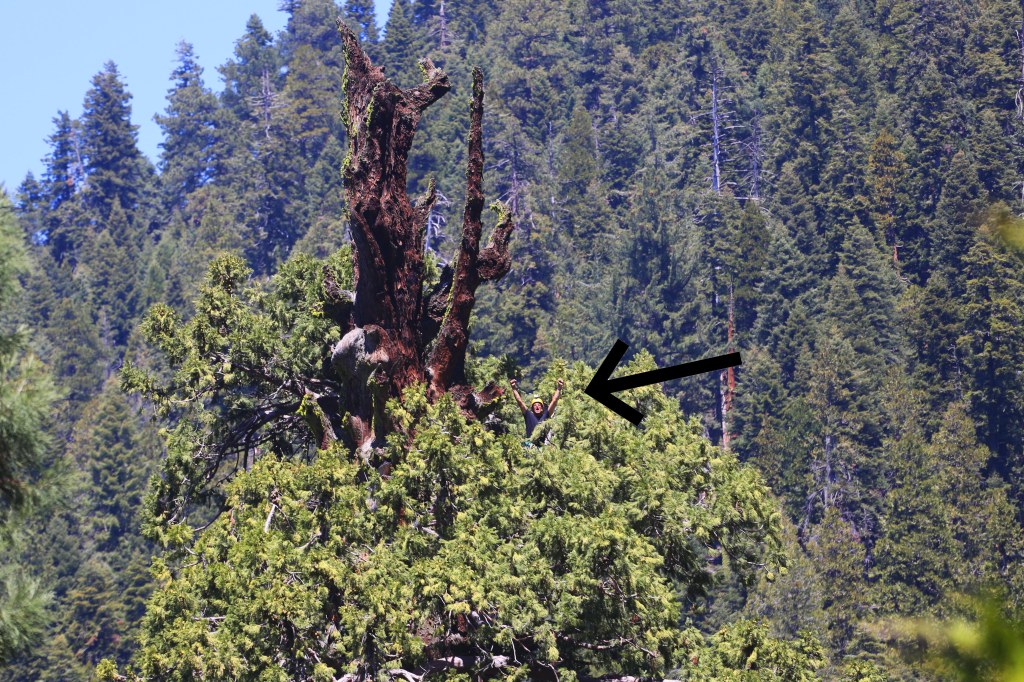
I have personally climbed the Stagg tree for a New York Times story years ago (see photo below, that’s me). The Stagg is the fifth-largest sequoia in the world, and I will forever remember the experience…even though I chickened out a bit and didn’t make it to the top.
The author climbs the Stagg tree, the fifth-largest tree in the world. (Erik Olsen)
We are lucky to still have our big trees, what’s left of them, anyway. Just a century and a half ago, old-growth redwoods and sequoias were remarkably plentiful. People marveled at them, with some early settlers in California spinning unbelievable yarns of trees that rise from the earth “like a great tower“. They also saw them as a bounteous resource, ripe for plunder (mankind, sigh).
By 1900, nearly all of California’s tall trees had been purchased by private landowners who saw in the trees not beauty, but dollar signs. By 1950, an estimated 95% of California’s original old-growth coast redwood forests had been logged, particularly along the coast from Big Sur to the Oregon border. For giant sequoias, about one-third of the original groves had been cut down, largely in the late 19th and early 20th centuries before protections were put in place.
Between 1892–1918, the Sanger Lumber Company logged the Converse Basin Grove, one of the largest stands of sequoia in the world, using ruinous clearcutting practices. They cut down 8,000 giant sequoias, some of them over 2000 years old, in a decade-long event that has been described as “the greatest orgy of destructive lumbering in the history of the world.” Only 60-100 large specimens in the grove survived. We wrote about that awful event here.
Today, only a small fraction of the old-growth coast redwood forest remains. The largest surviving stands of ancient coast redwoods are found in Humboldt Redwoods State Park, Redwood National and State Parks and Big Basin Redwoods State Park. It’s a wonder and a blessing that there are some left. And even then, they face an uncertain future thanks to climate change.
The remarkable size and height of these incredible organisms are largely due to California’s unique geography, though genetics likely play a significant role as well. Before diving into those factors, let’s take a moment to appreciate just how extraordinary these trees truly are.
Professional tree climber Rip Thompkins at the top of the Stagg tree, a giant sequoia. (Photo: Erik Olsen)
Sequoias and redwoods are closely related. Both belong to the cypress family (Cupressaceae). The primary difference between sequoias and redwoods is their habitat. Redwoods live near the moist, foggy coast, while sequoias thrive in higher-elevation subalpine zones of the Sierra Nevada. Redwoods are the tallest trees in the world. Sequoias are the biggest, if measured by circumference and volume. Redwoods can grow over 350 feet (107 m). The tallest tree in the world that we know of is called the Hyperion, and it tickles the sky at 379.7 feet (115.7 m). But it is quite possible another tree out there is taller than Hyperion. Redwoods are growing taller all the time, and many of the tallest trees we know of are in hard-to-reach areas in Northern California. Hyperion was only discovered about a decade ago, on August 25, 2006, by naturalists Chris Atkins and Michael Taylor. The exact location of Hyperion is a secret to protect the tree from damage.
The giant sequoia (Sequoiadendron giganteum) is Earth’s most massive living organism. While they do not grow as tall as redwoods – the average size of old-growth sequoias is from 125-275 feet – they can be much larger, with diameters of 20–26 feet. Applying some basic Euclidean geometry (remember C = πd?), that means that the average giant sequoia has a circumference of over 85 feet.
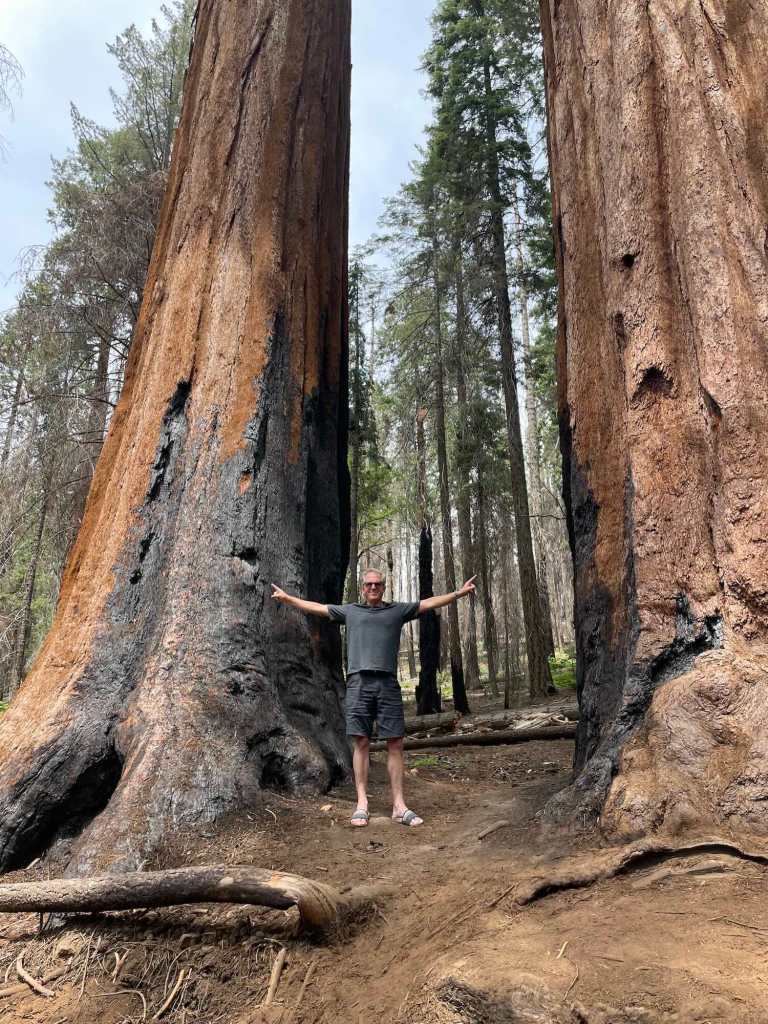
Giant sequoia and man for scale (Photo: Erik Olsen)
Sequoias grow naturally along the western slope of the Sierra Nevada mountain range at an altitude of between 5,000 and 7,000 feet. They tend to grow further inland where the dry mountain air and elevation provide a comfortable environment for their cones to open and release seeds. They consume vast amounts of runoff from Sierra Nevada snowpack, which provides groves with thousands of gallons of water every day. But some say the majestic trees face an uncertain future. Many scientists are deeply concerned about how climate change might affect the grand trees, as drought conditions potentially deprive them of water to survive.
The General Sherman tree in Sequoia National Park. (Photo: Erik Olsen)
The world’s largest sequoia, thus the world’s largest tree, is General Sherman, in Sequoia National Park. General Sherman is 274.9 feet high and has a diameter at its base of 36 feet, giving it a circumference of 113 feet. Scientists estimate that General Sherman weighs some 642 tons, about as much as 107 elephants. The tree is thought to be 2,300 to 2,700 years old, making it one of the oldest living things on the planet. (To learn more about the oldest thing in the world, also in California, see our recent feature on Bristlecone pines.) Interesting fact: in 1978, a branch broke off General Sherman that was 150 feet long and nearly seven feet thick. Alone, it would have been one of the tallest trees east of the Mississippi.
Many sequoias exist on private land. Just last month, one of the largest remaining private stands of Sequoias in the world – the Alder Creek Grove of giant sequoias – was bought by the Save the Redwoods League conservation group for nearly $16 million. The money came from 8,500 contributions from individual donors around the world. The property includes both the Stagg Tree mentioned above and the Waterfall Tree, another gargantuan specimen. The grove is considered “the Crown Jewel” of remaining giant Sequoia forests.
Redwoods (Sequoia sempervirens), also known as coast redwoods, generally live about 500 to 700 years, although some have been documented at more than 2,000 years old. While wood from sequoias was found to be too brittle for most kinds of construction, the redwoods were a godsend for settlers and developers who desperately needed raw material to build homes and city buildings, to lay railroads, and erect bridge trestles. The construction and subsequent reconstruction of San Francisco following the 1906 earthquake heavily relied on redwood timber, prized for its strength, resilience, and natural resistance to decay, making it a foundational resource for the city’s growth and recovery after the earthquake.
The timber companies who profited from redwoods only began to cut them down in earnest a bit over a century ago. But cut them down they did, with vigor and little regard for the preservation of such an amazing organism. After World War II, California experienced an unprecedented building boom, and the demand for redwood (and Douglas fir) soared. Coastal sawmills more than tripled between 1945 and 1948. By the end of the 1950s, only about 10 percent of the original two-million-acre redwood range remained untouched.
The author standing by burned sequoias. (Photo: Erik Olsen)
OK, you got this far. I hope. So how did these trees get so big and tall? Most scientists agree it has to do with climate. Sequoias benefit from California’s often prodigious snowpack, mentioned above, which seeps into the ground, constantly providing water to the roots of the trees. In addition to the snowpack, the thick (up to 2 feet), fire-resistant bark of sequoias helps protect them from wildfires. This forest ecology helps as well, since the fires themselves clear competing vegetation, allowing more sunlight and nutrients to reach the trees. The temperate climate of California, with its relatively mild winters and summer fog, also helps sustain these giants by moderating temperatures and reducing water loss, creating an environment where sequoias can thrive for centuries.
Conversely, Redwoods get much of their water from the air, when dense fog rolls in from the coast and is held firm by the redwoods themselves and the steep terrain. Because of the unique interplay of ocean currents and climate in California, the amount of fog that is available to trees is highly unusual. The trees’ leaves actually consume water in fog, particularly in their uppermost shoots. According to scientists who study the trees using elaborate climbing mechanisms to reach the treetops, in summer, coast redwoods can get more than half of their moisture from fog. (In fact, fog plays a central role in sustaining several of California’s coastal ecosystems.) The reason is that fog is surprisingly dense with water. One study from scientists Daniel Fernandez of California State University, Monterey Bay, showed that a one-square-meter fog collector could harvest some 39 liters, or nearly 10 gallons, of water from fog in a single day.
Giant sequoia – family for scale (Erik Olsen)
Another possible explanation for the coast redwood’s remarkable size lies in its extraordinary genome. According to research from the Redwood Genome Project, the coast redwood (Sequoia sempervirens) is hexaploid, meaning it carries six copies of each chromosome in every cell, an extremely rare feature in trees. In contrast, humans and most other plants and animals are diploid, carrying only two sets of chromosomes.
The coast redwood genome is indeed massive, estimated at around 27 billion base pairs, which is approximately nine times larger than the human genome (which has about 3 billion base pairs). While not exactly ten times larger, the general comparison holds and highlights the tree’s genetic complexity.
By comparing the coast redwood’s genome with those of other conifers, researchers have found hundreds of unique gene families, many of which are associated with stress tolerance, wound repair, fungal resistance, toxin metabolism, and the biosynthesis of flavonoids, all compounds that help mitigate cellular stress.
This rich genetic toolkit may contribute to the tree’s legendary resilience, longevity, and ability to grow to extraordinary heights, though the full relationship between genome size and physical traits in redwoods is still being studied.
Yet another factor may be the trees remarkable longevity. They are survivors. The Sierra Nevadas have long experienced dramatic swings in climate, and this age may be yet another of those swings that the trees will simply endure. Or maybe not. For most of the time that redwoods and sequoias have existed, they have done a remarkable job fighting off fires, swings in climate, as well as disease and bug infestations. Because their bark and heartwood are rich in compounds called polyphenols, bugs and decay-causing fungi don’t like them. Many trees, not just redwoods and sequoias, have genes that help them resist the typical aging processes that limit the lifespan of animals. For instance, trees can compartmentalize and isolate damaged or diseased wood, preventing the problem from spreading to the rest of the tree.
Giant sequoias in California. (Photo: Erik Olsen)
As the air heats up due to global warming, there is a rising threat to the trees’ survival. Warm air pulls moisture from leaves, and the trees often close their pores, or stomata, to maintain their water supply. When the pores close, that prevents carbon dioxide from nourishing the tree, slowing or even halting photosynthesis. The climate in areas where the trees grow hasn’t yet experienced the kind of temperatures that might kill them, but we are really just at the beginning of this current era of global warming, and some scientists warn hotter temperatures could doom many trees.
That said, other studies that show the increased carbon that causes warming could actually be good for the trees. According to an ongoing study from Redwoods Climate Change Initiative, California’s coast redwood trees are now growing faster than ever. As most people know, trees consume carbon dioxide from the air, so, the scientists argue, more carbon means more growth. However, scientists caution that climate change is not a net benefit. Increased drought, fire risk, and ecosystem stress may ultimately outweigh these temporary growth gains.
We will see. While coast redwoods have shown resilience during recent droughts, with no widespread mortality observed, giant sequoias have not fared as well. In the past decade, drought, bark beetles, and intense wildfires have killed nearly 20% of all mature giant sequoias, a sharp and alarming decline for such a long-lived species.
Redwood grove in Northern California (Photo: Erik Olsen)
It all comes down to some kind of balance. Trees may benefit from more carbon, but if it gets too hot, trees could start to perish. That’s a bit of a conundrum, to say the least.
The prospect of losing these magnificent trees to climate change is a double whammy. Not only would a mass die-off of trees be terrible for tourism and those who simply love and study them, but trees are some of the best bulwarks we have on the planet to fight climate change. Redwoods are among the fastest-growing trees on earth; they can grow three to ten feet per year. In fact, a redwood achieves most of its vertical growth within the first 100 years of its life. Among trees that do the best job taking carbon out of the atmosphere, you could hardly do better than redwoods and sequoias.
The Archangel Ancient Tree Archive, an organization out of Copemish, Michigan, has been “cloning” California’s big trees for nearly a decade. They take snippets of the trees from the top canopy and replant them, essentially creating genetically identical copies of the original tree. It’s more like propagating than cloning, but that’s what they call it. The group’s founder, David Milarch, believes fervently that planting large trees is our best bet in stopping climate change. This is the video story I produced about Milarch back in 2013. It’s worth a watch. He’s an interesting character with a lot of passion.
Preserving and protecting what’s left of these amazing organisms should be a priority in California. These trees are not only part of the state’s rich natural legacy, but they offer ample opportunities for tourism and strengthening the economies of the regions where they grow. It’s hard to visit Redwood National and State Parks or Sequoia & Kings Canyon National Parks and to come away with anything but awe at these magnificent organisms. California is special, and we are blessed to have these trees and the places where they grow in our state.
Lying east of the Owens Valley and the jagged crags of the Sierra Nevadas, the White Mountains rise high above the valley floor, reaching over 14,000 feet, nearly as high as their far better-known relatives, the Sierra Nevadas. Highway 168 runs perpendicular to Highway 395 out of Big Pine and leads up into the mountains to perhaps the most sacred place in California.
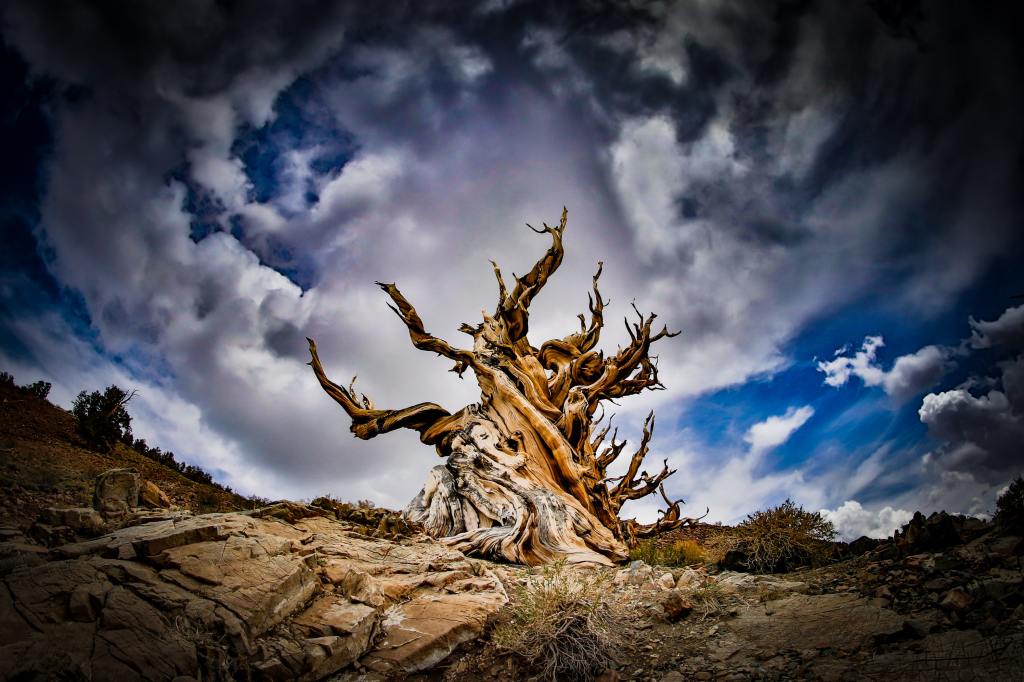
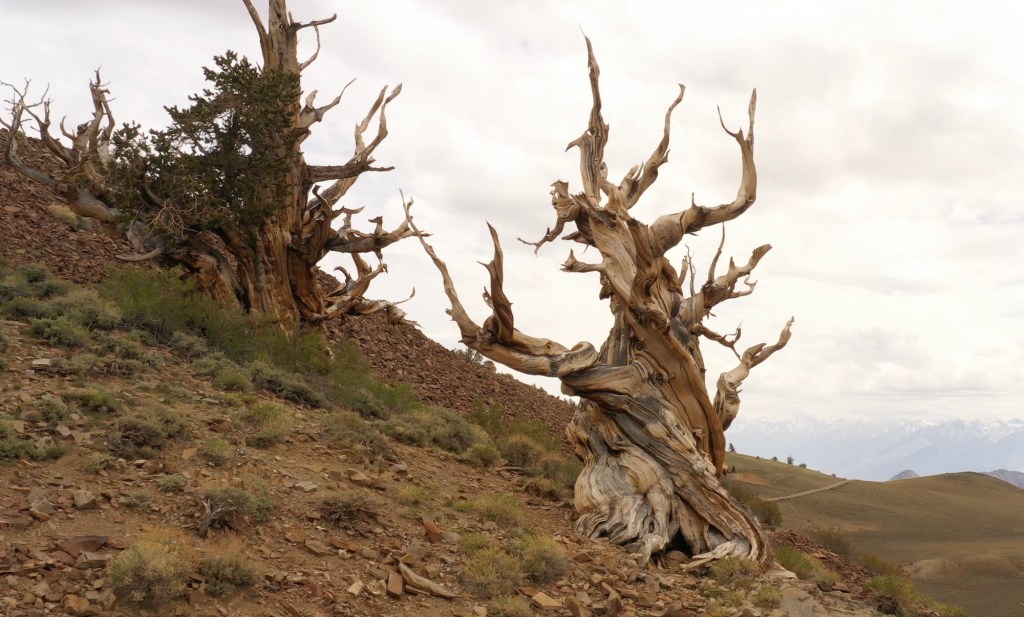
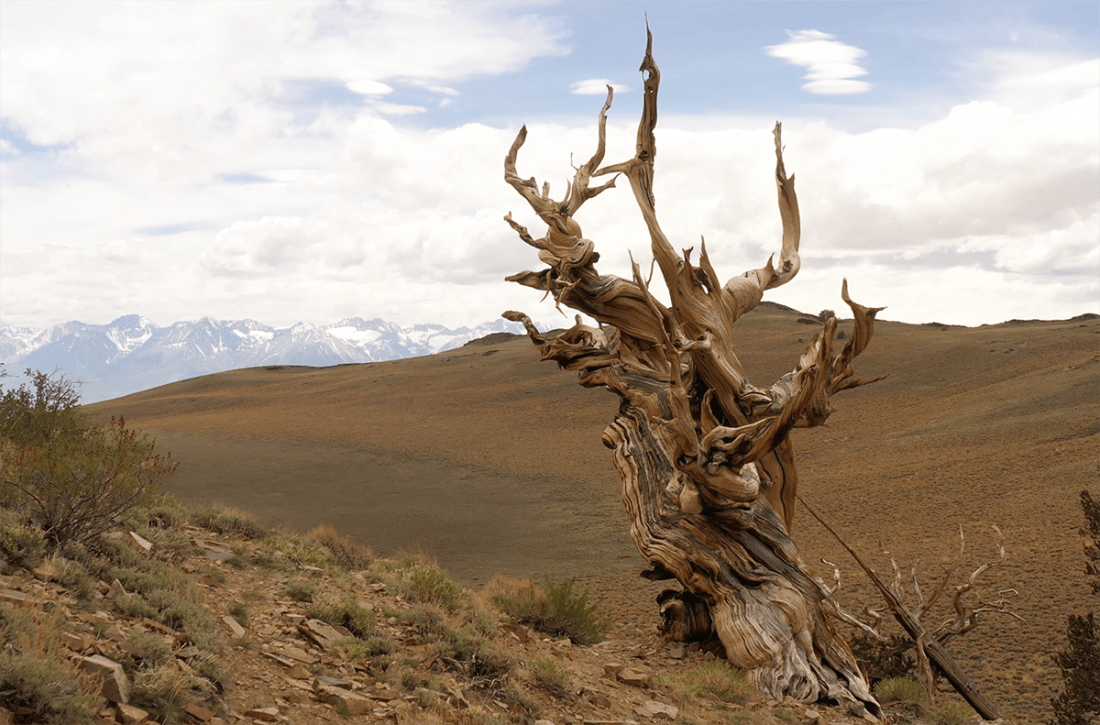
Far above sea level, where the air is thin, live some of the most amazing organisms on the planet: the ancient bristlecone pines. To the untrained eye, the bristlecone seems hardly noteworthy. Gnarled and oftentimes squat, especially when compared to the majestic coastal redwoods and giant sequoias living near the coast further west, they hardly seem like mythical beings. But to scientists, they are a trove of information, offering clues to near immortality and to the many ways that the earth’s climate has changed over the last 5,000 years.
In the January 20, 2020 edition of the New Yorker, music writer Alex Ross writes about the trees and the scientists who are trying to unlock the secrets of the bristlecone’s unfathomable endurance. The trees, he writes, “seem sentinel-like”.
Video of ancient bristlecone pine that I shot and put together.
Bristlecones are the longest living organism on earth. The tree’s Latin name is Pinus longaeva, and it grows exclusively in subalpine regions of the vast area known to geologists as the Great Basin, which stretches from the eastern Sierra Nevadas to the Wasatch Range, in Utah. Bristlecones grow between 9,800 and 11,000 feet above sea level, where some people get dizzy and there are few other plants or animals that thrive. The greatest abundance of bristlecones can be found just east of the town of Bishop, California in the Ancient Bristlecone Pine Forest. There, a short walk from where you park your car, you can stroll among these antediluvian beings as they imperceptibly twist, gnarl and reach towards the heavens.
While most of the bristlecones in the national Ancient Bristlecone Pine Forest are mere hundreds of years old, there are many that are far older. Almost ridiculously so. Methuselah, a Great Basin bristlecone, is 4,851 years old, as measured by its rings, taken by scientists decades ago using a drilled core. Consider that for a moment: this tree, a living organism, planted its tentacle-like roots into the soil some 2000 years before the birth of Christ, around the time that the Great Pyramids of Egypt were built. By contrast, the oldest human being we know of lived just 122 years. That’s 242 human generations passing in the lifetime of a single bristlecone that still stands along a well-trodden trail in the high Sierras.
National Park Service
That said, if you were to try and see Methuselah for yourself, you are out of luck. The Forest Service is so protective of its ancient celebrity that it will not even share its picture. What’s more, it’s probably the case that there are bristlecones that are even older than Methuselah. Scientists think there could be trees in the forest that are over 5,000 years old.
How the bristlecone has managed this incredible feat of endurance is a mystery to researchers. Many other tree species are prone to insect infestations, wildfires, climate change. In fact, over the last two decades, the vast lodgepole pine forests of the Western United States and British Columbia have been ravaged by the pine beetle. Millions of acres of trees have been lost, including more than 16 million of the 55 million acres of forest in British Columbia.
But insects don’t seem to be a problem for bristlecones. Bristlecone wood is so dense that mountain-pine beetles and other pests can rarely burrow their way into it. Further, the region where the bristlecones live tends to be sparse with vegetation, and thus far less prone to wildfire.
A recent study by scientists at the University of North Texas looked at the amazing longevity of the ginkgo tree, examining individuals in China and the US that have lived for hundreds, perhaps more than a thousand years. One thing they found is that the trees’ immune systems remain largely intact, even youthful, throughout their lives. It turns out the genes in the cambium, or the cylinder of tissue beneath the bark, contain no “program” for senescence, or death, but continue making defenses even after hundreds of years. Researchers think the same thing might be happening in the bristlecone. This is not the case in most organisms and certainly not humans. Like replicants in the movie Blade Runner, we seem to have a built-in clock in our cells that only allows us to live for so long. (I want more life, f$@$@!)
Scientists at the University of Arizona’s Laboratory of Tree-Ring Research (LTRR) have built up the world’s largest collection of bristlecone cross-sections, which they carefully examine under the microscope, looking for clues about how the trees have managed to survive so long, and how they can inform us of the many ways the earth’s climate has changed over the millennia.
The LTRR houses the nation’s only dendrochronology lab (the term for the study of tree rings), and the researchers there have made several discoveries using tree cores that have changed or confirmed climate models. For example, in 1998, the climatologist Michael E. Mann published the “hockey stick graph,” that revealed a steep rise in global mean temperature from about 1850 onward (i.e. the start of the industrial revolution). There was intense debate about this graph, with many scientists and climate change skeptics saying that Mann’s projections were too extreme. But numerous subsequent studies, some using the trees’ rings new models, confirmed the hockey-stick model.
Bristlecone Pine
The bristlecones will continue to help us understand the way the earth is changing and to see into the deep human past in a way few other living organisms can do. They also improve our understanding of possible future environmental scenarios and the serious consequences of allowing carbon levels in the atmosphere to continue to grow.
In this sense, they truly are sentinels.
Bristlecone pine in the White Mountains (Unsplash)
Interestingly, it wasn’t until 1953 that we found out just how ancient these trees are. Credit for this breakthrough goes to Edmund Schulman, a dendrochronologist. Schulman and his colleague Frits Went stumbled upon an ancient limber pine while conducting research in Sun Valley, Idaho. This tree, which they found to be around 1,650 years old, got them thinking: could there be even older trees hidden away in the mountains?
Shulman then traveled to the White Mountains and began a long-term exploration of the Bristlecone forest. He took core samples from many trees and made a startling discovery. At night, at his camp, he began counting the annual growth rings on a slender piece of wood. He counted and counted, not daring to believe what was unfolding before his eyes. When he finally put down his magnifying glass in the enveloping darkness, he had counted rings that went back past the year 2046 BCE. Schulman had stumbled upon a tree that had been alive for over four millennia. Not only alive, but continuing to grow!
Schulman had effectively expanded our understanding of how long a single tree can endure—providing key insights into environmental longevity, climate history, and even the resilience of life on Earth.
Bristlecone forest in the White Mountains of California (Erik Olsen)
In tribute to the momentous find, he dubbed the tree “Pine Alpha,” a name that’s as much a testament to the tree’s age as it is to the groundbreaking nature of Schulman’s work. Until then, no one knew a living tree could be that old. The discovery was a pivotal moment that opened up a new frontier in the study of dendrochronology, and it became a cornerstone example of how trees serve as living records of Earth’s history.
It should be said that the trees themselves, in their gnarled, frozen posture, are truly are beautiful. They should be protected and preserved, admired and adulated. Indeed, Federal law prohibits any attempt to damage the trees, including taking a mere splinter from the forest floor. The trees have also become an obsession for photographers, particularly those who favor astrophotography. A quick search on Instagram reveals a stunning collection of images showing the majesty and haunting beauty of these ancient trees.
So, if you are ever headed up Highway 395 into the Sierras, it is well worth the effort to make the right-hand turn out of Big Pine to visit the Ancient Bristlecone Pine Forest. The air is thin, but the views are spectacular. And where else can you walk among the oldest living things on the planet?
51 years ago today a man named Edwin Philip Pister rescued an entire species from extinction.
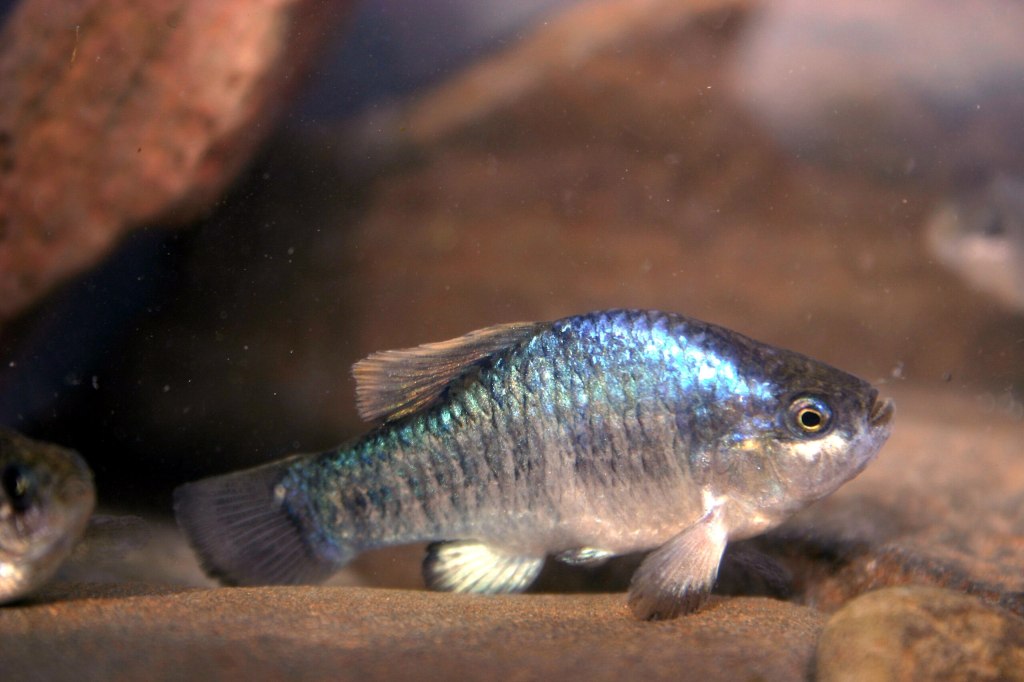
Less than 2.5 inches in length, the Owens pupfish is a silvery-blue fish in the family Cyprinodontidae. Endemic to California’s Owens Valley, 200 miles north of Los Angeles, the fish has lived on the planet since the Pleistocene, becoming a new species when its habitat was divided by changing climatic conditions, 60,000 years ago.
For thousands of years, the Owens Valley was largely filled with water, crystal-clear snowmelt that still streams off the jagged, precipitous slab faces of the Sierra Nevada mountains. Pupfish were common, with nine species populating various lakes and streams from Death Valley to an ara just south of Mammoth Lakes. The Paiute people scooped them out of the water and dried them for the winter.
In the late 19th century, Los Angeles was a rapidly growing young metropolis, still in throes of growing pains that would last decades. While considered an ugly younger sibling to the city of San Francisco, Los Angeles had the appeal of near year-round sunshine and sandy beaches whose beauty that rivaled those of the French Riviera.
Owens pupfish (California Department of Fish and Wildlife)
But by the late 1900s, the city began outgrowing its water supply. Fred Eaton, mayor of Los Angeles, and his water czar, William Mulholland, hatched a plan to build an aqueduct from Owens Valley to Los Angeles. Most Californians know the story. Through a series of shady deals, Mulholland and Eaton managed to get control of the water in the Owens Valley and, in 1913, the aqueduct was finished. It was great news for the new city, but terrible news for many of the creatures (not to mention the farmers) who depended on the water flowing into and from the Owens Lake to survive.
So named because they exhibit playful, puppy-like behavior, the Owens pupfish rapidly began to disappear. Pupfish are well-known among scientists for being able to live in extreme and isolated situations. They can tolerate high levels of salinity. Some live in water that exceeds 100° Fahrenheit, and they can even tolerate up to 113° degrees for short periods. They are also known to survive in near-freezing temperatures common in the lower desert.
Owens River in the Eastern Sierra (Erik Olsen)
One of those animals is the Owens pupfish.
But hot or cold are one thing. The disappearance of water altogether is another.
As California has developed, and as climate change has caused temperatures to rise, thus increasing evaporation, all of California’s pupfish populations have come under stress. Add to these conditions, the early 20th-century introduction by the California Department of Fish and Wildlife of exotic species like largemouth bass and rainbow trout to lakes and streams in the eastern Sierras, and you get a recipe for disaster. And disaster is exactly what happened.
Several species of pupfish in the state have been put on the endangered species list. Several species, including the Owens pupfish, the Death Valley Pupfish and the Devils Hole pupfish are some of the rarest species of fish on the planet. The Devils Hole pupfish recently played the lead role in a recent story about a man who accidentally killed one of the fish during a drunken spree. According to news stories, he stomped on the fish when he tried to swim in a fenced-off pool in Death Valley National Park. He went to jail.
The remains of the Owens River flowing through Owens Valley in California. Credit: Erik Olsen
The impact on the Owens pupfish habitat was so severe that in 1948, just after it was scientifically described, it was declared extinct.
That is, until one day in 1964, when researchers discovered a remnant population of Owens pupfish in a desert marshland called Fish Slough, a few miles from Bishop, California. Wildlife officials immediately began a rescue mission to save the fish and reintroduce them into what were considered suitable habitats. Many were not, and by the late 1960s, the only remaining population of Owens pupfish, about 800 individuals, barely hung on in a “room-sized” pond near Bishop.
On August 18, 1969, a series of heavy rains caused foliage to grow and clog the inflow of water into the small pool. It happened so quickly, that when scientists learned of the problem, they realized they had just hours to save the fish from extinction.
Edwin Philip Pister
Among the scientists who came to the rescue that day was a stocky, irascible 40-year-old fish biologist named Phil Pister. Pister had worked for the California Department of Fish and Game (now the California Department of Fish and Wildlife) most of his career. An ardent acolyte of Aldo Leopold, regarded as one of the fathers of American conservation, Pister valued nature on par, or even above, human needs. As the Los Angeles Times put it in a 1990 obituary, “The prospect of Pister off the leash was fearsome.”
“I was born on January 15, 1929, the same day as Martin Luther King—perhaps this was a good day for rebels,” he once said.
Pister had few friends among his fellow scientists. Known for being argumentative, disagreeable, and wildly passionate about the protection of California’s abundant, but diminishing, natural resources, Pister realized that immediate action was required to prevent the permanent loss of the Owens pupfish. He rallied several of his underlings and rushed to the disappearing pool with buckets, nets, and aerators.
Within a few hours, the small team was able to capture the entire remaining population of Owens pupfish in two buckets, transporting them to a nearby wetland. However, as Pister himself recalls in an article for Natural History Magazine:
“In our haste to rescue the fish, we had unwisely placed the cages in eddies away from the influence of the main current. Reduced water velocity and accompanying low dissolved oxygen were rapidly taking their toll.”
Los Angeles Aqueduct. Credit: Erik Olsen
As noted earlier, pupfish are amazingly tolerant of extreme conditions, but like many species, they can also be fragile, and within a short amount of time, many of the pupfish Pister had rescued were dying, floating belly up in the cages. Pister realized immediate action was required, lest the species disappear from the planet forever. Working alone, he managed to net the remaining live fish into the buckets and then carefully carried them by foot across an expanse of marsh. “I realized that I literally held within my hands the existence of an entire vertebrate species,” he wrote.
Pister managed to get the fish into cool, moving water where the fish could breathe and move about. He says about half the the population survived, but that was enough.
Today, the Owens pupfish remains in serious danger of extinction. On several occasions over the last few decades, the Owens pupfish have suffered losses by largemouth bass that find their way into the pupfish’s refuges, likely due to illegal releases by anglers. In 2009, the US Fish and Wildlife Service estimated that five populations totaling somewhere between 1,500 and 20,000 Owens pupfish live in various springs, marshes, and sloughs in the Owens Valley, where they are federally protected.
Last week we had the opportunity to head up Highway 395 into Big Pine where we made a left up to the Ancient Bristlecone Pine Forest. Because of the coronavirus, the place was empty. Not a soul to be seen anywhere.
We did a feature on bristlecones a few months ago in which we marveled at the majesty and seeming immortality of these incredible organisms, probably the longest living things on the planet. We brought along a drone to get some shots of these trees, whose gnarled, swirling branches are like something out of a fantasy novel. Take a minute (literally a minute) to enjoy.
Yesterday, the California Institute of Technology (Caltech) in Pasadena made a major announcement: philanthropists and entrepreneurs Stewart and Lynda Resnick gave the school $750 million to develop technologies to tackle climate change. The news of the announcement was somewhat lost in the craziness of the news cycle following the whistle-blower revelations of the Trump administration, but make no bones about it, this is major news.
Thomas F. Rosenbaum, president of Caltech, told the New York Times that, “the money will be used to build a research center and to support a broad range of projects. Among them are finding ways to sequester carbon from the atmosphere and perhaps store it in the ocean; to capture and reuse rainfall; make plants more resistant to drought; and create plastics that are easier to recycle.” In other words, a key focus is going into geoengineering.
Coal mine in Germany. Credit: Erik Olsen
Many people believe that solving the climate crisis is a matter of reducing our use of fossil fuels. While this is unquestionably part of the equation, it is also very unlikely, if not impossible, that as a species we will muster the discipline and accept the cost of reducing our consumption of fossil fuels to levels that make a significant impact on carbon in the atmosphere. This argument was recently made by the writer Jonathan Franzen in an article in the New Yorker magazine. While Franzen was viciously pilloried for this opinion, both in rebuttal articles as well as Twitter, he is largely correct.
Currently, global temperature is on track to rise by an average of 6 °C (10.8 °F), according to the latest estimates. Some scientists say that we are already on the verge of a “global disaster” at the planet’s poles. Melting ice at the Arctic and in Greenland this year reached a record level, with Greenland shedding 12.5 billion tons of water into the sea. That’s more water than at any time since record-keeping began in the 1950s. It gets worse.
As NASA points out “Even if we stopped emitting greenhouse gases today, global warming would continue to happen for at least several more decades, if not centuries.” Even if the United States and Europe enacted stringent, extensive measures to reduce carbon output, China, India, and many other developing countries will continue to depend on fossil fuels to foster economic growth. Asking other poorer countries to slow their progress after two centuries of our own largely uninhibited industrial development is the quintessence of hypocrisy. Yes, it is possible that some countries will develop with certain sustainable measures in place, but if we look at the technologies currently available even to wealthy countries, there is no viable or affordable technology currently available to offset the consumption of carbon-rich sources of energy. This is not to say that we should not try to implement measures to reduce carbon output. It makes sense to do this even if global warming were not a factor. Renewables are cleaner, far less environmentally destructive and simply make more sense, assuming they can be implemented at scale and reasonable cost. We should do everything we can to implement renewable energy sources.
Wind turbine
This gets us to the $750 billion Caltech donation. It is far more likely that some form of geoengineering is going to end up solving the carbon problem. While many scientists and entrepreneurs are currently developing ways to take caarbon out of the atmosphere, at the moment, there is no scalable or viable means of doing so. But that may not be the case in the future. It is possible, if not likely, that someone will find a way to remove carbon from the air on a global scale. The question is one of investment, ingenuity and, of course, luck.
There is a historical precedent for tackling such a large problem. In the early 20th century, humankind was faced with a global food crisis. Agricultural production was slowing due to shortages of fertilizer, which largely came from the mining of guano, or bird droppings, which existed in large deposits in a select few places around the world, including Peru. The key ingredient in fertilizer is nitrogen, which plants depend on for growth and which is slowly depleted as crops are harvested and replanted. (Back before humans started agriculture, nitrogen would return to the soil when plants died, but when plants are grown for food, they are removed, depleting nitrogen from the ground.)
With the naturally occurring nitrogen found in guano, we had a reprive. But it only took a few decades for most of the key sources of guano to be exploited. And so, early in the 20th century, scientists warned that we were on the verge of perhaps the most dire environmental crisis in the history of humanity: there was not enough fertilizer to support the earth’s rapidly growing population. They were certain that, unless another source of nitrogen could be found, large-scale starvation would certainly occur.
Which brings us to the Austrian chemist Fritz Haber. Haber figured out a way to use high-pressure (in a huge machine he designed) and a catalyst to get nitrogen from the air. Air is nearly 80 percent nitrogen, but it is in a form that makes it hard to separate from air’s other components: oxygen, argon, carbon dioxide and water vapor. Haber’s process converts atmospheric nitrogen (N2) to ammonia (NH3) by a reaction with hydrogen (H2) using a metal catalyst under high temperatures and pressures.
Fritz Haber
Haber’s breakthrough enabled mass production of agricultural fertilizers and led to a massive increase in crops for human consumption. The food production for half the world’s current population involves Haber’s method for producing nitrogen fertilizers. The world’s authority on nitrogen fertilizer, Vaclav Smil, has said the industrial synthesis of ammonia from nitrogen and hydrogen “has been of greater fundamental importance to the modern world than the invention of the airplane, nuclear energy, space flight, or television.” In other words, one man, armed with an idea and the resources to make it happen, largely saved humanity in its time of greatest crisis.
It is not merely wishful thinking to believe that we are in a similar moment now and that human ingenuity and perseverance will help us find a way to remove carbon from the atmosphere on a global scale. Many people are working on geoengineering solutions, from carbon sequestration to solar radiation modification to the widespread production of carbon sinks (for example, planting trees). It could take several different approaches, or perhaps just one, assuming there is another Fritz Haber out there today, which undoubtedly there is. But what’s required is funding and commitment. It will likely take several years and many billions (trillions) of dollars to find the solution, and that is why the $750 million gift to Caltech is a great start.
The questions are: Where do we invest our time and money to solve this crisis? Where do our priorities lie? Again, I’m not saying in any way that we should give up on finding and implementing ways to reduce carbon output, but resources to tackle the climate problem are finite, and most people have largely demonstrated that they are, so far, unwilling to make even the most basic sacrifices to cope with the problem. It’s hard to imagine this changing because it is part of human nature. As Franzen wrote in reference to the most basic carbon reduction targets discussed today: “Call me a pessimist or call me a humanist, but I don’t see human nature fundamentally changing anytime soon. I can run ten thousand scenarios through my model, and in not one of them do I see the two-degree target being met.”
With what resources we do have, therefore, a much larger proportion should be directed towards geoengineering solutions, developing and implementing technologies to remove carbon from the atmosphere. But where should those resources go, specifically? To whom do we direct money for this kind of research and development? The Resnicks got it right. There is likely ould be no better single place to funnel funds for geoengineering solutions than the nation’s premier technological institution: Caltech. That’s why yesterday’s announcement is such big news, and far more significant than President Trump’s Ukraine problem. That said, if Trump is eventually removed from office, we do regain some sense in our own country’s climate policy, which he has largely derailed. So, we may have that, too.