A Tiny California Seaweed Could Make a Big Dent in Livestock Methane

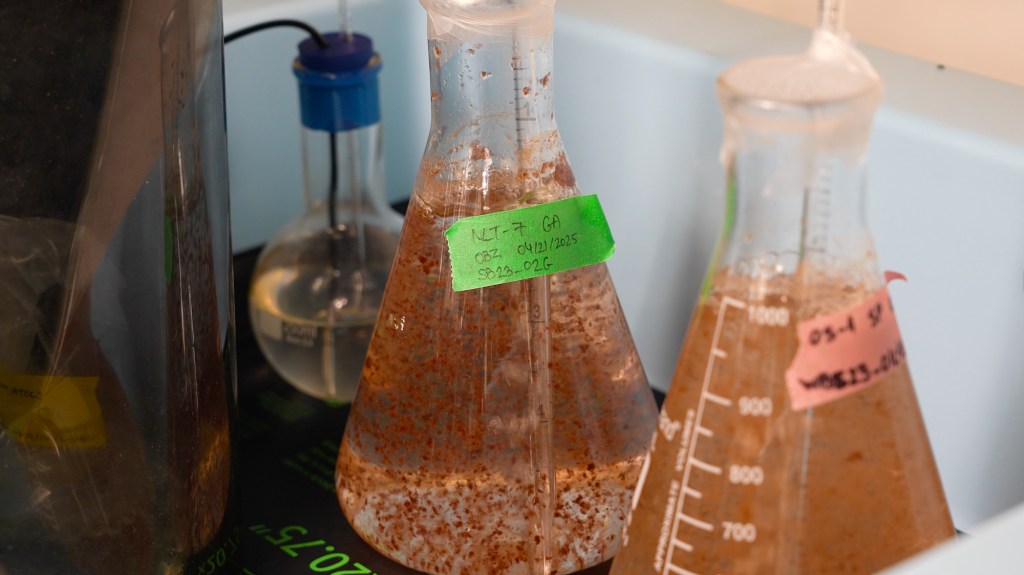
Flasks of Asparagopsis taxiformis growing at Scripps Institution of Oceanography. Researchers are studying this red seaweed for its potential to slash methane emissions from cattle when added in small amounts to their feed. (Photo: Erik Olsen)

Inside a long, brightly lit basement lab at the Scripps Institution of Oceanography at UC San Diego, a large aquarium filled with live corals sits against the wall, the vibrant shapes and colors of the coral standing out against the otherwise plain white surroundings. Nearby, in a side alcove, dozens of glass flasks bubble with aerated water, each holding tiny crimson clusters of seaweed swirling in suspension, resembling miniature lava lamps. These fragile red fragments, born in California and raised under tightly controlled conditions, are part of a global effort to harness seaweed to fight climate change.

Cattle and other ruminant livestock are among the largest contributors to methane emissions worldwide, releasing vast amounts of the gas through digestion and eructation. Burps, not farts. The distinction is not especially important, but it matters because critics of climate science often mock the idea of “cow farts” driving climate change. In reality, the methane comes primarily from cow burps, not flatulence.

But I digress. 
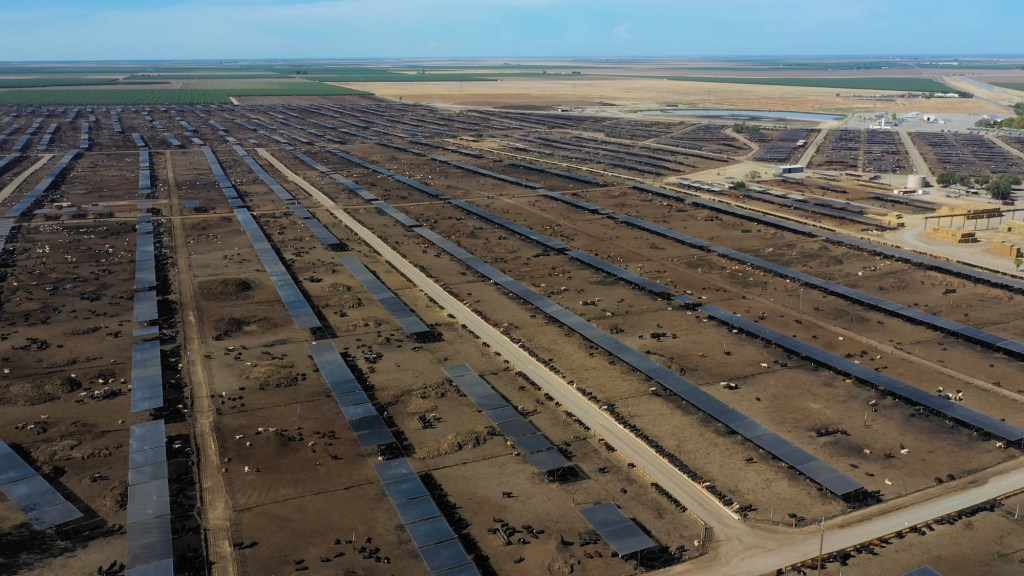
Cattle at Harris Ranch in California’s Central Valley, one of the largest beef producers in the United States. Livestock operations like this are a major source of methane emissions, a greenhouse gas more than 80 times as potent as carbon dioxide over a 20-year period. (Photo: Erik Olsen)

Globally, livestock are responsible for roughly 14 percent of all human-induced greenhouse gases, with methane from cattle making up a significant portion of that total. The beef and dairy industries alone involve more than a billion head of cattle, producing meat and milk that fuel economies but also generating methane on a scale that rivals emissions from major industrial sectors. Because methane is so potent, trapping more than 80 times as much heat as carbon dioxide over a 20-year period, the livestock industry’s footprint has become a central focus for climate scientists searching for solutions. 

Enter Jennifer Smith and her colleagues at the Smith Lab at Scripps in beautiful La Jolla, California. Their team is tackling urgent environmental challenges, from understanding coral die-offs to developing strategies that reduce greenhouse gas emissions, among them, the cultivation of seaweed to curb methane from cattle.  

The seaweed species is Asparagopsis taxiformis. Native to tropical and warm temperate seas and found off the coast of California, in fact right here off the coast in San Diego, it produces natural compounds such as bromoform that interfere with the microbes in a cow’s stomach that generate methane gas, significantly reducing the production of methane and, of course, it’s exhalation by the animals we eat. It turns out the seaweed, when added to animal feed can be very effective:  
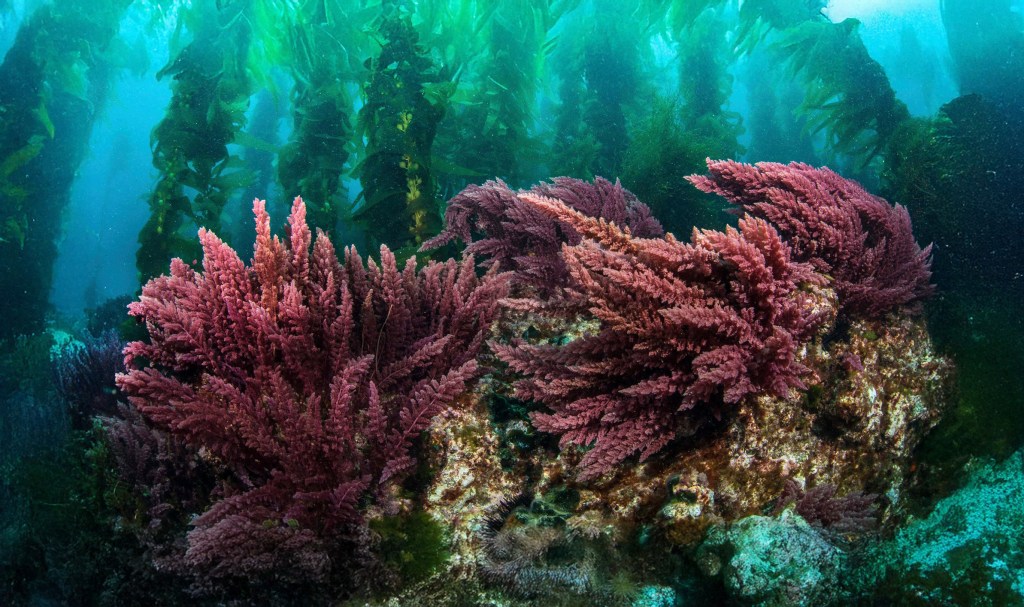
Asparagopsis taxiformis, commonly known as red sea plume, a tropical red algae being studied for its ability to cut methane emissions from cattle. (Photo: Wikipedia)

“You need to feed the cows only less than 1% of their diet with this red algae and it can reduce up to 99% of their methane emissions,” said Dr. Or Ben Zvi, an Israeli postdoctoral researcher at Scripps who studies both corals and seaweeds.

Trials in Australia, California, and other regions have shown just how potent this seaweed can be. As Dr. Ben Zvi indicated, even at tiny doses, fractions of a percent of a cow’s feed, other studies have shown that it can reduce methane by 30 to 90 percent, depending on conditions and preparation. Such results suggest enormous potential, but only if enough of the seaweed can be produced consistently and sustainably.

“At the moment it is quite labor intensive,” says Ben Zvi. “We’re developing workflows to create a more streamlined and cost-effective industry.”

Which explains to bubbling flasks around me now. 
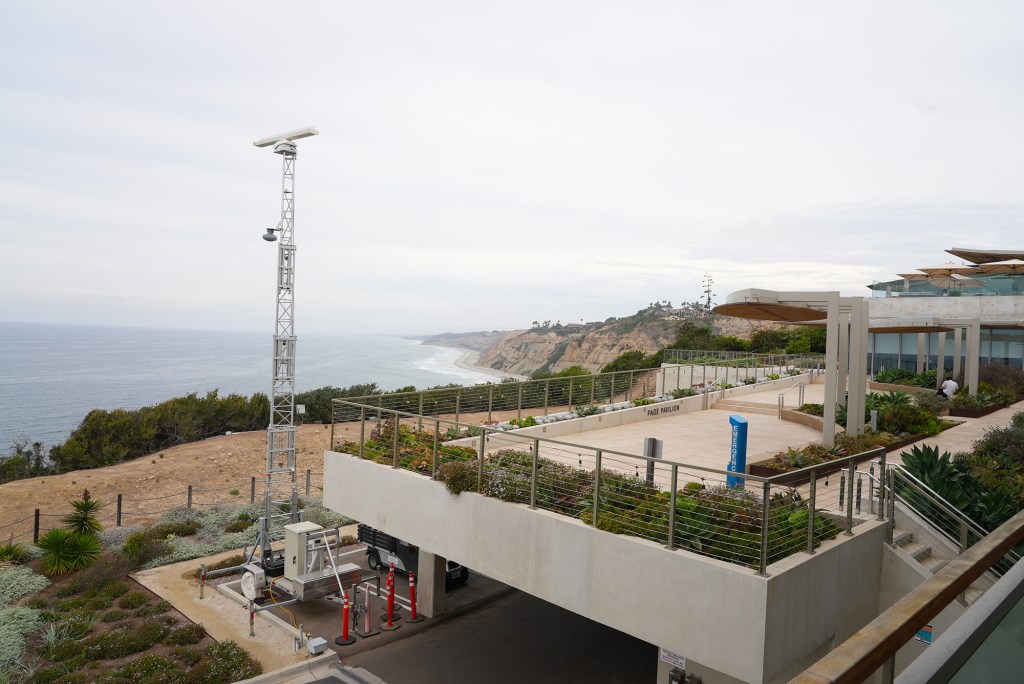
Scripps Institution of Oceanography at UC San Diego (Photo: Erik Olsen)

The Smith lab here at Scripps studies every stage of the process, from identifying which strains of Asparagopsis thrive locally to testing how temperature, light, and carbon dioxide affect growth and bromoform content. Dr. Ben Zvi is focused on the life cycle and photosynthesis of the species, refining culture techniques that could make large-scale cultivation possible. At Scripps, environmental physiology experiments show that local strains grow best at 22 to 26 °C and respond well to elevated COâ‚‚, information that could guide commercial farming in Southern California.

The challenges, however, are considerable. Wild harvesting cannot meet demand, and cultivating seaweed at scale requires reliable methods, stable yields, and affordable costs. Bromoform content varies widely depending on strain and growing conditions, so consistency remains an issue. Some trials have noted side effects such as reduced feed intake or excess mineral uptake, and long-term safety must be established since we’re talking about animals that we breed and raise to eat.

“It’s still a very young area, and we’re working on the legislation of it,” says Ben Zvi. “We need to make it legal to feed to a cow that eventually we either drink their milk or eat their meat. We need for it to be safe for human consumption.” 

Dr. Or Ben Zvi (Photo: Erik Olsen)

And, of course, large-scale aquaculture raises ecological questions, from nutrient demands and pollution to the fate of volatile compounds like bromoform.

To overcome these obstacles, collaborations are underway. UC San Diego and UC Davis have launched a pilot project under the UC Carbon Neutrality Initiative to test production methods and carbon benefits. In 2024, CH4 Global, a U.S.-based company with operations in New Zealand and Australia that develops seaweed feed supplements to cut livestock methane, partnered with Scripps to design cultivation systems that are efficient, inexpensive, and scalable. Within the Smith Lab, researchers are continuing to probe the biology of Asparagopsis, mapping its genetics, fine-tuning its culture, and testing ways to maximize both growth and methane-suppressing compounds.

At a time when university-based science faces immense pressures, the Smith Lab at Scripps provides a glimpse of research that is making a real impact. The coral tanks against the wall belong to another project at the lab, and we have another story coming soon about the research that readers will find very interesting, but the bubbling flasks in the alcove reveal how breakthroughs often start with small details. In this case, the discovery that a chemical in a widely available seaweed could have such a dramatic, and apparently harmless, effect on the methane that animals make in their guts. These modest but powerful steps are shaping solutions to global challenges, and California, with its wealth of scientific talent and institutions, remains at the forefront. It is one of many other stories we want to share, from inside the labs to the wide open spaces of the state’s natural landscapes. 

John Isaacs, the Maverick Oceanographer Who Wanted to Tow Icebergs to California

An AI rendering of Isaacs’ bold idea (Midjourney)

California’s water crises have always inspired bold solutions, but few ideas rival the sheer audacity of John Isaacs’ proposal to tow a giant Antarctic iceberg to San Diego. A brilliant and unconventional researcher at the Scripps Institution of Oceanography, Isaacs made waves in 1949 with his imaginative, though controversial, plans to quench California’s chronic droughts by harnessing the frozen reservoirs of the polar regions.

Isaacs’ career was defined by his boundary-pushing ideas. A polymath with a keen interest in marine biology, engineering, and climate science, he often operated at the intersections of disciplines, challenging conventional thinking. The iceberg-towing proposal exemplified his knack for blending vision and pragmatism—if one were willing to stretch the definition of “pragmatic.”

Isaacs theorized that large Antarctic icebergs could be wrapped in insulation to slow their melting and then towed by tugboats up the Pacific coast. The journey, spanning thousands of miles, would end with the iceberg positioned off the coast of Southern California, where its meltwater could be harvested to replenish reservoirs. Isaacs estimated that a single large iceberg, some the size of Manhattan, could supply tens of billions of gallons of freshwater—enough to offset drought conditions for millions of people.

John D. Isaacs (Scripps Institution of Oceanography)

The concept wasn’t a fleeting thought. Isaacs expanded on his idea in 1956, suggesting the capture of an eight-billion-ton iceberg—20 miles long, 3,000 feet wide, and 1,000 feet deep—and towing it to San Clemente Island off San Diego in approximately 200 days. He even calculated that a fleet of six ocean-going tugs could accomplish the feat, taking about six months to tow the iceberg from the 65th parallel south to the Californian coast.

In October 1973, the RAND Corporation took Isaacs’ vision further with an extensive report titled “Antarctic Icebergs as a Global Fresh Water Source” for the National Science Foundation. This 96-page document, authored by J.L. Hult and N.C. Ostrander, provided the most detailed scheme to date, transforming the theoretical idea into a more structured and mathematical model. It envisioned the creation of an “iceberg train” and delved into the technicalities and logistics of towing icebergs across the ocean. Hult explained, “Bringing icebergs to where the water is needed was suggested by John Isaacs of Scripps Institute of Oceanography in the 1950s. It is our job to show how practical it is.” However, the plan was not without eccentricities—such as the suggestion of using a floating nuclear power plant to supply the energy needed for the operation. The RAND report exemplified the ambition of its era, though many of its assumptions leaned heavily on theoretical modeling rather than practical viability.

AI rendering of an iceberg being dismantled (Midjourney)

Isaacs wasn’t alone in dreaming big. His proposal came at a time when other researchers and engineers were exploring similarly outlandish ideas, like seeding clouds with silver iodide to induce rain or building massive aqueducts from Alaska. But Isaacs’ iceberg scheme captured imaginations for its sheer romance and its symbolic uniting of Earth’s polar extremes with parched California landscapes.

Isaacs knew his plan faced enormous technical, logistical, and financial hurdles. For one, towing an iceberg would require immense energy and coordination, as well as a fleet of powerful ships. The iceberg’s tendency to melt during transit—especially when entering warmer waters—posed another significant obstacle. To mitigate this, Isaacs suggested covering the iceberg in reflective materials or insulating blankets to slow heat absorption.

Then there was the issue of economics. Calculations revealed that the cost of transporting a single iceberg could run into the billions, far outweighing the price of more conventional water solutions like desalination plants or water recycling programs. Critics also worried about ecological disruption, from changing ocean currents to the impact on marine ecosystems along the iceberg’s route.

While Isaacs’ iceberg idea was never realized, it sparked a wave of creative thinking about unconventional water solutions. Today, some of the principles behind his ideas have resurfaced in modern innovations. Advanced engineering methods, including climate-resilient infrastructure and adaptive water management, owe a debt to the exploratory spirit of Isaacs’ era.

AI rendering of an aqueduct built to carry water from Alaska to California (Midjourney)

The iceberg-towing concept is occasionally revisited, especially as climate change intensifies water scarcity. For example, in recent years, researchers in the United Arab Emirates have considered similar plans to bring freshwater from polar ice to arid regions. Advances in materials science and energy efficiency have made some aspects of Isaacs’ vision more feasible, though the logistics remain daunting.

CALIFORNIA CURATED ART ON ETSY

Purchase stunning art prints of iconic California scenes.
Check out our Etsy store.

John Isaacs’ career extended far beyond icebergs. He contributed to deep-sea exploration, studied the effects of nuclear fallout on marine life, and was an early advocate for understanding the ocean’s role in climate systems. His interdisciplinary approach and willingness to embrace unorthodox solutions left a lasting impact on oceanography and environmental science.

Isaacs’ iceberg proposal remains a testament to his fearless creativity and his deep commitment to solving humanity’s greatest challenges. While the world never saw an iceberg floating past Los Angeles, Isaacs’ bold thinking continues to inspire researchers grappling with the complex interplay of science, technology, and the environment.

Black Gold Beach or How Oil Transformed Long Beach and Built the Southern California Economy

Signal Hill oil development (Photo: The Huntington Library, Art Museum, and Botanical Gardens)

Southern California is best known for its sun-soaked beaches and Hollywood glamour, but it also has a wilder, largely forgotten past: it was once an oil kingdom. It’s a story even many Californians don’t know, a tale of spectacular gushers, fortunes won and lost, and larger-than-life characters straight out of a movie. Without oil, Los Angeles, and much of Southern California, would be very different places today.

The story of oil in Southern California is inextricably linked to the Long Beach fields, an area that once seemed more like a scene from Texas or There Will Be Blood than the Golden State. The discovery of oil in this region wasn’t just a footnote in economic journals; it was a seismic event that transformed the landscape, both literally and metaphorically. And it provided an industrial center of gravity to a region of the state that was just beginning to emerge as one of the world’s great gateways of commerce.

Signal Hill, 1926 (Public Domain)

The early 20th century was the beginning of the era of oil in California. On June 23, 1921 at 9:30 a.m., the Alamitos No. 1 oil well on Signal Hill in Long Beach was drilling 2,765 feet beneath the surface when the drill struck an underground oil deposit. This oil was under high pressure due to natural gas, blowing a gusher of oil over 100 feet high, and heralding the start of the Long Beach oil boom.

This event marked the discovery of one of the most prolific oil fields in the Los Angeles basin. Throughout the 1920s, Signal Hill, along with the nearby Santa Fe Springs field, experienced numerous blowouts, which erupted into dramatic pillars of flame that could be seen for miles. These incidents eventually prompted calls for stricter safety regulations. Consequently, in 1929, the state mandated the use of blow-out prevention equipment on all oil wells drilled in California.

Signal Hill quickly mushroomed into a forest of oil derricks, with fortunes being made overnight. As one of the most productive oil fields in the world, the Long Beach field was at one point yielding a staggering one-third of California’s total oil production. By the mid-1920s, California was producing nearly a quarter of the world’s entire petroleum supply, much of it from the Long Beach area.

Signal Hill, Long Beach oil development. (Public domain)

That so much oil is present beneath the surface of this stretch of Southern California is a gift of geology. Millions of years ago, the area that is now Long Beach was covered by the ocean. This marine environment was ideal for the accumulation of organic material, such as the remains of tiny plants and animals, on the ocean floor.

CALIFORNIA CURATED ON ETSY

Purchase stunning art prints of iconic California scenes.
Check out our Etsy store.

Over time, layers of sediment buried this organic matter. The high pressure and temperatures associated with deep burial initiated the transformation of this organic material into hydrocarbons – essentially, the formation of oil. Southern California is, of course, known for its active tectonics, influenced by the Pacific and North American Plate boundary. This tectonic activity has created a complex network of faults and folds in the earth’s crust in the Long Beach area.

The folding of the earth’s layers into anticlines (a type of fold that is convex up and has its oldest beds at its core) and the formation of fault traps (where displaced rocks create a seal that traps oil) are particularly important. These structures create reservoirs where oil can accumulate and be preserved over geological time scales.

Map of the Long Beach oil field.

As the oil flowed, so did the stories of those who sought their fortune in black gold. Perhaps the most famous of these was Edward L. Doheny, a name synonymous with California oil. Doheny, an ambitious prospector, was one of the first to recognize the potential of the Los Angeles Basin’s oil fields. His success in the oil industry was meteoric, but it was not without controversy, as he was later embroiled in the infamous Teapot Dome scandal.

Portrait of oil magnate Edward L. Doheny (Wikipedia)

The impact of oil production in Southern California extended beyond economics. It reshaped the region’s landscape, both physically and culturally. Towns sprung up around oil fields, and workers flocked to the area, drawn by the promise of jobs and prosperity. Long Beach, once a sleepy coastal town, burgeoned into a bustling city.

During the 1920s, regulations on well spacing were minimal, allowing Signal Hill to market narrow town lots. These lots were swiftly purchased by aspiring oil tycoons who installed wells so close to each other that they almost touched. Despite the dense placement, the wells generally remained profitable, though they rapidly depleted the oil field. The hill earned the nickname “Porcupine Hill” due to its appearance from afar, bristling with numerous wooden oil derricks since the more compact “nodding-donkey” pumpjack had not yet been developed.

The booming oil industry in the region attracted a massive influx of workers and investments. As oil fields expanded, Long Beach rapidly transformed from a seaside resort into an industrial powerhouse. The surge in economic activity and the availability of abundant oil fueled the growth of industries in and around Long Beach, including the burgeoning shipping and maritime sectors.

Container ships outside the Port of Los Angeles during the Covid lockdown in 2020. (Photo: Erik Olsen)

The construction of the Port of Los Angeles, which began in earnest in the early 1900s, was driven by the need to support the growing economic activities in Southern California, including agriculture, manufacturing, and oil. The proximity of Long Beach to the port, only about 20 miles south, meant that it was strategically positioned to benefit from and contribute to the port’s activities. The port served as a critical node for shipping oil, among other goods, which further integrated Long Beach, and Southern California as a whole, into the global trade system.

Signal Hill in Long Beach today. (Erik Olsen)

Moreover, the infrastructure developments necessary to support the oil industry, such as roads, railroads, and later pipelines, also facilitated the growth of the port. These developments enhanced the logistical capabilities of the region, making it more attractive for commercial and industrial activities. The oil boom thus not only transformed Long Beach but also had a cascading effect on the development of the Port of Los Angeles, cementing the region’s role as a vital hub in international trade and commerce.

As big and diverse in industry Los Angeles has become, it mostly started with oil. The fact that Los Angeles is now hardly known for oil, but better known for its massive entertainment and tourism economies is an astonishing transformation.

Of course, the influx of wealth and people also brought challenges, including environmental concerns and the need for regulatory oversight. It is well known that several major oil spills have taken place off the coast, ruining beaches and killing animals by the millions. In 1969, the Santa Barbara oil spill released vast quantities of oil into the ocean, creating an environmental disaster along the California coastline. This catastrophic event galvanized public awareness and activism, leading to the creation of the first Earth Day, as well as significant environmental legislation, including the establishment of the U.S. Environmental Protection Agency.

The oil slick visible around Platform A in the Santa Barbara Channel emanated from fissures in the seabed. (Photo: USGS)

Oil spills continue to take place in Southern California and the existence of 26 rigs off the coast are a reminder of that oil boom era. Those rigs are coming to the end of their productive life, however, and an on-gong controversy is what to do with them. Remove them or leave them — or part of them — as artificial reefs?

Over time, oil production in Southern California has waxed and waned. The easily accessible oil has largely been extracted, and production has declined from its mid-20th-century peak. Yet, the legacy of this era persists. It’s etched into the region’s physical and cultural landscape, from the bobbing oil derricks still dotting Signal Hill to the fortunes and institutions built on oil money.

The story of oil in Southern California, particularly the Long Beach fields, is a saga of geologic luck, ambition, ingenuity, and, at times, dangerous greed. It’s a chapter in the state’s history that’s as rich and complex as the oil that still lies beneath its surface, and yet it remains largely unknown to many people who think of Southern California as a paradise of sand and rolling waves.