The Salton Sea Was California’s Strangest Catastrophe

In California’s southeastern desert, the Salton Sea stretches across a wide, shimmering basin, a lake where there shouldn’t be one. At about 340 square miles, it’s the state’s largest lake. But it wasn’t created by natural forces. It was the result of a major engineering failure. I’ve long been fascinated with the place: its contradictions, its strangeness, its collision of nature and human ambition. It reflects so many of California’s tensions: water and drought, industry and wilderness, beauty and decay. And it was only relatively recently that I came to understand not just how the Salton Sea came to exist, but how remarkable the region’s geological past really is, and how it could play a major role in the country’s sustainable energy future.

In the early 1900s, the Imperial Valley was seen as promising farmland: its deep, silty soil ideal for agriculture, but the land was arid and desperately needed irrigation. To bring water from the Colorado River, engineers created the Imperial Canal, a massive infrastructure project meant to transform the desert into productive farmland. But the job was rushed. The canal had to pass through the Mexican border and loop back into California, and much of it ran through highly erodible soil. Maintenance was difficult, and by 1904, silt and sediment had clogged portions of the canal.
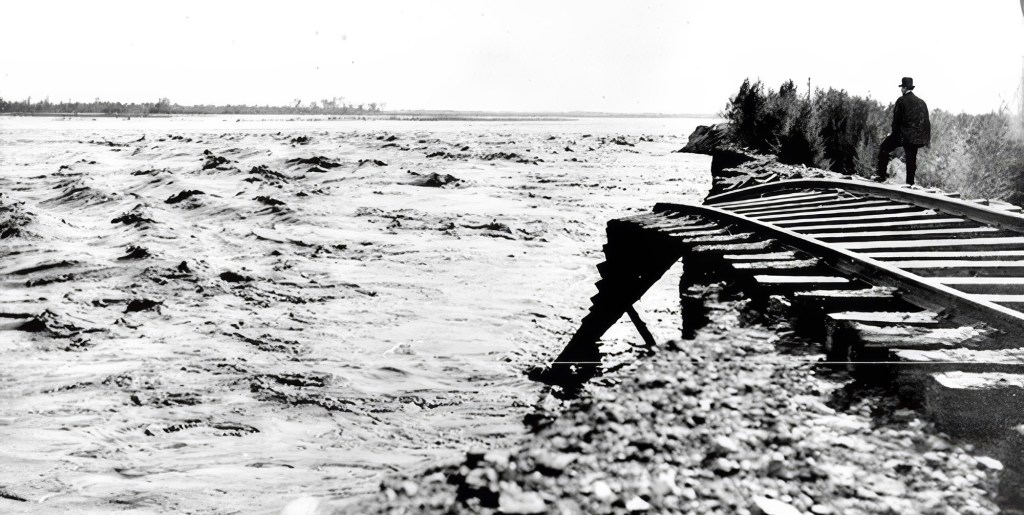
The Southern Pacific Railroad was forced to move it lines several times as the raging, unleashed Colorado River expanded the Salton Sea. (Credit: Imperial Irrigation District)

To keep water flowing, engineers hastily dug a temporary bypass channel south of the clogged area, hoping it would only be used for a few months. But they failed to build proper headgates, critical structures for controlling water flow. In 1905, an unusually heavy season of rain and snowmelt in the Rockies caused the Colorado River to swell. The torrent surged downriver and overwhelmed the temporary channel, carving it wider and deeper. Before long, the river completely abandoned its natural course and began flowing unchecked into the Salton Sink, an ancient, dry lakebed that had once held water during wetter epochs but had long since evaporated. (This has happened many times over in the region’s history).

For nearly two years, the Colorado River flowed uncontrolled into this depression, creating what is now known as the Salton Sea. Efforts to redirect the river back to its original course involved a frantic, expensive engineering campaign that included the Southern Pacific Railroad and U.S. government assistance. The breach wasn’t fully sealed until early 1907. By then, the sea had already formed: a shimmering, accidental lake nearly 35 miles long and 15 miles wide, with no natural outlet, in the middle of the California desert.

In the 1950s and early ’60s, the Salton Sea was a glamorous desert escape, drawing crowds with boating, fishing, and waterskiing. Resorts popped up along the shore, and celebrities like Frank Sinatra, Jerry Lewis, Rock Hudson, the Beach Boys, and the Marx Brothers came to visit and perform. It was billed as a new Palm Springs with water, until rising salinity and environmental decline ended the dream. There have been few if any similarly starge ecological accidents like it.
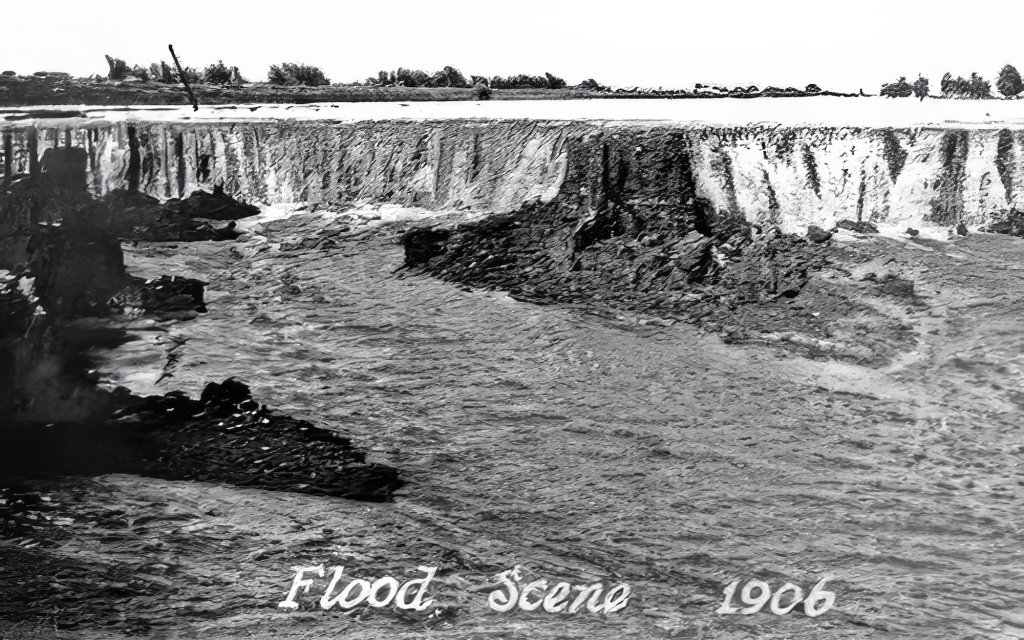
The erosive power of the floodwaters was immense. The river repeatedly scoured channels that created waterfalls, which cut back through the ground, eroding soil at a rate of about 1,200 meters per day and carving gorges 15 to 25 meters deep and more than 300 meters wide. (Credit: Imperial Irrigation District)

The creation of the Salton Sea was both a blessing and a curse for the people of the Imperial Valley. On the one hand, the lake provided a new source of water for irrigation, and the fertile soil around its shores proved ideal for growing crops. On the other hand, the water was highly saline, and the lake became increasingly polluted over time, posing a threat to both human health and the environment.

Recently, with most flows diverted from the Salton Sea for irrigation, it has begun to dry up and is now considered a major health hazard, as toxic dust is whipped up by heavy winds in the area. The disappearance of the Salton sea has also been killing off fish species that attract migratory birds.

California Curated Etsy

 The New York Times recently wrote about the struggles that farmers face as the Salton Sea disappears, and how the sea itself will likely disappear entirely at some point.

“There’s going to be collateral damage everywhere,” Frank Ruiz, a program director with California Audubon, told the Times. “Less water coming to the farmers, less water coming into the Salton Sea. That’s just the pure math.”

Salton Sea can be beautiful, if toxic (Photo: Wikipedia)

To me, the story of the Salton Sea is fascinating: a vivid example of how human intervention can radically reshape the environment. Of course, there are countless cases of humans altering the natural world, but this one feels particularly surreal: an enormous inland lake created entirely by accident, simply because a river, the Colorado, one of the most powerful in North America, was diverted from its course. It’s incredible, and incredibly strange. What makes the region even more fascinating, though, is that the human-made lake sits in a landscape already full of geological drama.

The area around the Salton Sea is located in a techtonically active region, with the San Andreas Fault running directly through it. The San Andreas Fault is a major plate boundary, where the Pacific Plate is moving north relative to the North American Plate (see our story about how fast it’s moving here). As pretty much every Californian knows, the legendary fault is responsible for the earthquakes and other tectonic activity across much of California.

If you look at a map of the area, you can see how the low lying southern portion of the Salton Sea basin goes directly into the Gulf of California. Over millions of years, the desert basin has been flooded numerous times throughout history by what is now the Gulf of California. As the fault system cuts through the region, the Pacific Plate is slowly sliding northwest, gradually pulling the Baja Peninsula away from mainland Mexico. Over millions of years, this tectonic motion is stretching and thinning the crust beneath the Imperial Valley and Salton Basin. If the process continues, geologists believe the area could eventually flood again, forming a vast inland sea, perhaps even making an island out of what is today Baja California. (We wrote about this earlier.)

Entrance to the Salton Sea Recreation Area (Wikipedia)

Yet even as the land shifts beneath it, the Salton Sea’s future may be shaped not just by geology, but by energy. Despite the ongoing controversy over the evaporating water body, the Salton Sea may play a crucial role in California’s renewable energy future. The region sits atop the Imperial Valley’s geothermal hotspot, where underground heat from all that tectonic activity creates ideal conditions for producing clean, reliable energy. Already home to one of the largest geothermal fields in the country, the area is now gaining attention for something even more strategic: lithium.
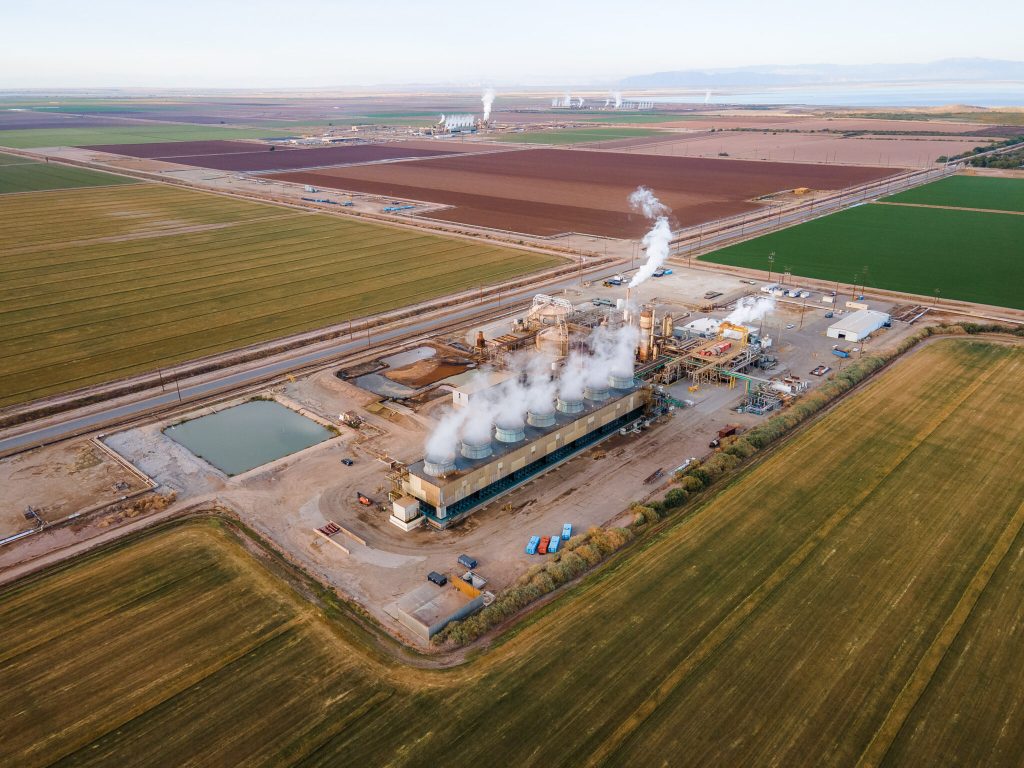
An aerial view of geothermal power plants among the farmland around the southern shore of the Salton Sea.
(Credit: Courtesy Lawrence Berkeley National Lab)

Beneath the surface, the hot, mineral-rich brine used in geothermal energy production contains high concentrations of lithium, a critical component in electric vehicle batteries. Known as “Lithium Valley,” the Salton Sea region has become the focus of several ambitious extraction projects aiming to tap into this resource without the large environmental footprint of traditional lithium mining. Gov. Gavin Newsom called the area is “the Saudi Arabia of lithium.” Even the Los Angeles Times has weighed in, claiming that “California’s Imperial Valley will be a major player in the clean energy transition.”

Companies like Controlled Thermal Resources (CTR) and EnergySource are developing direct lithium extraction (DLE) technologies that pull lithium from brine as part of their geothermal operations. The promise is a closed-loop system that produces both renewable energy and battery-grade lithium on the same site. If it proves viable, the Salton Sea could significantly reduce U.S. dependence on foreign lithium and cement California’s role in the global shift to clean energy. That’s a big if…and one we’ll be exploring in depth in future articles.
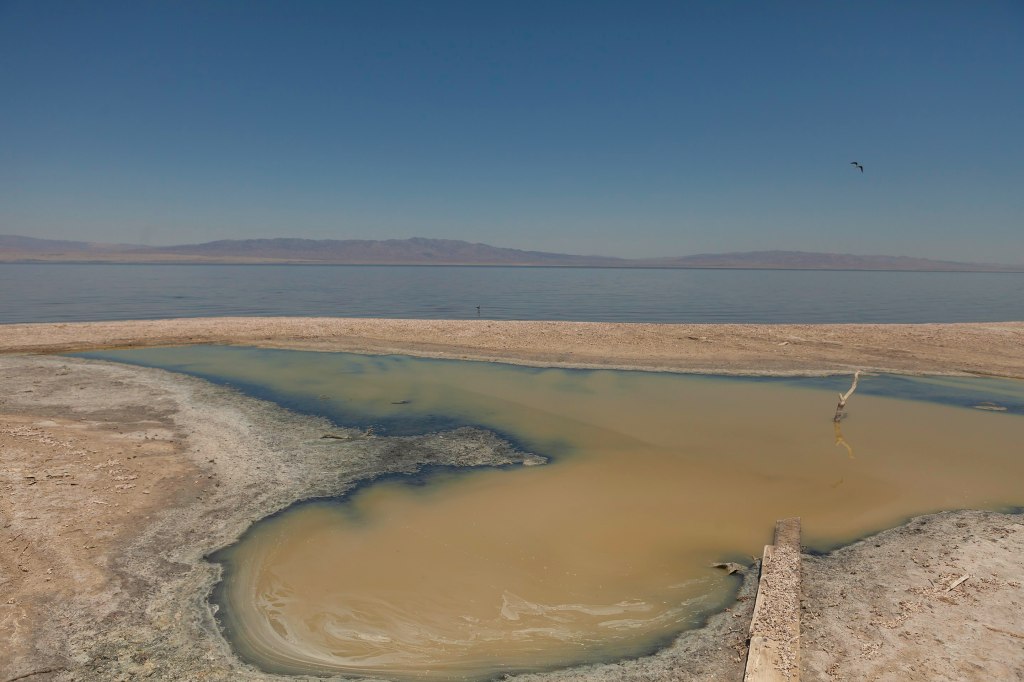
Toxic salt ponds along the Western shoreline (Photo: EmpireFootage)

Such projects could also potentially provide significant economic investment in the region and help power California’s green energy ambitions. So for a place that looks kind of wrecked and desolate, there actually a lot going on. We promise to keep an eye on what happens. Stay tuned.
Creosote Bushes Are the Mojave Desert’s Time Travelers 

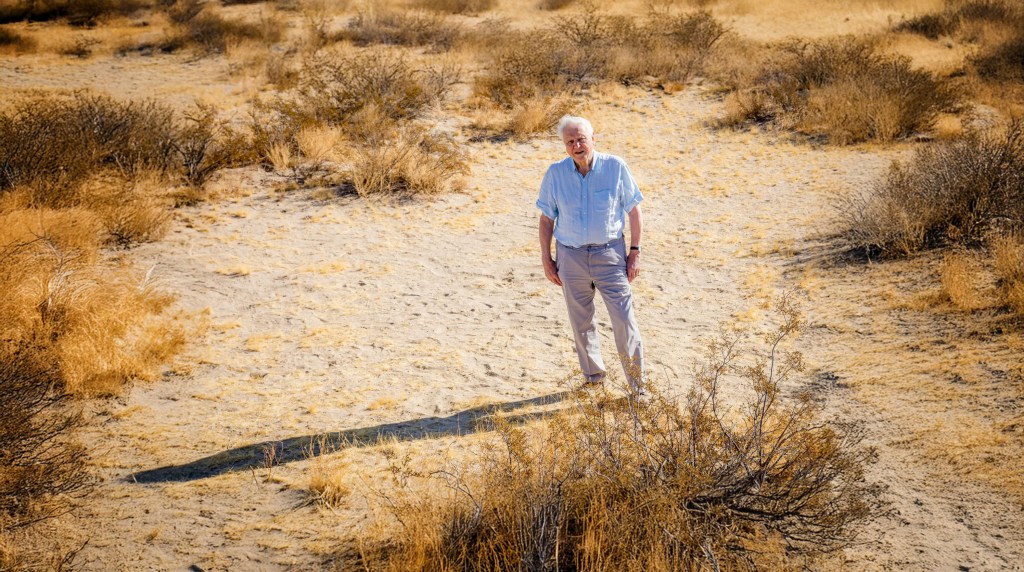
Scene from BBC’s Green Planet in California’s Mojave Desert (BBC)

The creosote bush, a seemingly unassuming plant that dots the arid expanses of North American deserts, holds secrets to aging that would make Silicon Valley longevity bros green with envy. In the Mojave Desert, one creosote plant known as “King Clone” is estimated to be over 12,000 years old, making it one of the oldest living clonal organisms on Earth. This astonishing fact was highlighted in the BBC series The Green Planet, where Sir David Attenborough brought the extraordinary resilience and survival strategies of desert flora to a broad public audience. The series as a whole is excellent, but the episode on desert plants, Desert Worlds, was especially fascinating and enlightening—particularly for a dedicated succulent fan like me. Watching it inspired me to research and write this article.

While many of the other filming locations were far-flung landscapes like the Succulent Karoo Desert in South Africa, one story unfolds in California’s Mojave Desert, where Attenborough, with his signature mellifluous voice, marvels at the remarkable longevity of the creosote bush. In a compelling scene, Attenborough revisits “King Clone” in the Mojave that he first filmed in 1982 for “The Living Planet.” Despite the four-decade interval, the bush had grown less than one inch, highlighting its incredibly slow growth rate.

King Clone, the 11,700-year-old creosote bush ring in the Mojave Desert (Wikipedia)

Creosote bushes, or Larrea tridentata, are native to the deserts of the southwestern United States and northern Mexico. Though often associated with arid landscapes, they are also a defining species of desert chaparral. Much of Southern California’s landscape is dominated by chaparral, a diverse and resilient plant community adapted to dry summers, periodic wildfires, and nutrient-poor soils. This ecosystem, characterized by drought-resistant shrubs like manzanita, chamise, and scrub oak, extends from coastal foothills to inland mountains, shaping the region’s ecology and fire cycles.

Creosote bushes thrive in some of the harshest environments on the planet, enduring scorching temperatures, relentless sunlight, and prolonged droughts. Few other plants are so hardy. The secret to their survival lies in their evolutionary adaptations, honed over millennia to combat the unforgiving desert landscape.

CALIFORNIA CURATED ON ETSY

Purchase stunning art prints of iconic California scenes.
Check out our Etsy store.

As climate change intensifies heatwaves and disrupts rainfall patterns, even these desert survivors are showing signs of stress. Rising temperatures accelerate evapotranspiration, pushing groundwater further out of reach, while prolonged droughts hinder seedling establishment, threatening the species’ long-term viability. Scientists are studying how creosote’s resilience is being tested, and whether its decline could signal deeper ecological shifts in desert ecosystems already on the edge of survival. A 2021 University of California, Irvine study observed a 35% decrease in vegetation cover, including creosote bushes, in Southern California deserts between 1984 and 2017, attributing this decline to rising temperatures and increased aridity.

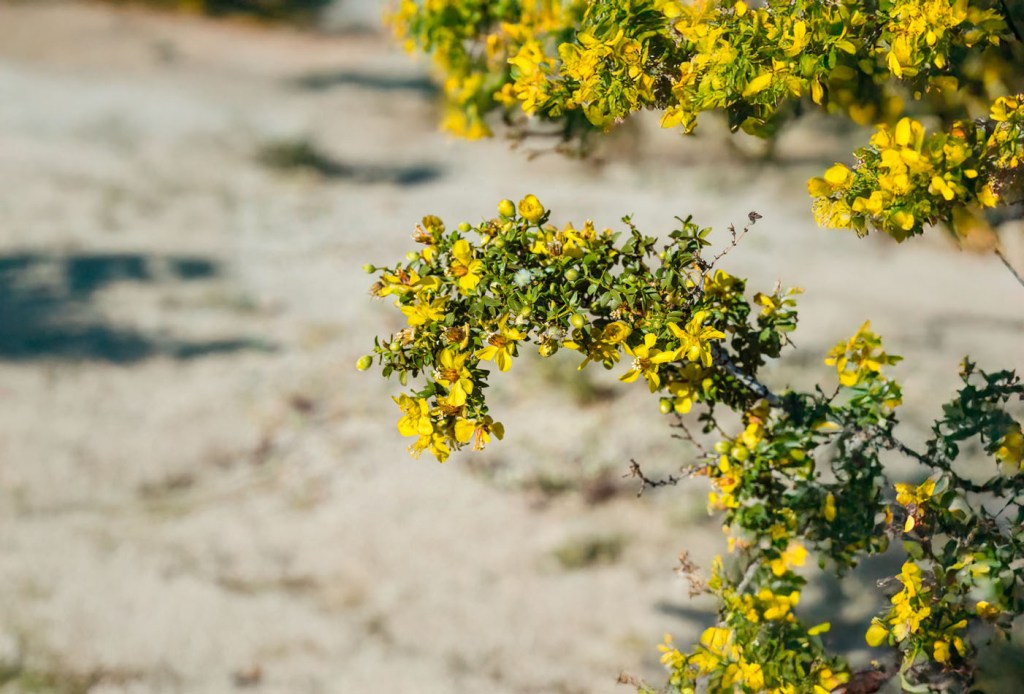
Golden bursts of resilience—creosote in bloom, thriving in the heart of the desert. (Erik Olsen)

Despite its usual appearance as a dry, uninviting shrub, the creosote bush surprises with delicate bursts of yellow when it blooms. After rainfall, its tough, resinous branches come alive with small, waxy flowers, adding a rare vibrancy to the desert. Unlike many plants that follow a strict seasonal cycle, creosote can bloom multiple times a year whenever moisture allows, a testament to its adaptability.

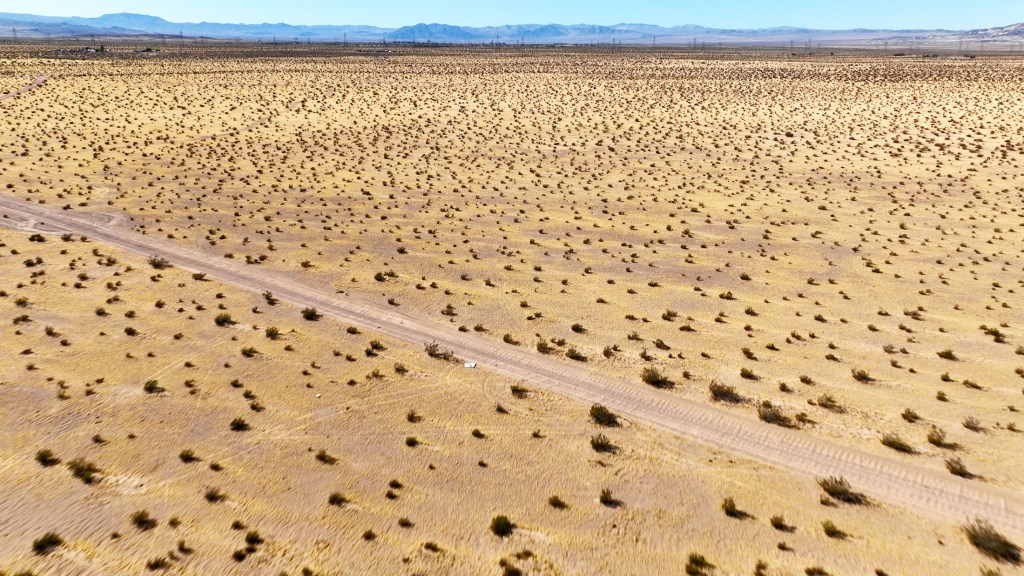
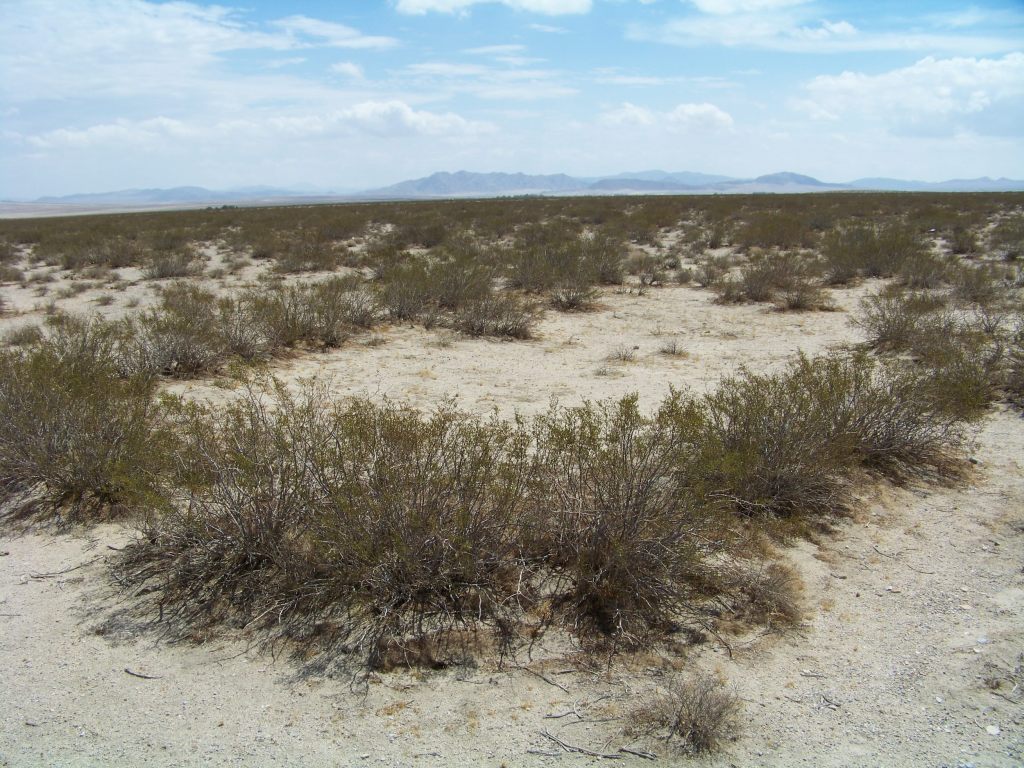
As mentioned, one of the most fascinating aspects of the creosote bush is its strategy of slow growth. This deliberate pace is not a sign of fragility but an ingenious response to scarcity. By growing slowly, creosote bushes conserve precious resources like water and nutrients, ensuring their survival even in the driest years. Few plants are quite so good at this feat. Their roots extend deep into the ground, tapping into hidden water reserves, while their leaves are coated in a waxy layer to minimize water loss through evaporation. This slow-and-steady approach has allowed them to outlast countless environmental changes and competitors. As a result of this unique adaptation, the creosote largely dominates much of the desert landscape, particularly in the Mojave. If you’ve ever driven along Highway 395 through the desert, creosote bushes often dot the landscape for as far as the eye can see.

Creosote in the Mojave desert (Photo: Erik Olsen)

The creosote bush’s longevity also owes much to its clonal growth pattern, where new stems sprout from the same root system, allowing the plant to persist for thousands of years. King Clone, for instance, is not a single plant but a massive clonal colony that spans over 11 meters in diameter. Each stem may live for decades before dying off, but new stems sprout from the same root system, creating a continuous cycle of renewal. This clonal reproduction ensures genetic stability and resilience, enabling the plant to survive for thousands of years. While King Clone represents one of the oldest clonal organisms, it is important to distinguish this from the bristlecone pine (see our story), which holds the title for the oldest singular organism. Unlike the creosote bush, which survives through clonal reproduction by sprouting new stems from a shared root system, the bristlecone pine—like the renowned “Methuselah“—is a single tree that has endured for nearly 5,000 years as an individual entity. (Ponder that for a moment).

Beyond its impressive age and survival strategies, the creosote bush plays a vital ecological role. It provides shelter and sustenance for desert wildlife, including insects, rodents, and birds. Its resinous leaves emit a distinctive odor after rain—a smell that is deeply evocative of the desert and beloved by many who live near these arid regions. Indigenous peoples have long used the plant for medicinal purposes, creating teas and poultices from its leaves to treat ailments such as colds, wounds, and infections.

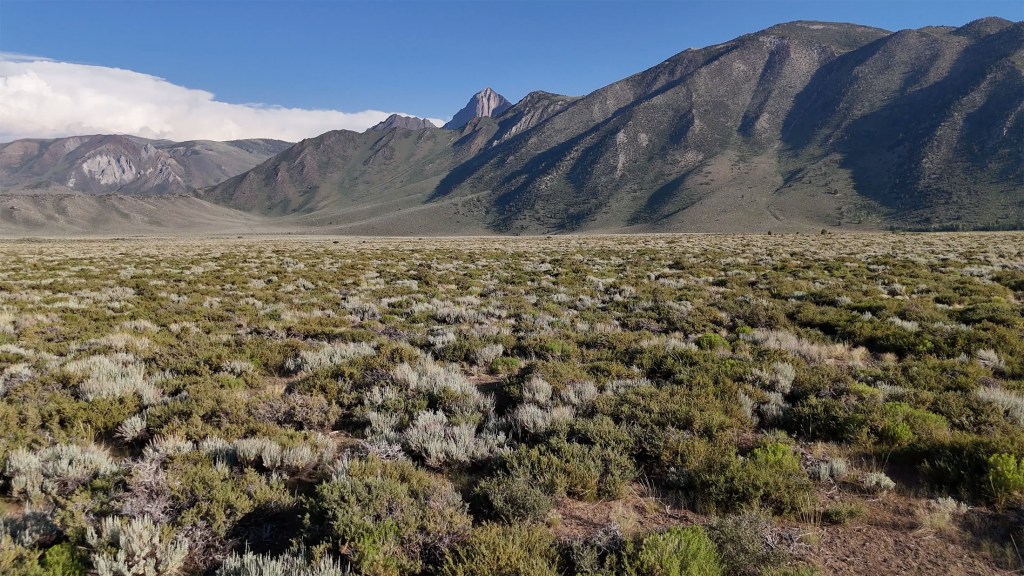
A vast expanse of chaparral stretches endlessly across the eastern Sierra, its rugged shrubs and hardy vegetation thriving in the dry, windswept landscape. (Erik Olsen)

Recent scientific studies have uncovered more about the creosote bush’s unique chemistry. The plant produces a range of compounds to deter herbivores and pathogens, many of which have potential applications in medicine and agriculture. These secondary metabolites are a testament to the plant’s evolutionary ingenuity, further demonstrating how it has carved out a niche in an inhospitable environment. Researchers at the Skaggs School of Pharmacy and Pharmaceutical Sciences at the University of California San Diego and the University of Colorado Anschutz Medical Campus have discovered that compounds from the creosote bush possess strong anti-parasitic properties. These compounds effectively target the protozoa responsible for giardia infections and an amoeba that causes a potentially deadly form of encephalitis. Similarly, The creosote bush contains the antioxidant nordihydroguaiaretic acid (NDGA), which has been extensively studied for its potential anti-carcinogenic, bactericidal, and preservative properties.

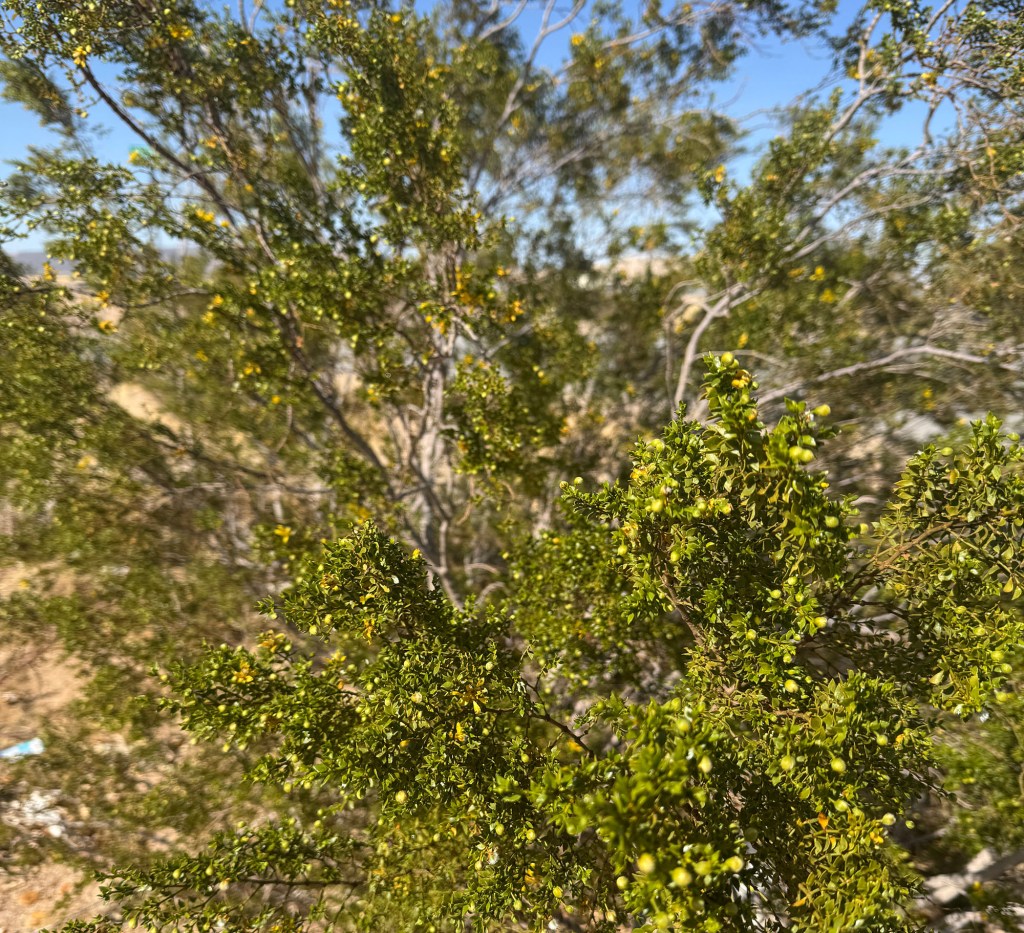
Creosote in the Mojave Desert (Photo: Erik Olsen)

Creosote has played a starring role in the cultural mythology of the American Southwest, serving as a symbol of endurance, isolation, and the stark beauty of the desert. In Edward Abbey’s Desert Solitaire, the tough shrub embodies the rugged resilience of the land, surviving in the harshest conditions with roots that tap deep into the earth. Similarly, in Blood Meridian, Cormac McCarthy’s sun-scorched landscapes are often sprawling with creosote, reinforcing the novel’s themes of violence and survival. The plant also makes its way into music, as seen in Tom Russell’s song Creosote, where it becomes a poetic stand-in for the rough, untamed spirit of the Southwest. Even in visual media like Breaking Bad, the ever-present creosote in the barren New Mexico desert could be interpreted as a symbol of the transformation of Walter White, mirroring the show’s themes of survival at any cost. Across literature, music, and film, creosote remains an enduring emblem of the Southwest, its gnarled branches and pungent scent evoking both the loneliness and allure of the desert frontier.

By the time the animals were secured and they had thrown themselves on the ground under the creosote bushes with their weapons readied the riders were beginning to appear far out on the lake bed, a thin frieze of mounted archers that trembled and veered in the rising heat.

Blood Meridian by Cormac McCarthy

One aim of this publication is to illuminate the mystery and wonder of the world around us. For those of us who call California home, as I have for most of my life (including being born here), we are constantly surrounded by a powerful, awe-inspiring nature—one that is both captivating and exhilarating. Yet, truly grasping the uniqueness of this place often requires more than a passing glance. Even a plant as seemingly ordinary as the creosote bush holds something extraordinary, a blend of magic and science waiting to be recognized. My hope is that on your next drive through the desert, you see that stark landscape with fresh eyes, with a little more respect, a little more wonder, and a deeper sense of admiration.

The Desert Tortoise: A Resilient Survivor of the Mojave

a close-up of a desert tortoise

The Mojave Desert, a harsh yet strikingly beautiful landscape that extends across four western U.S. states, is home to an equally fascinating and resilient creature: the desert tortoise (Gopherus agassizii). This fascinating reptile has evolved to survive in one of the world’s most inhospitable environments, but today, it faces numerous threats that are jeopardizing its existence.

The desert tortoise is a tortoise species in the family Testudinidae native to the Mojave and Sonoran deserts. They are specially adapted to withstand the extreme conditions of their desert habitat. Desert tortoises can tolerate water, salt, and energy imbalances on a daily basis, which increases their lifespans. On average, adult desert tortoises measure between 10 to 14 inches in shell length and weigh from 8 to 15 pounds. They have a high-domed shell, typically brownish in color, which serves as protection from predators. Their strong, stocky limbs are adapted for digging, an essential behavior for both foraging and creating burrows for shelter.

One of the desert tortoise’s most fascinating adaptations is its ability to store water. They have a large urinary bladder that can store over 40% of the tortoise’s body weight in water, urea, uric acid, and nitrogenous wastes. During the hot, dry summer months, this stored water can be reabsorbed back into the tortoise’s system, effectively allowing them to survive up to a year without access to fresh water.

a close-up of a desert tortoise

Desert tortoises are a testament to survival, with their lineage dating back 15 to 20 million years. They are primarily herbivorous, with a diet consisting of a variety of desert grasses, herbs, and wildflowers, along with the occasional consumption of insects and new growth of cacti.

Tortoises spend much of their lives in burrows, which provide refuge from extreme heat, cold, and predators. They are most active during the cooler hours of the day, and their activity pattern shifts with the changing seasons. Mating typically occurs in the spring and fall, with females laying a clutch of up to 15 eggs, though the survival rate of these hatchlings is low due to predation and harsh environmental conditions.

In 2011, on the basis of DNA, geographic, and behavioral differences between desert tortoises east and west of the Colorado River, it was decided that two species of desert tortoises exist: Agassiz’s desert tortoise (Gopherus agassizii) and Morafka’s desert tortoise (Gopherus morafkai). The new species name is in honor of the late Professor David Joseph Morafka of California State University, Dominguez Hills.

Desert tortoises spend 95% of their lives in their burrow. Seeing them on the landscape is a rare treat.

Estimates suggest that the population of desert tortoises has plummeted by as much as 90% since the mid-20th century. This decline is due to a variety of factors, including habitat loss from urban development and agriculture, road mortality, predation by dogs and other introduced species, and disease. In particular, upper respiratory tract disease (URTD), caused by the bacterium Mycoplasma agassizii, has been responsible for significant mortality.

Recognizing the threats faced by the desert tortoise, the U.S. Fish and Wildlife Service listed the species as threatened under the Endangered Species Act in 1990. This has led to numerous conservation efforts aimed at preserving the desert tortoise and its habitat.

Habitat conservation is a key focus, with several Desert Wildlife Management Areas established to protect crucial tortoise habitats. Efforts are also being made to reduce the impact of roads and highways on tortoise populations, such as the construction of underpasses and fencing along known tortoise crossing areas.

Education and public engagement are also critical components of conservation efforts. Initiatives are underway to educate the public about the desert tortoise and the importance of not removing them from their natural environment, a practice that can lead to population decline and the spread of disease.

Over the past few decades, desert tortoise populations have declined significantly, with estimates suggesting a staggering 90% reduction in some areas of the Mojave Desert. This decline has led to the desert tortoise being listed as “threatened” under the U.S. Endangered Species Act.

Desert tortoise facts
Lifespan: 30-50 years, but some can live to be over 80 years old
Weight: 8-15 pounds (3.5-7 kilograms)
Length: 9-15 inches (23-38 centimeters)
Range: Only found in the Mojave Desert in California, Nevada, Arizona, and Utah
Conservation status: Listed as threatened under the Endangered Species Act

Nature Conservancy

Numerous factors contribute to this decline, including habitat loss due to urbanization, off-road vehicle use, and livestock grazing. Additionally, the introduction of non-native predators, such as the common raven, has led to increased predation on juvenile tortoises.

Conservation organizations, government agencies, and local communities have come together to implement various strategies aimed at protecting and preserving the desert tortoise. These efforts include habitat restoration, fencing off sensitive areas, and developing educational programs to raise awareness about the species.

One such initiative is the “Adopt-a-Tortoise” program, which allows individuals and organizations to symbolically adopt a tortoise, with the proceeds going towards conservation efforts. Another important initiative is the “Head Start” program, which raises hatchlings in captivity until they reach a size less vulnerable to predators before releasing them into the wild.