Transforming California’s Oil Platforms into Marine Sanctuaries

An abundance of sea life is thriving on the substructure beneath the Eureka oil rig in Southern California (Erik Olsen)

If I told you that some of the richest, densest communities of marine life anywhere in the world thrive off California, you might not be surprised. We all know California has a vibrant marine ecosystem offshore. But if I told you that much of that life clings to the submerged steel legs of offshore oil rigs, you might pause, blink, and say: really?

The answer is yes.

I know because I have dived a few of them several times. Most recently this November, when I took a dive boat called the Giant Stride out of San Pedro and motored 12 miles out to the Eureka platform, which sits in 700 feet of water. From the deck, the rig looms like a floating city of steel and shadow, its massive pylon legs disappearing into the depths below.
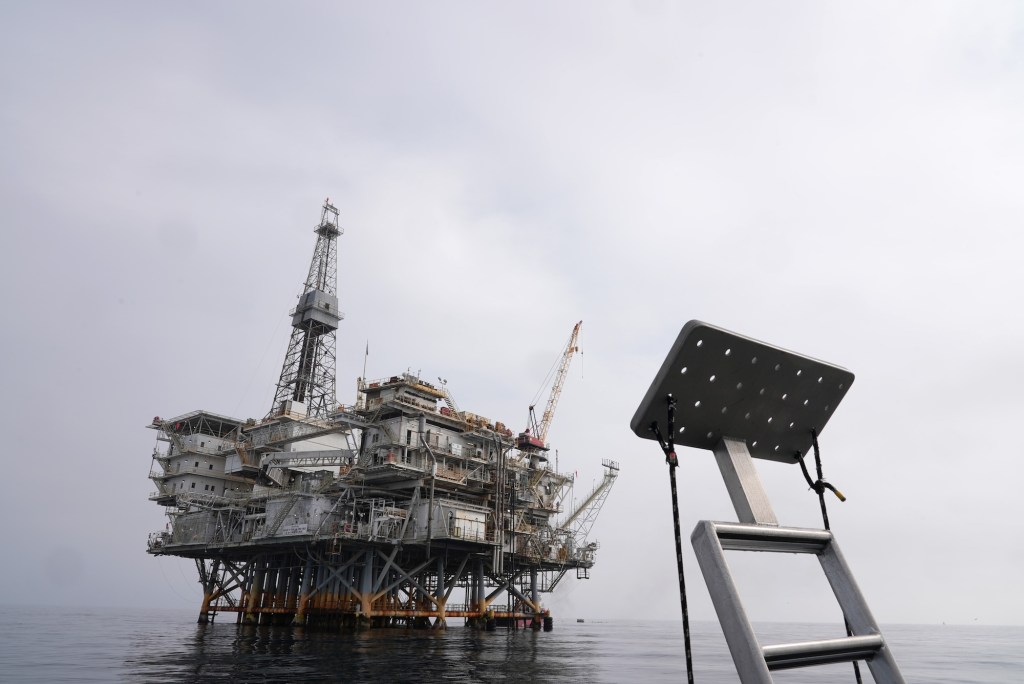
The Eureka oil rig off the coast of California from the Giant Stride dive boat. An industrial behemoth above water, beneath, it is home to an immense diversity of sea life. (Photo: Erik Olsen)

But below the surface is another world, one teeming with millions of colorful fish, including blazing orange garibaldi, schools of dark blue blacksmiths, halfmoons, calico bass, yellowtail, and even the occasional mola mola or sunfish. A few rigs are the playground of scores of jubilant sea lions, many of them precocious youngsters that swoop and spin in the waters beneath the massive structure of the rigs like children let loose in a grassy park.
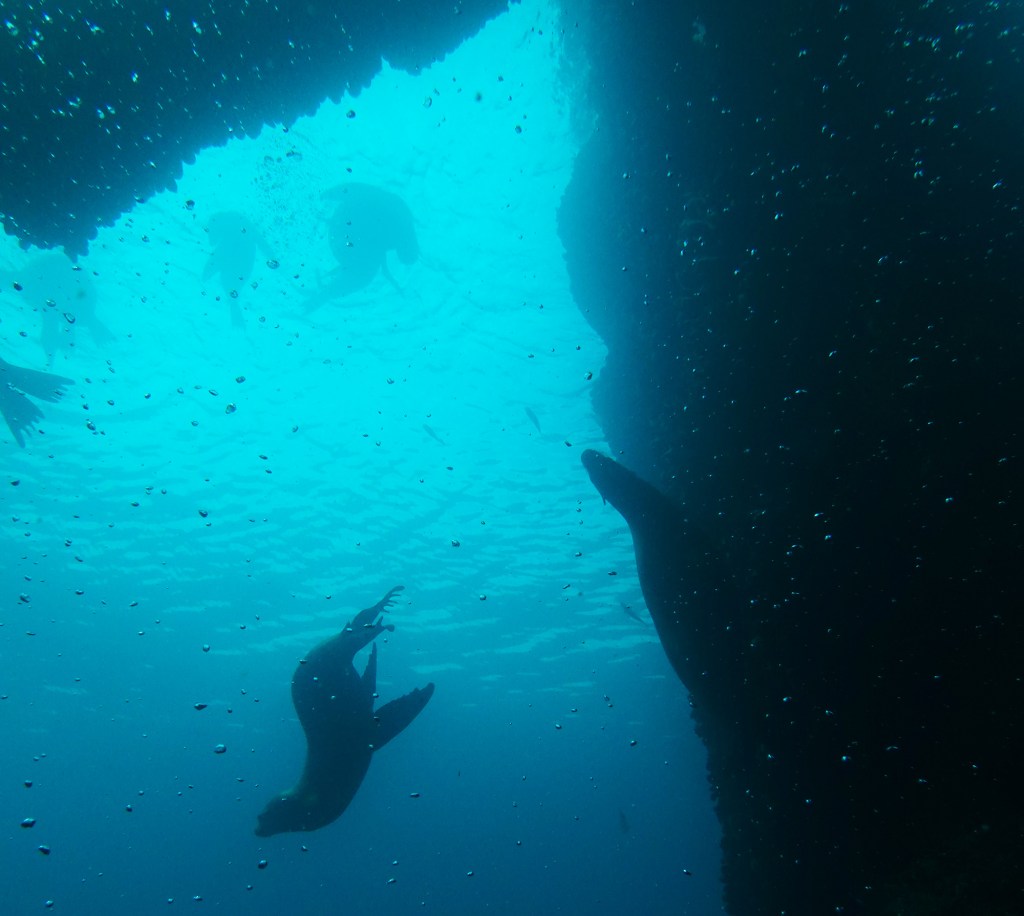
Playful sea lions frolic around the rigs beneath the surface. (Photo: Erik Olsen)

And then there are the pylons themselves and the life they support. Made of welded steel, these massive structures hold the entire oil platform above the water, millions of tons of machinery and deck space, often topped by a helicopter pad, all balanced on the integrity of engineering. Some descend straight down into the darkening waters, while others are reinforced by diagonal braces and horizontal crossbeams, a lattice of intersecting steel that keeps the rig steady against waves and wind.

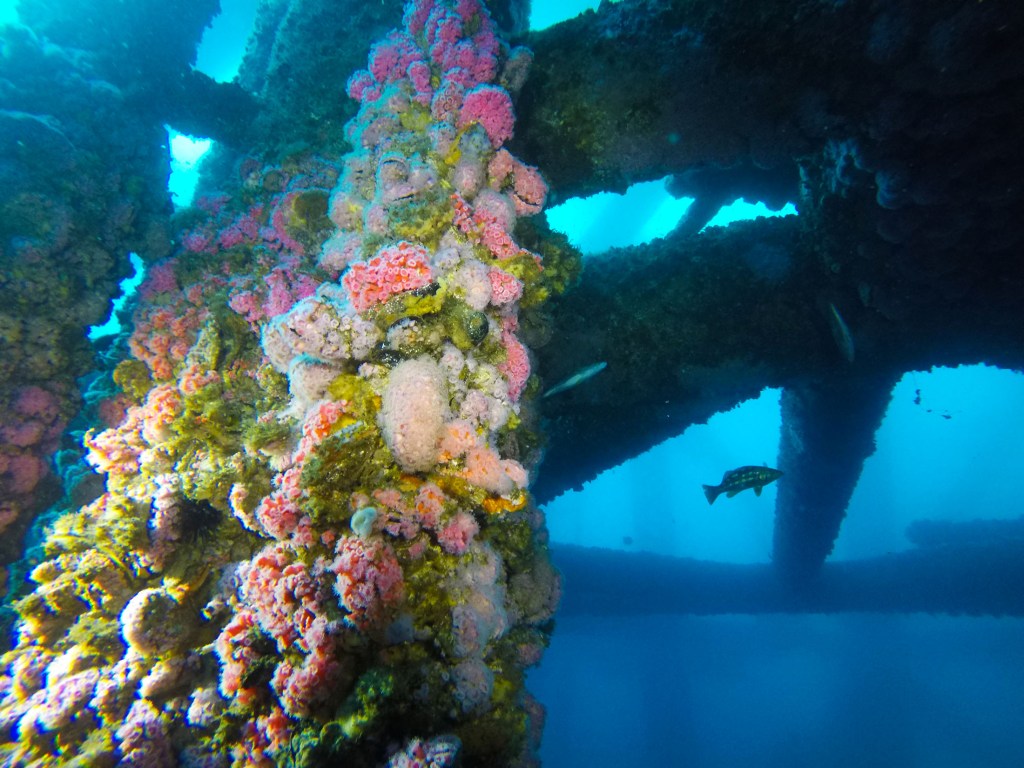
But up close, you can hardly make out the metal. The substructure is so encrusted with life, layers of scallops, brittle stars, mussels, anemones, barnacles, and sponges, that the steel beneath has vanished into a living reef. In some areas, there are thousands of brittle stars clinging to the structure, they lie so thick on it that it’s hard to imagine how they compete for food. But food here is plentiful, and that abundance is one reason these rigs harbor so much life. They stand near the edge of the continental shelf, where the seafloor plunges into deeper water and cold, nutrient-rich currents surge upward toward the light. Those nutrients ignite blooms of plankton, feeding swarms of tiny crustaceans and filter feeders that coat the rig’s pilings. Those smaller creatures, in turn, sustain fish, sea lions, and even passing seabirds, a food web in full expression, built around the steel spine of an oil platform.

Brittle stars, mussels and other oprganisms blanket the rig supports in incredible numbers. (Photo: Erik Olsen)

All of this is not just my observation, however. Numerous studies have been done about the life on the rigs and most of them point to an astonishing fact: these rigs are some of the most productive ecosystems on the planet. In one study, University of California Santa Barbara marine biologist Milton Love and his colleagues found that certain platforms, including Eureka, produced more fish biomass per square meter than even the most productive natural environments in the world. More than mangroves, coral reefs, estuaries, etc.
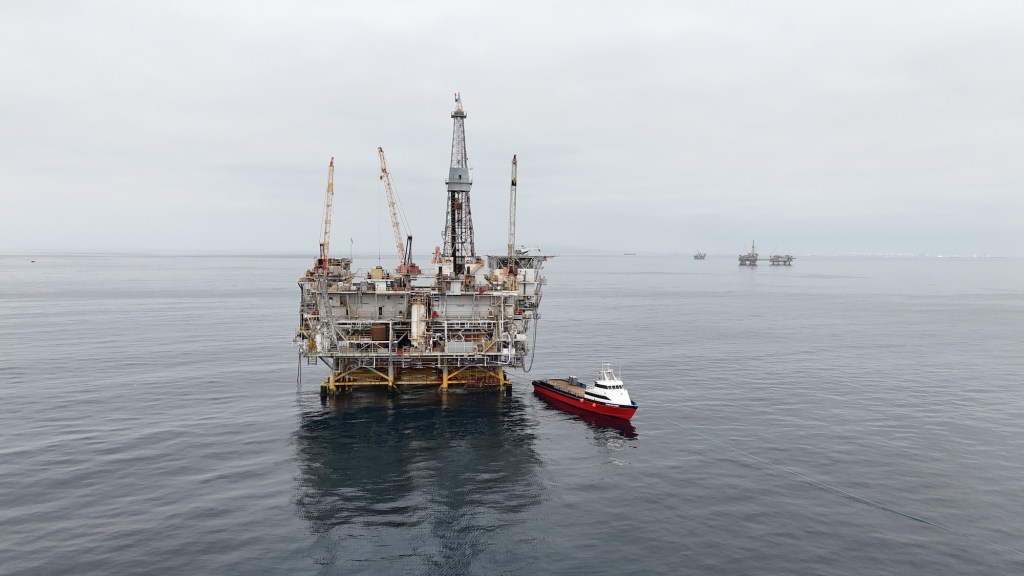
The Eureka rig off the coast of Southern California. Once built to pump oil, it’s now also home to sea lions, fish, and a reef of life growing on its legs below the waves. (Photo: Erik Olsen)

This is good news for everyone. But there’s more. Other research suggests that the life flourishing on these offshore rigs doesn’t stay confined to them; it drifts, swims, and spawns its way back toward the coast, helping to replenish nearshore habitats. Rockfish are a perfect example. Once severely overfished, several species have made a remarkable comeback in California waters, perhaps due in part to these structures. As we wrote recently, the recovery of rockfish is one of the state’s quiet success stories.

But there’s a hitch.

Pick up some California wildlife gifts at our Etsy store. Seriously, they’re cool.

Several of these rigs are now nearing, or have already reached, the end of their productive lifespan, meaning that they no longer produce much oil. What should be done with them? In California, when offshore oil rigs reach the end of their productive life, state law mandates their decommissioning, which involves safely plugging wells, dismantling structures, and restoring the environment. Traditionally, this has meant full removal of the platform and associated infrastructure: a very expensive proposition, likely costing in the billions of dollars.
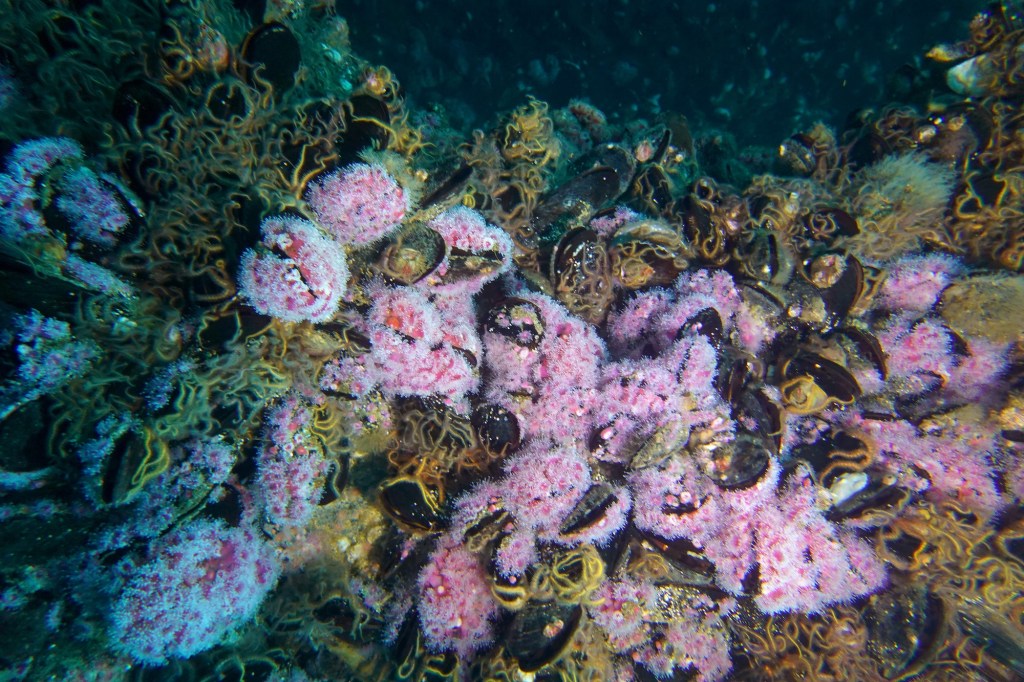
Clusters of mussels and strawberry anemones (Corynactis californica) coat the rig’s submerged structure in a dense mosaic of color. They form living carpets over the steel, while mussels, bryozoans, and brittle stars fill the gaps between them. (Photo: Erik Olsen)

However, the California Marine Resources Legacy Act (AB 2503), enacted in 2010, introduced an alternative known as the “rigs-to-reefs” program. This legislation allows oil companies to apply for permits to partially remove decommissioned rigs, essentially shearing off the part of the structure above water and leaving a portion of it underwater to serve as artificial reefs. Obviously they’d do it deep enough, about 80 feet, that the structure would not become a hazard to ship traffic. The goal is to enhance marine habitats by preserving the ecosystems that have developed around these structures over time. Rig removal is a growing billion-dollar-a-year business, and by removing only part of the rig and leaving behind the rest, an oil company can save millions in decommissioning costs.

As of January 2024, there are eight offshore production platforms in various stages of decommissioning; several have had multiple owners and operators. It’s complicated, but the biggest issue is liability. That is, what happens down the line when there is a leak, or if the plugging of the wells was done improperly? Who pays for that? This is all being hashed out, as it has been for some 20 years now. Californians hate oil washing up on their beaches. Many hate the idea of the oil companies getting a financial break after plundering the sea floor for oil. But there is no denying that all that life is there. You can see it. And, as Milton Love said: “If you remove a platform, you may be killing tens of millions of animals because they happened to settle on steel instead of a rock. Which I think is a tragedy.”
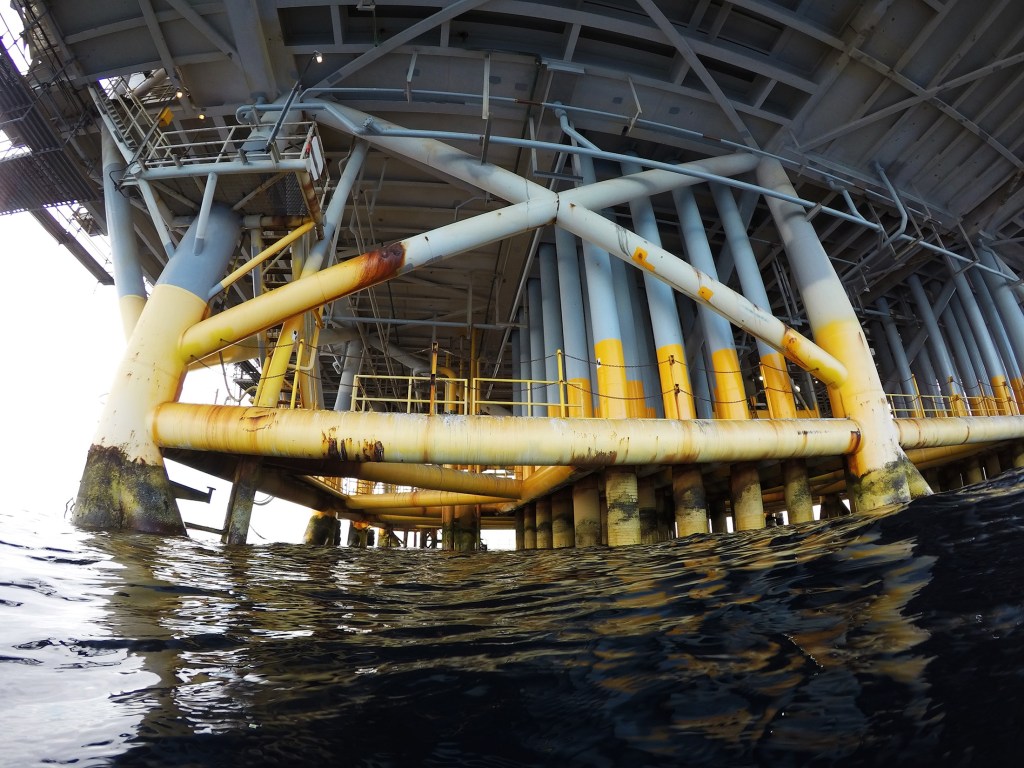
Substructure of the Eureka rig above water in California (Erik Olsen)

Oil companies have not used California’s Rigs-to-Reefs law because it leaves them financially and legally burdened. They must keep long-term liability for the structures and give up to 80 percent of their cost savings to the state, which makes full removal simpler and less risky than the complex and politically sensitive reefing process.

And so, as some of these platforms near the end of their productive lives, a significant debate has emerged over their future. Should they be removed entirely, or could they be repurposed into artificial reefs that continue to support marine biodiversity? The discussion is not just about engineering challenges or environmental concerns; it’s about reimagining the relationship between human infrastructure and the natural world.

Amber Sparks led the expedition I took out to the rigs. I’ve dived with her several times before and believe she’s a passionate advocate for sea life and for a healthy offshore California marine ecosystem. She and her co-founder Emily Hazelwood are strong supporters of reefing the rigs, and through their work with Blue Latitudes, they collaborates with scientists, government agencies, and oil companies to explore ways decommissioned platforms could be transformed into permanent marine habitats rather than dismantled and removed.

“The big question is, are these structures good habitat that should be left in place to continue to thrive as reefs, or should they be removed? In my opinion, they would be really valuable to be left in place as reefs.”

A brittle star falls through the water column beneath the Eureka rig (Erik Olsen)

So where do things stand today? A December 2023 Public Environmental Impact Statement (PEIS) from the Bureau of Safety and Environmental Enforcement and Bureau of Ocean Energy Management marks the most recent major development in the offshore rig debate, and it could significantly shape future decommissioning of California’s oil platforms. Though the PEIS identifies partial removal as the environmentally preferable option (italics mine) because it would preserve the habitat of existing biological communities, the agencies involved selected “Alternative 1a”, mandating complete removal of platform jackets and associated infrastructure offshore southern California. The final decision over what to do with the rigs has not yet been made, but the current wisdom suggests that they may have to go. As a diver and novice fisherman, I consider this a shame.

Public opposition to “big oil” remains strong in California, fueling demands among small but vocal groups for the complete removal of oil rigs, despite the potential loss of coral-like ecosystems. Environmental groups like the Natural Resources Defense Council argue that retaining any portion of these structures enables the oil industry to persist as an environmental threat.
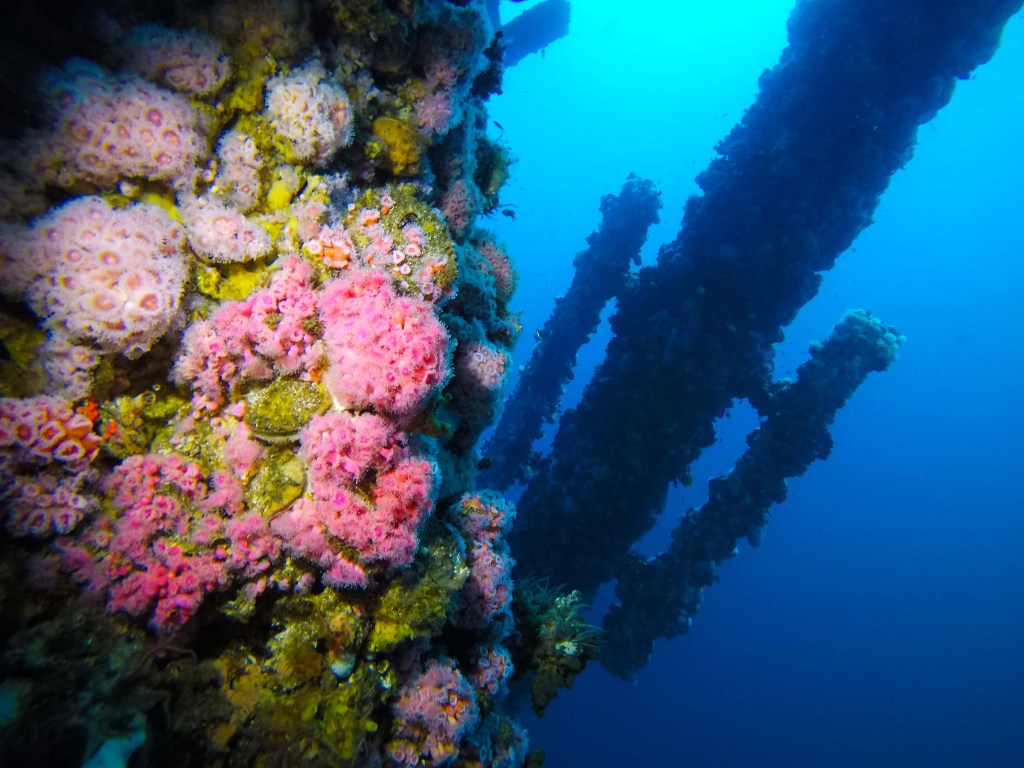
Beneath the surface of a California oil rig, a vibrant colony of pink strawberry anemones transforms industrial infrastructure into an underwater oasis. (Erik Olsen)

“People here have been waiting for these oil platforms to go away,” Linda Krop, an environmental lawyer with the Environmental Defense Center, an advocacy group based in Santa Barbara, told the me when I reported on this for the New York Times. Ms. Krop challenged the notion that the science definitively supports the role of rigs in fostering marine life. She argued that leaving the rigs in place would effectively reward polluters by allowing them to avoid the expense of removal.

Globally, the concept of Rigs-to-Reefs has seen success, particularly in the Gulf of Mexico, where over 500 platforms have been converted into artificial reefs. These structures have become magnets for fish and invertebrates, supporting commercial and recreational fishing and diving industries. However, critics argue that not all programs are created equal. In some regions, lax regulations have allowed oil companies to avoid fully addressing environmental risks, leaving behind structures that degrade over time and release pollutants. California’s approach, with its stringent oversight and commitment to environmental benefits, aims to avoid these pitfalls while maximizing ecological gains.
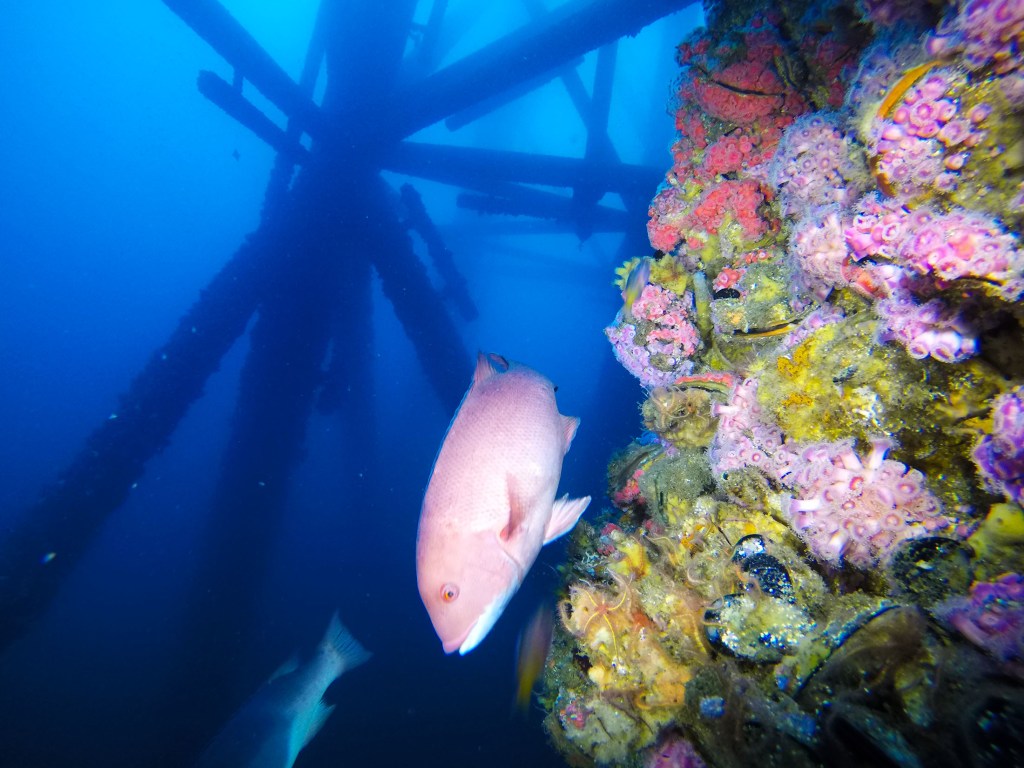
The oil rigs substructure provides a fascinating contrast to the life on large sections of it. (Erik Olsen)

What happens to California’s oil platforms will reveal how the state chooses to balance economic legacy with ecological responsibility. Few would argue that oil companies deserve further rewards after decades of drilling and profits, yet the decision ahead is not so simple, it is about what becomes of the ecosystems that have grown around their steel foundations. There should be a way to move forward responsibly, one that removes the risk and legacy of drilling while preserving the thriving marine life that has made these structures their home.
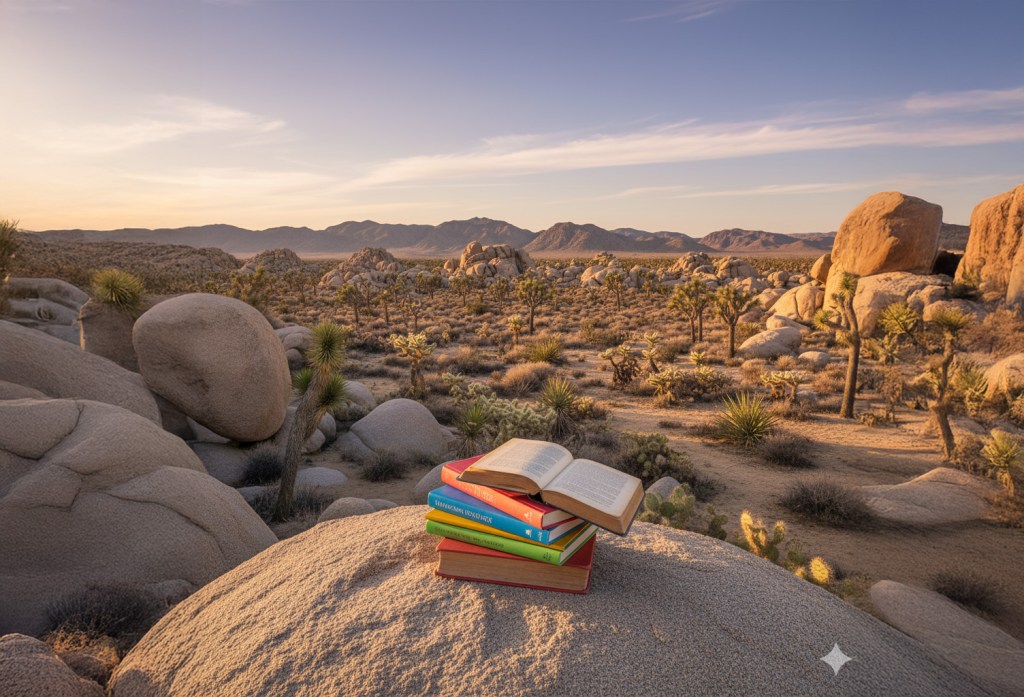
Ten Essential Books About California’s Nature, Science, and Sense of Place

You can scroll endlessly through TikTok and Instagram for quick bursts of California’s beauty, but to truly sink into a subject, and to savor the craft of a great writer, you need a book. I’m an avid reader, and over the past decade I’ve dedicated a large section of my bookshelf to books about California: its wild side, its nature, and its scientific wonders.

There are surely many other books that could be included in this top ten list, but these are the finest I’ve come across in the years since returning to live in the state.They capture the extraordinary diversity of California’s landscapes and wildlife, found nowhere else on Earth, and many also explore issues and themes that hold deep importance for the state and its people. Although I’ve read some of these titles digitally, I love having many of them in print, because there are few things more satisfying than settling into a beach, a forest campsite, or a favorite chair at home with a beautifully made book in hand.


California Against the Sea: Visions for Our Vanishing Coastline by Rosanna Xia

I first discovered Rosanna Xia’s work through her stunning exposé on the thousands of DDT barrels found dumped on the seafloor near Catalina Island. It remains one of the most shocking, and yet not technically illegal, environmental scandals in California’s history.

Her recent book, California Against the Sea: Visions for Our Vanishing Coastline, is a beautifully written and deeply reported look at how California’s coastal communities are confronting the realities of climate change and rising seas. Xia travels the length of the state, from Imperial Beach to Pacifica, weaving together science, policy, and personal stories to show how erosion, flooding, and climate change are already reshaping lives. What makes the book stand out is its relative balance; it’s not a screed, nor naïvely hopeful. It nicely captures the tension between human settlement — our love and need to be near the ocean — and the coast’s natural (and unnatural, depending on how you look at it) cycles of change.

Xia is at her best when exploring adaptation and equity. She reminds us that even if emissions stopped today, the ocean will keep rising, and that not all communities have equal means to respond. The stories of engineers, Indigenous leaders, and ordinary residents highlight how resilience and adaptation must be rooted in local realities. I was especially drawn to Xia’s account of the California Coastal Commission, a wildly controversial agency that wields immense power over the future of the shoreline. Yet it was the commission and its early champions, such as Peter Douglas, who ensured that California’s coast remained open and accessible to all, a decision I consider one of the greatest legislative achievements in modern conservation history.

Thoughtful, accessible, and rooted in the coast we all care about, California Against the Sea challenges us to ask a pressing question: how can we live wisely, and with perspective, at the edge of a changing world?

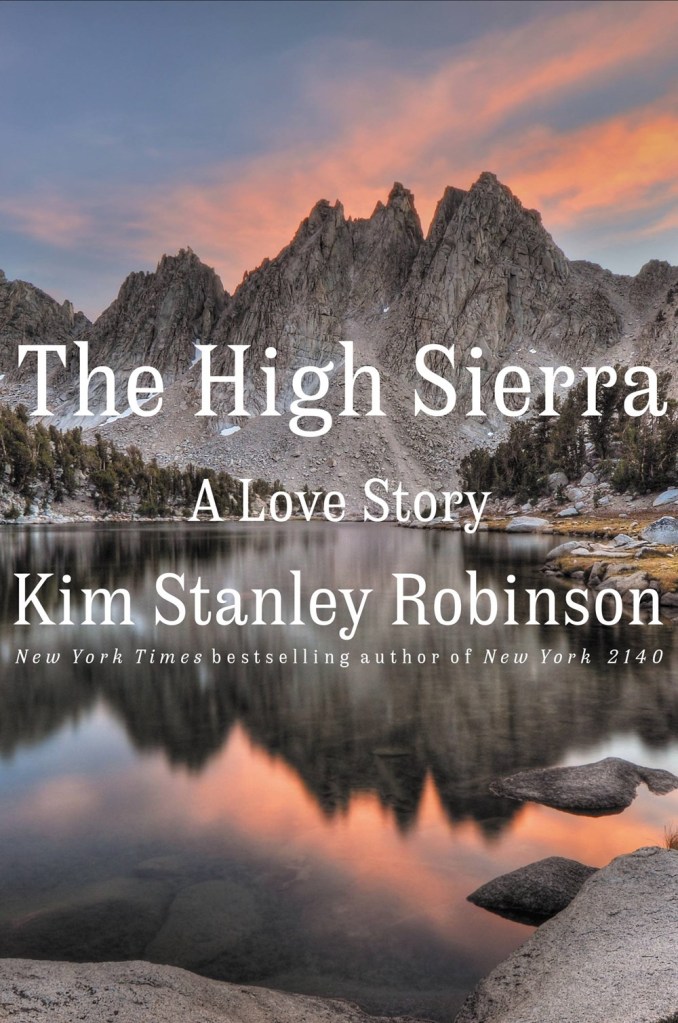
The High Sierra: A Love Story by Kim Stanley Robinson

Kim Stanley Robinson’s The High Sierra: A Love Story is an expansive, heartfelt tribute to California’s most iconic mountain range. Because of the Sierra’s vast internal basins, which are missing from many of the world’s other great mountain ranges, Robinson argues they are among the best mountains on Earth. His point is hard to refute. He makes a convincing case that the Sierra Nevada may be the greatest range in the world, formed from the planet’s largest single block of exposed granite and lifted over millions of years into its dramatic present shape.

Blending memoir, geology (my favorite part of the book), and adventure writing, Robinson chronicles his own decades of exploration in the Sierra Nevada while tracing the forces — glacial, tectonic, and emotional, that shaped both the landscape and his own life.

Considered one of our greatest living science fiction writers (I’ve read Red Mars — long, but superb — and am currently reading The Ministry for the Future — the opening chapter is gripping and terrifying), Robinson might seem an unlikely guide to the granite heights of California. Yet reading The High Sierra: A Love Story reveals how naturally his fascination with imagined worlds extends into this very real one. The drama of the range, with its light, vastness, and sculpted peaks and basins, feels like raw material for his other universes.

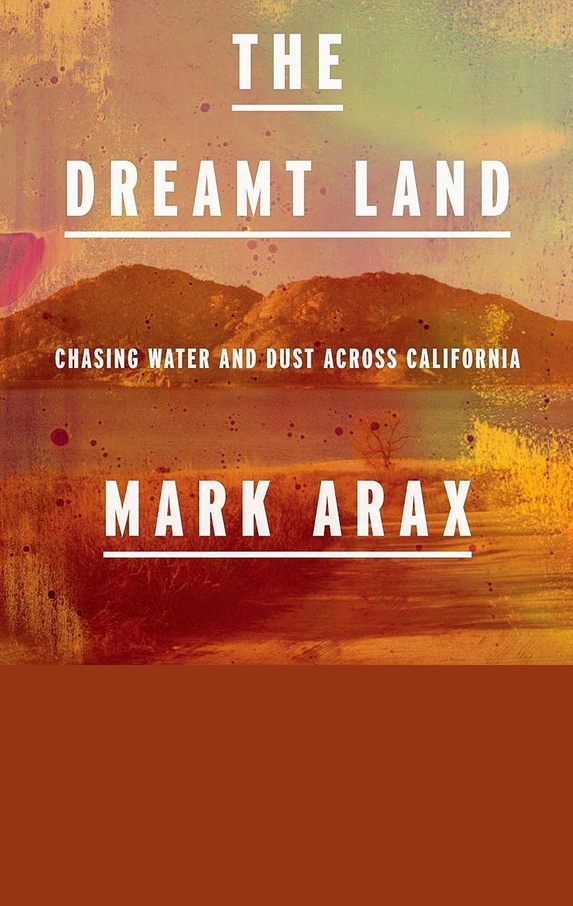
The Dreamt Land by Mark Arax

The Dreamt Land is a portrait of California’s Central Valley, where the control of water has defined everything from landscape to power (power in the form of hydroelectric energy and human control over who gets to shape and profit from the valley’s vast resources). Blending investigative journalism, history, and memoir, Arax explores how the state’s rivers, dams, and aqueducts turned desert into farmland and how that transformation came at immense ecological and social cost.

I’ve read several Arax books, but this one is my favorite. He’s one of the finest writers California has produced. He writes with passion and clarity, grounding his ideas in decades of firsthand experience with California’s land and water. His focus on the fertile Central Valley, where he grew up as a reporter and farmer’s son, gives the book both intimacy and authority, revealing how decisions about water shape not just the landscape but the people who depend on it. There are heroes and villains, plenty of the latter, and all of them unmistakably real. Yet Arax’s prose is so fluid and eloquent that you’ll keep reading not only for the story, but for the sheer pleasure of his writing.

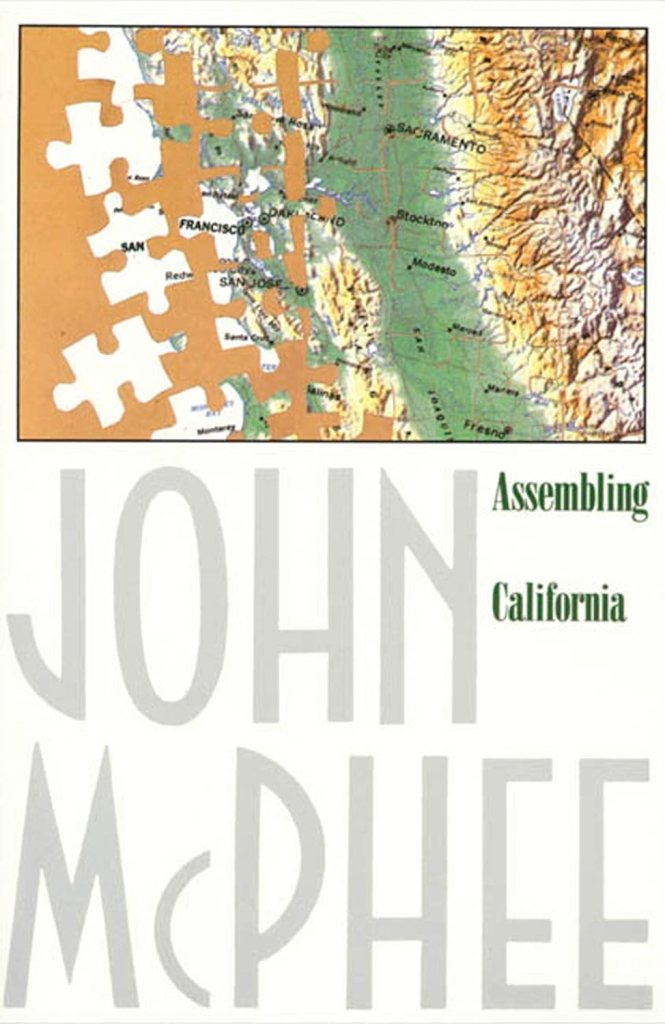
Assembling California by John McPhee (1993)

If you’re at all fascinated by California’s wild geology — and it truly is wild, just ask any geologist — this classic from one of the finest nonfiction writers alive is a must-read. McPhee takes readers on a geological road-trip through California, from the uplifted peaks of the Sierra Nevada to the fault-riven terrain of the San Andreas zone. He teams up with UC Davis geologist Eldridge Moores to explain how oceanic plates, island arcs, and continental blocks collided over millions of years to “assemble” the landmass we now call California. His prose is classic McPhee: clean, vivid, perhaps sometimes overly technical, as he turns terms like “ophiolite” and “batholith” into aspects of a landscape you can picture and feel.

What makes the book especially rewarding, especially for someone interested in earth systems, mapping, and the deep time, is how McPhee seamlessly links everyday places with deep-time events. You’ll read about gold-rush mining camps and vineyard soils, but all of it is rooted in tectonics, uplift, erosion, and transformation. I’ve gotten some of my favorite stories here on California Curated from the pages of this book. It can be ponderous at times, but you’ll not regret giving it a try.

The California Lands Trilogy by Obi Kaufman

The Forests of California (2020)

The Coasts of California (2022)

The Deserts of California (2023)

Obi Kaufman’s California Lands Trilogy is one of the most visually stunning and ambitious projects in California natural history publishing. Beginning with The Forests of California, the first of three volumes that reimagine the state not through its highways or cities but through its living systems, Kaufman invites readers to see California as a vast and interconnected organism, a place defined by its natural rhythms rather than human boundaries. Each book is filled with delicate watercolor maps and diagrams by the author himself. The result is part art book and part ecological manifesto, a celebration of the interconnectedness of California’s natural world. Kaufman’s talents as an artist are breathtaking. If he ever offered his original watercolors for sale, I’d be among the first in line to buy them. Taken together, the series forms a panoramic vision of the state’s natural environments.

That said, Kaufman’s books can be dense, filled with data, maps, and cross-references that reward slow reading more than quick browsing. If I’m honest, I tend to dip in and out of them, picking them up when I’m bored or need a break from the latest political bombshell. Every page offers something to linger over, whether it’s a river system painted like a circulatory map or a meditation on the idea of rewilding. For anyone fascinated by California’s natural systems, all Kaufman’s Field Atlases are invaluable companions endlessly worth revisiting.

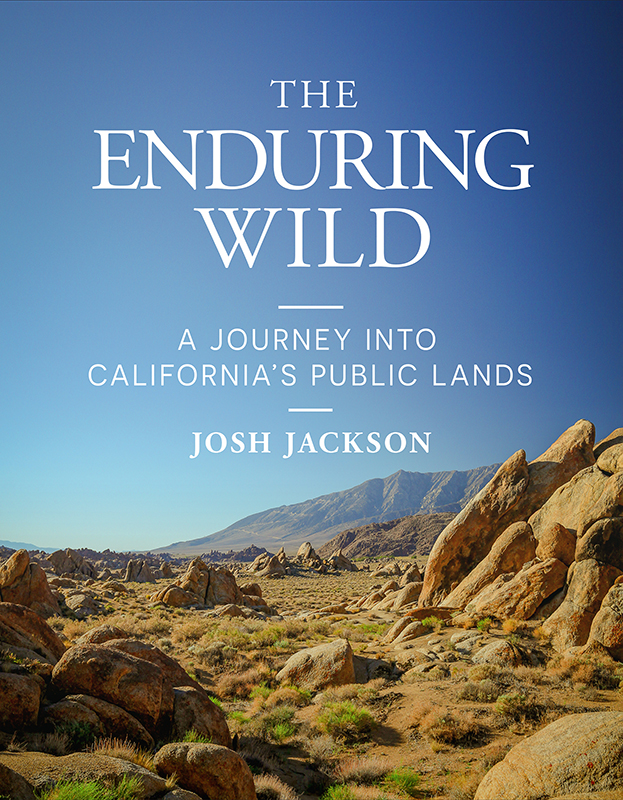
The Enduring Wild: A Journey Into California’s Public Lands by Josh Jackson

My first job out of college was with the Department of the Interior in Washington, D.C., by far by the nation’s largest land management agency. A big part of that work involved traveling to sites managed by Interior across the country. I came to understand just how vast America’s public lands are and how much of that expanse, measured in millions of acres, is under the care of the Bureau of Land Management (BLM).

Josh Jackson takes readers on a road trip across California’s often overlooked public wilderness, focusing on the lands managed by the BLM, an agency once jokingly referred to as the Bureau of Livestock and Mining. He shows how these so-called “leftover lands” hold stories of geology, Indigenous presence, extraction, and conservation.

His prose and photography (he has a wonderful eye for landscapes) together invite the reader to slow down, look closely at the subtleties of desert mesas, sagebrush plains, and coastal bluffs, and reckon with what it means to protect places many people have never heard of. His use of the environmental psychology concept of “place attachment” struck a chord with me. The theory suggests that people form deep emotional and psychological bonds with natural places, connections that shape identity, memory, and a sense of belonging. As a frequent visitor to the Eastern Sierra, especially around Mammoth Lakes and Mono Lake, I was particularly drawn to Jackson’s chapter on that region. His account of the lingering impacts of the Mining Act of 1872, and how its provisions still allow for questionable practices today, driven by high gold prices, was eye-opening. I came away with new insights, which is always something I value in a book.

I should mention that I got my copy of the book directly from Josh, who lives not far from me in Southern California. We spent a few hours at a cafe in Highland Park talking about the value and beauty of public lands, and as I sat there flipping through the book, I couldn’t help but acknowledge how striking it is. Part of that comes from Heyday Books’ exceptional attention to design and production. Heyday also publishes Obi Kaufman’s work and they remain one of California’s great independent publishers. But much my appreciation for the book also comes from from Jackson himself, whose photographs are simply outstanding.

Get California wildlife gifts at our Etsy store. It helps support us!

What makes this book especially compelling is its blend of adventure and stewardship. Jackson doesn’t simply celebrate wildness; he also lays out the human and institutional connections that shape (and threaten) these public lands, from grazing rights to mining to climate-change impacts. Some readers may find the breadth of landscapes and stories a little ambitious for a first book, yet the richness of the journey and the accessibility of the writing make it a strong addition for anyone interested in California’s endless conflict over land use: what should be used for extraction and what should be preserved? While I don’t fully agree with Jackson on the extent to which certain lands should be preserved, I still found the book a wonderful exploration of that question.

The Backyard Bird Chronicles by Amy Tan

Amy Tan’s The Backyard Bird Chronicles is a charming and unexpectedly personal journal of bird-watching, set in the yard of Tan’s Bay Area home. Tan is an excellent writer, as one would expect from a wildly successful novelist (The Joy Luck Club, among others). But she also brings a curiosity and wonder to the simple act of looking across one’s backyard. I loved it. Who among us in California doesn’t marvel at the sheer diversity of birds we see every day? And who hasn’t wondered about the secret lives they lead? A skilled illustrator as well as a writer, she studies the birds she observes by sketching them, using art as a way to closely connect with the natural world around her.

What begins as a peaceful retreat during the Covid catastrophe becomes an immersive odyssey of observation and drawing. Tan captures the comings and goings of more than sixty bird species, sketches their lively antics, as she reflects on how these small winged neighbors helped calm her inner world when the larger world felt unsteady.

My only quibble is that I was hoping for more scientific depth; the book is more of a meditation than a field study. Still, for anyone who loves birds, sketching, or the quiet beauty of everyday nature, it feels like a gentle invitation to slow down and truly look.

“Trees in Paradise” by Jared Farmer

California is the most botanically diverse state in the U.S. (by a long shot), home to more than 6,500 native plant species, about a third of which exist nowhere else on Earth. Jared Farmer’s Trees in Paradise: A California History follows four key tree species in California: the redwood, eucalyptus, orange, and palm. Through these examples, Farmer reveals how Californians have reshaped the state’s landscape and its identity. It’s rich in scientific and historical detail. I have discovered several story ideas in the book for California Curated and learned a great deal about the four trees that we still see everywhere in the California landscape.

In telling the story of these four trees (remember, both the eucalyptus and the palm were largely brought here from other places), Farmer avoids easy sentimentality or harsh judgment, instead exploring how the creation of a “paradise” in California came with ecological costs and profoundly shaped the state’s identity. While the book concentrates on those four tree categories, its detailed research and insight make it a compelling read for anyone interested in the state’s environment, history, and the ways people shape and are shaped by land.

The Salton Sea Was California’s Strangest Catastrophe

In California’s southeastern desert, the Salton Sea stretches across a wide, shimmering basin, a lake where there shouldn’t be one. At about 340 square miles, it’s the state’s largest lake. But it wasn’t created by natural forces. It was the result of a major engineering failure. I’ve long been fascinated with the place: its contradictions, its strangeness, its collision of nature and human ambition. It reflects so many of California’s tensions: water and drought, industry and wilderness, beauty and decay. And it was only relatively recently that I came to understand not just how the Salton Sea came to exist, but how remarkable the region’s geological past really is, and how it could play a major role in the country’s sustainable energy future.

In the early 1900s, the Imperial Valley was seen as promising farmland: its deep, silty soil ideal for agriculture, but the land was arid and desperately needed irrigation. To bring water from the Colorado River, engineers created the Imperial Canal, a massive infrastructure project meant to transform the desert into productive farmland. But the job was rushed. The canal had to pass through the Mexican border and loop back into California, and much of it ran through highly erodible soil. Maintenance was difficult, and by 1904, silt and sediment had clogged portions of the canal.

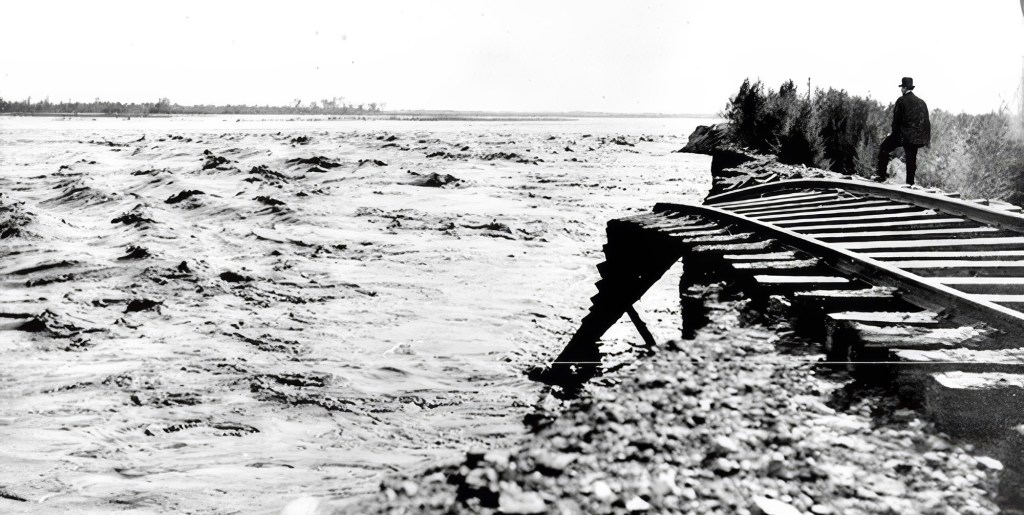
The Southern Pacific Railroad was forced to move it lines several times as the raging, unleashed Colorado River expanded the Salton Sea. (Credit: Imperial Irrigation District)

To keep water flowing, engineers hastily dug a temporary bypass channel south of the clogged area, hoping it would only be used for a few months. But they failed to build proper headgates, critical structures for controlling water flow. In 1905, an unusually heavy season of rain and snowmelt in the Rockies caused the Colorado River to swell. The torrent surged downriver and overwhelmed the temporary channel, carving it wider and deeper. Before long, the river completely abandoned its natural course and began flowing unchecked into the Salton Sink, an ancient, dry lakebed that had once held water during wetter epochs but had long since evaporated. (This has happened many times over in the region’s history).

For nearly two years, the Colorado River flowed uncontrolled into this depression, creating what is now known as the Salton Sea. Efforts to redirect the river back to its original course involved a frantic, expensive engineering campaign that included the Southern Pacific Railroad and U.S. government assistance. The breach wasn’t fully sealed until early 1907. By then, the sea had already formed: a shimmering, accidental lake nearly 35 miles long and 15 miles wide, with no natural outlet, in the middle of the California desert.

In the 1950s and early ’60s, the Salton Sea was a glamorous desert escape, drawing crowds with boating, fishing, and waterskiing. Resorts popped up along the shore, and celebrities like Frank Sinatra, Jerry Lewis, Rock Hudson, the Beach Boys, and the Marx Brothers came to visit and perform. It was billed as a new Palm Springs with water, until rising salinity and environmental decline ended the dream. There have been few if any similarly starge ecological accidents like it.

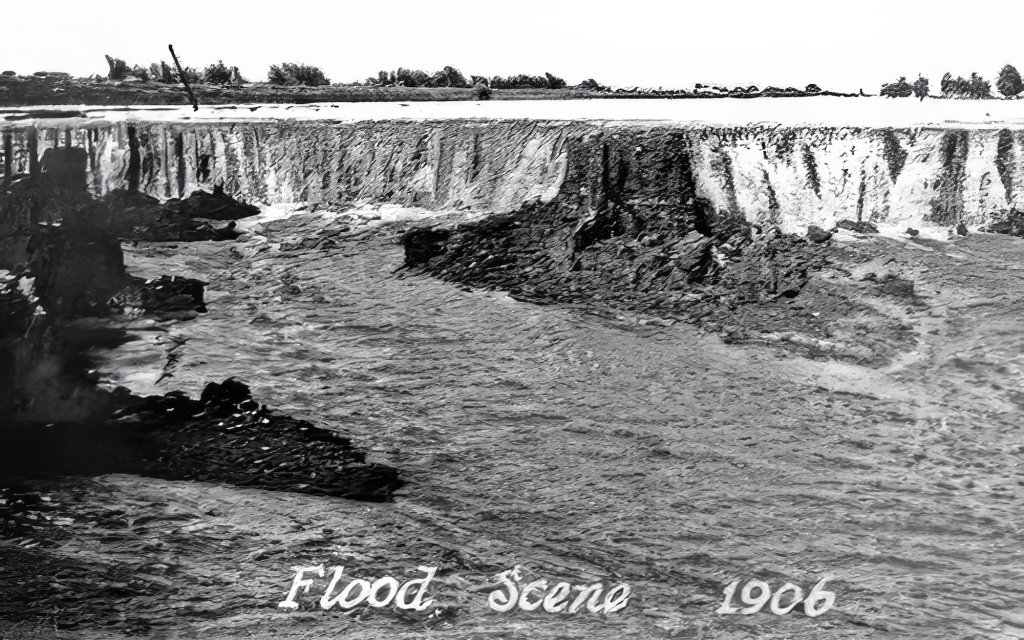
The erosive power of the floodwaters was immense. The river repeatedly scoured channels that created waterfalls, which cut back through the ground, eroding soil at a rate of about 1,200 meters per day and carving gorges 15 to 25 meters deep and more than 300 meters wide. (Credit: Imperial Irrigation District)

The creation of the Salton Sea was both a blessing and a curse for the people of the Imperial Valley. On the one hand, the lake provided a new source of water for irrigation, and the fertile soil around its shores proved ideal for growing crops. On the other hand, the water was highly saline, and the lake became increasingly polluted over time, posing a threat to both human health and the environment.

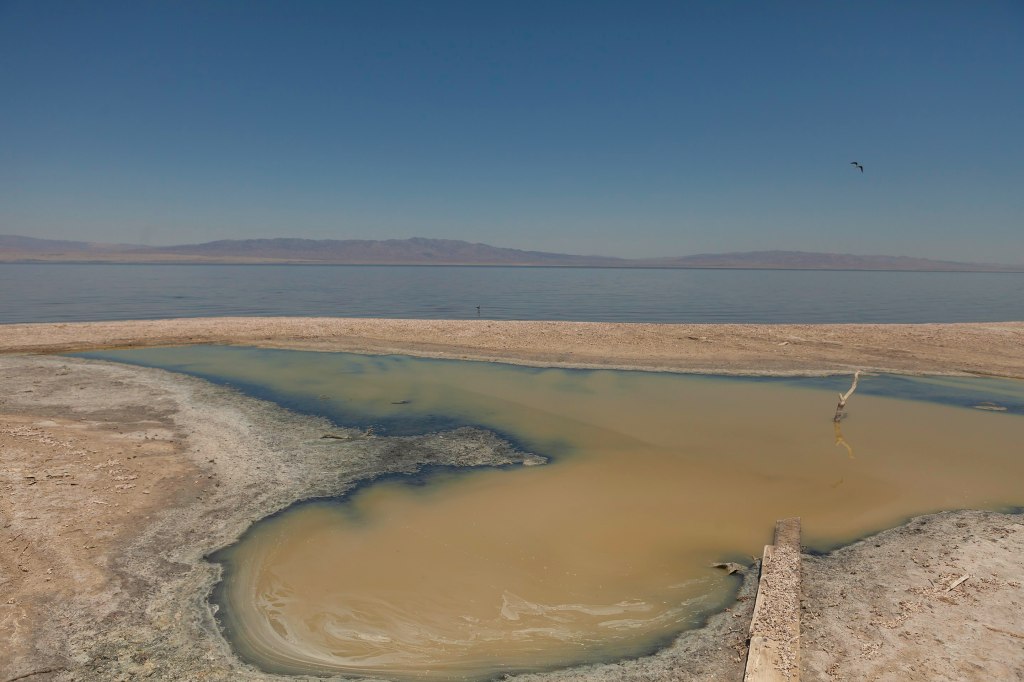
Recently, with most flows diverted from the Salton Sea for irrigation, it has begun to dry up and is now considered a major health hazard, as toxic dust is whipped up by heavy winds in the area. The disappearance of the Salton sea has also been killing off fish species that attract migratory birds.

California Curated Etsy

 The New York Times recently wrote about the struggles that farmers face as the Salton Sea disappears, and how the sea itself will likely disappear entirely at some point.

“There’s going to be collateral damage everywhere,” Frank Ruiz, a program director with California Audubon, told the Times. “Less water coming to the farmers, less water coming into the Salton Sea. That’s just the pure math.”

Salton Sea can be beautiful, if toxic (Photo: Wikipedia)

To me, the story of the Salton Sea is fascinating: a vivid example of how human intervention can radically reshape the environment. Of course, there are countless cases of humans altering the natural world, but this one feels particularly surreal: an enormous inland lake created entirely by accident, simply because a river, the Colorado, one of the most powerful in North America, was diverted from its course. It’s incredible, and incredibly strange. What makes the region even more fascinating, though, is that the human-made lake sits in a landscape already full of geological drama.

The area around the Salton Sea is located in a techtonically active region, with the San Andreas Fault running directly through it. The San Andreas Fault is a major plate boundary, where the Pacific Plate is moving north relative to the North American Plate (see our story about how fast it’s moving here). As pretty much every Californian knows, the legendary fault is responsible for the earthquakes and other tectonic activity across much of California.

If you look at a map of the area, you can see how the low lying southern portion of the Salton Sea basin goes directly into the Gulf of California. Over millions of years, the desert basin has been flooded numerous times throughout history by what is now the Gulf of California. As the fault system cuts through the region, the Pacific Plate is slowly sliding northwest, gradually pulling the Baja Peninsula away from mainland Mexico. Over millions of years, this tectonic motion is stretching and thinning the crust beneath the Imperial Valley and Salton Basin. If the process continues, geologists believe the area could eventually flood again, forming a vast inland sea, perhaps even making an island out of what is today Baja California. (We wrote about this earlier.)

Entrance to the Salton Sea Recreation Area (Wikipedia)

Yet even as the land shifts beneath it, the Salton Sea’s future may be shaped not just by geology, but by energy. Despite the ongoing controversy over the evaporating water body, the Salton Sea may play a crucial role in California’s renewable energy future. The region sits atop the Imperial Valley’s geothermal hotspot, where underground heat from all that tectonic activity creates ideal conditions for producing clean, reliable energy. Already home to one of the largest geothermal fields in the country, the area is now gaining attention for something even more strategic: lithium.

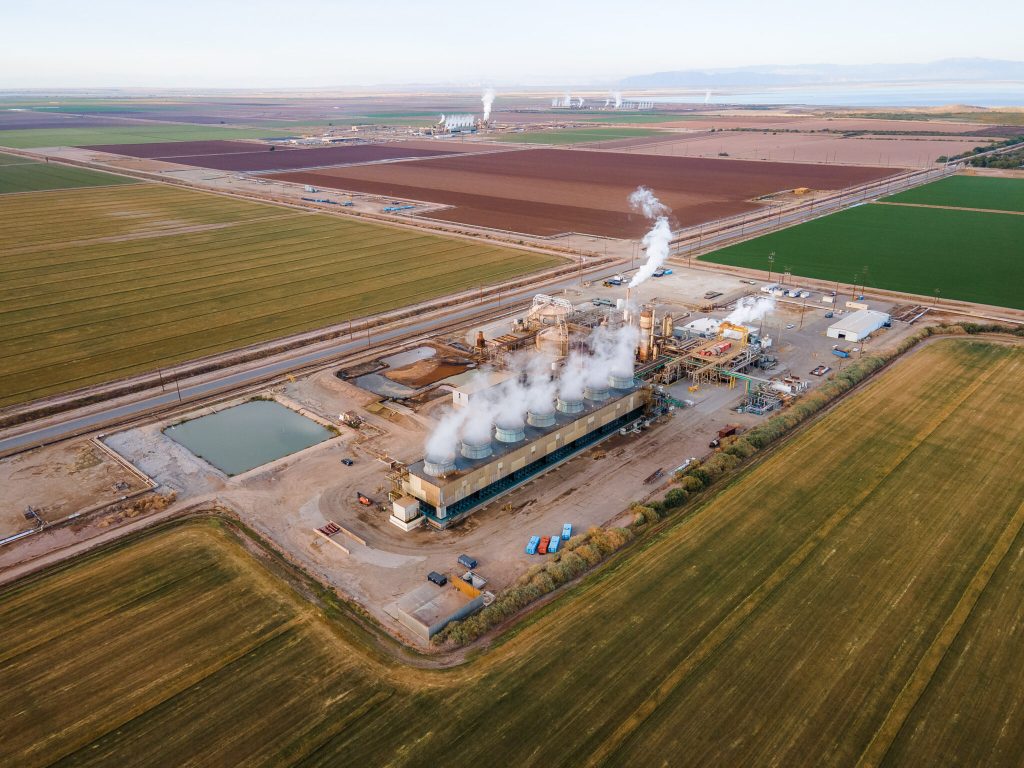
An aerial view of geothermal power plants among the farmland around the southern shore of the Salton Sea.
(Credit: Courtesy Lawrence Berkeley National Lab)

Beneath the surface, the hot, mineral-rich brine used in geothermal energy production contains high concentrations of lithium, a critical component in electric vehicle batteries. Known as “Lithium Valley,” the Salton Sea region has become the focus of several ambitious extraction projects aiming to tap into this resource without the large environmental footprint of traditional lithium mining. Gov. Gavin Newsom called the area is “the Saudi Arabia of lithium.” Even the Los Angeles Times has weighed in, claiming that “California’s Imperial Valley will be a major player in the clean energy transition.”

Companies like Controlled Thermal Resources (CTR) and EnergySource are developing direct lithium extraction (DLE) technologies that pull lithium from brine as part of their geothermal operations. The promise is a closed-loop system that produces both renewable energy and battery-grade lithium on the same site. If it proves viable, the Salton Sea could significantly reduce U.S. dependence on foreign lithium and cement California’s role in the global shift to clean energy. That’s a big if…and one we’ll be exploring in depth in future articles.

Toxic salt ponds along the Western shoreline (Photo: EmpireFootage)

Such projects could also potentially provide significant economic investment in the region and help power California’s green energy ambitions. So for a place that looks kind of wrecked and desolate, there actually a lot going on. We promise to keep an eye on what happens. Stay tuned.