How tectonics, sediment, and water created one of the most productive landscapes on Earth.
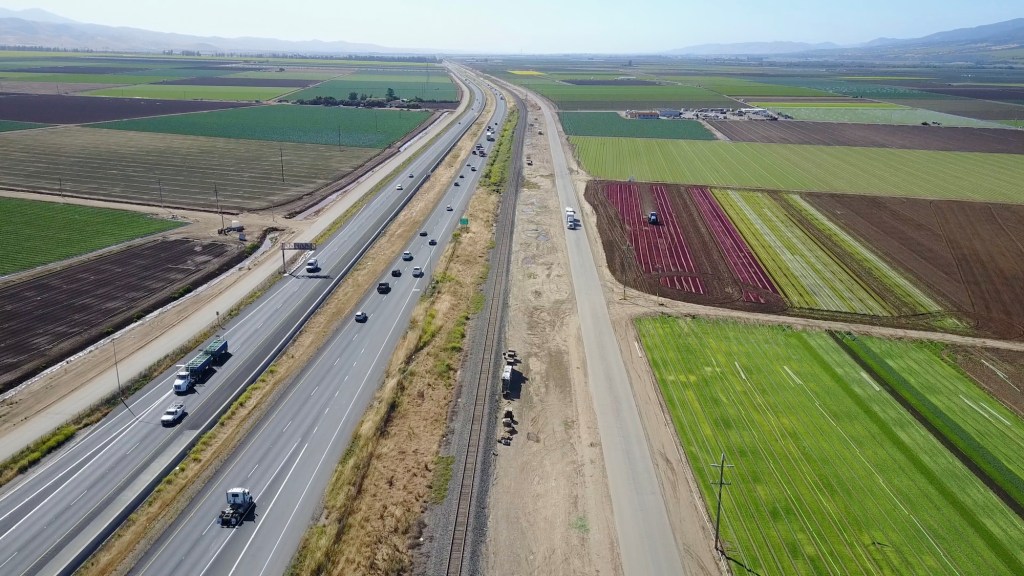
Aerial view of California’s Central Valley, where Interstate 5 slices through a vast patchwork of irrigated fields, some of the most productive farmland on Earth, shaped by deep alluvial soils and Sierra Nevada snowmelt. (Photo: Erik Olsen)
I love California’s bizarre, complicated geology. For many years, I had a wonderful raised-relief map of the state on my wall made by Hubbard Scientific (it hangs on my son’s bedroom wall today). On the map, color and molded plastic contours reveal the state’s diverse and often startling geological formations. I loved staring at it, touching it, imagining how those landscapes came to be over geologic time.
There is so much going on here geologically compared to almost any other state that geologists often describe California as one of the best natural laboratories on Earth, a place so rich and varied that entire careers have been built trying to understand how all its pieces fit together. As the U.S. Geological Survey (USGS) puts it, nearly every major force that shapes the Earth’s crust is visible here, from plate collision and volcanism to basin formation and mountain uplift. Some of my favorite writers, like John McPhee, have described California as a collage of geological fragments, assembled piece by piece over deep time, in a way that more closely resembles an entire continent than a single region.
But when we think about California’s geology, most of us probably imagine the Sierra Nevada’s towering granite peaks, the pent-up force of the San Andreas Fault, or the fact that Lassen Peak is still an active volcano. Those places grab our attention. Yet when it comes to a geological feature that has quietly shaped daily life in California more than almost any other, we should consider the Central Valley, arguably the state’s most important geological masterpiece.
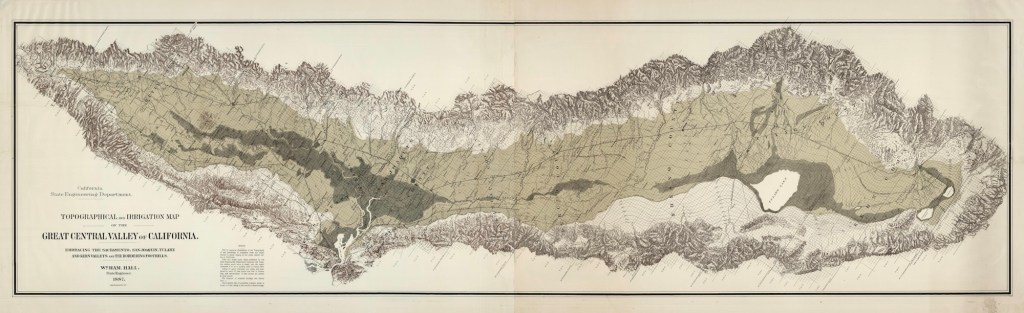
Topographical and irrigation map of the Great Central Valley of California: embracing the Sacramento, San Joaquin, Tulare and Kern Valleys and the bordering foothills (Source: NYPL Digital Collection)
Sure, the valley is flat as a tabletop, stretching out for mile after mile as you drive Interstate 5 or Highway 99 (one of my favorites), but once you consider how it formed and what lies beneath the surface, the Central Valley reveals itself as a truly remarkable place on the planet, another superlative in our state, which, of course, is already full of them.
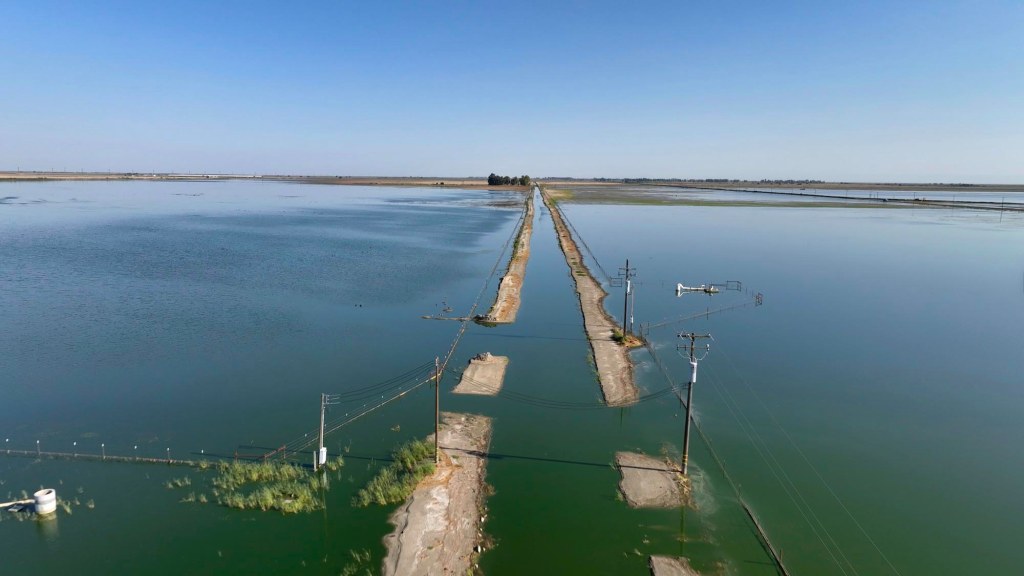
The Central Valley was formed when tectonic forces lowered a broad swath of California’s crust between the rising Sierra Nevada to the east and the Coast Ranges to the west, creating a long, subsiding basin that slowly filled with sediment eroded from those mountains over millions of years. For thousands of years, the southern end of the valley was dominated by Lake Tulare, a mega-freshwater lake that was once the largest freshwater lake west of the Mississippi. You might remember that just a few years ago, Lake Tulare briefly reappeared after a series of powerful atmospheric river storms. I went up there and flew my drone because I was working on a story about the construction of California’s long-troubled high-speed rail, which had halted construction because of the new old lake.
Lake Tulare reemerges in the southern San Joaquin Valley after powerful winter storms, flooding roads and farmland and briefly restoring the historic inland lake that once dominated this basin. (Photo: Erik Olsen)
On the other side in the west, the Coast Ranges rise up, hemming in the valley and basically holding it in place, forming something like a gigantic, hundreds-of-miles-long bathtub. One popular Instagrammer commented that it looks as if someone used a huge ice cream scoop to dig out the valley. As the surrounding mountains continued to rise, rain, snowmelt, and wind carried untold tons of silt and sediment downslope, steadily depositing them into this enormous basin over millions of years.
This process created what geologists call the Great Valley Sequence, a staggering accumulation of sedimentary material that, in some western portions of the basin, reaches a depth of 20,000 meters, or approximately 66,000 feet. Ten MILES.
Celebrate California’s wild side with our beautifully illustrated wildlife mugs, featuring the state’s most iconic birds and animals. Visit our store and bring a little piece of California nature to your morning coffee.
This long, slow process produced what geologists call the Great Valley Sequence, an immense stack of sedimentary rock built up over tens of millions of years as the basin steadily subsided and filled. In some western portions of the valley, that accumulated package reaches a depth of 20,000 meters in thickness, about 66,000 feet, or close to ten miles of layered geological history lying beneath the surface. That’s kind of mind-blowing.
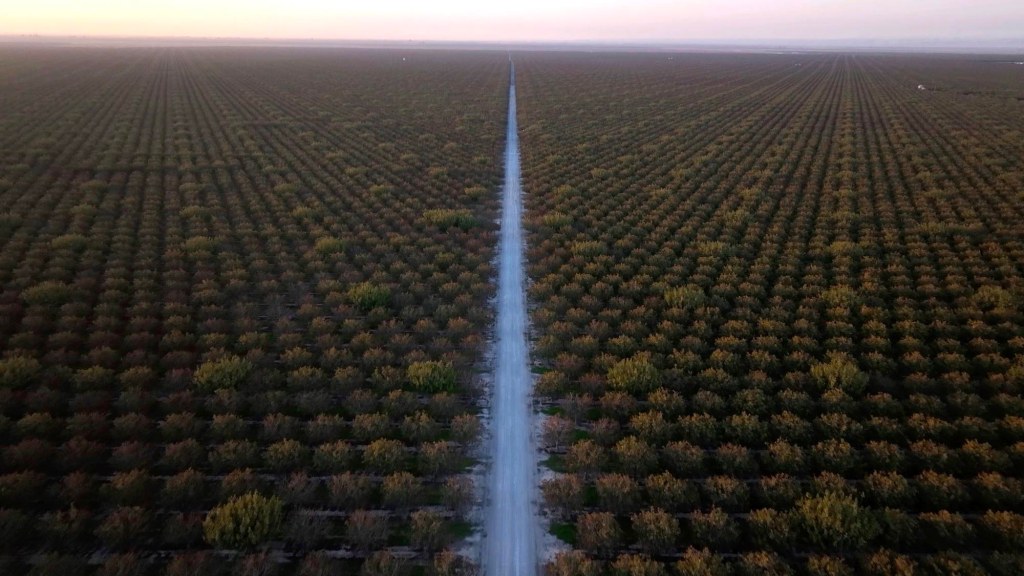
Endless rows of pistachio orchards stretch across the Central Valley at dusk, a geometric testament to the deep soils and engineered water systems that have turned this ancient basin into one of the world’s great agricultural landscapes. (Photo: Erik Olsen)
It’s not just “dirt”; it’s a ridiculously deep, nutrient-rich record of California’s geologic history. There are the remains of trillions of diatoms, or microscopic plankton, whose organic remains were crushed into oil shales that are home to significant petroleum deposits. During the late Pleistocene and into the Holocene, the southern end of the valley was dominated by Lake Tulare, mentioned above, a vast freshwater lake that in wet periods spread across 600 to 800 square miles, making it the largest freshwater lake west of the Mississippi. As the water evaporated and drained, the valley floor became exceptionally flat, similar to what we see today.
Most valleys are narrow corridors carved by a single river, but the Central Valley is a vast, enclosed catchment shaped by many rivers, trapping minerals and sediments from surrounding mountains rather than letting them wash quickly out to sea. This mix created near-ideal conditions for agriculture. For the uninitiated, the Central Valley is typically divided into two major sections: the northern third, known as the Sacramento Valley, and the southern two-thirds, known as the San Joaquin Valley. That lower region can be further broken down into the San Joaquin Basin to the north and the Tulare Basin to the south.
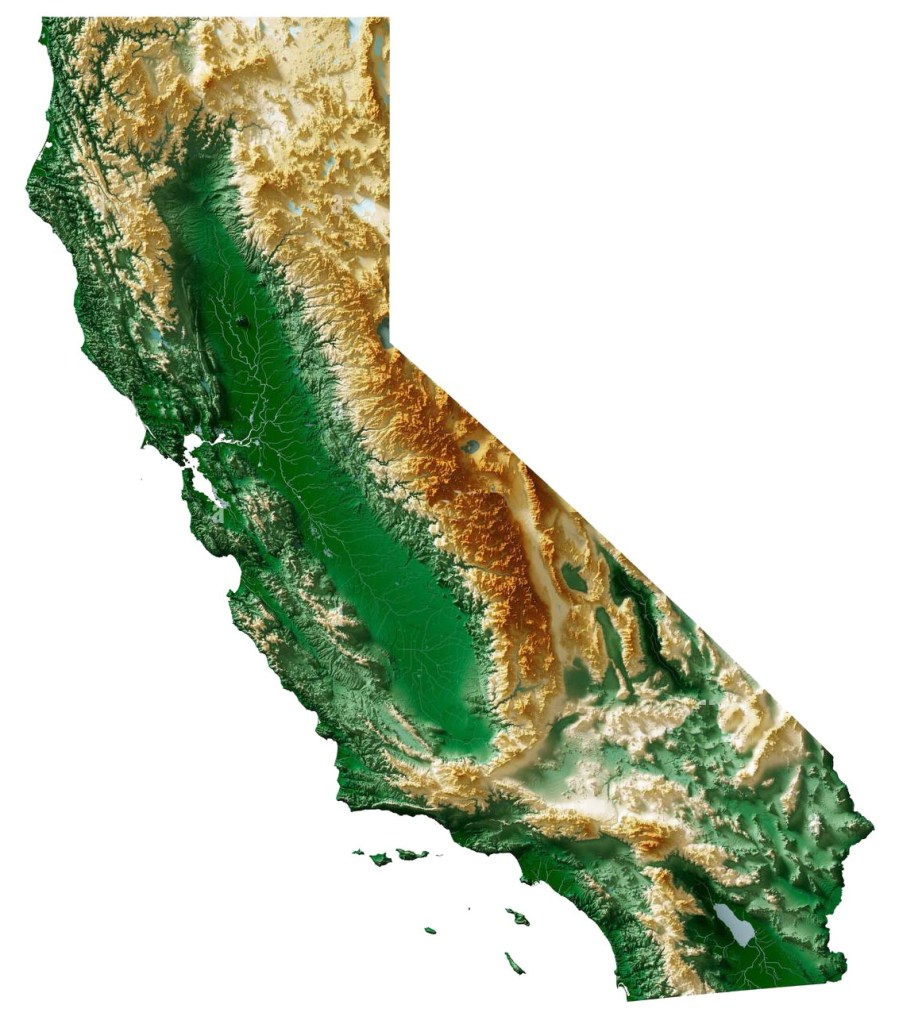
Relief map of California showing the Central Valley standing out as a wide, uninterrupted green swath between the rugged Sierra Nevada and the Coast Ranges, its flat, low-lying basin sharply contrasting with the surrounding mountains that frame and define it.
Today, because of all that fertility, the Central Valley is one of the world’s most productive agricultural regions, growing over 230 different crops. It produces roughly a quarter of the nation’s food by value, supplies about 40 percent of U.S. fruits, nuts, and vegetables, and dominates global markets for crops like almonds, pistachios, strawberries, tomatoes, and table grapes. Truly a global breadbasket.
Of course, none of this would have been possible without water. The real turning point in California’s story was learning how to capture it, move it, and store it. From mountain snowpack to canals and reservoirs, controlling water has been the quiet engine behind much of the state’s success. When human engineering intervened in the 20th century through the Central Valley Project and the State Water Project, it essentially redirected a geological process that was already in place, replacing seasonal floods and ancient lakes with a controlled system of dams and canals.
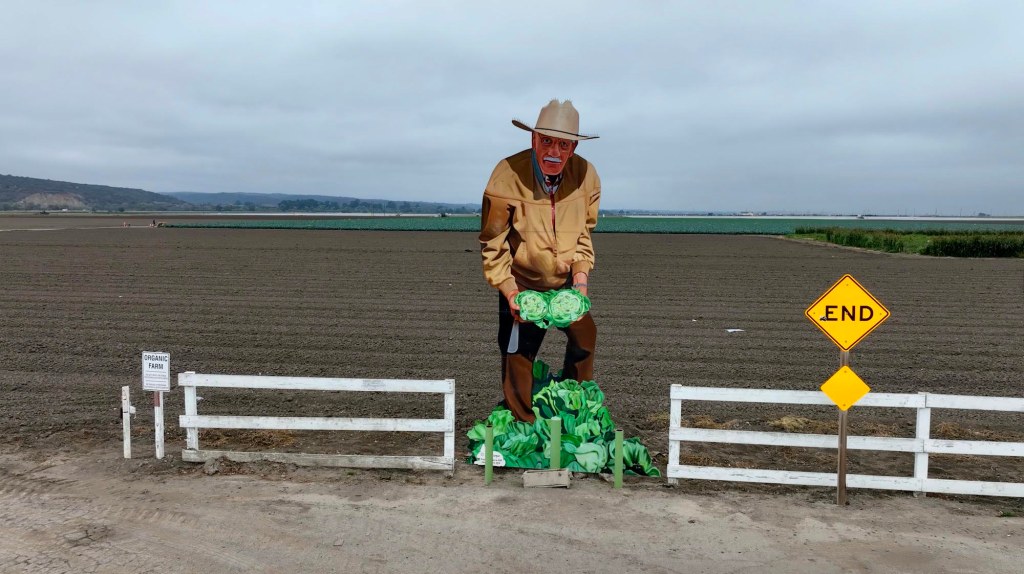
Roadside cutout farmer holding bright green heads of lettuce at the edge of a Central Valley field, a playful nod to the region’s identity as one of the most productive agricultural landscapes in the world. (Photo: Erik Olsen)
Alas, this productivity is not without geological limits, and we’ve done a pretty good job over-exploiting the valley’s resources, particularly groundwater, to achieve these things. The same porous sediments that store our life-giving groundwater are susceptible to compaction. In parts of the San Joaquin Valley, excessive pumping has caused the land to subside, sinking by as much as 28 feet in some locations, causing the soil to crack and the landscape to physically lower as the water is withdrawn. How we deal with that is a whole other story. Recent storms have helped California’s water supply tremendously, but the state seems destined to remain in a permanently precarious state of drought.
But when you talk geology, you talk deep time. You talk about eons and erosion, mountain ranges that rise and are slowly worn down, sometimes leaving behind something as breathtaking as the granite domes of Yosemite.Against that scale, the Central Valley can seem almost plain, but as I hope I’ve made the case here, when you look a little closer at even the most mundane things, you realize there is magnificence there, and few places on this planet are as magnificent as the state of California.
We also have the world’s tallest and biggest trees.
California’s giant sequoias and redwoods are nature’s skyscrapers. Redwoods exist in a few narrow pockets in Northern and Central California and into Southern Oregon. Sequoias live exclusively in small groves in central and Northern California with the largest grouping of them found in Sequoia National Park. These two tree species are wonders of the biological world. They are also some of the most magnificent things to behold on the planet.
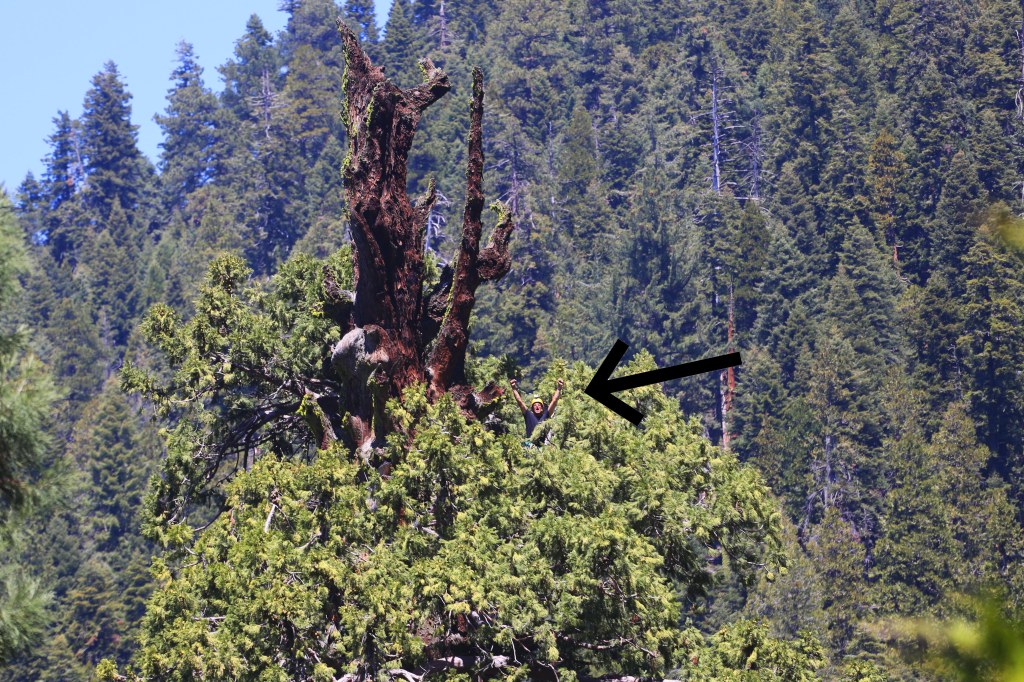
I have personally climbed the Stagg tree for a New York Times story years ago (see photo below, that’s me). The Stagg is the fifth-largest sequoia in the world, and I will forever remember the experience…even though I chickened out a bit and didn’t make it to the top.
The author climbs the Stagg tree, the fifth-largest tree in the world. (Erik Olsen)
We are lucky to still have our big trees, what’s left of them, anyway. Just a century and a half ago, old-growth redwoods and sequoias were remarkably plentiful. People marveled at them, with some early settlers in California spinning unbelievable yarns of trees that rise from the earth “like a great tower“. They also saw them as a bounteous resource, ripe for plunder (mankind, sigh).
By 1900, nearly all of California’s tall trees had been purchased by private landowners who saw in the trees not beauty, but dollar signs. By 1950, an estimated 95% of California’s original old-growth coast redwood forests had been logged, particularly along the coast from Big Sur to the Oregon border. For giant sequoias, about one-third of the original groves had been cut down, largely in the late 19th and early 20th centuries before protections were put in place.
Between 1892–1918, the Sanger Lumber Company logged the Converse Basin Grove, one of the largest stands of sequoia in the world, using ruinous clearcutting practices. They cut down 8,000 giant sequoias, some of them over 2000 years old, in a decade-long event that has been described as “the greatest orgy of destructive lumbering in the history of the world.” Only 60-100 large specimens in the grove survived. We wrote about that awful event here.
Today, only a small fraction of the old-growth coast redwood forest remains. The largest surviving stands of ancient coast redwoods are found in Humboldt Redwoods State Park, Redwood National and State Parks and Big Basin Redwoods State Park. It’s a wonder and a blessing that there are some left. And even then, they face an uncertain future thanks to climate change.
The remarkable size and height of these incredible organisms are largely due to California’s unique geography, though genetics likely play a significant role as well. Before diving into those factors, let’s take a moment to appreciate just how extraordinary these trees truly are.
Professional tree climber Rip Thompkins at the top of the Stagg tree, a giant sequoia. (Photo: Erik Olsen)
Sequoias and redwoods are closely related. Both belong to the cypress family (Cupressaceae). The primary difference between sequoias and redwoods is their habitat. Redwoods live near the moist, foggy coast, while sequoias thrive in higher-elevation subalpine zones of the Sierra Nevada. Redwoods are the tallest trees in the world. Sequoias are the biggest, if measured by circumference and volume. Redwoods can grow over 350 feet (107 m). The tallest tree in the world that we know of is called the Hyperion, and it tickles the sky at 379.7 feet (115.7 m). But it is quite possible another tree out there is taller than Hyperion. Redwoods are growing taller all the time, and many of the tallest trees we know of are in hard-to-reach areas in Northern California. Hyperion was only discovered about a decade ago, on August 25, 2006, by naturalists Chris Atkins and Michael Taylor. The exact location of Hyperion is a secret to protect the tree from damage.
The giant sequoia (Sequoiadendron giganteum) is Earth’s most massive living organism. While they do not grow as tall as redwoods – the average size of old-growth sequoias is from 125-275 feet – they can be much larger, with diameters of 20–26 feet. Applying some basic Euclidean geometry (remember C = πd?), that means that the average giant sequoia has a circumference of over 85 feet.
Giant sequoia and man for scale (Photo: Erik Olsen)
Sequoias grow naturally along the western slope of the Sierra Nevada mountain range at an altitude of between 5,000 and 7,000 feet. They tend to grow further inland where the dry mountain air and elevation provide a comfortable environment for their cones to open and release seeds. They consume vast amounts of runoff from Sierra Nevada snowpack, which provides groves with thousands of gallons of water every day. But some say the majestic trees face an uncertain future. Many scientists are deeply concerned about how climate change might affect the grand trees, as drought conditions potentially deprive them of water to survive.
The General Sherman tree in Sequoia National Park. (Photo: Erik Olsen)
The world’s largest sequoia, thus the world’s largest tree, is General Sherman, in Sequoia National Park. General Sherman is 274.9 feet high and has a diameter at its base of 36 feet, giving it a circumference of 113 feet. Scientists estimate that General Sherman weighs some 642 tons, about as much as 107 elephants. The tree is thought to be 2,300 to 2,700 years old, making it one of the oldest living things on the planet. (To learn more about the oldest thing in the world, also in California, see our recent feature on Bristlecone pines.) Interesting fact: in 1978, a branch broke off General Sherman that was 150 feet long and nearly seven feet thick. Alone, it would have been one of the tallest trees east of the Mississippi.
Many sequoias exist on private land. Just last month, one of the largest remaining private stands of Sequoias in the world – the Alder Creek Grove of giant sequoias – was bought by the Save the Redwoods League conservation group for nearly $16 million. The money came from 8,500 contributions from individual donors around the world. The property includes both the Stagg Tree mentioned above and the Waterfall Tree, another gargantuan specimen. The grove is considered “the Crown Jewel” of remaining giant Sequoia forests.
Redwoods (Sequoia sempervirens), also known as coast redwoods, generally live about 500 to 700 years, although some have been documented at more than 2,000 years old. While wood from sequoias was found to be too brittle for most kinds of construction, the redwoods were a godsend for settlers and developers who desperately needed raw material to build homes and city buildings, to lay railroads, and erect bridge trestles. The construction and subsequent reconstruction of San Francisco following the 1906 earthquake heavily relied on redwood timber, prized for its strength, resilience, and natural resistance to decay, making it a foundational resource for the city’s growth and recovery after the earthquake.
The timber companies who profited from redwoods only began to cut them down in earnest a bit over a century ago. But cut them down they did, with vigor and little regard for the preservation of such an amazing organism. After World War II, California experienced an unprecedented building boom, and the demand for redwood (and Douglas fir) soared. Coastal sawmills more than tripled between 1945 and 1948. By the end of the 1950s, only about 10 percent of the original two-million-acre redwood range remained untouched.
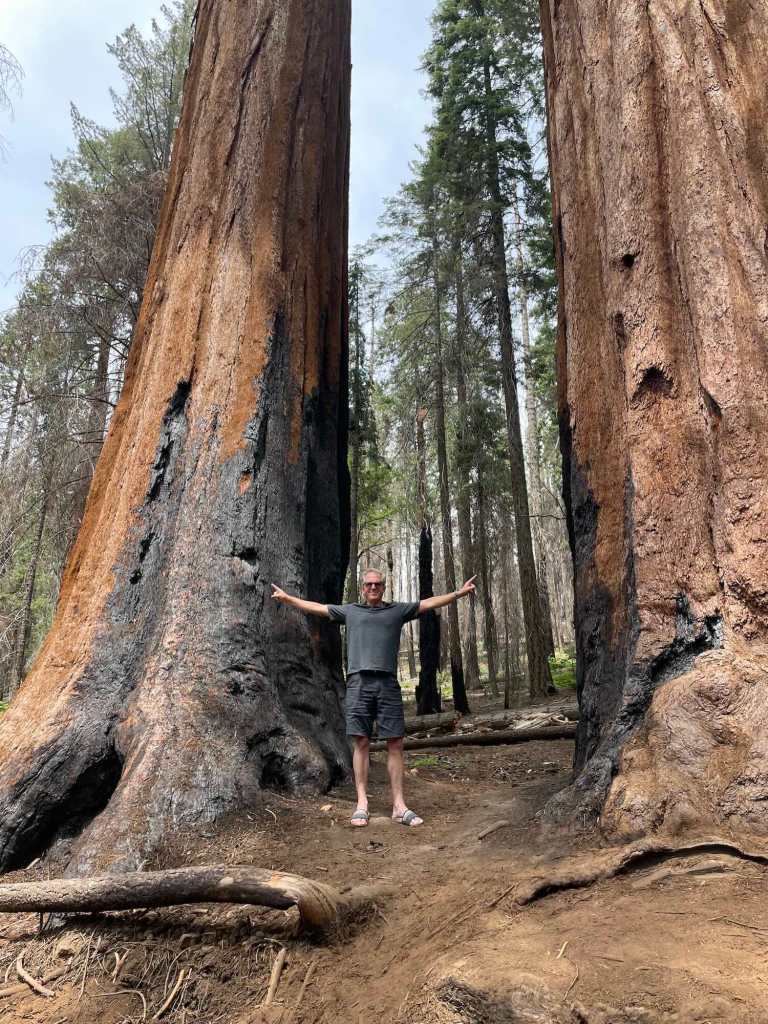
The author standing by burned sequoias. (Photo: Erik Olsen)
OK, you got this far. I hope. So how did these trees get so big and tall? Most scientists agree it has to do with climate. Sequoias benefit from California’s often prodigious snowpack, mentioned above, which seeps into the ground, constantly providing water to the roots of the trees. In addition to the snowpack, the thick (up to 2 feet), fire-resistant bark of sequoias helps protect them from wildfires. This forest ecology helps as well, since the fires themselves clear competing vegetation, allowing more sunlight and nutrients to reach the trees. The temperate climate of California, with its relatively mild winters and summer fog, also helps sustain these giants by moderating temperatures and reducing water loss, creating an environment where sequoias can thrive for centuries.
Conversely, Redwoods get much of their water from the air, when dense fog rolls in from the coast and is held firm by the redwoods themselves and the steep terrain. Because of the unique interplay of ocean currents and climate in California, the amount of fog that is available to trees is highly unusual. The trees’ leaves actually consume water in fog, particularly in their uppermost shoots. According to scientists who study the trees using elaborate climbing mechanisms to reach the treetops, in summer, coast redwoods can get more than half of their moisture from fog. (In fact, fog plays a central role in sustaining several of California’s coastal ecosystems.) The reason is that fog is surprisingly dense with water. One study from scientists Daniel Fernandez of California State University, Monterey Bay, showed that a one-square-meter fog collector could harvest some 39 liters, or nearly 10 gallons, of water from fog in a single day.
Giant sequoia – family for scale (Erik Olsen)
Another possible explanation for the coast redwood’s remarkable size lies in its extraordinary genome. According to research from the Redwood Genome Project, the coast redwood (Sequoia sempervirens) is hexaploid, meaning it carries six copies of each chromosome in every cell, an extremely rare feature in trees. In contrast, humans and most other plants and animals are diploid, carrying only two sets of chromosomes.
The coast redwood genome is indeed massive, estimated at around 27 billion base pairs, which is approximately nine times larger than the human genome (which has about 3 billion base pairs). While not exactly ten times larger, the general comparison holds and highlights the tree’s genetic complexity.
By comparing the coast redwood’s genome with those of other conifers, researchers have found hundreds of unique gene families, many of which are associated with stress tolerance, wound repair, fungal resistance, toxin metabolism, and the biosynthesis of flavonoids, all compounds that help mitigate cellular stress.
This rich genetic toolkit may contribute to the tree’s legendary resilience, longevity, and ability to grow to extraordinary heights, though the full relationship between genome size and physical traits in redwoods is still being studied.
Yet another factor may be the trees remarkable longevity. They are survivors. The Sierra Nevadas have long experienced dramatic swings in climate, and this age may be yet another of those swings that the trees will simply endure. Or maybe not. For most of the time that redwoods and sequoias have existed, they have done a remarkable job fighting off fires, swings in climate, as well as disease and bug infestations. Because their bark and heartwood are rich in compounds called polyphenols, bugs and decay-causing fungi don’t like them. Many trees, not just redwoods and sequoias, have genes that help them resist the typical aging processes that limit the lifespan of animals. For instance, trees can compartmentalize and isolate damaged or diseased wood, preventing the problem from spreading to the rest of the tree.
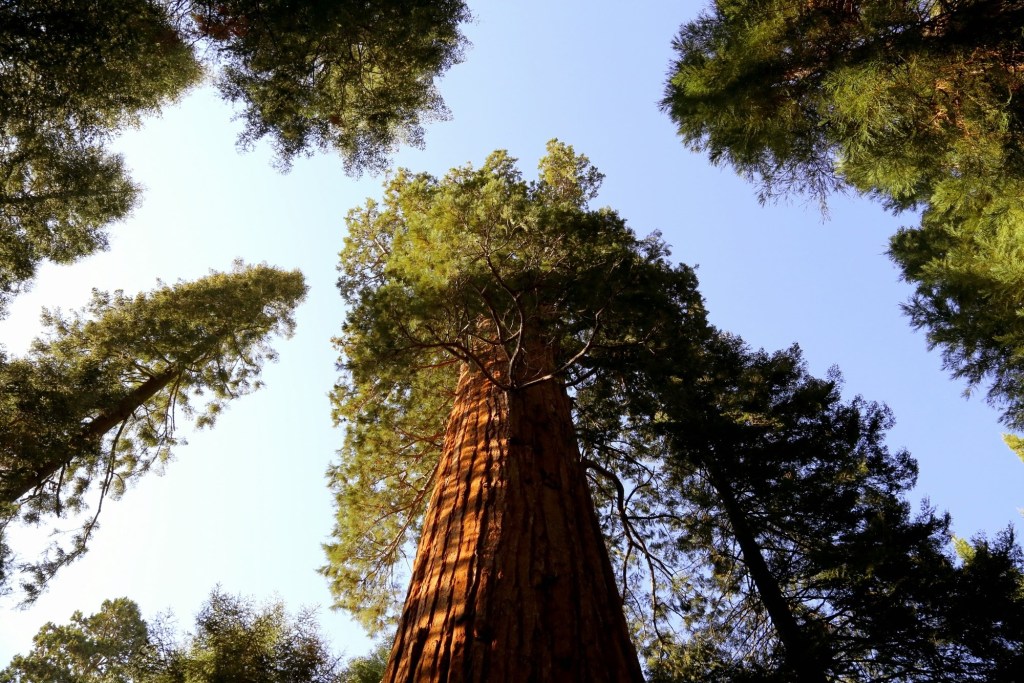
Giant sequoias in California. (Photo: Erik Olsen)
As the air heats up due to global warming, there is a rising threat to the trees’ survival. Warm air pulls moisture from leaves, and the trees often close their pores, or stomata, to maintain their water supply. When the pores close, that prevents carbon dioxide from nourishing the tree, slowing or even halting photosynthesis. The climate in areas where the trees grow hasn’t yet experienced the kind of temperatures that might kill them, but we are really just at the beginning of this current era of global warming, and some scientists warn hotter temperatures could doom many trees.
That said, other studies that show the increased carbon that causes warming could actually be good for the trees. According to an ongoing study from Redwoods Climate Change Initiative, California’s coast redwood trees are now growing faster than ever. As most people know, trees consume carbon dioxide from the air, so, the scientists argue, more carbon means more growth. However, scientists caution that climate change is not a net benefit. Increased drought, fire risk, and ecosystem stress may ultimately outweigh these temporary growth gains.
We will see. While coast redwoods have shown resilience during recent droughts, with no widespread mortality observed, giant sequoias have not fared as well. In the past decade, drought, bark beetles, and intense wildfires have killed nearly 20% of all mature giant sequoias, a sharp and alarming decline for such a long-lived species.
Redwood grove in Northern California (Photo: Erik Olsen)
It all comes down to some kind of balance. Trees may benefit from more carbon, but if it gets too hot, trees could start to perish. That’s a bit of a conundrum, to say the least.
The prospect of losing these magnificent trees to climate change is a double whammy. Not only would a mass die-off of trees be terrible for tourism and those who simply love and study them, but trees are some of the best bulwarks we have on the planet to fight climate change. Redwoods are among the fastest-growing trees on earth; they can grow three to ten feet per year. In fact, a redwood achieves most of its vertical growth within the first 100 years of its life. Among trees that do the best job taking carbon out of the atmosphere, you could hardly do better than redwoods and sequoias.
The Archangel Ancient Tree Archive, an organization out of Copemish, Michigan, has been “cloning” California’s big trees for nearly a decade. They take snippets of the trees from the top canopy and replant them, essentially creating genetically identical copies of the original tree. It’s more like propagating than cloning, but that’s what they call it. The group’s founder, David Milarch, believes fervently that planting large trees is our best bet in stopping climate change. This is the video story I produced about Milarch back in 2013. It’s worth a watch. He’s an interesting character with a lot of passion.
Preserving and protecting what’s left of these amazing organisms should be a priority in California. These trees are not only part of the state’s rich natural legacy, but they offer ample opportunities for tourism and strengthening the economies of the regions where they grow. It’s hard to visit Redwood National and State Parks or Sequoia & Kings Canyon National Parks and to come away with anything but awe at these magnificent organisms. California is special, and we are blessed to have these trees and the places where they grow in our state.