Caltech Fly Labs and a Century of Genetic Discovery

Fruit fly Drosophila melanogaster

Few organisms in the history of science have been as important to our understanding of life as the humble fruit fly. The genus Drosophila melanogaster holds a particularly esteemed spot among the dozens of model organisms that provide insight into life’s inner workings. For more than 100 years, this tiny, but formidable creature has allowed scientists to unwind the infinitesimal mechanisms that make every living creature on the planet what it is.

And much of the work to understand the fruit fly has taken place and is taking place now, right here in California at the Cal Tech fly labs.

CALIFORNIA CURATED ON ETSY

Purchase stunning art prints of iconic California scenes.
Check out our Etsy store.

Over the decades, Drosophila have been key in studying brain, behavior, development, flight mechanics, genetics, and more in many labs across the globe. These tiny, round-bodied, (usually) red-eyed flies might appear irrelevant, but their simplicity makes them ideal models. They’re easy to breed—mix males and females in a test tube, and in 10 days, you have new flies. Their 14,000-gene DNA sequence is relatively short, but extremely well-studied and there are some 8,000 genes which have human analogs. (The fly’s entire genome was fully sequenced in 2000.) Crucially, a century of fruit fly research, much of it led by Caltech, has produced genetic tools for precise genome manipulation and shed light on the act of flight itself.

But how did Drosophila become the darling of genetics?

In the early 20th century, the field of genetics was still in its infancy. Thomas Hunt Morgan, a biologist at Columbia University with a background in embryology and a penchant for skepticism began with an effort to find a simple, cheap, easy-to-breed model organism. At Columbia, he established a laboratory in room 613 of Schermerhorn Hall. This cramped space became famous for groundbreaking research in genetics, with Morgan making innovative use of the common fruit fly.

Thomas Hunt Morgan in the Fly Room at Columbia, 1922 (Cal Tech Archives)

Morgan, who joined Columbia University after teaching at Bryn Mawr College, chose the fruit fly for its ease of breeding and rapid reproduction cycle. Morgan observed a male fly with white eyes instead of the usual red. Curious about this trait’s inheritance, he conducted breeding experiments and discovered that eye color is linked to the X chromosome. He realized a male fly, with one X and one Y chromosome, inherits the white-eye trait from its mother, who provides the X chromosome. This led him to conclude that other traits might also be linked to chromosomes. His extensive experiments in this lab confirmed the chromosomal theory of inheritance, demonstrating that genes are located on chromosomes and that some genes are linked and inherited together.

After his groundbreaking research in genetics at Columbia University, Morgan moved to Pasadena and joined the faculty at CalTech in 1928, where he became the first chairman of its Biology Division and continued his influential work in the field of genetics establishing a strong genetics research program. Morgan’s work, supported by notable students like Alfred Sturtevant and Hermann Muller, laid the foundation for modern genetics and earned him the Nobel Prize in 1933.

CalTech then became a world center for genetics research using the fruit fly. Other notable names involved in fruit fly research at CalTech include Ed Lewis, a student of Morgan, who focused his research on the bithorax complex, a cluster of genes responsible for the development of body segments in Drosophila. His meticulous work over several decades revealed the existence of homeotic and Hox genes, which control the basic body plan of an organism (for which he won the 1995 Nobel Prize).

Novel prize winner Edward Lewis (Nobel Prize.org)

Seymour Benzer, another luminary at CalTech, shifted the focus from genes to behavior. Benzer’s innovative experiments in the 1960s and 1970s sought to understand how genes influence behavior. His work demonstrated that mutations in specific genes could affect circadian rhythms, courtship behaviors, and learning in fruit flies. Benzer’s approach was revolutionary, merging genetics with neurobiology and opening new avenues for exploring the genetic basis of behavior. His contributions are chronicled in Jonathan Weiner’s “Time, Love, Memory: A Great Biologist and His Quest for the Origins of Behavior,” a riveting account of Benzer’s quest to uncover the genetic roots of behavior. Lewis Wolpert in his review for the New York Times wrote, “Benzer has many gifts beyond cleverness. He has that special imagination and view of the world that makes a great scientist.”

Since Benzer’s retirement in 1991, new vanguard in genetics research has taken over at CalTech, which continues to be at the forefront of scientific discovery, driven by a new generation of researchers who are unraveling the complexities of the brain and behavior with unprecedented precision.

Elizabeth Hong is a rising star in biology, with her Hong lab investigating how the brain orders and encodes complex odors. Her research focuses on the olfactory system of Drosophila, which, despite its simplicity, shares many features with the olfactory systems of more complex organisms. Hong’s work involves mapping the synapses and neural circuits that process olfactory information, seeking to understand how different odors are represented in the brain and how these representations influence behavior. Her findings could have profound implications for understanding sensory processing and neural coding in general.

David Anderson, another prominent figure at Caltech, studies the neural mechanisms underlying emotions and behaviors. While much of Anderson’s work now focuses on mice as a model organism, the lab’s research explores how different neural circuits contribute to various emotional states, such as fear, aggression, and pleasure, essentially how emotions are encoded in the circuitry and chemistry of the brain, and how they control animal behavior. Using advanced techniques like optogenetics and calcium imaging, Anderson’s lab can manipulate specific neurons and observe the resulting changes in behavior. This work aims to bridge the gap between neural activity and complex emotional behaviors, providing insights into mental health disorders and potential therapeutic targets.

In 2018, the Anderson laboratory identified a cluster of just three neurons in the fly brain that controls a “threat display” — a specific set of behaviors male fruit flies exhibit when facing a male challenger. During a threat display, a fly will extend its wings, make quick, short lunges forward, and continually reorient itself to face the intruder.

California Institute of Technology (Photo: Erik Olsen)

Michael Dickinson is renowned for his studies on the biomechanics and neural control of flight in Drosophila. In the Dickenson Lab, researchers combine behavioral experiments with computational models and robotic simulations, seeking to understand how flies execute complex flight maneuvers with such precision. His work has broader applications in robotics and may inspire new designs for autonomous flying robots.

“He’s a highly original scientist,” Alexander Borst, a department director at the Max Planck Institute of Neurobiology in Germany, told the New York Times. 

Fruit fly scientific illustration

Dickinson’s investigations also delve into how sensory information is integrated and processed to guide flight behavior, offering insights into the general principles of motor control and sensory integration.

As science advances, Caltech’s Fly Lab’s remind us of the power of curiosity, perseverance, and the endless quest to uncover the mysteries of life. The tiny fruit fly, with its simple elegance, remains a powerful model organism, driving discoveries that illuminate the complexities of biology and behavior. Just recently, scientists (though not at CalTech) unveiled the first fully image of the fruit fly brain. Smaller than a poppy seed, the brain is an astonishingly complex tangle of 140,000 neurons, joined together by more than 490 feet of wiring.

In essence, the fruit fly remains a key to unlocking the wonders and intricacies of life, and in the Fly Labs at Caltech, that spirit of discovery thrives, ensuring that the legacy of Morgan, Lewis, Benzer, and their successors will continue to inspire generations of scientists to come.

California Coastline Teems with Whale Skeletons

A whale fall recorded off the Coast of California. (Photo: Ocean Exploration Trust/NOAA)

In the depths of the ocean, when a whale dies, its carcass sinks to the seafloor, creating a unique and rich ecosystem known as a whale fall. Recently, scientists have discovered an extraordinary number of these whale falls off the coast of Los Angeles—over 60 skeletons, a number that surpasses the total found worldwide since 1977. This remarkable density of whale falls has turned the region into a hotspot for marine biologists and ecologists eager to study these deep-sea oases. A recent video (2019) from the Exploration Vessel (E/V) Nautilus captured the excitement as scientists came upon a whale fall on the Davidson Seamount off California.

(The Davidson Seamount, which we have written about before, is a hotbed of biological activity, a deep sea oasis of life, providing habitat for millions of creatures, including the famous gathering of brooding ocotpus (Muusoctopus robustus) known as the Octopus Garden, seen in video here.)

Photo: Ocean Exploration Trust

Whale falls provide a dramatic example of how death can foster life. When a whale carcass settles on the ocean floor, it becomes a feast for a variety of marine creatures. Initially, scavengers like hagfish, sharks, and crabs strip the soft tissues. Over time, the remaining bones support a succession of organisms, including bone-eating worms called Osedax, which bore into the bones and extract lipids. These processes can sustain life for decades, creating a complex and dynamic micro-ecosystem.

The discovery off Los Angeles is attributed to several factors. Detailed surveys of the area have been conducted, coupled with the region’s oxygen-poor waters, which slow decomposition and preserve the skeletons longer. Additionally, the lack of heavy sedimentation ensures that the whale bones remain exposed and easier to find. However, the proximity to busy shipping lanes raises concerns about the potential role of ship strikes in the high number of whale deaths.

Blue whale (Photo: Erik Olsen)

Eric Terrill and Sophia Merrifield, oceanographers from the Scripps Institution of Oceanography at UCSD, led surveys in 2021 and 2023 to assess waste spread across 135 square miles of seafloor in the San Pedro Basin. This area, twice the size of Washington, D.C., and located about 15 miles offshore, was used as an industrial dumping ground in the early to mid-1900s. Many of the objects discovered during the survey were barrels containing the banned pesticide DDT and its toxic byproducts.

Visit the California Curated store on Etsy for original prints showing the beauty and natural wonder of California.

Researchers consider it unlikely that the toxic waste and discarded weapons in the area are causing whale deaths. Instead, the high volume of ship traffic is a probable factor, as this area might see more whales killed by ship strikes compared to other regions. The Los Angeles and Long Beach ports, the two busiest in the United States, are located just northeast of the study site, with shipping lanes spreading throughout the area. Additionally, thousands of gray whales migrate through these waters each year, and blue whales regularly feed here, John Calambokidis, a marine biologist with Cascadia Research Collective, a nonprofit in Washington State, told The Atlantic.

Blue whale off the coast of Los Angeles (Photo: Erik Olsen)

Whale falls are crucial not only for the biodiversity they support but also for their role in carbon sequestration. When a whale dies and sinks, it transfers a significant amount of carbon to the deep sea, where it can be stored for centuries. This process helps mitigate the effects of climate change by reducing the amount of carbon dioxide in the atmosphere. The impact is not huge, but scientists say it is significant.

The size of whales plays a significant role in the extent of these ecosystems. Blue whales, the largest animals on Earth, are now seen regularly off the coast. The population of blue whales off the coast of California (as well as Oregon, Washington and Alaska) is known as the Eastern North Pacific blue whale population. This group is one of the largest populations of blue whales globally and migrates between feeding grounds off the coast of California and breeding grounds in the tropical waters of the Pacific Ocean. Their massive bodies provide an abundant food source, supporting a greater diversity and number of species at whale fall sites.

(It should be noted that many articles and Web sites regularly claim that blue whales often reach 100 feet or more. That is false. It is unlikely any blue whale over 80 feet has plied California waters in modern history. John Calambokidis told California Curated that the persistent use of the 100-foot figure can be misleading, especially when the number is used as a reference to all blue whales.)

Ocean Exploration Trust (OET) 

As many who spend time along the shore know, the waters off California are home to a variety of whale species, including blue whales, humpback whales, gray whales, and fin whales. Blue whale populations, although still endangered, have shown signs of recovery due to conservation efforts. Humpback whales, known for their acrobatic breaches and complex songs, undertake one of the longest migrations of any mammal, traveling between feeding grounds in the Arctic and breeding grounds in Mexico. Fin whales, the second-largest whale species, are also present in these waters, though their populations are also still recovering from historic whaling.

The newfound whale falls off Los Angeles offer a unique opportunity to study these deep-sea ecosystems in greater detail. Researchers are particularly interested in understanding the succession of species that colonize these sites and the overall impact on deep-sea biodiversity. Furthermore, studying whale falls can provide insights into the health of whale populations and the broader marine environment.

The discovery of whale falls in the deep sea reveals the remarkable interdependence of life in our oceans. These massive carcasses, sinking silently to the ocean floor, become rich oases that sustain a diverse array of creatures—from giant scavengers to microscopic bone-eating worms. This cycle of life and death highlights the ocean’s intricate balance, where even in the darkest depths, every organism contributes to a larger, interconnected web. Gaining a deeper understanding of these hidden processes is vital, not just for the sake of marine conservation, but for preserving the overall health and resilience of our planet’s ecosystems.

Giants Fallen: The Destruction of Converse Basin Grove and its Giant Sequoias

The true tragic story of one of the worst environmental crimes in California history.

The stump of a Giant Sequoia at Converse Grove in California. (Photo: National Park Service)

“A story of greed and mass destruction of a mighty forest.”

California has faced its share of environmental calamities. We’ve experienced wildfires that have denuded the landscape, destroying valuable forests and homes, and taking human lives. Oil spills have soiled coastlines and killed wildlife. But of all the great environmental crimes the state has faced, perhaps few rank as high as the destruction of Converse Basin Grove in the late 1800s. And yet very few people have ever heard of it.  

Located in the southern part of the Sierra Nevada Mountains east of Fresno, just outside Kings Canyon National Park, Converse Basin Grove spans over 6,000 acres and 700 feet of elevation. The basin was once home to the densest and most majestic expanse of Giant Sequoia (Sequoiadendron giganteum) on the planet. This remarkable concentration of trees was largely due to the basin’s unique combination of geological and climatic conditions.

The grove’s deep, well-draining granitic soils provided a stable foundation for sequoia growth, allowing their extensive root systems to spread and access water efficiently. Additionally, the region’s position in the Sierra Nevada ensured a steady supply of moisture from winter snowfall, which melted slowly into the summer, maintaining the soil’s hydration even during dry months. Sequoias also depend on periodic low-intensity wildfires, which clear competing vegetation, release seeds from their cones, and create the mineral-rich soil conditions necessary for seedlings to establish. This natural fire cycle once maintained the grove’s density, fostering the exceptional concentration of ancient trees that once dominated area.

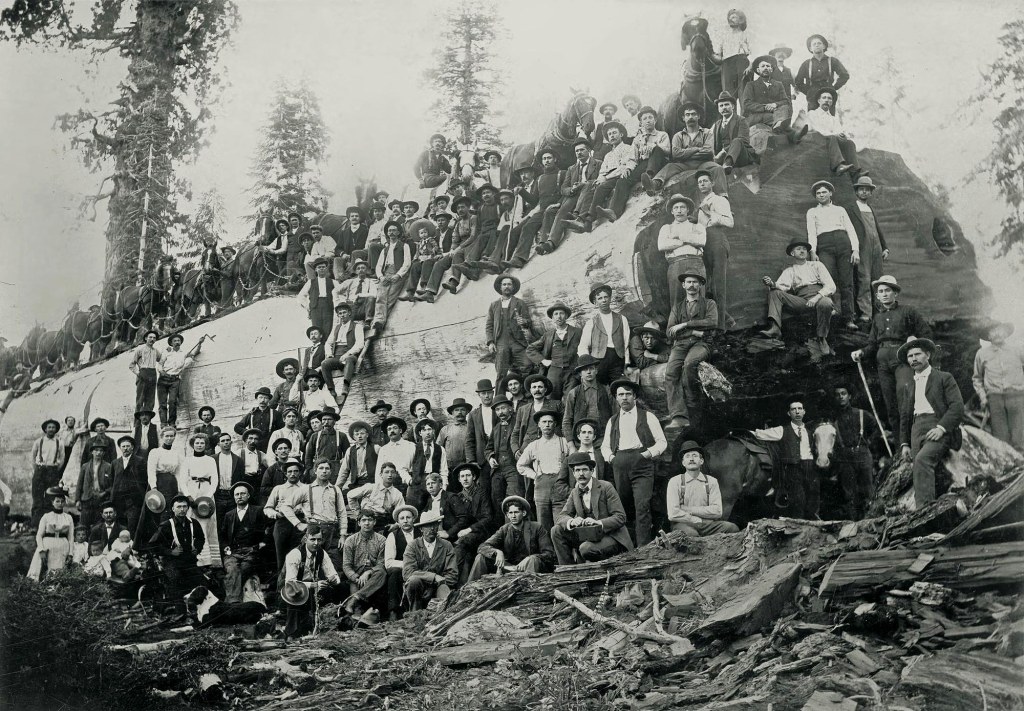
Loggers and a team of horses pose on a fallen sequoia 26 feet in diameter. Converse Grove, California 1917. (Wikipedia)

Between 1892–1918, the Sanger Lumber Company logged the grove using ruinous clearcutting practices, and cut down 8,000 giant sequoias, some of them over 2000 years old, in a decade-long event that has been described as “the greatest orgy of destructive lumbering in the history of the world.” Only 60-100 large specimens survived.

CALIFORNIA CURATED ON ETSY

Purchase stunning art prints of iconic California scenes.
Check out our Etsy store.

Currently, the most expansive remaining sequoia domain is the Giant Forest in Sequoia National Park, which has an estimated 8,400 giant sequoia trees that are more than one foot in diameter at their bases. The park is home to the world’s biggest tree, the General Sherman

(See our feature on the biology behind the immense size of redwoods and sequoias here.)

General Sherman Tree (Photo: Erik Olsen)

So how did this happen? The Converse Basin grove’s discovery in the late 19th century coincided with a burgeoning demand for lumber in the wake of California’s Gold Rush and subsequent population boom, particularly in San Francisco. A huge portion of early San Francisco was built using redwood. In fact, redwood was the dominant building material in much of 19th-century California, and San Francisco was practically a redwood city.

This demand drew the attention of loggers to the massive potential of sequoias. In particular, the Kings River Lumber Company, which secured this coveted area through both lawful and dubious means shortly after its incorporation in 1888. This marked the first instance of industrial-scale logging targeting the Sierra redwoods, a venture that required substantial initial investment due to the challenges of building a mill in the mountains and the engineering marvel needed to transport the colossal timber to lower elevations.

The 54-mile-long flume, or log conveyor, from Converse Basic Grove to the town of Sanger, about 20 miles from Fresno.
(Photo: National Park Service)

To get the logs to mills from the High Sierra Mountains the SF-based company constructed a 54-mile-long flume, or log conveyor, from Converse Basic Grove to the town of Sanger, about 20 miles from Fresno. This giant wooden waterslide, balanced on trestles along steep canyon sides, allowed lumber to be swiftly transported to the nearest train station, some 60 miles away, in just half a day. Upon reaching the station in Sanger, a town that proudly proclaimed itself the “Flumeopolis of the West,” the lumber was dried, finished and prepared for rail transport to markets across California.

Fun fact: the massive flume later inspired modern amusement park log rides like the Timber Mountain Log Ride at Knotts Berry Farm in Southern California.

High trestle under construction on the Sanger Flume 1905. (Public Domain)

But how did this happen in the first place?

Rugged terrain and unnavigable streams had protected these big trees for decades. That it became possible to log so many magnificent trees in such a hard-to-reach place was due to the passage of one of the most unintentionally destructive environmental laws ever passed in the United States.

In 1878, the United States Congress enacted the Timber and Stone Act to promote the private ownership of timberland and support the logging industry. This legislation permitted individuals to claim federal lands in the Sierra Nevada mountains, acquiring individual parcels of 160 acres for a nominal fee if they simply filed a claim.  Like other land laws of the era, it was also designed to encourage westward expansion by making it easier for settlers and speculators to acquire and develop land in the American West.

Stacks of lumber with workers at Converse Basin (Public Domain)

Prior to this legislation, there was no legal framework allowing individuals to purchase timberland directly from the government specifically for logging purposes, as opposed to agricultural use. However, following the enactment of the law in 1878, it became possible to acquire nonarable, nonmineral public lands at a minimal cost of $2.50 per acre. To claim these 160-acre parcels, the claimant only needed to attest that their intention was to utilize the land for practical, non-speculative purposes, excluding any plans for resale or contractual transfer to another entity.

This enabled the easy transfer of vast expanses of land from the government to lumber companies, which commonly enlisted and compensated individuals to file claims on their behalf. Among these companies was the Kings River Lumber Company, which acquired some of the lands legally, but also got its hands on vast acreages using dubious and illegal tactics that took place right under the noses of government regulators. 

Converse Basin Panorama from 1900. (Photo: National Park Service)

The Timber and Stone Act required buyers to use the land for personal, non-speculative purposes, but the company circumvented these restrictions by using a practice known as “dummying.” In this scheme, the lumber company recruited individuals to act as stand-ins or “dummies” to file claims on parcels of the Converse Basin under the pretense that these claims were for personal use. After securing the claims, these individuals would then transfer the parcels to the Kings River Lumber Company, often for a profit. This allowed the company to amass large areas of prime sequoia forest, much of which was still old-growth timber, under dubious legal pretenses.

Lumber production began in Converse Basin in 1891, launching with 20 million board feet of timber flowing down the flume. But the company had been created through the issuance of massive debt, and the company was under pressure to increase output to become profitable. However, the flume frequently required costly repairs. In 1895, following an unsuccessful reorganization attempt, the firm was taken over by creditors and renamed Sanger Lumber. The new management pushed for maximum production, extending the narrow-gauge railroad deeper into the basin and constructing a new sawmill in 1897.

Cut end of tree showing welded crosscut saws. (Photo: National Park Service)

During its operation, Sanger Lumber was responsible for the felling of approximately eight thousand mature sequoias within the 5,000-acre Converse Basin, leaving only one giant standing. At the northern edge of the grove, overlooking Kings Canyon, loggers spared a single large tree, now among the world’s ten largest, and named it after their foreman, Frank Boole. The Boole Tree still stands today. It is the eighth tallest sequoia in the world and ranks No. 1 in base circumference, at 112 feet. Estimated to be more than 2,000 years old, the behemoth is the largest tree in America’s national forests, but it stands less as a monument to the grandeur of the trees themselves than as a testament to human avarice and recklessness. 

The operation peaked in 1903 with a production of 191 million board feet, employing up to seven hundred men. However, the process was notoriously unsafe and wasteful. Decades later, the superintendent of Sequoia National Park noted the profound damage and inefficiency of the logging, with many fallen trunks left unprocessed, free to decompose over time.

Logging, Converse Basin, near Boole Tree. (Photo: National Park Service)

The entire operation ended without profit, leading to the sale of the company in 1905 and the eventual destruction of the Converse Basin mill. What followed was a period of secondary logging, akin to scavenging, that persisted into the 1910s. In a Harpers’ essay titled The Last Stand of the Redwoods, the Yale English professor Henry Seidel Canby wrote that a visit to the basin evoked a deep sense of melancholy, describing what he saw as “a vast and lonely cemetery”.

By 1905, after depleting the majestic stand of trees without turning a profit, a Michigan lumberman acquired the operation and shifted focus to a lower-elevation, mixed-species forest. The remaining structures at Converse Basin were deliberately burned, and logging continued on a smaller scale, resembling scavenging more than harvesting.

In 1935, the U.S. government repurchased the ravaged land for fifteen dollars per acre, incorporating it into what is now the Giant Sequoia National Monument. This area, marked by fields of blackened stumps and surrounded by new growth, stands as a public testament to the historic exploitation and a somber reminder of the past.

Converse Basin Grove today (Wikipedia)

The devastation of Converse Basin helped to catalyze the conservation movement in the early 20th century. Galvanized by the widespread destruction of such majestic trees, naturalists and conservationists, led by figures like John Muir, began to advocate more vehemently for the protection of natural landscapes. Their efforts were instrumental in the establishment of national parks and protected areas, ensuring that other groves and natural habitats were spared from the fate of Converse Basin.

Today, most remaining sequoia groves are publicly owned and managed for conservation purposes. Giant sequoia forests have faced extensive fire exclusion over the past century and suffer from the lack of frequent low-intensity fires that are necessary for giant sequoia reproduction. The long-term trend of Sierra snowpack reduction, in combination with warmer temperatures and widespread fir, pine, and cedar tree mortality from drought and pests, is greatly increasing the risk of severe fire and threatening the giant sequoia ecosystem. 

U.S. Forest Service wildland firefighters protect Giant Sequoia tree during the Castle Fire in August 2020.
(Photo: US Forest Service)

The 2020 Castle Fire, part of the larger SQF Complex Fire in California, was particularly devastating for the giant sequoia population. Estimates suggest that approximately 7,500 to 10,600 mature giant sequoias were killed by this fire, which represents 10-14% of the total population. These numbers underscore the severe impact of intense wildfires on these ancient trees, which are typically resilient to fire but have been increasingly vulnerable due to factors like drought and climate change. This event has highlighted the need for new strategies in forest management and fire prevention to protect these iconic trees.

Today, the area, with its fields of blackened stumps encircled by new growth, stands as a testament to both the destructive power of industrial logging and the fragility and resilience of nature.

Julia Platt was the Unwavering Force Behind Monterey’s Ecological Conservation

Monterey Bay (Photo: Erik Olsen)

In the 18th century, when Spanish and French explorers ventured along the northern California coast they encountered Monterey Bay and marveled at the astonishing ecological abundance of this 25-mile wide bite mark in the land. The shores buzzed with the lively interactions of sea birds, sea otters played amidst the luxuriant kelp beds, and the waters teemed with many species of whale. 

Yet, by the late 19th and early 20th centuries, this rich tapestry of marine life and biodiversity had largely been erased, replaced by the destructive industrial operations of sardine canneries. These factories, though they brought economic activity and prosperity to a few, also introduced a plague of environmental problems that began a period of staggering ecological decline. 

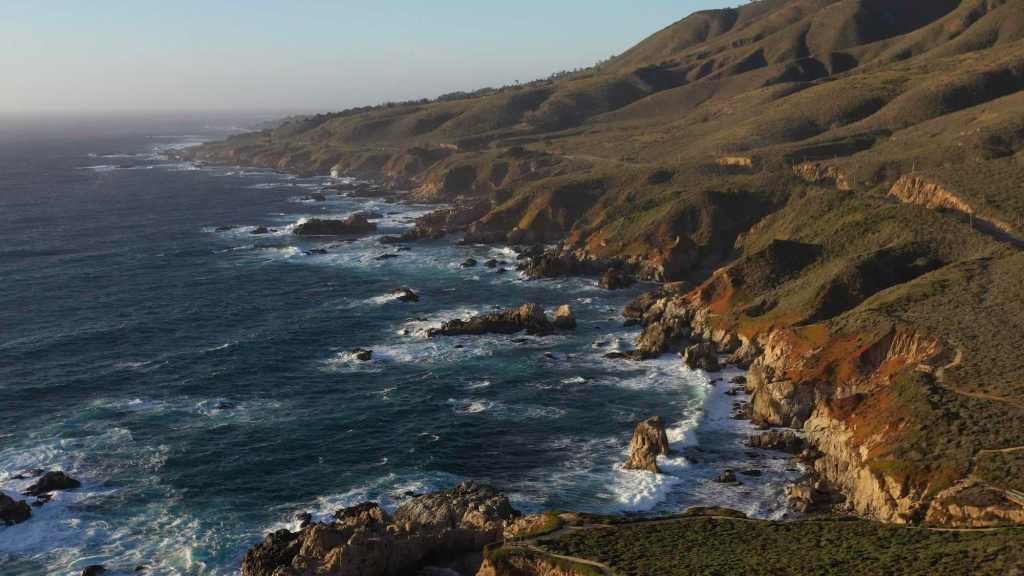
California Coast out of Big Sur (photo: Erik Olsen)

But the tide turned in the early 20th century, in large part due to the efforts of a determined, pioneering woman who took a stand against the sardine industry and began an effort of restoration that helped make Monterey Bay one of the most celebrated shorelines in the world.

CALIFORNIA CURATED ON ETSY

Purchase stunning art prints of iconic California scenes.
Check out our Etsy store.

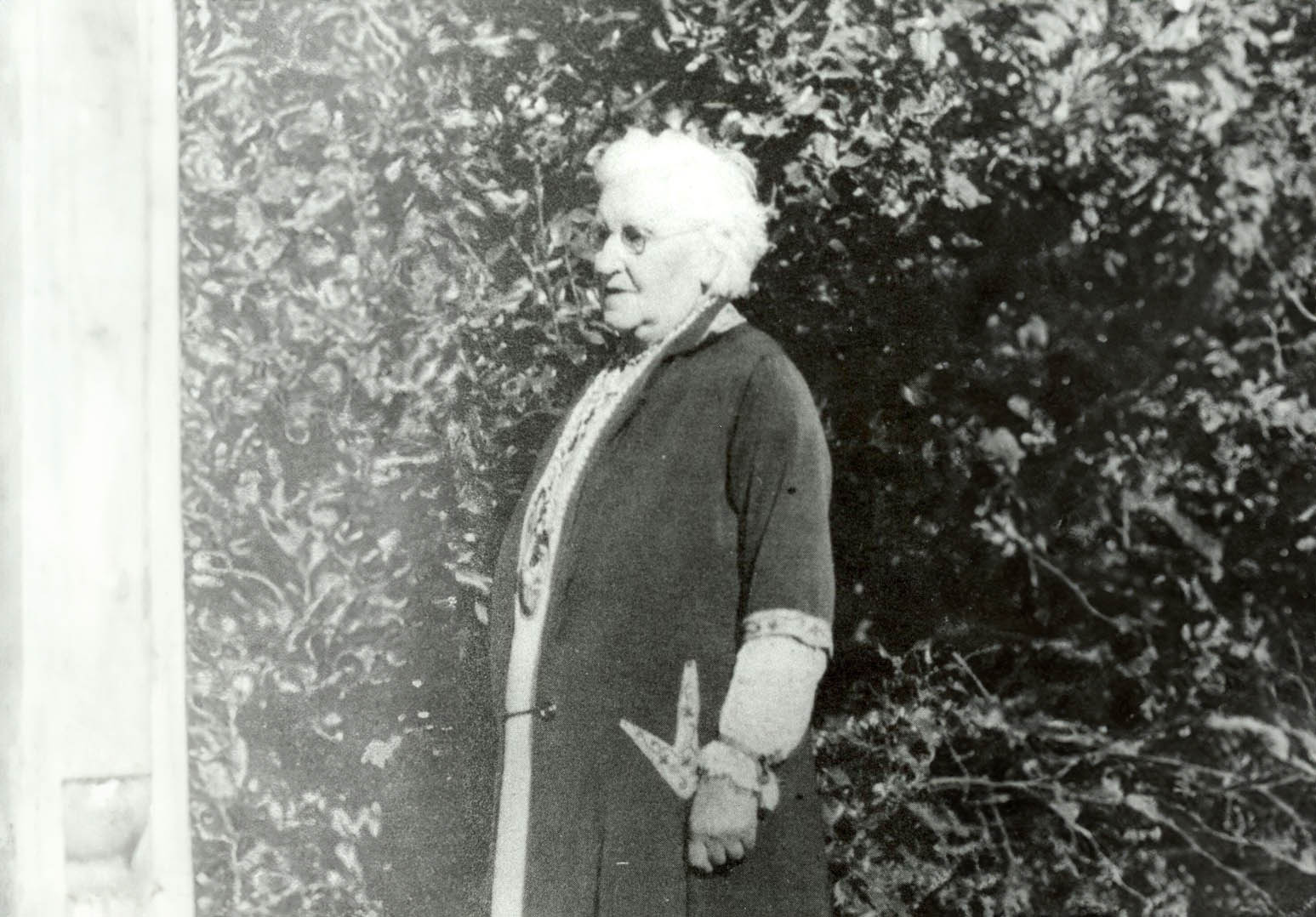
 This transformational figure was Julia Platt, whose contributions were instrumental in the conservation efforts that led to the revival of Monterey’s natural and economic landscape. As mayor of Pacific Grove and a pioneer in marine conservation, Platt used her authority and vision to establish protected marine areas and implement regulations that curbed overfishing and habitat destruction. Her efforts laid the groundwork for a broader environmental awareness and action within the community.

Julia Platt began her career not in politics, but in science. She was born on September 14, 1857, in San Francisco, California, and later moved to Burlington, Vermont. She studied at the University of Vermont and then at Harvard University for her graduate studies.

During her academic journey, Julia faced the limitations imposed on women in academia at the time. In the late 1800s in the United States, it was nearly impossible for a woman to pursue a Ph.D. in zoology due to prevailing gender biases. However, the University of Freiburg in Baden, Germany, presented her with an opportunity to break through these barriers. She seized this chance and became one of the first women to earn a zoological Ph.D. there, challenging the norms and paving the way for future generations. 

Her academic achievements were significant, and she had already made significant contributions to science, including pioneering research on chick embryo development and identifying a new head segment in shark embryos. 

But upon returning to the US, she once again ran up against the glass ceiling of academia. While she worked with some of the top zoologists of the time, she could not find steady work in science. Admitting defeat, but determined to make her mark, she decided on politics, writing to a friend, “Without work, life isn’t worth living. If I cannot obtain the work I wish, then I must take up with the next best.” 

Cannery Row in Monterey 2023 – (Photo by Erik Olsen)

Monterey Bay’s legendary biodiversity was under serious threat. In 1854, a whale was as valuable as several pounds of pure gold, and J.P. Davenport harvested them using exploding lances, processing the carcasses in shore-based vats of boiling oil. By the late 19th century, the lucrative abalone industry had attracted Chinese fishermen village to the shores of Pacific Grove over-burdening the population. During the Gold Rush, prospectors consumed fourteen million seabird eggs from the Farallon islands, a practice that decimated seabird populations. From the 1910s to the 1940s, Monterey Bay’s sardine population fueled a burgeoning canning industry, reaching unprecedented scales that caused horrific smells in town and rendered the beach useless for recreation. 

Each of these industries ultimately collapsed under the weight of its own exploitation; otters, whales, seabirds, abalone, and sardines were all harvested to the brink of extinction.

Whales at Moss Landing near Monterey

In 1899, as the age of 42, she moved to Pacific Grove, the photogenic seaside hamlet next to Monterey where industrial canning and the environmental destruction wrought by it was at its peak. The pollution from canning operations (romanticized in John Steinbeck’s Cannery Row) made the beaches unusable and the smell wafting from Monterey made conditions almost unlivable. Platt decided to redirect her passion for understanding the intricacies of life into preserving it. 

Photo by Eadweard Muybridge of egg collectors on South Farallon Island
Courtesy of New York Public Library via Wikicommons

Taking matters into her own hands, she ran for public office. In 1931, at the age of 70, she became the mayor of Pacific Grove. Despite facing challenges as one of the few female mayors of her time, she wielded her position with an iron will and a clear vision for the future. She was an ardent advocate for beach access for all people, and wielded crowbars, hammers and her own strong will against the rich beachfront land owners who sought to fence off their properties. In this regard, she was a pioneer, foreshadowing the California Coastal Act of 1976—one of the most treasured aspects of California’s landmark coastal protection system—which protects the state’s iconic coastlines from unchecked development and preserves their natural beauty and accessibility for future generations.

Platt’s most significant and lasting contribution as mayor was the establishment of one of the first marine protected areas in California. She passionately argued for the designation of a marine refuge along the coastline, driven by her belief in the innate value of conserving marine habitats and their inhabitants. With her guidance, what became the Lovers Point-Julia Platt State Marine Reserve (SMR) and Edward F. Ricketts State Marine Conservation Area (SMCA), became two of four marine protected areas (MPAs) located on the Monterey Peninsula between Monterey and Pacific Grove.

Bixby Bridge near Monterey (Photo: Erik Olsen)

Thanks to Platt’s efforts, the region saw a revival in its marine biodiversity. Her initiatives ensured that the delicate balance of the marine ecosystem was maintained and allowed for species that were on the brink of being decimated due to human activities to thrive once more.

Julia Platt was more than just Pacific Grove’s mayor; she was its guardian. Through her vision and determination, she transformed Monterey into a beacon of marine conservation. Even after her tenure as mayor, Platt’s legacy lived on. Her initiatives paved the way for future conservation efforts, including the establishment of the iconic Monterey Bay Aquarium.

JPL and the Voyager Golden Record: Humanity’s A Cosmic Mixtape in Space

The Jet Propulsion Laboratory (JPL) in La Canada Flintridge, California is well-known for building and sending spacecraft far into the cosmos to help us better understand the universe. But the agency was also extensively involved in one of the most ambitious and symbolic projects in the history of space exploration, one that in many ways was more art than science: the Voyager Golden Record.

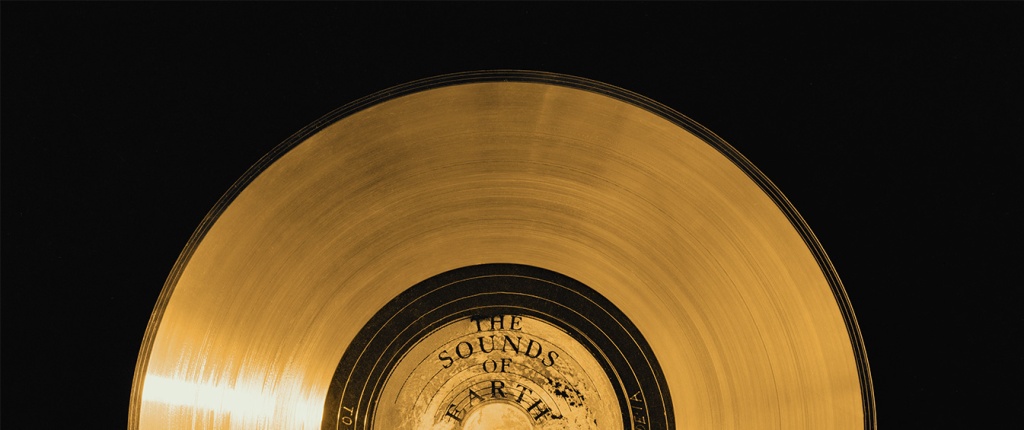
In 1977, as the twin Voyager spacecraft prepared to journey beyond the confines of our solar system, they carried with them what might be the most profound artifacts ever created by humanity: the Voyager Golden Records. These records, designed to last a billion years, are time capsules intended not for Earthlings but for potential extraterrestrial finders or future humans. Engraved in gold-plated copper discs, the records encapsulate the Earth’s diverse cultural and natural heritage—from music to languages to sounds of nature.

Photo: NASA/JPL-Cal Tech

The idea of the Golden Record was developed by a talented team led by Carl Sagan, the renowned astronomer and science communicator. Sagan, alongside other prominent figures such as Frank Drake, Ann Druyan, science journalist Jon Lomberg, and Linda Salzman Sagan, crafted a selection that aimed to represent the entirety of Earth. The content ranged from classical music by Bach and Beethoven to greetings in 55 languages, natural sounds like thunderstorms and whales, and a diverse set of 115 images depicting life and culture on Earth.

But producing a record that could survive the harsh environment of space, while also being understandable and playable by beings of unknown technology, posed unique challenges. This is where the Jet Propulsion Laboratory (JPL) stepped in, playing a pivotal role in transforming this ambitious vision into a tangible, durable artifact capable of traversing the cosmos.

Inspection of the engraving of the Voyager Golden Record.
Photo: NASA/JPL-Cal Tech

JPL, managed by Caltech under a NASA contract, was primarily responsible for the construction and operation of the Voyager spacecraft. Their expertise was crucial not just in the scientific instrumentation and engineering of the spacecraft but also in integrating the Golden Records. The lab’s engineers worked meticulously to ensure that the records were equipped with everything needed for potential playback: a cartridge, a needle, and symbolic instructions detailing their use. These instructions, etched onto the record’s cover, provided a universal map indicating Earth’s location in relation to pulsar stars, which are highly stable and can be used as galactic landmarks.

JPL’s involvement extended to the actual physical preparation of the records. They coordinated closely with RCA Records to produce the master disc from which the Voyager records were replicated. The final products were then plated in gold and encased in a protective aluminum jacket, designed to withstand the vacuum of space, cosmic rays, and extreme temperatures.

Photo: NASA/JPL-Cal Tech

The technical contributions of JPL ensured that the Golden Records were not only a feat of cultural expression but also a marvel of scientific and engineering ingenuity. By equipping the Voyager spacecraft with these messages, JPL helped bridge the human desire to explore and communicate with the tangible reality of space travel. The records, mounted aboard Voyagers 1 and 2, continue to be ambassadors of Earth, carrying sounds, music, and images intended to convey the story of our world to whoever, or whatever, might find them.

Today, both Voyager spacecraft, with their Golden Records, have entered interstellar space, marking them as the most distant human-made objects in existence. They serve as reminders of humanity’s ambition to reach beyond our immediate grasp and to communicate across vast cosmic distances. JPL’s role in this historic endeavor highlights the profound connection between human creativity and technological advancement, ensuring that our message to the cosmos will endure long after the original voices have faded.

JPL written on the Voyager Golden Record
Photo: NASA/JPL-Cal Tech

As these records voyage through the cosmos, they remind us not just of where we have been, but also of the far reaches that our curiosity can take us. Through the combined efforts of visionaries like Carl Sagan and the engineering prowess of JPL, the Voyager Golden Record stands as a testament to the best of human knowledge, culture, and technological achievement.


The Voyager Golden Records are phonograph records, much like the vinyl records used to listen to music before digital media became widespread. They are constructed from copper discs coated in gold to withstand the harsh environment of space. Each record is encased in a protective aluminum jacket, along with a cartridge and a needle. Instructions in symbolic language explain the origin of the spacecraft and indicate how the record should be played. The playback speed (16 2/3 revolutions per minute) is much slower than typical records, which typically spin at 33 1/3 or 45 rpm.

The content of the Golden Record is a meticulously curated selection intended to represent the diversity of life and culture on Earth:

Sounds of Earth: The records include audio of nature sounds like thunder, wind, and animals (including the songs of birds and whales). Human sounds like footsteps, a heartbeat, and laughter are also embedded, capturing the biological and social essence of Earth.

The DNA structure magnified, light hit image is one of the pictures electronically placed on the phonograph records which are carried onboard the Voyager 1 and 2 spacecraft. Credit: Jon Lomberg

Musical Selections: There are 27 musical tracks from different cultures and eras, ranging from classical pieces by Bach and Beethoven to traditional songs from various cultures, including a Navajo chant and a Peruvian wedding song. These selections were intended to showcase the diversity of musical expression on Earth.

Greetings in 55 Languages: A variety of spoken greetings from “Hello” in English to ancient languages like Akkadian. The inclusion of a broad range of languages aims to depict the linguistic diversity of humanity.

Images: The record also contains 115 analog-encoded photographs and diagrams. These images show a wide range of subjects, including humans of different sexes and races, everyday activities, scientific knowledge like mathematical definitions, and the Solar System. The intent was to offer a visual summary of our planet and its inhabitants.

CALIFORNIA CURATED ART ON ETSY

Purchase stunning art prints of iconic California scenes.
Check out our Etsy store.

Message from the UN Secretary-General and the President of the United States: There are also printed messages from prominent global leaders at the time, including U.S. President Jimmy Carter and United Nations Secretary-General Kurt Waldheim.

Sounds of Human Origin: Beyond natural and environmental sounds, the record also includes a montage of the sounds of Earth, a screaming chimpanzee, a medley of human-originated noises like tools, vehicles, and a kiss, among others.

The idea behind the Voyager Golden Record is not just to communicate where and who we are but also to share a message of hope and peace with any possible recipient, even if that recipient is far in the future. The chances of the Voyager spacecraft actually being found by extraterrestrial life are slim, but the Golden Record serves as a profound gesture of goodwill and a testament to the human spirit’s longing to reach out and explore the universe.

The Enigmatic Island Fox: A Tale of Survival and Conservation

Nature Conservancy

In the rugged, isolated beauty of California’s Channel Islands, a small, curious creature scampers through the chapparal, playing a crucial role in the archipelago’s ecosystem. It’s the Island Fox (Urocyon littoralis), a species that encapsulates both the vulnerability and resilience of island ecosystems.

The island fox only lives on six of the eight Channel Islands off the coast of southern California–they are found nowhere else on Earth. Each island population is recognized as a separate endemic or unique subspecies. This divergence is a classic case of allopatric speciation, where geographic isolation leads to the evolution of different species.

The Island Fox, notably smaller than its mainland cousin, the gray fox, stands as a striking example of insular dwarfism – a phenomenon found in the theory of island biogeography where species evolve smaller sizes on islands. It should be noted that island biogeography, which explores the distribution of species and ecosystems in island environments, finds a perfect case study in the Channel Islands. For instance, the discovery of remains of the pygmy mammoth (Mammuthus exilis) on Santa Rosa Island provides a classic example of how isolation and limited resources can lead to significant evolutionary changes. 

Skeleton of the Pygmy Mammoth at the Santa Barbara Museum of Natural History

The Island Fox is known for its curiosity and intelligence. It’s primarily nocturnal but is often active during the day, especially when tourists and their food are around. Visitors to the most popular Channel Islands like Anacapa, Santa Rosa, and Santa Cruz may regularly see the foxes scurrying around campsites looking for scraps of food. They readily approach humans, perhaps an unfortunate sign that they have become too habituated to humans. The island fox is an omnivore, with a diet ranging from fruits and insects to small mammals and birds. Its diet shifts with the seasons, reflecting the availability of different food sources on the islands.

Island Foxes typically form monogamous pairs during the breeding season, which runs from January to March. The female gives birth to a litter of two to four pups around 50 days after mating. These pups are weaned and ready to fend for themselves after about 9 months, reaching sexual maturity at 10 months. The average lifespan of an Island Fox in the wild is 4 to 6 years, though they can live longer in captivity.

Island Fox on the Channel Islands (Photo: Erik Olsen)

The story of the Island Fox’s conservation is one of remarkable success but also a stark reminder of the fragility of island ecosystems. In the late 1990s, the Island Fox population faced a catastrophic decline, primarily due to predation by golden eagles and a disease outbreak. By 2004, fewer than 100 foxes remained on some islands, leading to their classification as an endangered species.

Island Fox looking for food scraps. (Photo: Erik Olsen)

A concerted effort by conservationists, including the National Park Service and the Nature Conservancy, initiated a recovery program. This program involved breeding foxes in captivity, vaccinating them against diseases, and relocating golden eagles while reintroducing bald eagles, a natural competitor. Remarkably, by 2016, the Island Fox populations had bounced back sufficiently for them to be removed from the endangered species list, marking one of the fastest recoveries of an endangered species in U.S. history.

The Island Fox’s journey from the brink of extinction to a conservation success story is a testament to the power of dedicated conservation efforts. It also highlights the importance of maintaining ecological balance in sensitive environments like the Channel Islands.

California’s SLAC and the Mission to Unveil the Mysteries of Matter and the Cosmos

The BaBar Detector at SLAC with physicist Michael Kelsey inside wearing a red hard hat, 2002. 
(Peter Ginter/SLAC National Accelerator Laboratory)

The SLAC National Accelerator Laboratory in Menlo Park, California, is a testament to human curiosity and the pursuit of the unknown. Since its inception in 1962, originally as the Stanford Linear Accelerator Center (as it was previously known), it has been on the forefront of scientific discovery in numerous scientific disciplines. It is truly one of the nation’s great scientific institutions, being at the forefront of numerous major discoveries that have deeply impacted – and will impact – the world. 

Six scientists have received four Nobel prizes for their groundbreaking research conducted at SLAC, which led to the discovery of two elementary particles, confirmed that protons consist of quarks, and elucidated the process by which DNA orchestrates the synthesis of proteins in cells.

Stanford’s Roger Kornberg received the 2006 chemistry Nobel for work on RNA transcriptase, shown on screens.  
(Peter Ginter/SLAC National Accelerator Laboratory)

Administered by Stanford University and sponsored by the U.S. Department of Energy, SLAC has grown into a multifaceted research institution that explores a broad program in atomic and solid-state physics, chemistry, biology, and medicine. The lab employs the use of X-rays generated from synchrotron radiation and a free-electron laser, among other tools, to push the boundaries of our understanding in areas ranging from elementary particle physics to cosmology​​.

CALIFORNIA CURATED ART ON ETSY

Purchase stunning coffee mugs and art prints of iconic California species.
Check out our Etsy store.

SLAC’s roots can be traced back to the construction of the 3.2-kilometer Stanford Linear Accelerator in 1966, the world’s longest linear accelerator at the time. This remarkable structure has been pivotal in fundamental research that led to the discovery of the charm quark in 1976, the quark structure inside protons and neutrons in 1990, and the tau lepton in 1995, each discovery earning a Nobel Prize in Physics​​. This pioneering spirit is also embedded in SLAC’s cultural heritage, having provided a meeting space for the Homebrew Computer Club, which significantly contributed to the home computer revolution of the late 1970s and early 1980s​​. For example, Steve Wozniak debuted the prototype Apple-1 at the Homebrew Computer Club in 1976. 

Steve Jobs and Steve Wozniak
Apple 1

SLAC has also played a significant role in the digital age, hosting the first World Wide Web server outside of Europe in December 1991, a milestone that underscores its contribution beyond the realm of physics​​. In the 1990s, the Stanford Linear Collider delved into the properties of the Z boson, further cementing SLAC’s position at the cutting edge of particle physics research​​.

New projects and experiments are undertaken at SLAC all the time, and new discoveries are constantly being made to help us understand the nature of matter, biological processes and the evolution of the universe, as well as to help bring us into a greener future. In November 2023, a team at SLAC along with the Toyota Motor Company made significant advances in fuel cell efficiency.

The Linac Coherent Light Source (LCLS), a free-electron laser facility, has been a highlight of SLAC’s facilities, providing intense X-ray radiation for diverse research areas since 2009. In September 2023, SLAC fired up the world’s most powerful X-ray laser, the LCLS-II, to explore atomic-scale, ultrafast phenomena that are key to a broad range of applications, from quantum materials to clean energy technologies and medicine.

“This achievement marks the culmination of over a decade of work,” said LCLS-II Project Director Greg Hays. “It shows that all the different elements of LCLS-II are working in harmony to produce X-ray laser light in an entirely new mode of operation.”  

It was in the facility that scientists and researchers developed the first X-ray free-electron lasers (XFELs). XFELs are like X-ray microscopes, and generate exceptionally bright and fleeting bursts of X-ray light, enabling researchers to observe the dynamics of molecules, atoms, and electrons with unparalleled clarity, exactly as these events unfold in their native, rapid timescales—a realm where the intricacies of chemistry, biology, and materials science play out. These facilities have played a pivotal role in numerous scientific breakthroughs, such as producing the first “molecular movie” that reveals the intricacies of complex chemical reactions, capturing the precise moments when plants and algae harness solar energy to generate the oxygen we rely on, and probing the intense conditions that shape the formation of planets and extraordinary events like diamond precipitation.

Over the years, SLAC has evolved to support a growing community of scientists. As of 2021, the lab employs approximately 1,600 staff members from 55 different countries, in addition to 470 postdoctoral researchers and graduate students. The center welcomes over 3,000 visiting researchers annually​​. This community has access to facilities such as the Stanford Synchrotron Radiation Lightsource for materials science and biology experiments and the Fermi Gamma-ray Space Telescope for astrophysics research​​.

After decades of effort and help from SLAC’s X-ray laser, scientists have finally seen the process by which nature creates the oxygen we breathe. (SLAC)

The lab is also working at the forefront of astronomy and imaging. The SLAC National Accelerator Laboratory is at the helm of an ambitious project, crafting the world’s largest digital camera for the Vera Rubin Observatory’s Legacy Survey of Space and Time (LSST). Set to capture the southern sky from high on a mountaintop in Chile, this camera is a marvel of engineering and scientific collaboration. Its 3.2-gigapixel capacity allows it to snap detailed images every 15 seconds, offering an unprecedented window into the cosmos. The camera’s wide field of view can image an area 40 times larger than the full moon in one shot, and its advanced filters enable astronomers to probe the universe across a range of wavelengths. As part of the decade-long LSST, it will gather vast amounts of data, propelling our understanding of dark matter, dark energy, galaxy formation, and more​

SLAC has developed the world’s largest digital camera for the Vera Rubin Observatory’s Legacy Survey of Space and Time (LSST)

In 2008, the lab was renamed from the Stanford Linear Accelerator Center to SLAC National Accelerator Laboratory, reflecting a broader scientific mission. Since then, the lab has continued to receive significant funding, including $68.3 million in Recovery Act Funding in 2009​​. Notably, SLAC and Stanford University initiated the Bits and Watts project to develop better, greener electric grids, although SLAC later withdrew due to concerns over an industry partner​​.

SLAC’s current endeavors include the Facility for Advanced Accelerator Experimental Tests (FACET), where research on plasma acceleration continues to advance the field​​. Theoretical research at the lab spans quantum field theory, collider physics, astroparticle physics, and particle phenomenology​​. Moreover, SLAC has contributed to the development of the klystron, a high-power microwave amplification tube that amplifies high radio frequencies and has aided in archaeological discoveries such as revealing hidden text in the Archimedes Palimpsest​​.

Archimedes Palimpsest (Wikipedia)

Other recent updates from SLAC include a new system for turning seawater into hydrogen fuel​​​​. They have also made advancements in understanding the production of nitroxide, a molecule with potential biomedical applications, and the operation of superconducting X-ray lasers at temperatures colder than outer space​​​​.

The SLAC National Accelerator Laboratory’s legacy is rich with scientific triumphs, and its future beckons with the promise of unraveling more of the universe’s deepest secrets. Whether through peering into the atomic structure or probing the vast cosmos, SLAC remains a beacon of discovery and innovation.