Black Gold Beach or How Oil Transformed Long Beach and Built the Southern California Economy

Signal Hill oil development (Photo: The Huntington Library, Art Museum, and Botanical Gardens)

Southern California is best known for its sun-soaked beaches and Hollywood glamour, but it also has a wilder, largely forgotten past: it was once an oil kingdom. It’s a story even many Californians don’t know, a tale of spectacular gushers, fortunes won and lost, and larger-than-life characters straight out of a movie. Without oil, Los Angeles, and much of Southern California, would be very different places today.

The story of oil in Southern California is inextricably linked to the Long Beach fields, an area that once seemed more like a scene from Texas or There Will Be Blood than the Golden State. The discovery of oil in this region wasn’t just a footnote in economic journals; it was a seismic event that transformed the landscape, both literally and metaphorically. And it provided an industrial center of gravity to a region of the state that was just beginning to emerge as one of the world’s great gateways of commerce.

Signal Hill, 1926 (Public Domain)

The early 20th century was the beginning of the era of oil in California. On June 23, 1921 at 9:30 a.m., the Alamitos No. 1 oil well on Signal Hill in Long Beach was drilling 2,765 feet beneath the surface when the drill struck an underground oil deposit. This oil was under high pressure due to natural gas, blowing a gusher of oil over 100 feet high, and heralding the start of the Long Beach oil boom.

This event marked the discovery of one of the most prolific oil fields in the Los Angeles basin. Throughout the 1920s, Signal Hill, along with the nearby Santa Fe Springs field, experienced numerous blowouts, which erupted into dramatic pillars of flame that could be seen for miles. These incidents eventually prompted calls for stricter safety regulations. Consequently, in 1929, the state mandated the use of blow-out prevention equipment on all oil wells drilled in California.

Signal Hill quickly mushroomed into a forest of oil derricks, with fortunes being made overnight. As one of the most productive oil fields in the world, the Long Beach field was at one point yielding a staggering one-third of California’s total oil production. By the mid-1920s, California was producing nearly a quarter of the world’s entire petroleum supply, much of it from the Long Beach area.

Signal Hill, Long Beach oil development. (Public domain)

That so much oil is present beneath the surface of this stretch of Southern California is a gift of geology. Millions of years ago, the area that is now Long Beach was covered by the ocean. This marine environment was ideal for the accumulation of organic material, such as the remains of tiny plants and animals, on the ocean floor.

CALIFORNIA CURATED ON ETSY

Purchase stunning art prints of iconic California scenes.
Check out our Etsy store.

Over time, layers of sediment buried this organic matter. The high pressure and temperatures associated with deep burial initiated the transformation of this organic material into hydrocarbons – essentially, the formation of oil. Southern California is, of course, known for its active tectonics, influenced by the Pacific and North American Plate boundary. This tectonic activity has created a complex network of faults and folds in the earth’s crust in the Long Beach area.

The folding of the earth’s layers into anticlines (a type of fold that is convex up and has its oldest beds at its core) and the formation of fault traps (where displaced rocks create a seal that traps oil) are particularly important. These structures create reservoirs where oil can accumulate and be preserved over geological time scales.

Map of the Long Beach oil field.

As the oil flowed, so did the stories of those who sought their fortune in black gold. Perhaps the most famous of these was Edward L. Doheny, a name synonymous with California oil. Doheny, an ambitious prospector, was one of the first to recognize the potential of the Los Angeles Basin’s oil fields. His success in the oil industry was meteoric, but it was not without controversy, as he was later embroiled in the infamous Teapot Dome scandal.

Portrait of oil magnate Edward L. Doheny (Wikipedia)

The impact of oil production in Southern California extended beyond economics. It reshaped the region’s landscape, both physically and culturally. Towns sprung up around oil fields, and workers flocked to the area, drawn by the promise of jobs and prosperity. Long Beach, once a sleepy coastal town, burgeoned into a bustling city.

During the 1920s, regulations on well spacing were minimal, allowing Signal Hill to market narrow town lots. These lots were swiftly purchased by aspiring oil tycoons who installed wells so close to each other that they almost touched. Despite the dense placement, the wells generally remained profitable, though they rapidly depleted the oil field. The hill earned the nickname “Porcupine Hill” due to its appearance from afar, bristling with numerous wooden oil derricks since the more compact “nodding-donkey” pumpjack had not yet been developed.

The booming oil industry in the region attracted a massive influx of workers and investments. As oil fields expanded, Long Beach rapidly transformed from a seaside resort into an industrial powerhouse. The surge in economic activity and the availability of abundant oil fueled the growth of industries in and around Long Beach, including the burgeoning shipping and maritime sectors.

Container ships outside the Port of Los Angeles during the Covid lockdown in 2020. (Photo: Erik Olsen)

The construction of the Port of Los Angeles, which began in earnest in the early 1900s, was driven by the need to support the growing economic activities in Southern California, including agriculture, manufacturing, and oil. The proximity of Long Beach to the port, only about 20 miles south, meant that it was strategically positioned to benefit from and contribute to the port’s activities. The port served as a critical node for shipping oil, among other goods, which further integrated Long Beach, and Southern California as a whole, into the global trade system.

Signal Hill in Long Beach today. (Erik Olsen)

Moreover, the infrastructure developments necessary to support the oil industry, such as roads, railroads, and later pipelines, also facilitated the growth of the port. These developments enhanced the logistical capabilities of the region, making it more attractive for commercial and industrial activities. The oil boom thus not only transformed Long Beach but also had a cascading effect on the development of the Port of Los Angeles, cementing the region’s role as a vital hub in international trade and commerce.

As big and diverse in industry Los Angeles has become, it mostly started with oil. The fact that Los Angeles is now hardly known for oil, but better known for its massive entertainment and tourism economies is an astonishing transformation.

Of course, the influx of wealth and people also brought challenges, including environmental concerns and the need for regulatory oversight. It is well known that several major oil spills have taken place off the coast, ruining beaches and killing animals by the millions. In 1969, the Santa Barbara oil spill released vast quantities of oil into the ocean, creating an environmental disaster along the California coastline. This catastrophic event galvanized public awareness and activism, leading to the creation of the first Earth Day, as well as significant environmental legislation, including the establishment of the U.S. Environmental Protection Agency.

The oil slick visible around Platform A in the Santa Barbara Channel emanated from fissures in the seabed. (Photo: USGS)

Oil spills continue to take place in Southern California and the existence of 26 rigs off the coast are a reminder of that oil boom era. Those rigs are coming to the end of their productive life, however, and an on-gong controversy is what to do with them. Remove them or leave them — or part of them — as artificial reefs?

Over time, oil production in Southern California has waxed and waned. The easily accessible oil has largely been extracted, and production has declined from its mid-20th-century peak. Yet, the legacy of this era persists. It’s etched into the region’s physical and cultural landscape, from the bobbing oil derricks still dotting Signal Hill to the fortunes and institutions built on oil money.

The story of oil in Southern California, particularly the Long Beach fields, is a saga of geologic luck, ambition, ingenuity, and, at times, dangerous greed. It’s a chapter in the state’s history that’s as rich and complex as the oil that still lies beneath its surface, and yet it remains largely unknown to many people who think of Southern California as a paradise of sand and rolling waves.

Feathers on the Flyway: Unraveling Avian Mysteries at Bear Divide with the Moore Lab

Western tanager (Ryan Terrill)

“Personally, I really think it’s one of the best birding spots in the world,” Ryan Terrill, science director at the Klamath Bird Observatory.

Within a 45 minute drive from the urban chaos of downtown Los Angeles, lies a natural, ornithological marvel: Bear Divide, a vital corridor for the annual migration of numerous bird species. Every year — roughly between March 15 and June 15, with peak migration between April 10 and May 20 — thousands of birds funnel through the narrow pass. The divide is a small dip in the otherwise impregnable San Gabriel mountains, allowing birds in the midst of their migration to pass through safely at relatively low altitudes. This area is not just a haven for bird enthusiasts but also a critical research site, especially for the team from the Moore Lab of Zoology at Occidental College, who have been delving into the intricacies of these migratory patterns.

The Moore Lab of Zoology is renowned for its extensive bird specimen collection, one of the largest of its kind in the world for Mexican birds.

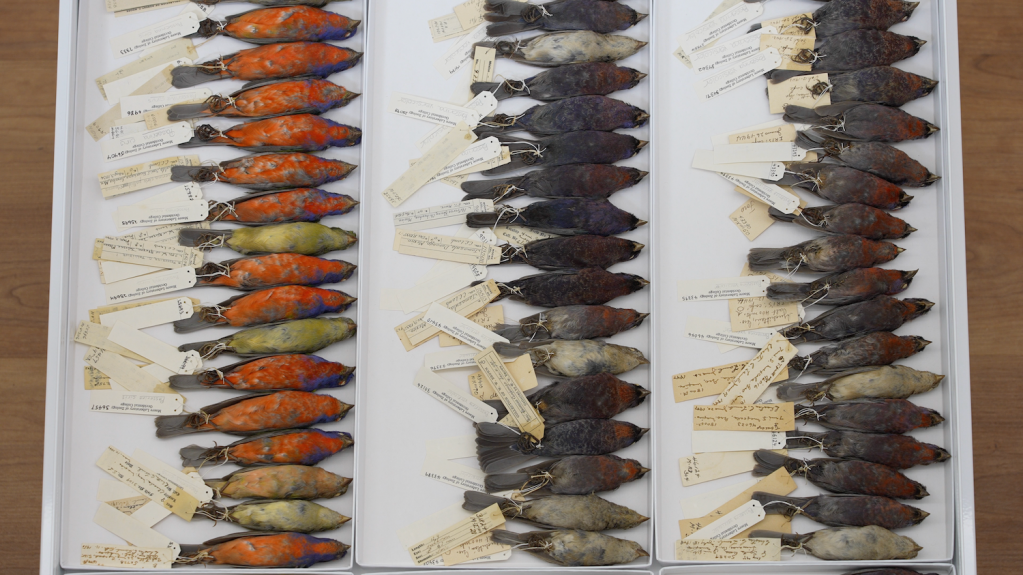
Part of the large bird collection at the Moore Lab at Occidental College in Pasadena (Erik Olsen)

Bear Divide is strategically positioned along the Pacific Flyway, a significant north-south migratory route used by birds traveling between Alaska and Patagonia. The geographical features of the San Gabriels provide an ideal resting and feeding ground for these birds, making Bear Divide a crucial stopover during their long journeys. It’s this unique combination of location and topography that makes Bear Divide an essential component of avian migration.

U.S. Fish and Wildlife Service

The discovery of Bear Divide was a lucky happenstance. A bird researcher was conducting overnight monitoring in the spring of 2016, and when morning came, he noticed legions of small songbirds whizzing past his monitoring spot. His report caught the attention of postdoc bird scientist Ryan Terrill at Moore Lab at the time, and he began an effort to monitor the birds. Terrill and his team would ultimately record as many as 20,000 birds in a single morning.

“It really is overwhelming to stand on the road and have 5,000 birds of 80 species fly by your knees in a morning,” Terrill said. The effort has continued to this day with startling results. Terrill has since left and is now the science director at the Klamath Bird Observatory.

CALIFORNIA CURATED ON ETSY

Purchase stunning coffee mugs and art prints of iconic California species.
Check out our Etsy store.

“Last year 2023 we counted 53,511 birds of 140 species from February to May,” said John McCormack, a professor of biology and the Director and Curator of the Moore Laboratory of Zoology. “And of course, we missed many thousands more because most travel at night. It’s easy to say that there are hundreds of thousands of birds passing through Bear Divide.”

Swainson’s Hawk (Marky Mutchler)

As many as 13,000 western tanagers, lazuli buntings, chipping sparrows, hermit warblers, orioles, grosbeaks and warblers pass through Bear Divide on a single day. Why they do so, is not entirely understood. The unusual topography of Bear Divide essentially serves as a funnel for the migrating birds, with many of them shooting through the gap just a meter or two above ground.

“Personally, I really think it’s one of the best birding spots in the world,” Terrill told the LA Times.

McCormack says that the “ultimate goal is to better understand the Pacific Flyway and how it’s used, especially by small terrestrial birds. Little is known about their movements because they are hard to see and usually travel at night.”

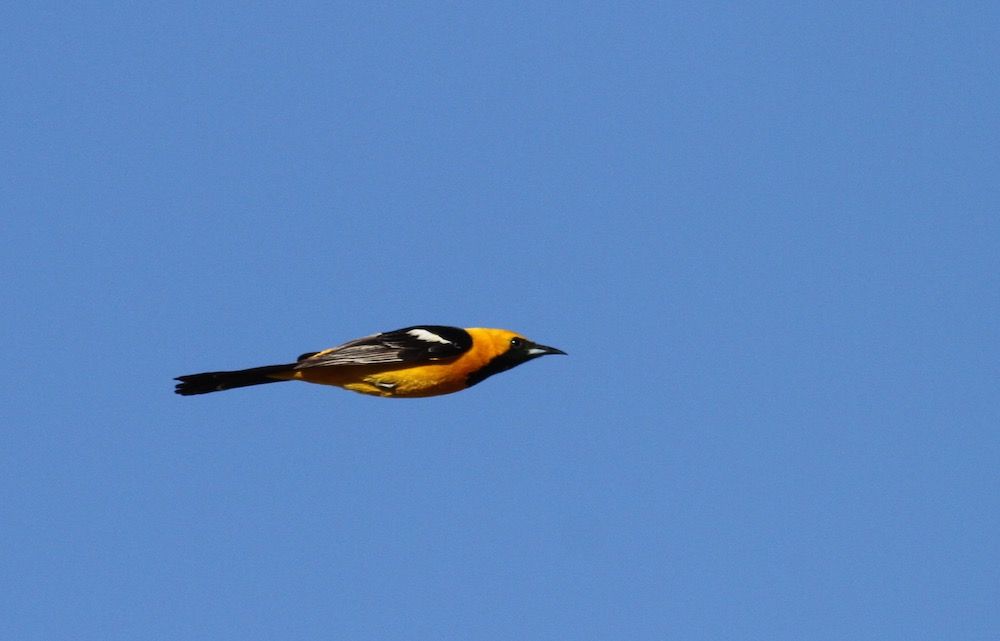
Hooded Oriole (Ryan Terrill)

Because many of the species sighted at Bear Divide are in steep decline. The lab says that year-to-year counts will help set a baseline for future trends that can be associated with weather, climate, and urbanization. “Tracking individual birds will give granular knowledge on how migratory birds use the landscape, which helps individuals and homeowners create corridors for them to travel,” says McCormack.

The best time to catch the show at Bear Divide is late winter early Spring. McCormack says Cliff Swallows and Lawrence’s Goldfinch are some of the early movers in March, and that by May, streaking by are Yellow Warblers, sunset-faced Western Tanagers, and bright blue Lazuli Buntings.

“There is so much we still don’t know about these birds and their world,” Lauren Hill, the site’s lead bird bander, told the Los Angeles Times. “For example, no one knows where they were before showing up here after sunrise.”

Lazuli Bunting zips past the camera at Bear Divide (Ryan Terrill)

The team is counting birds in order to establish a baseline of the populations coming through Bear Divide so they can understand how much we are changing the environment and what effect that may have on bird populations, many of which are in severe decline.

Their research spans a variety of topics, including how climate change is impacting migration routes and the effects of urbanization on bird populations. The lab has recently begun a program to put satellite trackers on birds at Bear Divide to follow individual birds, providing deep insight into their migration and resting patterns. This research is not only pivotal in understanding avian behavior but also crucial in shaping conservation policies.

One of the most fascinating aspects of Bear Divide is the sheer variety of bird species it attracts. From the diminutive hummingbirds to the impressive birds of prey, each species adds a unique dimension to the study of migration. The Moore lab’s findings have shed light on the varied responses of different species to environmental changes, offering a glimpse into the broader ecological shifts occurring across the globe.

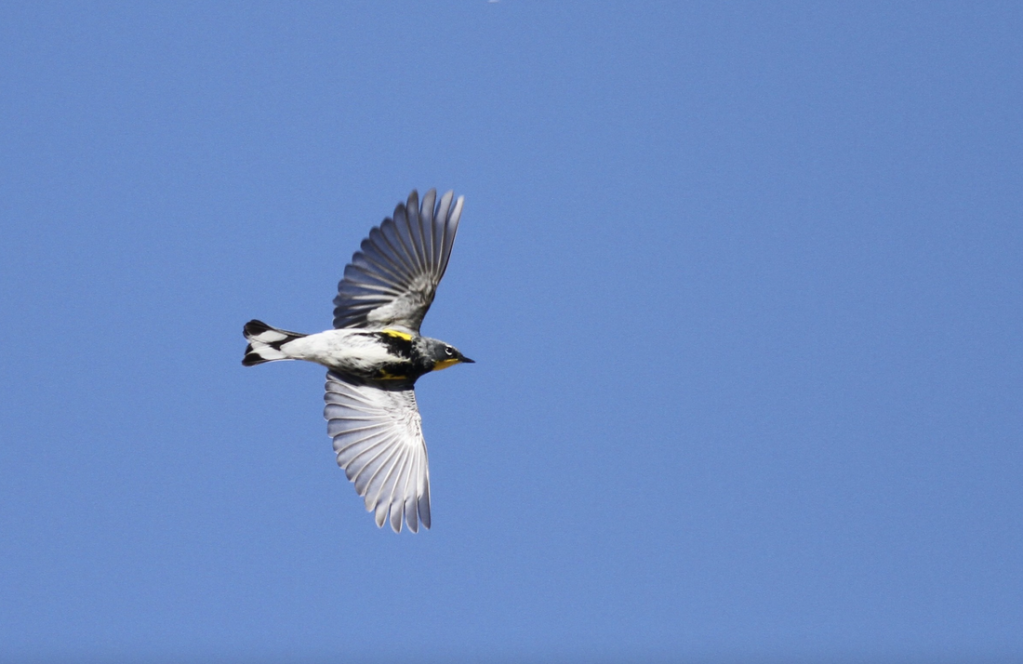
Yellow-rumped Warbler (Ryan Terrill)

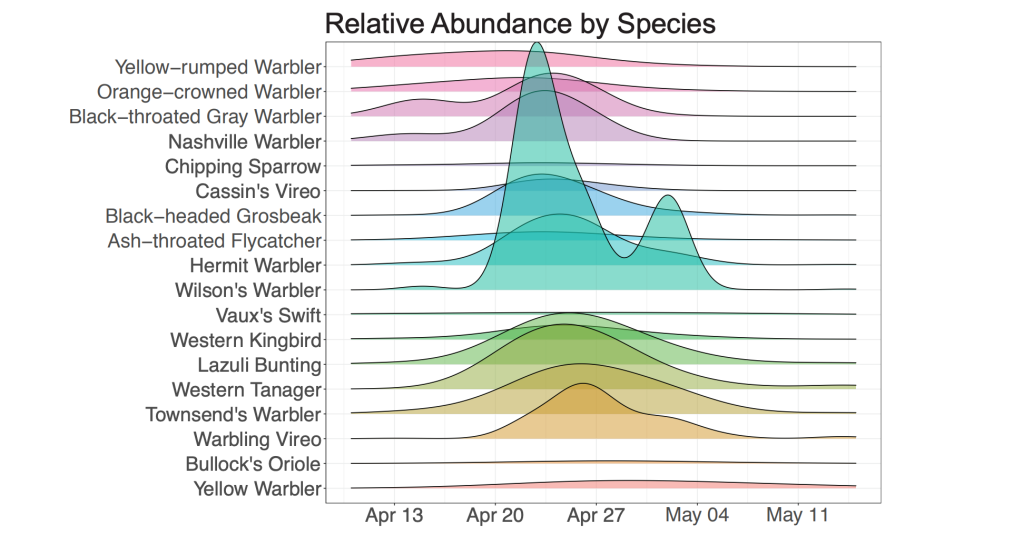
One compelling result of the Moore Lab’s study at Bear Divide suggests that the peak of a particular species’ migration is correlated with the latitude of its breeding site. Species that breed at higher latitudes migrated through Bear Divide at later dates. It’s also unusual in the West for species to migrate during the day. Most species of birds using the Pacific Flyway are known to migrate at night.

The Moore Lab of Zoology

In addition to its scientific contributions, the Moore lab is also known for its involvement in citizen science. Collaborating with local birdwatchers and volunteers, the lab extends its research capabilities and cultivates a community actively engaged in bird conservation. This collaborative approach not only enhances the breadth of their research but also underscores the importance of community involvement in conservation efforts.

Bear Divide is on public land, so anyone with a legitimate research project can get permission to work there. UCLA graduate student Kelsey Reckling, who has worked as a counter at Bear Divide since the beginning, is leading the counting efforts this Spring to understand changes in numbers of birds and species across years. Cal State L.A. graduate student Lauren Hill lea ds the group of bird banders, who catch some of the birds and record data, attaching a lightweight metal band around one leg and releasing them. Her lab mate Tania Romero is putting small, lightweight tracking devices on Yellow Warblers, which send signals to a network of tracking (MOTUS) towers across the continent.

Many bird species are under serious threat around the globe from a number of different impacts, including climate change, pesticides and habitat loss. Birds play a critical role in the health of our planet. They regulate ecosystems by preying on insects, pollinating plants, and spreading seeds. Healthy ecosystems are important for breathable air, food, and a regulated climate.

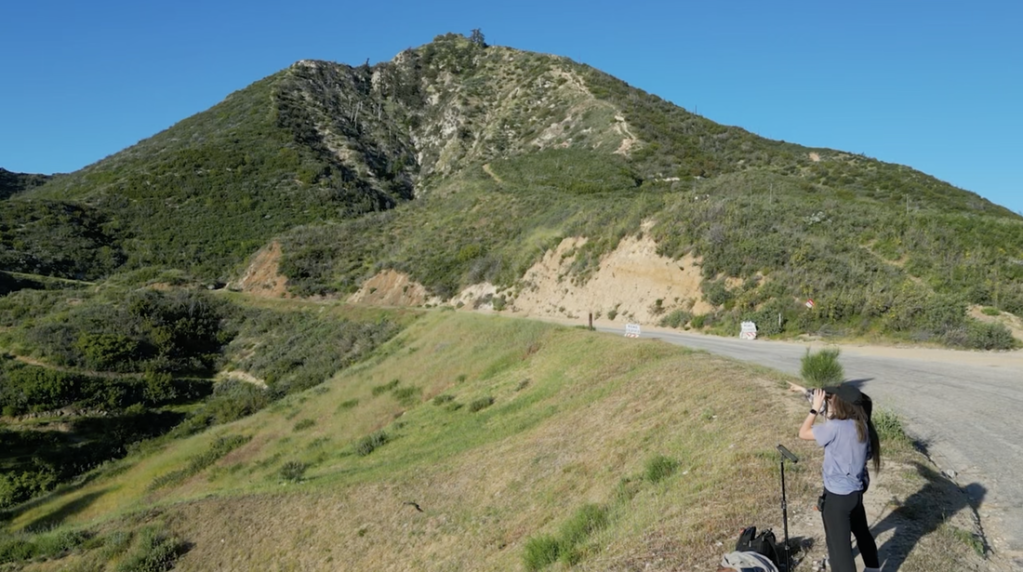
Bear Divide (Ian Davies)

According to a 2019 study, nearly 3 billion breeding birds have been lost in North America and the European Union since 1970. That’s about 30% of the bird population in North America. The 2022 State of the Birds Report for the United States found that bird declines are continuing in almost every habitat, except wetlands. Protecting birds’ habitats, and migration routes and reducing mortality through conservation efforts are crucial to ensuring the survival of these magnificent creatures.

The research conducted at Bear Divide by the Moore lab transcends academic interests, emphasizing the interconnectivity of ecosystems and underscoring the need to preserve natural migration corridors amid urban expansion. The insights gained here are invaluable to both the scientific community and conservation efforts, highlighting the need for a balanced approach to wildlife preservation and ecological sustainability.

Band-tailed Pigeon (Ryan Terrill)

“What’s magical about Bear Divide is that it’s the first real place to see small, migrating birds at eye level in daylight hours,” says McCormack. “I don’t want to oversell it: it’s still a lot of small birds zinging by in a wide open place and it takes a while to get good at identifying them. But by seeing them out there, struggling against the wind and the cold, but still making progress, it gives you a real sense of how amazing their journeys are–and how we shouldn’t make them harder if there’s anything we can do about it.”

Underground Fury: The 1985 Methane Blast That Rocked Los Angeles and Rerouted Its Subways

A 1985 methane explosion in L.A.’s Fairfax district turned a Ross Dress for Less into a disaster scene.
Photo by Dean Musgrove, courtesy of the Herald-Examiner Collection – Los Angeles Public Library.

In the heart of Los Angeles, on a seemingly ordinary spring day in 1985, a sudden explosion tore through the Ross Dress for Less store at the corner of 3rd Street and Fairfax Avenue. This wasn’t an industrial accident nor was it an act of malice—it was a force of nature that had been lurking unseen beneath the city’s streets: methane gas.

The Fairfax District, a bustling area known for its shopping and historic Farmers Market, is also part of the larger Salt Lake Oil Field, a subterranean landscape rich in hydrocarbons. Over millions of years, decaying organic matter trapped in the earth’s crust had transformed into vast reservoirs of oil and methane gas. It was this methane that had stealthily migrated close to the surface, building up in closed spaces, waiting for an ignition source to set off a dramatic release.

On that day, as shoppers browsed through discounted apparel, an explosive mixture of methane, oxygen, and sewer gases found its spark. The blast shattered the storefront windows and caused a partial cave-in of the roof, turning the shop’s interior into a mangled wreck of metal debris. Twenty-three individuals were left with injuries severe enough to necessitate hospital care. In the aftermath, police cordoned off a four-block radius encompassing the bizarre spectacle of gas fires that jetted into the night sky, a haunting tableau that persisted until dawn.

The aftermath of the explosion was a scene of chaos and confusion. Emergency services sprang into action, addressing the immediate humanitarian concerns. But once the dust settled, a more profound issue loomed: the implications for the city’s ambitious underground Metro Rail project.

At the time, Los Angeles was in the throes of planning and constructing the Metro Red Line, a subway system that promised to link various parts of the sprawling city. Wilshire Boulevard, one of the busiest thoroughfares in Los Angeles, was to be a central artery in this new subterranean network. However, the explosion at Ross Dress for Less exposed the heretofore underestimated risk of tunneling through methane-rich zones.

The city of Los Angeles created a methane zone map showing shaded regions of the methane zone and methane buffer zones.

Fears quickly escalated about the potential for similar explosions occurring elsewhere, particularly along the planned subway routes. The public, already wary of the high costs and disruptions associated with the Metro line, grew increasingly concerned about the dangers of tunneling through methane pockets.

In the wake of the explosion, city officials and Metro Rail engineers faced a daunting challenge. They needed to ensure public safety without derailing the critical infrastructure project. This task required a multifaceted approach. First, there was a thorough scientific investigation. Experts from various fields, including geologists, engineers, and safety specialists, were brought in to assess the risks of methane gas in the Fairfax District and along the proposed Metro route.

In a comprehensive regulatory response, the city imposed stringent building codes and established the Methane Zone Ordinance, which required new constructions in certain areas to implement gas detection and venting systems.

But the blast also resulted in a measure of technological innovation. The Metro Rail project incorporated state-of-the-art methane detection systems and emergency ventilation procedures in its design, setting a new standard for subway safety. The process was aided to some extent by significant community engagement. Public meetings and forums were held to address community concerns, offer reassurances, and provide education on the measures being taken to prevent future incidents.

B Line train at Union Station (Wikipedia)

Despite these efforts, the fear of what lay beneath Los Angeles’ streets had a chilling effect on the Metro’s progress. The Red Line faced delays as policymakers and the public grappled with the cost and complexity of making the subway safe. It wasn’t until the early 2000s, with the introduction of advanced tunneling technologies and robust safety protocols, that the Metro expansion regained momentum.

The 1985 methane explosion, while a localized event, reverberated through time to shape the development of Los Angeles in profound ways. It brought to the forefront the invisible risks of urban growth, challenged engineers and city planners to innovate, and ultimately reaffirmed the resilience of a city determined to rise above its subterranean challenges.

1983 rendering for the planned subway station at Wilshire and Fairfax – a casualty of the Ross explosion.
\Courtesy of the Metro Transportation Library and Archive.

The dangers of methane beneath Los Angeles are far from gone. The Porter Ranch leak, also known as the Aliso Canyon gas leak, was a massive methane leak in the Santa Susana Mountains near the neighborhood of Porter Ranch in the northwest section of the San Fernando Valley.. Discovered on October 23, 2015, gas was discovered escaping from a well within the Aliso Canyon underground storage facility. On January 6, 2016, Governor Jerry Brown issued a state of emergency, and numerous media reports suggested that the methane could be dangerous to residents.  On February 11, the gas company reported that it had the leak under control, and finally  on February 18, state officials announced that the leak was permanently plugged. Still, an estimated 97,100 tonnes (95,600 long tons; 107,000 short tons) of methane and 7,300 tonnes (7,200 long tons; 8,000 short tons) of ethane were released into the atmosphere.

Today, as the Los Angeles Metro continues to expand, the lessons learned from that explosive day in 1985 continue to resonate, ensuring that safety remains at the core of the city’s march toward the future.

Hey there! If you enjoy California Curated, consider donating the price of a coffee to support its creation!

The Majestic San Gabriel Mountains: A Deep Dive into Their Formation, History, and Biodiversity

Photo: “LA Skyline Mountains2” by Nserrano is licensed under  CC BY-SA 3.0

Towering over Los Angeles like quiet guardians, the San Gabriel Mountains stretch across the northern edge of the city, keeping watch over the busy sprawl below. More than just a dramatic barrier, these mountains are packed with stories of shifting earth, ancient rock, wild weather, and the people who’ve passed through them for thousands of years. They are also a primary source of Southern California beaches. They’re not just a backdrop; they’re a vital part of the region’s identity, full of science, history, and amazing nature.

Part of the Transverse Ranges, a rare east-west trending group of mountains in California, the San Gabriels rise abruptly from the San Gabriel Valley and form a kind of barrier between L.A. and the Mojave Desert. Framed by Interstate 5 to the west and Interstate 15 to the east, the range is anchored on its north side by the famous San Andreas Fault, where the Pacific and North American tectonic plates constantly grind against each other. That ongoing crush is what helped push these peaks up so quickly. Geologically speaking, they’re growing surprisingly quickly.

Side note: The Transverse Ranges also include the Santa Monica Mountains, San Bernardino Mountains, Santa Ynez Mountains, Topatopa Mountains, Tehachapi Mountains, Santa Susana Mountains, and Sierra Madre Mountains.

Inside the range you’ll find the Angeles and San Bernardino National Forests, along with the San Gabriel Mountains National Monument, first established in 2014 and significantly expanded in 2024 to protect more than 450,000 acres of rugged, biodiverse, and culturally significant terrain. (There is excellent hiking in these mountains.) These protected areas include steep canyons, chaparral, rare wildlife, and sites that are important to the history and traditions of Native American communities.

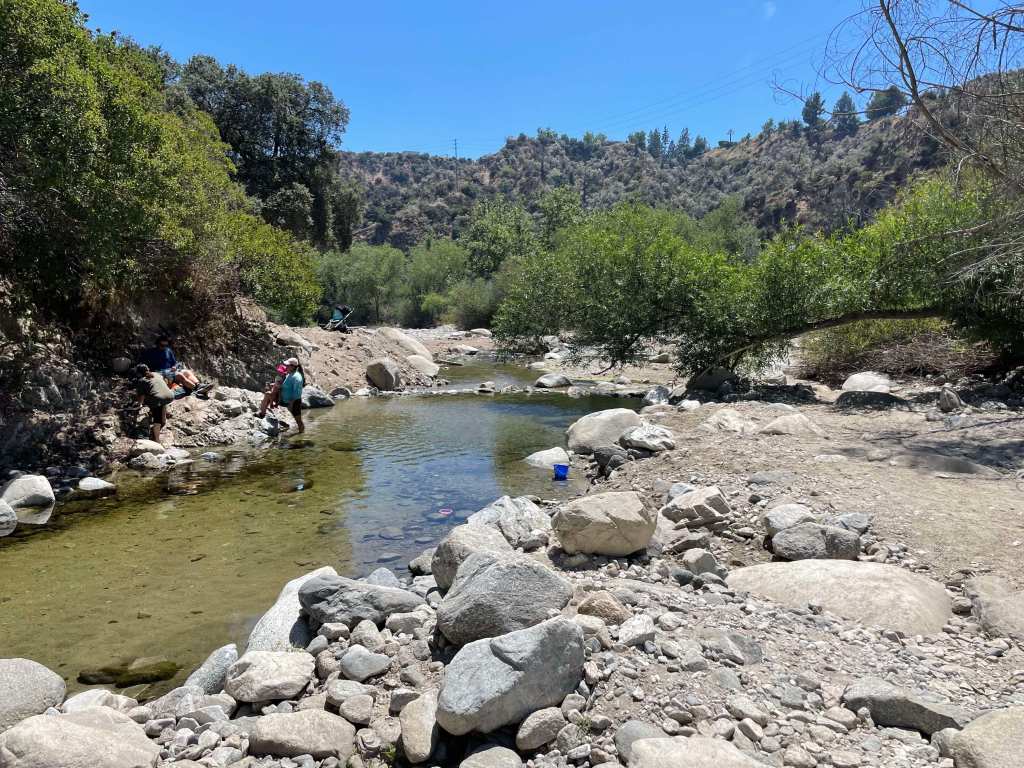
A pool of water from the Arroyo Seco in the San Gabriel Mountain (Erik Olsen)

The rocks here are some of the oldest in the region, but the mountains also tell stories from more recent times: gold miners, early astronomers, hikers, and wildfire researchers. The San Gabriels help shape the weather, store precious snowpack, and remind everyone in L.A. that nature is always nearby and always in motion.

The San Gabriel Mountains offer an impressive rise in elevation, they really kind of explode out of the earth. While the foothills begin at nearly sea level, the highest point in the range is Mount San Antonio, but most people know it as Mount Baldy because, let’s face it, with its distinctive, treeless summit, it looks kind of bald. This peak reaches an altitude of 10,064 feet (3,068 meters). The quick transition from the bustling city to towering peaks is part of the magic of these mountains, a dramatic wall standing guard over downtown Los Angeles.

While the San Gabriels are much smaller in terms of length than, say the Appalachians, they are significantly taller on average. The highest peak in the Appalachians, Mount Mitchell in North Carolina, reaches 6,684 feet (2,037 meters). That’s considerably lower than Mount Baldy in the San Gabriels. The San Gabriels, therefore, boast higher peaks even though they cover a smaller area. However, compared to the Appalachians, which are thought to be billions of years old, the San Gabriel Mountains are relatively young, geologically speaking, and are characterized by rugged and steep features. In essence, being younger, they’ve undergone less erosion.

San Gabriel mountains from La Cañada Flintridge (Photo: Erik Olsen)

It is believed that much of the sand on California’s legendary beaches originated in the San Gabriel mountains, the result of erosion and various rivers and streams that run into the Pacific Ocean.

To understand the story of the San Gabriel Mountains, we need to embark on a temporal journey spanning millions of years. The mountains’ tale starts about 100 million years ago, during the Mesozoic Era, when massive tectonic plates—the Pacific and North American plates—began to converge. The interaction of these tectonic plates was dramatic, with the Pacific Plate subducting, or diving beneath, the North American Plate. This subduction caused the rocks to melt and, over time, rise to form granitic masses known as plutons.

Rocks of a roadcut in the San Gabriel Mountains (Erik Olsen)

As the ages rolled on, these plutons were uplifted, and the erosion of the surrounding softer rocks exposed the granitic cores, giving birth to the San Gabriel Mountains we see today. The primary rock composition of these mountains is granite, with large-grained crystals of feldspar, quartz, and mica that glitter when the sun kisses their surfaces. These mountains also feature significant deposits of sedimentary rocks, particularly in the lower elevations, which date back to the Mesozoic and Cenozoic eras.

CALIFORNIA CURATED ON ETSY

Purchase stunning art prints of iconic California scenes.
Check out our Etsy store.

The drainage system of the San Gabriel Mountains is defined by numerous canyons, streams, and arroyos that channel water down from the high elevations into the valleys below. The Arroyo Seco, one of the most well-known waterways, begins near Mount Wilson and flows southwest through Pasadena before merging with the Los Angeles River. Other important streams include the Big Tujunga Creek, which cuts through the mountains to feed into the San Fernando Valley, and the San Gabriel River, which drains much of the range’s eastern side. These waterways are seasonal, swelling during winter rains and spring snowmelt, and often run dry during summer months. Their canyons have been carved by the relentless forces of erosion, creating deep ravines that are vital for wildlife and plant habitats.

Heavy rains cause flooding in the Arroyo Seco near Pasadena. (Erik Olsen)

The San Gabriel Mountains play a critical role in the watershed that serves the greater Los Angeles area. Rain and snowmelt from the mountains replenish groundwater basins and feed into reservoirs, such as the San Gabriel Reservoir and the Morris Reservoir, which are essential for water supply. These mountains act as a natural guidance system, capturing precipitation and funneling it into the region’s aquifers and rivers, supporting both the municipal water supply and flood control efforts. The watershed is crucial for Los Angeles, which depends on these local sources of water to supplement imported supplies from distant regions like the Colorado River and the Owens Valley. The mountain runoff helps maintain the flow of the Los Angeles River, contributing to the city’s efforts to recharge groundwater and ensure a reliable water supply in this semi-arid region.

Visit the California Curated store on Etsy for original prints showing the beauty and natural wonder of California.

When it rains it pours, and sometimes causes landslides

Flood control has long been a central concern in managing the water systems of the San Gabriel Mountains, particularly due to the area’s vulnerability to intense, episodic storms. The steep slopes of the mountains funnel rainwater rapidly into urban areas, leading to a heightened risk of flash floods and debris flows. Over time, this led to the construction of a vast network of catchment basins, dams, and debris basins at the foot of the mountains. These basins are designed to capture stormwater runoff, preventing the overflow of water into densely populated areas and managing the sediment and debris that comes with mountain runoff, which can clog waterways and exacerbate flooding.

Catchment basins in the San Gabriel Mountains are critical for controlling debris flows that occur during and after heavy rains, which can be particularly dangerous in areas where wildfires have stripped the landscape of vegetation. When intense rainstorms hit the steep, fire-scarred slopes, they trigger massive torrents of mud, boulders, and tree debris that rush down the mountain canyons toward the urban foothills. These debris flows can overwhelm creeks and spill into residential neighborhoods, causing widespread destruction. The catchment basins are designed to trap this debris before it reaches populated areas, but their effectiveness depends on regular maintenance and clearing. When these basins fill up too quickly or are not properly maintained, debris can overtop them, leading to significant flooding and property damage.

default

A stark example of the dangers posed by debris flows occurred in Montrose in 1934. Following a series of intense storms in the aftermath of the New Year’s Day floods, massive debris flows roared out of the San Gabriel Mountains, devastating the communities of Montrose, La Crescenta, and Tujunga. The floods and debris flows buried homes and roads under several feet of mud and debris, killing at least 45 people. The Montrose landslide became a tragic reminder of the risks associated with living near the San Gabriel Mountains, particularly in the face of severe weather. This event spurred greater investments in flood control infrastructure, including the construction of more robust debris basins to mitigate the effects of future storms.

A fascinating article on the efforts to control debris flows from the San Gabriels, though a bit dated, was penned by John McPhee—whose work we greatly admire. It remains a deeply engaging read on the subject.

The San Gabriel Mountains aren’t just a spectacle of natural processes; they’ve also been a silent witness to numerous significant historical events. The grave of Owen Brown can be found in the mountains just outside of La Canada Flintridge. Owen was the third son of abolitionist John Brown, and has a resting place that has stirred intrigue and speculation for generations. Owen’s grave has become a kind of pilgrimage site for those interested in American history.

Locals gather to celebrate the installation of a gravestone honoring abolitionist Owen Brown on January 29, 1898,
nearly a decade after his death. Photo: Brown family and Paul Ayers.

Owen Brown was a fervent abolitionist like his father and participated in the famous raid on Harpers Ferry. After the tumultuous events that marked his early life, he moved to California, seeking solace in the west. He settled near El Prieto Canyon and lived a relatively secluded life. After his death in 1889, he was buried on a hillside overlooking the canyon, and his grave was marked with a simple headstone. Over time, nature, vandals, and other factors led to the original headstone’s disappearance, adding a layer of mystique to the grave’s location. However, in 2019, a replica of the gravestone was installed.

Mount Wilson telescope

Mount Wilson is another historical wonder in the range. Standing at a towering height of 5,710 feet, it’s not just its elevation that sets Mt. Wilson apart. In the early 20th century, the Mount Wilson Observatory was established, and it soon became a hub of astronomical discoveries. It was here that Edwin Hubble, using the Hooker Telescope, provided evidence of the expansion of the universe—a groundbreaking observation that eventually led to the Big Bang Theory.

Infrastructure Marvel: The Angeles Crest Highway
The human connection to the San Gabriel Mountains was further cemented with the construction of the Angeles Crest Highway in the 1930s. Spanning approximately 66 miles, this scenic byway was a colossal engineering challenge. Its creation provided access to previously remote regions and breathtaking panoramic views that today lure thousands of tourists and nature enthusiasts. The highway is also one of the highest in Southern California, with a summit of 7,903 feet at the Dawson Saddle.

Angeles Crest Highway roadcut (Photo: Erik Olsen)

Driving on the Angeles Crest Highway is an experience that’s both thrilling and a bit nerve-wracking. Winding and twisting through the mountains, you can come across steep drop-offs, sharp turns, and narrow lanes. With elevation changes ranging from around 1,200 feet to more than 7,900 feet, it’s a route that demands respect and attention from those behind the wheel.

Flora, Fauna, and Natural History: A Biodiversity Hotspot
Beyond geology and history, the San Gabriel Mountains are a treasure trove of biodiversity. The montane environment, with its varied elevation and climate zones, has given rise to a rich tapestry of flora and fauna. Iconic trees like the Jeffrey pine, Coulter pine, and California black oak adorn the landscape. Wildflowers paint the meadows in vibrant hues, from the golden yarrow to the scarlet larkspur.

The fauna is just as diverse, with animals like the California condor, bighorn sheep, and mountain lions roaming the rugged terrain. The waters that trickle and rush down these mountains are home to arroyo chubs and Santa Ana suckers.

The California condor is known to inhabit the San Gabriel range

Protection of this vital ecosystem came in the form of the San Gabriel Mountains National Monument designation in 2014, ensuring that the mountains’ rich biodiversity and cultural significance will be preserved for generations.

The San Gabriel Mountains are more than just a scenic backdrop. They reflect the Earth’s active geology, hold key historical moments, and support diverse ecosystems. Amid growing urbanization, these mountains remain a lasting reminder of the interconnectedness of life, history, and natural forces.

The Eucalyptus Tree’s Twisted Path to Californian Soil

Eucalyptus in Los Angeles (Erik Olsen)

The California landscape is dotted with numerous plant species, many of them native, but few have a story as rich and multi-faceted as the eucalyptus tree. Native to Australia, this tree has made California its home over the past century and a half, creating a blend of wonder, economic expectation, and ecological concerns.

The journey of the eucalyptus tree to California dates back to the mid-19th century. Attracted by tales of gold and prosperity, many Australians made their way to the Golden State. Along with them came seeds of the eucalyptus tree, which they believed had great potential value. By the 1870s and 1880s, California was amidst a timber crisis. Native woodlands were diminishing, and the state was in dire need of a rapidly growing timber source. The eucalyptus tree, known for its rapid growth and towering heights, appeared to be a promising solution. Its proponents, believing it would not only serve as an excellent timber source but also act as a windbreak and ornamental plant, began widespread plantations.

While the eucalyptus grew impressively fast, hopes for it being a top-tier lumber source were quickly dashed. Most species planted in California had wood that was prone to warping and splitting upon drying. The enthusiasm surrounding the eucalyptus as a miracle timber tree gradually waned. What was initially perceived as a solution turned out to be more of a decorative element in the landscape rather than an economic boon.

CALIFORNIA CURATED ART ON ETSY

Purchase stunning art prints of California icons.
Check out our Etsy store.

Despite its failure in the lumber industry, the eucalyptus managed to root itself firmly in the Californian soil. Over time, this rapid settler began to pose significant environmental concerns. Eucalyptus trees are thirsty plants. Their deep roots often outcompete native species for water, hindering the growth and survival of native Californian plants and altering the balance of local ecosystems. Furthermore, eucalyptus groves have become a concern for wildfires. Their oil-rich leaves and peeling bark make them exceptionally flammable, amplifying dangers during California’s fire-prone seasons.

While over 700 eucalyptus species exist, only a handful made it to California. The most commonly planted and now dominant species is the blue gum eucalyptus (Eucalyptus globulus). Towering over most trees, the blue gum can reach staggering heights, quickly establishing its dominance in the landscape. Other species like the red gum (Eucalyptus camaldulensis) and the sugar gum (Eucalyptus cladocalyx) have also found their way into California, albeit in smaller numbers. The sugar gum is particularly present around the campus of Stanford University.

Sugar gum pods Stanford

By the late 1900s, concerns over the eucalyptus’ impact on native habitats led to movements advocating for their removal. Environmentalists and local residents began to see the tree as an invasive species that hindered the natural balance. Efforts to cut down and manage the eucalyptus population intensified, often clashing with those who had come to admire the tree’s majestic presence and the unique ambiance it provided.

Considered among the thousand-plus established alien vascular plants in California—two-thirds of which originated in Eurasia—Eucalyptus seems relatively benign. Of the 374 species in the genus that have been introduced since the 1850s, only 18 have naturalized, and only one of those, E. globulus, has become a nuisance, and then only at the urban-wildland interface along the fog belt of the central coast and Bay Area, and there only after humans gave it an enormous head start with plantations.

Even in these locations, self-sustaining feral forests have not grown dramatically beyond the boundaries of the original plantings. In the Golden State the blue gum has never been especially invasive; rather, it used to be hugely desirable. Other vegetation imported to California for ornamental purposes has spread far more widely or densely—for example, English ivy, periwinkle, ice plant, and pampas grass. Unlike Saltcedar (Tamarix ramosissima), Tasmanian blue gum is not a true problem plant. It cannot be considered a paradigmatic invader, or even a noteworthy one. The authoritative Encyclopedia of Biological Invasions makes note of the “enigmatic” low invasiveness of eucalypts worldwide—“orders of magnitude less successful as invaders than pines.”

From the perspective of both ecology and fire safety, the blue gum eucalyptus is particularly concerning in California when plantations of a single species have transformed into dense, closed-canopy forests. This issue, though, is confined to a limited number of areas within the fog belt. Even within these regions, the eucalyptus thickets are far from being barren, hostile environments.

Eucalyptus grove in California

That said, a relatively recent event did not cast the tree in good light.

The East Bay firestorm of 1991 was a catastrophic event that claimed 25 lives and rendered thousands homeless. Extensive areas of eucalyptus were consumed by the flames. For 26 years, the East Bay Firestorm firestorm was considered the worst fire in California’s history. It was also America’s most costly fire in the wildland-urban interface (WUI).

“People at the time, I don’t think, associated that with a planted plantation; it was just a eucalyptus forest,” CalPoly botanist Jenn Yost told KQED. “And then when the fire came through — I mean that fire came through so fast and so hot and so many people lost their homes that it was a natural reaction to hate blue gums at that point.”

However, it is again important to point out that the density of trees in the area was unusual and not representative of many other areas where eucalyptus have taken root.

Those opposed to the trees argue that their tendency to shed large quantities of bark exacerbates the fire hazard, and hence, they should be removed. On the other hand, proponents highlight that many of California’s native plants are also prone to burning. The 2018 Camp Fire scorched an area 153,336 acres in size, and destroyed more than 18,000 structures, most of the destruction happened within the first four hours of the fire and most of the destruction was the result of pine forests that have long been improperly managed. Both factions claim that science supports their viewpoint, but as of now, no definitive study has been able to settle the argument conclusively.

Camp Fire of 2018

This ongoing debate has stirred deep emotions. A few years ago, an incident in the East Bay hills saw federal funding for cutting down trees withdrawn after protesters, in a dramatic display of support for the eucalyptus, got naked and literally embraced the trees on the Cal campus. While some have argued that California needs to return its natural environment to a more “pristine” state, meaning just California natives, others say that the eucalyptus poses no greater danger than many species of conifer, and that the effort to expunge eucalyptus from the landscape, given its contribution to the culture and beautification of the state is tantamount to discrimination against immigrant trees solely due to their origin, an idea which some have extended to the human population.

“We’re not natives either,” the San Diego County chief entomologist said in defense of the county’s signature tree genus.

One ecological study that compared a gathering of oaks to a blue gum grove in the neighboring areas, concluded that the blue gem eucalyptus has no major impact on animal life. In fact, the tree’s leaf litter is bustling with life, containing a complex array of microhabitats. In fact, while oaks tend to be home to more rodents, eucalyptus contains a greater number of below-ground invertebrates.

Fruit of Eucalyptus globulus

The complex relationship between Californians and the eucalyptus reflects deeper questions about nature, risk, and our connection to the landscape, and it’s a debate that shows no signs of resolution.

Among the thousand-plus non-native vascular plants that have made their home in California—two-thirds of which hail from Eurasia—the Eucalyptus is relatively mild-mannered. Since the 1850s, 374 species of Eucalyptus have been introduced to the state. Yet, of these, only 18 have successfully naturalized, and merely one, the E. globulus, has ever become problematic. This issue is isolated mainly to the WUI boundary along the fog belt of the central coast and Bay Area, and even there, only after humans heavily promoted its growth through plantation efforts.

Even within these specific regions, the self-sustaining “feral” forests haven’t expanded significantly beyond the original planting sites. In California, the blue gum eucalyptus has never been notorious for being particularly invasive; rather, it was once highly sought-after. Other non-native plants brought to California for decorative purposes, such as periwinkle, English ivy, ice plant, pampas grass, and tamarisk, have spread much more extensively or densely.

Pampas Grass

Unlike plants like Scotch and French broom, the Tasmanian blue gum eucalyptus doesn’t qualify as a genuine problem plant. It’s not viewed as a typical invader, nor is it even considered particularly noteworthy in that regard. A state survey that consulted floricultural experts produced a broad spectrum of opinions concerning the potential threat posed by eucalyptus to California’s wildlands. This contrasts sharply with the unified negative evaluation of salt cedar, which has bedeviled land managers from Southern California to Mexico.

CALIFORNIA CURATED ART ON ETSY

Purchase stunning coffee mugs and art prints of California icons.
Check out our Etsy store.

The final verdict on the fate of eucalyptus in Southern California has yet to be rendered. Many still think the trees have become an iconic symbol of the state, with so many trees proudly and elegantly lining pocketed and immensely Instagrammable stretches of California highway. Perhaps the key to the trees survivability and reputation is simply one of proper management. Where the trees have become too dense in fire-prone areas, maybe some measure of thinning is prudent. But to eliminate them entirely would be a great loss to the aesthetic visual appeal of California, an appeal that many Californians, even conservation-minded artists like Ansel Adams and Erin Hanson often summoned in their work.

The eucalyptus tree’s journey in California is a tale of expectations, surprises, and evolving perspectives. Whether viewed as an ornamental marvel or an ecological concern, the eucalyptus remains an integral part of California’s diverse tapestry.

Mt. Wilson Observatory in Los Angeles is a Celestial Time Capsule

Mt. Wilson Observatory (Erik Olsen)

Perched atop a lofty peak in the San Gabriel Mountains of California sits a historic treasure, one of the great astronomical tools of the 20th century: the Mt. Wilson Observatory. For more than 100 years, it has been a centerpiece for major astronomical discoveries, playing a pivotal role in our understanding of the universe. The observatory, with its rich history shaped by devoted scientists, advanced technology, and revolutionary discoveries, stands as a testament to humanity’s relentless pursuit of knowledge.

The story of the Mt. Wilson Observatory begins with the visionary astronomer George Ellery Hale. Recognizing the importance of location, Hale selected Mt. Wilson for its elevation of 5,710 feet and its proximity to the Pacific Ocean, which provided consistently stable, clear skies—perfect conditions for astronomical observations. In 1904, he installed the first telescope at the site, the Snow Solar Telescope, specifically designed for studying the Sun. This telescope marked the beginning of groundbreaking solar research at the observatory and set the stage for future advancements in astronomy.

Many brilliant minds walked the halls and explored domes of Mt. Wilson, but few shone as brightly as Edwin Hubble. In the 1920s, using the Hooker Telescope – then the largest in the world – Hubble made two groundbreaking discoveries:

Before Hubble’s observations at Mt. Wilson, the prevailing belief was that our galaxy, the Milky Way, constituted the entirety of the universe. The existence of other galaxies was not yet confirmed, and what we now know as galaxies were often referred to as “nebulae” and thought to be part of the Milky Way.

Hubble’s groundbreaking discovery in 1923-1924, using the 100-inch Hooker telescope at Mt. Wilson, revealed that the Andromeda Nebula (now known as the Andromeda Galaxy) was far beyond the Milky Way, providing the first concrete evidence that the universe extended far beyond our own galaxy. This discovery fundamentally altered our understanding of the cosmos, leading to the realization that the universe is vast and filled with countless galaxies.

Expanding Universe

Using the powerful Hooker telescope once again, Hubble carefully observed distant galaxies and made a groundbreaking discovery: these galaxies were moving away from us. Even more astonishing was that the farther a galaxy was, the faster it was receding. This finding provided clear evidence that the universe itself was expanding. Hubble’s revelation shattered the long-held belief in a static universe and laid the groundwork for the Big Bang theory, suggesting that the universe had a specific beginning and has been expanding ever since. Through Hubble’s meticulous observations, humanity gained a new understanding of a dynamic, ever-evolving cosmos, far more vast and mysterious than anyone had previously imagined.

Edwin Hubble

Many other scientists have also made major discoveries at Mt. Wilson. One luminary, Harlow Shapley, used the observatory to gauge more specifically our place in the Milky Way. Before Shapley, Earth was believed to be at the galaxy’s center. However, through his observations of globular clusters, he pinpointed our more humble location on a distant spiral arm.

Another notable scientists who made significant contributions at Mt. Wilson Observatory was Walter Baade. Baade, a German-American astronomer, played a key role in refining our understanding of the universe by studying stars in different populations. During World War II, when Los Angeles experienced blackout conditions, Baade took advantage of the clearer skies at Mt. Wilson to observe celestial objects with unprecedented clarity. He discovered that there were two distinct types of stars in the Milky Way, which led to the realization that galaxies had different stellar populations. This breakthrough allowed Baade to correct the scale of the universe, doubling the previously estimated size of galaxies and distances to them. His work helped refine Hubble’s expanding universe theory and provided a deeper understanding of the evolutionary stages of stars. Baade’s observations were critical in the advancement of modern cosmology and our comprehension of the vastness of space.

Instruments of Enlightenment

Over the years, Mt. Wilson has housed a suite of powerful telescopes:

  • The Hooker Telescope: At 100-inches, it was the world’s largest when it was installed in 1917. It’s the very instrument Hubble used for his revolutionary work.
  • The Snow Solar Telescope: The observatory’s inaugural instrument remains crucial for solar studies.
  • The CHARA Array: The Center for High Angular Resolution Astronomy array is an impressive configuration of six telescopes that function as an interferometer. It allows for sharper images of stars than even the Hubble Space Telescope. The CHARA Array has a spatial resolution equivalent to a single telescope 331 meters (over 1000 ft) in diameter. Light from each of the six telescopes is transported through fiber optics to a special beam-combining room. 

Not only has Mt. Wilson been instrumental in observing distant stars, but it also has a unique device: the Snow Horizontal Solar Telescope. This apparatus, combined with the spectrograph, was used to study the sun’s magnetic fields. It has since been fundamental in understanding solar cycles and the impact of solar phenomena on Earth’s climate.

Mt. Wilson Observatory

In 2020, the Bobcat Fire, the second largest fire on record in Los Angeles County to date, burned over 115,000 acres and was active for more than three months. Annually, the team at Mount Wilson Observatory takes measures against potential forest fires, removing fire-hazardous invasive plants and ensuring their extensive water tanks are full for the fire suppression system. Just a few months prior to the blaze, they had fitted new high-capacity hydrants. These proactive steps played a pivotal role in safeguarding the Observatory when the Bobcat Fire flames approached within a mere 20 feet of its perimeter. A dozen fire squads, each consisting of 40 to 50 firefighters from various units, tirelessly worked day and night to protect this cherished landmark.

Scene at Mt. Wilson after the 2020 Bobcat Fire (Erik Olsen)

Visitors to the Mt. Wilson Observatory have a rare chance to not only tour the grounds but also look through the same telescopes that revolutionized astronomy. Public “Telescope Nights” offer the exciting opportunity to observe the night sky through the famous 60-inch or 100-inch telescopes, the latter being the largest in the world open to the public. These sessions allow people to view celestial objects like planets, star clusters, and nebulae in stunning detail. Reservations are necessary for these events, as spots fill up quickly due to high demand. Additionally, private group sessions and special events can be arranged, providing an unforgettable, up-close experience with the universe. Guided tours are also available for those who want to dive into the observatory’s rich history, tracing the steps of astronomers who made some of the greatest discoveries of the 20th century.

Hey there! If you enjoy California Curated, consider donating the price of a coffee to support its creation!

Einstein in Pasadena: Three Wonderful Winters in Paradise

Einstein at the Santa Barbara home of Caltech trustee Ben Meyer on Feb. 6, 1933.
(The Caltech Archives)

“Here in Pasadena, it is like Paradise. Always sunshine and clear air, gardens with palms and pepper trees and friendly people who smile at one and ask for autographs.” – Albert Einstein (U.S. Travel Diary, 1930-31, p. 28)

Albert Einstein is often associated with Princeton, where he spent his later years as a towering intellectual figure, and with Switzerland, where he worked as a young patent clerk in Bern. It was in that spartan, dimly lit office, far from the great universities of the time, that Einstein quietly transformed the world. In 1905, his annus mirabilis or “miracle year,” he published a series of four groundbreaking papers that upended physics and reshaped humanity’s understanding of space, time, and matter. With his insights into the photoelectric effect, Brownian motion, special relativity, and the equivalence of mass and energy (remember E=mc2?), he not only laid the foundation for quantum mechanics and modern physics but also set in motion technological revolutions that continue to shape the future. Pretty good for a guy who was just 26.

Albert Einstein spent his later years as a world-famous scientist traveling the globe and drawing crowds wherever he went. His letters and travel diaries show how much he loved exploring new places, whether it was the mountains of Switzerland, the temples of Japan, or the intellectual circles of his native Germany. In 1922, while on his way to accept the Nobel Prize, he and his wife, Elsa, arrived in Japan for a six-week tour, visiting Tokyo, Kyoto, and Osaka.

But of all the places he visited, one city stood out for him in particular. Pasadena, with its warm weather, lively culture, and, most importantly, its reputation as a scientific hub, had a deep personal appeal to Einstein. ​He visited Pasadena during the winters of 1931, 1932, and 1933, each time staying for approximately two to three months. These stays were longer than many of his other travels, giving him time to fully immerse himself in the city. He spent time at Caltech, exchanging ideas with some of the brightest minds in physics, and fully embraced the California experience, rubbing elbows with Hollywood stars (Charlie Chapman among them), watching the Rose Parade, and even tutoring local kids. Einstein may have only been a visitor, but his time in Pasadena underscores how deeply rooted science was in the city then, and how strongly that legacy endures today. Pasadena remains one of the rare places in the country where scientific inquiry and creative spirit continue to thrive side by side. Pasadena was among the earliest cities to get an Apple Store, with its Old Pasadena location opening in 2003.

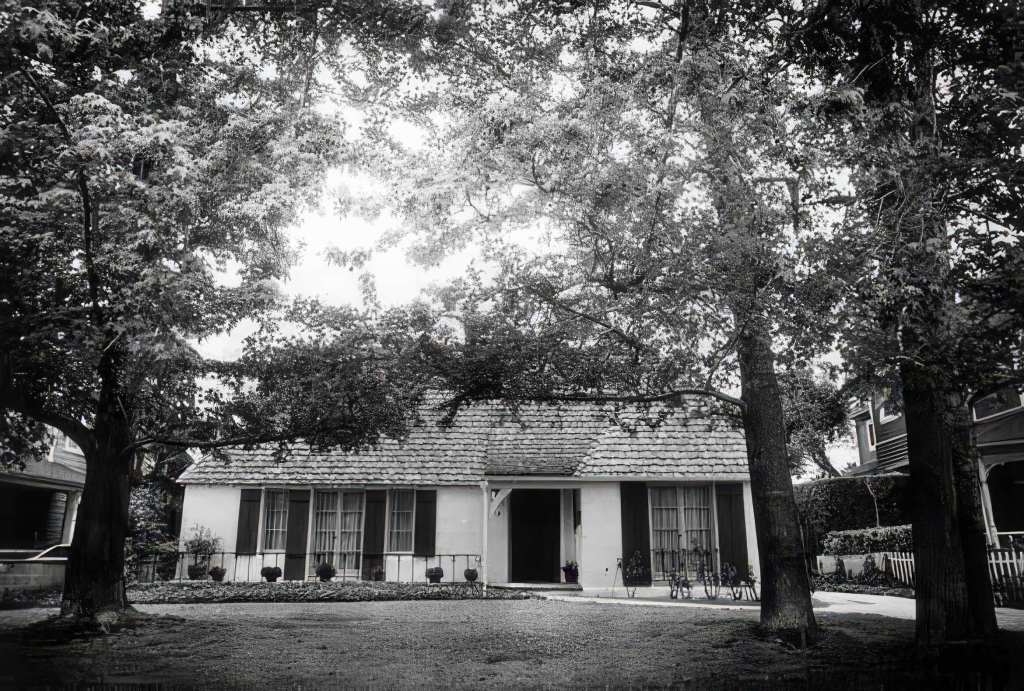
Einstein’s residence at 707 South Oakland Avenue in Pasadena, where he stayed his first winter in California (CalTech Archives)

Few scientists have received the public adulation that Einstein did during his winter stays in Pasadena. As a hobbyist violinist, he engaged in one-on-one performances with the conductor of the Los Angeles Philharmonic. Local artists not only painted his image and cast him in bronze but also transformed him into a puppet figure. Frank J. Callier, a renowned violin craftsman, etched Einstein’s name into a specially carved bow and case.

During his first winter of residence in 1931, Einstein lived in a bungalow at 707 South Oakland Avenue. During the following two winters, he resided at Caltech’s faculty club, the Athenaeum, a faculty and private social club that is still there today.

Yet, the FBI was keeping a watchful eye on Einstein as well. He was one of just four German intellectuals, including Wilhelm Foerster, Georg Nicolai, and Otto Buek, to sign a pacifist manifesto opposing Germany’s entry into World War I. Later, Einstein aligned himself with Labor Zionism, a movement that supported Jewish cultural and educational development in Palestine, but he opposed the formation of a conventional Jewish state, instead calling for a peaceful, binational arrangement between Jews and Arabs.

In front of the Athenaeum Faculty Club, Caltech, 1932. 
(Courtesy of the Caltech Archives.)

After his annus mirabilis in 1905, Einstein’s influence grew rapidly. In 1919, his theory of relativity was confirmed during a solar eclipse by the English astronomer Sir Arthur Eddington. The announcement to the Royal Society made Einstein an overnight sensation among the general public, and in 1922, he was awarded the 1921 Nobel Prize in Physics. While teaching at the University of Berlin in 1930, Arthur H. Fleming, a lumber magnate and president of Caltech’s board, successfully persuaded him to visit the university during the winter. The visit was intended to remain a secret, but Einstein’s own travel arrangements inadvertently made it public knowledge.

Einstein speaking at the dedication of the Pasadena Junior College (now PCC) astronomy building, February 1931. 
(Courtesy of the Caltech Archives)

After arriving in San Diego on New Year’s Eve 1930, following a month-long journey on the passenger ship Belgenland, Einstein was swarmed by reporters and photographers. He and his second wife, Elsa, were greeted with cheers and Christmas carols. Fleming then drove them to Pasadena, where they settled into the bungalow on S Oakland Ave.

Albert Einstein and his violin (Caltech Archives)

During their first California stay, the Einsteins attended Charlie Chaplin’s film premiere and were guests at his Beverly Hills home. “Here in Pasadena, it is like Paradise,” Einstein wrote in a letter. He also visited the Mt. Wilson Observatory high in the San Gabriel Mountains. Einstein’s intellectual curiosity extended far beyond his scientific endeavors, leading him to explore the Huntington Library in San Marino, delighting in its rich collections. At the Montecito home of fellow scientist Ludwig Kast, he found comfort in being treated more as a tourist than a celebrity, relishing a brief respite from the spotlight.

In Palm Springs, Einstein relaxed at the winter estate of renowned New York attorney and human rights advocate Samuel Untermeyer. He also embarked on a unique adventure to the date ranch of King Gillette, the razor blade tycoon, where he left with a crate of dates and an intriguing observation. He noted that female date trees thrived with nurturing care, while male trees fared better in tough condition: “I discovered that date trees, the female, or negative, flourished under coddling and care, but in adverse conditions the male, or positive trees, succeeded best,” he said in a 1933 interview.

CALIFORNIA CURATED ON ETSY

Purchase stunning coffee mugs and art prints of California icons.
Check out our Etsy store.

Not exactly relativity, but a curiosity-driven insight reflecting his ceaseless fascination with the world.

During his three winters in Pasadena, Einstein’s presence was a source of intrigue and inspiration. Students at Caltech were treated to the sight of the disheveled-haired genius pedaling around campus on a bicycle, launching paper airplanes from balconies, and even engaging in a heated debate with the stern Caltech president and Nobel laureate, Robert A. Millikan, on the steps of Throop Hall. Precisely what they debated remains a mystery. (Maybe something about the dates?)

Einstein with Robert A. Millikan, a prominent physicist who served as the first president of Caltech from 1921 to 1945 and won the Nobel Prize in Physics in 1923. (Courtesy of the Caltech Archives.)

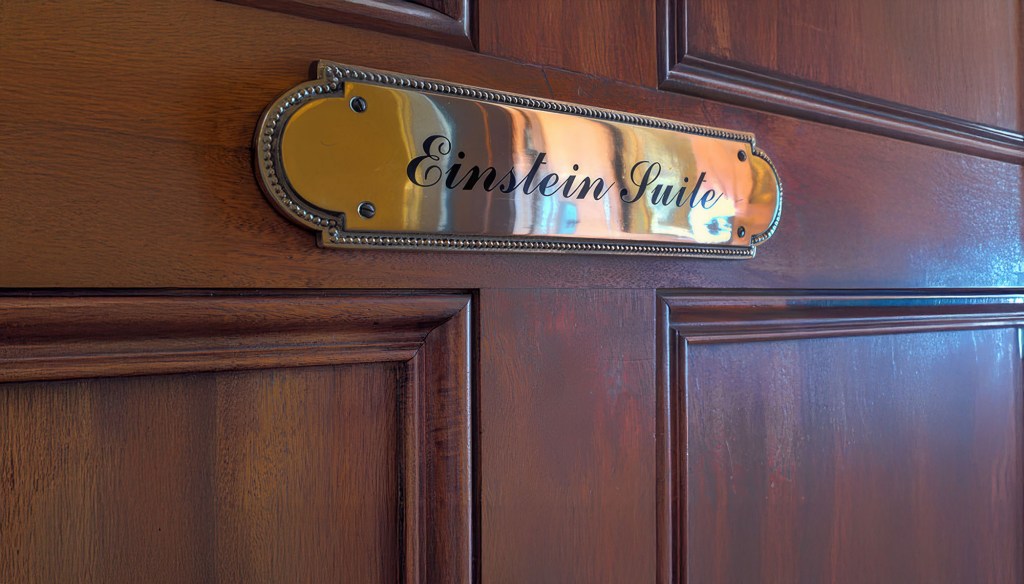
During his final winter in California, a near-accident led the couple to move into Caltech’s Athenaeum. His suite, No. 20, was marked with a distinctive mahogany door, a personal touch from his sponsor, Fleming. In 1933, as Nazi power intensified in Germany, Einstein began searching for a safe place to continue his work. Although Caltech made an offer, it was Princeton University‘s proposal that ultimately won him over. Einstein relocated to Princeton that same year, where he played a significant role in the development of the Institute for Advanced Study and remained there until his death in 1955.

Suite No. 20, Einstein’s mahogany door at the Caltech Athenaeum

Today, a large collection of Einstein’s papers are part of the Einstein Papers Project at Caltech. And Einstein’s suite at Caltech’s Athenaeum, still displaying the mahogany door, serves as a physical reminder of his visits.

During his third and final visit to Caltech in 1933, Hitler rose to power as Chancellor of Germany. Realizing that, as a Jew, he could not safely return home, Einstein lingered in Pasadena a little longer before traveling on to Belgium and eventually Princeton, where he received tenure. He never returned to Germany, or to Pasadena. Yet he often spoke fondly of the California sunshine, which he missed, and in its own way, the sunshine seemed to miss him too.