The stretch of water hugging the western shores of North America is a biological powerhouse, teeming with life and considered one of the most fertile marine environments on the planet. The California Current, originating from the colder regions up near British Columbia, sweeps its way down toward Baja California, extending laterally several hundred miles offshore into deep oceanic waters off the continental shelf. The current brings with it not just frigid waters but also a richness of life. As if choreographed, winds usually gust from the land towards the ocean, nudging surface waters away from the coastline. This displacement makes room for deeper, nutrient-packed waters to ascend, in a phenomenon aptly termed upwelling. Coastal upwelling is the dominant physical forcing affecting production in the California Current System.
This blend of icy waters and nutrient wealth sparks a bloom of marine vegetation, ranging from minuscule phytoplankton to sprawling underwater forests of kelp. These plants, often dubbed the “primary producers,” act as the nucleus of an intricate food web. The bounty includes thriving fisheries, generous populations of marine mammals like whales, seals, and dolphins, as well as a multitude of seabirds. The breadth of this fecund ecosystem can span an astonishing distance—up to 300 miles from the shoreline, enveloping a rich diversity of life within its aquatic embrace.
Phytoplankton are a critical part of the ocean’s food web.
The California Current System (CCS) is one of those natural phenomena that don’t often make headlines but quietly shape life as we know it on the West Coast. It’s like the unsung hero of the Pacific, affecting everything from marine biodiversity to our climate, even having a say in whether you’ll need to pack sunscreen or an umbrella for your beach day.
At its core, the California Current is a cold, southward-flowing oceanic current that starts from the Gulf of Alaska and hugs the western coastline of North America. Picture a river within the ocean, except this river is carrying cold, nutrient-rich water from the North Pacific all the way down to the southern tip of Baja California in Mexico. The California Current is part of a broader gyre system that also includes the North Pacific Current, the California Undercurrent, and the Davidson Current. Together, they create a dynamic dance of currents that provide a lifeline to a host of marine species and play a significant role in weather patterns.
The dynamics of the California Current result in abundant wildlife, like these common dolphins, off the coast of California.
The CCS owes its formation to a combination of factors like Earth’s rotation, the prevailing westerly winds, and the shape of the coastline. These elements work in concert to set up a sort of “conveyor belt” for water, funneling it down from higher latitudes. Over millions of years, this system has become a finely tuned natural mechanism that has shaped the ecology and climate of the region in profound ways.
The cold, nutrient-rich waters of the California Current serve as a veritable buffet for marine life. When we talk about nutrients, we’re primarily talking about nitrates and phosphates that act like fertilizer for phytoplankton, the microscopic plants at the base of the marine food web. As phytoplankton bloom, they become a food source for zooplankton, which in turn are gobbled up by larger fish. This cascade effect supports a rich, biodiverse ecosystem that includes everything from sardines and anchovies to humpback whales and even great white sharks. Even seabirds get in on the action, relying on the abundant marine life for nourishment.
The cold, nutrient-rich waters of the California Current serve as a veritable buffet for marine life.
But the California Current doesn’t stop at influencing marine biology; it’s a key player in regional climate as well. For example, the current helps moderate coastal temperatures by funneling cooler air inland. This has a ripple effect on weather patterns and even contributes to the famous “June Gloom” that Angelenos love to lament. Ever wonder why California’s coastal cities have relatively mild, Mediterranean climates while just a short drive inland can bring you much hotter conditions? Tip your hat to the CCS.
Climate change is, of course, the elephant in the room. A study published in the journal “Geophysical Research Letters” in 2019 highlighted a gradual weakening of the California Current due to warming ocean temperatures. As the current weakens, there’s potential for less upwelling, which means fewer nutrients reaching the surface. Less nutrient-rich water could be a gut punch to the marine food web, affecting fish populations and, by extension, the larger predators and human industries that rely on them.
The cold, nutrient-rich waters of the California Current serve as a veritable buffet for marine life.
Another concern is ocean acidification. The same cold, nutrient-rich waters that make the CCS a hotspot for marine life also make it more susceptible to acidification as they absorb more CO2 from the atmosphere. According to a 2020 study in the journal “Nature,” this could have far-reaching consequences for shell-forming organisms like mollusks and some types of plankton, which play crucial roles in the ecosystem.
So why is all of this important? Well, the California Current is a vital cog in the machinery of our planet. It supports rich biodiversity, influences climate, and even has economic implications, given the commercial fisheries that rely on its abundant marine life. A healthy CCS is good news for everyone, from the weekend beachgoer to scientists concerned about biodiversity.
But as we confront a changing climate, the CCS is a poignant reminder that even the most stable and established natural systems are not immune to disruption. Therefore, understanding it is not just an academic exercise, but a necessary step in safeguarding the fragile balance of life along the western edge of North America.
If you’ve ever looked out at the vastness of the ocean, you might think it’s a uniformly barren and flat landscape below the tranquil or tempestuous waves. But you’d be mistaken. Imagine for a moment a hidden world of underwater mountains, volcanoes that never broke the water’s surface, all lying in the mysterious depths of the ocean. These enigmatic formations are known as seamounts, and off the coast of California, they constitute an environment as fascinating as it is vital.
Interestingly, a lot of these seamounts off California are actually relatively new to science. According to Robert Kunzig and his book Mapping the Deep: “In 1984, a sidescan survey off southern California revealed a hundred uncharted seamounts, or undersea volcanoes, in a region that had been thought to be flat.”
The genesis of these structures begins with a geologic process known as plate tectonics. As tectonic plates move beneath the Earth’s crust, they create hotspots of molten rock. This magma escapes through weak points in the crust and solidifies as it reaches the cold seawater, gradually building up into an undersea mountain. After thousands of years, a seamount is born. Most of California’s seamounts are conical in shape, though erosion and other geological forces can turn them into more complex formations over time.
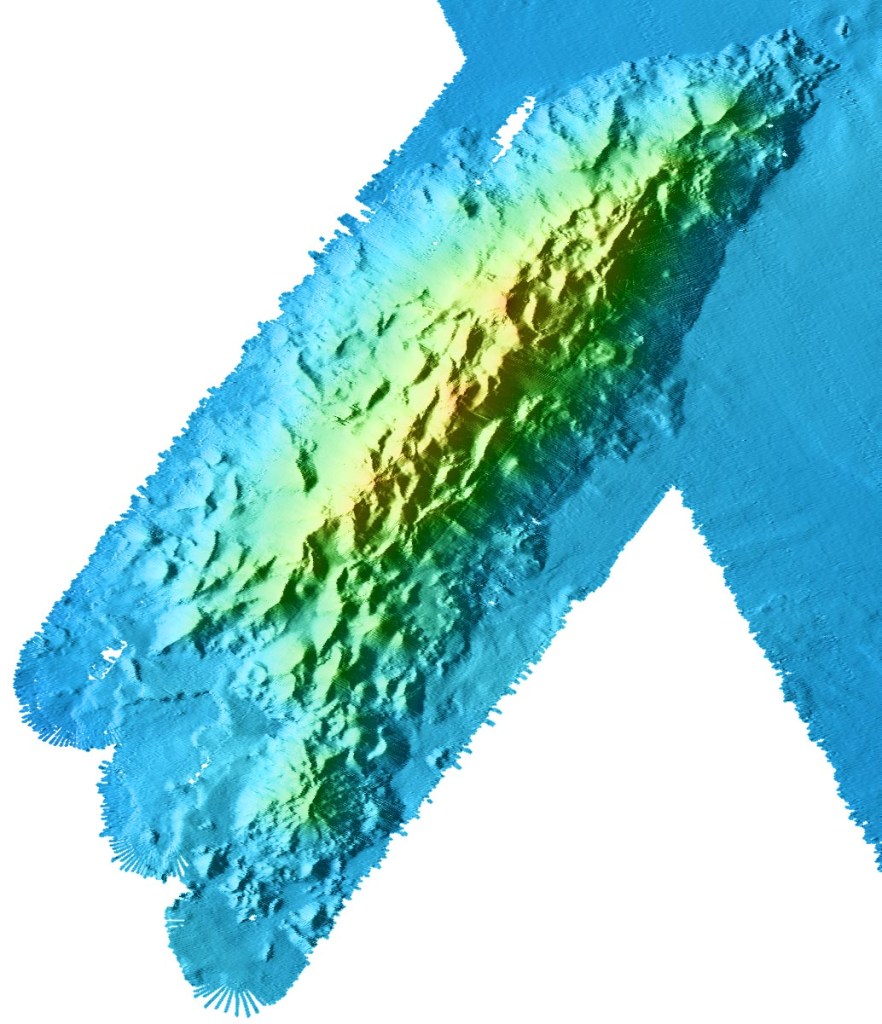
Each seamount is a world unto itself, with distinct mineral compositions, shapes, and ecosystems. Recent research has energized the scientific community. For instance, the Davidson Seamount is the most well-known of these volcanoes and was the first underwater peak to be named a seamount. The seamount is named for George Davidson, a British pioneering scientist and surveyor. Located about 80 km (50 miles) off the coast of Big Sur, it’s shaped like an elongated arrowhead made up of several parallel ridges of sheer volcanic cones. Most of these erupted about 10-15 million years ago, and are made up 320 cubic km of hawaiite, mugearite, and alkalic basalt, the basalt types commonly found along spreading ridges like the Mid-Atlantic Ridge.
Davidson Seamount, Wikipedia
The sheer number of seamounts only began to emerge when new detection methods were developed, including the ability to spot them from space. These underwater mountains are so massive that they create a gravitational pull, drawing seawater slightly toward their center of mass, much like the moon’s pull generates tides. Since seawater is incompressible, it doesn’t compress around the seamounts but instead forms slight bulges on the ocean surface. Satellites can detect these bulges, helping locate the hidden, basaltic peaks below. Satellite studies suggest that the largest seamounts—those over 5,000 feet—may number anywhere from thirty thousand to over one hundred thousand worldwide, with high concentrations in the central Pacific, Indian, and Atlantic Oceans, around Antarctica, and in the Mediterranean. Each of these seamounts is an underwater volcano, typically lining mid-ocean ridges, subduction zones, or one of the forty to fifty oceanic hot spots where the earth’s crust is thin and magma rises from the mantle.
Davidson Seamount is by far the best-studied of the many seamounts off the California coast. Stretching a sprawling 26 miles in length and spanning 8 miles across, this colossal seamount ranks among the largest known formations of its kind in U.S. territorial waters. Towering at a remarkable 7,480 feet from its base to its peak, the mountain remains shrouded in the depths, with its summit situated a substantial 4,101 feet beneath the ocean’s surface. Studies have indicated that some seamounts contain deposits of rare earth elements, which could have potential economic importance in the future.
A rorqual whale fall found near Davidson Seamount at a depth of 3,200 meters. Photo Credit: Chad King / OET, NOAA
Seamounts are biodiversity hotspots. Boasting an incredibly diverse range of deep-sea corals, Davidson Seamount serves as a kind of underwater Eden. Often referred to as “An Oasis in the Deep,” this submerged mountain is a bustling metropolis of marine life, featuring expansive coral forests and sprawling sponge fields. But it doesn’t stop there—crabs, deep-sea fishes, shrimp, basket stars, and a host of rare and still-unidentified bottom-dwelling creatures also call this place home. The seamount is more than just a biologically rich environment; it’s a treasure trove of national importance for its contributions to ocean conservation, scientific research, education, aesthetics, and even history.
Map of seamounts along the California coast. (Marine Conservation Institute)
Perhaps the most astonishing discovery at Davidson Seamount occurred in 2018, when scientists discovered the “Octopus Garden,” the largest known aggregation of octopuses in the world. The garden is about two miles deep and was discovered by researchers on the research vessel (RV) Nautilus. The team of scientists initially spotted a pair of octopuses through a camera on a remotely operated vehicle (ROV). Amanda Kahn, an ecologist at Moss Landing Marine Laboratories and San Jose State University, who was on the Nautilus during the discovery, told Scientific American that after observing the pair for a bit, the operators started to drift away from the rocks to move on, but immediately saw something unusual. “Up ahead of us were streams of 20 or more octopuses nestled in crevices,” Kahn says.
Typically lone wanderers of the ocean, octopuses aren’t known for their social gatherings. So, when researchers stumbled upon more than just one or two of these creatures, they knew something out of the ordinary was afoot. Swiftly pivoting from their original plans, the team zeroed in for a closer look. What they found was a community of these grapefruit-sized, opalescent octopuses, along with something even more mysterious—unusual shimmers in the surrounding water, hinting at the existence of some kind of underwater fluid seeps or springs. It turns out the octopuses migrate to deep-sea hydrothermal springs to breed. The females brood their eggs in the garden, where it is warmer than surrounding waters.
“This Octopus Garden is by far the largest aggregate of octopuses known anywhere in the world, deep-sea or not,” James Barry, a benthic ecologist at the Monterey Bay Aquarium Research Institute told Scientific American. Barry is the leader of the new study, published on in August in Science Advances, that reveals why the animals are gathering. The researchers have observed over 5,700 Pearl octopuses (Muusoctopus robustus) breeding near Davidson Seamount, 3,200 meters below the ocean’s surface. In this deep-sea nursery, octopus mothers keep their eggs warm in 5°C waters flowing from a hydrothermal spring. The water is more than 3°C warmer than the surrounding ocean. This added warmth accelerates the embryos’ development, allowing them to fully mature in just under two years on average.
The Octopuses Garden was studied over the course of 14 dives with MBARI’s remotely operated vehicle (ROV) Doc Ricketts. It is within the Monterey Bay National Marine Sanctuary, so it is federally protected against exploitation and extraction., although many scientists are concerned that global warming could end up having a deleterious impact on the biological life found around seamounts.
So far scientists have discovered other octopus gardens around the globe. There are four deep-sea octopus gardens in total. Two are located off the coast of Central California and two are off the coast of Costa Rica.
New technological advancements like Remotely Operated Vehicles (ROVs) have recently opened doors to discoveries we never thought possible. Cutting-edge imaging technology has finally given us the ability to capture strikingly clear and high-resolution pictures from this enigmatic deep-sea habitat. These vivid images provide both the scientific community and the general public with unprecedented peeks into the lives of rare marine species inhabiting this mostly cold and dark underwater world.
Depth color-coded map of Monterey Canyon. (Monterey Bay Aquarium Research Institute)
Davidson Seamount’s proximity to the rich educational and research ecosystem in the Monterey Bay area. One of the world’s preeminent ocean research organizations, the Monterey Bay Research Institute (MBARI), is located in Moss Landing, California, right at the spot where the magnificent Monterey Canyon stretches away from the coast for hundreds of miles. This geographic boon makes it easier for interdisciplinary teams to join forces, enriching our understanding and educational outreach related to this uniquely captivating undersea landscape.
Beyond being hubs of biodiversity, seamounts also serve as waypoints for migratory species. Just like rest stops along a highway, these underwater mountains provide food and shelter for creatures like whales and tuna on their long journeys. This makes seamounts critical for the health of global marine ecosystems. Additionally, understanding seamounts could give us insights into climate change. They play a role in ocean circulation patterns, which, in turn, affect global weather systems. They are also excellent “archives” of long-term climate data, which could help us understand past climate variations and predict future trends.
Advances in underwater technology, like ROVs, autonomous submersibles and better remote sensing methods, are making it easier to study these mysterious mountains. But many questions still remain unanswered. For instance, how exactly do seamount ecosystems interact with surrounding marine environments? What are the long-term impacts of human activities, like deep-sea mining or overfishing, on these fragile habitats? And what untapped resources, both biological and mineral, lie waiting in these submerged summits?
A time-lapse camera designed by MBARI engineers allowed researchers to observe activity at the Octopus Garden between research expeditions. (Photo: MBARI)
We can wax poetic about the mysteries of seamounts, but understanding them better is crucial for the preservation of marine ecosystems and for equipping ourselves with the knowledge to tackle environmental challenges. So, the next time you look out over the ocean, consider the hidden worlds lying beneath those waves—each a bustling metropolis of life and a potential goldmine of scientific discovery.
Towering over Los Angeles like quiet guardians, the San Gabriel Mountains stretch across the northern edge of the city, keeping watch over the busy sprawl below. More than just a dramatic barrier, these mountains are packed with stories of shifting earth, ancient rock, wild weather, and the people who’ve passed through them for thousands of years. They are also a primary source of Southern California beaches. They’re not just a backdrop; they’re a vital part of the region’s identity, full of science, history, and amazing nature.
Part of the Transverse Ranges, a rare east-west trending group of mountains in California, the San Gabriels rise abruptly from the San Gabriel Valley and form a kind of barrier between L.A. and the Mojave Desert. Framed by Interstate 5 to the west and Interstate 15 to the east, the range is anchored on its north side by the famous San Andreas Fault, where the Pacific and North American tectonic plates constantly grind against each other. That ongoing crush is what helped push these peaks up so quickly. Geologically speaking, they’re growing surprisingly quickly.
Side note: The Transverse Ranges also include the Santa Monica Mountains, San Bernardino Mountains, Santa Ynez Mountains, Topatopa Mountains, Tehachapi Mountains, Santa Susana Mountains, and Sierra Madre Mountains.
Inside the range you’ll find the Angeles and San Bernardino National Forests, along with the San Gabriel Mountains National Monument, first established in 2014 and significantly expanded in 2024 to protect more than 450,000 acres of rugged, biodiverse, and culturally significant terrain. (There is excellent hiking in these mountains.) These protected areas include steep canyons, chaparral, rare wildlife, and sites that are important to the history and traditions of Native American communities.
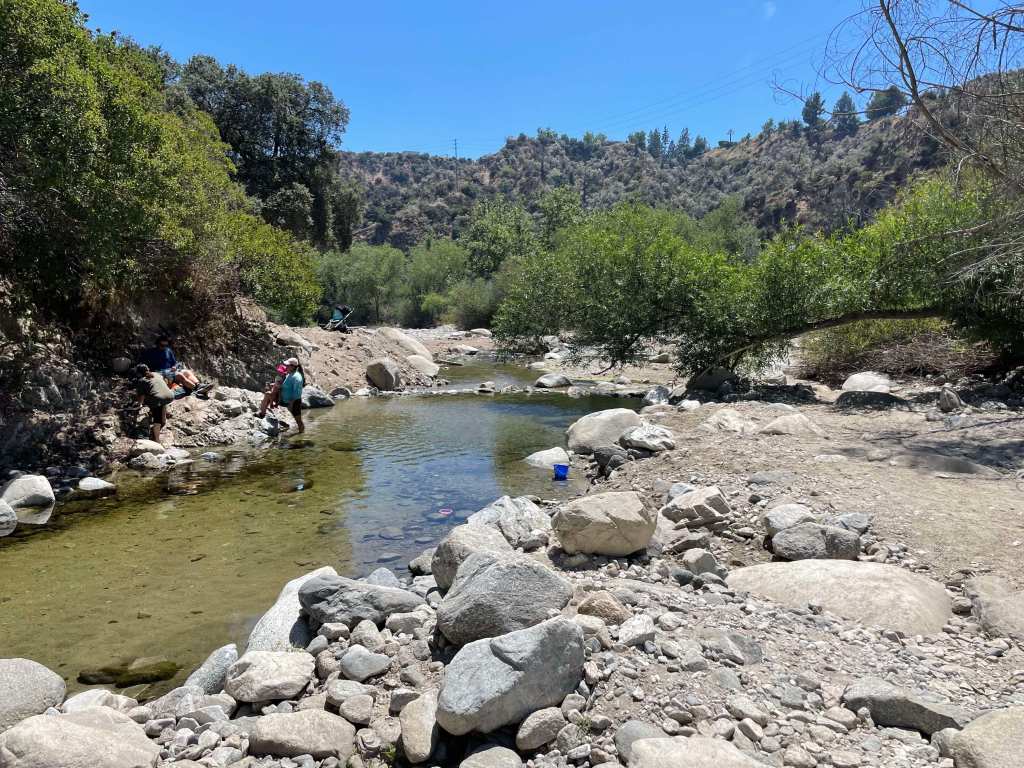
A pool of water from the Arroyo Seco in the San Gabriel Mountain (Erik Olsen)
The rocks here are some of the oldest in the region, but the mountains also tell stories from more recent times: gold miners, early astronomers, hikers, and wildfire researchers. The San Gabriels help shape the weather, store precious snowpack, and remind everyone in L.A. that nature is always nearby and always in motion.
The San Gabriel Mountains offer an impressive rise in elevation, they really kind of explode out of the earth. While the foothills begin at nearly sea level, the highest point in the range is Mount San Antonio, but most people know it as Mount Baldy because, let’s face it, with its distinctive, treeless summit, it looks kind of bald. This peak reaches an altitude of 10,064 feet (3,068 meters). The quick transition from the bustling city to towering peaks is part of the magic of these mountains, a dramatic wall standing guard over downtown Los Angeles.
While the San Gabriels are much smaller in terms of length than, say the Appalachians, they are significantly taller on average. The highest peak in the Appalachians, Mount Mitchell in North Carolina, reaches 6,684 feet (2,037 meters). That’s considerably lower than Mount Baldy in the San Gabriels. The San Gabriels, therefore, boast higher peaks even though they cover a smaller area. However, compared to the Appalachians, which are thought to be billions of years old, the San Gabriel Mountains are relatively young, geologically speaking, and are characterized by rugged and steep features. In essence, being younger, they’ve undergone less erosion.
San Gabriel mountains from La Cañada Flintridge (Photo: Erik Olsen)
To understand the story of the San Gabriel Mountains, we need to embark on a temporal journey spanning millions of years. The mountains’ tale starts about 100 million years ago, during the Mesozoic Era, when massive tectonic plates—the Pacific and North American plates—began to converge. The interaction of these tectonic plates was dramatic, with the Pacific Plate subducting, or diving beneath, the North American Plate. This subduction caused the rocks to melt and, over time, rise to form granitic masses known as plutons.
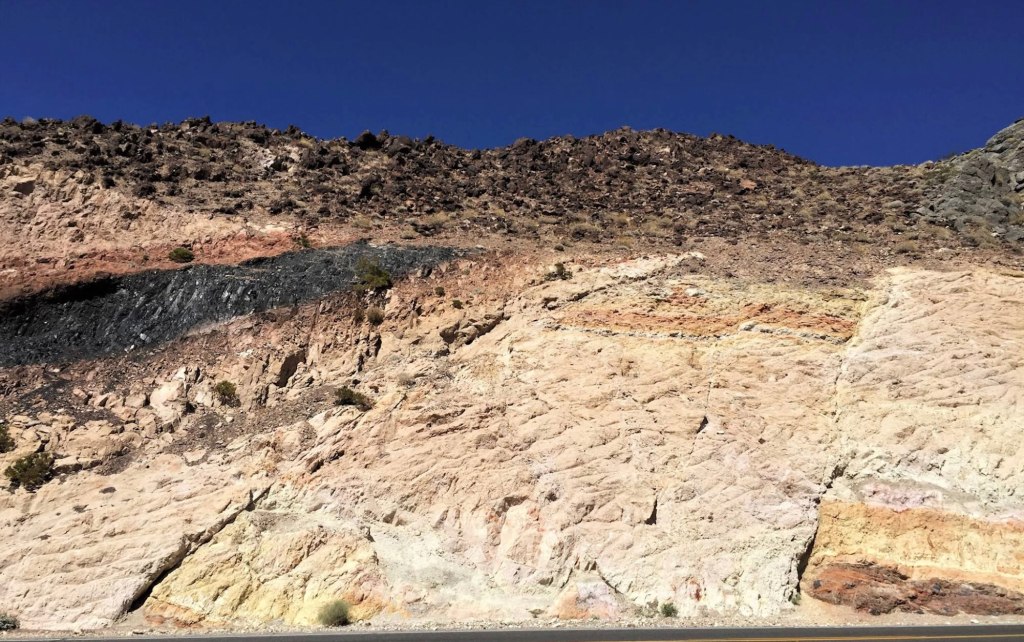
Rocks of a roadcut in the San Gabriel Mountains (Erik Olsen)
As the ages rolled on, these plutons were uplifted, and the erosion of the surrounding softer rocks exposed the granitic cores, giving birth to the San Gabriel Mountains we see today. The primary rock composition of these mountains is granite, with large-grained crystals of feldspar, quartz, and mica that glitter when the sun kisses their surfaces. These mountains also feature significant deposits of sedimentary rocks, particularly in the lower elevations, which date back to the Mesozoic and Cenozoic eras.
The drainage system of the San Gabriel Mountains is defined by numerous canyons, streams, and arroyos that channel water down from the high elevations into the valleys below. The Arroyo Seco, one of the most well-known waterways, begins near Mount Wilson and flows southwest through Pasadena before merging with the Los Angeles River. Other important streams include the Big Tujunga Creek, which cuts through the mountains to feed into the San Fernando Valley, and the San Gabriel River, which drains much of the range’s eastern side. These waterways are seasonal, swelling during winter rains and spring snowmelt, and often run dry during summer months. Their canyons have been carved by the relentless forces of erosion, creating deep ravines that are vital for wildlife and plant habitats.
Heavy rains cause flooding in the Arroyo Seco near Pasadena. (Erik Olsen)
The San Gabriel Mountains play a critical role in the watershed that serves the greater Los Angeles area. Rain and snowmelt from the mountains replenish groundwater basins and feed into reservoirs, such as the San Gabriel Reservoir and the Morris Reservoir, which are essential for water supply. These mountains act as a natural guidance system, capturing precipitation and funneling it into the region’s aquifers and rivers, supporting both the municipal water supply and flood control efforts. The watershed is crucial for Los Angeles, which depends on these local sources of water to supplement imported supplies from distant regions like the Colorado River and the Owens Valley. The mountain runoff helps maintain the flow of the Los Angeles River, contributing to the city’s efforts to recharge groundwater and ensure a reliable water supply in this semi-arid region.
When it rains it pours, and sometimes causes landslides
Flood control has long been a central concern in managing the water systems of the San Gabriel Mountains, particularly due to the area’s vulnerability to intense, episodic storms. The steep slopes of the mountains funnel rainwater rapidly into urban areas, leading to a heightened risk of flash floods and debris flows. Over time, this led to the construction of a vast network of catchment basins, dams, and debris basins at the foot of the mountains. These basins are designed to capture stormwater runoff, preventing the overflow of water into densely populated areas and managing the sediment and debris that comes with mountain runoff, which can clog waterways and exacerbate flooding.
Catchment basins in the San Gabriel Mountains are critical for controlling debris flows that occur during and after heavy rains, which can be particularly dangerous in areas where wildfires have stripped the landscape of vegetation. When intense rainstorms hit the steep, fire-scarred slopes, they trigger massive torrents of mud, boulders, and tree debris that rush down the mountain canyons toward the urban foothills. These debris flows can overwhelm creeks and spill into residential neighborhoods, causing widespread destruction. The catchment basins are designed to trap this debris before it reaches populated areas, but their effectiveness depends on regular maintenance and clearing. When these basins fill up too quickly or are not properly maintained, debris can overtop them, leading to significant flooding and property damage.
default
A stark example of the dangers posed by debris flows occurred in Montrose in 1934. Following a series of intense storms in the aftermath of the New Year’s Day floods, massive debris flows roared out of the San Gabriel Mountains, devastating the communities of Montrose, La Crescenta, and Tujunga. The floods and debris flows buried homes and roads under several feet of mud and debris, killing at least 45 people. The Montrose landslide became a tragic reminder of the risks associated with living near the San Gabriel Mountains, particularly in the face of severe weather. This event spurred greater investments in flood control infrastructure, including the construction of more robust debris basins to mitigate the effects of future storms.
The San Gabriel Mountains aren’t just a spectacle of natural processes; they’ve also been a silent witness to numerous significant historical events. The grave of Owen Brown can be found in the mountains just outside of La Canada Flintridge. Owen was the third son of abolitionist John Brown, and has a resting place that has stirred intrigue and speculation for generations. Owen’s grave has become a kind of pilgrimage site for those interested in American history.
Locals gather to celebrate the installation of a gravestone honoring abolitionist Owen Brown on January 29, 1898, nearly a decade after his death. Photo: Brown family and Paul Ayers.
Owen Brown was a fervent abolitionist like his father and participated in the famous raid on Harpers Ferry. After the tumultuous events that marked his early life, he moved to California, seeking solace in the west. He settled near El Prieto Canyon and lived a relatively secluded life. After his death in 1889, he was buried on a hillside overlooking the canyon, and his grave was marked with a simple headstone. Over time, nature, vandals, and other factors led to the original headstone’s disappearance, adding a layer of mystique to the grave’s location. However, in 2019, a replica of the gravestone was installed.
Mount Wilson is another historical wonder in the range. Standing at a towering height of 5,710 feet, it’s not just its elevation that sets Mt. Wilson apart. In the early 20th century, the Mount Wilson Observatory was established, and it soon became a hub of astronomical discoveries. It was here that Edwin Hubble, using the Hooker Telescope, provided evidence of the expansion of the universe—a groundbreaking observation that eventually led to the Big Bang Theory.
Infrastructure Marvel: The Angeles Crest Highway The human connection to the San Gabriel Mountains was further cemented with the construction of the Angeles Crest Highway in the 1930s. Spanning approximately 66 miles, this scenic byway was a colossal engineering challenge. Its creation provided access to previously remote regions and breathtaking panoramic views that today lure thousands of tourists and nature enthusiasts. The highway is also one of the highest in Southern California, with a summit of 7,903 feet at the Dawson Saddle.
Angeles Crest Highway roadcut (Photo: Erik Olsen)
Driving on the Angeles Crest Highway is an experience that’s both thrilling and a bit nerve-wracking. Winding and twisting through the mountains, you can come across steep drop-offs, sharp turns, and narrow lanes. With elevation changes ranging from around 1,200 feet to more than 7,900 feet, it’s a route that demands respect and attention from those behind the wheel.
Flora, Fauna, and Natural History: A Biodiversity Hotspot Beyond geology and history, the San Gabriel Mountains are a treasure trove of biodiversity. The montane environment, with its varied elevation and climate zones, has given rise to a rich tapestry of flora and fauna. Iconic trees like the Jeffrey pine, Coulter pine, and California black oak adorn the landscape. Wildflowers paint the meadows in vibrant hues, from the golden yarrow to the scarlet larkspur.
The fauna is just as diverse, with animals like the California condor, bighorn sheep, and mountain lions roaming the rugged terrain. The waters that trickle and rush down these mountains are home to arroyo chubs and Santa Ana suckers.
The California condor is known to inhabit the San Gabriel range
Protection of this vital ecosystem came in the form of the San Gabriel Mountains National Monument designation in 2014, ensuring that the mountains’ rich biodiversity and cultural significance will be preserved for generations.
The San Gabriel Mountains are more than just a scenic backdrop. They reflect the Earth’s active geology, hold key historical moments, and support diverse ecosystems. Amid growing urbanization, these mountains remain a lasting reminder of the interconnectedness of life, history, and natural forces.
There’s a drive that I’ve done many times where I tend to look around and wonder about the place. It’s while I’m on I-5 headed north, a while after passing Santa Clarita, Magic Mountain (I always strain to see if there are people on the roller coasters), and the CalArts up on the hill (where so many Pixar legends once trained).
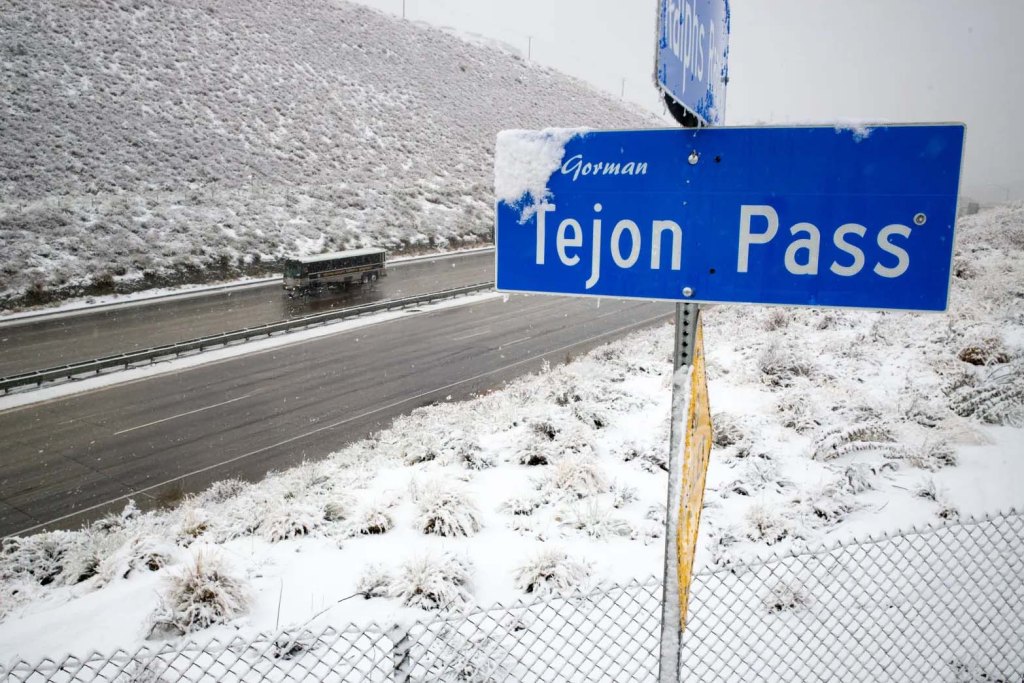
Perhaps you’ve done it, too. Maybe you get gas in Castaic, then you pass Pyramid Lake, and you’ve fully left the San Fernando Valley behind. Then the climb begins and the terrain changes dramatically. It’s subtle at first. The road starts to rise, winding past low ridges covered in golden grass and sun-bleached rock. Then the grade steepens. You see warning signs for trucks: “Turn off A/C to avoid overheating.” Semis tuck into the right lanes, their flashers blinking, straining against gravity. You’re ascending into the Tehachapi Mountains. The name comes from the Southern Paiute word “Tihachipia” meaning “hard climb”, which makes a ton of sense when you’re there. These mountains are part of the geologically fascinating Transverse Ranges, which we’ve written about before. Up ahead is Tejon Pass, the official name for the mountain crossing, but it’s more famously known to most drivers as the Grapevine, the steep stretch of I-5 that descends into the Central Valley.
The highway carves through steep canyon walls and hillsides sometimes bright with flowers, sometimes scarred by past wildfires. If it’s summer, the air gets drier and hotter; in winter, it might be raining or even snowing. You’re crossing one of the most weather-vulnerable stretches of highway in the state. The road is wide but unforgiving. Watch for crosswinds, or the occasional patrol car tucked into a turnout. Tejon Pass is more than just a mountainous pathway connecting the San Joaquin Valley to Los Angeles. It’s a geological and historical hotspot that tells a story of native tribes, daring transportation, seismic activity, and human ingenuity.
The weather can change quickly near Tejon Pass (Photo: Erik Olsen)
Rising to an elevation of 4,160 feet, Tejon Pass’s unique topography is a fascinating blend of rugged mountains, deep canyons, and expansive plateaus. At the summit, the land briefly levels out. There’s a moment where the mountains give you a glimpse in both directions. Behind, the tangled ridges of Southern California. Ahead, a vast, hazy bowl: the southern end of the Central Valley. You pass the Fort Tejon Historical Park turnoff, and suddenly, you’re descending.
The road plunges down in a series of long, controlled curves. Runaway truck ramps cut into the hillside like scars. Then, like stepping through a door, you’re out of the mountains. Flatness stretches to the horizon. Orchards, oil derricks, and cattle fields mark your arrival in the valley. The air feels different. Denser, warmer. You’re in Kern County now, approaching the outskirts of Bakersfield, and the Grapevine is behind you. It’s as if you crossed an invisible line, a border between two Californias.
Perhaps one of the most captivating aspects of Tejon Pass is its seismic significance. The region is situated at the intersection of two major fault lines: the San Andreas Fault and the Garlock Fault. This combination has made the area a hotspot for seismic activity and has resulted in a number of substantial earthquakes over the years.
Image of the Garlock Fault created with data from NASA’s Shuttle Radar Topography Mission (SRTM)
The most significant of these occurred in 1857, with an estimated magnitude of 7.9. Known as the Fort Tejon earthquake, it caused a rupture along the San Andreas Fault, leaving a lasting imprint on the landscape. Although the area was sparsely populated at the time, the quake’s impacts were far-reaching and could be felt as far as Las Vegas. The event is a reminder of the LA region’s seismic vulnerability, spurring modern research and monitoring to understand and mitigate future risks.
Long before European contact, Tejon Pass was a vital passageway for several Native American tribes, including the Chumash and Tataviam. The area around present-day Gorman, near the pass, was home to the Tataviam village of Kulshra’jek, which functioned as a significant trading crossroads for centuries. These Indigenous communities recognized the strategic importance of the pass, utilizing it for travel, trade, and communication across regions.
With the arrival of European settlers, the pass continued to play a vital role in California’s development. It became one of the state’s oldest continuously used roadside rest stops, a title it still holds today. The pass has borne witness to the evolution of transportation, from horse-drawn carriages to modern highways.
However, not all the tales from Tejon Pass are picturesque. The area has earned the foreboding nickname “Dead Man’s Curve.” This name references a notoriously dangerous curve on the old Ridge Route, infamous for its high number of accidents. The treacherous curve became symbolic of the broader challenges of early automotive travel through the mountains, where both engineering and human limitations were tested.
A section of the 1915 Ridge Route in Lebec, California, known as “deadman’s curve,” was abandoned when the highway was improved over the Tejon Pass. photo by George Garrigues.
The Ridge Route, completed in 1915, was California’s first paved highway directly connecting the Los Angeles Basin with the San Joaquin Valley. Engineered to traverse the challenging terrain of the Sierra Pelona Mountains, it followed a winding path from Castaic to Gorman, culminating at Tejon Pass. This innovative route was a significant milestone in California’s transportation history, facilitating automobile travel between Southern and Central California.
A notable segment of this route is known as “The Grapevine,” located in the northern portion descending into the Central Valley. The name originates from the Spanish term “La Cañada de las Uvas,” meaning “The Canyon of the Grapes,” a reference to the wild grapevines that early Spanish explorers, including Don Pedro Fages in 1772, observed growing abundantly in the area.
Over time, the Ridge Route underwent several significant transformations to accommodate increasing traffic and improve safety. In 1933, it was replaced by a three-lane alternate highway, later designated as U.S. Route 99. This was expanded into a four-lane expressway by 1953 . Eventually, the route evolved into the modern eight-lane beast known as the Interstate 5 Freeway, completed in 1970, which continues to serve as a vital artery for transportation in California. You will encounter lots and lots of trucks.
Driving Tejon Pass and the Grapevine
Today, Tejon Pass continues to serve as a crucial thoroughfare for Californians and visitors alike, with Interstate 5 traversing the landscape. The Tejon Ranch Conservancy plays a central role in protecting and interpreting this remarkable landscape. Established as part of a landmark 2008 conservation agreement, the Conservancy is tasked with stewarding over 240,000 acres of permanently protected land—making it one of the largest private conservation efforts in California history. Its mission goes beyond preservation; the Conservancy offers guided hikes, wildlife tracking programs, and educational outreach that invite the public to engage directly with the land.
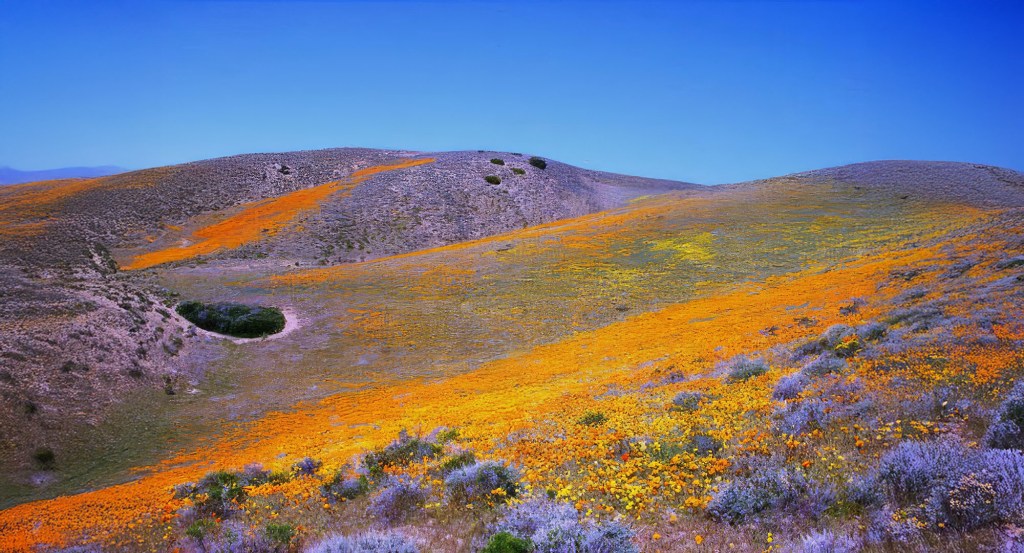
Superbloom near Tejon Ranch (Tejon Ranch Conservancy)
Soon, however, you leave Tejon Pass behind and continue north on I-5, dropping into the southern end of the Central Valley. You pass through the outskirts of Buttonwillow and Lost Hills, where the landscape flattens into a broad, arid plain. It’s mile after mile of industrial agriculture, just endless rows of almonds, pistachios, and oil wells under a hazy sky. The scenery turns monotonous, and although it does have a story (mostly about moving water), it’s one we’ll save for later.
Tejon Pass is one of those places most people barrel through without a second thought. It’s just a steep stretch of I-5 between Los Angeles and the Central Valley, a name on a weather report when the Grapevine closes in winter. But if you take a moment to look beyond the guardrails and gas stations, you’ll find a landscape layered with deep history and surprising complexity. Knowing what lies beneath the pavement won’t make the climb any less steep—but it might make the ride a little more meaningful.
Geological forces are always at work, reshaping the planet, just usually on a timescale too slow for us to notice. But over the long haul, they can completely transform places we think of as fixed and familiar, like Southern California and northern Mexico. I’ve been down to Baja a bunch of times, including a few unforgettable multi-day kayak trips in the Sea of Cortez. Paddling past sheer cliffs and sleeping on empty beaches under the stars, it’s easy to feel like the landscape has been frozen in time. But that sense of permanence? It’s an illusion.
Baja California stretches like a crooked finger pointing toward the tropics, wedged between the restless Pacific and the calm, warm waters of the Gulf of California. This long, skinny slice of land, more than 1,200 miles from Mexicali to Cabo, is full of contrasts: sun-blasted deserts, jagged mountains, hidden oases and mangroves. But it’s not just a finger of land: it’s a fracture. Baja was ripped from mainland Mexico by slow, grinding tectonic forces, the Pacific Plate dragging it north and leaving the Gulf in its wake. And it’s still on the move.
Kayaking the Sea of Cortez out of Loreto, Mexico on the Baja Peninsula (Photo: Erik Olsen)
Every year, Baja creeps a little farther away from the continent, slowly widening the gap. Some scientists think that, millions of years from now, the whole rift could flood, turning parts of northern Mexico into a vast inland sea. It’s the continent, cracking apart right under our feet. it’s just taking its time.
This process is linked to the activity of the San Andreas Fault and other associated fault systems, which collectively form a boundary between the Pacific Plate and the North American Plate. The movement of these tectonic plates is a slow but relentless process, occurring over millions of years. (Slow, and yet as we’ve documented, there’s been quite a bit of movement over that long period of time).
The Pacific Plate is moving northwest relative to the North American Plate, and the San Andreas Fault system primarily accommodates this movement. In essence, the Baja California Peninsula is moving with the Pacific Plate alongside and away from the North American Plate.
The separation is taking place at an average rate of about 2 to 5 centimeters per year. Over millions of years, these movements accumulate, leading to significant shifts in the geography of regions like Baja California. According to some geologists, within the next 20-30 million years, this tectonic movement could eventually break Baja and the westernmost part of California off of North America to create a vast inland sea, if not an island.
The movement of the continental crust in the area is due in part to seafloor spreading at a massive underwater seam called the East Pacific Rise. This mid-ocean ridge stretches from the southeastern Pacific near Antarctica all the way north into the Gulf of California. Its northernmost extension, known as the Gulf of California Rift Zone, reaches close to the mouth of the Colorado River, helping drive the slow but steady separation of the Baja California Peninsula from mainland Mexico.
That geological rift didn’t just shape the land—it created an entirely new sea. The story of Baja California’s tectonic journey isn’t just about earthquakes and shifting plates, it’s also a story of water. The Gulf of California, also known as the Sea of Cortez, is a geologically young sea, having formed around 5.3 million years ago when the Baja Peninsula began drifting northwest. That rifting process continues today, slowly widening the gulf and redrawing the landscape of northwest Mexico.
The azure waters of the Sea of Cortez (Photo: Erik Olsen)
This body of water is a critical habitat for marine life, including several species of whales and dolphins that depend on its warm waters. Jacques Cousteau, the famous French oceanographer, famously referred to the Gulf of California as “the world’s aquarium” due to its vast array of (declining) marine life.
The Sea of Cortez today is under threat from our short time so far on the planet. Unfortunately, overfishing and pollution, including nitrogen-rich runoff from the Colorado River, which (sort of) flows directly into the gulf, imperils wildlife. Nutrient flows can lead to a dramatic decrease in oxygen, depriving plants and animals of the life-giving gas. The potential extinction of the critically endangered vaquita (Phocoena sinus), represents one of the most urgent conservation crises in the region. The vaquita is the world’s most endangered marine cetacean, with estimates suggesting only a few individuals remain. This dire situation is primarily due to bycatch in illegal gillnets used for fishing another endangered species, the totoaba fish, whose swim bladder is highly valued in traditional Chinese medicine.
Habitat destruction is another growing concern, as mangroves, estuaries, and reefs, vital for the breeding and feeding of marine species, are increasingly destroyed to make way for tourism infrastructure and coastal development. Climate change intensifies these problems, with rising sea temperatures and ocean acidification threatening reefs and the broader ecosystem.
Baja California as seen in April 1984, from the bay of a Space Shuttle (Photo: NASA)
The birth of the Sea of Cortez also has an intriguing connection to a body of water hundreds of miles to the north: the Salton Sea. The Salton Sea, California’s largest lake, sits in the Salton Trough, an area geologists consider a “rift zone,” an extension of the same tectonic forces at work in the Gulf of California.
As the North American and Pacific Plates continue their slow-motion dance, the area around the Salton Sea may sink further, eventually linking with the Gulf of California. If this occurs, seawater could flood the basin, creating a new body of water significantly opening the Sea of Cortez. As mentioned above, eventually this could lead to the full separation of the peninsula from the mainland. However, such a dramatic event is likely millions of years in the future, if it happens at all. Interestingly, the Salton Sea acts as a mirror, reflecting the past processes that led to the formation of the Sea of Cortez.
Salton Sea (Wikipedia)
The Sea of Cortez stands at a crossroads, shaped by both human impact and tectonic drift. Baja California is slowly pulling away from mainland Mexico, a process that could one day create a vast inland sea and dramatically reshape the region. While no one alive today will witness the full transformation, its ultimate impacts could be extreme—redrawing coastlines, shifting ecosystems, and isolating parts of southern California and Mexico in ways we can scarcely imagine.
Southern California’s sandy beaches are more than just popular spots for surfing and sunbathing—they’re the product of a dramatic geologic story that’s been unfolding for millions of years. With their sweeping ocean views and turquoise waters, these iconic coastlines attract millions every year. But few people stop to think about how these beaches actually came to be.
To get the full picture, you have to go way back—about 200 million years, to the Mesozoic era. Back then, the land we now know as Southern California was underwater, part of a vast oceanic plate. As the North American continent drifted westward, it collided with and began to override the Pacific plate. This slow-motion crash, called subduction, set the stage for the coast we see today.
This subduction zone generated intense heat and pressure, melting portions of the oceanic crust and upper mantle. The resulting magma rose to the surface, forming a chain of volcanic islands and large underground magma chambers. Over time, these chambers cooled and solidified into granite, forming what’s now known as the Southern California batholith—an enormous mass of igneous rock that underlies much of the region. This tectonic activity also helped uplift and shape many of the mountain ranges we see today, including the Santa Monica and San Gabriel Mountains.
Beach sand, particularly in Southern California, is primarily composed of quartz and feldspar mixed with silvery mica and milky quartz. These minerals originally existed in the granite of the local mountains, miles from the shoreline. Studies have shown that much of the sand on Southern California beaches actually comes from the San Gabriel mountain range.
“Sediment that’s derived from granite-type watersheds is generally comprised of a lot of quartz,” says UCLA geography professor Tony Orme. “It tends to be light in color.”
San Gabriel Mountains
The San Gabriel Mountains are part of the Transverse Ranges, are known for their rugged terrain, diverse ecosystems, and recreational opportunities, stretching approximately 68 miles from Los Angeles County to San Bernardino County.
It may be surprising to learn that the San Gabriel Mountains, towering over Los Angeles, play a critical role in forming the region’s stunning beaches. They are, in fact, the primary source of much of Southern California’s beach sand, particularly around Los Angeles. But how does this granitic mountain material end up miles away on the beach?
The answer lies in the forces of erosion and weathering. The mountains’ granite is gradually worn down over time by rain, wind, and cycles of freezing and thawing. This erosion process, which can take millions of years, results in smaller and smaller particles. Rainfall and streams transport these eroded particles down the mountain slopes and into the regions rivers.
Southern California beach
These rivers, such as the Los Angeles and San Gabriel Rivers, act as conveyor belts, carrying the eroded material – the future sand of our beaches – toward the Pacific Ocean. Renowned geomorphologist Douglas Sherman of the University of Alabama has extensively studied these sediment transport processes, highlighting their importance in coastal formation.
Sand continuously migrates from land to sea. As rivers met the ocean, they deposited their sediment load, forming deltas. Coastal currents then took over, redistributing these sediments along the shoreline, a process known as longshore drift. Waves, powered by the coastal winds, continually pushes this sediment onto the shore, gradually creating the wide, sandy beaches we enjoy today.
This ongoing transfer is accompanied by watershed run-off and the erosion of bluffs and hillsides, which carry sand toward the beach. Grains of sand then embark on a southward journey along the coast, while the smaller sediment particles are swept further offshore and deposited deep on the ocean floor.
Lifeguard tower (Erik Olsen)
While there is still widespread belief among geologists that most of California’s sand originates in the mountains, two relatively recent studies conducted by researchers at the University of California, San Diego have suggested that another key source of erosion might be the grand sea cliffs of the region.
“Much to our surprise,” expressed Scott Ashford, formerly a professor of engineering at UCSD, and now at Oregon State, who employed a mobile laser imaging system to examine coastal formations for one of the studies. “It’s revealing that our comprehension of the beach system isn’t as thorough as we’ve presumed.”
His research analyzed six years’ worth of imaging data from the 50-mile (80-kilometer) coastline stretching from Dana Point to La Jolla. Previously, geologists had conjectured that up to 90% of the beach sand in this sector originated from deposits transported by coastal rivers, but Ashford’s research indicated that the sea cliff erosion accounts for some 67% of Southern California’s beach sand. However, since Ashford’s study was focused on such a small area of the coast, many geologists are wary of embracing his conclusions.
The coastal journey of the sand concludes either when it is blown inland to form dunes or more frequently, when it descends into a submarine canyon, such as Monterey Canyon in Northern California. The deep underwater chasm of a canyon signifies the endpoint of a littoral cell. A littoral cell is a unique coastal region where sand embarks on a journey from land into the ocean, traverses down the coast, and then exits the system. The volume of sand accessible to beaches equals the quantity entering the littoral cell minus the quantity exiting. Changes to this sand budget can result in the contraction or even complete vanishing of beaches.
Hermosa Beach (Erik Olsen)
The formation of Southern California’s beaches is not a completed process but an ongoing one. Waves and currents continue to shape the coastline, sometimes depositing sand to widen the beach, and at other times eroding the shoreline. Los Angeles has paved most of its major rivers, reducing the amount of sand that comes from the mountains onto the beaches. In fact, it is not uncommon for Southern California beaches to be missing close to 50% of their historical sand supply.
California has added sand to its beaches for decades through projects called “nourishment”. These projects are often used to restore eroded beaches and protect against sea level rise. Sand is typically dredged offshore and pumped onto the shore, where trucks spread it around. The goal is to widen the beach so that wave energy breaks sooner and dissipates towards the bluff face.
Rosanna Xia’s book, California Against the Sea: Visions for Our Vanishing Coastline (2023) is an excellent source of information on California beach erosion and the threats posed by the loss of significant portions of the coast. The book explores how human activities like coastal development, urbanization, and dam construction have intensified natural erosion processes. She provides a historical context for these developments and their long-term impacts, while also exploring innovative adaptation strategies and community-led efforts to protect the coastline. Balancing a sense of urgency with cautious optimism, Xia presents a vision for a resilient future where informed policies and sustainable practices can help safeguard California’s coastal treasures for generations to come.
Los Angeles River
Understanding the geological history of Southern California’s beaches not only adds depth to our appreciation of these natural wonders but also highlights the need for careful stewardship. By minimizing our environmental impact, reducing development and mitigating the effects of climate change, we can ensure that these incredible landscapes continue to evolve and endure for generations to come.
Hadrosaur on ancient California landscape. Hadrosaurs like this AI generated one are among the very few dinosaurs whose fossils have ever been found in California.
You’ve surely seen those dramatic museum displays: fearsome T-Rex skulls, triceratops horns, towering brachiosaur skeletons – tangible reminders of a world with giant animals that roamed our planet millions of years ago. Some states are rich in the fossils of ancient dinosaurs. Montana, Wyoming, Utah all have rich fossil records. But not California. Very few dinosaur fossils have ever been found in the Golden State.
But why? We’ve got Hollywood, Silicon Valley, lots of oil, and the Giant Redwoods, but where are our prehistoric dinosaur residents hiding?
To understand this prehistoric puzzle, we have to venture back into the geologic past, and also consider some unique aspects of California’s geographical and geologic evolution.
Dinosaurs were mostly present during the Mesozoic Era, from about 252 million to 66 million years ago. The Mesozoic is divided into three periods: the Triassic, Jurassic, and Cretaceous. The dinosaurs reign likely ended with a massive meteorite impact that caused a mass extinction, wiping out the dinosaurs and up to 80% of life on Earth.
While dinosaur fossils are found around the globe, their distribution is far from even. Fossilization itself is a relatively rare event that depends on several specific conditions. Generally, fossilization requires rapid burial to protect the remains from scavengers and environmental factors, as well as a lack of oxygen to slow down decay. Over time, minerals gradually replace organic material, preserving the structure and creating a fossil, but only a small fraction of organisms ever undergo this process.
Jack Horner, Curator of Paleontology at Museum of the Rockies, provides scale for Tyrannosaurus rex fossils at excavation site near the Fort Peck Reservoir, Fort Peck, Mont., June 1990. (Photo: courtesy Museum of the Rockies
So, when a dinosaur died, its body needed to be quickly covered by sediment, like sand, mud, or volcanic ash. This prevented the remains from being scavenged or decomposed and allowed for the slow process of mineralization, where bones and teeth gradually turn to stone.
Even if these conditions were met, the resulting fossils had to survive millions of years of geologic processes, such as erosion, plate tectonics, and volcanic activity. To find dinosaur fossils today, the layers of rock in which they are embedded must be exposed at the Earth’s surface.
But now here’s where California’s unique geologic history comes into play. Most of the land we see today in California wasn’t even above sea level during the Mesozoic Era, instead it was submerged beneath the Pacific Ocean. Only small, scattered volcanic islands or bits of uplifted crust occasionally broke the surface, shaped by the intense movement of tectonic plates. That means there were no T. rexes or Stegosaurs ambling through Yosemite Valley…which, by the way, hadn’t even formed yet.
California’s active geology works against fossil preservation. The state sits on the boundary of tectonic plates (the Pacific and North American plates), resulting in significant geological activity including earthquakes, volcanic activity, mountain building, and erosion. These processes tend to destroy fossils rather than preserve them.
Head section of Olenellid trilobite in a Latham Shale slab. (Credit: National Park Service)
California, in the form we recognize today, is relatively new land that finally began rising out of the ocean near the end of the dinosaur age, as mountain ranges like the Sierra Nevada started to form and ancient sea basins uplifted. While these earlier conditions weren’t favorable for preserving land-dwelling dinosaur fossils, they did leave behind a rich marine fossil record, including ammonites, marine reptiles, and countless microfossils.
That said, there have been several discoveries of particular animals in California, representing animals much later in the dinosaur story. The majority of the dinosaur fossils found in California are the bones of hadrosaurs, duck-billed dinosaurs that lived during the Late Cretaceous period. These herbivorous dinosaurs thrived in what was once a coastal plain environment, and their remains have been uncovered in parts of California like the Point Loma Formation near San Diego, the Panoche Hills area near Fresno, and in Baja California.
While much of California was underwater during the Late Cretaceous, it was home to mosasaurs, large carnivorous marine reptiles that lived in oceans all over the world. These fearsome predators had long, streamlined bodies with powerful fins and jaws lined with sharp teeth. They hunted fish, ammonites, and possibly even other mosasaurs. Some species grew as big as modern whales and ruled the seas at the very end of the dinosaur age. Mosasaurs shared the world with creatures like Triceratops and Tyrannosaurus, but they vanished along with the dinosaurs during the mass extinction at the close of the Cretaceous. Today, paleontologists recognize mosasaur fossils by distinctive features on their skeletons, including unique muscle attachment scars and specialized bone knobs.
Artists recreation of the hadrosaur Augustynolophus by the Natural History Museum of Los Angeles County
As mentioned above, the action of plate tectonics, the slow but powerful movements of sections of the Earth’s crust, has significantly affected California’s fossil record. Over millions of years, California has been built from pieces of the Earth’s crust that traveled here aboard tectonic plates.
Much of the rock we see at the surface today, especially along the coast and in the western mountains, arrived during the Cenozoic Era, after the age of dinosaurs. These younger rocks, while not bearing dinosaur fossils, have yielded rich caches of mammal fossils, including creatures like saber-toothed cats, mammoths, and dire wolves, which roamed California long after the dinosaurs.
In recent years, paleontologists have begun to find more dinosaur fossils in California, albeit still far fewer than in states like Utah, Montana, or Wyoming. These discoveries, often of marine animals or those who lived near the coast, are expanding our understanding the ancient Californian landscape.
Saber-toothed cat (State of California Capitol Museum)
In 2022, a remarkable fossil discovery was made during a construction project at San Pedro High School in Los Angeles. The excavation revealed a massive trove of marine fossils from the Miocene Epoch, dating back around 5 to 23 million years (so, not technically dinosaur fossils). Among the finds were the remains of ancient whales, sharks, fish, and mollusks, offering a rare glimpse into Southern California’s prehistoric past when the region was submerged under a warm, shallow sea. This discovery provided paleontologists with valuable insights into the marine ecosystems that once thrived in the area.
Among the fossils found under San Pedro High School are juvenile megalodon teeth, right, the great white shark’s ancestor; those from mako sharks, center; and from smaller sharks. (Wayne Bischoff / Envicom Corp.)
In addition to the marine fossils, a few terrestrial remains were also uncovered, hinting at a nearby coastline that once supported a variety of land animals. The discovery of such well-preserved fossils captured the attention of scientists and the local community alike, briefly turning the San Pedro High School campus into an unexpected center of scientific excitement. For students and residents, the find offered a cool reminder of the ancient worlds buried just beneath their everyday lives.
While California’s record of dinosaur fossils is relatively sparse, its mammal fossil record is nothing short of astonishing. Sites like the La Brea Tar Pits in Los Angeles preserve an incredible array of Ice Age mammals, from saber-toothed cats and mammoths to giant ground sloths. These fossils provide an unparalleled window into the vibrant ecosystems that thrived long after the age of dinosaurs ended, showcasing California’s rich and varied prehistoric past.
Saber-toothed cat fossil skeleton at the La Brea Tar Pits in Los Angeles (Photo: Erik Olsen)
While it might be tempting to feel a little disappointed that California doesn’t have an abundance of dinosaur fossils, that’s simply the way the landscape evolved. But there’s still plenty to celebrate. California’s unique geologic past has produced a vibrant fossil record of other ancient life — from towering prehistoric sequoias to tiny, long-lost plankton. Every fossil, big or small, offers a glimpse into the rich, complicated, and ever-changing story of this remarkable place we call California.