Baja California Is Slowly Breaking Away from the Mainland and May One Day Become an Island

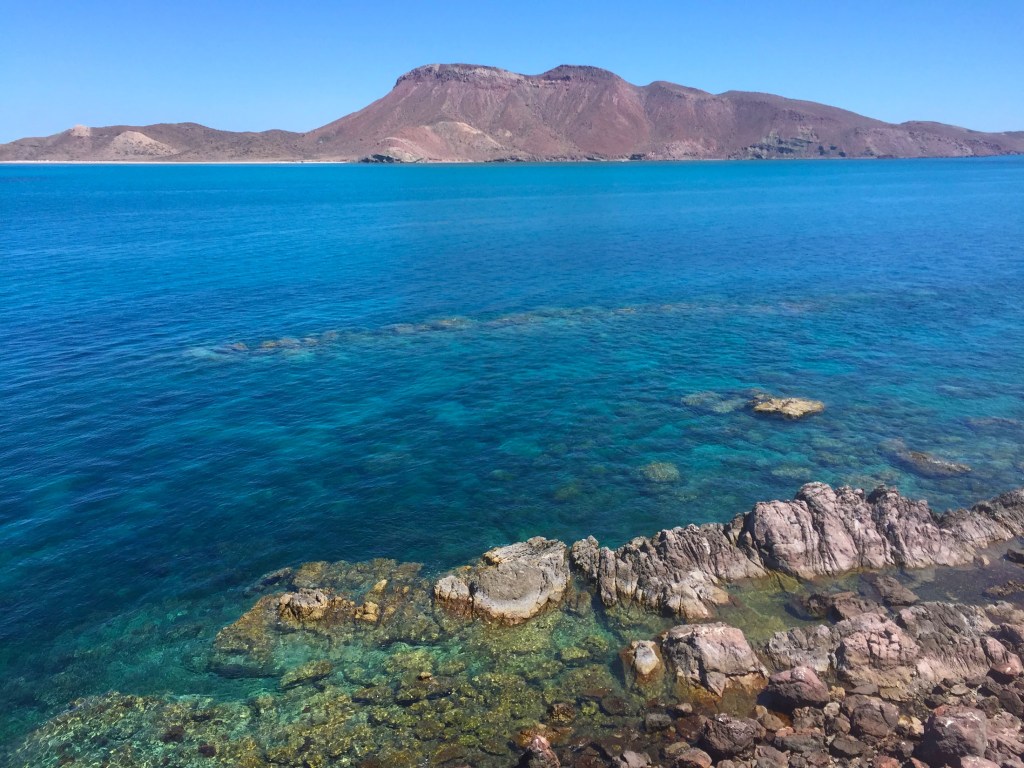
Baja California and the Sea of Cortez (Photo: Erik Olsen)

Geological forces are always at work, reshaping the planet, just usually on a timescale too slow for us to notice. But over the long haul, they can completely transform places we think of as fixed and familiar, like Southern California and northern Mexico. I’ve been down to Baja a bunch of times, including a few unforgettable multi-day kayak trips in the Sea of Cortez. Paddling past sheer cliffs and sleeping on empty beaches under the stars, it’s easy to feel like the landscape has been frozen in time. But that sense of permanence? It’s an illusion.

Baja California stretches like a crooked finger pointing toward the tropics, wedged between the restless Pacific and the calm, warm waters of the Gulf of California. This long, skinny slice of land, more than 1,200 miles from Mexicali to Cabo, is full of contrasts: sun-blasted deserts, jagged mountains, hidden oases and mangroves. But it’s not just a finger of land: it’s a fracture. Baja was ripped from mainland Mexico by slow, grinding tectonic forces, the Pacific Plate dragging it north and leaving the Gulf in its wake. And it’s still on the move.

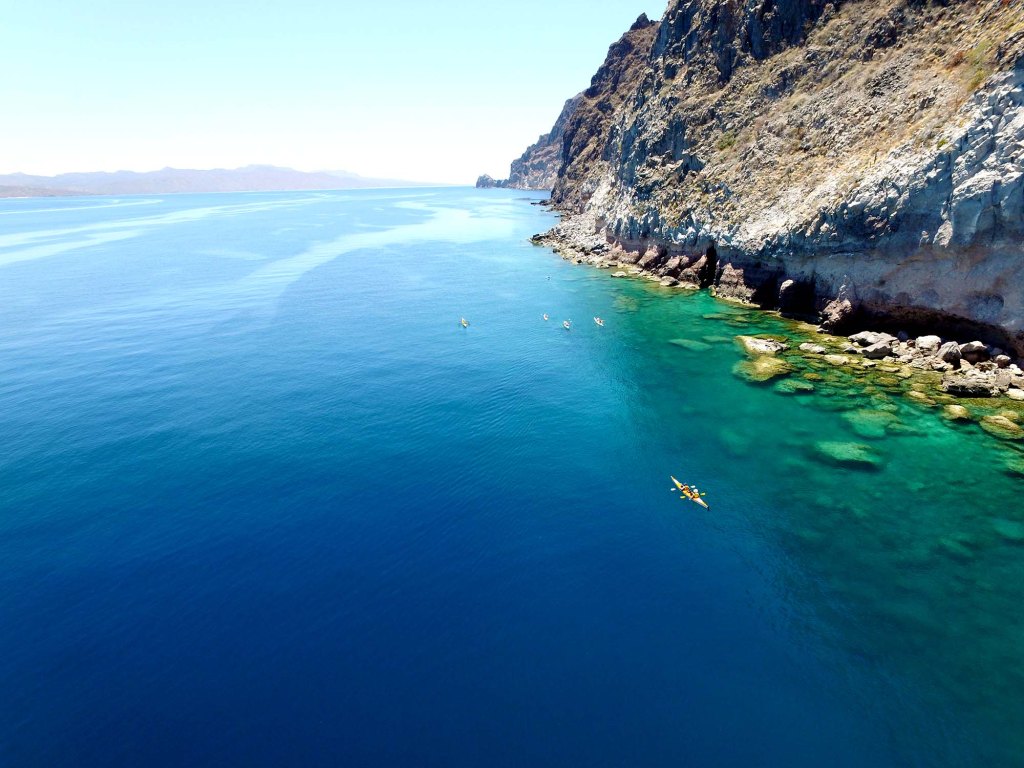
Kayaking the Sea of Cortez out of Loreto, Mexico on the Baja Peninsula (Photo: Erik Olsen)

Every year, Baja creeps a little farther away from the continent, slowly widening the gap. Some scientists think that, millions of years from now, the whole rift could flood, turning parts of northern Mexico into a vast inland sea. It’s the continent, cracking apart right under our feet. it’s just taking its time.

This process is linked to the activity of the San Andreas Fault and other associated fault systems, which collectively form a boundary between the Pacific Plate and the North American Plate. The movement of these tectonic plates is a slow but relentless process, occurring over millions of years. (Slow, and yet as we’ve documented, there’s been quite a bit of movement over that long period of time).

The Pacific Plate is moving northwest relative to the North American Plate, and the San Andreas Fault system primarily accommodates this movement. In essence, the Baja California Peninsula is moving with the Pacific Plate alongside and away from the North American Plate. 

The separation is taking place at an average rate of about 2 to 5 centimeters per year. Over millions of years, these movements accumulate, leading to significant shifts in the geography of regions like Baja California. According to some geologists, within the next 20-30 million years, this tectonic movement could eventually break Baja and the westernmost part of California off of North America to create a vast inland sea, if not an island.

The movement of the continental crust in the area is due in part to seafloor spreading at a massive underwater seam called the East Pacific Rise. This mid-ocean ridge stretches from the southeastern Pacific near Antarctica all the way north into the Gulf of California. Its northernmost extension, known as the Gulf of California Rift Zone, reaches close to the mouth of the Colorado River, helping drive the slow but steady separation of the Baja California Peninsula from mainland Mexico.

Check out our Etsy store for California wildlife gifts.

That geological rift didn’t just shape the land—it created an entirely new sea. The story of Baja California’s tectonic journey isn’t just about earthquakes and shifting plates, it’s also a story of water. The Gulf of California, also known as the Sea of Cortez, is a geologically young sea, having formed around 5.3 million years ago when the Baja Peninsula began drifting northwest. That rifting process continues today, slowly widening the gulf and redrawing the landscape of northwest Mexico.

The azure waters of the Sea of Cortez (Photo: Erik Olsen)

This body of water is a critical habitat for marine life, including several species of whales and dolphins that depend on its warm waters. Jacques Cousteau, the famous French oceanographer, famously referred to the Gulf of California as “the world’s aquarium” due to its vast array of (declining) marine life.

The Sea of Cortez today is under threat from our short time so far on the planet. Unfortunately, overfishing and pollution, including nitrogen-rich runoff from the Colorado River, which (sort of) flows directly into the gulf, imperils wildlife. Nutrient flows can lead to a dramatic decrease in oxygen, depriving plants and animals of the life-giving gas. The potential extinction of the critically endangered vaquita (Phocoena sinus), represents one of the most urgent conservation crises in the region. The vaquita is the world’s most endangered marine cetacean, with estimates suggesting only a few individuals remain. This dire situation is primarily due to bycatch in illegal gillnets used for fishing another endangered species, the totoaba fish, whose swim bladder is highly valued in traditional Chinese medicine.

Habitat destruction is another growing concern, as mangroves, estuaries, and reefs, vital for the breeding and feeding of marine species, are increasingly destroyed to make way for tourism infrastructure and coastal development. Climate change intensifies these problems, with rising sea temperatures and ocean acidification threatening reefs and the broader ecosystem.

Baja California as seen in April 1984, from the bay of a Space Shuttle  (Photo: NASA)

The birth of the Sea of Cortez also has an intriguing connection to a body of water hundreds of miles to the north: the Salton Sea. The Salton Sea, California’s largest lake, sits in the Salton Trough, an area geologists consider a “rift zone,” an extension of the same tectonic forces at work in the Gulf of California.

As the North American and Pacific Plates continue their slow-motion dance, the area around the Salton Sea may sink further, eventually linking with the Gulf of California. If this occurs, seawater could flood the basin, creating a new body of water significantly opening the Sea of Cortez. As mentioned above, eventually this could lead to the full separation of the peninsula from the mainland. However, such a dramatic event is likely millions of years in the future, if it happens at all. Interestingly, the Salton Sea acts as a mirror, reflecting the past processes that led to the formation of the Sea of Cortez.

Salton Sea (Wikipedia)

The Sea of Cortez stands at a crossroads, shaped by both human impact and tectonic drift. Baja California is slowly pulling away from mainland Mexico, a process that could one day create a vast inland sea and dramatically reshape the region. While no one alive today will witness the full transformation, its ultimate impacts could be extreme—redrawing coastlines, shifting ecosystems, and isolating parts of southern California and Mexico in ways we can scarcely imagine.

How one building survived the San Francisco earthquake and changed the world.

The Bekins Warehouse following the 1906 San Francisco earthquake

When the 1906 earthquake struck San Francisco, most of the buildings at the time in the city were made of wood (like redwood harvested from the once vast stands of coastal redwood that grew in Northern California). This did not bode well for San Franciscans because immediately after the earthquake, a series of fires spread quickly over the city, largely razing to the ground almost every wooden structure that withstood the tremblor.

But curiously, a few structures did survive largely intact. Among them, are the Old United States Mint (also known as The Granite Lady) and a half-finished warehouse built for the Bekins Van and Storage Company at Mission and Thirteenth. Although the brick facade cracked, the interior steel framing remained intact, according to a U.S. Geographical Report issued in 1907.

Rebar – used for steel reinforced concrete – being used in a high-rise building.

The Bekins warehouse survived because it was made of a relatively new material that had largely been ignored (and vigorously opposed) in California. That material is reinforced concrete, and its use in this instance played a crucial role in demonstrating the practicality and benefits of reinforced concrete in large-scale urban buildings around the world.

A problem with concrete is that it has great compressive strength. It can withstand high pressure without cracking. But it lacks tensile strength, meaning it cannot bend without shattering. Throughout the late 1800s, various builders tried to strengthen concrete with metal, mostly iron. With the advent of steel, which was becoming increasingly cheap to manufacture, and with a new technique based on twisting the metal to allow it to adhere better to the liquid concrete, a new era of construction was born.

US Mint Building in San Francisco

In the years before the 1906 earthquake, the use of concrete was resisted by the legions of bricklayers, masons, and powerful builders’ unions that saw the material as a threat to their survival. Others called the material ugly and not worthy of a great city like San Francisco.

One trade publication at the time wrote: “a city of the dull grayness of concrete would defy all laws of beauty. Concrete does not lend itself architecturally to anything that appeals to the eye. Let us pause a moment before we transform our city into such hideousness as has been suggested by concrete engineers and others interested in its introduction.”

The novel shape of the Philips Pavilion built in Brussels for Expo 58 was achieved using reinforced concrete. (Wikipedia)

The resistance against concrete was formidable enough that the material was not used widely in the city. Even after the earthquake, it took a while for people to grasp its value. Despite the overwhelming evidence that this new building material could dramatically help a city not only withstand an earthquake but fire as well, San Francisco building codes still forbade the use of concrete in high, load-bearing walls.

The Bekins Warehouse itself was designed to serve as a storage building and office for the Bekins Van and Storage Company, a firm specializing in moving and storage services. The choice of reinforced concrete was strategic, as warehouses of the era required robust structures that could withstand the heavy loads associated with storage, as well as offer protection against fire, a common hazard in densely packed urban centers.

Moreover, the use of reinforced concrete allowed for the construction of large, open interior spaces without the obstruction of support columns. This architectural freedom not only facilitated the efficient organization and movement of goods within the warehouse but also allowed for the adaptation of the building to various uses over time.

San Francisco today. Unsplash: Jared Erondu

It wasn’t until two years later, in a contentious San Francisco board of supervisors meeting, that the city changed its building codes to allow the widespread use of reinforced concrete. By 1910, the city had issued permits for 132 new reinforced concrete buildings. The science of building advanced hugely in the wake of the disaster.

As urban areas continued to grow and evolve, the principles demonstrated by the construction of the Bekins Warehouse—such as the emphasis on durability, fire safety, and spatial efficiency—became increasingly central to architectural and urban planning philosophies. The building not only serves as a testament to the innovative use of materials and techniques in early 20th-century architecture but also as a precursor to modern construction practices where reinforced concrete remains a fundamental building block.

Today, most every tall building in the world makes use of steel-reinforced concrete. The survival of the Bekins building was transformational for not only the city of San Francisco but in many ways, it heralded a watershed moment in the history of architecture, construction, and the planet’s cities.

Vasquez Rocks: Where Plates Collide and Captain Kirk Roamed

Vasquez Rocks (Erik Olsen)

It’s not every day that you can drive down the highway and personally witness one of the great tectonic collisions in Earth’s history. But, if you happen to be motoring along Highway 14, the Antelope Valley Freeway, towards Palmdale near Santa Clarita, there they are:  great slabs of rock stretching skyward at steep angles out of the dirt and scrub brush, creating dramatic formations that seem otherworldly. 

This is Vasquez Rocks, one of California’s most interesting and dramatic geologic formations. 

In a way, the rocks are otherworldly. Widely used as a setting for Westerns and space dramas, they have been seen in more than 200 films and television shows. But this is no ordinary set, erected for a few months and taken down. Vasquez Rocks have taken shape over 25 million years, erected through the violent, but slow, tectonic forces of two continental plates crashing into one another. This is near the top of the San Andreas Fault, at the juncture of the North American and Pacific continental plates.

Vasquez Rocks’ tallest peak juts 150 feet above the canyon floor, offering spectacular views to those courageous (or foolhardy) enough to scramble up it’s steep and treacherous face. (I’ve done it. Many times) The fact is, though, that the rock above ground is like an iceberg. The rock below extends an extra 22,000 feet into the earth.

Credit: Erik Olsen

Over the last half-century, Vasquez Rocks have been a stage for episodes of the TV series “Star Trek: The Next Generation,” “Star Trek: Voyager” and “Star Trek: Enterprise” as well as the films, including “Star Trek VI: The Undiscovered Country” and J.J. Abrams’ 2009 “Star Trek” reboot. They served as part of the planet Vulcan landscape, home to Spock. Abrams said that the site was chosen in homage to the site’s use in the original, including the classic episode of the original Star Trek series “Arena” which pit Kirk against an ambling, hissing, intelligent lizard creature on a foreign world. 

The original Star Trek TV series made use of Vasquez Rocks as an other worldly setting. 

There’s a reason that Vasquez Rocks is so often chosen as a set. The site lies at the edge of what’s known as the Thirty Mile Zone, a region around Los Angeles and Hollywood where those in the Screen Actors Guild and technical crew can report for work without paying higher premiums which dramatically increase the costs of production.

Named for Tiburcio Vásquez, a notorious California Bandit who used the formation to elude officials in 1873-1874, the rocks have made it a favorite filming location going back to the Saturday-morning westerns of the 1920s and ’30s like “The Texas Ranger” in 1931 and “The Girl and the Bandit” in 1939. Other, non-Star Trek productions include the 1994 film version of “The Flintstones” and “The Big Bang Theory.” 

Tiburcio Vásquez

Most people are aware of the rocks’ fame in cinema, but its geological history is in many ways even more interesting. Vasquez Rocks sit astride or are near several other faults. The Elkhorn Fault, an offshoot of the San Andreas Fault, runs right through the Vasquez Rocks Natural Area Park, administered by LA County. Other faults, such as the Pelona, Vasquez Canyon, Soledad, and San Gabriel Faults, all lie near to the formation, making it a boon for geologists hoping to better understand California’s geological and seismographic history. 

(Hikers: It should also be noted that the site also serves as a small section of The Pacific Crest Trail.) 

The rocks consist mainly of sandstone that accumulated over millions of years from the erosion of the nearby San Gabriel Mountains. Rain, landslides, wind, flooding, and earthquakes, all played a role, depositing vast amounts of sand and gravel in the region.

CALIFORNIA CURATED ON ETSY

Purchase stunning art prints of iconic California scenes.
Check out our Etsy store.

Over time, two continental plates – the North American and the Pacific plates – crashed into one another, consuming another plate called the Farallon Plate, which has since disappeared. The process led to an uplifting of the giant slabs that now rise above the otherwise flat terrain. The same process also created California’s best-known fault: the San Andreas, which lies only miles away and slices the state California, finally heading into the Pacific Ocean near San Francisco.

The region is a hotbed of geological activity. Two major quakes have taken place in the last 50 years: the Sylmar earthquake of 1971, which killed 64 people, and the 6.7 magnitude 1994 Northridge earthquake, which killed 57 people and injured another 8,700. Most scientists believe we are due for another big earthquake in the relative near future (geologically-speaking). 

Credit: Erik Olsen

The rocks at Vaquez point at angles between 45-52 degrees, looking at times like huge ships under sail. In fact, formations of this type are known as “hogs back ridges” since they also resemble an arching backbone. Scientists believe they vary in age from 10 to 40 million years old.

Geologists estimate that the rocks sink deep into the earth, perhaps as far as 4 miles. What we see is very much the tip of the iceberg.

For hundreds of millions of years, most of California was found beneath the sea. Very few dinosaur bones have ever been found in California. One exception is the hadrosaur (which also happens to be the state dinosaur). Hadrosaurs were large herbivorous dinosaurs that lived near the end of the Cretaceous. However, marine fossils are plentiful in the region.

There are plenty of wonderful hikes around Vasquez rocks, but seeing them up close is easy, with parking directly beneath some of the most impressive formations. They are very simple to reach from LA, located just off Highway 14. So the next time you happen to be out there, take a moment to gaze and ponder the strange, lovely rocks that have played such a big role in California’s deep geological and cinematographic history.

Erik Olsen