Standing tall against the backdrop of the sun-scorched Mojave Desert, the Joshua Tree (Yucca brevifolia) is an emblematic figure of resilience and beauty. With its twisted, bristled limbs reaching towards the sky, this iconic species is not just a tree but a symbol of the untamed wilderness that is California’s desert landscape.
The Joshua Tree’s biology is as unique as its silhouette. It’s often considered to be a member of the Agavaceae family (along with agaves), more closely related to the asparagus than to other trees. This desert dweller is an arborescent, or tree-like, species of yucca, characterized by its stout, shaggy trunk and a crown of spiky leaves. Unlike most trees, the Joshua Tree doesn’t have growth rings, making it difficult to determine their age. However, these trees can live for hundreds of years, with some ancient sentinels estimated to be over a millennium old. The tallest trees reach about 15 m (49 ft). New plants can grow from seed, but in some populations, new stems grow from underground rhizomes that spread out around the parent tree.
Joshua Tree National Park (Erik Olsen)
The Joshua tree is also known as izote de desierto (Spanish for “desert dagger”). It was first formally described in the botanical literature as Yucca brevifolia by George Engelmann in 1871 as part of the famous Geological Exploration of the 100th meridian (or “Wheeler Survey“).
The moniker “Joshua tree” is believed to originate from Mormon pioneers traversing the expanses of the Mojave Desert around the mid-1800s. They found the tree’s distinctive shape—with its limbs persistently outstretched—reminiscent of the biblical tale where Joshua extends his hands for a prolonged period, assisting the Israelites in their capture of Canaan, as recounted in the Book of Joshua. The tree’s tangled leaves also contributed to this image, giving it the semblance of a beard.
Nevertheless, this charming story lacks direct historical evidence from the period and the name “Joshua tree” doesn’t appear in records until after the Mormons had already settled in the area. Interestingly, the tree’s unique form may bear a stronger resemblance to narratives associated with Moses rather than Joshua. The absence of contemporary accounts leaves the true origin of the name enshrouded in the mystery of the past, adding to the tree’s allure and the folklore of the American West.
Joshua Trees burned in the 2020 Dome fire. (Photo: Erik Olsen)
The habitat of the Joshua Tree is as unforgiving as it is beautiful. They are found primarily in the Mojave Desert, the highest and coldest desert in the United States. These trees have adapted to the extremes, flourishing at elevations between 2,000 and 6,000 feet where the temperatures can plummet below freezing at night and soar during the day.
One of the most fascinating aspects of the Joshua Tree is its symbiotic relationship with the yucca moth. In a marvelous evolutionary dance, the moth is the tree’s sole pollinator, and in turn, the tree provides the moth a place to lay its eggs. This mutualistic relationship underscores the delicate balance of desert ecosystems.
Joshua Tree National Park was established as a national monument in 1936 and later upgraded to a national park in 1994, largely to protect the distinctive Joshua Trees and the unique desert ecosystem they epitomize. The effort to safeguard this landscape was driven by citizens and supporters who were passionate about the conservation of its otherworldly terrain and the diverse life forms that inhabit it.
Despite their hardy appearance, Joshua Trees harbor secrets that are only now being fully understood by scientists. Their root systems, for instance, can extend vertically to 30 feet and horizontally to 36 feet, a testament to their search for water in arid soils. Moreover, these trees are a keystone species, providing critical habitat for a host of desert organisms, from the Scott’s Oriole that nests in its branches to the black-tailed jackrabbit seeking shade under its canopy.
Joshua Trees burned in the 2020 Dome Fire (Photo: Erik Olsen)
However, the stability of the Joshua Tree’s future is uncertain. Climate change poses a significant threat to its survival. Rising temperatures and altered precipitation patterns are projected to shrink the suitable habitat for Joshua Trees by up to 90% by the end of the century. Efforts are underway to understand and mitigate these impacts, with conservationists advocating for policies to reduce carbon emissions and protect the Joshua Tree’s habitat from development and resource exploitation.
In August 2020, a devastating blaze known as the Dome Fire swept through the Mojave National Preserve, scorching over 43,000 acres of one of the most extensive Joshua tree forests on the planet, located at Cima Dome. The inferno, which was one of the most destructive in recent history, decimated an estimated 1 million to 1.3 million Joshua trees, transforming a once thriving ecosystem into a haunting landscape of charred remains.
Joshua Trees burned in the 2020 Dome Fire (Photo: Erik Olsen)
This catastrophic event not only altered the physical landscape but also raised urgent questions about the future of these iconic trees in the face of escalating climate change threats. The resilience of Joshua trees to fire is typically low, and the recovery of these forests could be severely hampered by the changing climate, with hotter, drier conditions becoming more common. The loss of these trees in such vast numbers is a stark reminder of the vulnerability of desert ecosystems and the need for immediate action to mitigate the impacts of climate change and protect these natural treasures for future generations.
Although California came out of drought in 2023, there is no guarantee that dry, hot conditions won’t continue. If they do, Joshua trees could lose 90 percent of their range by the end of the century, Dr. Cameron Barrows, a research ecologist with the University of California Riverside’s Center for Conservation Biology told Outside magazine.
The Joshua Tree’s importance to California’s landscape is indelible. It’s not only an ecological mainstay but also a cultural and historical icon, inspiring artists, musicians, and nature lovers alike. The trees’ spiky profiles are a testament to the unrivaled beauty of the American West.
Ah, the changing of the leaves—a hallmark of autumn that heralds the end of long summer days and the arrival of crisp, cool weather. The spectacle is especially captivating in the high Sierra region of California, where deciduous trees put on a breathtaking show every year. This year’s show began in early October with an explosion of gold, persimmon, and vibrant orange blanketing the granite crags of the Eastern Sierra.
For years, the Eastern Sierra Fall Color Report has dutifully documented the arrival of Autumn and the magnificent changing hues of millions of trees. But have you ever stopped to wonder why the leaves change color? Why do leaves go from a robust green to vibrant hues of orange, red, and yellow? Well, it’s not just nature’s way of getting all dressed up for Halloween; there’s a complex interplay of biological, chemical, and physical processes at work.
(Photo: Erik Olsen)
Let’s start with the basics: chlorophyll. During the growing season, leaves are green due to chlorophyll, the molecule that helps plants photosynthesize. Photosynthesis is the process by which plants convert sunlight, water, and carbon dioxide into sugar and oxygen. Chlorophyll’s structure is such that it absorbs blue and red light well but reflects green light, making leaves appear green. However, as the days shorten and temperatures drop, it becomes a signal to the trees that it’s time to get ready for winter.
Structurally, chlorophyll is a complex molecule with a central magnesium ion surrounded by a long hydrocarbon tail. This structure is particularly adept at capturing and utilizing photons from sunlight for photosynthesis. Yet, chlorophyll is also a bit delicate, getting easily damaged by factors like intense light, exposure to oxygen, and even its own activity. That’s why plants are continuously synthesizing it during the growing season. In a sense, chlorophyll is both the engine and the fuel of the plant world, driving the processes that sustain not just the trees themselves but also the ecosystems that rely on them.
Seen through a microscope, chlorophyll is concentrated within organisms in structures called chloroplasts – shown here grouped inside plant cells. By Kristian Peters — Fabelfroh – Self-photographed, CC BY-SA 3.0
As autumn approaches, the biological clock inside trees ticks toward a season of preservation. Photosynthesis slows down, partly because there’s less sunlight but also because the plant is actively throttling this process. As a result, chlorophyll begins to break down and isn’t replenished. Other pigments present in leaves then take center stage, like carotenoids and anthocyanins. Carotenoids are always there, hanging out alongside chlorophyll, but are usually overshadowed by it. They are the ones that give leaves their yellow and orange hues, and are also the molecules that give the pink flamingo its rosy color.
Drone view of changing Fall colors in the Eastern Sierras
Anthocyanins are another class of pigments, but these are a little more high-maintenance; they form only when certain conditions are met. You see, anthocyanins are created through chemical reactions that are influenced by the pH levels in the leaf cells and the amount of sugar that is present. That’s why some years, when conditions are just so—like a warm, sunny fall following a cooler period—you’ll see a dazzling display of red leaves. Anthocyanins absorb light at both the blue and green ends of the spectrum and reflect red light, giving leaves their gorgeous red and purple shades. Anthocyanins are what help give boysenberries their deep purple color.
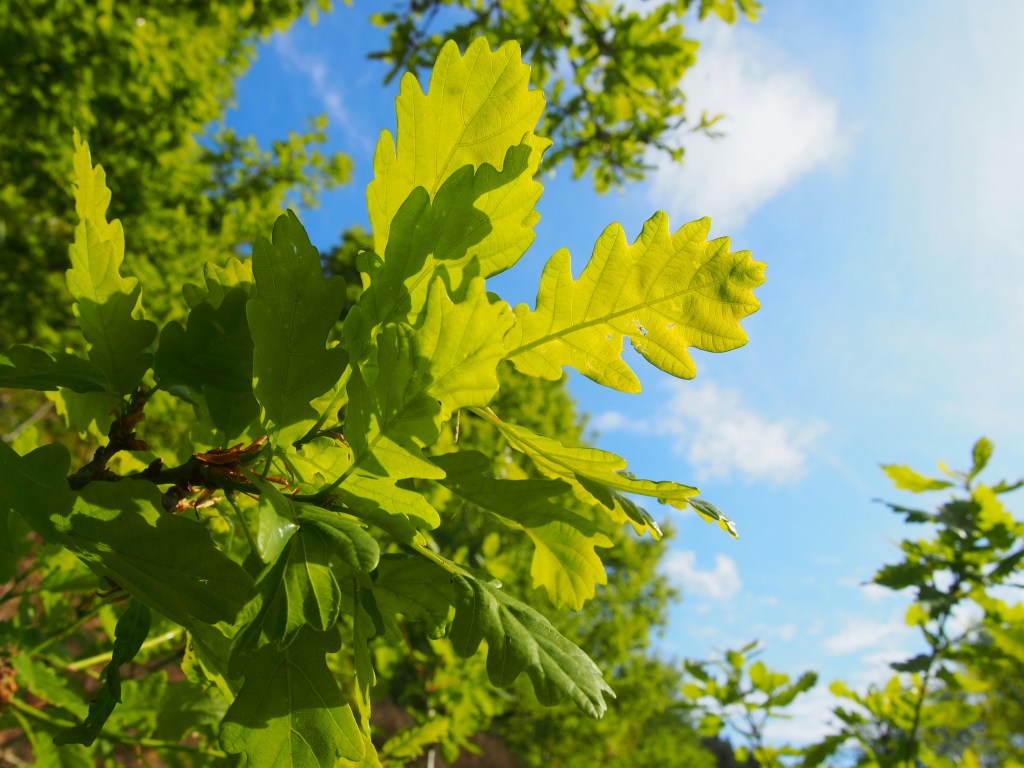
In California’s high Sierra region, where the elevation provides a unique set of environmental factors, the changing of the leaves can be particularly spectacular. Deciduous trees like the Black Oak, Quaking Aspen, and Dogwood populate these areas. The interplay of sunlight, soil acidity, and temperature variations at higher elevations creates an ideal stage for the full spectrum of fall colors to be displayed. Even within the same species of tree, or sometimes even on the same tree, you can see a diversity of colors due to slight variations in soil composition, moisture, and sunlight exposure.
Changing aspens in the Eastern Sierra (Erik Olsen)
It’s all a spectacular display, but it doesn’t last forever; in fact, the most vibrant colors only last a few weeks. And then the leaves die and fall off. It’s not gravity doing its thing, but rather a biological process called “abscission.” As winter approaches, a layer of specialized cells grows between the leaf stem and the tree, severing the vessels that supply nutrients and water to the leaf. This triggers the leaf to die and eventually fall, making way for new growth in the spring.
While the fall colors in California’s Eastern Sierra are an annual marvel, they’re not immune to the sweeping hand of climate change. Rising temperatures and shifting precipitation patterns have started to tinker with the timing and intensity of the autumnal display. For instance, warmer conditions could delay the onset of the color changes and potentially shorten the duration of peak colors, while altered moisture levels might impact the vibrancy of hues. Even subtle shifts in climate can affect the complex chemistry of leaf coloration. As much as the changing leaves are a symbol of nature’s constancy, they also serve as a barometer for the environmental changes unfolding on a global scale.
The transformation of leaves in the high Sierra is far more than a seasonal aesthetic; it’s a vivid illustration of how meticulously nature has calibrated life to adapt and thrive. As the leaves cycle through shades of green, orange, red, and finally brown, they tell a tale of survival and renewal, a complex story scripted in their very cells. This fall spectacle is a fleeting moment of brilliance, orchestrated by an array of biological, chemical, and physical processes, each contributing to the grand narrative of life on Earth. In essence, each leaf is a microcosm of resilience and change, characteristics not just of a California autumn, but of life itself.
The California landscape is dotted with numerous plant species, many of them native, but few have a story as rich and multi-faceted as the eucalyptus tree. Native to Australia, this tree has made California its home over the past century and a half, creating a blend of wonder, economic expectation, and ecological concerns.
The journey of the eucalyptus tree to California dates back to the mid-19th century. Attracted by tales of gold and prosperity, many Australians made their way to the Golden State. Along with them came seeds of the eucalyptus tree, which they believed had great potential value. By the 1870s and 1880s, California was amidst a timber crisis. Native woodlands were diminishing, and the state was in dire need of a rapidly growing timber source. The eucalyptus tree, known for its rapid growth and towering heights, appeared to be a promising solution. Its proponents, believing it would not only serve as an excellent timber source but also act as a windbreak and ornamental plant, began widespread plantations.
While the eucalyptus grew impressively fast, hopes for it being a top-tier lumber source were quickly dashed. Most species planted in California had wood that was prone to warping and splitting upon drying. The enthusiasm surrounding the eucalyptus as a miracle timber tree gradually waned. What was initially perceived as a solution turned out to be more of a decorative element in the landscape rather than an economic boon.
Despite its failure in the lumber industry, the eucalyptus managed to root itself firmly in the Californian soil. Over time, this rapid settler began to pose significant environmental concerns. Eucalyptus trees are thirsty plants. Their deep roots often outcompete native species for water, hindering the growth and survival of native Californian plants and altering the balance of local ecosystems. Furthermore, eucalyptus groves have become a concern for wildfires. Their oil-rich leaves and peeling bark make them exceptionally flammable, amplifying dangers during California’s fire-prone seasons.
While over 700 eucalyptus species exist, only a handful made it to California. The most commonly planted and now dominant species is the blue gum eucalyptus (Eucalyptus globulus). Towering over most trees, the blue gum can reach staggering heights, quickly establishing its dominance in the landscape. Other species like the red gum (Eucalyptus camaldulensis) and the sugar gum (Eucalyptus cladocalyx) have also found their way into California, albeit in smaller numbers. The sugar gum is particularly present around the campus of Stanford University.
Sugar gum pods Stanford
By the late 1900s, concerns over the eucalyptus’ impact on native habitats led to movements advocating for their removal. Environmentalists and local residents began to see the tree as an invasive species that hindered the natural balance. Efforts to cut down and manage the eucalyptus population intensified, often clashing with those who had come to admire the tree’s majestic presence and the unique ambiance it provided.
Considered among the thousand-plus established alien vascular plants in California—two-thirds of which originated in Eurasia—Eucalyptus seems relatively benign. Of the 374 species in the genus that have been introduced since the 1850s, only 18 have naturalized, and only one of those, E. globulus, has become a nuisance, and then only at the urban-wildland interface along the fog belt of the central coast and Bay Area, and there only after humans gave it an enormous head start with plantations.
Even in these locations, self-sustaining feral forests have not grown dramatically beyond the boundaries of the original plantings. In the Golden State the blue gum has never been especially invasive; rather, it used to be hugely desirable. Other vegetation imported to California for ornamental purposes has spread far more widely or densely—for example, English ivy, periwinkle, ice plant, and pampas grass. Unlike Saltcedar (Tamarix ramosissima), Tasmanian blue gum is not a true problem plant. It cannot be considered a paradigmatic invader, or even a noteworthy one. The authoritative Encyclopedia of Biological Invasions makes note of the “enigmatic” low invasiveness of eucalypts worldwide—“orders of magnitude less successful as invaders than pines.”
From the perspective of both ecology and fire safety, the blue gum eucalyptus is particularly concerning in California when plantations of a single species have transformed into dense, closed-canopy forests. This issue, though, is confined to a limited number of areas within the fog belt. Even within these regions, the eucalyptus thickets are far from being barren, hostile environments.
Eucalyptus grove in California
That said, a relatively recent event did not cast the tree in good light.
The East Bay firestorm of 1991 was a catastrophic event that claimed 25 lives and rendered thousands homeless. Extensive areas of eucalyptus were consumed by the flames. For 26 years, the East Bay Firestorm firestorm was considered the worst fire in California’s history. It was also America’s most costly fire in the wildland-urban interface (WUI).
“People at the time, I don’t think, associated that with a planted plantation; it was just a eucalyptus forest,” CalPoly botanist Jenn Yost told KQED. “And then when the fire came through — I mean that fire came through so fast and so hot and so many people lost their homes that it was a natural reaction to hate blue gums at that point.”
However, it is again important to point out that the density of trees in the area was unusual and not representative of many other areas where eucalyptus have taken root.
Those opposed to the trees argue that their tendency to shed large quantities of bark exacerbates the fire hazard, and hence, they should be removed. On the other hand, proponents highlight that many of California’s native plants are also prone to burning. The 2018 Camp Fire scorched an area 153,336 acres in size, and destroyed more than 18,000 structures, most of the destruction happened within the first four hours of the fire and most of the destruction was the result of pine forests that have long been improperly managed. Both factions claim that science supports their viewpoint, but as of now, no definitive study has been able to settle the argument conclusively.
Camp Fire of 2018
This ongoing debate has stirred deep emotions. A few years ago, an incident in the East Bay hills saw federal funding for cutting down trees withdrawn after protesters, in a dramatic display of support for the eucalyptus, got naked and literally embraced the trees on the Cal campus. While some have argued that California needs to return its natural environment to a more “pristine” state, meaning just California natives, others say that the eucalyptus poses no greater danger than many species of conifer, and that the effort to expunge eucalyptus from the landscape, given its contribution to the culture and beautification of the state is tantamount to discrimination against immigrant trees solely due to their origin, an idea which some have extended to the human population.
“We’re not natives either,” the San Diego County chief entomologist said in defense of the county’s signature tree genus.
One ecological study that compared a gathering of oaks to a blue gum grove in the neighboring areas, concluded that the blue gem eucalyptus has no major impact on animal life. In fact, the tree’s leaf litter is bustling with life, containing a complex array of microhabitats. In fact, while oaks tend to be home to more rodents, eucalyptus contains a greater number of below-ground invertebrates.
Fruit of Eucalyptus globulus
The complex relationship between Californians and the eucalyptus reflects deeper questions about nature, risk, and our connection to the landscape, and it’s a debate that shows no signs of resolution.
Among the thousand-plus non-native vascular plants that have made their home in California—two-thirds of which hail from Eurasia—the Eucalyptus is relatively mild-mannered. Since the 1850s, 374 species of Eucalyptus have been introduced to the state. Yet, of these, only 18 have successfully naturalized, and merely one, the E. globulus, has ever become problematic. This issue is isolated mainly to the WUI boundary along the fog belt of the central coast and Bay Area, and even there, only after humans heavily promoted its growth through plantation efforts.
Even within these specific regions, the self-sustaining “feral” forests haven’t expanded significantly beyond the original planting sites. In California, the blue gum eucalyptus has never been notorious for being particularly invasive; rather, it was once highly sought-after. Other non-native plants brought to California for decorative purposes, such as periwinkle, English ivy, ice plant, pampas grass, and tamarisk, have spread much more extensively or densely.
Pampas Grass
Unlike plants like Scotch and French broom, the Tasmanian blue gum eucalyptus doesn’t qualify as a genuine problem plant. It’s not viewed as a typical invader, nor is it even considered particularly noteworthy in that regard. A state survey that consulted floricultural experts produced a broad spectrum of opinions concerning the potential threat posed by eucalyptus to California’s wildlands. This contrasts sharply with the unified negative evaluation of salt cedar, which has bedeviled land managers from Southern California to Mexico.
The final verdict on the fate of eucalyptus in Southern California has yet to be rendered. Many still think the trees have become an iconic symbol of the state, with so many trees proudly and elegantly lining pocketed and immensely Instagrammable stretches of California highway. Perhaps the key to the trees survivability and reputation is simply one of proper management. Where the trees have become too dense in fire-prone areas, maybe some measure of thinning is prudent. But to eliminate them entirely would be a great loss to the aesthetic visual appeal of California, an appeal that many Californians, even conservation-minded artists like Ansel Adams and Erin Hanson often summoned in their work.
The eucalyptus tree’s journey in California is a tale of expectations, surprises, and evolving perspectives. Whether viewed as an ornamental marvel or an ecological concern, the eucalyptus remains an integral part of California’s diverse tapestry.
Amid the barren, high-altitude desert of California’s White Mountains, the Bristlecone Pines stand as enduring sentinels, their gnarled forms chronicling millennia of survival in one of the planet’s most unforgiving landscapes. For thousands of years, these ancient organisms have endured drought, freezing temperatures, and brutal winds. Each twisted trunk and weathered branch tells a story of resilience. Yet in a bitter twist, one of the oldest among them, a tree known as Prometheus that once grew in the nearby Great Basin National Park, met its end not from the slow violence of nature but from a single human decision. And it wasn’t the result of malice or careless destruction, like the foolish vandals who felled the U2 Joshua Tree. It was a mistake, made in the name of science.
The Prometheus stump. All that is left of one of the oldest organisms on Earth.
Prometheus, named after the Titan who defied the gods in Greek mythology, was an extraordinary specimen of the Pinus longaeva species, or the Great Basin Bristlecone Pine. It is believed to have germinated around the time of the Bronze Age, making it likely older than the Great Pyramids of Giza. By the 1960s, when its existence was noted by researchers, it was already around 4900 years old. Unfortunately, that’s when tragedy struck.
In 1964, a young geographer named Donald Rusk Currey was studying climate dynamics of the Little Ice Age. He was especially drawn to Bristlecone pines because their rings hold valuable records of past climate conditions, a core focus of dendrochronology, the study of tree rings, which continues to be an important scientific tool today. Some details of the story vary, but Currey had supposedly been coring several trees in the area to measure their age, but he encountered difficulties with Prometheus. He was unaware that the tree was not only ancient, but likely the oldest non-clonal organism on the planet. The coring tool broke, and unable to get the data he needed, Currey believed that cutting down the tree was the only way to continue his research. The Forest Service, unaware of the tree’s significance, approved the request.
And so he cut it down.
Bristlecone forest in the White Mountains of California (Erik Olsen)
Once Prometheus was cut down, its extraordinary age became clear. By counting its growth rings, Currey estimated that Prometheus was at least 4,844 years old, making it the oldest known tree in the world at the time. A few years later, this age was increased to 4,862 by Donald Graybill of the University of Arizona‘s Laboratory of Tree-Ring Research.
The scientific community and general public were outraged at the unnecessary loss, sparking conversations about the protection of these ancient trees. In the words of one writer-activist, Currey had “casually killed (yes, murdered!)” the world’s oldest tree. As if a curse had been unleashed, a year after Prometheus was cut down, a young Forest Service employee died of a heart attack while trying to remove a slab from the tree. Currey was obviously beside himself. Whoops.
Whether Prometheus should be considered the oldest organism ever known depends on how we define “oldest” and “organism.” Some clonal species may claim even more ancient origins when we consider the entire genetic individual rather than a single stem or trunk. The creosote bush ring known as King Clone, located in the Mojave Desert in California, is estimated to be nearly 12,000 years old. Similarly, the massive aspen colony known as Pando in Utah spans over 100 acres and may be more than 14,000 years old. Unlike Prometheus, which was a single, ancient tree, these clonal colonies persist by continuously regenerating themselves, allowing the larger organism to survive for tens of thousands of years.
Creosote growing in the Mojave Desert (Photo: Erik Olsen)
Prometheus’s death brought global attention to the incredible age and ecological value of Bristlecone Pines, sparking a deeper appreciation for their role in Earth’s history. In the years since, increased protections have been put in place to preserve these ancient trees. Today, they are part of the Inyo National Forest’s Ancient Bristlecone Pine Forest, a protected area in the White Mountains that draws scientists and visitors from around the world.
California is home to the oldest, tallest, and largest trees on the planet, not just the ancient Bristlecone Pines, but also the sky-scraping coast redwoods and the enormous giant sequoias. It’s also the most biodiverse state in the U.S., making it one of the most ecologically exceptional places on Earth.
Even as we mourn Prometheus, it’s important to remember that it is not the end of the story for the Bristlecone Pines. There are still many of these ancient trees alive today. One of them, named Methuselah, is known to be 4,851 years old and is often considered the oldest living tree in the world. While it is known to live somewhere in the White Mountains of California, its exact location is kept a secret to protect it. The tree’s name refers to the biblical patriarch Methuselah, who ostensibly lived to 969 years of age.
There’s also the potential for even older specimens. Given the harsh, remote habitats these trees often occupy, it is likely that there are older Bristlecones yet to be discovered.
California’s White Mountains (Photo: Erik Olsen)
The cutting of Prometheus was a mistake, an irreversible loss. But its story became a turning point, highlighting the need to treat ancient and rare life with more care. While Prometheus is gone, many other long-lived and fragile organisms still exist. Its fate is a reminder that our curiosity should always be balanced by a responsibility to protect what can’t be replaced.
Today, a cross-section of Prometheus is on display at the Great Basin National Park visitor center in Nevada, as well as the U.S. Forest Service’s Institute of Forest Genetics in Placerville, California. The tree’s thousands of growth rings are a reminder of its incredible longevity and a sobering memory of the tree that had survived for millennia. The region’s diverse landscapes are home to an incredible abundance of life, from ancient trees to unique coastal ecosystems. Protecting and understanding these natural treasures ensures they remain for future generations to study, appreciate, and enjoy.
California is known for its sunny beaches, bustling cities, and iconic landmarks such as the Golden Gate Bridge and Hollywood sign. However, the state is also home to a wealth of scientific discoveries and phenomena that are not as well-known. From ancient fossils to cutting-edge research, California has a lot to offer in the realm of science. In this list, we’ll explore ten of the most fascinating scientific things that you probably didn’t know about California. Get ready to be amazed by the natural wonders and innovative research that make this state such a unique and exciting place for science enthusiasts.
California is home to the tallest tree in the world, a coastal redwood named Hyperion that measures 379.7 feet (115.7 meters) in height. The state is also home to the largest (by volume) tree, named General Sherman in Sequoia National Park. General Sherman is 274.9 feet high and has a diameter at its base of 36 feet, giving it a circumference of 113 feet. General Sherman’s estimated volume is around 52,508 cubic feet (1,487 cubic meters), which would correspond to an estimated weight of around 2.7 million pounds.
The Salton Sea, a large inland lake in southern California, is actually an accidental body of water that was created by a flood in 1905 when Colorado River floodwater breached an irrigation canal being constructed in the Imperial Valley and flowed into the Salton Sink.
TheSan Andreas Fault, the state’s best-known and most dangerous fault that runs through the middle of California and to the coast, moves about 2 inches (5 centimeters) per year (or, so they say, the speed that a fingernail grows).
The state of California has more national parks than any other state in the US, with nine in total. Among them is one of the crown jewels of the National Park system: Yosemite National Park.
California is one of the only places in the world where you can find naturally occurring asphalt, at the La Brea Tar Pits in Los Angeles.
The oldest living organism on Earth, a bristlecone pine tree named Methuselah, can be found in the White Mountains of California and is over 4,800 years old.
TheMonterey Bay Aquarium in Monterey, California was the first aquarium to successfully keep a great white shark in captivity for more than 16 days. The first great white that the aquarium tried to display died after 11 days in 1984 because it would not eat.
The Joshua Tree, a type of yucca plant (NOT a tree) found in the Mojave Desert, is named after the biblical figure Joshua because of its outstretched branches that resemble a person reaching up to the sky in prayer.
The California grizzly bear, which appears on the state flag, went extinct in the early 1900s due to hunting and habitat loss. The last California grizzly was seen near Yosemite in 1924, going extinct after decades of hunting. Fossils of the California grizzly can be seen at the La Brea tar Pits.
The California Institute of Technology, also known as Caltech, is one of the world’s leading scientific research institutions and has produced 39 Nobel laureates, more than any other university in the world.
We also have the world’s tallest and biggest trees.
California’s giant sequoias and redwoods are nature’s skyscrapers. Redwoods exist in a few narrow pockets in Northern and Central California and into Southern Oregon. Sequoias live exclusively in small groves in central and Northern California with the largest grouping of them found in Sequoia National Park. These two tree species are wonders of the biological world. They are also some of the most magnificent things to behold on the planet.
I have personally climbed the Stagg tree for a New York Times story years ago (see photo below, that’s me). The Stagg is the fifth-largest sequoia in the world, and I will forever remember the experience…even though I chickened out a bit and didn’t make it to the top.
The author climbs the Stagg tree, the fifth-largest tree in the world. (Erik Olsen)
We are lucky to still have our big trees, what’s left of them, anyway. Just a century and a half ago, old-growth redwoods and sequoias were remarkably plentiful. People marveled at them, with some early settlers in California spinning unbelievable yarns of trees that rise from the earth “like a great tower“. They also saw them as a bounteous resource, ripe for plunder (mankind, sigh).
By 1900, nearly all of California’s tall trees had been purchased by private landowners who saw in the trees not beauty, but dollar signs. By 1950, an estimated 95% of California’s original old-growth coast redwood forests had been logged, particularly along the coast from Big Sur to the Oregon border. For giant sequoias, about one-third of the original groves had been cut down, largely in the late 19th and early 20th centuries before protections were put in place.
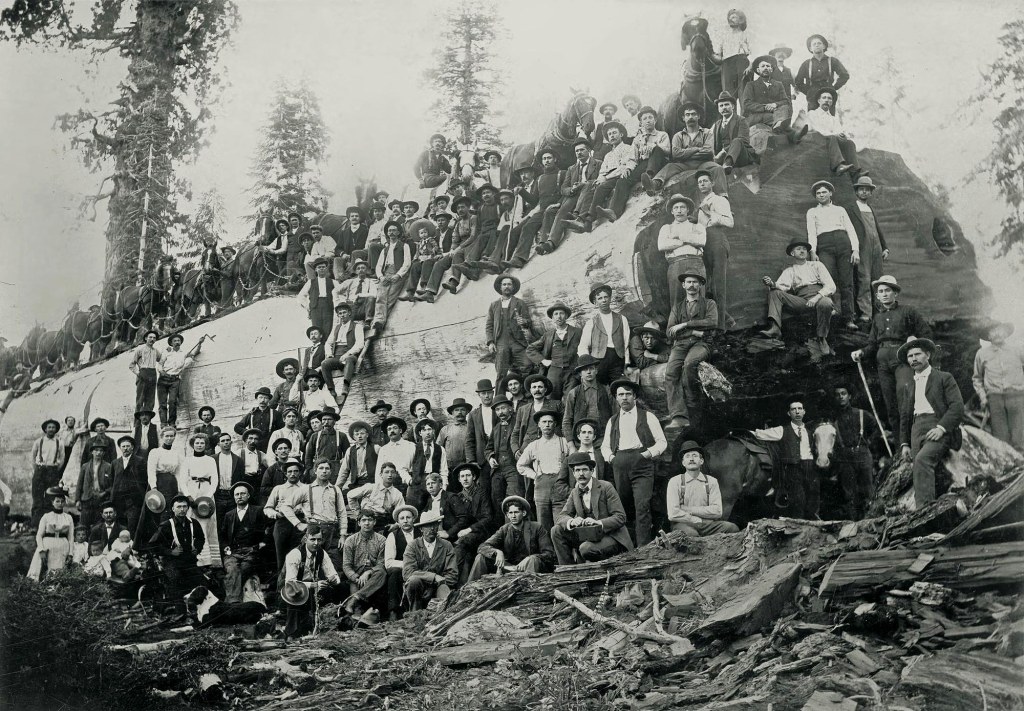
Between 1892–1918, the Sanger Lumber Company logged the Converse Basin Grove, one of the largest stands of sequoia in the world, using ruinous clearcutting practices. They cut down 8,000 giant sequoias, some of them over 2000 years old, in a decade-long event that has been described as “the greatest orgy of destructive lumbering in the history of the world.” Only 60-100 large specimens in the grove survived. We wrote about that awful event here.
Today, only a small fraction of the old-growth coast redwood forest remains. The largest surviving stands of ancient coast redwoods are found in Humboldt Redwoods State Park, Redwood National and State Parks and Big Basin Redwoods State Park. It’s a wonder and a blessing that there are some left. And even then, they face an uncertain future thanks to climate change.
The remarkable size and height of these incredible organisms are largely due to California’s unique geography, though genetics likely play a significant role as well. Before diving into those factors, let’s take a moment to appreciate just how extraordinary these trees truly are.
Professional tree climber Rip Thompkins at the top of the Stagg tree, a giant sequoia. (Photo: Erik Olsen)
Sequoias and redwoods are closely related. Both belong to the cypress family (Cupressaceae). The primary difference between sequoias and redwoods is their habitat. Redwoods live near the moist, foggy coast, while sequoias thrive in higher-elevation subalpine zones of the Sierra Nevada. Redwoods are the tallest trees in the world. Sequoias are the biggest, if measured by circumference and volume. Redwoods can grow over 350 feet (107 m). The tallest tree in the world that we know of is called the Hyperion, and it tickles the sky at 379.7 feet (115.7 m). But it is quite possible another tree out there is taller than Hyperion. Redwoods are growing taller all the time, and many of the tallest trees we know of are in hard-to-reach areas in Northern California. Hyperion was only discovered about a decade ago, on August 25, 2006, by naturalists Chris Atkins and Michael Taylor. The exact location of Hyperion is a secret to protect the tree from damage.
The giant sequoia (Sequoiadendron giganteum) is Earth’s most massive living organism. While they do not grow as tall as redwoods – the average size of old-growth sequoias is from 125-275 feet – they can be much larger, with diameters of 20–26 feet. Applying some basic Euclidean geometry (remember C = πd?), that means that the average giant sequoia has a circumference of over 85 feet.
Giant sequoia and man for scale (Photo: Erik Olsen)
Sequoias grow naturally along the western slope of the Sierra Nevada mountain range at an altitude of between 5,000 and 7,000 feet. They tend to grow further inland where the dry mountain air and elevation provide a comfortable environment for their cones to open and release seeds. They consume vast amounts of runoff from Sierra Nevada snowpack, which provides groves with thousands of gallons of water every day. But some say the majestic trees face an uncertain future. Many scientists are deeply concerned about how climate change might affect the grand trees, as drought conditions potentially deprive them of water to survive.
The General Sherman tree in Sequoia National Park. (Photo: Erik Olsen)
The world’s largest sequoia, thus the world’s largest tree, is General Sherman, in Sequoia National Park. General Sherman is 274.9 feet high and has a diameter at its base of 36 feet, giving it a circumference of 113 feet. Scientists estimate that General Sherman weighs some 642 tons, about as much as 107 elephants. The tree is thought to be 2,300 to 2,700 years old, making it one of the oldest living things on the planet. (To learn more about the oldest thing in the world, also in California, see our recent feature on Bristlecone pines.) Interesting fact: in 1978, a branch broke off General Sherman that was 150 feet long and nearly seven feet thick. Alone, it would have been one of the tallest trees east of the Mississippi.
Many sequoias exist on private land. Just last month, one of the largest remaining private stands of Sequoias in the world – the Alder Creek Grove of giant sequoias – was bought by the Save the Redwoods League conservation group for nearly $16 million. The money came from 8,500 contributions from individual donors around the world. The property includes both the Stagg Tree mentioned above and the Waterfall Tree, another gargantuan specimen. The grove is considered “the Crown Jewel” of remaining giant Sequoia forests.
Redwoods (Sequoia sempervirens), also known as coast redwoods, generally live about 500 to 700 years, although some have been documented at more than 2,000 years old. While wood from sequoias was found to be too brittle for most kinds of construction, the redwoods were a godsend for settlers and developers who desperately needed raw material to build homes and city buildings, to lay railroads, and erect bridge trestles. The construction and subsequent reconstruction of San Francisco following the 1906 earthquake heavily relied on redwood timber, prized for its strength, resilience, and natural resistance to decay, making it a foundational resource for the city’s growth and recovery after the earthquake.
The timber companies who profited from redwoods only began to cut them down in earnest a bit over a century ago. But cut them down they did, with vigor and little regard for the preservation of such an amazing organism. After World War II, California experienced an unprecedented building boom, and the demand for redwood (and Douglas fir) soared. Coastal sawmills more than tripled between 1945 and 1948. By the end of the 1950s, only about 10 percent of the original two-million-acre redwood range remained untouched.
The author standing by burned sequoias. (Photo: Erik Olsen)
OK, you got this far. I hope. So how did these trees get so big and tall? Most scientists agree it has to do with climate. Sequoias benefit from California’s often prodigious snowpack, mentioned above, which seeps into the ground, constantly providing water to the roots of the trees. In addition to the snowpack, the thick (up to 2 feet), fire-resistant bark of sequoias helps protect them from wildfires. This forest ecology helps as well, since the fires themselves clear competing vegetation, allowing more sunlight and nutrients to reach the trees. The temperate climate of California, with its relatively mild winters and summer fog, also helps sustain these giants by moderating temperatures and reducing water loss, creating an environment where sequoias can thrive for centuries.
Conversely, Redwoods get much of their water from the air, when dense fog rolls in from the coast and is held firm by the redwoods themselves and the steep terrain. Because of the unique interplay of ocean currents and climate in California, the amount of fog that is available to trees is highly unusual. The trees’ leaves actually consume water in fog, particularly in their uppermost shoots. According to scientists who study the trees using elaborate climbing mechanisms to reach the treetops, in summer, coast redwoods can get more than half of their moisture from fog. (In fact, fog plays a central role in sustaining several of California’s coastal ecosystems.) The reason is that fog is surprisingly dense with water. One study from scientists Daniel Fernandez of California State University, Monterey Bay, showed that a one-square-meter fog collector could harvest some 39 liters, or nearly 10 gallons, of water from fog in a single day.
Giant sequoia – family for scale (Erik Olsen)
Another possible explanation for the coast redwood’s remarkable size lies in its extraordinary genome. According to research from the Redwood Genome Project, the coast redwood (Sequoia sempervirens) is hexaploid, meaning it carries six copies of each chromosome in every cell, an extremely rare feature in trees. In contrast, humans and most other plants and animals are diploid, carrying only two sets of chromosomes.
The coast redwood genome is indeed massive, estimated at around 27 billion base pairs, which is approximately nine times larger than the human genome (which has about 3 billion base pairs). While not exactly ten times larger, the general comparison holds and highlights the tree’s genetic complexity.
By comparing the coast redwood’s genome with those of other conifers, researchers have found hundreds of unique gene families, many of which are associated with stress tolerance, wound repair, fungal resistance, toxin metabolism, and the biosynthesis of flavonoids, all compounds that help mitigate cellular stress.
This rich genetic toolkit may contribute to the tree’s legendary resilience, longevity, and ability to grow to extraordinary heights, though the full relationship between genome size and physical traits in redwoods is still being studied.
Yet another factor may be the trees remarkable longevity. They are survivors. The Sierra Nevadas have long experienced dramatic swings in climate, and this age may be yet another of those swings that the trees will simply endure. Or maybe not. For most of the time that redwoods and sequoias have existed, they have done a remarkable job fighting off fires, swings in climate, as well as disease and bug infestations. Because their bark and heartwood are rich in compounds called polyphenols, bugs and decay-causing fungi don’t like them. Many trees, not just redwoods and sequoias, have genes that help them resist the typical aging processes that limit the lifespan of animals. For instance, trees can compartmentalize and isolate damaged or diseased wood, preventing the problem from spreading to the rest of the tree.
Giant sequoias in California. (Photo: Erik Olsen)
As the air heats up due to global warming, there is a rising threat to the trees’ survival. Warm air pulls moisture from leaves, and the trees often close their pores, or stomata, to maintain their water supply. When the pores close, that prevents carbon dioxide from nourishing the tree, slowing or even halting photosynthesis. The climate in areas where the trees grow hasn’t yet experienced the kind of temperatures that might kill them, but we are really just at the beginning of this current era of global warming, and some scientists warn hotter temperatures could doom many trees.
That said, other studies that show the increased carbon that causes warming could actually be good for the trees. According to an ongoing study from Redwoods Climate Change Initiative, California’s coast redwood trees are now growing faster than ever. As most people know, trees consume carbon dioxide from the air, so, the scientists argue, more carbon means more growth. However, scientists caution that climate change is not a net benefit. Increased drought, fire risk, and ecosystem stress may ultimately outweigh these temporary growth gains.
We will see. While coast redwoods have shown resilience during recent droughts, with no widespread mortality observed, giant sequoias have not fared as well. In the past decade, drought, bark beetles, and intense wildfires have killed nearly 20% of all mature giant sequoias, a sharp and alarming decline for such a long-lived species.
Redwood grove in Northern California (Photo: Erik Olsen)
It all comes down to some kind of balance. Trees may benefit from more carbon, but if it gets too hot, trees could start to perish. That’s a bit of a conundrum, to say the least.
The prospect of losing these magnificent trees to climate change is a double whammy. Not only would a mass die-off of trees be terrible for tourism and those who simply love and study them, but trees are some of the best bulwarks we have on the planet to fight climate change. Redwoods are among the fastest-growing trees on earth; they can grow three to ten feet per year. In fact, a redwood achieves most of its vertical growth within the first 100 years of its life. Among trees that do the best job taking carbon out of the atmosphere, you could hardly do better than redwoods and sequoias.
The Archangel Ancient Tree Archive, an organization out of Copemish, Michigan, has been “cloning” California’s big trees for nearly a decade. They take snippets of the trees from the top canopy and replant them, essentially creating genetically identical copies of the original tree. It’s more like propagating than cloning, but that’s what they call it. The group’s founder, David Milarch, believes fervently that planting large trees is our best bet in stopping climate change. This is the video story I produced about Milarch back in 2013. It’s worth a watch. He’s an interesting character with a lot of passion.
Preserving and protecting what’s left of these amazing organisms should be a priority in California. These trees are not only part of the state’s rich natural legacy, but they offer ample opportunities for tourism and strengthening the economies of the regions where they grow. It’s hard to visit Redwood National and State Parks or Sequoia & Kings Canyon National Parks and to come away with anything but awe at these magnificent organisms. California is special, and we are blessed to have these trees and the places where they grow in our state.
Lying east of the Owens Valley and the jagged crags of the Sierra Nevadas, the White Mountains rise high above the valley floor, reaching over 14,000 feet, nearly as high as their far better-known relatives, the Sierra Nevadas. Highway 168 runs perpendicular to Highway 395 out of Big Pine and leads up into the mountains to perhaps the most sacred place in California.
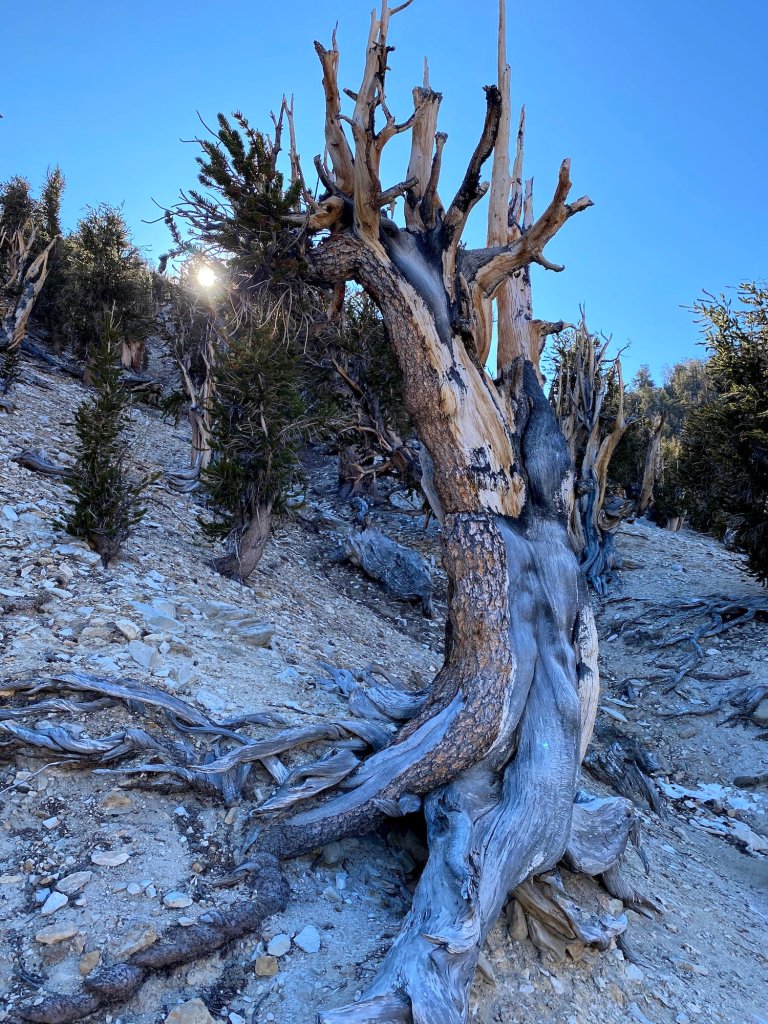
Far above sea level, where the air is thin, live some of the most amazing organisms on the planet: the ancient bristlecone pines. To the untrained eye, the bristlecone seems hardly noteworthy. Gnarled and oftentimes squat, especially when compared to the majestic coastal redwoods and giant sequoias living near the coast further west, they hardly seem like mythical beings. But to scientists, they are a trove of information, offering clues to near immortality and to the many ways that the earth’s climate has changed over the last 5,000 years.
In the January 20, 2020 edition of the New Yorker, music writer Alex Ross writes about the trees and the scientists who are trying to unlock the secrets of the bristlecone’s unfathomable endurance. The trees, he writes, “seem sentinel-like”.
Video of ancient bristlecone pine that I shot and put together.
Bristlecones are the longest living organism on earth. The tree’s Latin name is Pinus longaeva, and it grows exclusively in subalpine regions of the vast area known to geologists as the Great Basin, which stretches from the eastern Sierra Nevadas to the Wasatch Range, in Utah. Bristlecones grow between 9,800 and 11,000 feet above sea level, where some people get dizzy and there are few other plants or animals that thrive. The greatest abundance of bristlecones can be found just east of the town of Bishop, California in the Ancient Bristlecone Pine Forest. There, a short walk from where you park your car, you can stroll among these antediluvian beings as they imperceptibly twist, gnarl and reach towards the heavens.
While most of the bristlecones in the national Ancient Bristlecone Pine Forest are mere hundreds of years old, there are many that are far older. Almost ridiculously so. Methuselah, a Great Basin bristlecone, is 4,851 years old, as measured by its rings, taken by scientists decades ago using a drilled core. Consider that for a moment: this tree, a living organism, planted its tentacle-like roots into the soil some 2000 years before the birth of Christ, around the time that the Great Pyramids of Egypt were built. By contrast, the oldest human being we know of lived just 122 years. That’s 242 human generations passing in the lifetime of a single bristlecone that still stands along a well-trodden trail in the high Sierras.
National Park Service
That said, if you were to try and see Methuselah for yourself, you are out of luck. The Forest Service is so protective of its ancient celebrity that it will not even share its picture. What’s more, it’s probably the case that there are bristlecones that are even older than Methuselah. Scientists think there could be trees in the forest that are over 5,000 years old.
How the bristlecone has managed this incredible feat of endurance is a mystery to researchers. Many other tree species are prone to insect infestations, wildfires, climate change. In fact, over the last two decades, the vast lodgepole pine forests of the Western United States and British Columbia have been ravaged by the pine beetle. Millions of acres of trees have been lost, including more than 16 million of the 55 million acres of forest in British Columbia.
But insects don’t seem to be a problem for bristlecones. Bristlecone wood is so dense that mountain-pine beetles and other pests can rarely burrow their way into it. Further, the region where the bristlecones live tends to be sparse with vegetation, and thus far less prone to wildfire.
A recent study by scientists at the University of North Texas looked at the amazing longevity of the ginkgo tree, examining individuals in China and the US that have lived for hundreds, perhaps more than a thousand years. One thing they found is that the trees’ immune systems remain largely intact, even youthful, throughout their lives. It turns out the genes in the cambium, or the cylinder of tissue beneath the bark, contain no “program” for senescence, or death, but continue making defenses even after hundreds of years. Researchers think the same thing might be happening in the bristlecone. This is not the case in most organisms and certainly not humans. Like replicants in the movie Blade Runner, we seem to have a built-in clock in our cells that only allows us to live for so long. (I want more life, f$@$@!)
Scientists at the University of Arizona’s Laboratory of Tree-Ring Research (LTRR) have built up the world’s largest collection of bristlecone cross-sections, which they carefully examine under the microscope, looking for clues about how the trees have managed to survive so long, and how they can inform us of the many ways the earth’s climate has changed over the millennia.
The LTRR houses the nation’s only dendrochronology lab (the term for the study of tree rings), and the researchers there have made several discoveries using tree cores that have changed or confirmed climate models. For example, in 1998, the climatologist Michael E. Mann published the “hockey stick graph,” that revealed a steep rise in global mean temperature from about 1850 onward (i.e. the start of the industrial revolution). There was intense debate about this graph, with many scientists and climate change skeptics saying that Mann’s projections were too extreme. But numerous subsequent studies, some using the trees’ rings new models, confirmed the hockey-stick model.
Bristlecone Pine
The bristlecones will continue to help us understand the way the earth is changing and to see into the deep human past in a way few other living organisms can do. They also improve our understanding of possible future environmental scenarios and the serious consequences of allowing carbon levels in the atmosphere to continue to grow.
In this sense, they truly are sentinels.
Bristlecone pine in the White Mountains (Unsplash)
Interestingly, it wasn’t until 1953 that we found out just how ancient these trees are. Credit for this breakthrough goes to Edmund Schulman, a dendrochronologist. Schulman and his colleague Frits Went stumbled upon an ancient limber pine while conducting research in Sun Valley, Idaho. This tree, which they found to be around 1,650 years old, got them thinking: could there be even older trees hidden away in the mountains?
Shulman then traveled to the White Mountains and began a long-term exploration of the Bristlecone forest. He took core samples from many trees and made a startling discovery. At night, at his camp, he began counting the annual growth rings on a slender piece of wood. He counted and counted, not daring to believe what was unfolding before his eyes. When he finally put down his magnifying glass in the enveloping darkness, he had counted rings that went back past the year 2046 BCE. Schulman had stumbled upon a tree that had been alive for over four millennia. Not only alive, but continuing to grow!
Schulman had effectively expanded our understanding of how long a single tree can endure—providing key insights into environmental longevity, climate history, and even the resilience of life on Earth.
Bristlecone forest in the White Mountains of California (Erik Olsen)
In tribute to the momentous find, he dubbed the tree “Pine Alpha,” a name that’s as much a testament to the tree’s age as it is to the groundbreaking nature of Schulman’s work. Until then, no one knew a living tree could be that old. The discovery was a pivotal moment that opened up a new frontier in the study of dendrochronology, and it became a cornerstone example of how trees serve as living records of Earth’s history.
It should be said that the trees themselves, in their gnarled, frozen posture, are truly are beautiful. They should be protected and preserved, admired and adulated. Indeed, Federal law prohibits any attempt to damage the trees, including taking a mere splinter from the forest floor. The trees have also become an obsession for photographers, particularly those who favor astrophotography. A quick search on Instagram reveals a stunning collection of images showing the majesty and haunting beauty of these ancient trees.
So, if you are ever headed up Highway 395 into the Sierras, it is well worth the effort to make the right-hand turn out of Big Pine to visit the Ancient Bristlecone Pine Forest. The air is thin, but the views are spectacular. And where else can you walk among the oldest living things on the planet?