
How the Boysenberry Was Saved From a Weedy Lot and Built Knott’s Berry Farm
The boysenberry was bred in Anaheim, nearly lost and rescued by Walter Knott, whose roadside berry stand grew into Knott’s Berry Farm. The sweet, slightly tart story of a California original.
Updated
California has been inventing new berries for a long time, from strawberries and blackberries to loganberries, raspberries and even blueberries.
Somewhere in the pantheon of berries, tucked between the familiar blackberry and the enigmatic lingonberry (a Scandinavian staple, just ask the Swedes, or swing by IKEA), you’ll find the boysenberry. It’s big, dark maroon and both sweet and tart, and it’s a California original. (Who knew we needed yet another berry?) So where did it come from, and how did an amusement park make it famous?
It starts with its namesake, Rudolph Boysen, a farmer and horticulturist who liked to tinker with plants. In the early 1920s, he set out to breed a berry that combined the best of the European raspberry, the blackberry, the American dewberry and the loganberry.
 Rudolph Boysen
He brought his berry vines with him from Napa to Orange County and planted them on his in-laws’ land in Anaheim, which back then was mostly orange and lemon groves and small farms.
From 1921 to 1950, Boysen’s day job was Anaheim City Parks superintendent. His work bore fruit (ha) in 1923, when his new hybrid took off. But he never managed to grow it on a big scale, and after a bad accident some years later, he gave up. His vines were left to wither, and the berry nearly disappeared.

Enter Walter Knott, another farmer, with plenty of curiosity and even more ambition. Knott heard about Boysen’s berry and went looking for it, along with George M. Darrow of the USDA. At Boysen’s old farm, buried in weeds, they found a few sickly vines still hanging on. They dug them up and took them to Knott’s farm in Buena Park, where Knott nursed them back to health. He became the first to grow the berry commercially in Southern California.
 Knott’s Berry Farm
Knott sold the berries at a roadside stand on his farm in Buena Park.
As the boysenberries caught on, so did the farm. By the 1940s, people were coming for boysenberries and boysenberry pie, and Knott built a fake ghost town and other attractions to keep them entertained while they waited. That grew into Knott’s Berry Farm, one of Southern California’s most popular amusement parks.
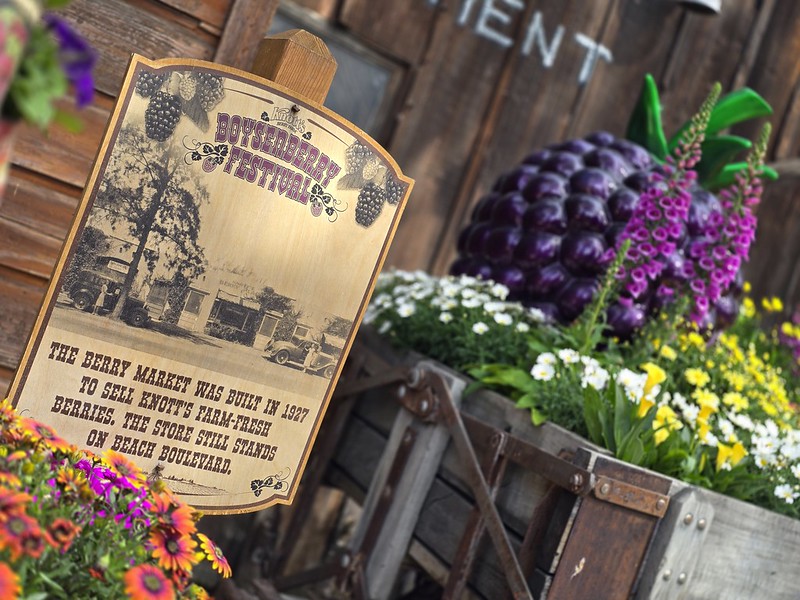
Today, it’s a full-blown amusement park with high-speed roller coasters like GhostRider, a massive wooden coaster, and Silver Bullet, a looping steel ride that twists over the park’s lake. The Timber Mountain Log Ride, one of the park’s most beloved attractions, simulates a journey through a 19th-century logging camp, complete with animatronic lumberjacks and sawmills. It’s a tribute to the massive wooden flumes that loggers once built to move timber from deep in the forest down to the mills and markets. One of the largest of these flumes was at Converse Basin, once home to the biggest contiguous grove of giant sequoias on Earth. That same area became the site of one of the most devastating logging operations in American history, where thousands of ancient sequoias—some millenia old—were cut down in the rush to harvest timber. We did a story about it you can read here. It’s a reminder of how fast early California chewed through its natural wonders.
But back to Boysenberries. Let’s finish this one up, shall we?
The boysenberry is what plant hybridization can do: cross a few different berries and get something entirely new. And tasty. But it’s also a classic California story, a little stubbornness, a little luck and a lot of sunshine. A forgotten berry, rescued from a weedy lot by two farmers, ended up with a theme park built around it.
More California science, photography and wild places on Instagram @californiacuratedus