When Big Joe Turner sang “Shake, Rattle and Roll,” he probably wasn’t thinking about a dusty little town in Central California, but in Parkfield, it’s practically the town motto.
Parkfield, California, is a quiet, dusty farming town tucked into the rolling hills of the Cholame Valley, just off Highway 46 (worth the drive if you ever have the chance). A few miles down the road lies an historic intersection, the place where James Dean was killed in a near head on collision crash in his Porsche 550 Spyder on September 30, 1955. The collision ended a blazing young career just as it was taking off and cemented Dean’s image as a tragic icon of American cinema. While tourists still visit the nearby memorial, Parkfield itself is better known to scientists than to star-watchers.
Parkfield is an unremarkable town, with one exception: it lies directly atop the San Andreas Fault and is known as the Earthquake Capital of the World. This is not because there are so many earthquakes there, although there are, but because it has one of the highest densities of seismic technology anywhere. In addition to the larger magnitude 6.0 earthquakes that tend to strike about every 22 years, Parkfield also experiences a steady rhythm of smaller quakes. These minor tremors, often below magnitude 1.0, happen with such regularity, that scientists have compared them to “seismic pulsars” for their consistent, almost clock-like behavior. (And for what it’s worth, Petrolia, California actually has the most earthquakes).
The San Andreas Fault is one of the best known, and most active faults in the world. In the Parkfield area, the San Andreas Fault is constantly shifting—millimeter by millimeter, day by day. This continuous movement is unique to the region, as the fault remains relatively locked in both the northern section around San Francisco and the southern section near Palmdale. While the fault in these other areas stays immobile, the central part near Parkfield steadily creeps, creating a contrast that puts pressure on the locked sections to the north and south.
Parkfield’s main strip, stretching just a quarter mile, hosts a small collection of buildings, including a one-room elementary school, the USGS-Berkeley earthquake monitoring site, a Cal Fire station, and the Parkfield Cafe and Lodge. Outside the cafe, a row of mismatched mailboxes serves the dozen or so homes scattered along a few dirt roads branching off the main street. Parkfield might be a small, obscure town to most Californians, but to geologists fascinated by the workings of the Earth, it’s the epicenter of seismic research.
San Andreas Fault (Wikipedia)
Every hillside and valley, grassy nook and riverbed is home to some kind of instrument that measures earthquakes. Over the years, these instruments have become more sophisticated and expensive, making it necessary in many cases to fence them off with the threat of arrest. These instruments monitor, hour by hour, or better, millisecond by millisecond, the stirrings of the earth. To geologists, it is ground zero for seismic measurement.
The town is proud of its reputation. A water tower boasts the tourism slogan: BE HERE WHEN IT HAPPENS (see photo). There is also an iron bridge in the town that has the distinction of standing astride the San Andreas Fault. One one side of the creek that runs beneath the bridge is the North American tectonic plate. On the other is the Pacific tectonic plate. Those two plates are moving south and north respectively at a rate of about 2 inches a year. As we all know, that movement creates immense pressure as the two plates seem otherwise locked in place. That pressure will have to be released at some point. It always has. When that happens, we can expect a potentially devastating earthquake that will rock the state from top to bottom.
Parkfield, CA (Photo: Wikipedia)
The writer Simon Winchester calls the fault an “ever-evolving giant that slumbers lightly under the earth’s surface and stirs, dangerously and often, according to its own whims and its own rules.”
Since 1985, a focused earthquake prediction experiment has been in progress in Parkfield. Known as “The Parkfield Experiment“, the project’s stated purpose is to “better understand the physics of earthquakes — what actually happens on the fault and in the surrounding region before, during and after an earthquake.”
Since the mid-1980s, scientists have deployed an array of advanced monitoring devices, including seismometers, strainmeters, creepmeters, and GPS sensors, to capture detailed data on ground movement and strain accumulation. These instruments are designed to measure subtle changes in the Earth’s crust, helping researchers predict seismic events and understand the processes leading up to an earthquake. By continuously collecting data, the experiment has provided valuable insights into the mechanics of fault movement and the potential for earthquake prediction.
An art installation, known as the Parkfield Interventional EQ Fieldwork (PIEQF), used earthquake waves recorded by the USGS seismic network in California to trigger a hydraulic shake table which was installed in an excavated trench. (USGS)
Experts also once bored a 10,000-foot-deep hole into the ground in Parkfield, into which they placed a large array of sensors to measure the earth’s movements. The goal of the $300 million project, called the San Andreas Fault Observatory at Depth, or SAFOD, was to allow scientists to study how faults work and how earthquakes happen. The drilling stopped in 2007, but Parkfield remains a hot spot for geologic research.
Parkfield remains critical to better understanding seismic dangers in California. The fault zone is poorly understood at depth and so far, the predictability of earthquakes in the near term is pretty limited. But devices like these could help improve prediction, especially if there is a large quake. But that’s the rub, really. We need to experience a large earthquake to get the best data to know how to predict later ones. So it is in California.
The 26th President of the United States was a soldier, a historian, an amateur scientist, a best-selling writer, an avid outdoorsman and much much more. He has been called the “father of conservation,” because, as president, he authorized the creation of 150 national forests, 18 national monuments, 5 national parks, 4 national game preserves, and 51 federal bird reservations. We think he deserves the moniker.
President Roosevelt and John Muir at the base of the Grizzly Giant. Credit: Photographer: Joseph Nisbet LeConte; Yosemite NP Archives
But many people may be unaware that TR has a very important California connection. 121 years ago, in 1903, just two years after becoming our nation’s youngest president at the age of forty-two, following the assassination of President William McKinley, Roosevelt embarked on one of the most important Presidential trips in the history of America.
In 1903, President Theodore Roosevelt embarked on a grand tour of the western United States. At the time, Roosevelt was already known for his passion for the outdoors and his desire to protect the nation’s natural resources. This trip would cement his legacy as a conservationist and lead to the expansion of America’s national parks.
The impact of his trip to California is still being felt today.
The trip, taken by railroad, took Roosevelt across the American continent. The 3,000-mile journey began in April from Washington D.C., and took TR through twenty-five states, and lasted nine weeks. He traveled through the American West and stopped at Yellowstone National Park for a hiking and camping trip with naturalist and essayist John Burroughs. He continued on and ended up touring a large swath of the state of California, including Yosemite, which had been declared a national park in 1890.
Yellowstone National Park (National Park Service)
It was a tenuous time for the American environment. Millions of buffalo had been slaughtered across the plains, often for sport, their carcasses left to rot in the sun. The passenger pigeon, a bird that once filled the skies by the billions, had been exterminated. But America was also in the midst of a nature renaissance, and Roosevelt was one of its pivotal figures. The impact of his trip to California is still felt today.
Millions of buffalo were slaughtered during the western expansion of the United States (Wikipedia)
In California, Teddy Roosevelt’s journey was a mix of official duties and personal exploration, reflecting his dual role as a statesman and an outdoorsman. After arriving in San Francisco, Roosevelt was greeted with great fanfare, delivering speeches to large crowds and meeting with local dignitaries. His visit to the city included a tour of its bustling port, symbolizing the growing importance of California as a gateway to the Pacific. Roosevelt also visited Stanford University, where he spoke about education, progress, and the future of the American West. His time in the urban centers highlighted California’s rapid development and its significance in the nation’s expansion.
However, the most profound part of Roosevelt’s time in California came during his visit to Yosemite National Park. He met with naturalist John Muir on May 15th, 1903. The meeting took place on a train in the dusty town of Raymond, California, the closest station to Yosemite. From there, the men traveled 40 miles (about 8 hours) by stagecoach, which gave them the opportunity to get acquainted. They stopped in Mariposa Grove, where TR saw his first sequoia and had his picture taken driving through the “Tunnel Tree,” which no longer stands.
That first night, President Roosevelt dismissed his aides and the press, which was unusual for him because he was a publicity hound. In the wilds of Yosemite, he and Muir spent three days “roughing it,” camping beneath the stars and enjoying conversation around a campfire. It was during those conversations that Muir made the case for the preservation of forests and other natural resources. Likely, these talks created the impetus for Roosevelt’s support for the 1906 Antiquities Act, arguably one of the most important pieces of conservation law in the United States. With the power to proclaim lands as monuments in the public interest, Roosevelt in 1908 set aside some 800,000 acres as Grand Canyon National Monument. Congress later gave it a national park status.
Arguably, no other President has had such a singular impact on protecting American lands, and it’s fair to say, we think, that his visit to California had a lot to do with it.
When people think of Santa Monica, images of sun-soaked beaches, the iconic pier, and leisurely strolls along the Pacific Coast Highway often come to mind. It’s a city synonymous with surf, sand, and a laid-back California lifestyle. Yet, bunkered within this seaside haven is an institution far removed from the carefree spirit of the shore: RAND Corporation, one of the world’s most influential think tanks, with deep ties to the Department of Defense. While tourists flock to the hot sands and the 3rd Street Promenade, behind the walls of RAND’s headquarters, some of the nation’s brightest minds have quietly shaped U.S. policy and technology for decades.
The RAND Corporation, originally an acronym for “Research ANd Development,” is a think tank that has had a profound impact on policy and decision-making in various fields, including national security, science, technology, and social policy.
RAND emerged from the devastation of World War II, inspired by the success of the Manhattan Project, a $2 billion effort that produced the first atomic bomb. Seeing this achievement, five-star Air Force General Henry “Hap” Arnold recognized the need for a group of brilliant minds to keep America at the forefront of technological innovation. In 1946, Arnold assembled a small team of scientists with $10 million in funding to create RAND, short for Research and Development. He persuaded a family friend, aircraft mogul Donald Douglas, to host the project at his factory in Santa Monica.
Within months, RAND captured the attention of academics, politicians, and military leaders with its groundbreaking report, “Preliminary Design of an Experimental World-Circling Spaceship.” At a time when rocket science was in its infancy, the think tank’s vision of an orbiting space station was revolutionary. The report not only detailed the type of fuel needed and the feasibility of constructing the station but also highlighted its potential to revolutionize weather forecasting, long-distance communication, and most crucially, its ability to intimidate America’s adversaries. If America could launch a satellite into space, what else might it achieve?
Although President Truman decided against pursuing the space station, the military quickly embraced RAND. Thanks to Hap Arnold’s connections, the Air Force became RAND’s primary contractor, and the think tank began consulting on a wide range of projects, from propeller turbines to missile defense systems. The influx of contracts soon overwhelmed RAND, prompting the need to hire hundreds of additional researchers. In its recruitment ads, RAND proudly highlighted its intellectual pedigree, even drawing a direct line from its president, Frank Collbohm, to Isaac Newton. Whether or not that claim held water, the institute rapidly earned a reputation as the go-to place for envisioning innovative strategies to wage wars and deter adversaries.
In fact, in 1960s the Soviet newspaper Pravda nicknamed RAND “the academy of science and death and destruction.” American media outlets preferred to call them the “wizards of Armageddon.” The Atlantic called them “the paramilitary academy of United States strategic thinking”.
RAND’s strategic theories, including the concept of Mutually Assured Destruction (MAD), were born from the devastating potential of atomic weapons, aiming to prevent nuclear war through deterrence.
But where is RAND located? When RAND was first established in 1946, it was housed in a building provided by Donald Douglas at his aircraft factory in Santa Monica. However, as RAND grew, it eventually moved to its own dedicated headquarters.
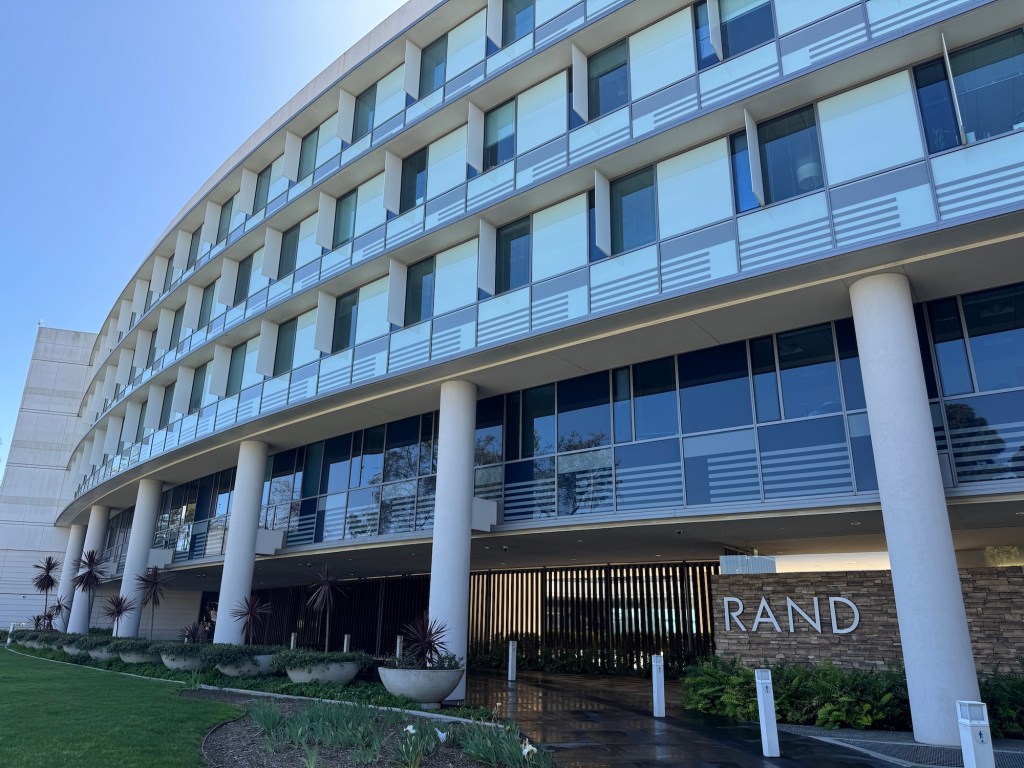
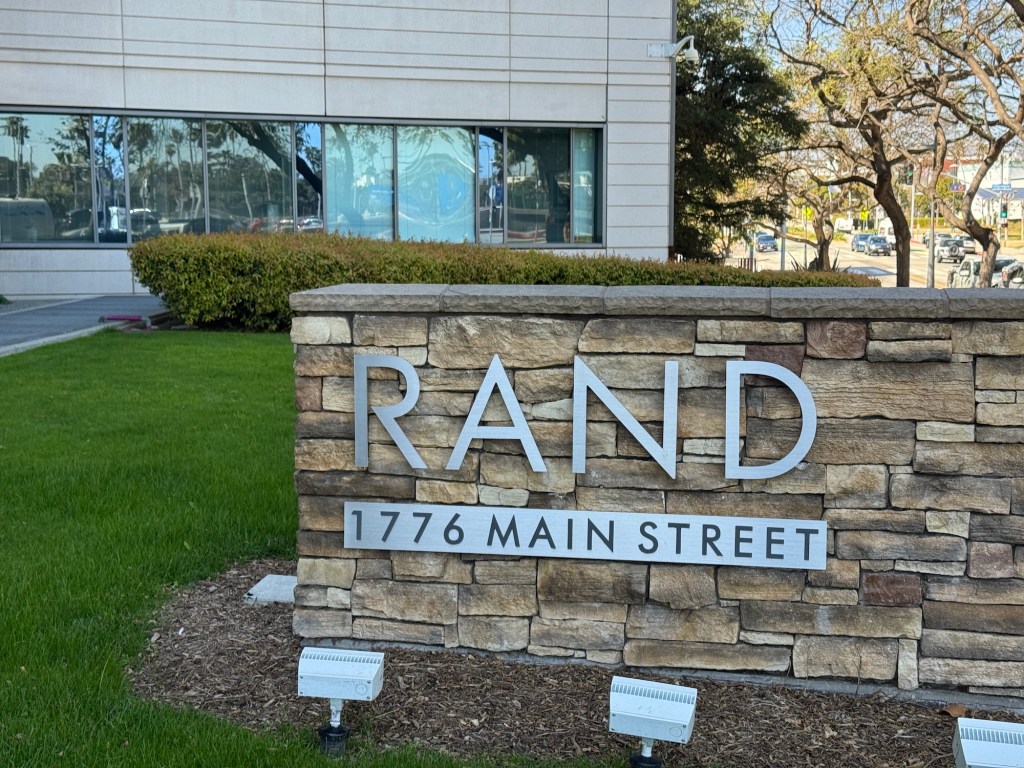
In 1953, RAND moved to a new building on a site provided by the city of Santa Monica. This building was designed specifically for RAND’s needs and became a recognizable landmark near the beach. In 2004, RAND moved again to a newly constructed headquarters in Santa Monica, located at 1776 Main Street. This modern facility was designed to better accommodate RAND’s evolving research activities and staff. So while RAND has always been in Santa Monica, it has moved to different buildings over the years.
Hand-tinted photo of the original RAND building at 1700 Main Street in Santa Monica, California, circa 1960s RAND Archives
During the early years, RAND’s work was heavily focused on military and defense issues, reflecting the geopolitical climate of the Cold War. One of RAND’s most significant early contributions was the development of game theory and its application to military strategy. Pioneers like John Nash, who would later win the Nobel Prize in Economics, conducted seminal work at RAND during this period.
RAND’s analysts played a crucial role in the development of nuclear strategy, including the doctrine of mutually assured destruction (MAD). The think tank’s work on systems analysis, a method for evaluating complex systems, became a cornerstone of U.S. defense planning. RAND’s analysts developed strategies for deterrence, nuclear war scenarios, and the implications of various levels of nuclear arsenals.
“This was a very smart bunch,” said Ellsberg, just before his death on June 16, 2023. “The smartest group of people I ever did associate with. It turns out, by the way, intelligence is not a very good guarantee of wisdom.”
Daniel Ellsberg
Two key figures at the time, Albert Wohlstetter and Herman Kahn, were both pivotal figures at the RAND Corporation, where they contributed significantly to the development of U.S. nuclear strategy during the Cold War. Wohlstetter, known for his rigorous and analytical approach, emphasized the importance of maintaining a credible deterrent to Soviet aggression, which he articulated in his influential work, “The Delicate Balance of Terror.” Herman Kahn, another RAND was renowned for his work on nuclear warfare scenarios and is often credited with popularizing the concept of “mutual assured destruction” (MAD).
Albert Wohlstetter (Wikipedia)
Their paths intersected with Daniel Ellsberg, who also worked at RAND as an analyst. Ellsberg, who later became famous for leaking the Pentagon Papers, was influenced by both Wohlstetter’s strategic insights and Kahn’s scenarios, but the resulting plans for how America would manage a nuclear war with the Russians terrified Ellsberg. As he recounted in the Netflix Documentary Turning Point, Ellsberg revealed that serious plans at RAND estimated a nuclear war with Russia and China could result in 600 million casualties, highlighting the catastrophic consequences that were considered in Cold War strategic planning. These revelations, along with his evolving moral stance, eventually led Ellsberg to become a vocal critic of U.S. military policies.
“This was a very smart bunch,” said Ellsberg, before his death on June 16, 2023. “The smartest group of people I ever did associate with. It turns out, by the way, intelligence is not a very good guarantee of wisdom.”
RAND’s current headquarters in Santa Monica (Erik Olsen)
By the 1960s, RAND began to diversify its research agenda. The think tank started to tackle a wider array of issues, including healthcare, education, and social policy. In 1968, RAND established the Health Insurance Experiment, a landmark study that explored the effects of different levels of health insurance coverage on medical spending and health outcomes. This study had a lasting impact on health policy and remains one of the largest and most comprehensive studies of its kind.
Although Silicon Valley is given most of the credit, RAND also contributed to the development of the internet. In the 1960s, RAND researchers, including Paul Baran, were instrumental in developing the concept of packet-switching networks, which later became a fundamental technology underlying the internet. The key idea (which Baran worked on with others) was to develop a communication system that could withstand potential disruptions, such as those caused by a nuclear attack. His concept of breaking data into small packets and routing them through a decentralized network was groundbreaking, ensuring that information could still be transmitted even if parts of the network were compromised.
Paul Baran presents his work at a RAND in 2009 Photo by Diane Baldwin/RAND
In the 1980s and 1990s, RAND continued to expand its global influence. The organization opened offices in Europe and started collaborating with international governments and institutions. RAND’s research began to encompass global security, international development, and global health issues. RAND also pioneered the study of terrorism in the 1970s, well before the United Nations had even defined the term. Today, the RAND Terrorism Chronology Database, tracking all terrorist acts since 1968, is a crucial resource for the military and government.
One notable area of RAND’s recent work is in the field of education. RAND has conducted extensive research on educational policies and practices, including studies on school choice, teacher effectiveness, and the impacts of educational technology.
Despite its many contributions, RAND has faced criticisms and challenges. Some have argued that the think tank’s close ties to the military and government agencies may bias its research. Others have pointed out that, like any large organization, RAND’s influence can sometimes lead to the prioritization of certain agendas over others.
A British MQ-9A Reaper operating over Afghanistan in 2009 (Wikipedia)
One of RAND’s more controversial recent activities involved its research on U.S. drone warfare. Critics have raised concerns that RAND’s analyses have sometimes downplayed the ethical and civilian impact of drone strikes, focusing instead on the strategic advantages for the U.S. military. This has sparked debates about whether RAND’s close ties to the Department of Defense might influence the objectivity of its findings, particularly in areas where the moral and humanitarian implications are significant.
As of the most recent data, RAND Corporation employs approximately 1,950 people, including researchers, analysts, and support staff. The think tank operates with an annual budget of around $390 million, funding a wide array of research projects across various disciplines, including national security, health, education, and more. These figures can fluctuate based on the specific projects and funding sources in any given year.
Despite concerns about its influence, the RAND Corporation has remained a significant player in policy research. Its ability to adapt and broaden its focus has helped it stay relevant over the years. RAND’s work continues to inform policies that affect many aspects of public life, reflecting the ongoing role of independent research in policy-making.
So the next time you take a trip to the beach, take a moment to consider that just a short distance from the waves, some of the nation’s most critical and controversial policy decisions are being shaped at RAND’s headquarters in Santa Monica.
Few organisms in the history of science have been as important to our understanding of life as the humble fruit fly. The genus Drosophila melanogaster holds a particularly esteemed spot among the dozens of model organisms that provide insight into life’s inner workings. For more than 100 years, this tiny, but formidable creature has allowed scientists to unwind the infinitesimal mechanisms that make every living creature on the planet what it is.
And much of the work to understand the fruit fly has taken place and is taking place now, right here in California at the Cal Tech fly labs.
Over the decades, Drosophila have been key in studying brain, behavior, development, flight mechanics, genetics, and more in many labs across the globe. These tiny, round-bodied, (usually) red-eyed flies might appear irrelevant, but their simplicity makes them ideal models. They’re easy to breed—mix males and females in a test tube, and in 10 days, you have new flies. Their 14,000-gene DNA sequence is relatively short, but extremely well-studied and there are some 8,000 genes which have human analogs. (The fly’s entire genome was fully sequenced in 2000.) Crucially, a century of fruit fly research, much of it led by Caltech, has produced genetic tools for precise genome manipulation and shed light on the act of flight itself.
But how did Drosophila become the darling of genetics?
In the early 20th century, the field of genetics was still in its infancy. Thomas Hunt Morgan, a biologist at Columbia University with a background in embryology and a penchant for skepticism began with an effort to find a simple, cheap, easy-to-breed model organism. At Columbia, he established a laboratory in room 613 of Schermerhorn Hall. This cramped space became famous for groundbreaking research in genetics, with Morgan making innovative use of the common fruit fly.
Thomas Hunt Morgan in the Fly Room at Columbia, 1922 (Cal Tech Archives)
Morgan, who joined Columbia University after teaching at Bryn Mawr College, chose the fruit fly for its ease of breeding and rapid reproduction cycle. Morgan observed a male fly with white eyes instead of the usual red. Curious about this trait’s inheritance, he conducted breeding experiments and discovered that eye color is linked to the X chromosome. He realized a male fly, with one X and one Y chromosome, inherits the white-eye trait from its mother, who provides the X chromosome. This led him to conclude that other traits might also be linked to chromosomes. His extensive experiments in this lab confirmed the chromosomal theory of inheritance, demonstrating that genes are located on chromosomes and that some genes are linked and inherited together.
After his groundbreaking research in genetics at Columbia University, Morgan moved to Pasadena and joined the faculty at CalTech in 1928, where he became the first chairman of its Biology Division and continued his influential work in the field of genetics establishing a strong genetics research program. Morgan’s work, supported by notable students like Alfred Sturtevant and Hermann Muller, laid the foundation for modern genetics and earned him the Nobel Prize in 1933.
CalTech then became a world center for genetics research using the fruit fly. Other notable names involved in fruit fly research at CalTech include Ed Lewis, a student of Morgan, who focused his research on the bithorax complex, a cluster of genes responsible for the development of body segments in Drosophila. His meticulous work over several decades revealed the existence of homeotic and Hox genes, which control the basic body plan of an organism (for which he won the 1995 Nobel Prize).
Seymour Benzer, another luminary at CalTech, shifted the focus from genes to behavior. Benzer’s innovative experiments in the 1960s and 1970s sought to understand how genes influence behavior. His work demonstrated that mutations in specific genes could affect circadian rhythms, courtship behaviors, and learning in fruit flies. Benzer’s approach was revolutionary, merging genetics with neurobiology and opening new avenues for exploring the genetic basis of behavior. His contributions are chronicled in Jonathan Weiner’s “Time, Love, Memory: A Great Biologist and His Quest for the Origins of Behavior,” a riveting account of Benzer’s quest to uncover the genetic roots of behavior. Lewis Wolpert in his review for the New York Times wrote, “Benzer has many gifts beyond cleverness. He has that special imagination and view of the world that makes a great scientist.”
Since Benzer’s retirement in 1991, new vanguard in genetics research has taken over at CalTech, which continues to be at the forefront of scientific discovery, driven by a new generation of researchers who are unraveling the complexities of the brain and behavior with unprecedented precision.
Elizabeth Hong is a rising star in biology, with her Hong lab investigating how the brain orders and encodes complex odors. Her research focuses on the olfactory system of Drosophila, which, despite its simplicity, shares many features with the olfactory systems of more complex organisms. Hong’s work involves mapping the synapses and neural circuits that process olfactory information, seeking to understand how different odors are represented in the brain and how these representations influence behavior. Her findings could have profound implications for understanding sensory processing and neural coding in general.
David Anderson, another prominent figure at Caltech, studies the neural mechanisms underlying emotions and behaviors. While much of Anderson’s work now focuses on mice as a model organism, the lab’s research explores how different neural circuits contribute to various emotional states, such as fear, aggression, and pleasure, essentially how emotions are encoded in the circuitry and chemistry of the brain, and how they control animal behavior. Using advanced techniques like optogenetics and calcium imaging, Anderson’s lab can manipulate specific neurons and observe the resulting changes in behavior. This work aims to bridge the gap between neural activity and complex emotional behaviors, providing insights into mental health disorders and potential therapeutic targets.
In 2018, the Anderson laboratory identified a cluster of just three neurons in the fly brain that controls a “threat display” — a specific set of behaviors male fruit flies exhibit when facing a male challenger. During a threat display, a fly will extend its wings, make quick, short lunges forward, and continually reorient itself to face the intruder.
California Institute of Technology (Photo: Erik Olsen)
Michael Dickinson is renowned for his studies on the biomechanics and neural control of flight in Drosophila. In the Dickenson Lab, researchers combine behavioral experiments with computational models and robotic simulations, seeking to understand how flies execute complex flight maneuvers with such precision. His work has broader applications in robotics and may inspire new designs for autonomous flying robots.
“He’s a highly original scientist,” Alexander Borst, a department director at the Max Planck Institute of Neurobiology in Germany, told the New York Times.
Fruit fly scientific illustration
Dickinson’s investigations also delve into how sensory information is integrated and processed to guide flight behavior, offering insights into the general principles of motor control and sensory integration.
As science advances, Caltech’s Fly Lab’s remind us of the power of curiosity, perseverance, and the endless quest to uncover the mysteries of life. The tiny fruit fly, with its simple elegance, remains a powerful model organism, driving discoveries that illuminate the complexities of biology and behavior. Just recently, scientists (though not at CalTech) unveiled the first fully image of the fruit fly brain. Smaller than a poppy seed, the brain is an astonishingly complex tangle of 140,000 neurons, joined together by more than 490 feet of wiring.
In essence, the fruit fly remains a key to unlocking the wonders and intricacies of life, and in the Fly Labs at Caltech, that spirit of discovery thrives, ensuring that the legacy of Morgan, Lewis, Benzer, and their successors will continue to inspire generations of scientists to come.
In the late 1800s, as California was emerging and gold fever captivated the public, a significant discovery in the vast, arid desert of modern-day Death Valley led to the development of a mining operation for one of the most versatile and useful materials on earth: borates.
With Hollywood and Silicon Valley dominating California’s identity, it’s easy to overlook the significant role extractive industries have played in shaping the state’s economic and industrial history. However, sites like the Rio Tinto Borax Mine in Boron, California, stand as enduring reminders of this often underappreciated chapter.
Despite the similar-sounding name, borates are far from boring. These indispensable compounds have a wide range of applications that significantly impact our daily lives. Remarkably, the mining operation in the desert of California is still active. In fact, it is one of the largest producers of borates in the world.
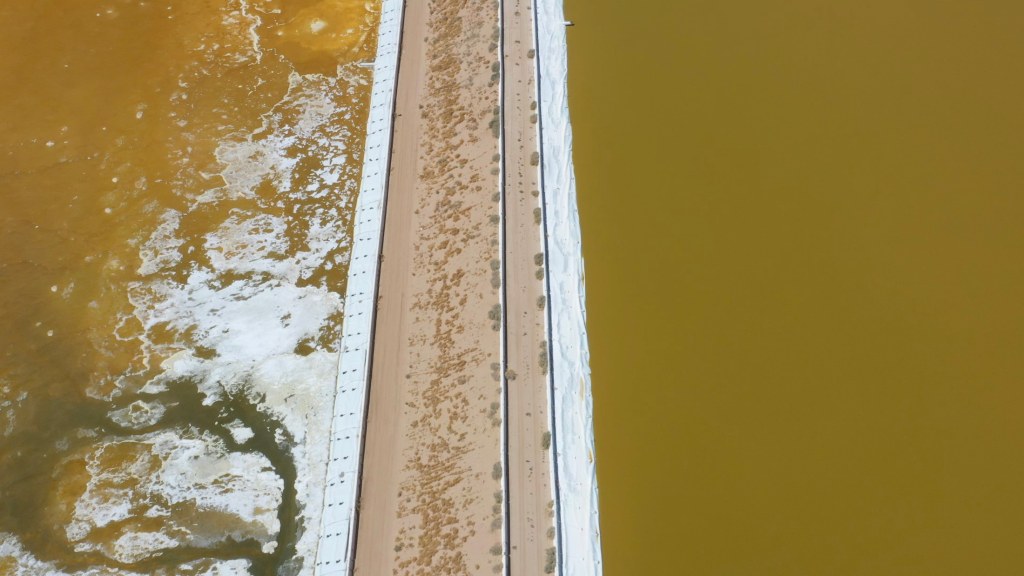
The evaporation ponds at the U.S. Borax Mine, used in the extraction of borates, have historically raised environmental concerns, including potential groundwater contamination and the management of hazardous waste byproducts. However, being located in a remote area far from major population centers has helped mitigate some of the risks associated with pollution, as the isolation reduces direct human exposure and minimizes immediate health impacts on surrounding communities. Additionally, the mine’s location in an arid climate helps slow the spread of contaminants in groundwater, though long-term environmental monitoring and mitigation remain critical. Efforts have also been made to manage waste responsibly and comply with environmental regulations to limit potential harm.
Rio Tinto U.S. Borax Mine in Boron, California (Erik Olsen)
U.S. Borax, part of the global mining company Rio Tinto, operates California’s largest open pit mine and the largest borax mine in the world, producing nearly half the world’s borates. It is located near Boron, California, just off California State Route 58 and North of Edwards Air Force Base. While the mine’s economic importance to California has been significant for decades, the critical contributions of borates to modern society remain a largely untold story.
U.S. Borax has roots stretching back to the late 19th century, when the company, then called The Pacific Coast Borax Company emerged as a leader in borate mining and production following the discovery of substantial boron deposits in California. Founded by Francis Marion Smith, known as the “Borax King,” the company initially gained fame for its iconic 20 Mule Team Borax brand. The brand originated from the company’s need for an efficient way to transport borates from the remote mines in Death Valley to the nearest railhead in Mojave, California, covering a distance of about 165 miles.
To accomplish this, the company used large wagons pulled by teams of 20 mules. Each team consisted of 18 mules and 2 horses, and the wagons carried loads of up to 10 tons of borax. These mule teams became legendary for their endurance and reliability, making the long and arduous journey through the harsh desert environment.
Smith’s innovative methods and relentless pursuit of high-quality borates propelled U.S. Borax to the forefront of the industry. Over the decades, U.S. Borax has evolved, focusing on sustainable mining practices and advanced technologies to maintain its status as a key player in the global market, providing essential borate products for various industrial and consumer applications.
Evaporation pools at US Borax in Boron, California (Erik Olsen)
These versatile minerals are critical in agriculture where borates serve as micronutrients, essential for the healthy growth of crops. They are also key ingredients in detergents, where their stain-fighting power ensures cleaner, brighter clothes. Moreover, borates are used in insulation and fiberglass, contributing to energy efficiency and safety in buildings. The importance of borates extends to pharmaceuticals and cosmetics, where they serve as vital components in various formulations. But perhaps the most impactful use of borates is in the production of borosilicate glass.
You’ve likely encountered borosilicate glass before, most recognizably under the brand name Pyrex, produced by Corning. This stable, clear, and robust material can withstand a wide range of temperatures, from the intense heat of a Bunsen burner to the extreme cold of deep space.
Hale telescope mirror on its way to California
Corning brought the future of borosilicate glass into the present by casting what was, at the time, the world’s largest primary telescope mirror. The primary mirror for the 200-inch Hale Telescope in California was cast out of Pyrex borosilicate glass and delivered to Caltech in the spring of 1936. Since manufacturing the Hale Telescope primary mirror blank, Corning has supplied many mirror blanks for astronomy tools worldwide.
Test tubes made of borosilicate glass
Borosilicate glass is one of the unsung heroes of the modern age. Unlike regular glass, which can leach small particles into liquids when exposed to potent chemicals, borosilicate glass remains chemically inert, making it ideal for test tubes, lab beakers, and medical vials. Almost every medicine or vaccine in history, including those developed for COVID-19, has relied on borosilicate containers for their development, storage, and transport. However, we often overlook the importance of these materials until there’s a shortage.
This was the case during the COVID-19 pandemic when concerns arose that the primary obstacle to vaccine distribution might not be the pharmaceuticals themselves, but the containers needed for shipping. In response, thousands of workers along a complex supply chain—from mines to refineries to factories—helped avert a crisis. Corning even introduced a new type of glass, made with aluminum, calcium, and magnesium, to meet the high demand for medicinal vials.
Evaporation ponds at the US Borax mine in Boron, California (Erik Olsen)
The invention of borosilicate glass is credited to German chemist Otto Schott in the late 19th century. Schott was driven by the need for a type of glass that could withstand extreme temperatures and resist chemical corrosion. In 1887, he succeeded in creating this revolutionary material by adding boron oxide to traditional silica-based glass, resulting in a product with exceptional thermal and chemical stability. This breakthrough led to the founding of the Jena Glassworks, where Schott’s borosilicate glass was produced and quickly found applications in scientific and industrial settings. Its remarkable properties made it indispensable for laboratory equipment, cookware, and a variety of other uses. The material’s resilience and reliability have ensured its place as a critical component in modern science and technology, solidifying Schott’s legacy as a pioneer in glassmaking.
Borosilicate glass lenses.
Due to its low coefficient of thermal expansion, borosilicate glass maintains the same optical properties across a range of temperatures, making it an ideal material for scientific lenses and other high-precision optical components, including lenses and mirrors for telescopes and microscopes.
It is also used in lighting, particularly for high-intensity lamps and projectors. Artists and craftspeople value borosilicate glass for its workability and durability in creating intricate glass sculptures and jewelry. Its robustness extends to the industrial sector, where it is used in chemical processing equipment, tubing, and sight glasses in high-temperature and corrosive environments. Overall, the unique properties of borosilicate glass make it indispensable across a wide range of applications, from everyday household items to specialized scientific and industrial equipment.
The abundance of boron in the California desert, particularly the Mojave Desert, is due to a combination of geological conditions and historical processes. Volcanic activity in the region has contributed boron-rich rocks, which, along with tectonic activity, has created basins and depressions where water could accumulate and evaporate. These conditions, coupled with the arid climate, led to the evaporation of ancient lakes and the formation of borate minerals in playas—flat, dry lakebeds that form in desert regions when water evaporates completely, leaving behind a layer of minerals. Hydrothermal activity also played a role by depositing borate minerals through fractures in the Earth’s crust. These factors collectively resulted in significant boron deposits, such as those found in the U.S. Borax boron mine, one of the world’s largest sources of boron.
The US Borax mine in Boron, California, is a fine example of some of the little-known places where California’s industrial history is laid out for all to see, even if few people probably visit. The mine highlights the ingenuity and perseverance of those who ventured into the state’s arid deserts to unearth one of the most versatile and indispensable materials known to modern industry.
Southern California is best known for its sun-soaked beaches and Hollywood glamour, but it also has a wilder, largely forgotten past: it was once an oil kingdom. It’s a story even many Californians don’t know, a tale of spectacular gushers, fortunes won and lost, and larger-than-life characters straight out of a movie. Without oil, Los Angeles, and much of Southern California, would be very different places today.
The story of oil in Southern California is inextricably linked to the Long Beach fields, an area that once seemed more like a scene from Texas or There Will Be Blood than the Golden State. The discovery of oil in this region wasn’t just a footnote in economic journals; it was a seismic event that transformed the landscape, both literally and metaphorically. And it provided an industrial center of gravity to a region of the state that was just beginning to emerge as one of the world’s great gateways of commerce.
Signal Hill, 1926 (Public Domain)
The early 20th century was the beginning of the era of oil in California. On June 23, 1921 at 9:30 a.m., the Alamitos No. 1 oil well on Signal Hill in Long Beach was drilling 2,765 feet beneath the surface when the drill struck an underground oil deposit. This oil was under high pressure due to natural gas, blowing a gusher of oil over 100 feet high, and heralding the start of the Long Beach oil boom.
This event marked the discovery of one of the most prolific oil fields in the Los Angeles basin. Throughout the 1920s, Signal Hill, along with the nearby Santa Fe Springs field, experienced numerous blowouts, which erupted into dramatic pillars of flame that could be seen for miles. These incidents eventually prompted calls for stricter safety regulations. Consequently, in 1929, the state mandated the use of blow-out prevention equipment on all oil wells drilled in California.
Signal Hill quickly mushroomed into a forest of oil derricks, with fortunes being made overnight. As one of the most productive oil fields in the world, the Long Beach field was at one point yielding a staggering one-third of California’s total oil production. By the mid-1920s, California was producing nearly a quarter of the world’s entire petroleum supply, much of it from the Long Beach area.
Signal Hill, Long Beach oil development. (Public domain)
That so much oil is present beneath the surface of this stretch of Southern California is a gift of geology. Millions of years ago, the area that is now Long Beach was covered by the ocean. This marine environment was ideal for the accumulation of organic material, such as the remains of tiny plants and animals, on the ocean floor.
Over time, layers of sediment buried this organic matter. The high pressure and temperatures associated with deep burial initiated the transformation of this organic material into hydrocarbons – essentially, the formation of oil. Southern California is, of course, known for its active tectonics, influenced by the Pacific and North American Plate boundary. This tectonic activity has created a complex network of faults and folds in the earth’s crust in the Long Beach area.
The folding of the earth’s layers into anticlines (a type of fold that is convex up and has its oldest beds at its core) and the formation of fault traps (where displaced rocks create a seal that traps oil) are particularly important. These structures create reservoirs where oil can accumulate and be preserved over geological time scales.
Map of the Long Beach oil field.
As the oil flowed, so did the stories of those who sought their fortune in black gold. Perhaps the most famous of these was Edward L. Doheny, a name synonymous with California oil. Doheny, an ambitious prospector, was one of the first to recognize the potential of the Los Angeles Basin’s oil fields. His success in the oil industry was meteoric, but it was not without controversy, as he was later embroiled in the infamous Teapot Dome scandal.
Portrait of oil magnate Edward L. Doheny (Wikipedia)
The impact of oil production in Southern California extended beyond economics. It reshaped the region’s landscape, both physically and culturally. Towns sprung up around oil fields, and workers flocked to the area, drawn by the promise of jobs and prosperity. Long Beach, once a sleepy coastal town, burgeoned into a bustling city.
During the 1920s, regulations on well spacing were minimal, allowing Signal Hill to market narrow town lots. These lots were swiftly purchased by aspiring oil tycoons who installed wells so close to each other that they almost touched. Despite the dense placement, the wells generally remained profitable, though they rapidly depleted the oil field. The hill earned the nickname “Porcupine Hill” due to its appearance from afar, bristling with numerous wooden oil derricks since the more compact “nodding-donkey” pumpjack had not yet been developed.
The booming oil industry in the region attracted a massive influx of workers and investments. As oil fields expanded, Long Beach rapidly transformed from a seaside resort into an industrial powerhouse. The surge in economic activity and the availability of abundant oil fueled the growth of industries in and around Long Beach, including the burgeoning shipping and maritime sectors.
Container ships outside the Port of Los Angeles during the Covid lockdown in 2020. (Photo: Erik Olsen)
The construction of the Port of Los Angeles, which began in earnest in the early 1900s, was driven by the need to support the growing economic activities in Southern California, including agriculture, manufacturing, and oil. The proximity of Long Beach to the port, only about 20 miles south, meant that it was strategically positioned to benefit from and contribute to the port’s activities. The port served as a critical node for shipping oil, among other goods, which further integrated Long Beach, and Southern California as a whole, into the global trade system.
Signal Hill in Long Beach today. (Erik Olsen)
Moreover, the infrastructure developments necessary to support the oil industry, such as roads, railroads, and later pipelines, also facilitated the growth of the port. These developments enhanced the logistical capabilities of the region, making it more attractive for commercial and industrial activities. The oil boom thus not only transformed Long Beach but also had a cascading effect on the development of the Port of Los Angeles, cementing the region’s role as a vital hub in international trade and commerce.
As big and diverse in industry Los Angeles has become, it mostly started with oil. The fact that Los Angeles is now hardly known for oil, but better known for its massive entertainment and tourism economies is an astonishing transformation.
Of course, the influx of wealth and people also brought challenges, including environmental concerns and the need for regulatory oversight. It is well known that several major oil spills have taken place off the coast, ruining beaches and killing animals by the millions. In 1969, the Santa Barbara oil spill released vast quantities of oil into the ocean, creating an environmental disaster along the California coastline. This catastrophic event galvanized public awareness and activism, leading to the creation of the first Earth Day, as well as significant environmental legislation, including the establishment of the U.S. Environmental Protection Agency.
The oil slick visible around Platform A in the Santa Barbara Channel emanated from fissures in the seabed. (Photo: USGS)
Oil spills continue to take place in Southern California and the existence of 26 rigs off the coast are a reminder of that oil boom era. Those rigs are coming to the end of their productive life, however, and an on-gong controversy is what to do with them. Remove them or leave them — or part of them — as artificial reefs?
Over time, oil production in Southern California has waxed and waned. The easily accessible oil has largely been extracted, and production has declined from its mid-20th-century peak. Yet, the legacy of this era persists. It’s etched into the region’s physical and cultural landscape, from the bobbing oil derricks still dotting Signal Hill to the fortunes and institutions built on oil money.
The story of oil in Southern California, particularly the Long Beach fields, is a saga of geologic luck, ambition, ingenuity, and, at times, dangerous greed. It’s a chapter in the state’s history that’s as rich and complex as the oil that still lies beneath its surface, and yet it remains largely unknown to many people who think of Southern California as a paradise of sand and rolling waves.
“A story of greed and mass destruction of a mighty forest.”
California has faced its share of environmental calamities. We’ve experienced wildfires that have denuded the landscape, destroying valuable forests and homes, and taking human lives. Oil spills have soiled coastlines and killed wildlife. But of all the great environmental crimes the state has faced, perhaps few rank as high as the destruction of Converse Basin Grove in the late 1800s. And yet very few people have ever heard of it.
Located in the southern part of the Sierra Nevada Mountains east of Fresno, just outside Kings Canyon National Park, Converse Basin Grove spans over 6,000 acres and 700 feet of elevation. The basin was once home to the densest and most majestic expanse of Giant Sequoia (Sequoiadendron giganteum) on the planet. This remarkable concentration of trees was largely due to the basin’s unique combination of geological and climatic conditions.
The grove’s deep, well-draining granitic soils provided a stable foundation for sequoia growth, allowing their extensive root systems to spread and access water efficiently. Additionally, the region’s position in the Sierra Nevada ensured a steady supply of moisture from winter snowfall, which melted slowly into the summer, maintaining the soil’s hydration even during dry months. Sequoias also depend on periodic low-intensity wildfires, which clear competing vegetation, release seeds from their cones, and create the mineral-rich soil conditions necessary for seedlings to establish. This natural fire cycle once maintained the grove’s density, fostering the exceptional concentration of ancient trees that once dominated area.
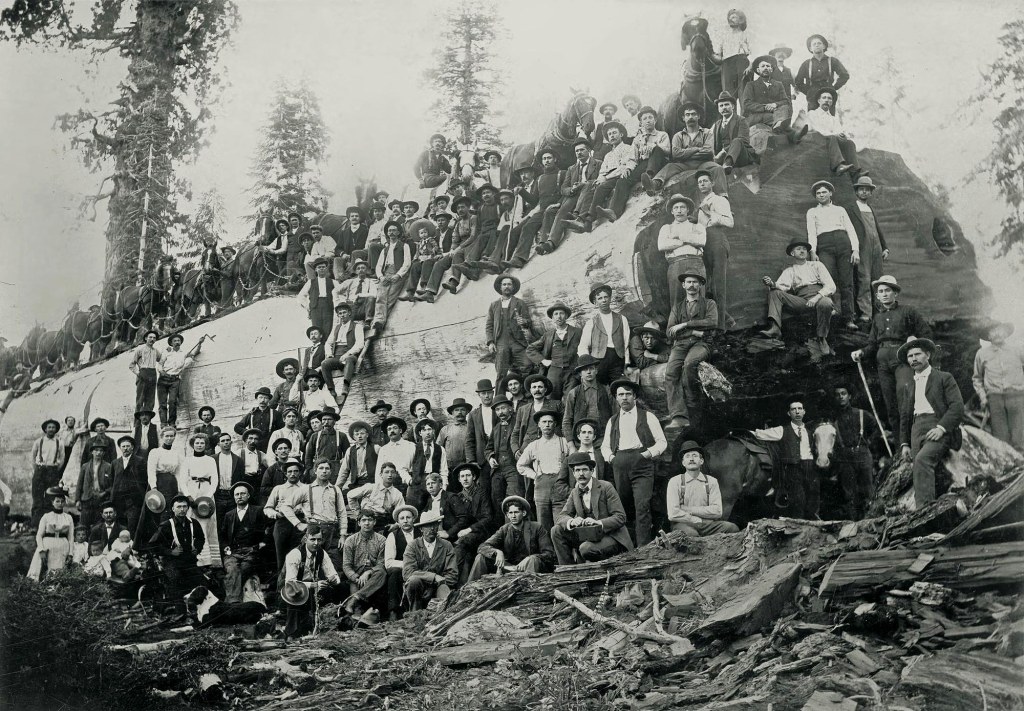
Loggers and a team of horses pose on a fallen sequoia 26 feet in diameter. Converse Grove, California 1917. (Wikipedia)
Between 1892–1918, the Sanger Lumber Company logged the grove using ruinous clearcutting practices, and cut down 8,000 giant sequoias, some of them over 2000 years old, in a decade-long event that has been described as “the greatest orgy of destructive lumbering in the history of the world.” Only 60-100 large specimens survived.
Currently, the most expansive remaining sequoia domain is the Giant Forest in Sequoia National Park, which has an estimated 8,400 giant sequoia trees that are more than one foot in diameter at their bases. The park is home to the world’s biggest tree, the General Sherman.
So how did this happen? The Converse Basin grove’s discovery in the late 19th century coincided with a burgeoning demand for lumber in the wake of California’s Gold Rush and subsequent population boom, particularly in San Francisco. A huge portion of early San Francisco was built using redwood. In fact, redwood was the dominant building material in much of 19th-century California, and San Francisco was practically a redwood city.
This demand drew the attention of loggers to the massive potential of sequoias. In particular, the Kings River Lumber Company, which secured this coveted area through both lawful and dubious means shortly after its incorporation in 1888. This marked the first instance of industrial-scale logging targeting the Sierra redwoods, a venture that required substantial initial investment due to the challenges of building a mill in the mountains and the engineering marvel needed to transport the colossal timber to lower elevations.
The 54-mile-long flume, or log conveyor, from Converse Basic Grove to the town of Sanger, about 20 miles from Fresno. (Photo: National Park Service)
To get the logs to mills from the High Sierra Mountains the SF-based company constructed a 54-mile-long flume, or log conveyor, from Converse Basic Grove to the town of Sanger, about 20 miles from Fresno. This giant wooden waterslide, balanced on trestles along steep canyon sides, allowed lumber to be swiftly transported to the nearest train station, some 60 miles away, in just half a day. Upon reaching the station in Sanger, a town that proudly proclaimed itself the “Flumeopolis of the West,” the lumber was dried, finished and prepared for rail transport to markets across California.
High trestle under construction on the Sanger Flume 1905. (Public Domain)
But how did this happen in the first place?
Rugged terrain and unnavigable streams had protected these big trees for decades. That it became possible to log so many magnificent trees in such a hard-to-reach place was due to the passage of one of the most unintentionally destructive environmental laws ever passed in the United States.
In 1878, the United States Congress enacted the Timber and Stone Act to promote the private ownership of timberland and support the logging industry. This legislation permitted individuals to claim federal lands in the Sierra Nevada mountains, acquiring individual parcels of 160 acres for a nominal fee if they simply filed a claim. Like other land laws of the era, it was also designed to encourage westward expansion by making it easier for settlers and speculators to acquire and develop land in the American West.
Stacks of lumber with workers at Converse Basin (Public Domain)
Prior to this legislation, there was no legal framework allowing individuals to purchase timberland directly from the government specifically for logging purposes, as opposed to agricultural use. However, following the enactment of the law in 1878, it became possible to acquire nonarable, nonmineral public lands at a minimal cost of $2.50 per acre. To claim these 160-acre parcels, the claimant only needed to attest that their intention was to utilize the land for practical, non-speculative purposes, excluding any plans for resale or contractual transfer to another entity.
This enabled the easy transfer of vast expanses of land from the government to lumber companies, which commonly enlisted and compensated individuals to file claims on their behalf. Among these companies was the Kings River Lumber Company, which acquired some of the lands legally, but also got its hands on vast acreages using dubious and illegal tactics that took place right under the noses of government regulators.
Converse Basin Panorama from 1900. (Photo: National Park Service)
The Timber and Stone Act required buyers to use the land for personal, non-speculative purposes, but the company circumvented these restrictions by using a practice known as “dummying.” In this scheme, the lumber company recruited individuals to act as stand-ins or “dummies” to file claims on parcels of the Converse Basin under the pretense that these claims were for personal use. After securing the claims, these individuals would then transfer the parcels to the Kings River Lumber Company, often for a profit. This allowed the company to amass large areas of prime sequoia forest, much of which was still old-growth timber, under dubious legal pretenses.
Lumber production began in Converse Basin in 1891, launching with 20 million board feet of timber flowing down the flume. But the company had been created through the issuance of massive debt, and the company was under pressure to increase output to become profitable. However, the flume frequently required costly repairs. In 1895, following an unsuccessful reorganization attempt, the firm was taken over by creditors and renamed Sanger Lumber. The new management pushed for maximum production, extending the narrow-gauge railroad deeper into the basin and constructing a new sawmill in 1897.
Cut end of tree showing welded crosscut saws. (Photo: National Park Service)
During its operation, Sanger Lumber was responsible for the felling of approximately eight thousand mature sequoias within the 5,000-acre Converse Basin, leaving only one giant standing. At the northern edge of the grove, overlooking Kings Canyon, loggers spared a single large tree, now among the world’s ten largest, and named it after their foreman, Frank Boole. The Boole Tree still stands today. It is the eighth tallest sequoia in the world and ranks No. 1 in base circumference, at 112 feet. Estimated to be more than 2,000 years old, the behemoth is the largest tree in America’s national forests, but it stands less as a monument to the grandeur of the trees themselves than as a testament to human avarice and recklessness.
The operation peaked in 1903 with a production of 191 million board feet, employing up to seven hundred men. However, the process was notoriously unsafe and wasteful. Decades later, the superintendent of Sequoia National Park noted the profound damage and inefficiency of the logging, with many fallen trunks left unprocessed, free to decompose over time.
Logging, Converse Basin, near Boole Tree. (Photo: National Park Service)
The entire operation ended without profit, leading to the sale of the company in 1905 and the eventual destruction of the Converse Basin mill. What followed was a period of secondary logging, akin to scavenging, that persisted into the 1910s. In a Harpers’ essay titled The Last Stand of the Redwoods, the Yale English professor Henry Seidel Canby wrote that a visit to the basin evoked a deep sense of melancholy, describing what he saw as “a vast and lonely cemetery”.
By 1905, after depleting the majestic stand of trees without turning a profit, a Michigan lumberman acquired the operation and shifted focus to a lower-elevation, mixed-species forest. The remaining structures at Converse Basin were deliberately burned, and logging continued on a smaller scale, resembling scavenging more than harvesting.
In 1935, the U.S. government repurchased the ravaged land for fifteen dollars per acre, incorporating it into what is now the Giant Sequoia National Monument. This area, marked by fields of blackened stumps and surrounded by new growth, stands as a public testament to the historic exploitation and a somber reminder of the past.
Converse Basin Grove today (Wikipedia)
The devastation of Converse Basin helped to catalyze the conservation movement in the early 20th century. Galvanized by the widespread destruction of such majestic trees, naturalists and conservationists, led by figures like John Muir, began to advocate more vehemently for the protection of natural landscapes. Their efforts were instrumental in the establishment of national parks and protected areas, ensuring that other groves and natural habitats were spared from the fate of Converse Basin.
Today, most remaining sequoia groves are publicly owned and managed for conservation purposes. Giant sequoia forests have faced extensive fire exclusion over the past century and suffer from the lack of frequent low-intensity fires that are necessary for giant sequoia reproduction. The long-term trend of Sierra snowpack reduction, in combination with warmer temperatures and widespread fir, pine, and cedar tree mortality from drought and pests, is greatly increasing the risk of severe fire and threatening the giant sequoia ecosystem.
U.S. Forest Service wildland firefighters protect Giant Sequoia tree during the Castle Fire in August 2020. (Photo: US Forest Service)
The 2020 Castle Fire, part of the larger SQF Complex Fire in California, was particularly devastating for the giant sequoia population. Estimates suggest that approximately 7,500 to 10,600 mature giant sequoias were killed by this fire, which represents 10-14% of the total population. These numbers underscore the severe impact of intense wildfires on these ancient trees, which are typically resilient to fire but have been increasingly vulnerable due to factors like drought and climate change. This event has highlighted the need for new strategies in forest management and fire prevention to protect these iconic trees.
Today, the area, with its fields of blackened stumps encircled by new growth, stands as a testament to both the destructive power of industrial logging and the fragility and resilience of nature.