
From Desert Treasures to Resilient Glass: How a California Boron Mine Transformed the World
Acknowledgment: Many of my stories begin with something I come across while reading. Often, it is a…
Acknowledgment: Many of my stories begin with something I come across while reading. Often, it is a larger story in a book or article, but a smaller detail inside it is what really captures my attention. That was the case here. This piece was inspired by Ed Conway’s Material World: The Six Raw Materials That Shape Modern Civilization , a fascinating exploration of the raw materials that underpin modern life and the industries built around them.
The modern world runs on materials most of us rarely think about. Take boron.
It helps make the tough glass in our kitchens and laboratories. It strengthens fiberglass. It appears in detergents, fertilizers, ceramics, and a wide range of industrial products. Many technologies depend on it. In our everyday lives, WE depend on it.
And one of the most important sources of boron on Earth lies in the Mojave Desert of California.
That may come as a surprise. When people think about California’s economy today, they usually think of Hollywood or Silicon Valley. Movies and microchips. But long before California exported entertainment and software, it exported raw materials. Gold. Oil. Copper. Minerals yanked from deserts and mountains.
Boron is part of that story.

The element, symbol B on the periodic table, occurs naturally in minerals known as borates. These minerals tend to form in dry desert basins where ancient lakes once existed. As water evaporates over time, dissolved minerals become concentrated and settle into thick deposits.
Some of the world’s largest borate reserves formed this way. Major deposits occur in Turkey, Chile, Iran, and the deserts of the western United States. In California, they formed in the Mojave. (Turkey is actually the world’s largest producer of borates, with 70–73% of the world’s known boron reserves.)
The industry began in the late nineteenth century. Prospectors searching the desert east of the Sierra Nevada discovered rich borate deposits in the basins around what is now Death Valley.
 Rio Tinto U.S. Borax Mine in Boron, California (Erik Olsen)
The man who turned those deposits into a business was Francis Marion Smith, a French-born entrepreneur who became known as the “Borax King.” Smith founded the The Pacific Coast Borax Company and began mining the mineral from the remote desert deposits.
Extracting the borax was only part of the challenge. Moving it out of Death Valley proved far more difficult.
There were no railroads nearby. The mines lay deep in one of the most isolated landscapes in North America. Smith’s solution became part of a legend of the American West.
Huge wagons loaded with borax were hauled across the desert by teams of twenty animals. Eighteen mules and two horses pulled loads weighing up to ten tons. The teams traveled about 165 miles across harsh desert terrain to reach the railhead in Mojave, California.

The “twenty-mule teams” soon became famous and later gave their name to the 20 Mule Team Borax brand.
Over time the industry shifted as new and larger deposits were discovered elsewhere in the Mojave Desert. Today the center of California’s boron production lies near the town of Boron.
There, a vast open-pit mine produces enormous quantities of borates each year. The deposit was initially developed in 1925 by Smith’s Pacific Coast Borax Company, and it later became U.S. Borax. U.S. Borax was acquired by the global mining company Rio Tinto in 1968. Today the operation is the largest borax mine in the world, supplying roughly a third of global demand. It is also the largest open-pit mine in California.
Side note: the site has also become part of the emerging lithium supply chain. Engineers discovered that waste rock and tailings at the Boron operation contain lithium, a metal essential for electric-vehicle batteries and energy storage. In 2024, Rio Tinto began developing a process to extract lithium from this material at the Boron Mine, turning what had once been mining waste into a new source of a critical battery metal.
 Evaporation pools at US Borax in Boron, California (Erik Olsen)
Borates have an unusual range of uses.
They strengthen glass and ceramics. In agriculture they act as micronutrients that help crops grow. They improve the cleaning power of detergents. They appear in fiberglass insulation and a variety of specialized industrial processes.
One of the most influential uses is in borosilicate glass.
By adding boron oxide to conventional silica glass, chemists created a material that can withstand large swings in temperature without cracking. It is chemically stable and highly durable.
Most people know it under the name Pyrex, produced by Corning.
 Hale telescope mirror on its way to California
Borosilicate glass became essential for laboratory equipment, medicine, and scientific instruments. Test tubes, beakers, and medical vials rely on it because the material doesn’t react with most chemicals. Nearly every modern medicine or vaccine has been developed, stored, or transported in borosilicate glass containers. We often overlook the importance of materials like these until supply tightens. During the COVID-19 pandemic, for example, there was real concern that the world might run short not of vaccines, but of the borosilicate glass vials needed to store and transport them.
The material has also found its way into astronomy. Engineers chose borosilicate glass when casting the giant 200-inch mirror for the 200-inch Hale Telescope in California because it maintains its shape as temperatures change.
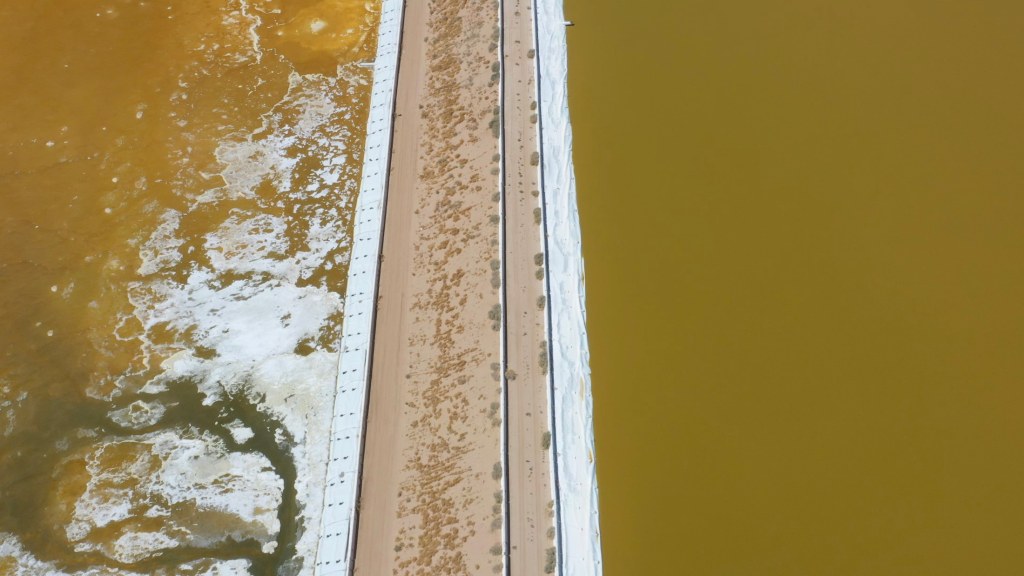 Evaporation ponds at the US Borax mine in Boron, California (Erik Olsen)
Borosilicate glass is also used in high-temperature lighting, including lamps and projectors. Artists value it for its durability and workability in glass sculptures and jewelry. In industry, it appears in chemical processing equipment, tubing, and sight glasses that must withstand heat and corrosive chemicals.
Borosilicate glass was developed in the late nineteenth century by the German chemist Otto Schott. Searching for a glass that could withstand extreme temperatures and resist chemical corrosion, Schott experimented by adding boron oxide to traditional silica glass. In 1887 he succeeded, producing a material with remarkable thermal stability and chemical resistance. The breakthrough led to the creation of the Jena Glassworks, where the new glass quickly found use in laboratories, industry, and eventually in cookware and scientific instruments.
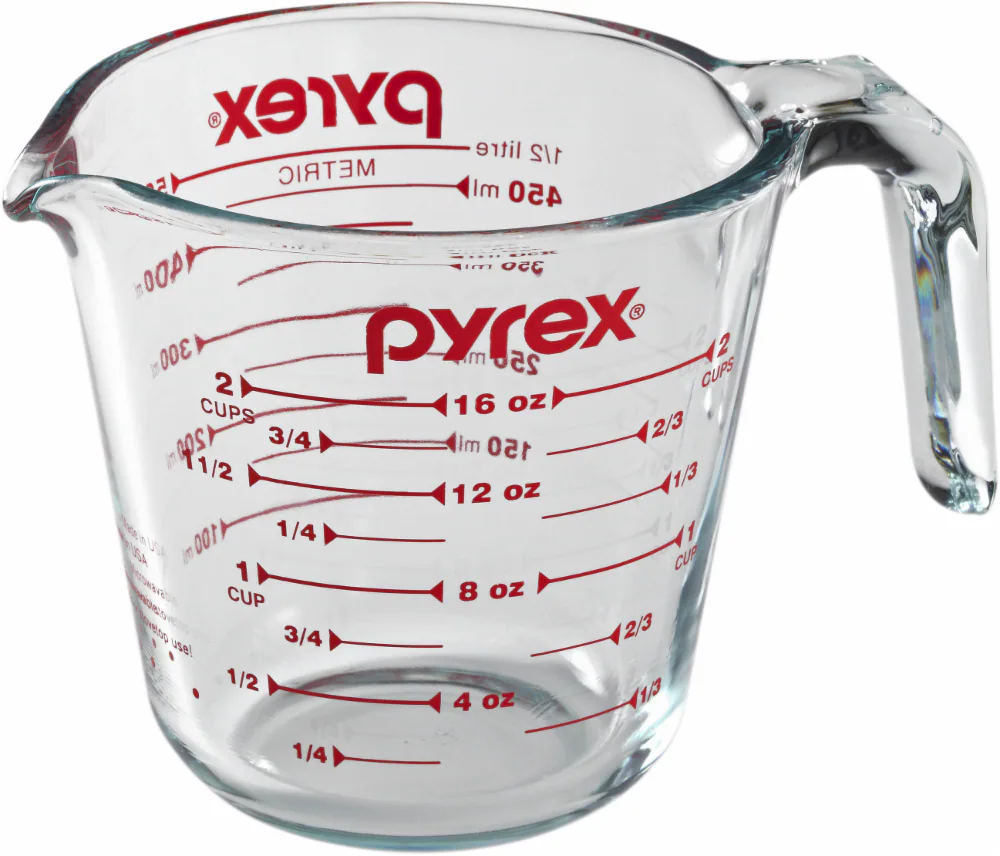 Pyrex measuring cup, made of borosilicate glass.
Mining any industrial mineral comes with environmental tradeoffs. Boron is no exception. Extracting it requires open-pit mining, drilling, blasting, and refining processes that can disturb landscapes and generate waste such as tailings. That said, Rio Tinto has at times been singled out as an unusually responsible steward in the industry. In his book Collapse, writer Jared Diamond pointed to the company as an exception among large mining firms, noting that its borax operation in California “is now perhaps the most cleanly operated mine in the U.S.”
The reality, as with most large mining operations, lies somewhere in between: the extraction of boron inevitably alters the desert landscape, but the Boron operation in California is perhaps an example of how modern mining companies can attempt to manage those impacts through environmental oversight and improved practices. We need these materials, and it’s good news when a company seems to take its environmental problems seriously. Not that Rio Tinto is immune to environmental controversy. In 2020 the company triggered global outrage after blasting a 46,000-year-old Aboriginal cultural site at Juukan Gorge in Western Australia to expand an iron ore mine.
The U.S. Borax mine in Boron is one of those little-known places where California’s industrial story sits in plain view, even if few people ever see it. I like visiting places like this. They show how California’s landscapes are not only beautiful settings for reflection and recreation, but also part of the long story of human progress, where extracting materials from the earth often leads to the innovations that shape our daily lives.rid deserts to unearth one of the most versatile and indispensable materials known to modern industry.
More California science, photography and wild places on Instagram @californiacuratedus