

Laurel Sumac, the Resilient Beauty of Southern California's Chaparral
Laurel sumac is one of Southern California's most resilient native shrubs — a chaparral cornerstone that shelters wildlife, survives fire, and thrives where other plants struggle.
I’ve hiked the Gabrielino Trail in the San Gabriel Mountains more times than I can count. It follows the Arroyo Seco up into the canyon, shaded and cool along the creek before opening onto exposed chaparral slopes where the sun hits hard. Every time I’m out there in the heat of a dry California summer, there’s one plant that shows up more reliably than almost anything else: large, aromatic, glossy-leafed, and absolutely everywhere on those sun-cooked hillsides.
That plant is laurel sumac (Malosma laurina), and I’ve developed a genuine soft spot for it.
Part of what I love about it is exactly that ubiquity. The San Gabriels are an interesting mix when it comes to plants. California’s Mediterranean climate (warm, dry summers and mild wet winters) turns out to be a near-perfect incubator for invasive species, and you encounter a lot of interlopers out there. Castor bean, tree tobacco, giant reed, pampas grass. These are the plants that colonize disturbed slopes and roadsides, thriving precisely because nothing evolved here to keep them in check. It can get a little discouraging, honestly, if you know what you’re looking at.
Laurel sumac is not that. It belongs here. It’s been here, growing across Southern California and Baja California and out onto the southern Channel Islands, since long before any of us showed up. And when you know that, those glossy hillside thickets look a little different. They look like the real thing.
 From a hike in the San Gabriel Mountains. Most of the large clumpy bushes are Laurel sumac (Erik Olsen)
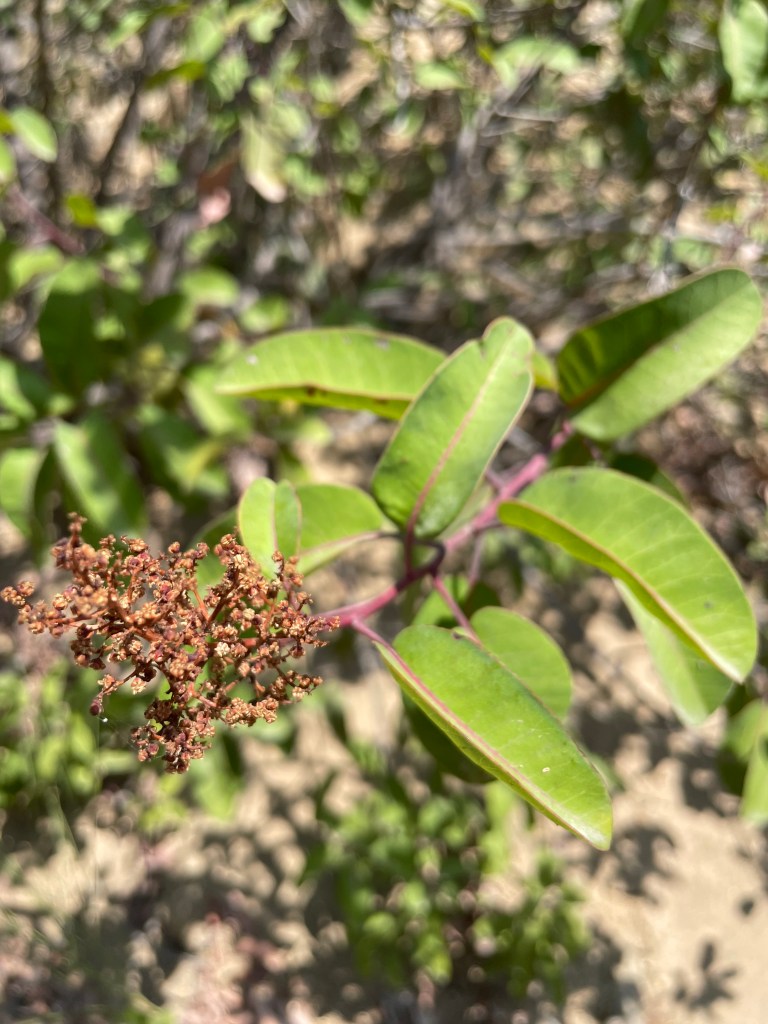
Laurel sumac is a large, rounded evergreen shrub (or a small tree, depending on how generous you’re feeling) that can grow up to 20 feet tall and wide. The leaves are lance-shaped with reddish veins and stems, which gives the whole plant a slightly rosy cast up close. Starting as early as February and running through early summer, it blooms in dense clusters of small white flowers at the tips of its branches, and the scent on a warm day is something: strong and resinous and distinctly wild. After the flowers go, the plant produces small reddish-brown drupes, berry-like fruits that the local birds are very enthusiastic about.
One of my favorite things about laurel sumac is a trick it pulls in extreme heat. The leaves curl upward, folding along their central spine to reduce the surface area exposed to the sun. It’s a clever piece of plant engineering, essentially minimizing water loss by giving the sun less to work with. This behavior has earned the plant a nickname I find irresistibly good: the taco plant. Because yes, the curled leaves look exactly like taco shells. I think about this every time I’m sweating through a noon hike and the laurel sumac looks perfectly comfortable.
 Laurel sumac along a trail in the San Gabriel Mountains (Erik Olsen)
Despite its name, laurel sumac has nothing to do with bay laurel. It’s actually a member of the cashew family, Anacardiaceae, which is one of those plant families that makes you do a double take when you see the full roster. The cashew family also includes mango, pistachio, poison ivy, and poison oak, that other San Gabriel hillside constant. (So laurel sumac and poison oak are, botanically speaking, cousins. I try not to read too much into that.) The family connection isn’t purely superficial: many Anacardiaceae plants produce resins and oils that can cause skin reactions in sensitive people, and laurel sumac, while not nearly as notorious as poison oak, can occasionally cause mild irritation.

What makes laurel sumac a genuine chaparral cornerstone is what happens when fire comes through, and in Southern California, fire always comes through eventually. Laurel sumac has deep, established root systems that survive the burn, and within a season or two of a fire, it’s already resprouting. This is not an accident of toughness; it’s an evolved strategy. The chaparral ecosystem is built around fire, shaped by thousands of years of periodic burning, and the plants that belong here have adapted to it. Laurel sumac doesn’t just survive fire. It’s structured its whole life history around the expectation of it. That’s a level of commitment to a place that I find pretty admirable.
 Laurel sumac with its fragrant white blossoms.
Long before I was hiking those trails, the Kumeyaay people knew this plant well. The Kumeyaay are indigenous to the region spanning southern California (San Diego County and surrounding areas) and northern Baja California, and they called laurel sumac ektii. It was a practical plant for them in multiple ways. Medicinally, a tea made from the root bark was used to treat dysentery. After childbirth, a wash made from the plant was used for its soothing properties, a use that speaks to how well-understood this plant’s chemistry was by the people who lived alongside it for centuries. The sturdy wood was used in construction. That’s a plant pulling real weight in a community, and it’s worth remembering that the next time you’re just walking past it on a trail.
One last thing, because I can’t let this go: the dried flower clusters of laurel sumac have apparently found a second life in the world of model railroading. Enthusiasts paint them and use them as miniature trees in their tiny, meticulous landscapes. There’s something I love about that: a plant that helped build Kumeyaay homes and fed generations of songbirds also moonlighting as a scale-model oak in someone’s basement train layout. California contains multitudes, and so does laurel sumac.
More California science, photography and wild places on Instagram @californiacuratedus