
See Dinosaur-Era Cycads at Descanso Gardens’ Ancient Forest
Cycads ruled the Jurassic and fed the dinosaurs. Thanks to a local couple’s donation, one of the best places to see them is Descanso Gardens’ Ancient Forest in La Cañada Flintridge.
Updated
Picture a Jurassic landscape, with Allosaurus, Brachiosaurus, Stegosaurus and the early bird Archaeopteryx. The movies usually fill in the background with ferns. That’s not wrong, but it leaves out the plants that really set the scene.
Those were cycads: seed plants with thick, woody trunks topped with crowns of stiff, feathery leaves. Cycads go back roughly 280 million years, and they were so common in the Jurassic, from about 201 to 145 million years ago, that it’s sometimes called the “Age of Cycads.” They’re still around today, and for a long time they were thought to have barely changed since then, although that idea is now being challenged.
The first thing you notice about a cycad is how tough the leaves are. Touch one. It’s far stiffer than almost any other plant. The leaves are thick, leathery and waxy, with a heavy cuticle, a protective outer coating. They’re built to handle harsh sun, hold on to water and discourage anything that wants to eat them. Some have spiny edges, too, which would have been a nice defense in a world full of giant plant-eating dinosaurs.
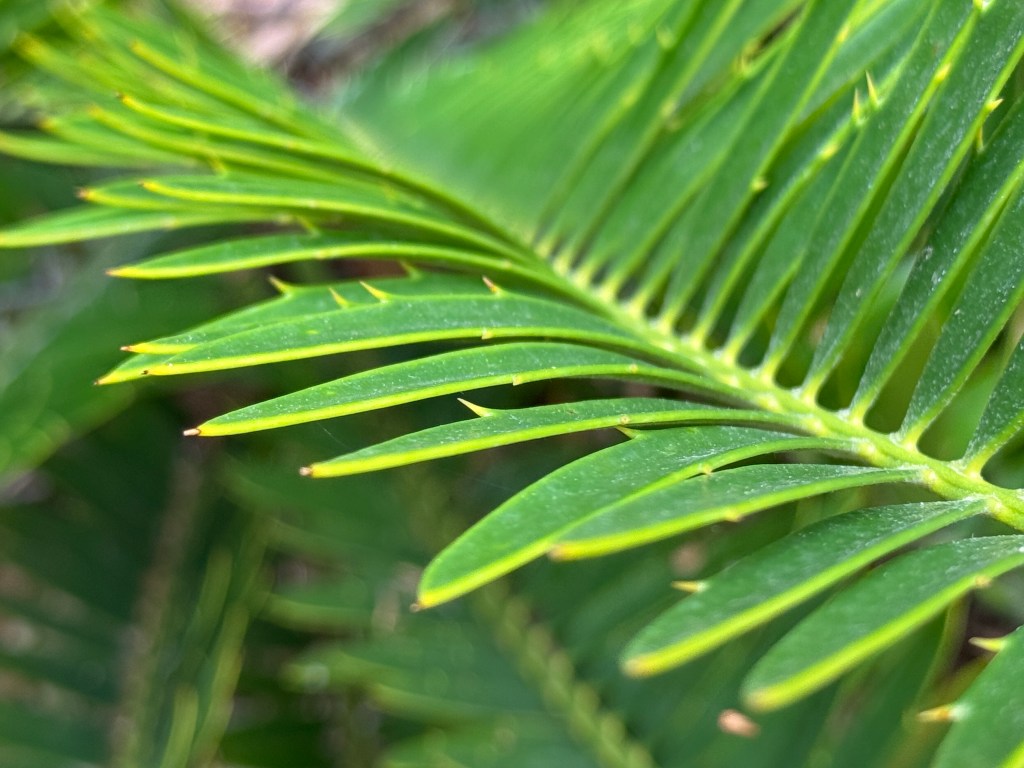 Cycad leaves are quite hard and resistant to insects. Evidence shows that dinosaurs ate cycad leaves regularly. (Photo: Erik Olsen)
It didn’t totally work. Dinosaurs did eat cycads. Fossilized dinosaur dung, called coprolites, has turned up with bits of cycad tissue and pollen inside. Plant-eaters like Stegosaurus and Ankylosaurus are thought to have browsed on cycads and other tough plants, which may be part of why they had strong jaws and grinding teeth. The cycads, for their part, were tough enough to survive the grazing and everything else the last few hundred million years threw at them. (FYI: flowering plants didn’t show up until the Cretaceous, near the end of the dinosaurs’ run, between about 145 and 66 million years ago.)
And here’s a California twist. In 2023, researchers described an 80-million-year-old fossil cycad cone found in Silverado Canyon, in Orange County. It was unlike any living cycad, and it suggests that cycads were far more varied in the age of dinosaurs than they are now, and that they kept evolving through the Cretaceous. So much for “living fossils.”
Cycads are cool to look at up close, and one of the best places in the country to see them is Descanso Gardens in La Cañada Flintridge. How they got there is a good story.
In 2014, La Canada Flintridge residents Katia and Frederick Elsea called the city’s Descanso Gardens with an odd proposal: would the famous horticultural center take their collection of over 180 rare cycads ?
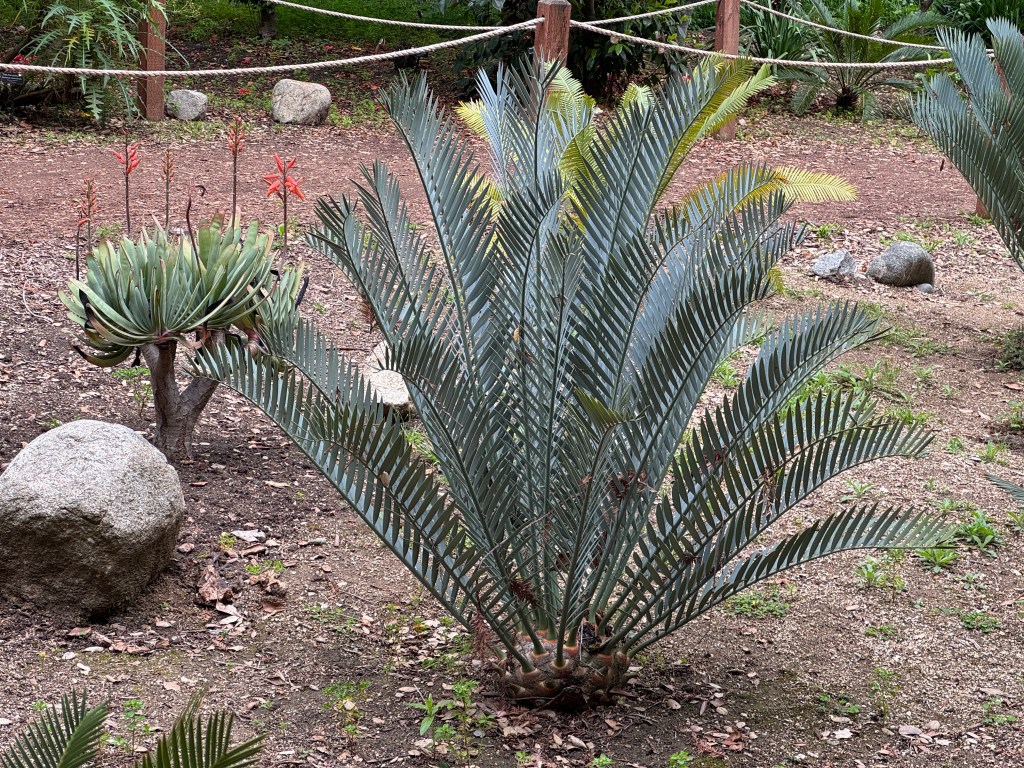
The garden said yes. Sixty-six species from the Elseas’ collection were moved into a new section called the Ancient Forest, which is meant to feel like a prehistoric landscape. Cycads are the centerpiece, mixed with tree ferns and ginkgoes, with their fan-shaped leaves, all of them plant lineages that have been around for hundreds of millions of years.
Cycads are gymnosperms, the group that also includes conifers and ginkgoes. Gymnosperms don’t make flowers or fruit. Their seeds sit out in the open, usually in cones, which is what “gymnosperm” (naked seed) means. Cycads look a bit like palms or ferns, but they’re neither. They’re their own group, with about 300 species alive today.
Flowering plants have been much more successful. There are an estimated 300,000 species of them, and flowers and fruit helped them spread into almost every habitat on land.
 Cycad cone (Dioon edule) at Descanso Gardens. Cycad cones are among the largest seed cones on Earth, and they evolved long before the first flower. (Erik Olsen)
Descanso’s cycads come from all over the world, including Africa, Asia, Australia, Madagascar and the Americas, and the collection includes rare and endangered species.
One you’ve probably seen before is the sago palm, Cycas revoluta, which isn’t a palm at all. It’s a common landscaping plant in Southern California. Sagos come in separate male and female plants. The males grow a tall cone in the center that sheds pollen, and the females grow a big, round cluster of seeds instead. Insects and wind carry pollen from one to the other.
The Ancient Forest also has a monkey puzzle tree, Araucaria araucana, a conifer from Chile and Argentina whose branches are completely covered in sharp, overlapping, scale-like leaves. Its family goes back to the age of dinosaurs too.
Cycads have another trick. They grow special roots, called coralloid roots, that house cyanobacteria. The bacteria pull nitrogen out of the air and feed it to the plant, which lets cycads grow in poor soil.
Survivors or not, cycads are in trouble now. Many species are endangered because of habitat loss and poaching for the plant trade. Collections like Descanso’s help keep some of them alive.
 Cycad at Descanso Gardens (Erik Olsen)
At Descanso, the cycads are planted by where they come from: Africa, Asia, Madagascar, Australia and Mexico. Some of them no longer exist in the wild.
“For a really long time, this was plant life on Earth,” the former director, David R. Brown told the Los Angeles Times. “This helps remind me that, for as self-absorbed as we are often, we’re but a part of a story that has been going on for a very, very long time.”
If you want to know more about Descanso Gardens and how it came to be, check out this episode of Lost LA. And if you go see the cycads, try late afternoon, when the low golden light makes the Ancient Forest look like the Jurassic again.
More California science, photography and wild places on Instagram @californiacuratedus