The 1975 Asilomar Conference, Where Scientists Decided to Police Genetic Engineering
In 1975, scientists met at Asilomar on the Monterey Peninsula to decide whether genetic engineering was too dangerous. Their answer, self-imposed safety rules, shaped biotech for decades and still echoes in the CRISPR debate.
Updated
 Asilomar Conference Grounds Interior (Erik Olsen)
In February 1975, about 140 scientists, plus a few lawyers and journalists, gathered among the pines and sand dunes of Asilomar, on the Monterey Peninsula, to argue about something brand new: the ability to cut DNA out of one organism and paste it into another. The question was whether that was too dangerous to do at all. The Asilomar Conference on Recombinant DNA became one of the most famous meetings in the history of science, the moment scientists decided to police themselves. (A smaller group had met at Asilomar in 1973, but that meeting mostly ended with everyone agreeing they needed to keep talking.)
 DNA
DNA
The driving force was Paul Berg, a Stanford biochemist who would later win the Nobel Prize for this work. In the early 1970s, Berg’s lab was among the first to splice together DNA from different sources, and he realized how risky it could be. What if a lab accidentally created a bacterium carrying a cancer gene and it escaped? Berg and others called for a voluntary pause on certain experiments until they knew more.
Maxine Singer, a molecular biologist, was another key figure. She helped write an early letter to the journal Science raising the alarm and urging caution. (In 2002, Discover magazine named her one of the 50 most important women in science.)

Purchase stunning art prints of iconic California scenes. **Check out our Etsy store. **
To see why this was such a big deal, back up a couple of decades. In the 1950s and ’60s, biologists figured out that genes are made of DNA, and then how DNA works: how it copies itself and how it carries instructions for making proteins.
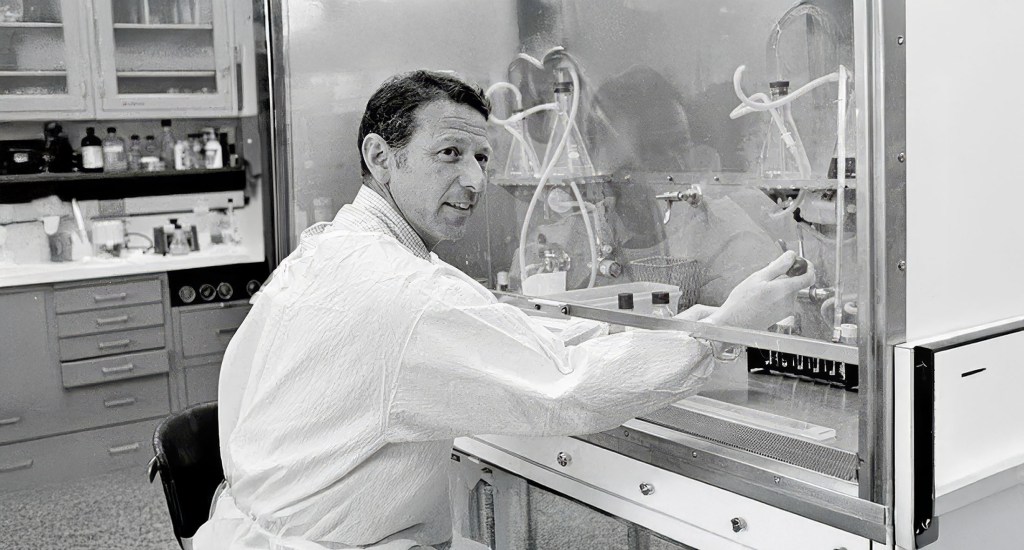 Paul Berg (Photo: Stanford University)
The key was the structure of DNA, the double helix, worked out in 1953 by James Watson and Francis Crick, using crucial X-ray images from Rosalind Franklin, who didn’t get nearly enough credit. Once scientists understood the molecule, the next step was obvious: change it.
Recombinant DNA was that step, a way to cut and splice genes and move them between species. It opened the door to insulin made by bacteria and much of modern biotech. It also scared people, including the scientists doing it.
 Asilomar Conference Building
As Siddhartha Mukherjee put it in his excellent book The Gene: An Intimate History, “There is an illuminated moment in the development of a child when she grasps the recursiveness of language: just as thoughts can be used to generate words, she realizes, words can be used to generate thoughts. Recombinant DNA had made the language of genetics recursive.”
At Asilomar, the participants argued over how to keep genetically modified organisms from escaping labs, whether some experiments should be off limits and even whether the technology could be used to build biological weapons. It was a bit like the Pugwash Conferences, where scientists from both sides of the Cold War met to talk about controlling nuclear weapons.
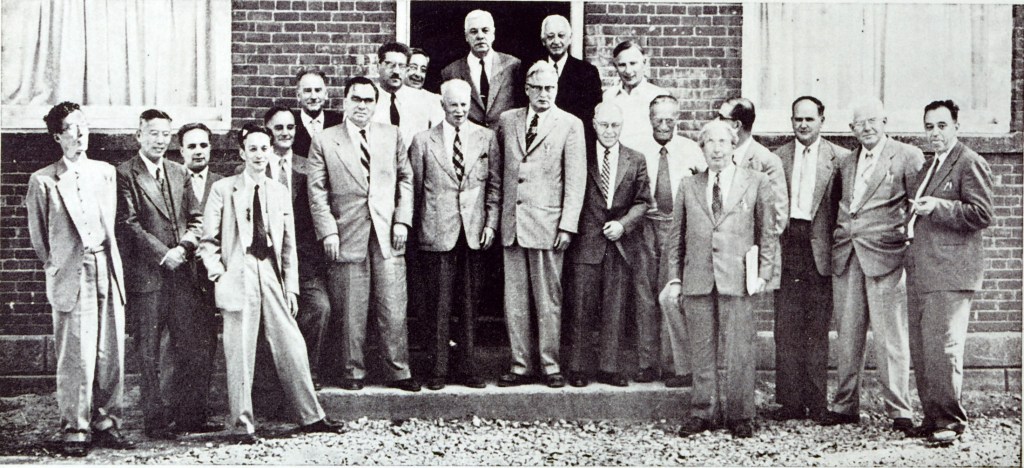 Participants in the First Pugwash Conference in 1957 in Pugwash, Nova Scotia, Canada. Notable figures included Joseph Rotblat, Bertrand Russell, Leo Szilard, Igor Tamm (pugwash.org)
The comparison fits. Like nuclear physics, genetic engineering promised enormous benefits, in this case cures for diseases, and carried risks nobody could fully predict. The Pugwash meetings, which began in 1957 in Pugwash, Nova Scotia, tried to bridge the Iron Curtain. Asilomar tried to bridge the gap between scientists eager to push ahead and those who wanted to slow down.
You could also go back to August 1939, when Albert Einstein and Leo Szilard wrote to President Franklin Roosevelt to warn him about a terrifying new possibility. A “new and important source of energy” had been discovered, Einstein wrote, and “it is conceivable … that extremely powerful bombs of a new type may thus be constructed. A single bomb of this type, carried by boat and exploded in a port, might very well destroy the whole port.”
 The Einstein–Szilard letter
At Asilomar, the scientists ended up agreeing that most recombinant DNA work could be done safely with the right precautions. They sorted experiments by how risky they were and matched each level with stricter lab containment. The National Institutes of Health turned that into official guidelines in 1976, and they became the foundation for how genetic engineering has been regulated ever since.
It worked. By setting their own rules, scientists headed off a public backlash that could have shut the field down, and genetic engineering took off. It also set an example of scientists taking responsibility for what their work might do to the world.
“The most important lesson of Asilomar,” Berg said, “was to demonstrate that scientists were capable of self-governance.” People used to the “unfettered pursuit of research” had to learn to fetter themselves.
 CRISPR
The same debate is back today with CRISPR gene editing, gene drives and synthetic biology, and people regularly call for “a new Asilomar.” Whether scientists can police themselves as well this time is an open question.
Asilomar is still there, a beautiful, rustic conference center by the beach in Pacific Grove. (It also hosted another big moment in science, the 1969 meeting where plate tectonics clicked.) If you stay there, take a walk on the dunes and think about the people who once argued there about whether we should be rewriting life.
More California science, photography and wild places on Instagram @californiacuratedus