The Channel Islands Are California’s Own Galápagos
Pygmy mammoths, island foxes and jays found nowhere else: California’s Channel Islands are a natural laboratory for evolution, and a conservation success story, just 12 miles off Ventura.
Updated
I recently took two scuba diving trips out to the Channel Islands to investigate and help remove ghost lobster traps: abandoned or lost gear that poses a serious threat to marine life. While out there, I also had a chance to explore the marine protected areas surrounding Anacapa and Santa Cruz Islands, getting a firsthand look at how these underwater reserves are helping to restore ocean health and marine life (another story on that coming). Diving in the Channel Islands is a great way for certified divers to experience the incredible biodiversity of California’s coastal waters, even if the water is cold as hell.
The Channel Islands are actually relatively close to the California mainland, just 12 miles from Ventura in the case of Anacapa. But the wild and windswept chain feels like a world apart. On a clear day, you can see them from Ventura or Santa Barbara, but oddly, few people actually visit. Compared to other national parks, they’re barely known, which is part of their charm. They’re sometimes called the “Galápagos of North America,” and for good reason. Evolution is happening out there in ways you can actually see.
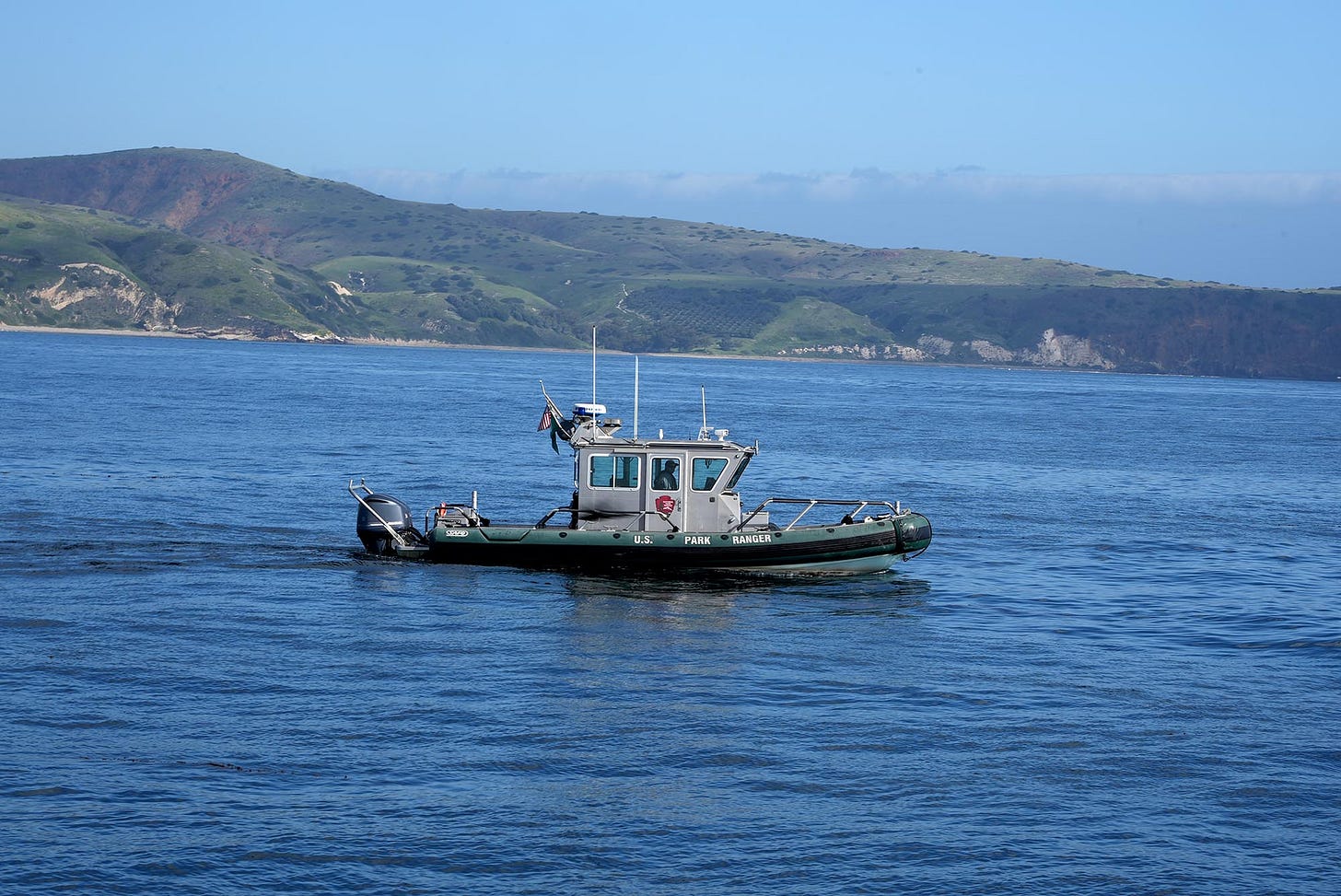 U.S. Park Service rangers patrol the marine protected area off of Anacapa Island in California’s Channel Islands
(Photo: Erik Olsen)
(Here’s a cool bit of history: there are eight Channel Islands today, but 20,000 years ago, during the last ice age when sea levels were much lower, four of them—San Miguel, Santa Rosa, Santa Cruz, and Anacapa—were connected as a single landmass called Santarosae.)
For biologists, the islands are a natural laboratory. Each one has its own size, shape and mix of plants and animals, and each has been cut off from the mainland, and to some degree from the others, for a very long time. That makes them perfect for studying island biogeography, the science of how life spreads, changes and survives on islands. And what happens on islands turns out to explain a lot about how evolution works everywhere.
 Sea lions on the Channel Islands (NPS)
Island biogeography is anchored in the theory proposed by E.O. Wilson and Robert MacArthur in the 1960s. Their idea was that the number of species on an island comes down to a balance between new arrivals and local extinctions, and the Channel Islands are a great place to see it play out.
There’s a lot of variety packed in: windswept cliffs, rocky shores, chaparral hillsides and thick kelp forests offshore. Each island is basically its own experiment, run with different starting conditions and a limited food supply over thousands of years. Usually evolution tweaks things a little. Sometimes it does something dramatic.

The best-studied example is the island fox (Urocyon littoralis), which lives nowhere else on Earth. Research led by the late evolutionary biologist Robert Wayne at UCLA showed that the foxes on each of the six islands where they live have evolved separately, with their own genetic lineages and their own physical traits.
Each island’s foxes carry their own genetic markers, and the differences show up in their bodies and behavior too. Foxes on smaller islands tend to be smaller, probably because there’s less to eat, which is called insular dwarfism. Their diets, hunting habits and even coat colors vary from island to island.
 Excavation of pygmy mammoth bones on the Channel Islands (Photo: National Park Service)
Foxes aren’t the only ones that shrank. The most famous example is the pygmy mammoth (Mammuthus exilis), whose fossils have been found on Santa Rosa Island. It descended from the giant Columbian mammoth, which swam out to the islands during the Ice Age. Stuck there, with limited food and no big predators, the mammoths shrank to about half their original size.
Plants evolve out there too, and the islands have plenty that grow nowhere else. Research by Kaius Helenurm, including genetic studies on species such as the Santa Cruz Island buckwheat (Eriogonum arborescens) and island mallow (Malva assurgentiflora), shows how these plants adapted to island conditions with little genetic mixing from the mainland.
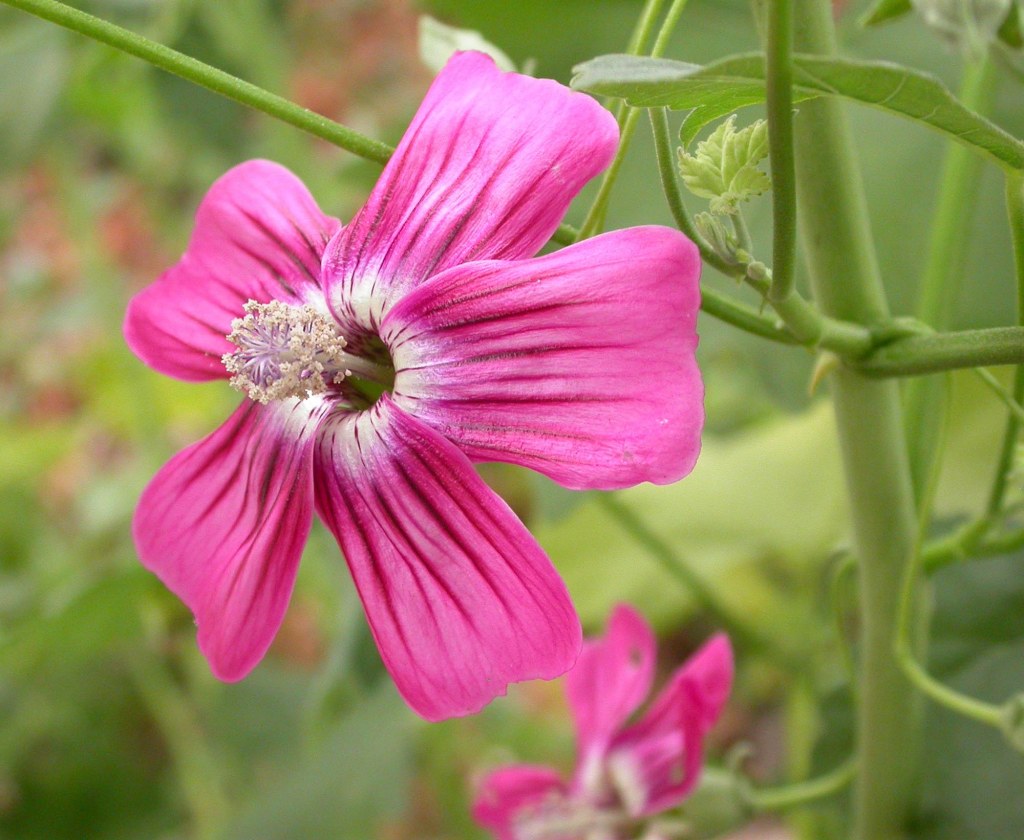 Island mallow (Malva assurgentiflora), a flowering plant found only on the Channel Islands. (Photo: Curtis Clark)
Part of what makes the islands so valuable to science is that they’re easy to get to. You can leave a lab at UCLA or UC Santa Barbara in the morning and be on an island by lunch. Some people have argued that if Darwin had landed here instead of the Galápagos, he could have come up with natural selection off California. A 2019 book, North America’s Galapagos: The Historic Channel Islands Biological Survey, tells the story of a group of researchers, naturalists, adventurers, cooks and curious teenagers who surveyed the islands in a series of big expeditions in the late 1930s.
Isolation tends to produce species found nowhere else, which biologists call endemics, and Darwin made it a central theme of On the Origin of Species. The island fox is the poster child here, with a different subspecies on each island, a small-scale version of what biologists call adaptive radiation. The foxes are also incredibly cute, and incredibly annoying if you’re camping, because they’ll ransack your food if you don’t lock it up tight.
 Island Fox on Santa Cruz Island (photo: Erik Olsen)
The birds have their own versions of Darwin’s finches. The island scrub-jay, which lives only on Santa Cruz Island, is bigger and more brightly colored than its mainland cousin. And even on that one island, jays in the pine forests have longer, shallower bills, while jays in the oak woodlands have shorter, deeper ones. That’s evolution straight out of the Darwin playbook. The San Clemente House Finch has also evolved its own traits, a reminder that even ordinary birds change when they’re cut off long enough.
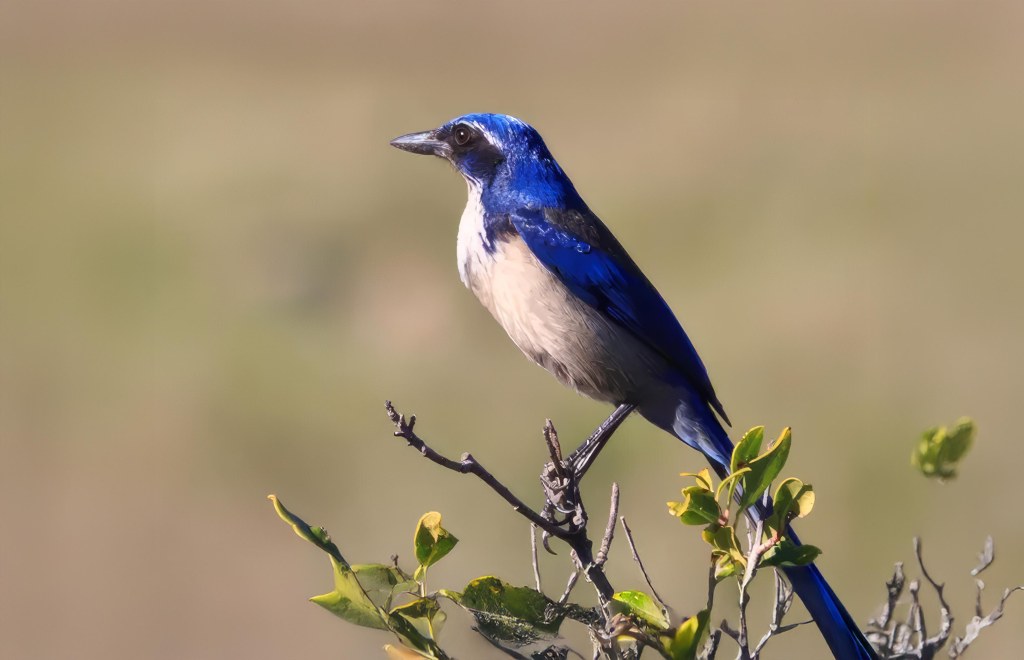 The Island Scrub-Jay (Aphelocoma insularis), found only on Santa Cruz Island, is larger and more brightly colored than its mainland cousin. (Photo: National Park Service)
Islands are also where invasive species do the most damage, and the Channel Islands have become a proving ground for undoing it. Removing invasive pigs and rats helped set up the recovery of native species like the island fox.
Plants are bouncing back too. In 1997, the U.S. Fish and Wildlife Service listed 13 plants from the northern Channel Islands under the Endangered Species Act, mostly because of decades of damage from extensive sheep grazing. The results have been good. The island bedstraw (Galium buxifolium) expanded from 19 known sites with approximately 500–600 individuals in 1997 to 42 sites with over 15,700 individuals. The Santa Cruz Island dudleya (Dudleya nesiotica) stabilized at around 120,000 plants. Both were taken off the endangered species list in 2023, the 50th anniversary of the Endangered Species Act.
 Santa Cruz Island Dudleya (Photo: National Park Service)
The comeback extends underwater, thanks to marine protected areas. I’ve seen it firsthand on several dives out there. There’s noticeably more life than at most mainland dive sites in Southern California.
The Channel Islands MPAs, set up in 2003, were some of the first in California. Fishing is limited or banned in them, and over two decades, scientists have measured increases in the size and abundance of kelp bass, lobsters and sheephead, along with the return of thick kelp forests. The reserves are good for wildlife, and they’ve become another kind of laboratory, a place to see what a protected ocean looks like over the long haul.
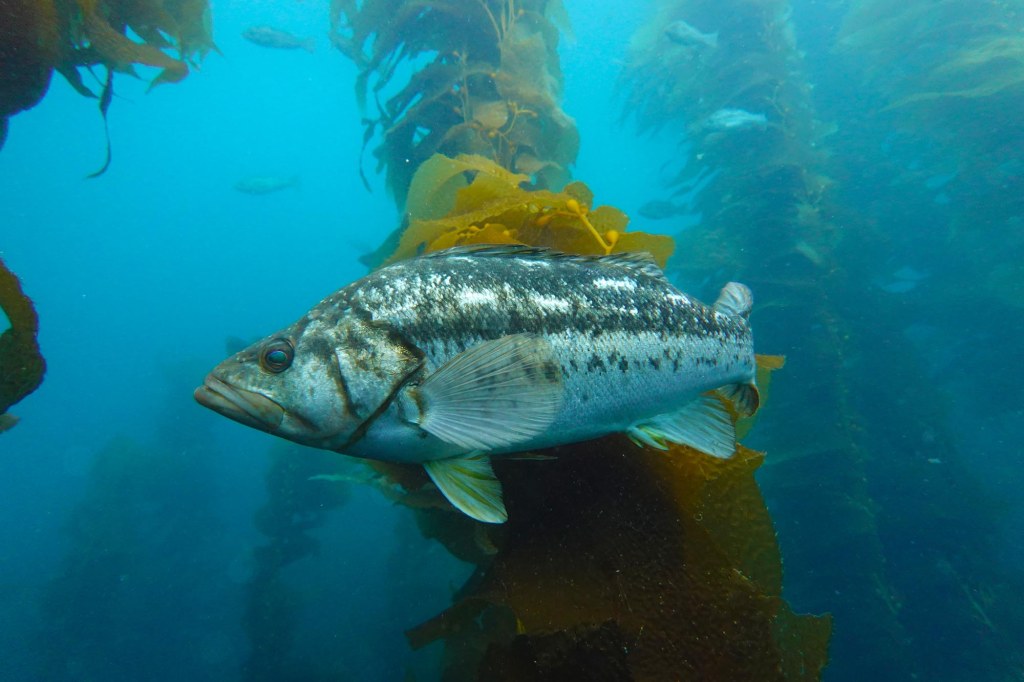 Kelp bass in the kelp forest at the Channel Islands (Photo: Erik Olsen)
None of this would be possible if the islands had been developed like so much of the mainland coast. Instead, they’re protected as a national park and a national marine sanctuary. Twelve miles from Ventura, there’s a place where evolution is still running its experiments. Go see it. Just bring a wetsuit, and lock up your food.
More California science, photography and wild places on Instagram @californiacuratedus