
Hannes Keller’s Deadly 1,000-Foot Descent off Catalina Island Was the Dive of the Century
In 1962, Swiss diver Hannes Keller and journalist Peter Small rode a diving bell 1,000 feet down off Catalina Island to prove humans could work at impossible depths. It made history and cost two lives.
Updated
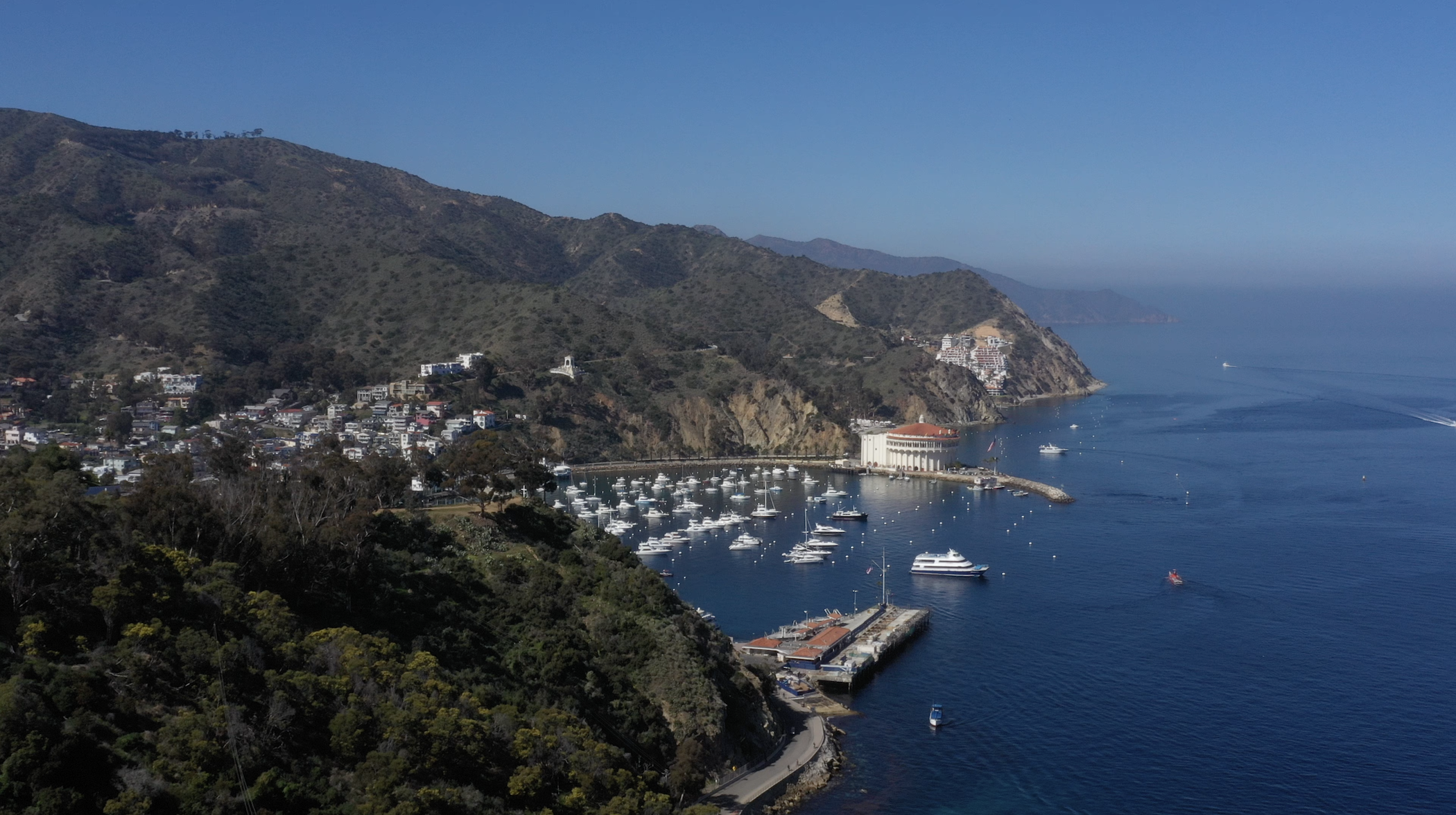
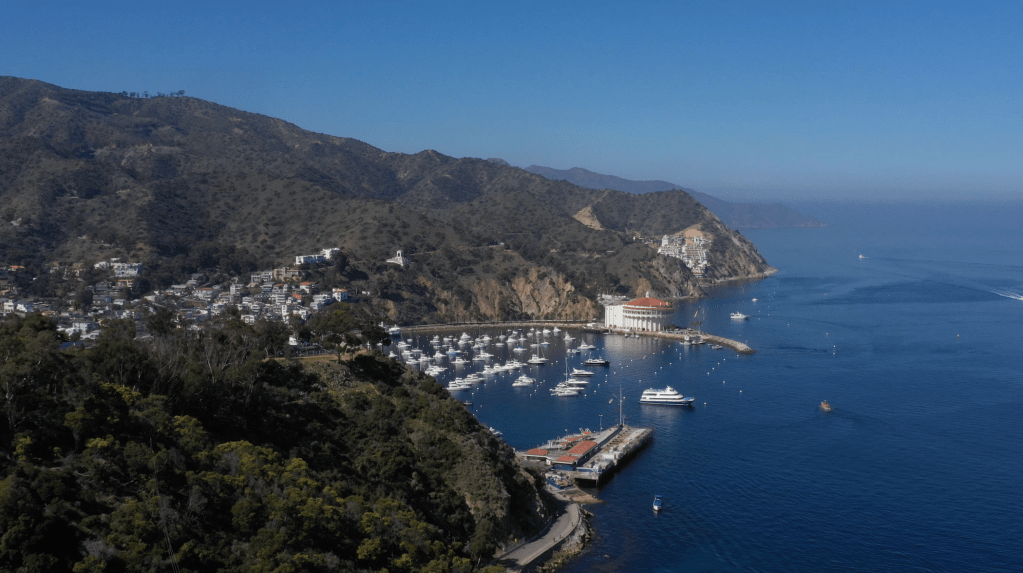 The city of Avalon on Catalina Island (Erik Olsen)
In December 1962, a Swiss math teacher climbed into a steel diving bell off Catalina Island and tried to do something nobody had ever done: go 1,000 feet down into the Pacific, step out onto the seafloor and come back alive. Two people didn’t come back.
The teacher was Hannes Keller, and his partner on the dive was Peter Small, a British diver and journalist. The plan was to ride down inside a pressurized bell called Atlantis, open the hatch at the bottom and work outside at a depth that was supposed to be impossible.
Keller was already famous in diving circles. Working with Dr. Albert Bühlmann, a Swiss physiologist who specialized in breathing, he had been setting depth records with secret mixtures of breathing gases. They used an IBM computer, cutting-edge for the time, to calculate the mixes and the decompression schedules. The goal was to beat the two big dangers of deep diving: nitrogen narcosis and the bends.

Diving wasn’t even Keller’s first plan. He taught math to engineering students in his hometown of Winterthur, near Zurich, and wanted to be a pilot, but flying was too expensive on a teacher’s salary. In the late 1950s, a friend got him into scuba, and Keller started applying his math to it. He decided that deep diving was stuck in the past, and that he could fix it.
“If a man could go, for instance, to 1,000 feet down and do practical work,” Keller wrote in The Sydney Morning Herald, “then all the continental shelf zone could be explored, a total of more than 16 million square miles.”
 Keller prepares for his May 1961 chamber dive at the United States Navy Experimental Diving Unit (NEDU). Photo: US Navy
For the big dive, Keller and Bühlmann chose a spot off Avalon on Catalina, where the seafloor drops steeply into deep water close to shore.
Back then, most experts believed nobody could dive much below 300 feet. Even at around 100 feet, a diver breathing ordinary air starts to get loopy from nitrogen narcosis. Going ten times deeper sounded crazy.
Peter Small, a co-founder of the British Sub-Aqua Club, signed on as Keller’s partner. The Atlantis diving bell would be lowered from a ship on the surface, where a crew would watch the gas levels and stay in touch with the divers by phone.

The U.S. Navy was interested. If Keller’s methods worked, they could rewrite the Navy’s dive tables and make deep diving much safer. After promising tests in pressure chambers and some shallower dives at sea, the Navy let Keller do a test dive at its main experimental diving facility in Washington, and it chipped in money for the 1,000-foot attempt.
The Navy also sent Dr. Robert Workman, one of its top decompression experts, to keep an eye on things. In late November, Workman, Bühlmann, the rest of Keller’s team and a crowd of onlookers gathered off Catalina aboard Eureka, an experimental offshore drilling ship lent by Shell Oil. Shell had a lot riding on it. Offshore drilling was moving into deeper water, off California and in the Gulf of Mexico, and if the dive worked, Shell would get Keller’s secret gas mix and a big head start on the competition.
Atlantis looked like a giant soup can, about seven feet tall and a little over four feet wide, with a hatch in the bottom and pipes and valves sticking out all over.
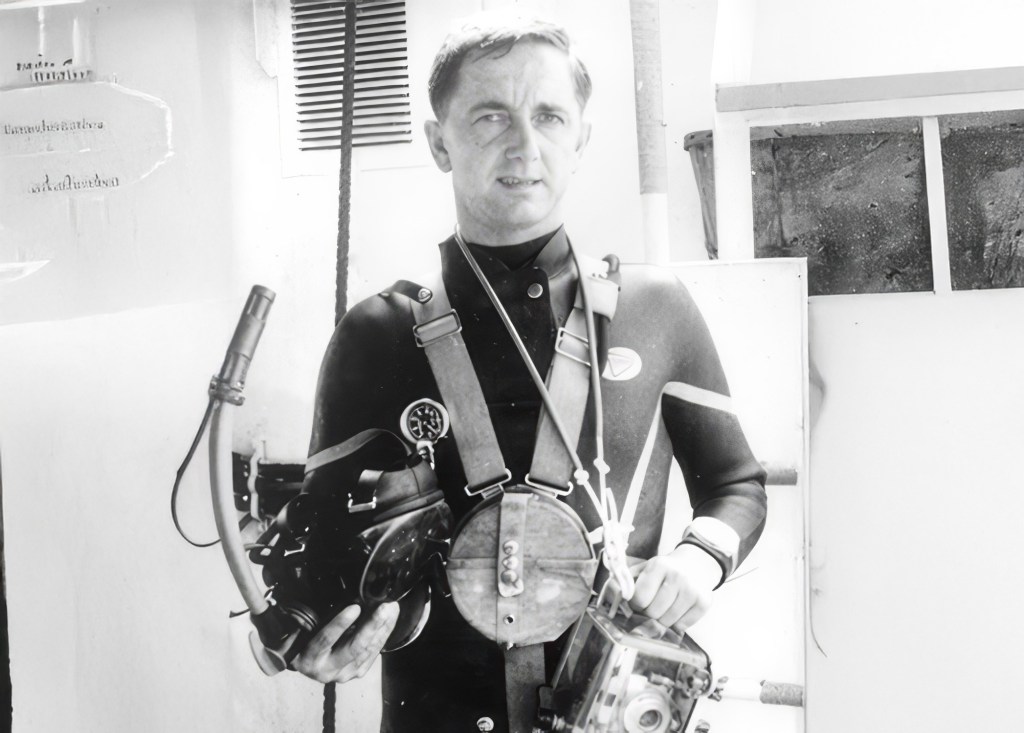 British journalist Peter Small (BSAC)
Small planned to write a firsthand account. On December 1, he and Keller made a final practice dive. They rode Atlantis down to 300 feet and spent an hour swimming outside the bell. On the way back up, both got mild cases of decompression sickness, the bends. Keller felt it in his belly, Small in his right arm.
Keller’s symptoms went away overnight, but Small needed recompression treatment. That should have been a warning. Instead of working up to 1,000 feet in steps, Keller decided to go straight for it. With reporters and spectators waiting, and time, money and borrowed equipment running short, there was a lot of pressure to stay on schedule.
 The diving bell Atlantis is lifted out of the water after Keller and the journalist Peter Small descended 1,020 feet to the Pacific Ocean floor in December 1962.
Around noon on Monday, December 3, Atlantis went under. It took less than half an hour to reach the bottom. Then everything went wrong. Keller climbed out to plant a Swiss flag and an American flag on the seafloor, and his breathing hoses got tangled in the flags. He made it back into the bell, then passed out.
Something had gone wrong with the gas. Small, who never left the bell, blacked out too. The crew hauled Atlantis up to about 200 feet, and support divers swam down to check on it. One of them, Christopher Whittaker, just 19 years old, disappeared and was never found.
 Pacific Ocean off Catalina Island (Erik Olsen)
Keller woke up about half an hour later. Small took nearly two hours. When he came to, he talked to Keller and made sense, but he said he was cold and couldn’t feel his legs. He wasn’t in pain, just too weak to stand, and he leaned against Keller and fell asleep while the bell slowly decompressed.
Hours later, as Atlantis was being carried back to Long Beach, Keller realized Small had stopped breathing. He had no pulse. Keller tried mouth-to-mouth and chest compressions, but Small was already cold and pale. The crew dumped the last of the pressure, about two atmospheres, to get him out and rush him to a hospital after eight hours in the bell. He was pronounced dead on arrival.
 The Atlantis diving bell (Paul Tzimoulis)
The Los Angeles County coroner ruled that Small died of decompression sickness. His tissues and organs were full of nitrogen bubbles. Keller argued that other things played a part, including a possible heart attack and the panic Small showed when they reached the bottom.
Whatever the cause, two men were dead, and enthusiasm for Keller’s methods collapsed. Plenty of people in deep diving had worried that something like this could happen, and the disaster set back the young field of saturation diving, which already had only lukewarm support from the Navy. It didn’t kill the idea, though, not by a long shot. Saturation diving went on to become standard for deep commercial work.
 Hannes Keller in his later years. (Credit: Keller, Esther, Niederglatt, Switzerland)
Modern deep diving owes Keller a lot. His dive to 1,020 feet (311 meters) off Catalina made headlines around the world, and while critics called it a stunt, it was a carefully planned experiment that pushed what people thought the human body could handle under the sea. It also showed, in the worst possible way, how much could go wrong.

CALIFORNIA CURATED ART ON ETSY
Purchase stunning art prints of iconic California scenes. **Check out our Etsy store. **
Christopher Swann, a diving historian, said the dive “was a milepost in the sense that it was the first time something like that had been done.”
Keller lived a long life after that. He died on December 1, 2022, at a nursing home in Wallisellen, Switzerland, near his home in Niederglatt. He was 88. The next time you take the ferry to Avalon, remember that about 1,000 feet below, two men once tried to rewrite the rules of diving, and a third, a 19-year-old, never came home.
More California science, photography and wild places on Instagram @californiacuratedus