
The Places We Thought Would Last
On the Southern California coast, the ocean is reshaping familiar ground.
Nearly every day now, my Instagram feed is showing me scenes of large chunks of the Southern California coast slipping into the ocean. A section of cliff broke off near one of my favorite dive spots in Laguna Beach just a few weeks ago. The Wedge, where I spent a fair amount of my youth in the summer, had much of its legendary beach sucked out to sea, revealing rusty metal fixtures and remnants of an old piece of jetty that I didn’t even know existed.
Then, just a few days later, Newport Beach flooded as unusually high tides combined with storm swell and elevated sea levels from an El Niño driven Kelvin wave. I’d never heard of a Kelvin wave, and I don’t remember ever seeing the town flooded the way it was the other day. Maybe it has been. Either way, waves battered homes in Long Beach, and towering sand berms were built along the beach to try to keep the ocean out.
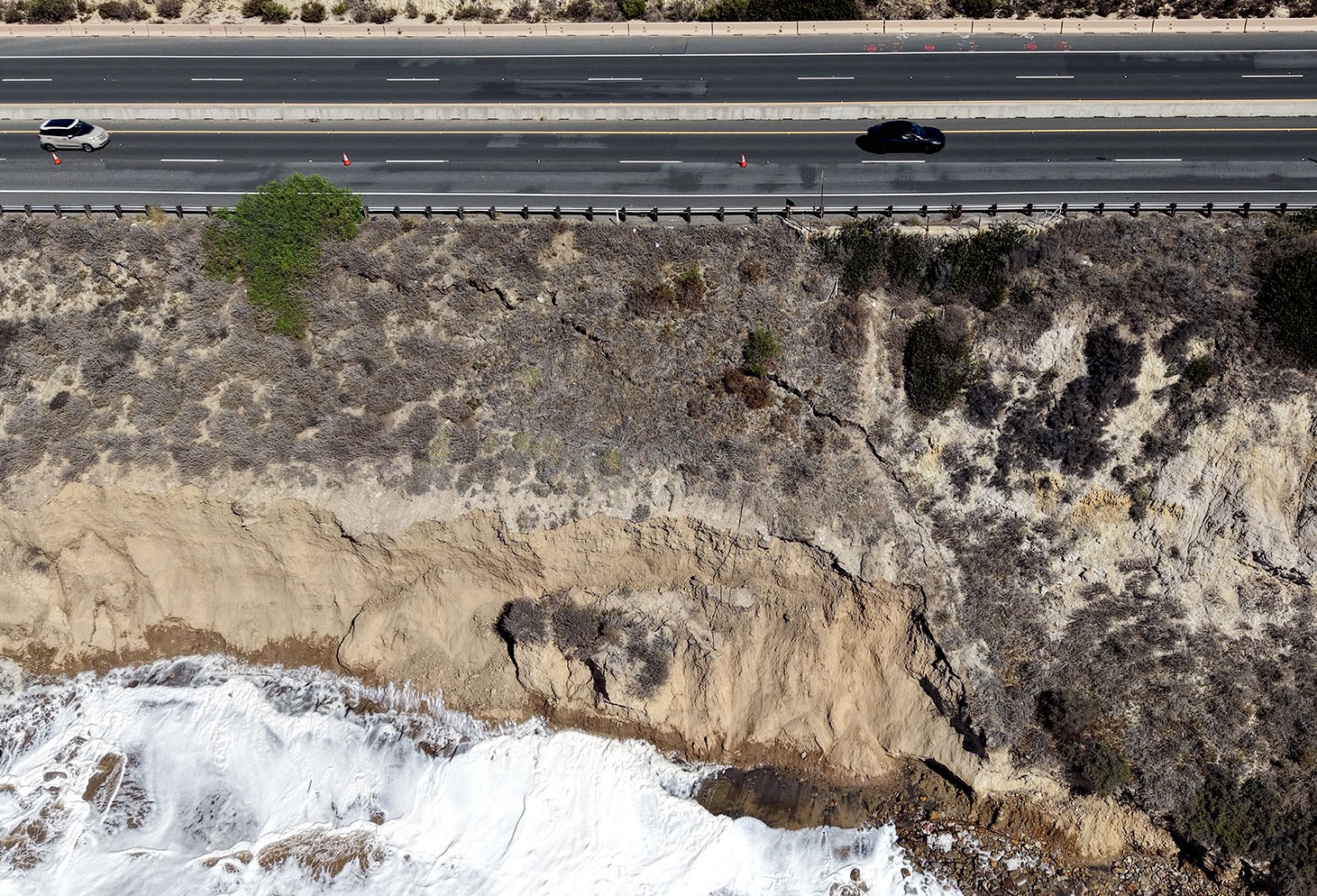
And then, just yesterday, my screen lit up with a scene of a massive crack in the bluffs along Pacific Coast Highway near Crystal Cove, one of the last remaining semi-pristine stretches of old California left in the region. The crack reaches right up near the edge of PCH, one of the world’s, and certainly one of California’s, great scenic highways. In fact, this stretch right here I would put up against almost any place in the world: the Italian coast, Australia, you name it, for its astounding mix of manmade infrastructure and stunning natural beauty. But what happens if that bluff collapses? What would happen to PCH? I have a hard time processing what’s going on.
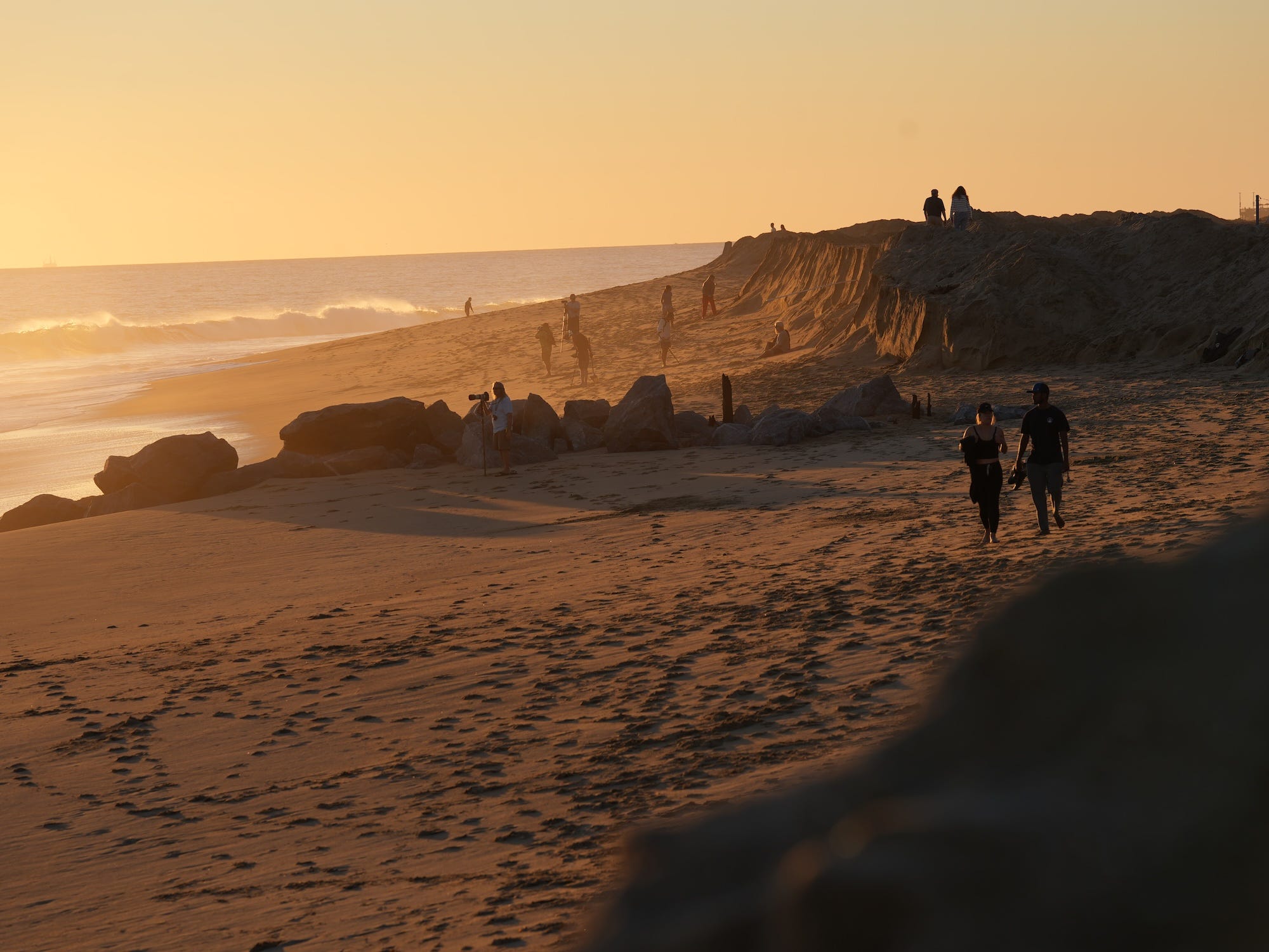 Sand berms near the Wedge in Newport Beach were built to hold back waves and unusually high tides after seawater flooded nearby homes and streets. But the sand that was pulled away revealed the remnants of a long buried jetty. (Photo: Erik Olsen)
Crystal Cove, by the way, is magnificent. It stretches along about 3 miles of beach, and roughly 2,400 acres of raw, open land. It’s a gorgeous landscape of bluff, beach, and chaparral that has been protected by the state since 1979, when the state acquired it from the Irvine Company. When I was a kid, I would spend hours wandering the chaparral along the rutted trails, looking for snakes and lizards to catch. I always found something. It was also a place where we had a horse at a stable on the same property, and I would literally, at the age of 10 or 11, brush, saddle, and ride that horse by myself. Then I would gallop him on the beach. Such was the way things were then.
But now the coast that I loved, and still love, is seemingly slipping into the sea. Yes, that’s overdramatic, but there is a measure of truth there, and I don’t think Californians quite understand what’s going on, nor are they prepared for where this all takes us.
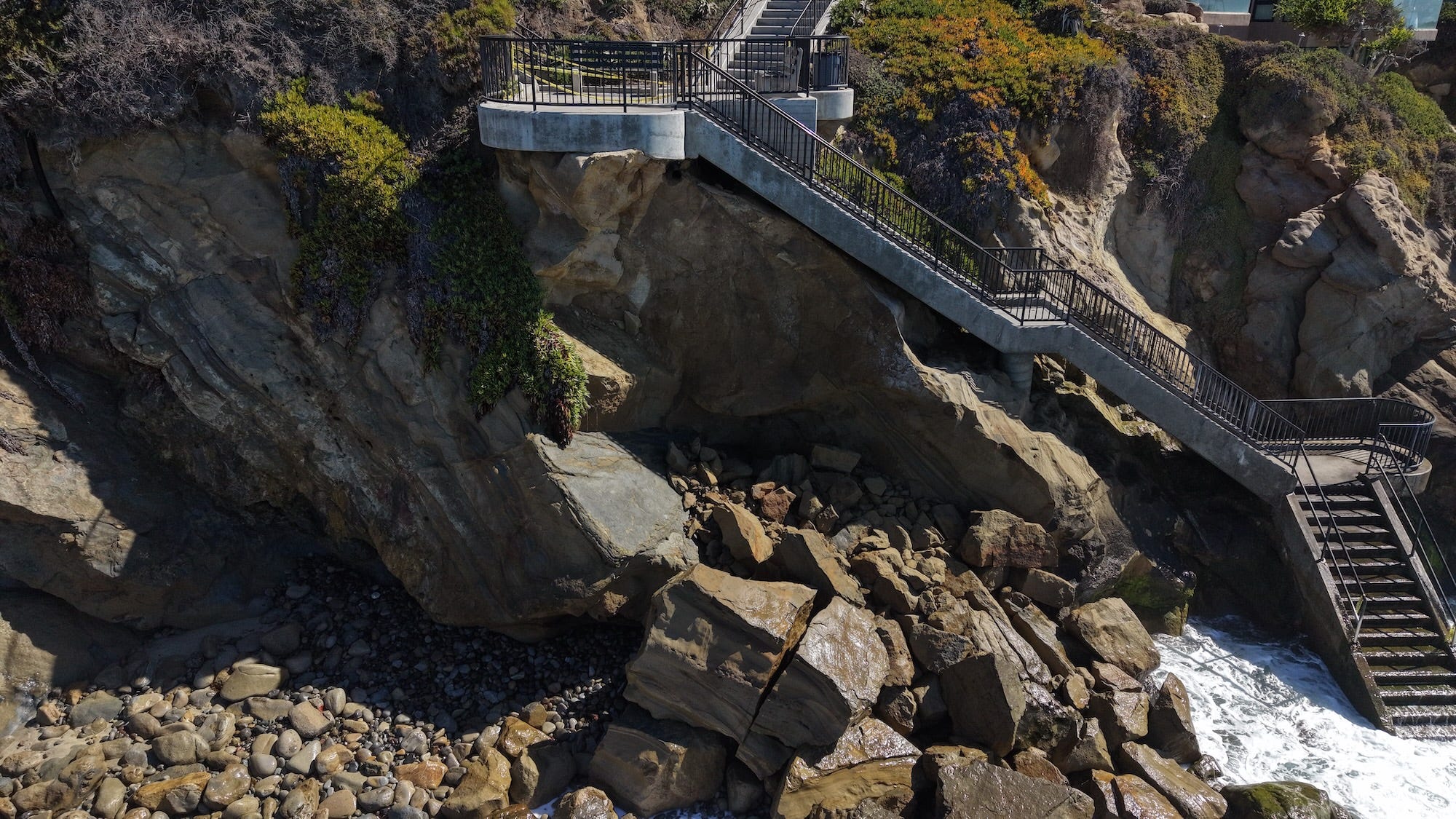 A large section of cliff collapsed off of Laguna Beach recently. (Photo: Erik Olsen)
I drove over to the Pacific Coast Highway crack today and checked it out for myself with my drone. A TV news crew was there filming as well. Sure enough, a very large fissure now spiders along the bluff, stretching up from the beach maybe 60 feet toward the edge of PCH. There were Caltrans crews there trying to figure out what to do. They want to “secure” the bluff, but how? Meanwhile, they’ve already closed one southbound lane while they assess what’s going on. The road itself had not yet been damaged, but the crack is crazily close.
So what does this all mean? Well, it means that for a lot of property owners who live near the sea, their homes could be in trouble. But it means more than that.
Coastal erosion is a natural process. It’s always happening, and it always has happened. But rising seas and powerful swells make it worse. It doesn’t happen at the same rate everywhere. Some places hold up for years, then lose a huge piece all at once. Scientists expect rising sea levels to increase erosion along Southern California’s coastal cliffs over the coming decades.
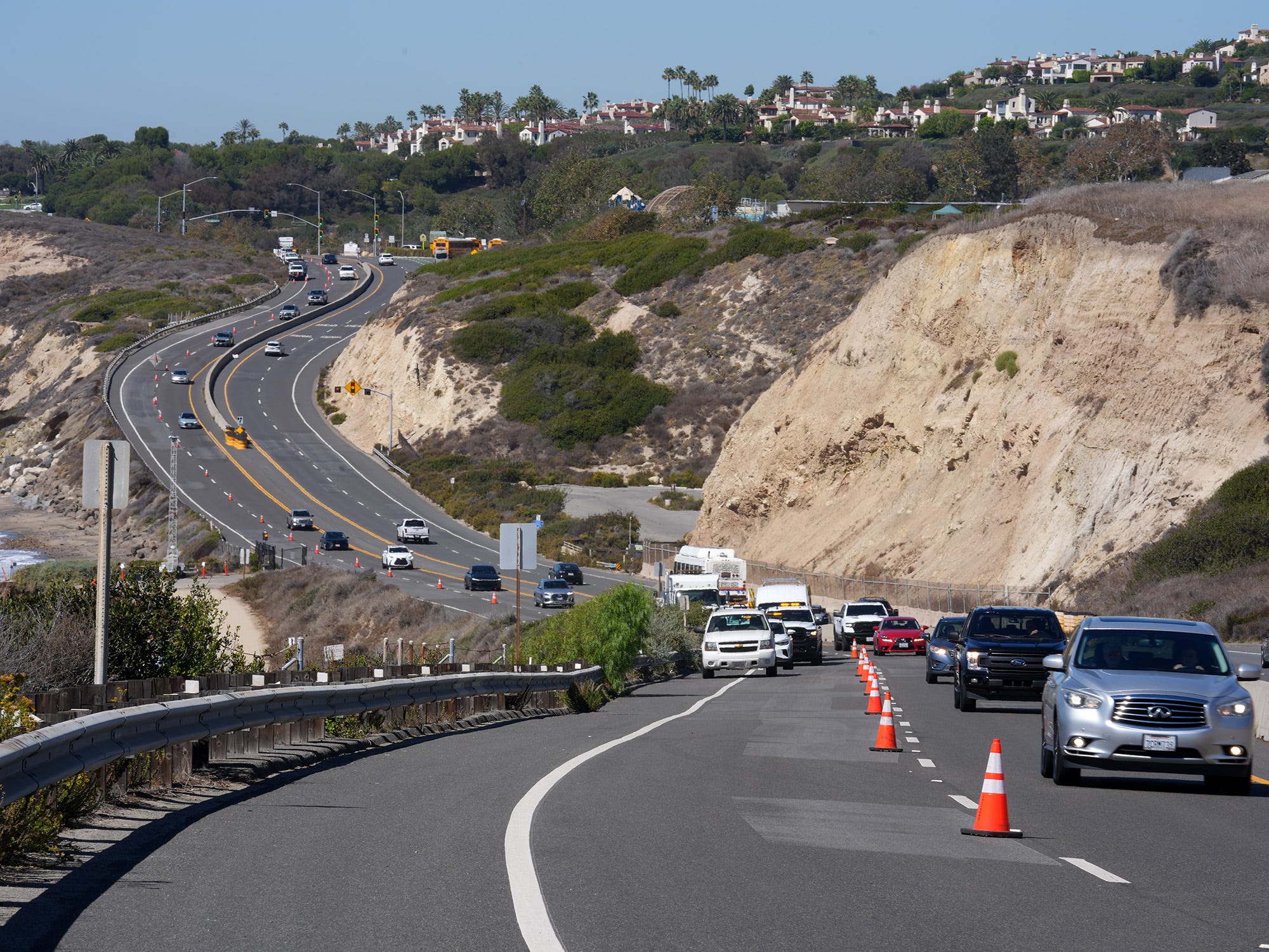
The southbound lane of Pacific Coast Highway near Laguna Beach was closed after a massive crack in the bluff right next to the highway was discovered. (Erik Olsen)
Last year, I read Rosanna Xia’s excellent book California Against the Sea, which investigates this conundrum California faces. Xia is an environmental reporter at the Los Angeles Times — the coast seems to be her beat. The book’s subtitle is Visions for Our Vanishing Coastline, which seemed a bit over dramatic back when I read the book, but now seems prescient. And then some of the worst problems are farther north, in places like Pacifica, where apartment buildings have had to be evacuated and demolished as the cliffs beneath them got eroded away.
So, this is not just a personal property problem. Pacific Coast Highway is a crucial piece of California infrastructure that a lot of people depend on. And then, down in San Clemente, which I also visited, train service has repeatedly been shut down because of erosion on one side of the tracks as well as landslides on the other. A double whammy of erosion. The Orange County Transportation Authority owns the tracks there and has been working with Metrolink to try and protect them and keep the trains running, but it does seem futile. What it looks like is that they will have to move the tracks further inland at a cost into the billions.
Xia talks at length about the future Californians are going to have to deal with. There are remedies, like adding sand to beaches, which is happening. They can try to stabilize bluffs, which doesn’t always work and is also very expensive. They can try and build protective barriers. There is also what’s called managed retreat, which basically means moving homes and roads and other development back from spots that are becoming too dangerous. But not many of these choices are going to be palatable to homeowners who have put their money, and often many years of their lives, into living by the ocean.
We’ve learned the hard way that some fixes come with bad consequences. Piling up large rocks or building seawalls can protect a home or a road, but it can also make things worse for the beach. Waves hitting barriers like rocks or walls often carries away sand at their base, a process known as scour. You might save the property but lose the beach. Xia also discusses this in her book.
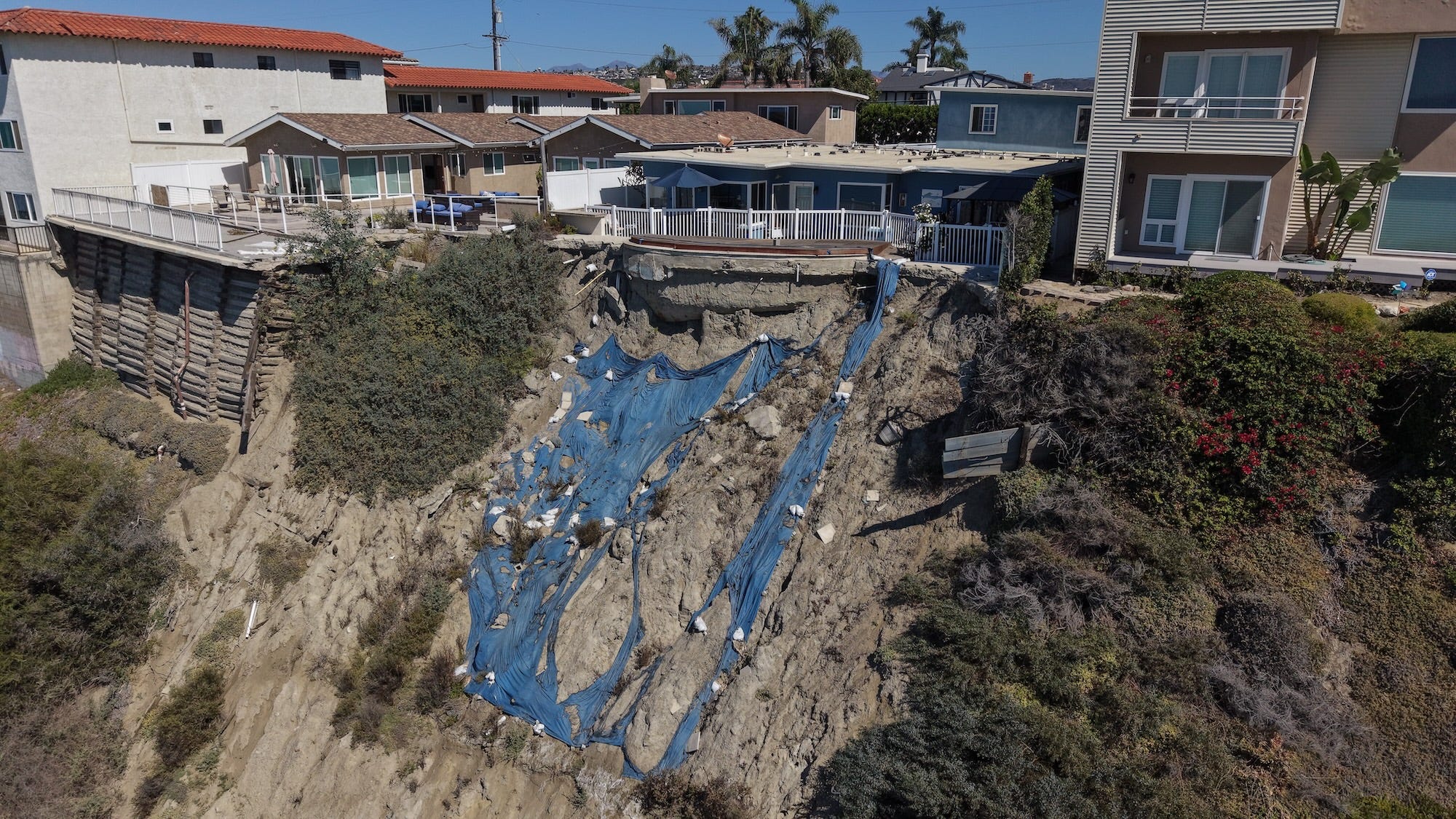 A home built along the cliff collapses into the ocean in San Clemente. (Photo: Erik Olsen)
Change is natural, but rising seas and more unpredictable weather are adding to the problems on a coast that was already changing. So things are changing faster. I don’t think we’re going to be able to stop it everywhere. Maybe nowhere. I think adaptation is really the only solution here, and it’s going to have to be how we deal with a warming planet. That doesn’t mean we stop trying to limit the warming. It means we also prepare for what’s already happening, and I don’t get the sense that’s what happening, at least not at the rate that we need to adapt.
I still want to come back to these places, to dive off Laguna and bodysurf at the Wedge. I want other kids to have a similar version of what I had. We can’t keep the coast exactly as it was, but we can make decisions now that leave them something worth coming back to. I’m just not sure what they are.