
The Walls of Yosemite Are Coming Down
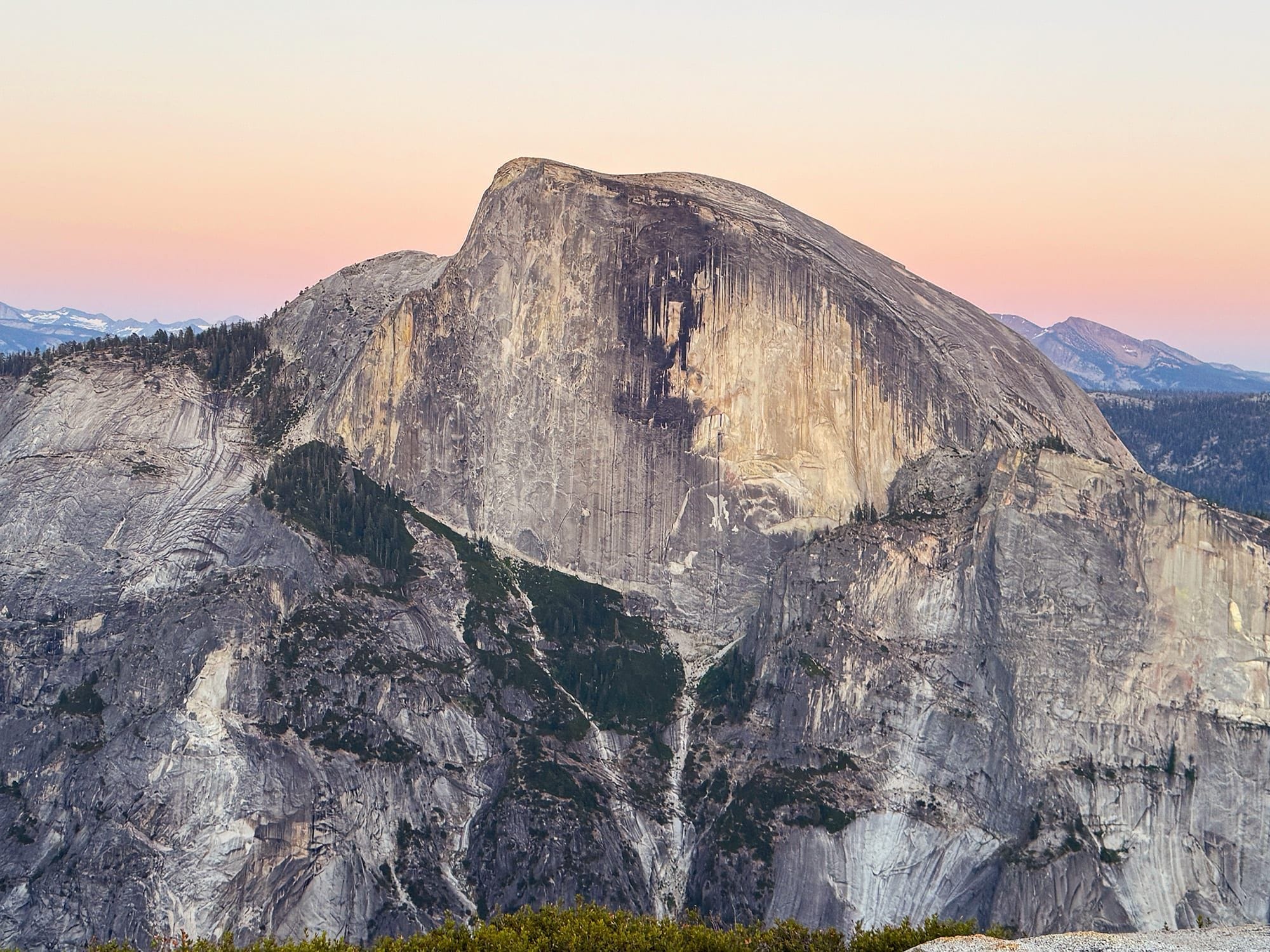
Exfoliation helped create Yosemite’s famous rounded granite domes and continues to peel the cliffs apart in massive sheets of rock.
Two years ago, I did the climb from the valley floor to the top of Yosemite Falls, a gain of some 2,800 feet in 7 miles. It was one of the most exhausting things I’ve ever done, but the views from up on those granite heights are magnificent and make all the work worthwhile.
Few places are as geologically mind-blowing as Yosemite. You’ve got epic scenery in every direction. Stunning waterfalls and rivers. Lots of animal life. And of course, those jaw-dropping granite walls that stretch thousands of feet above the valley floor: El Capitan and Half Dome.
But here’s something most people probably don’t know: those two world-famous cliffs are actively falling apart. Slowly. Constantly. In giant sheets that weigh hundreds of tons.
The process is called exfoliation, and it’s one of the more bizarre things geology does. Donald Prothero, the author of California’s Amazing Geology, defines it as “the peeling off of sheets of rock as they weather on the surface.” But that description, although you can picture it, doesn’t quite capture what’s actually going on. Or the magnitude of it. Or the danger. The fact is, some of the most massive, durable-looking rock formations on the planet are in a continuous state of so-called “pressure release”, shedding their outer layers in curved slabs the size of houses.
But why?
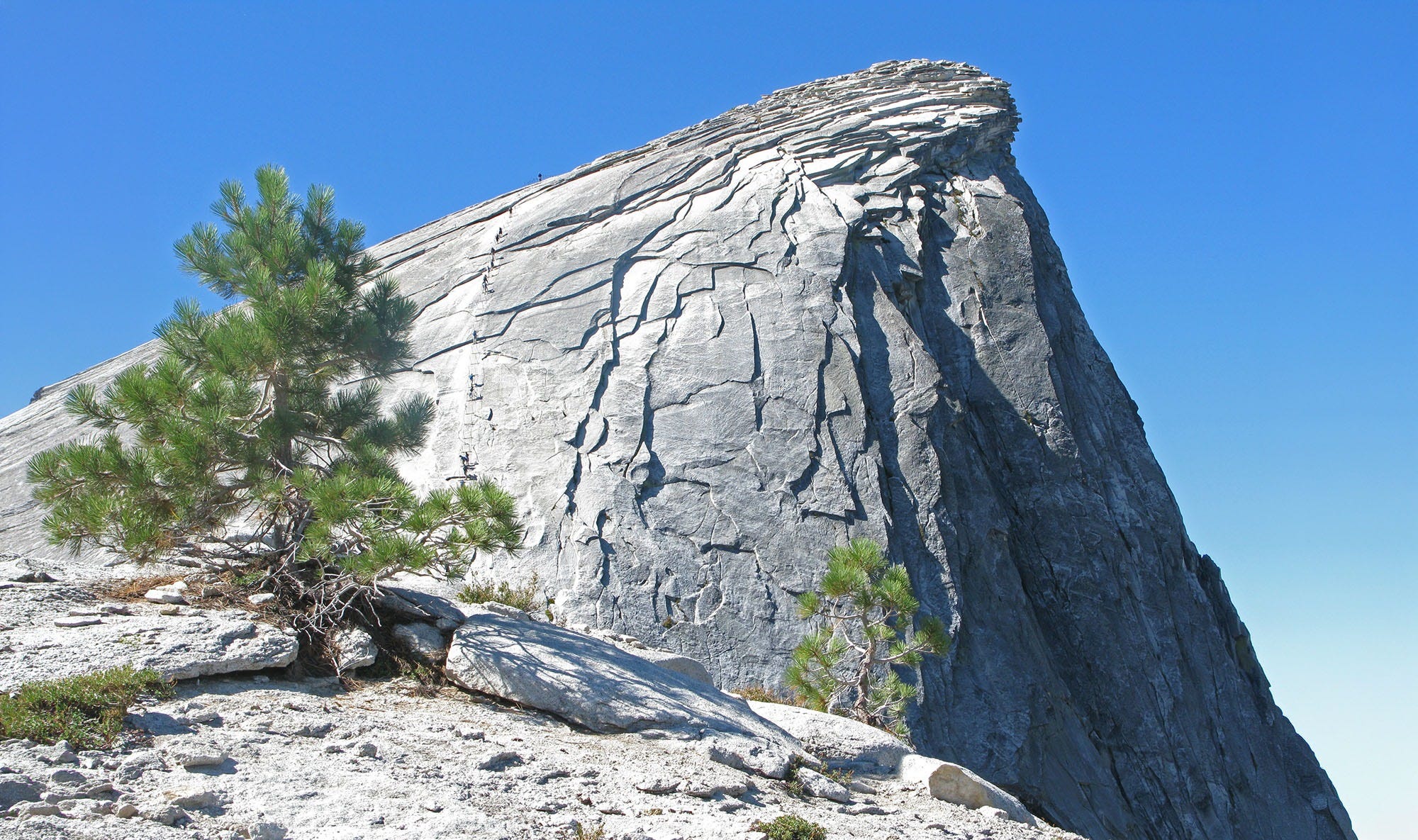 Exfoliation can be seen clearly on this slab of granite in the Sierra in Yosemite. (Photo: Wikipedia)
The granite that makes up Yosemite formed during the age of dinosaurs. We did a whole piece on the creation of the Sierra Batholith and its unimaginable immensity and mass. The enormous granite bodies that underly most of the Sierra range were part of one of the most rapid periods of continental crust assembly on record. The rock that would eventually become Half Dome and El Capitan spent tens of millions of years buried under tremendous pressure, with miles of material stacked above it. Erosion over time exposed the granite. And glaciers carved them into the gargantuan slabs we see today.
But granite is not forgiving. It doesn’t flex. It cracks.
Exfoliation happens through pressure release. In other words, the rocks form under great pressure beneath the surface, but once they rise into the sky and erosion reveals them, the built-up pressure dissipates, and the rock expands and cracks along what geologists call planes or zones of weakness. The result is a series of curved fractures that form parallel to the surface, concentric sheets that peel away layer by layer. As Prothero puts it, “they form curved fractures and the layers peel off in a manner that is similar to the peeling off of the layers of an onion.”
This is why formations like Half Dome, North Dome, and Liberty Cap look sculpted rather than jagged. Prothero writes that this onionskin peeling “is the predominant form of weathering and breakdown operating in the High Sierras today.”
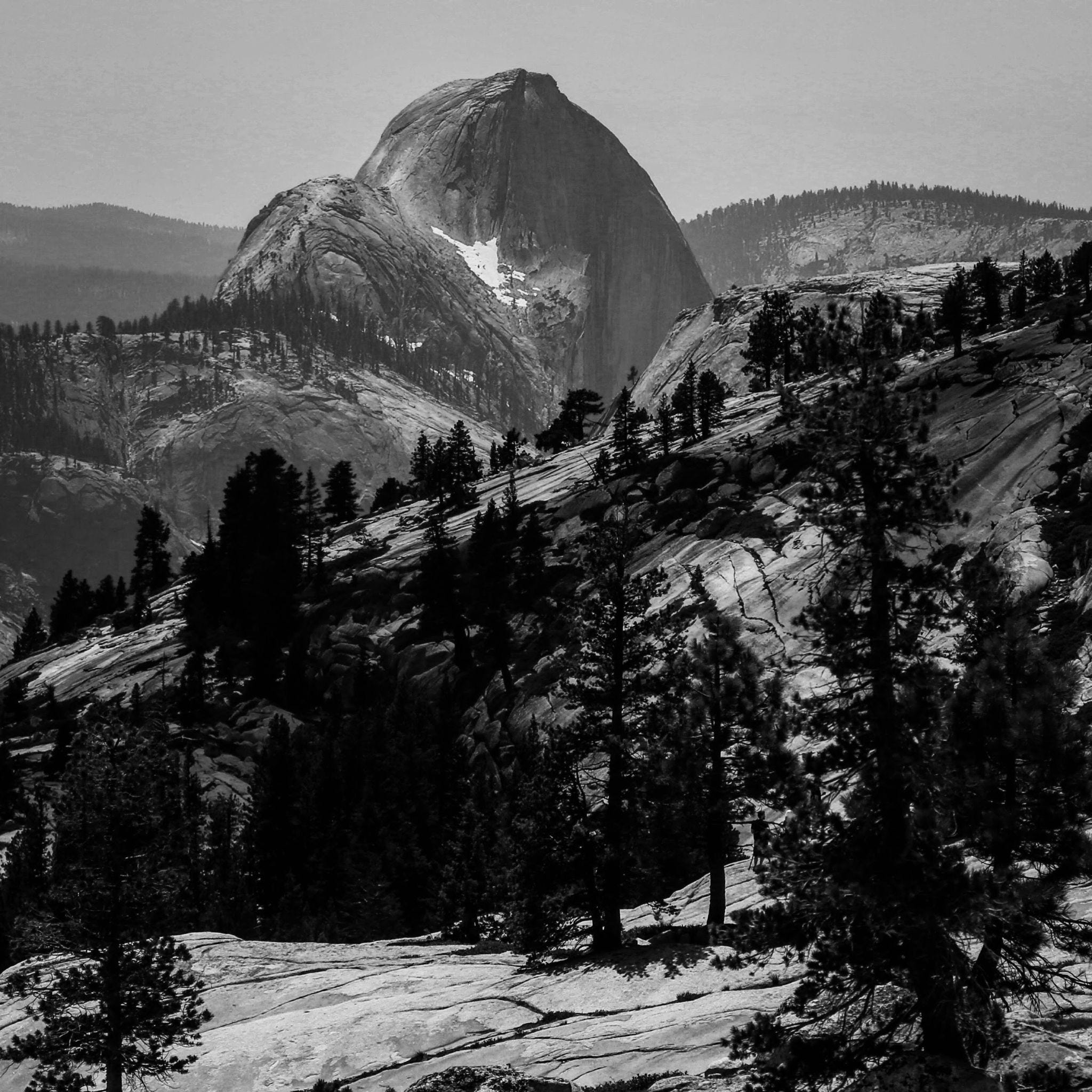 The massive granite domes of Yosemite National Park are one of nature’s great wonders. (Photo: Erik Olsen)
Glaciers were still essential to shaping Yosemite. During the Ice Ages, massive rivers of ice carved Yosemite Valley into its dramatic U-shape. They steepened the cliffs and polished exposed granite surfaces. But the domed geometry of formations like Half Dome is thought to result mainly from exfoliation and pressure release, with glaciers later refining and exposing them.
What accelerates the process is frost wedging. Water seeps into the hairline cracks created by pressure release, then freezes overnight and expands by nearly ten percent, forcing the crack wider. It thaws during the day, seeps deeper, then freezes again. It’s this cycle in the Sierra, where temperatures repeatedly rise and fall rapidly, that cause massive cracks in places that started as a microscopic fracture. Eventually, a sheet of rock that had been clinging to the cliff face for thousands of years simply lets go and crashes to the ground.
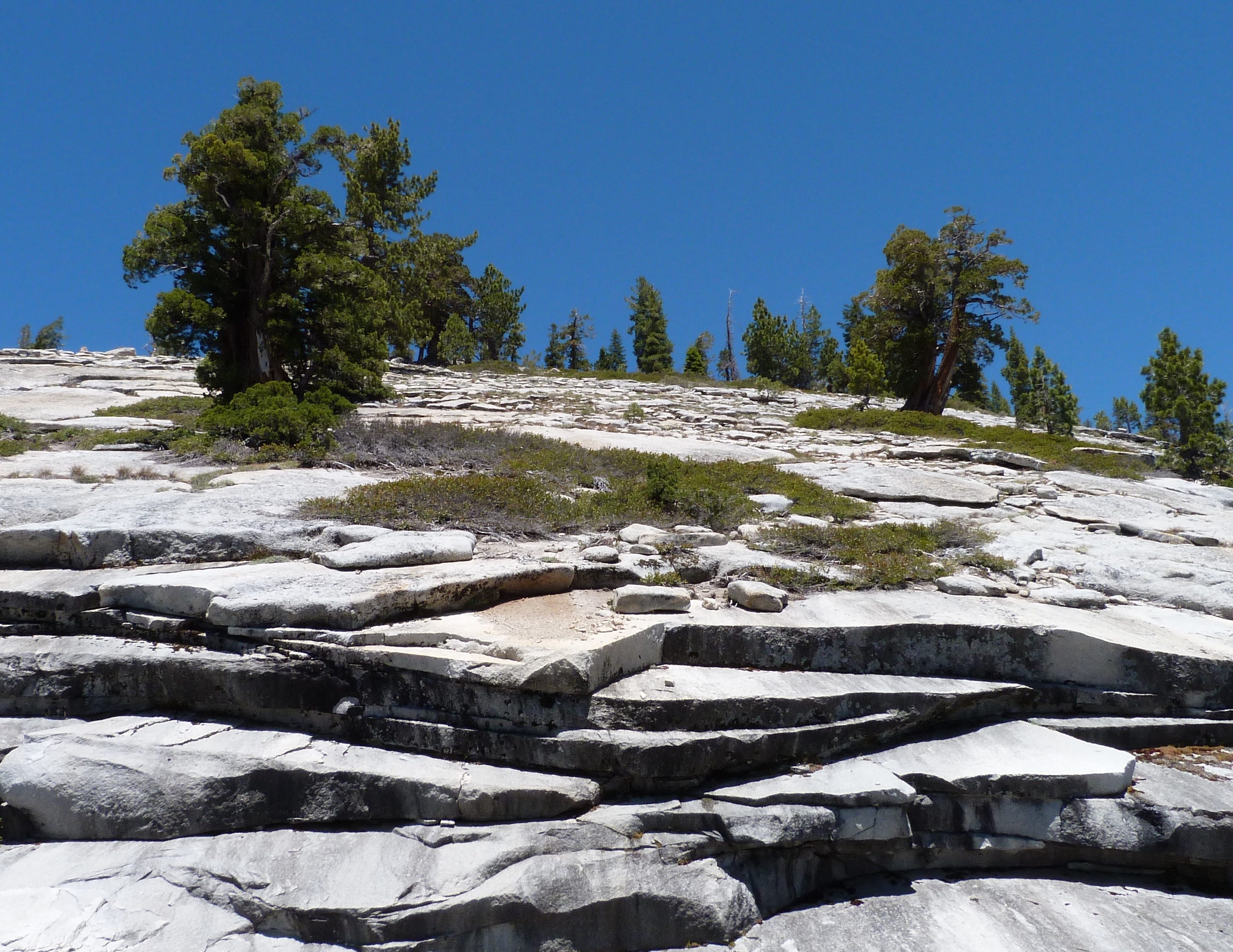 Evidence of exfoliation in Yosemite (Photo: Wikipedia)
And in a place like Yosemite that attracts millions of visitors, that can be very dangerous. Even deadly.
On September 27, 2017, a slab of granite roughly the size of a 13-story apartment building broke loose from El Capitan’s east face, 650 feet above the valley floor. Andrew Foster, 32, from Cardiff, Wales, and his wife Lucy, 28, were standing on a pile of rocks at the base of the wall, picking up trash. Andrew had just quit his job at Patagonia Europe. He and Lucy had taken the trip to celebrate their first wedding anniversary. When Andrew heard the crack and saw what was coming, he threw himself on top of his wife. Lucy later told his aunt: “Andrew saved my life. He dived on top of me as soon as he could see what was going to happen.”
Andrew Foster died. Lucy was airlifted out with a punctured lung.
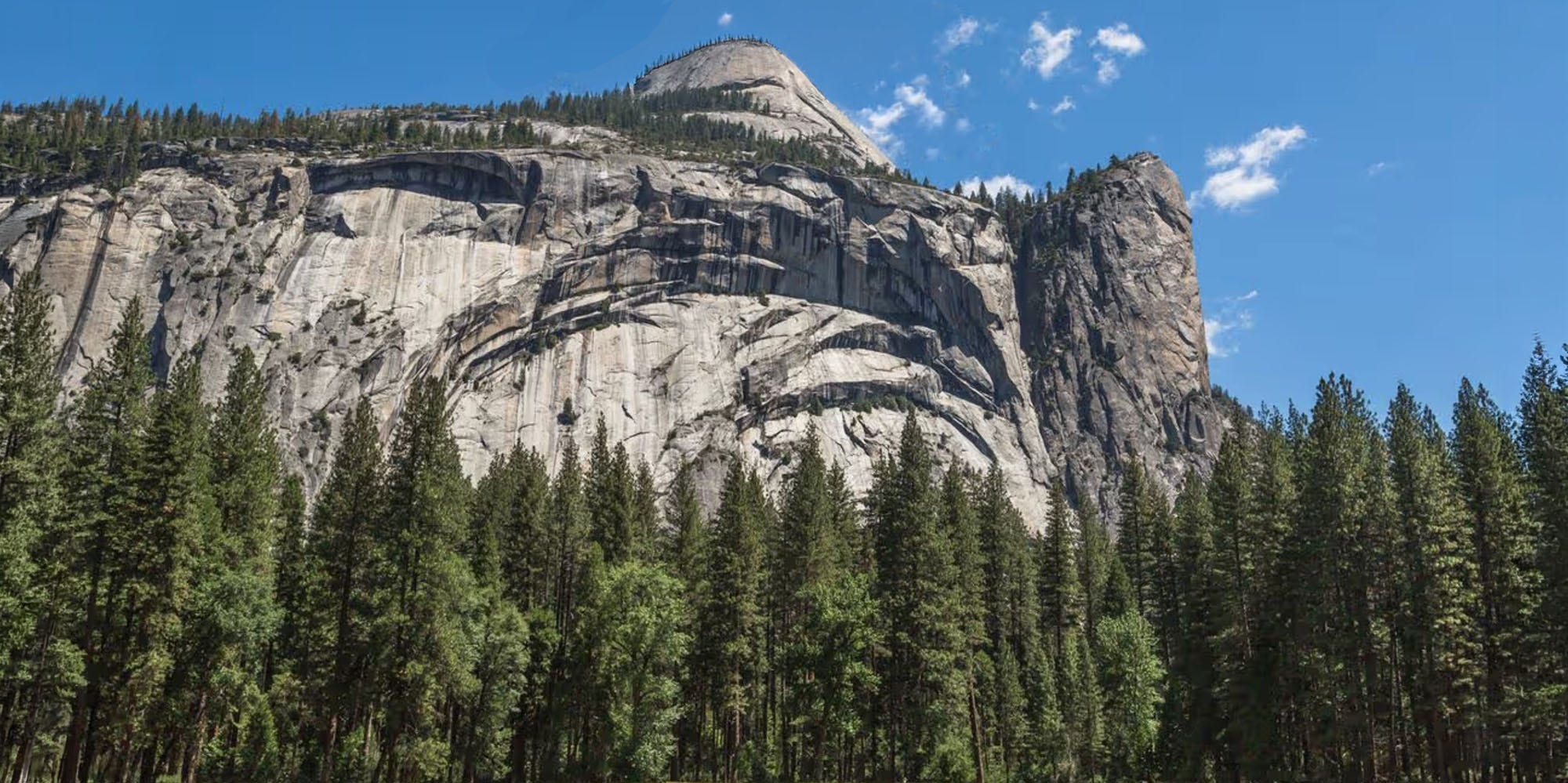 The sweeping curved cracks across this granite are exfoliation joints, giant sheets of rock formed as the Sierra Nevada slowly shed miles of overlying material.
The next day, a second fall came from the exact same location. It was significantly larger than the first. The dust cloud it sent into the valley could be seen for miles. Ken Yager, who has lived near the park for decades and climbed El Capitan many times, watched it from his car. “I’ve probably only witnessed clouds that big maybe six times,” he told the Times.
That evening, geologists worked the face of El Capitan by helicopter and lidar scanner, mapping the scar and modeling how the rock had broken away. Both events were classic exfoliation failures: rock sheets tens of meters tall and wide, typically less than a meter thick, peeling away those planes of weakness, those fractures that run parallel to the rock face, built up over thousands of years of thermal stress and freeze-thaw cycling.
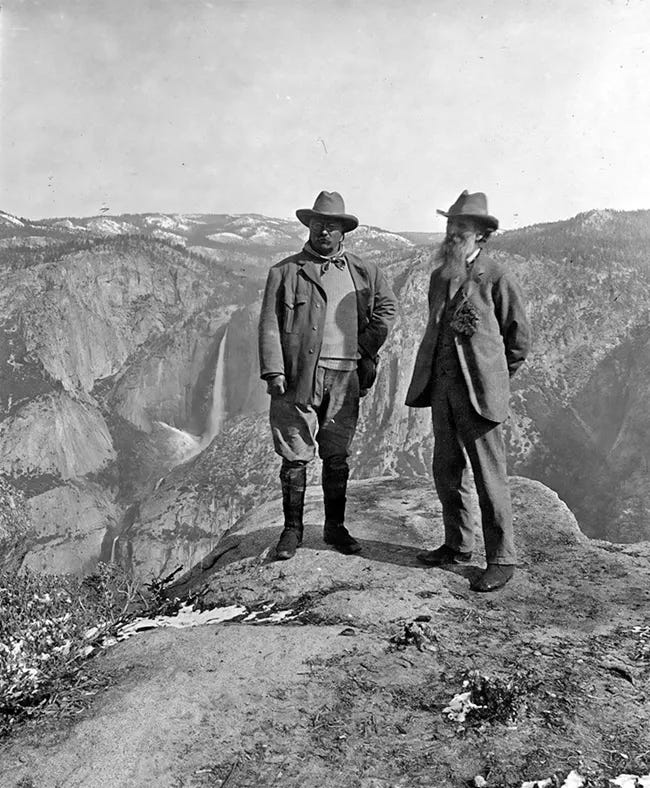 President Theodore Roosevelt and John Muir stand together at Glacier Point, Yosemite National Park, during their historic 1903 visit, with Yosemite Falls in the background. (Photo: Library of Congress)
Rockfalls in Yosemite are common; the park documents up to 80 events per year, and a 2013 USGS report catalogued 925 slope movements between 1857 and 2011, killing 15 people and injuring at least 85 over that span. El Capitan’s southeast face alone has experienced 57 documented rockfalls over the past 40 years. Most are small. Some are not.
The cliffs of Yosemite look like the quintessence of permanence. They have been there for millions of years. People have been standing at their base, camping, climbing, and taking photographs for over a century. Theodore Roosevelt and John Muir spent time near the granite behemoths. But nature does what it wants, and we are more or less oblivious to the ongoing, slow geologic processes that are hard to fathom in this age of immediate gratification. And, of course, the processes that shaped them doesn’t stop. The pressure that was locked into that granite 100 million years ago is still being released, still working its way outward through the rock, still finding new cracks to open.
More California science, photography and wild places on Instagram @californiacuratedus