
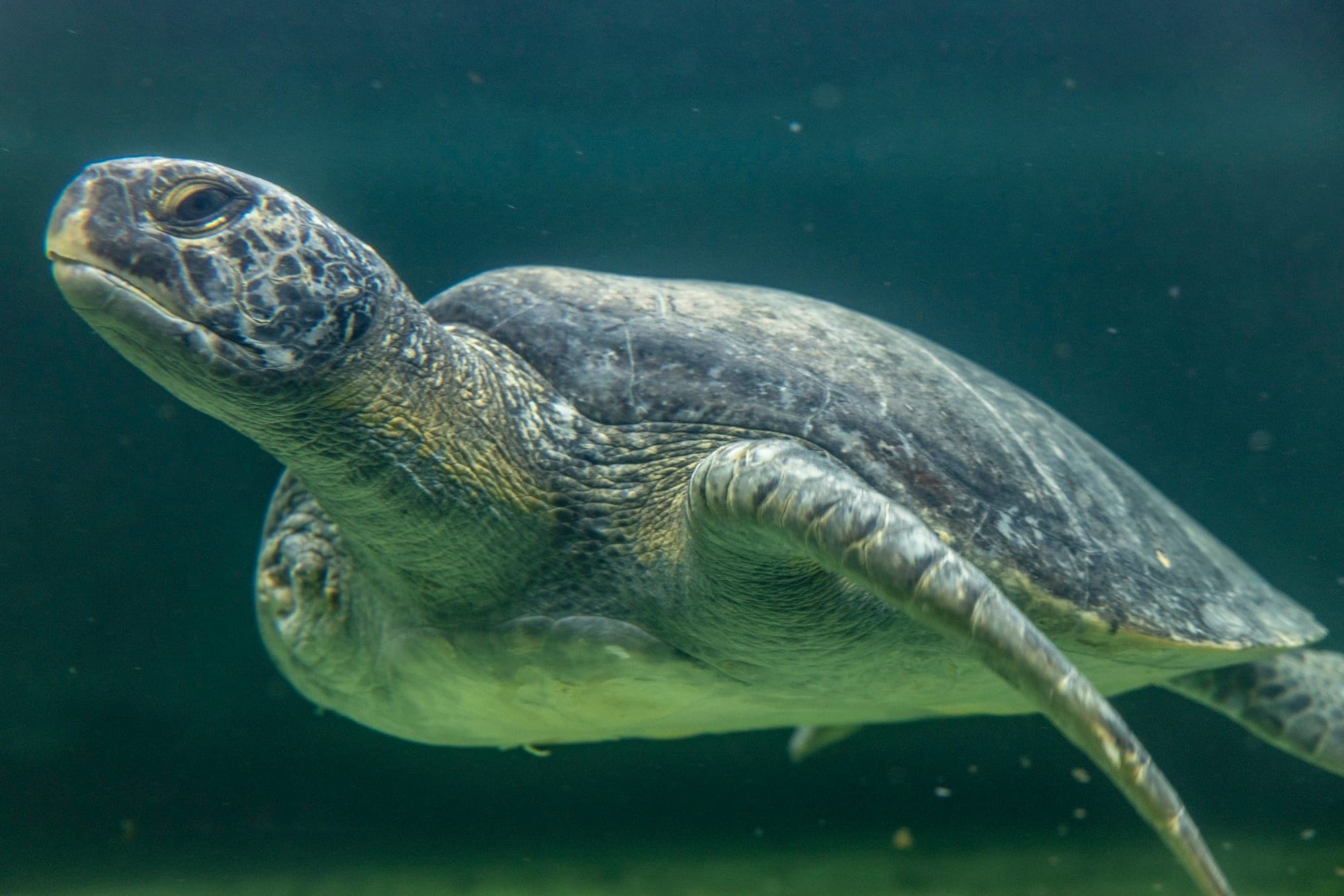
Sea Turtles Are Thriving in a Concrete River in Los Angeles
A threatened population of green sea turtles is thriving in the concrete channels of the San Gabriel River in Long Beach.
It’s one of the strangest and coolest wildlife stories in Southern California: green sea turtles are living and thriving at the mouth of the San Gabriel River. A big, urban, ugly concrete river in the middle of LA. Well, or Orange County. Or both, since the river is the boundary between the two counties.
And so I went and saw them. I found the spot on Google Maps after seeing a post on Instagram put out by the Aquarium of the Pacific. I parked near the 405 freeway, slipped through a hole in a fence, and climbed up a steep embankment where the San Gabriel River flows lazily through a concrete channel.
And there they were.
Sea turtles. Eastern Pacific green sea turtles, to be exact. Probably twenty of them. Several were huge, maybe two hundred pounds or more. Others were smaller. Perhaps juveniles. Swimming and feeding beneath bridges, beside power plants, and inside one of the most engineered waterways in California.
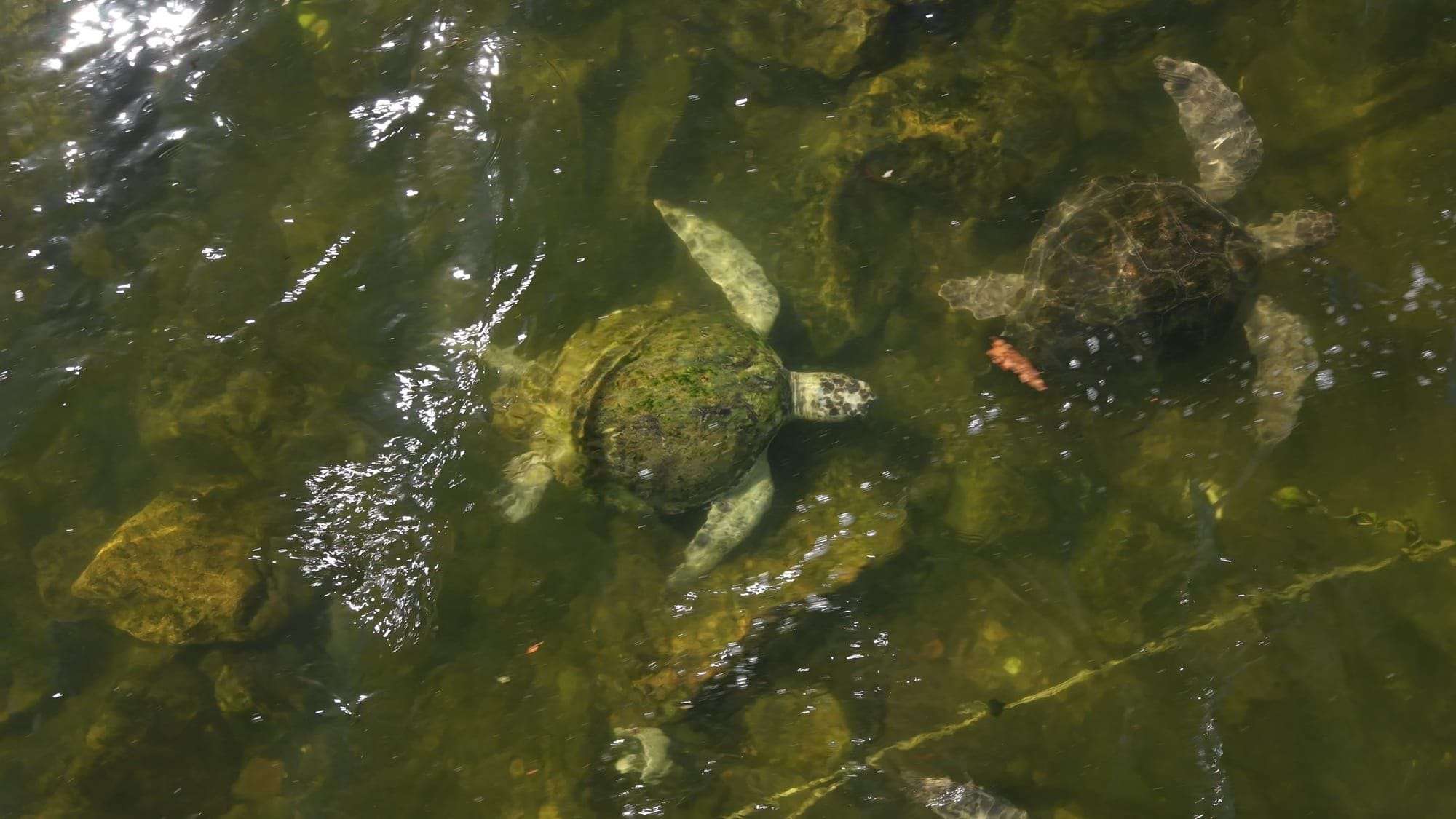 Eastern Pacific green sea turtles swim through the lower San Gabriel River near Long Beach, home to the northernmost resident population of green sea turtles in the eastern Pacific Ocean. (Photo: Erik Olsen)
Of course, I filmed them and hung around for a while, feeling both astonished by the sight and slightly embarrassed that I had never come to this spot before. A family of five people, locals, had come down, and the children whooped and giggled as they followed one particularly large turtle as it slowly paddled its way upriver.
They are majestic and beautiful, if a bit cartoonish. Swimming against the current, which also carries trash and other detritus, they use their flippers like giant oars and only progress a foot or two with each stroke. Every few minutes, one would raise its head above the water and take a quick sip of air. On a few occasions, one would glance quickly at me before going back under.
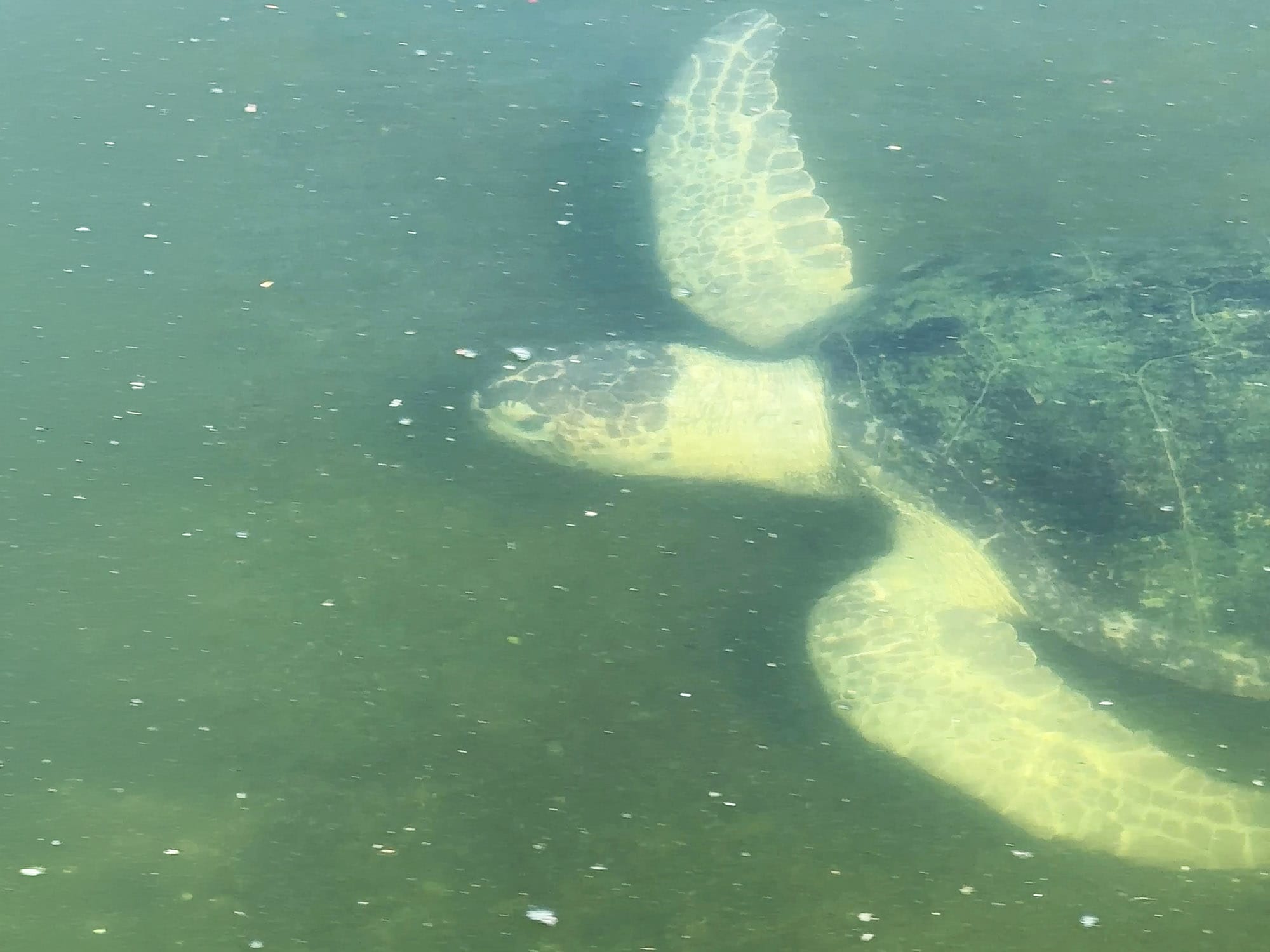 A lone Eastern Pacific green sea turtle surfaces inside the concrete channel of the San Gabriel River in Long Beach. (Photo: Erik Olsen)
What ancient-looking creatures! A sea turtle’s face has a segmented, reptilian look, like smooth, perfectly laid stones. Its eyes are blackish, but curious. The shell is also fantastically geometric, made up of large polygonal plates called scutes. Scutes are made of keratin, the same material found in human fingernails and hair. Beneath the scutes is the actual bone structure of the shell.
I wanted to know more, so I started digging through papers and reports, and when I still wasn’t satisfied, I called the Aquarium of the Pacific in Long Beach. It turns out the aquarium has been directly involved in the monitoring, conservation, rescue, and rehabilitation of these turtles for years. I spoke to Cassandra Davis, director of volunteer services for the Aquarium of the Pacific, who has been involved with the Aquarium’s turtle program for several years. The first thing I asked is: why are they here?
“It really is shocking. It’s surprising, magical, and surreal all at the same time,” says Davis. It turns out these animals travel thousands of miles across the Pacific to find refuge in one of the last places you’d expect: the concrete waterways of Los Angeles. “Green sea turtles are so good at navigation that they can find tiny islands in the middle of the Pacific that up until very recent modern technology, even humans couldn’t reliably find for the most part,” she says.
Far out at sea, the turtles migrate between feeding grounds and nesting beaches, with females returning to sandy beaches in places like Mexico to lay eggs. Weeks later, hatchlings emerge from the sand (I’ve personally seen this once) and scramble toward the ocean, beginning a journey that, for some, may eventually lead all the way to the San Gabriel River.
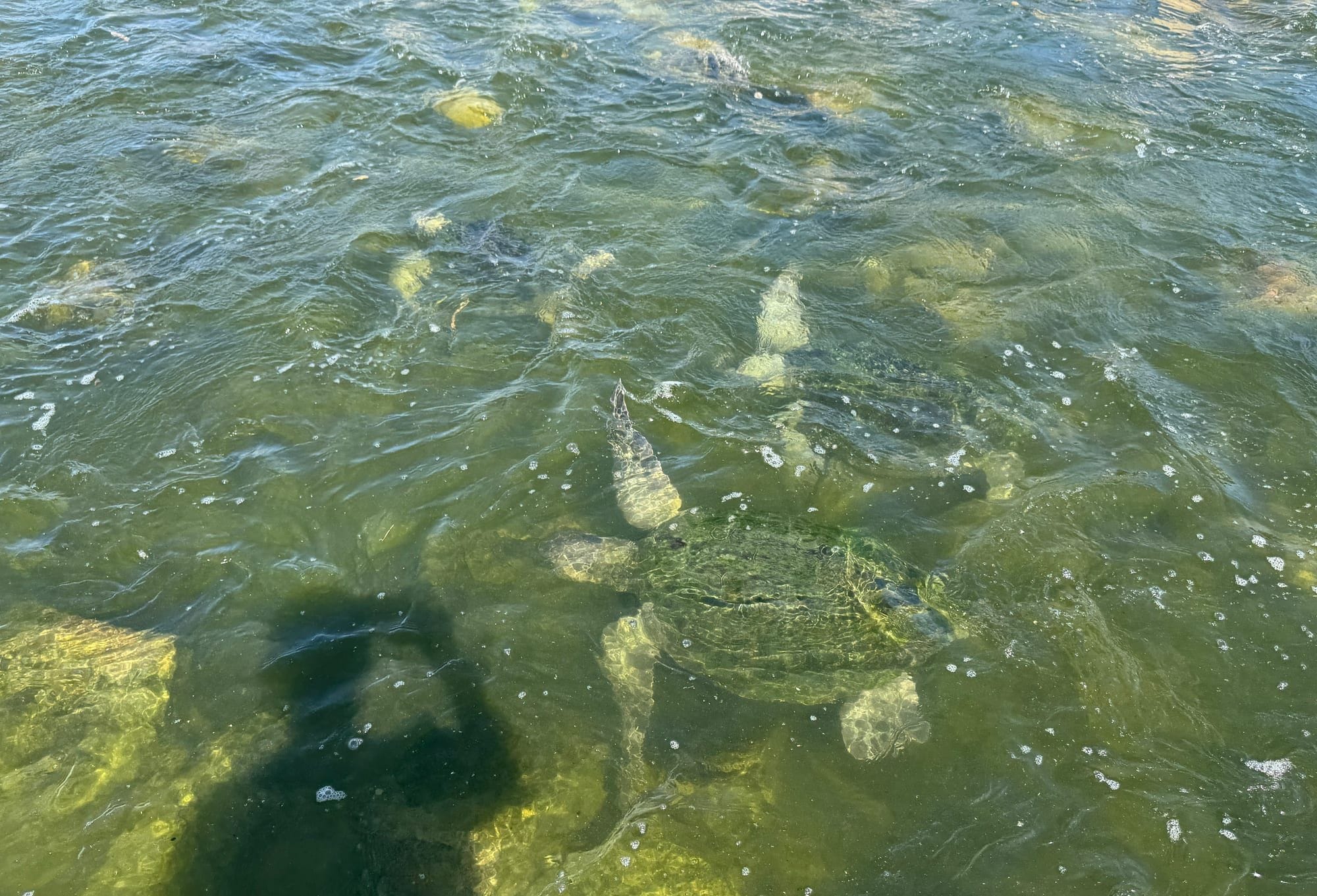 Eastern Pacific green sea turtles in the San Gabriel River (Photo: Erik Olsen)
The turtles here are considered the northernmost resident population of green sea turtles in the eastern Pacific Ocean. Scientists once thought that distinction belonged to turtles farther south near San Diego. Researchers estimate there could be well over a hundred turtles that call the San Gabriel River and the Cerritos Wetlands home.
But why here?
According to Davis, part of the answer is warmth. Green sea turtles are reptiles, and they tend to seek out a thermal refuge. Here at the outflow of the San Gabriel River, the waters are shallow and therefore keep relatively warm. “The sun shines and the water comes out at a nice spa temperature,” she says. Also, several nearby power plants have an impact as well. “They discharge warm water and that heats up that area of of the river.”
But the river also provides food and shelter. The turtles gather around the Los Cerritos Wetlands, where there is plenty of algae and aquatic vegetation, their favorite meal. I watched one grab a large chunk of green slime as it moved down river and gulped it down with one or two swallows.
We’ve known about the turtles for decades, but recently researchers, volunteers, and conservation groups have been working to better understand and protect them. The National Oceanic and Atmospheric Administration (NOAA) is deeply involved in sea turtle conservation in Southern California, including the San Gabriel River population.
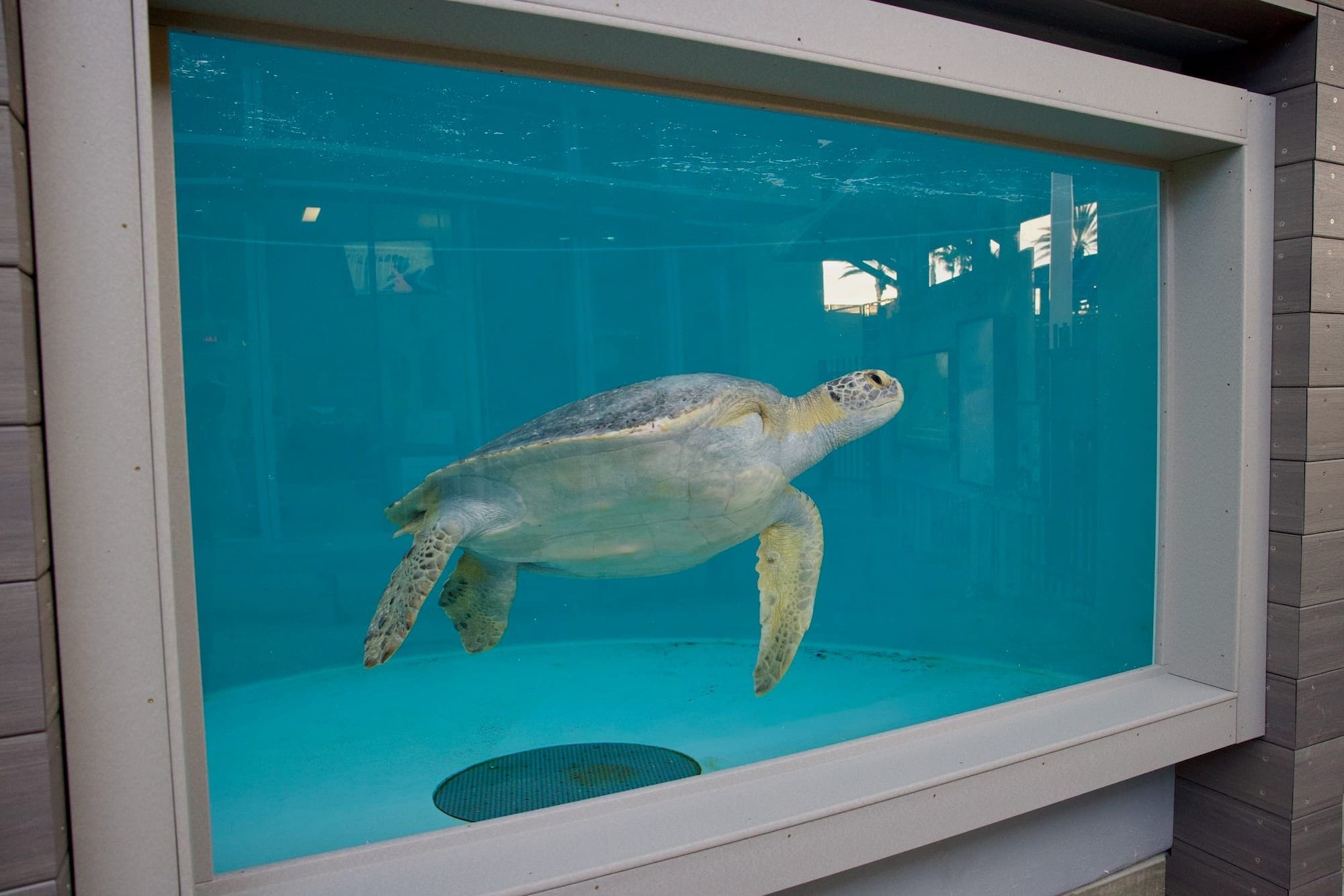 Porkchop at the Sea Turtle Rehab Center 2026 (Photo: Aquarium of the Pacific)
According to Davis, the turtles face threats from fishing line, hooks, pollution, habitat loss, and boat strikes. In March 2025, a turtle nicknamed Porkchop was rescued after becoming tangled in fishing line. It’s flipper had been cut deeply by the line, and after nearly a year of rehabilitation, including amputation of the damaged flipper, the Aquarium of the Pacific released it back into the San Gabriel River in February 2026.
Some turtles here are also fitted with tracking tags so scientists can better understand their movements and behavior. But satellite tags are expensive, and the turtles have a tendency to get rid of them, so some are fitted instead with small metal tags embedded with a microchip so they can be easily scanned and identified. “And then the latest method of tracking is we’re using photo ID. We’re using identification of the face itself of the sea turtles,” says Davis.
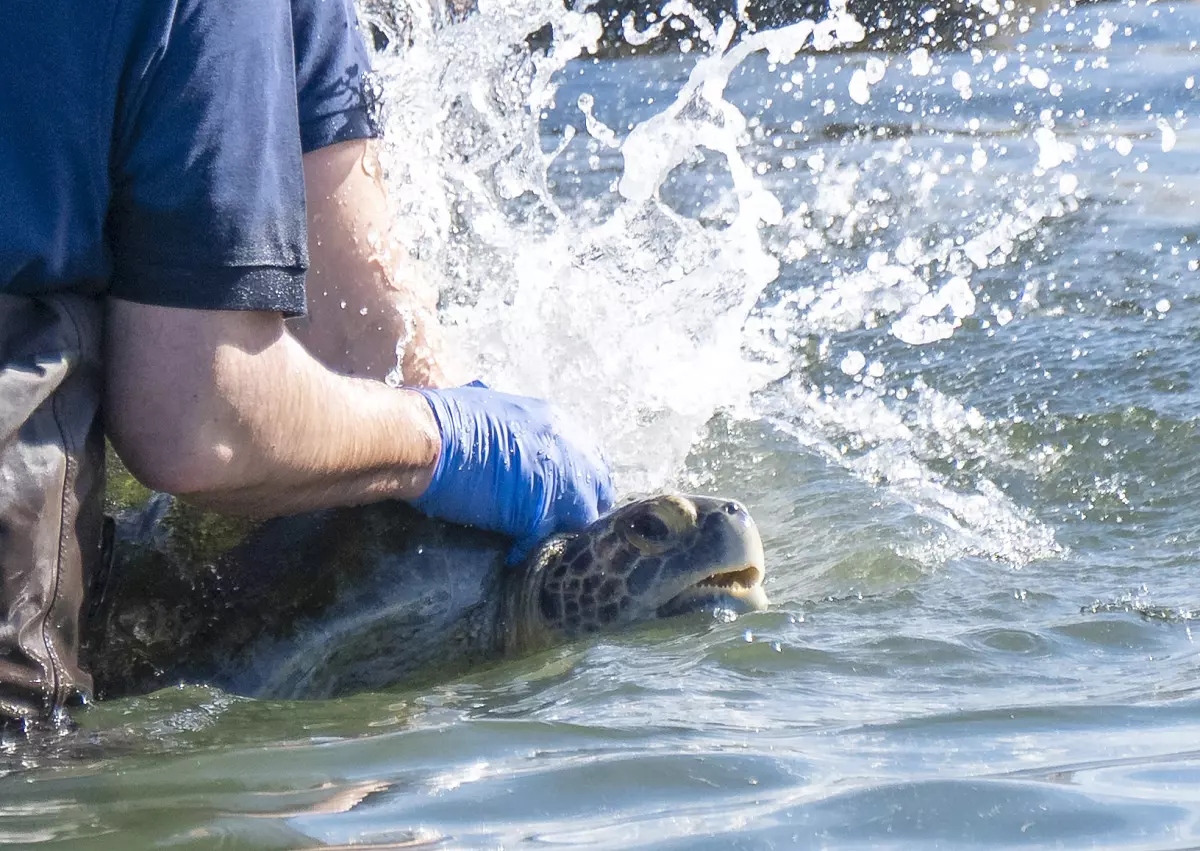 Porkchop, an Eastern Pacific green sea turtle, is released into the San Gabriel River after nearly a year of rehabilitation and medical care at Aquarium of the Pacific. (Josh Barber / Aquarium of the Pacific)
Though they are still considered threatened, green sea turtle numbers are rising in many parts of the world thanks to decades of conservation efforts and habitat restoration. Davis says researchers are seeing encouraging signs in Southern California as well.
“We are really, really hopeful for an animal like the green sea turtle,” she says.
And maybe that’s what makes this story so remarkable: a threatened sea turtle thriving in an urban river in Los Angeles.
As Davis puts it, “It is so amazing to live in a time when we get to see these recovery stories starting to play out.”