The Barreleye Fish Has a See-Through Head, and It Lives Off Monterey
With a transparent head and glowing tube-shaped eyes that swivel, the barreleye fish looks like science fiction. MBARI scientists filmed it in Monterey Canyon and solved the mystery of how it sees.
Updated
(Courtesy: Monterey Bay Aquarium Research Institute MBARI)
If you’ve seen the video, you don’t forget it: a little fish hanging in the dark with a clear, see-through head, and inside it, two big green eyes staring straight up. It looks like a sci-fi prop. It’s real. It’s the barreleye fish, Macropinna microstoma, and it lives right off California, in the deep water of Monterey Canyon.
First described in 1939, the barreleye lives across the North Pacific, from California, especially around Monterey Canyon, out toward Hawaii and up to Japan and the Bering Sea. It usually stays between about 400 and 2,500 feet down, in the twilight zone, where only a faint blue glow of sunlight reaches.

The name comes from its eyes, which are shaped like barrels, or tubes, and are extremely sensitive to light, which is in short supply down there. They usually point straight up, so the fish can spot the silhouettes of prey and predators against the dim light from above, or the glow of bioluminescent animals. It’s basically a living periscope. (And those things on the front of its face that look like eyes? Those are its nostrils.)
https://www.youtube.com/watch?v=Akv36y8WLYA
For decades, there was a puzzle. Scientists thought the barreleye’s eyes were fixed in place, pointing up. So how could it see the food in front of its mouth? In 2009, researchers at the Monterey Bay Aquarium Research Institute in Moss Landing figured it out.
Bruce Robison, a legendary deep-sea biologist I’ve interviewed at MBARI, and his colleague Kim Reisenbichler showed that the eyes can actually rotate inside the clear shield over the fish’s head. The barreleye looks up to spot food, then swivels its eyes forward as it rises to grab it.
 A remotely operated vehicle or ROV named Doc Ricketts (MBARI)
They worked it out from video shot by MBARI’s remotely operated vehicles about 2,000 to 2,600 feet down off Central California. The fish usually hung motionless, like little zeppelins, their eyes glowing green in the ROV lights. The video also showed something nobody had documented before: the clear, fluid-filled shield over the head. Specimens hauled up in nets had always arrived with it destroyed.
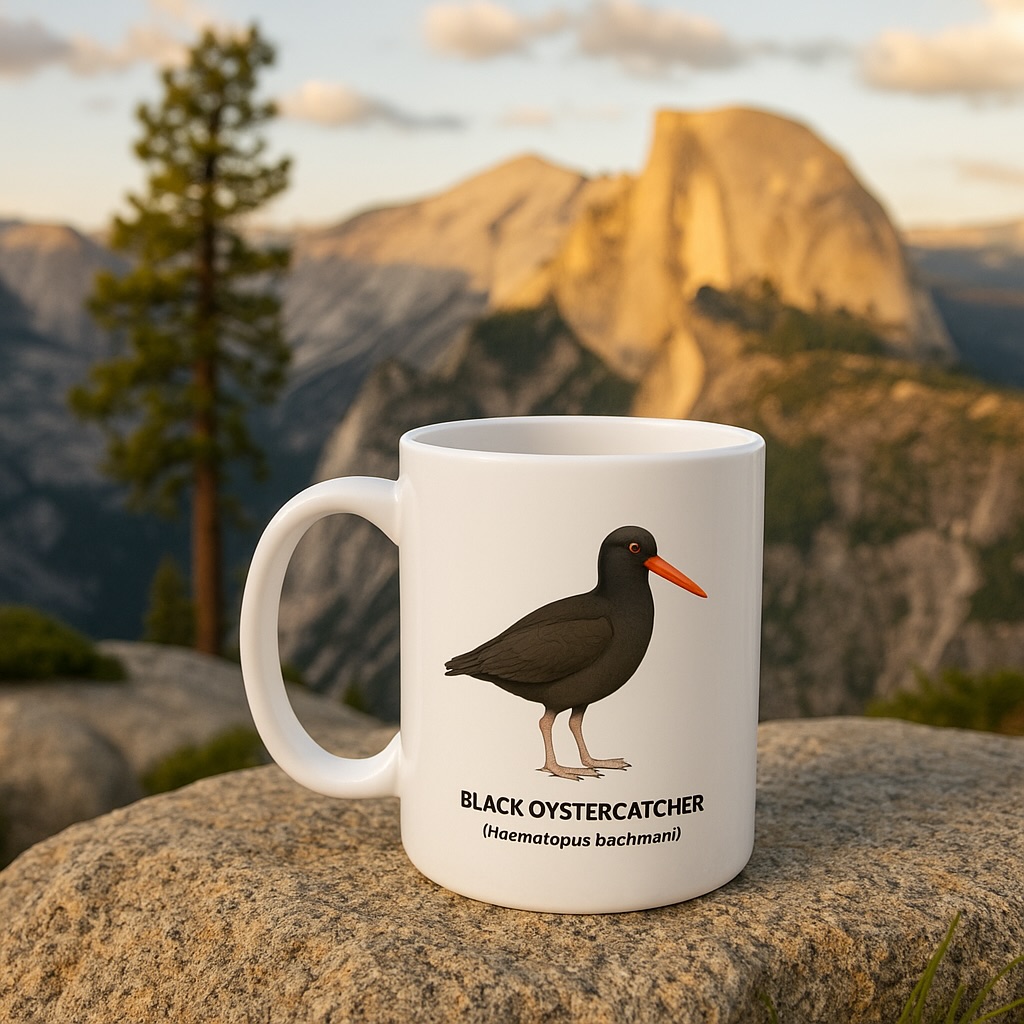
Celebrate California’s incredible birdlife one mug at a time. Each design features a native species illustrated in vivid detail,
**Check out our Etsy store. **
It’s a great example of evolution solving a weird problem in a weird way, and a reminder that some “facts” about deep-sea animals were based on dead specimens that had been crushed on the way up.
The barreleye has other tricks. Big, flat fins let it hover almost perfectly still, which saves energy where food is scarce. Its mouth is tiny, built for small animals like zooplankton. Robison and Reisenbichler also suspect it steals food from siphonophores, long, stinging jellyfish relatives that catch prey in their tentacles, and that the clear shield may protect its eyes from the stings.
 Monterey Bay Aquarium Research Institute (MBARI) in Moss Landing, California
Like other fish, it also has lateral line canals, fluid-filled channels that sense pressure changes, so it can feel movement nearby. In the dark, every bit of extra information helps.
There’s still a lot we don’t know, like how it breeds, how long it lives or how it spends its days. It’s just very hard to study something that lives half a mile down.
And it lives just a few miles off the coast of Monterey. Every time the robots go down into the canyon, there’s a chance they’ll find something just as strange, and nobody’s seen it yet.
More California science, photography and wild places on Instagram @californiacuratedus