California Has a Huge Whale Graveyard off the Coast. And That’s Not a Terrible Thing.
Whale falls offer scientists a treasure trove of information about life in the deep ocean. Microbiologist Jeffery Marlow talks about the importance of microbes.
Back in 2023, scientists surveying a vast military-industrial dumpsite in the deep ocean off Southern California were looking for barrels and other remnants of decades of industrial and military dumping. They found plenty of it. They had discovered an astonishing amount of it during earlier surveys and were now expanding the search across a much larger area of the seafloor.
There was a very unfortunate period after World War II when it wasn’t considered a big deal to take all your poisonous, caustic garbage — let alone unused munitions — and simply toss them over the side of a ship, letting it sink to the seafloor and do God-knows-what to the environment.
That’s a terrible story, and the Los Angeles Times broke the scandal back in 2022. But that’s not what I found most interesting about the recent survey. Along with all the barrels and old munitions, scientists also found an extraordinary number of whale skeletons on the seafloor. So many, in fact, that some researchers believe Southern California could be home to one of the largest whale graveyards in the world.
Seven whale carcasses were confirmed with underwater video. Sonar data suggested that more than 60 may lie within the surveyed area. These sunken carcasses are known as “whale falls.”
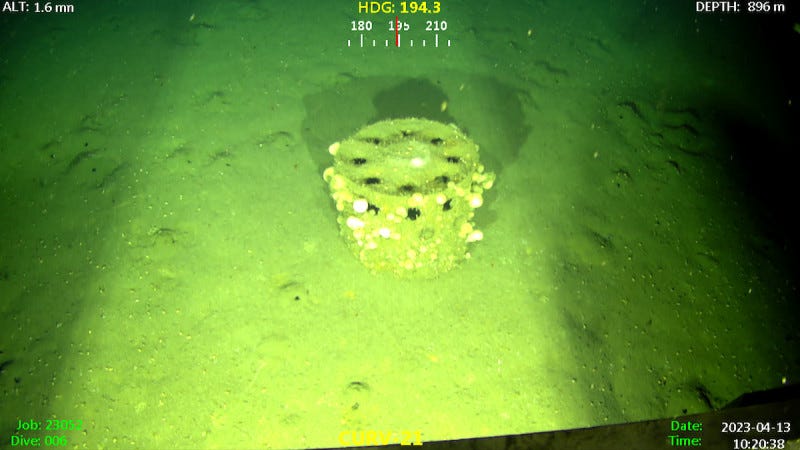 Sample munitions surveyed in Scripps expedition (Photo: Scripps Institute of Oceanography)
That may not be entirely surprising. California sits beside one of the world’s great whale corridors. Over the course of any given year, tens of thousands of large whales migrate through or feed in the waters off our coast, many within sight of land. Grays, blues, humpbacks and fin whales love the rich waters of the California Current, which can be abundant in food.
Still, the concentration found off Los Angeles was remarkable. Before the Scripps surveys, scientists had documented only about 50 naturally occurring whale falls across the world’s oceans. The possible discovery of more than 60 in one relatively small area would make the San Pedro Basin one of the greatest known concentrations of whale remains anywhere on Earth.
There is no evidence that the deaths were connected to the industrial waste or military munitions found nearby. The skeletons probably accumulated over many decades. The basin’s extremely low oxygen levels slow decomposition, while its low sedimentation rate may leave the bones exposed rather than burying them.
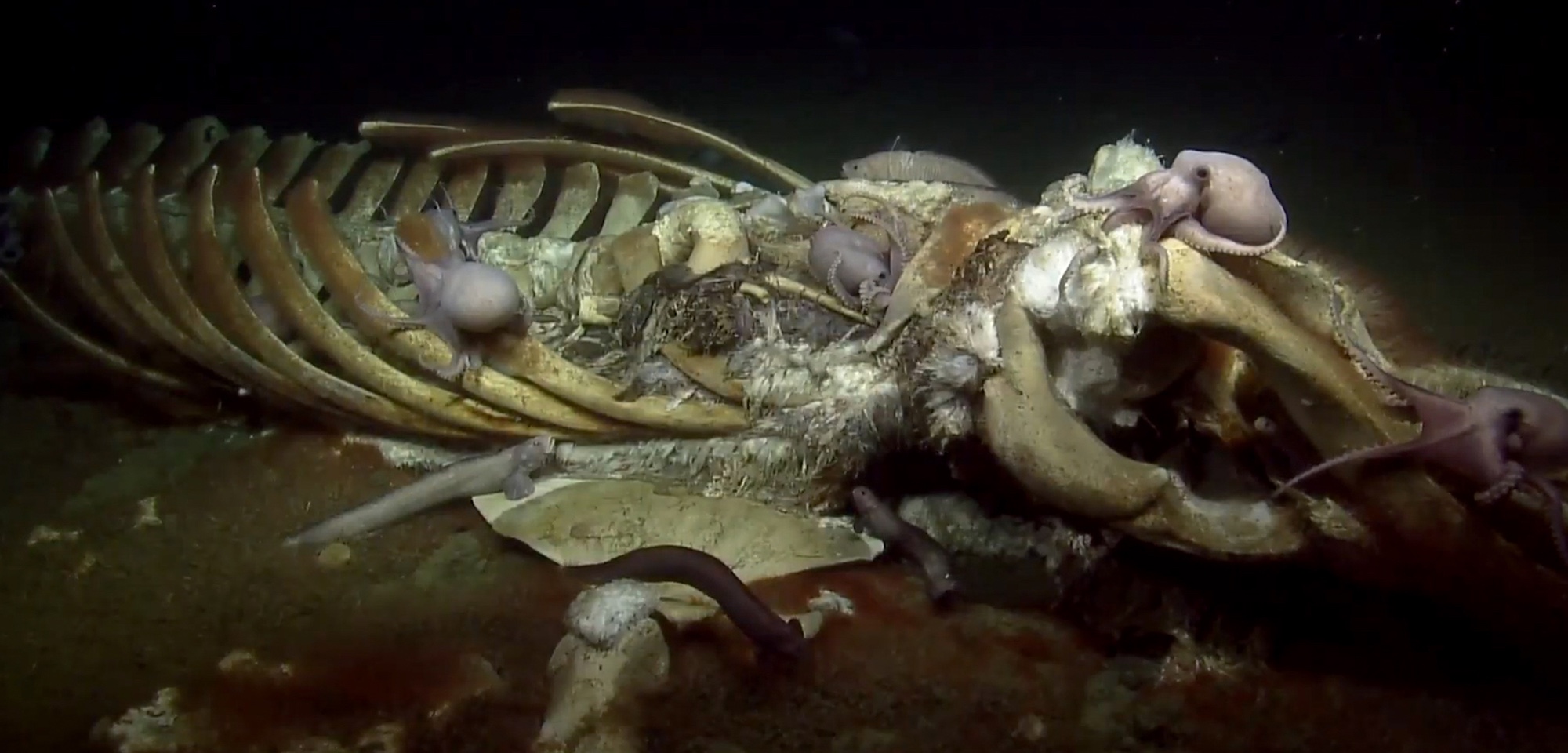
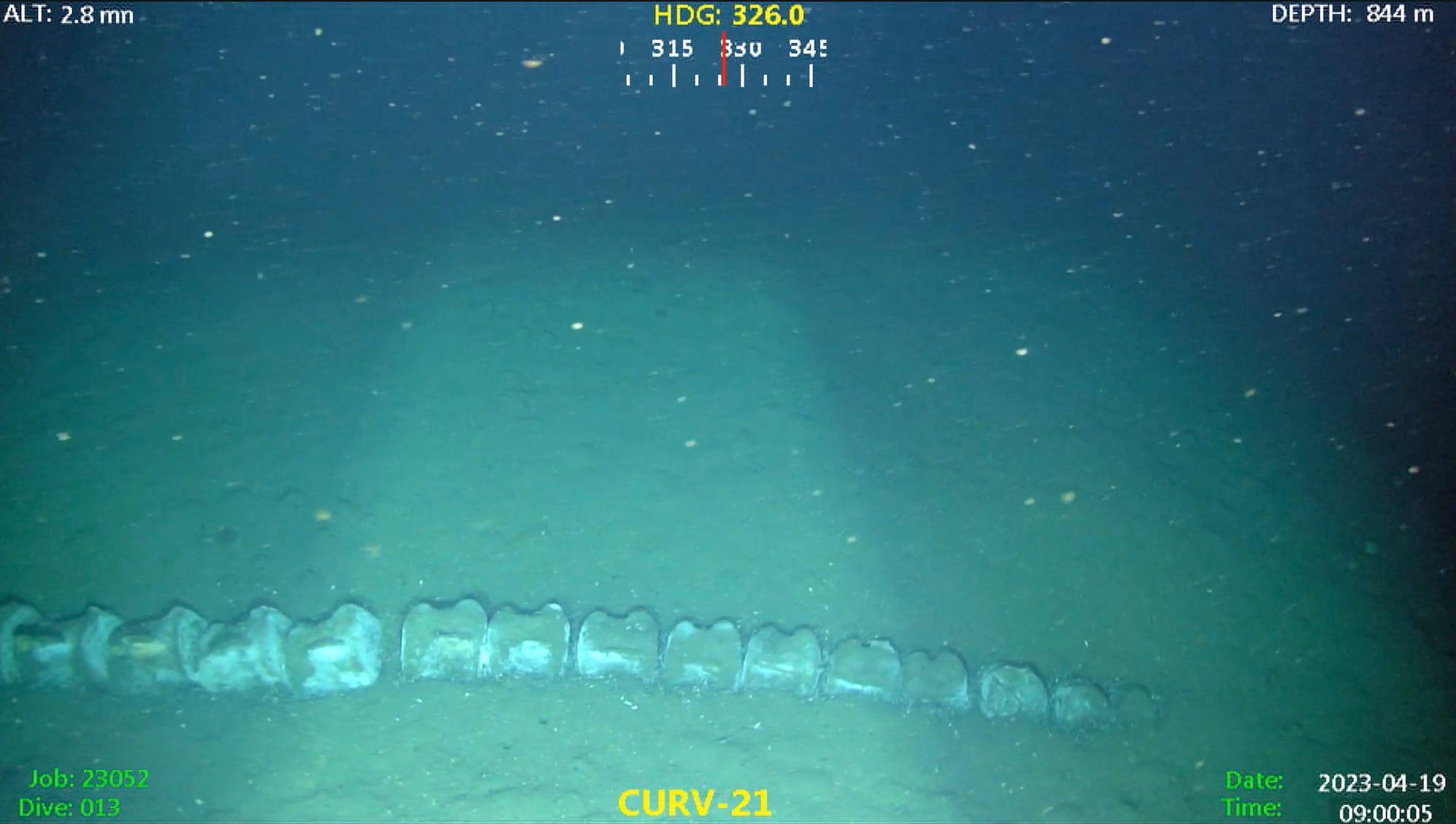 Whale spine seen in a frame of video from the Remotely Operated Vehicle (ROV) during the 2023 seafloor survey of the San Pedro Basin. (Credit: Scripps Institution of Oceanography/UC San Diego.)
Dead whales on the ocean floor may seem like a nothing burger to most of us. But to scientists, they can be a bounty of information about what happens in the deep ocean, a place humans have barely explored. Studying the biological processes around whale falls can tell us a great deal not only about life in the depths, but also about how carbon is sequestered, how nutrients move through the ocean, and how isolated deep-sea communities survive and spread.
I recently interviewed Dr. Jeffrey Marlow, a marine microbiologist and assistant professor of biology at Boston University. Marlow is also the author of The Dark Frontier: Unlocking the Secrets of the Deep Sea, a fascinating new book that explores life around hydrothermal vents, methane seeps, whale falls and other places where microorganisms help sustain much of the deep ocean.
I asked him in particular about the value of whale falls to scientists trying to understand what life is like in the murky depths.
“Most of the seafloor is actually pretty barren,” Marlow told me. “A lot of the organisms down there depend on food falling from above. Often it’s tiny pieces we call marine snow, roughly the size and shape of snowflakes.”
A whale fall delivers that food in one enormous pulse.
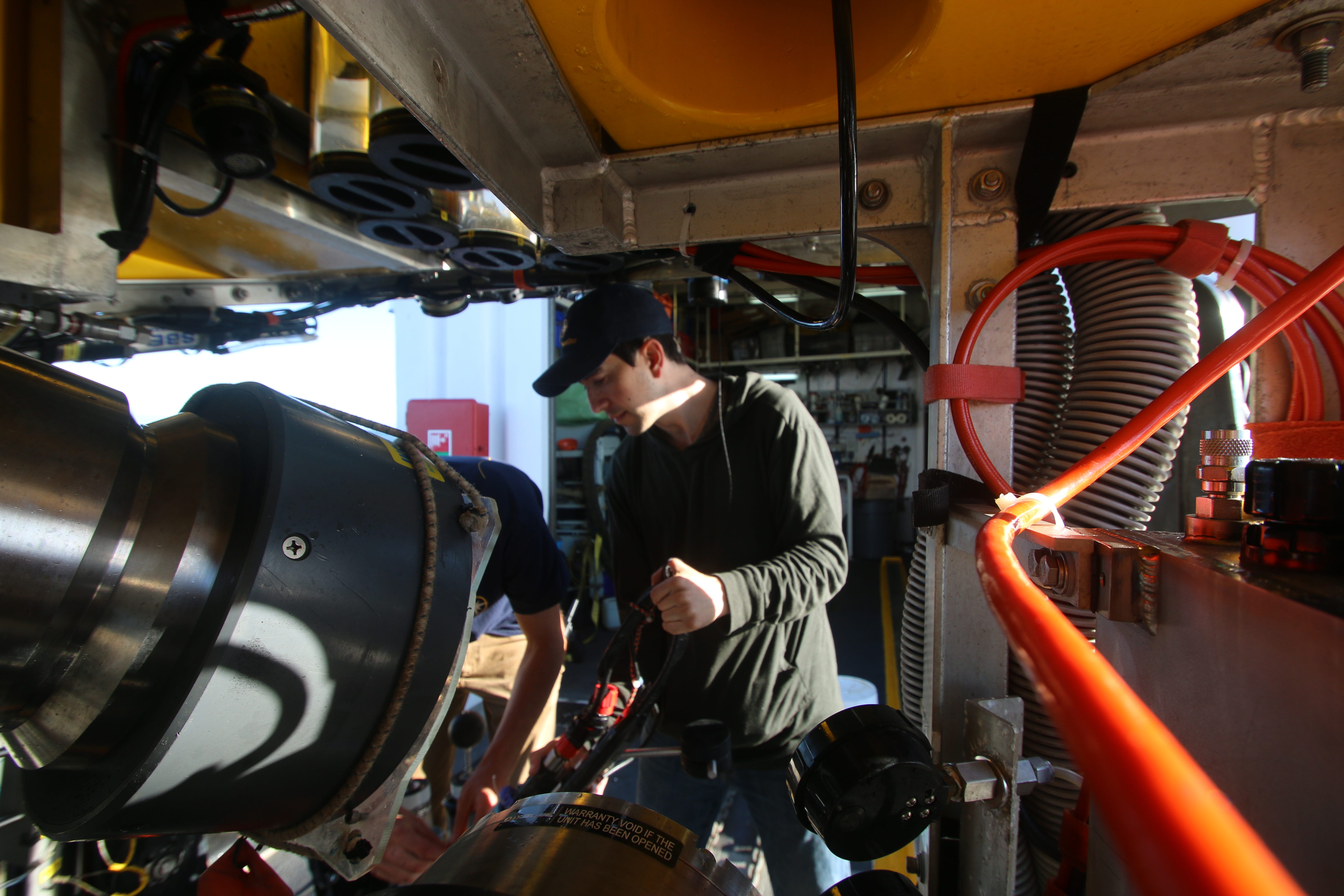 Jeff Marlow in the field. (Photo: Jeffrey Marlow)
“Every now and then, something huge, like a whale carcass, falls to the seafloor,” Marlow said. “That is an enormous amount of food, and it causes these oases to bloom on the seafloor.”
When a carcass reaches the bottom, large scavengers such as hagfish (ugly), sleeper sharks and crabs begin stripping away its skin, blubber and muscle. Smaller animals then colonize the remaining skeleton and the nutrient-rich sediment around it.
One of the strangest animals is a bone-eating worm called Osedax. They have no mouth or digestive system. Instead, root-like tissues penetrate and dissolve the bones, absorbing collagen and lipids (basically fats). The roots contain symbiotic bacteria that appear to play an important role in the worms’ nutrition.
Marlow has seen these worms firsthand at a whale fall off San Diego known as Rosebud, and he writes about it in the book. The whale had been killed by a ship several years earlier, giving Scripps marine biologist Greg Rouse a rare opportunity to follow the ecosystem from a known starting point. Rouse and his team towed the whale carcass out to sea and sank it in deep water.
“Most of the time, scientists come across whale falls that just happen to be there, which means we don’t know how long they’ve been there or what stage of ecological succession they’re in,” Marlow said. “But if you’re able to start the clock from zero, that is an exciting opportunity.”
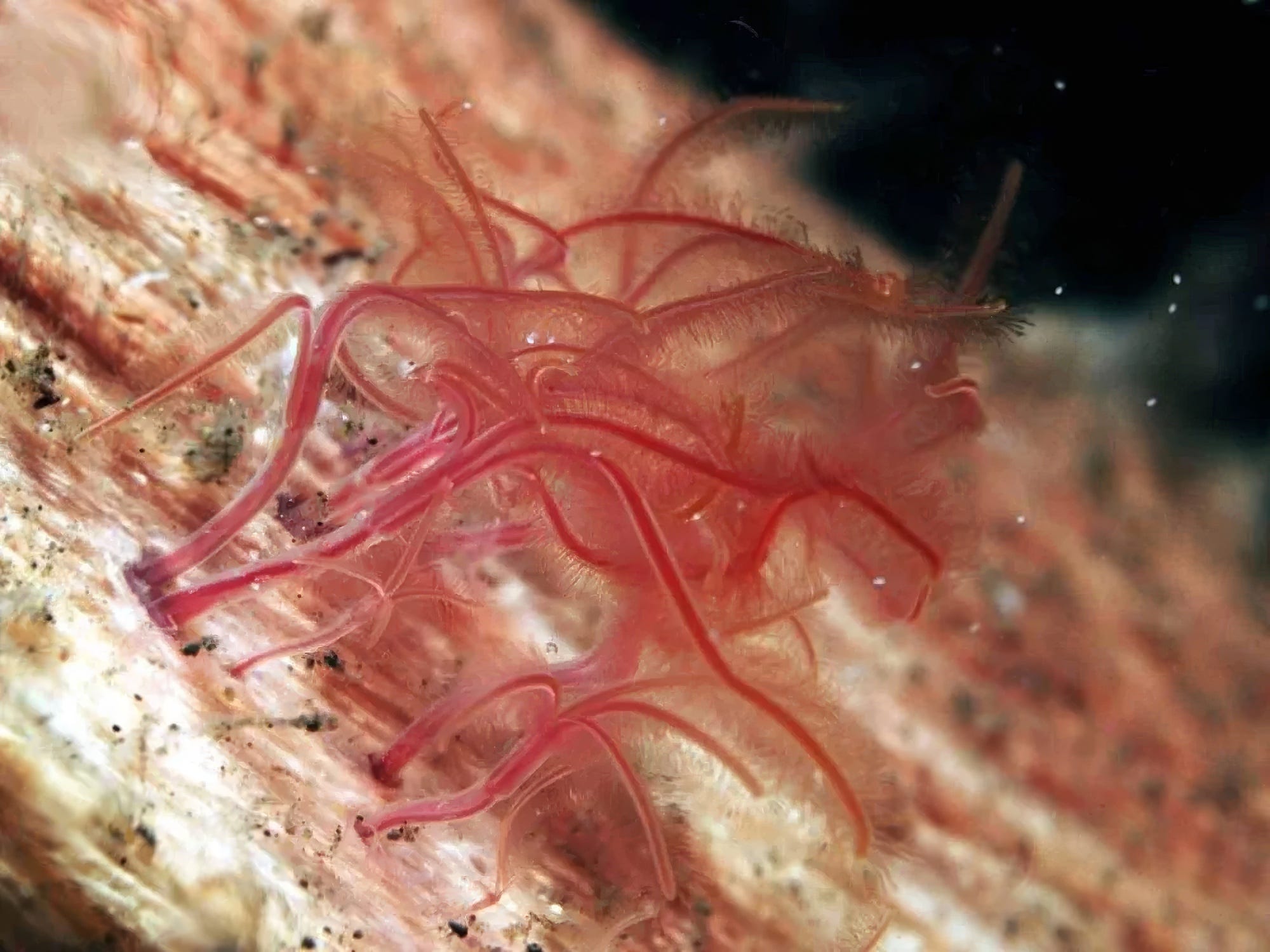 Zombie worm, Osedax on a bone. (Photo: Yoshihiro Fujiwara/JAMSTEC)
Marlow visited Rosebud roughly five years after the whale’s death. Large scavengers had consumed most of the soft tissue, although some fleshy bits remained.
“What interested me most were these tufts of fluffy, feather-like shapes on the bones,” Marlow said, referring to the bone-eating Osedax worms. “They work because they have microbes inside of them that are able to break down the tough fibers of whale bone and release nutrients.”
Marlow described it as “a really interesting endosymbiosis, where a microbe and an animal, in partnership, unlock new habitats for each of them.”
As decomposition continues, microbes break down organic compounds in and around the bones, generating hydrogen sulfide (which smells like rotten eggs). Other microorganisms use that chemical as an energy source, supporting communities that can include mussels, clams, worms and snails. This way of generating energy without light is known as chemosynthesis, and its pervasiveness in supporting life in the deep was largely unknown to science until relatively recently.
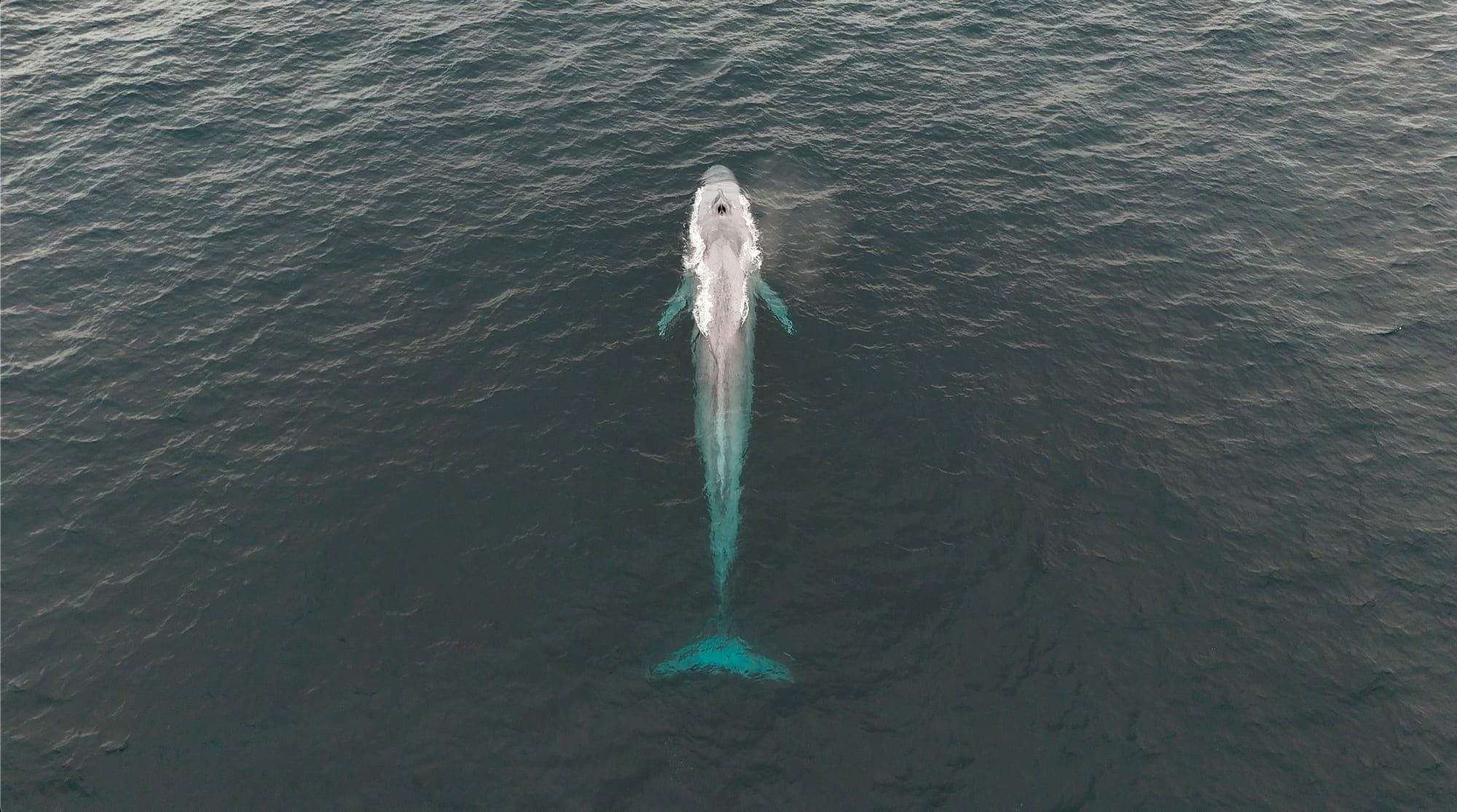 Blue whale off the coast of Southern California. (Photo: Erik Olsen)
Scientists do not know exactly how long the final stages of the breakdown of a whale fall can continue.
“We think this is probably the longest part of whale-fall succession,” Marlow said of the bone-eating stage. “The bone-eating worms can break it down over decades. We don’t really know how a whale-fall ecosystem ends. It may be even a century or two.”
I have seen many whales off the California coast during my adventures. Just two years ago, I filmed a blue whale with my drone off Newport. I have also swum with and filmed blue whales off Sri Lanka for a documentary. They are breathtakingly big. Having one swim past you is like watching a train arrive in the New York subway.
The concentration of whale falls off the coast of California is fascinating and a boon to science. But it is also worth remembering that whales here face the constant danger of ship strikes, although scientists do not yet know what killed the whales found in the San Pedro Basin. So I’ll end today’s piece with a quick shout-out to the folks at UC Santa Barbara’s Benioff Ocean Science Laboratory. They developed Whale Safe, a system that was built to warn large container vessels when whales may be nearby and encourage them to slow down.
Perhaps a bit of sage advice for all of us.