Dark Parks in California: Where to Find a Truly Dark Sky
Light pollution has erased the Milky Way for most Californians. Here’s why that matters and where to go to see a truly dark sky, from Death Valley and Joshua Tree to Anza-Borrego and Mount Shasta.
Updated
California is huge, more than 163,000 square miles, and yet it’s surprisingly hard to find a truly dark sky here. Step outside in Los Angeles or the Bay Area on a clear night and you’ll see the moon, a few planets and a handful of bright stars. The Milky Way is gone, washed out by the orange glow of millions of lights.
It’s not just us. A 2016 study found that about a third of humanity can no longer see the Milky Way from where they live. Yikes. And it’s getting worse as cities switch to LED lighting. LEDs are cheap and efficient, which is great for the electric bill, but because they’re so cheap, we use more of them, and their bright white-blue light is especially good at drowning out the stars.
 Light pollution in Los Angeles as seen from Angeles National Forest (Photo: Erik Olsen)
All that light also messes with us. Studies link it to scrambled circadian rhythms, bad sleep, stress and possibly longer-term problems like obesity and heart disease. It’s hard on wildlife too, changing how nocturnal animals behave and migrate. Lights confuse baby sea turtles, birds, insects, frogs and even plants, and for some of them, it’s deadly.

Purchase stunning art prints of iconic California scenes.
**Check out our Etsy store. **
That’s what makes dark places so valuable. They’ve become destinations for stargazers, astronomers and anybody who just wants to see what the sky is supposed to look like. Spend a night camping in the Eastern Sierra and you’ll know what I mean. There’s nothing quite like lying on your back under a sky packed with stars and wondering how many other worlds are out there. (It’s pretty much guaranteed there’s more than one, and more than just us.)
Fortunately, somebody is working on keeping some places dark.
DarkSky International, which was called the International Dark-Sky Association until recently, has been fighting light pollution since 1988. It pushes for better outdoor lighting, works with lawmakers on lighting rules and supports research on what artificial light does to people and wildlife. It also certifies Dark Sky Places, parks, reserves and towns that meet strict lighting standards. There are more than 130 Dark Sky Parks in the United States, but when this story was written, California had just three (see below).
 Death Valley National Park (Photo: NPS)
Darkness is measured on the Bortle Dark-Sky Scale, created by the amateur astronomer John E. Bortle. It runs from Class 1, a pristine sky with no artificial light, to Class 9, an inner-city sky. Under a Class 1 sky, found only in the most remote places, the Milky Way is a bright, detailed band across the sky. Under a Class 9 sky, like downtown Los Angeles or New York, you get the moon, a few planets and a handful of the brightest stars.
For almost all of human history, people looked up at a sky like that every night. They used it to navigate, keep time and tell stories. Now most of us have to drive hours to see it, and more people are doing exactly that. Dark-sky tourism is booming. Dark skies are good for more than the view, too. Astronomers need them, wildlife depends on them, and researchers say our bodies are better off with real nights.
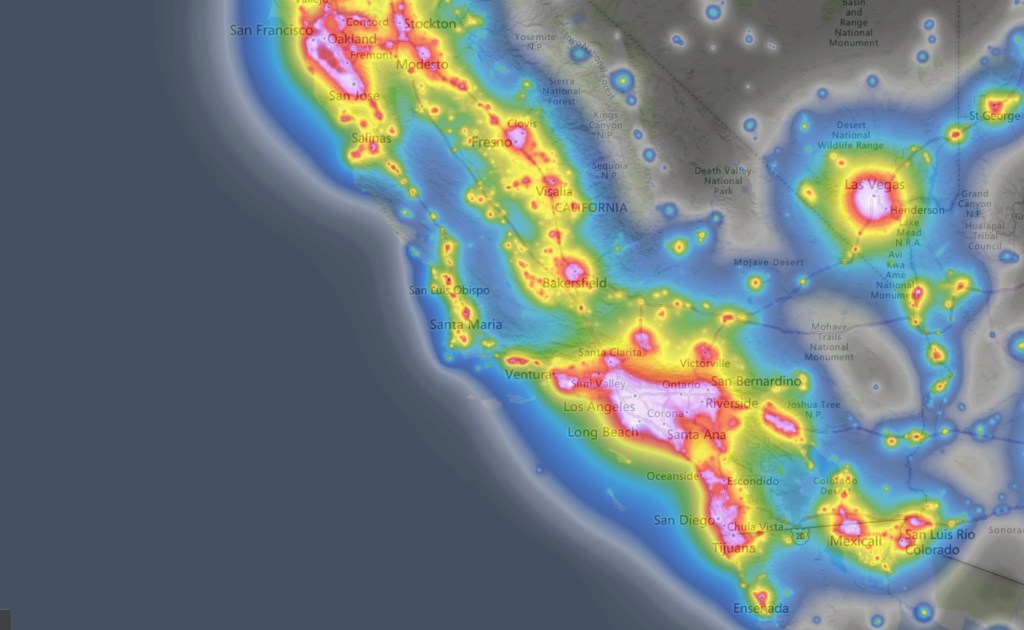 California light pollution map.
Meanwhile, astrophotography has gotten incredibly good. Modern cameras, telescopes and editing software can pull amazing detail out of the night sky, and time-lapse videos of the stars wheeling overhead are all over the internet. (I’ve watched scores of them.) They’re gorgeous. They also raise an odd and slightly unsettling question: what does it mean when the night sky looks better on a screen than it does over your own house?
If you want to see the best of it, check out the Milky Way Photographer of the Year awards from Capture the Atlas, which picks 25 images from more than 5,000 entries every year.
But all is not lost, dear California friends. Get away from Los Angeles, San Diego and the Bay Area, and there are still plenty of places to see a real night sky. Here are some of the best:
1. Death Valley National Park: Death Valley is one of the darkest places in the United States, and it’s the only park in California rated a Gold Tier Dark Sky Park. It’s remote and the air is dry, which makes for great viewing. Rangers’ top picks for star gazing locations in Death Valley National Park are: Mesquite Flat Sand Dunes, Harmony Borax Works, Badwater Basin and Ubehebe Crater.
2. Joshua Tree National Park: Joshua Tree is California’s second official Dark Sky Park, and it’s an easy drive from Los Angeles and Palm Springs. The park has four designated stargazing spots, all parking lots: Quail Springs, Hidden Valley, Cap Rock, and Ryan Mountain.
 Night skies ablaze with stars and the Milky Way in Joshua Tree National Park (Unsplash)
3. Anza-Borrego Desert State Park: At 600,000 acres, Anza-Borrego is California’s largest state park and its third Dark Sky Park. The nearby town of Borrego Springs is a certified Dark Sky Community, and the area holds regular star parties. If you’re looking for a guided tour, check out the Borrego Night Sky Tours.
https://www.instagram.com/p/BkDMcBynBn3/?utm_source=ig_web_copy_link
4. Mount Shasta : Way up north, Mount Shasta’s high elevation and clear air make for excellent stargazing. Everitt Vista Point and Bunny Flat at Mt. Shasta are prime spots for stargazing, along with Lake Siskiyou, Somes Bar, and Shafter Campground. So is Medicine Lake, near Lava Beds National Monument. On a calm night, Lake Siskiyou reflects the stars.
5. Pfeiffer Big Sur State Park : Big Sur is one of the few dark stretches of the California coast, and on a clear night you get stars over the Pacific.
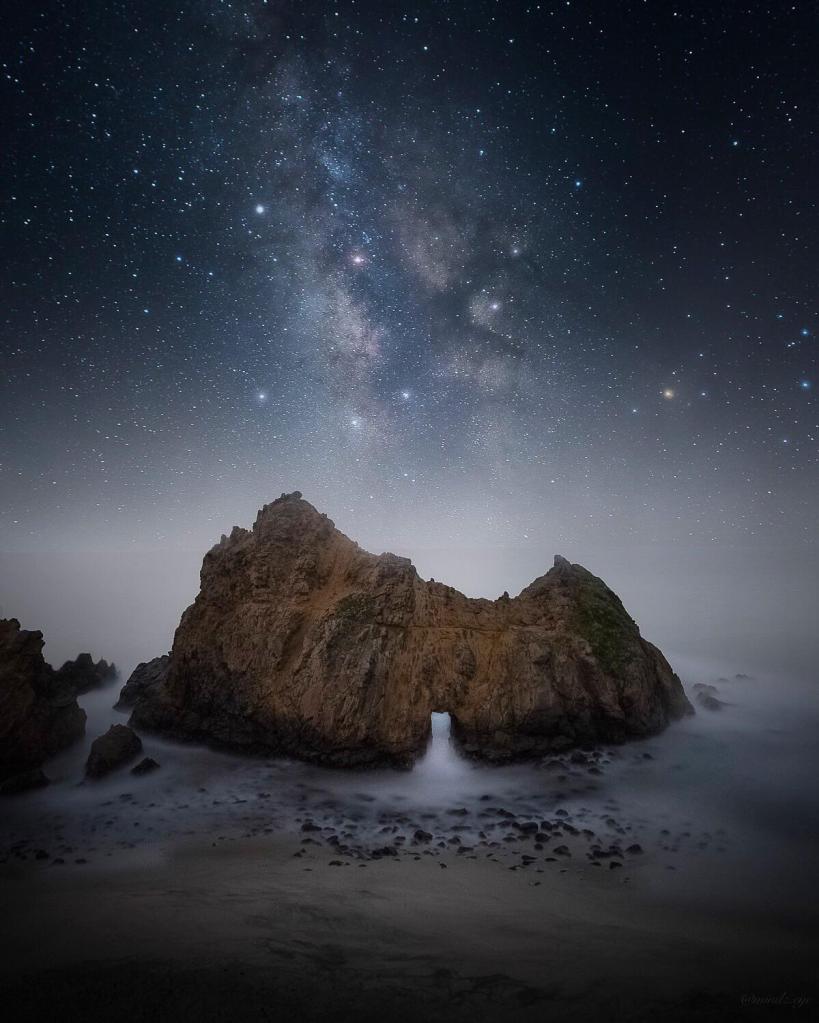 Pfeiffer Big Sur State Park (Photo: Reddit)
6. Mount Wilson Observatory : Mount Wilson, at 5,700 feet in the San Gabriel Mountains, has been an observatory since 1904, and you can look through some of the largest telescopes open to the public anywhere. It’s just above Los Angeles, so, yeah, the skies aren’t that clear, but we have seen the Milky Way up there before. The observatory offers guided and self-guided tours year-round.
7. Oasis. Said to be the darkest place in California, this tiny farming town tucked in between Death Valley National Park and the Nevada state line is the gateway to some of the best night gazing skies in the California desert. There’s a whole lot of wild area to the south, between Oasis and Ubehebe Crater in DVNP, with skies as dark as any in the United States.
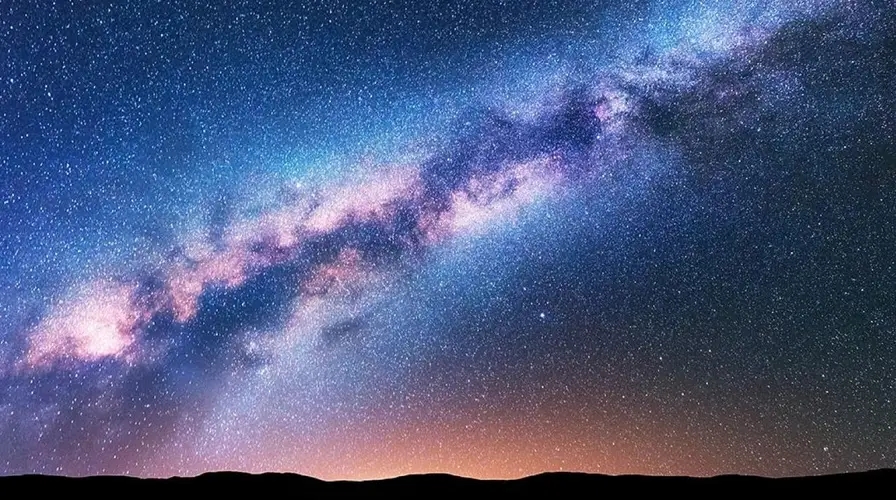 Photo: NASA
Go to one of these places on a moonless night, let your eyes adjust for 20 minutes or so, and the sky fills in. The Milky Way stops being a faint smudge and turns into a river of light with dark lanes of dust running through it. Then think about this: The Milky Way galaxy is home to an estimated 100 to 400 billion stars. And that’s just one galaxy! There are estimated to be between 100 billion and 2 trillion other galaxies out there. I mean, what?! It’s a scale so vast it’s almost impossible to comprehend.
And that’s what makes light pollution so sad and tragic. While we gain comfort and protection in our cities, the light we generate robs us of the chance to truly grasp our place in the universe. We are so small, and yet, as far as we know, we’re the only life out there. That’s a lot more thought-provoking than any Marvel movie (no offense to Marvel fans).

So every once in a while, get out of town. Drive to the desert or the mountains, turn off your headlights and look up. People did it every night for thousands of years. It’s worth making sure our kids can still do it too.
More California science, photography and wild places on Instagram @californiacuratedus