Hidden Near Los Angeles Is One of the World's Most Important Centers for Endangered Apes
The Gibbon Conservation Center in Santa Clarita is home to about 40 endangered apes and has become a globally important center for conservation, research, and education.
Years ago, before he passed away, I had the privilege of spending several days with the legendary Harvard biologist E.O. Wilson to produce a short documentary about his life and work that would air posthumously. Wilson’s groundbreaking work on ants, evolution, and sociobiology earned him two Pulitzer Prizes, the Crafoord Prize, and a devoted worldwide following. During one of our conversations, he said something I’ve never forgotten.
“Future generations are going to forgive us our horrible genocidal wars, because they’ll pass too far into history. They will forgive us the follies of earlier generations and much of the harm we caused. But they will not forgive us for having so carelessly thrown away a large part of the rest of life on our watch.”
That thought hit me like a slap last week as I walked through the Gibbon Conservation Center in Santa Clarita, which I visited with my colleague Tod Mesirow.
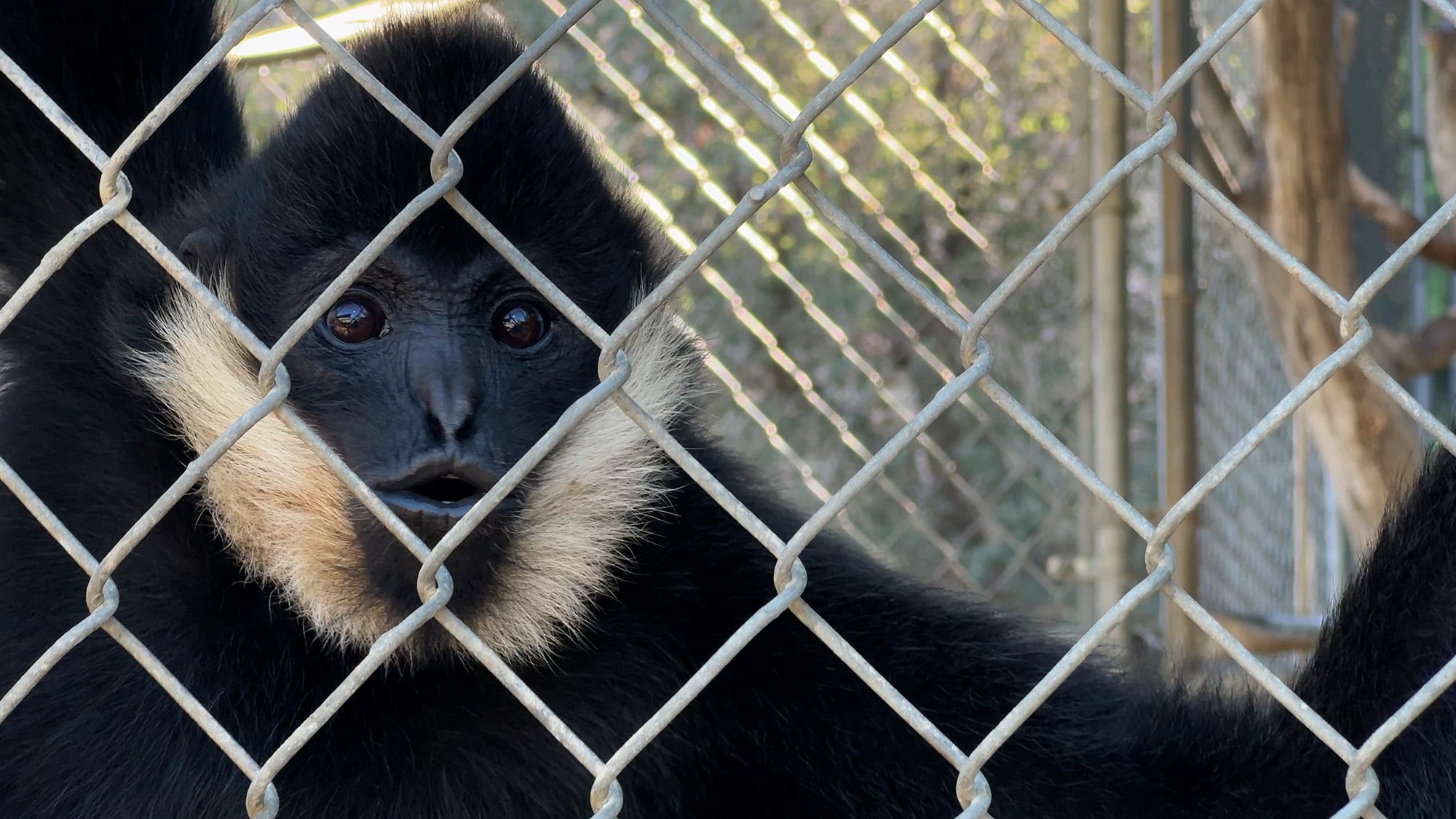 A northern white-cheeked gibbon (Nomascus leucogenys) named Winke at the Gibbon Conservation Center in Santa Clarita. Native to the forests of Vietnam, Laos, and southern China, the species is Critically Endangered due to habitat loss and illegal wildlife trafficking. (Photo: Erik Olsen)
Despite being less than an hour from downtown Los Angeles, few Southern Californians know the center exists. Yet it is one of the world’s most important institutions devoted entirely to the conservation, study and captive breeding of gibbons, the world’s smallest apes. About 40 gibbons representing all four genera and five species live here. Researchers come from around the world to study their remarkable vocalizations, behavior, cognition and social lives.
Gibbons are extraordinary animals. They are true apes, sharing ancestry with orangutans, gorillas, chimpanzees and bonobos. They were once known as the “lesser apes,” but today the preferred term is “small apes,” recognizing that their smaller size does not make them any less, well, remarkable. Built almost entirely for life high in the rainforest canopies of Southeast Asia, they swing through the trees using a form of locomotion called brachiation and can reach speeds approaching 35 miles per hour. They are also incredible singers.
We found that out when we arrived just after sunrise.
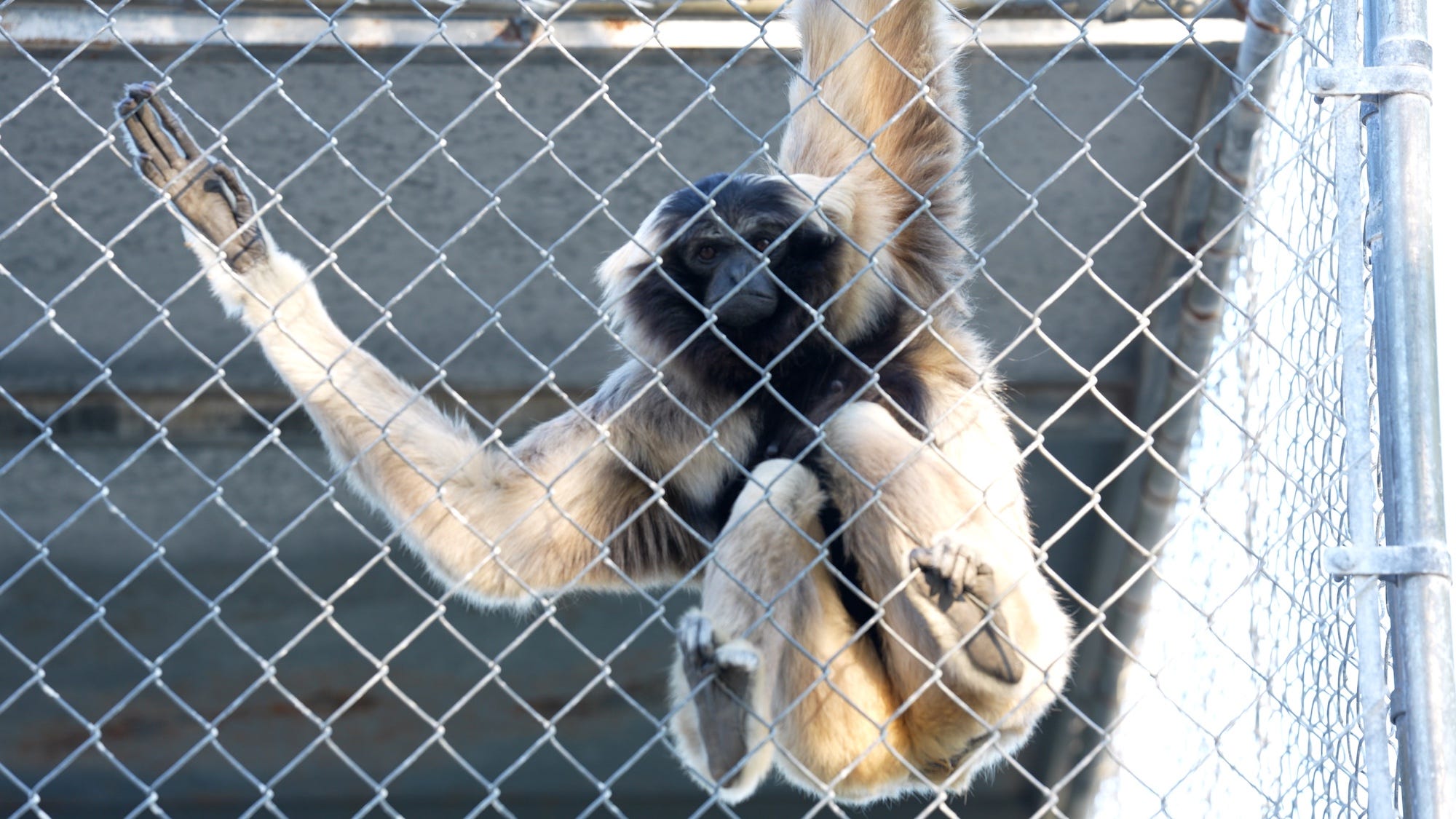 Tuk, a pileated gibbon (Hylobates pileatus), at the Gibbon Conservation Center in Santa Clarita. Native to the forests of Thailand, Cambodia, and a small part of southeastern Myanmar, pileated gibbons are classified as Endangered due to habitat loss, hunting, and the illegal wildlife trade. (Photo: Erik Olsen)
At first there was only a long, haunting call, a single note. Then a whoop.
Then another.
Within moments the entire center erupted into an eye-widening chorus of hoots, whoops, melodious screams, and booming calls that echoed across the canyon. Every species has its own song, and together they created one of the most stunning wildlife experiences I have had anywhere. It is difficult to believe something this extraordinary happens every morning just outside Los Angeles.
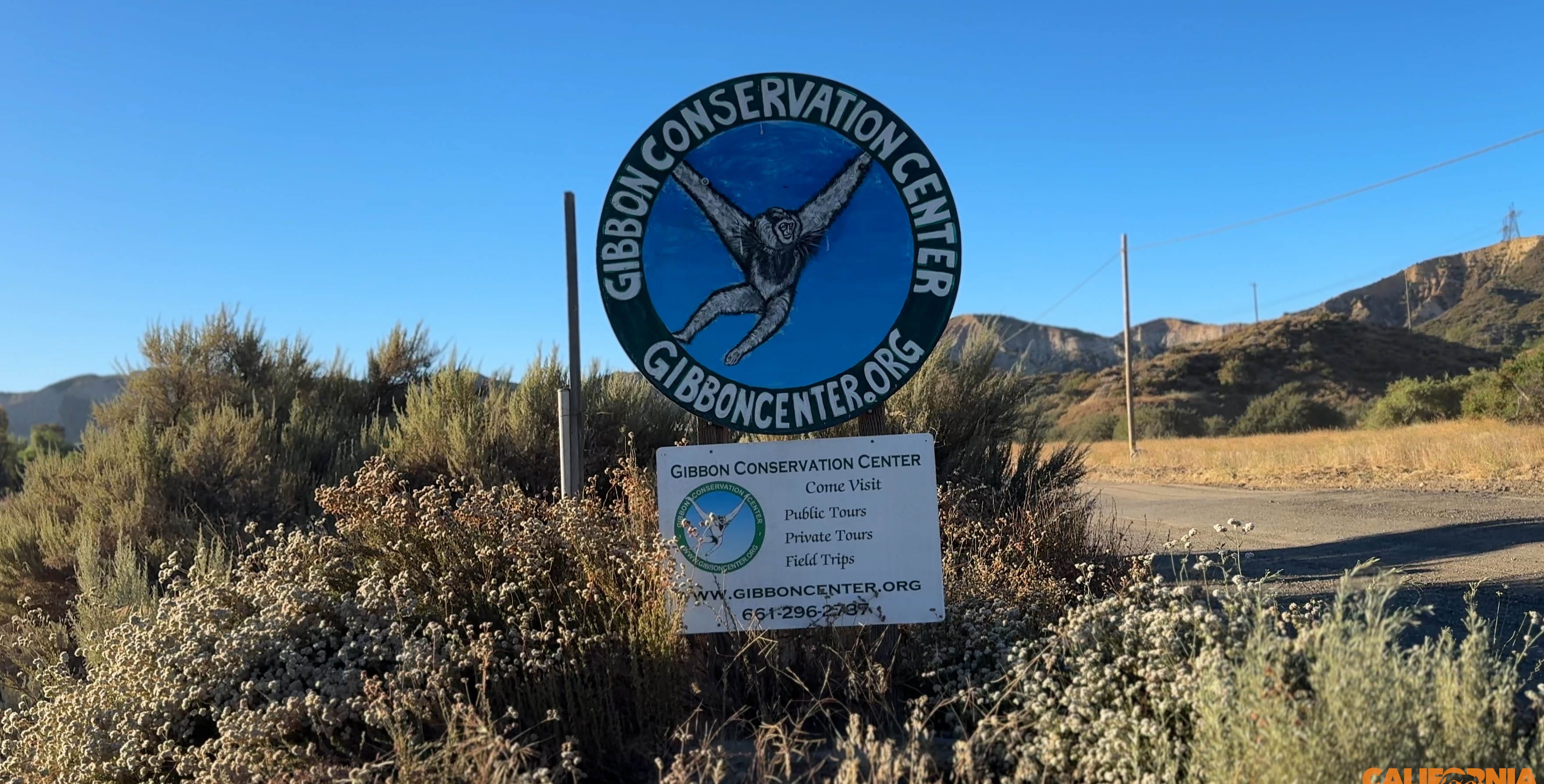 The Gibbon Conservation Center in Santa Clarita is one of the world’s leading institutions dedicated to the conservation, research, and care of endangered gibbons. Founded in 1976, it is home to about 40 gibbons representing all four genera of the world’s smallest apes. (Photo: Erik Olsen)
I’m not going to sugarcoat it. The gibbons are all in enclosures. They do not have the vast treetop forests that they would roam through in their native habitat. But that’s only because so much of that habitat is being destroyed. It’s heartbreaking, but I also realize it’s better to have gibbons here than no gibbons at all.
The center is led by Gabriella Skollar, who first came here from Hungary in 2005 to study gibbons and eventually became its director. Along with a small, dedicated staff and volunteers, she oversees the daily care of the animals while continuing the center’s scientific mission. During our visit, we also met Jodi Kleier, an anthropology graduate from the University of Kansas with a fascination for gibbon skeletal anatomy, particularly their enlarged hyoid bones (bones in the neck which help them make their vocalizations). Kleier spends much of her day preparing diets and hand-feeding broccoli, fruit, and so-called monkey nuggets to the gibbons, which eagerly stretch out their absurdly long, hairy arms to grab each piece.
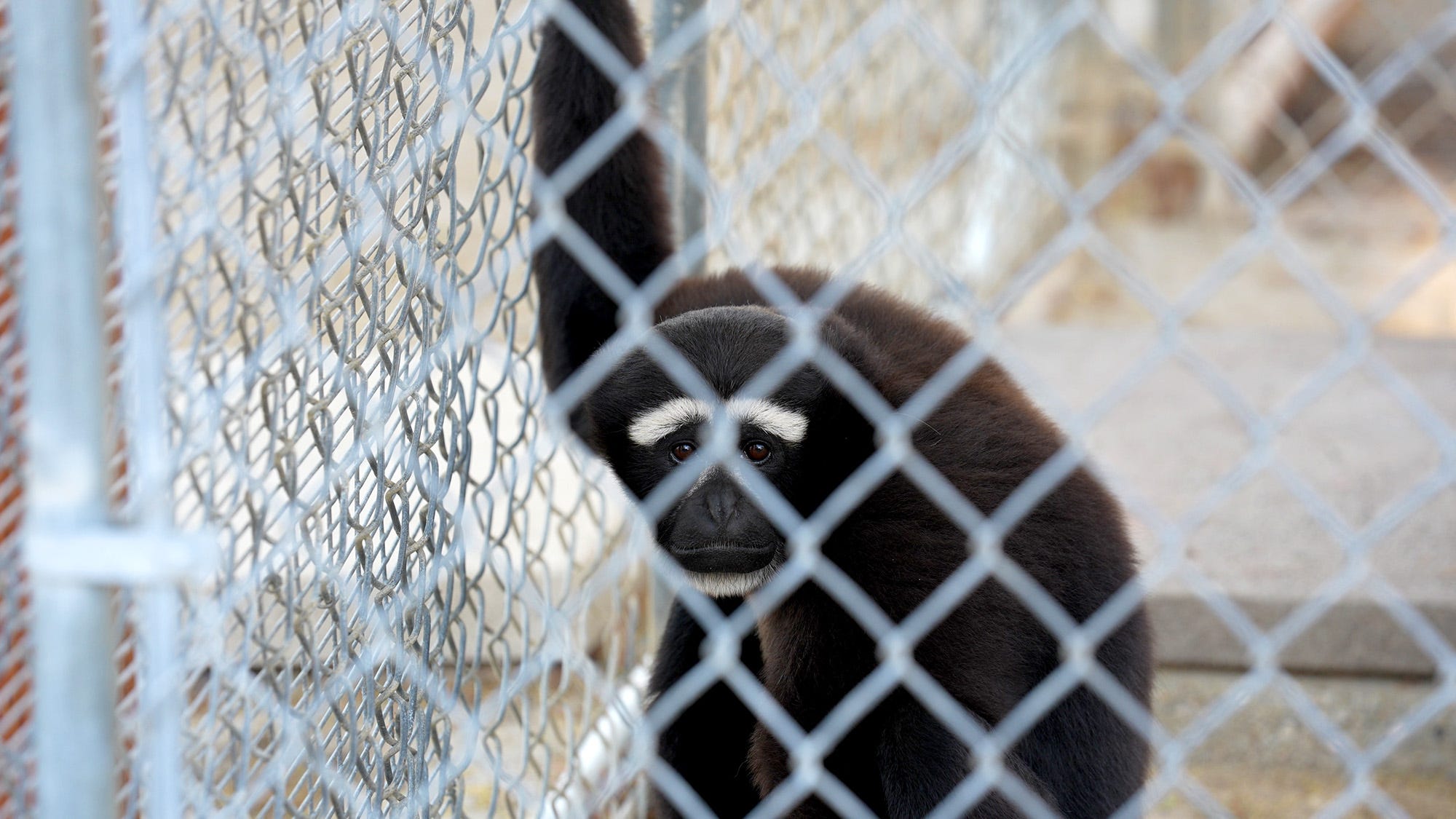 Alan Mootnick Jr., an eastern hoolock gibbon (Hoolock leuconedys), at the Gibbon Conservation Center in Santa Clarita. Native to northeastern India, Myanmar, and southwestern China, eastern hoolock gibbons are classified as Vulnerable due to habitat loss and hunting. Alan Mootnick Jr. is named in honor of the center’s founder, Alan Mootnick. (Photo: Erik Olsen)
The Gibbon Conservation Center was founded in 1976 by the late Alan Mootnick, a largely self-taught gibbon expert who devoted his life to understanding and protecting these animals. What began with a single rescued gibbon has grown into one of the world’s premier centers for gibbon conservation and research. The center participates in breeding programs, supports field conservation, welcomes researchers, and educates thousands of visitors every year.
It also serves as a reminder of how precarious the future of these animals has become.
There are 20 recognized species of gibbons, all native to the forests of Southeast Asia. Every one of them is threatened, and several are critically endangered. The rarest, the Hainan gibbon of China, numbers fewer than 40 individuals in the wild, making it the world’s rarest primate.
Spend even a few minutes watching a gibbon — the curiosity, intelligence, agility, individuality — the list goes on, and Wilson’s words begin to sting. We live in an age obsessed with artificial intelligence and sophisticated machines. Our attention is dominated by screens and YouTube and Instagram and a seemingly endless political circus. Meanwhile, the natural world is disappearing around us. Every extinction represents millions of years of evolution erased forever, taking with it behaviors, relationships, and mysteries we are only beginning to comprehend.
Fortunately, this is also a story of hope, because the gibbons are there, for all to see.
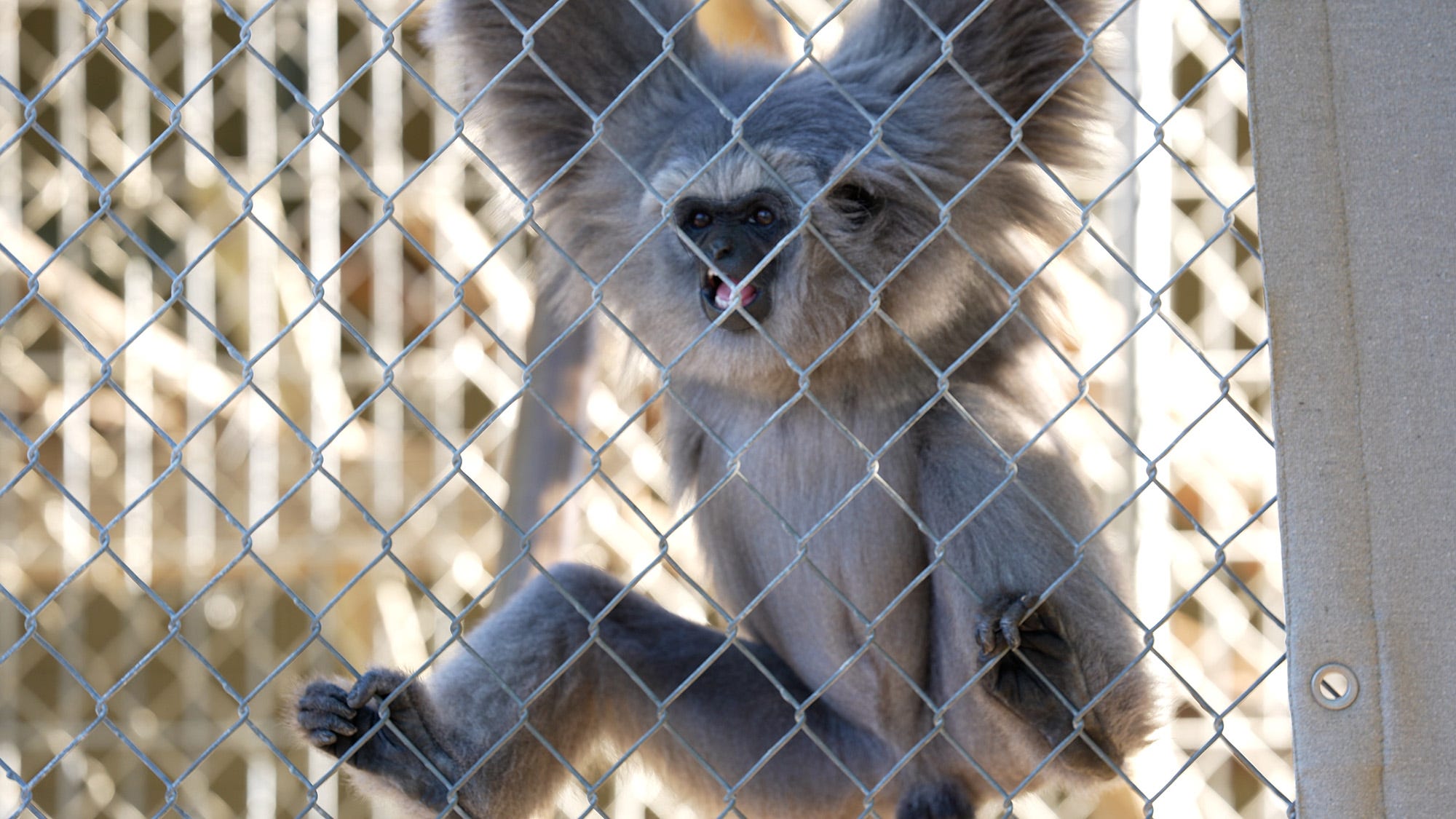 Rocky, a Javan gibbon (Hylobates moloch), at the Gibbon Conservation Center in Santa Clarita. Endemic to the island of Java in Indonesia, Javan gibbons are classified as Endangered due to habitat loss and forest fragmentation. (Photo: Erik Olsen)
The Gibbon Conservation Center is open to the public on weekends, offering guided tours that bring visitors face to face with some of our closest living relatives. Schoolchildren come through here every week. Families encounter a place they never knew existed. And if you arrive early enough, you’ll hear that crazy morning chorus, a sound you will never forget.
Wilson believed that future generations would judge us by how well we cared for the rest of life on Earth. All the organisms that are literally irreplaceable. Places like the Gibbon Conservation Center suggest that, at least in one small corner of California, there are still people working every day to preserve not only these remarkable apes, but also the sense of wonder that comes from knowing we share this planet with them.
(Please make sure to watch the video above. 👆🏻👆🏻👆🏻)